

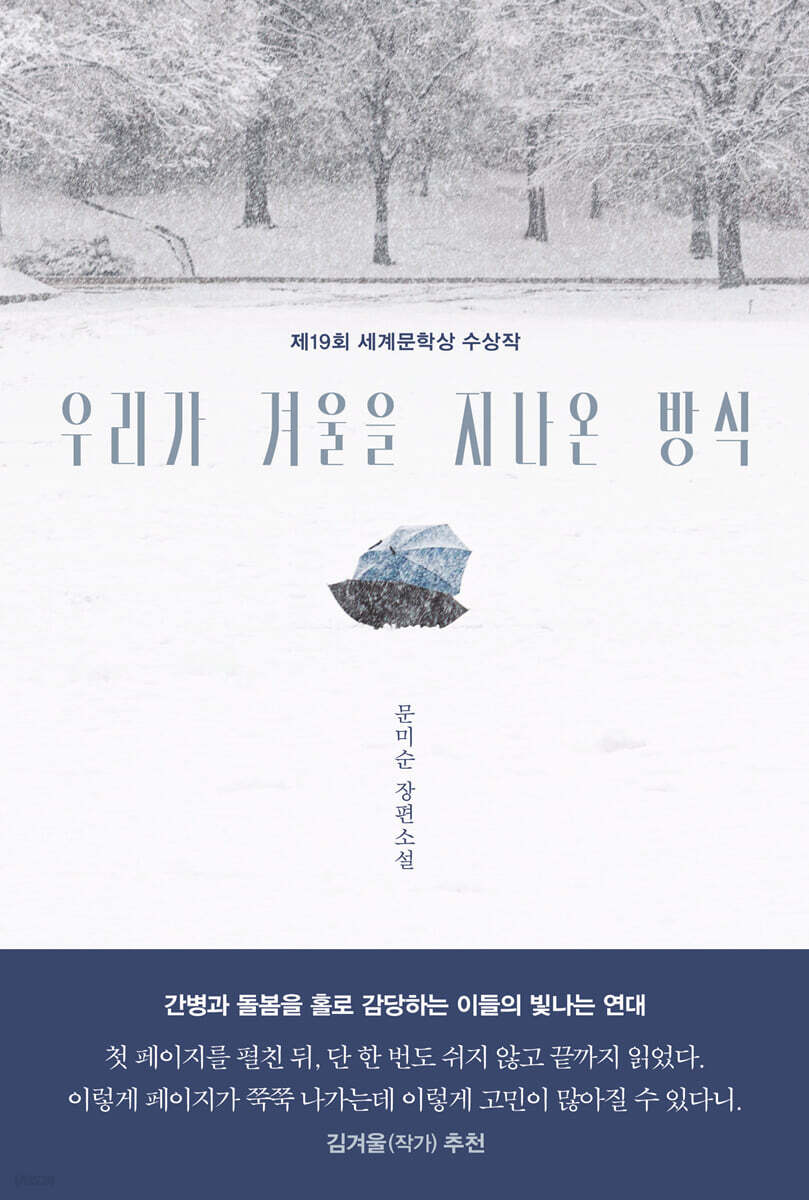
How we got through the winter
 |
Description
Book Introduction
“Mom, I’m so sorry I can’t do anything else.”
The precarious choice of those who bear the burden of care and nursing alone.
The art of hope: finding a glimmer of light even in the mud and ruins
The World Literature Award, which has produced outstanding full-length novels every year, such as 『Misil』(Kim Byeol-ah), 『My Wife Got Married』(Park Hyun-wook), 『Shoot My Heart』(Jeong Yu-jeong), 『Bohemian Rhapsody』(Jeong Jae-min), 『Justice Man』(Do Seon-woo), 『For Books Leaving the Library』(Oh Su-wan), and 『Where Our Night Begins』(Go Yo-han), has published 『The Way We Survived Winter』 by Moon Mi-soon, the 19th winner.
Selected with overwhelming support from the judges among 185 submissions, this work is a brutal yet heartwarming story of two protagonists who bear the burden of nursing and caring alone, but who, driven to the brink of despair, do not give up on life and find a glimmer of hope through solidarity.
The seven judges (Choi Won-sik, Kang Young-sook, Park Hye-jin, Eun Hee-kyung, Jeong Yu-jeong, Jeong Hong-su, and Ha Seong-ran) stated, “This work, which depicts the tragedy of two neighbors who cannot even take care of their own lives because they are too busy caring for their sick parents, is a modern successor to naturalistic novels and at the same time a counterattack of hope against a pessimistic world.” They added, “There was no disagreement in selecting this chilling and warm work, which shows hope even in a terrible reality, as the winner of this year’s World Literature Award.”
Myeong-ju, a 50-year-old caring for her mother with dementia, and Jun-seong, a 20-year-old caring for her father who suffered a stroke, are frustrated by a series of misfortunes and harsh realities, but when they are faced with the unexpected death of their parents, they conceal and postpone the death.
The author meticulously and meticulously depicts the desperate choice they had to make at a dead end, ultimately creating a compelling narrative of hope.
The precarious choice of those who bear the burden of care and nursing alone.
The art of hope: finding a glimmer of light even in the mud and ruins
The World Literature Award, which has produced outstanding full-length novels every year, such as 『Misil』(Kim Byeol-ah), 『My Wife Got Married』(Park Hyun-wook), 『Shoot My Heart』(Jeong Yu-jeong), 『Bohemian Rhapsody』(Jeong Jae-min), 『Justice Man』(Do Seon-woo), 『For Books Leaving the Library』(Oh Su-wan), and 『Where Our Night Begins』(Go Yo-han), has published 『The Way We Survived Winter』 by Moon Mi-soon, the 19th winner.
Selected with overwhelming support from the judges among 185 submissions, this work is a brutal yet heartwarming story of two protagonists who bear the burden of nursing and caring alone, but who, driven to the brink of despair, do not give up on life and find a glimmer of hope through solidarity.
The seven judges (Choi Won-sik, Kang Young-sook, Park Hye-jin, Eun Hee-kyung, Jeong Yu-jeong, Jeong Hong-su, and Ha Seong-ran) stated, “This work, which depicts the tragedy of two neighbors who cannot even take care of their own lives because they are too busy caring for their sick parents, is a modern successor to naturalistic novels and at the same time a counterattack of hope against a pessimistic world.” They added, “There was no disagreement in selecting this chilling and warm work, which shows hope even in a terrible reality, as the winner of this year’s World Literature Award.”
Myeong-ju, a 50-year-old caring for her mother with dementia, and Jun-seong, a 20-year-old caring for her father who suffered a stroke, are frustrated by a series of misfortunes and harsh realities, but when they are faced with the unexpected death of their parents, they conceal and postpone the death.
The author meticulously and meticulously depicts the desperate choice they had to make at a dead end, ultimately creating a compelling narrative of hope.
- You can preview some of the book's contents.
Preview
index
How we got through the winter
Recommendation
Author's Note
Recommendation
Author's Note
Detailed image

Into the book
Mom was wrapped in linen, just as she had been working on a few days ago.
Although the surrounding shape looked rough, there was no trace of pus soaking into the linen.
The sodium percarbonate and baking soda sprinkled inside the wooden coffin floor, as well as the charcoal and sandalwood pieces that are said to have preservative and deodorizing properties, seemed to be doing their job.
After carefully checking her mother's condition, Myeongju closed the lid of the wooden coffin.
I wondered if my nose had become dull, but there didn't seem to be any major problems.
Myeongju emptied the half-filled water bottle in the air purifier, sprayed cypress sap all over the room, and left the small room.
--- pp.10~11
After deducting monthly living expenses from the 1 million won pension, 280,000 won remains.
After calculating again and again, Myeongju circled 280,000 won.
280,000 won was the amount I spent on paying my mother's medical bills, hospital medicine, diapers and pads, nutritional cans, and underwear.
It meant that I didn't have to spend that kind of money anymore.
It was said that money was held in one's hands solely for one's own use.
My heart raced just thinking about it.
Myeongju couldn't believe the abundance and leisure her mother had left behind.
--- p.52
Myeongju opened her eyes and looked out the window.
I thought of my colleagues who, although poor, were more honest and warm-hearted than anyone else, and who helped pay for Myeongju's hospital bills by reducing their own living expenses.
I had hoped things would be a little better by now, but I felt bad because it seemed like everyone was following in Myeongju's footsteps.
I was annoyed that we were still repeating this same boring, boring poverty story.
But at some point, as I watched them hurry back home to their families, an inexplicable emotion stirred deep within me.
I thought I was freer and more carefree than anyone else, but then I suddenly missed my mom.
I missed my mother so much that I couldn't stop thinking about her.
--- pp.91~92
─My father wasn't like this.
You exercise hard and eat well.
When I came back from the mart, my father smelled bad.
He continued watching television without even realizing that he had made a mistake.
He said that his father first suffered a stroke when he was in high school.
At first, he recovered and got better within a month, but a few years later, he had a recurring stroke, and as a result, his speech and behavior gradually became slurred, and his energy and cognitive abilities also declined.
He said that he was practicing walking and going to the bathroom, but he was in a state where he could not be at ease because he had alcoholic dementia.
─You drank a lot while working in construction.
Myeongju remembered the incident she had recently encountered with an old man who was buying alcohol.
─When you apply for a nursing care level, you may be confused at first, but you will not be able to receive a level because you will be able to answer questions well in front of the examiners.
--- pp.121~122
This is my compensation for the insults and contempt the world has given me.
This world owes me a debt.
I apologize.
Myeongju decided that she would be rewarded until she finally felt satisfied, and only then would she go without any regrets.
But now, Myeongju was shaking her head vigorously.
It was because he knew that what he wanted was not something so grand and great.
All he wanted was a simple meal, the cool breeze of the winter forest, the silence of the snow, a ray of sunlight falling on his head, the resoluteness of wild flowers, and the affectionate greeting of a child he didn't know.
It was the reason why he still wanted to see and feel more, why he still wanted to live and not die.
--- p.138
─He suffered burns on his body after a stroke, and it was difficult to treat.
My genitals, thighs, and even the tops of my feet were all burned.
The doctor recommended that I move from a general ward to a nursing home to continue treatment, but I couldn't afford the treatment and nursing costs, so I brought him home.
I also stopped doing the designated driving job I had been doing.
I thought I could take good care of you.
But staying by my father's side, dressing him several times a day, and moving him here and there was by no means an easy task.
I wondered who would do this job if it was so hard for me, even as a young person.
Fortunately, my skin has healed well, but I have to start rehabilitation exercises again from the beginning to walk.
Starting over again.
--- pp.169~170
Junseong first filled the bathtub with warm water and warmed up the bathroom.
And then I helped my father to the bathroom.
As soon as I went into the bathroom and tried to take off my clothes, my father suddenly changed his mind and started screaming and twisting his body, refusing to do it.
Even though Junseong was holding on to the handrail his father had installed in the bathroom, he was very nervous when his father sat him down on the toilet or stood him up. It was difficult to control him when he started to squirm.
He was barely able to hold onto his father's shoulders and try to stand up again, but his father reached out with both hands and hit Junseong's elbow.
Junseong's wrist suddenly felt numb, his grip loosened, and he lost sight of his father.
In an instant, my father's knees buckled like a broken-jointed doll, and his head hit the sink and toilet in quick succession, collapsing to the floor.
--- pp.188~189
─Mom, I mean that wooden box I saw last time.
Eun-jin blurted out something strange without even saying hello.
─Is there a grandmother in there?
─What? What, what does that mean?
Myeongju was breathless.
I was so surprised that I even stuttered.
─Why are you so surprised? Is it true?
Eun-jin burst out laughing when she heard Myeong-ju stutter.
─Is that what you're saying about your grandmother?
─I was joking, I was joking.
But Mom, you're really excited?
Eun-jin seemed to find teasing Myeong-ju amusing.
--- p.193
─I think I slept for about half a day.
I suddenly woke up with a feeling of nausea and a headache, and I kept vomiting and feeling dizzy.
I was wandering around like that for half a day, half-asleep, when I got a text message from my mom on my phone.
I opened it because I was curious, and it was a text message notifying me that my pension had been deposited.
The moment I saw that, my heart started to flutter strangely.
My mother passed away and I still have a pension coming in.
Not funny.
I started to laugh out loud and wanted to live again.
I've never spent this much money on myself.
I don't have any regrets in this world, but I thought I'd at least spend this money to my heart's content before I die.
So I decided to live a little longer.
Decided to live with my mom.
It's not so wrong to postpone your mother's death for a little while.
If you're going to throw a stone, then throw it.
Who will throw stones at me?
--- p.208
─I don't even hope for a dignified life.
Shouldn't we be able to survive? Since the country can't do it, we're going to do it ourselves.
Let's live, let's live till the end, and let's see what the world does to us.
Until then, there is no law or order.
Myeong-ju patted Jun-seong's shoulder as he returned home.
In front of Junseong, I started talking a lot without realizing it.
Maybe we were just hanging out in Busan like this so we wouldn't remind each other of our guilt.
Before she knew it, a plan was forming in Myeongju's head to bury the two bodies in her mother's hometown.
I decided to tell Junseong after everything was definitely prepared.
Although the surrounding shape looked rough, there was no trace of pus soaking into the linen.
The sodium percarbonate and baking soda sprinkled inside the wooden coffin floor, as well as the charcoal and sandalwood pieces that are said to have preservative and deodorizing properties, seemed to be doing their job.
After carefully checking her mother's condition, Myeongju closed the lid of the wooden coffin.
I wondered if my nose had become dull, but there didn't seem to be any major problems.
Myeongju emptied the half-filled water bottle in the air purifier, sprayed cypress sap all over the room, and left the small room.
--- pp.10~11
After deducting monthly living expenses from the 1 million won pension, 280,000 won remains.
After calculating again and again, Myeongju circled 280,000 won.
280,000 won was the amount I spent on paying my mother's medical bills, hospital medicine, diapers and pads, nutritional cans, and underwear.
It meant that I didn't have to spend that kind of money anymore.
It was said that money was held in one's hands solely for one's own use.
My heart raced just thinking about it.
Myeongju couldn't believe the abundance and leisure her mother had left behind.
--- p.52
Myeongju opened her eyes and looked out the window.
I thought of my colleagues who, although poor, were more honest and warm-hearted than anyone else, and who helped pay for Myeongju's hospital bills by reducing their own living expenses.
I had hoped things would be a little better by now, but I felt bad because it seemed like everyone was following in Myeongju's footsteps.
I was annoyed that we were still repeating this same boring, boring poverty story.
But at some point, as I watched them hurry back home to their families, an inexplicable emotion stirred deep within me.
I thought I was freer and more carefree than anyone else, but then I suddenly missed my mom.
I missed my mother so much that I couldn't stop thinking about her.
--- pp.91~92
─My father wasn't like this.
You exercise hard and eat well.
When I came back from the mart, my father smelled bad.
He continued watching television without even realizing that he had made a mistake.
He said that his father first suffered a stroke when he was in high school.
At first, he recovered and got better within a month, but a few years later, he had a recurring stroke, and as a result, his speech and behavior gradually became slurred, and his energy and cognitive abilities also declined.
He said that he was practicing walking and going to the bathroom, but he was in a state where he could not be at ease because he had alcoholic dementia.
─You drank a lot while working in construction.
Myeongju remembered the incident she had recently encountered with an old man who was buying alcohol.
─When you apply for a nursing care level, you may be confused at first, but you will not be able to receive a level because you will be able to answer questions well in front of the examiners.
--- pp.121~122
This is my compensation for the insults and contempt the world has given me.
This world owes me a debt.
I apologize.
Myeongju decided that she would be rewarded until she finally felt satisfied, and only then would she go without any regrets.
But now, Myeongju was shaking her head vigorously.
It was because he knew that what he wanted was not something so grand and great.
All he wanted was a simple meal, the cool breeze of the winter forest, the silence of the snow, a ray of sunlight falling on his head, the resoluteness of wild flowers, and the affectionate greeting of a child he didn't know.
It was the reason why he still wanted to see and feel more, why he still wanted to live and not die.
--- p.138
─He suffered burns on his body after a stroke, and it was difficult to treat.
My genitals, thighs, and even the tops of my feet were all burned.
The doctor recommended that I move from a general ward to a nursing home to continue treatment, but I couldn't afford the treatment and nursing costs, so I brought him home.
I also stopped doing the designated driving job I had been doing.
I thought I could take good care of you.
But staying by my father's side, dressing him several times a day, and moving him here and there was by no means an easy task.
I wondered who would do this job if it was so hard for me, even as a young person.
Fortunately, my skin has healed well, but I have to start rehabilitation exercises again from the beginning to walk.
Starting over again.
--- pp.169~170
Junseong first filled the bathtub with warm water and warmed up the bathroom.
And then I helped my father to the bathroom.
As soon as I went into the bathroom and tried to take off my clothes, my father suddenly changed his mind and started screaming and twisting his body, refusing to do it.
Even though Junseong was holding on to the handrail his father had installed in the bathroom, he was very nervous when his father sat him down on the toilet or stood him up. It was difficult to control him when he started to squirm.
He was barely able to hold onto his father's shoulders and try to stand up again, but his father reached out with both hands and hit Junseong's elbow.
Junseong's wrist suddenly felt numb, his grip loosened, and he lost sight of his father.
In an instant, my father's knees buckled like a broken-jointed doll, and his head hit the sink and toilet in quick succession, collapsing to the floor.
--- pp.188~189
─Mom, I mean that wooden box I saw last time.
Eun-jin blurted out something strange without even saying hello.
─Is there a grandmother in there?
─What? What, what does that mean?
Myeongju was breathless.
I was so surprised that I even stuttered.
─Why are you so surprised? Is it true?
Eun-jin burst out laughing when she heard Myeong-ju stutter.
─Is that what you're saying about your grandmother?
─I was joking, I was joking.
But Mom, you're really excited?
Eun-jin seemed to find teasing Myeong-ju amusing.
--- p.193
─I think I slept for about half a day.
I suddenly woke up with a feeling of nausea and a headache, and I kept vomiting and feeling dizzy.
I was wandering around like that for half a day, half-asleep, when I got a text message from my mom on my phone.
I opened it because I was curious, and it was a text message notifying me that my pension had been deposited.
The moment I saw that, my heart started to flutter strangely.
My mother passed away and I still have a pension coming in.
Not funny.
I started to laugh out loud and wanted to live again.
I've never spent this much money on myself.
I don't have any regrets in this world, but I thought I'd at least spend this money to my heart's content before I die.
So I decided to live a little longer.
Decided to live with my mom.
It's not so wrong to postpone your mother's death for a little while.
If you're going to throw a stone, then throw it.
Who will throw stones at me?
--- p.208
─I don't even hope for a dignified life.
Shouldn't we be able to survive? Since the country can't do it, we're going to do it ourselves.
Let's live, let's live till the end, and let's see what the world does to us.
Until then, there is no law or order.
Myeong-ju patted Jun-seong's shoulder as he returned home.
In front of Junseong, I started talking a lot without realizing it.
Maybe we were just hanging out in Busan like this so we wouldn't remind each other of our guilt.
Before she knew it, a plan was forming in Myeongju's head to bury the two bodies in her mother's hometown.
I decided to tell Junseong after everything was definitely prepared.
--- p.218
Publisher's Review
“It all started so suddenly one day,
“Care becomes the responsibility of someone left behind.”
Myeongju moved into her mother's rental apartment a year and a half ago to live with her mother, who had severe dementia.
After the divorce, I worked in various jobs, but I suffered burns to my feet and was unable to find work due to the aftereffects, so I chose this path.
Myeong-ju, who had been living off of her mother's pension of about 1 million won and caring for her, attempts suicide after her mother's sudden death, but fails.
Myeong-ju changes her mind and decides to turn her mother's body into a mummy and live off her mother's pension for the time being.
But when the body begins to smell and Eun-jin, the daughter who lived apart from her mother's friend, Grandpa Jin-cheon, approaches, the burial becomes urgent.
While Myeong-ju was trying to relieve the burns with painkillers and worry about where to bury her, she runs into Jun-seong, the young man from next door, who runs out into the hallway covered in blood.
Junseong, who lives next door to Myeongju, is a 26-year-old man who has been taking care of his father who has suffered from stroke and alcoholic dementia since high school.
His dream is to become a physical therapist and work at a hospital, but his days are not easy as he takes his father to exercise every day, runs the household, and even drives for him.
Despite his efforts to get his father back on track, he is desperate because his father is secretly buying him alcohol. Then, a fire breaks out at home, and his father gets burned. Junseong also damages a customer's foreign car, resulting in a huge repair bill.
Junseong, unable to afford the hospital bills, brings his father home and becomes increasingly destitute as he endures pressure calls from the car owner demanding more money for repairs.
Then, while bathing his father, he accidentally loses sight of him and causes him to die.
Myeong-ju quickly took Jun-seong, who ran out with blood on his hands, into the house.
The moment he was about to call 119 after seeing an old man lying on the bathroom floor bleeding, he saw Junseong crying, asking if he was going to jail now and saying that he didn't know what his life had been like up until now.
Myeong-ju, who usually feels sorry for Jun-seong, thinks about how Jun-seong will live like a wreck after being investigated by the police and tried, filled with guilt, and wonders what is best for him.
Who can throw stones at the decision made by two people at the end of a long tunnel of caregiving?
- I don't even hope for a dignified life.
Shouldn't we be able to survive? Since the country can't do it, we're going to do it ourselves.
Let's live, let's live till the end, and let's see what the world does to us.
Until then, there is no law or order.
(In the text)
“What is that? It looks exactly like a coffin.
“Is there a grandmother in there?”
Myeong-ju, who abandoned her mother's body, must take care of it every day to prevent it from decaying, and is keenly aware of the eyes of those around her.
Even a simple greeting from a neighbor asking if my mother is well is not heard as ordinary.
What's more painful is the presence of Grandpa Jincheon, who keeps asking after my mother's well-being, saying he's my mother's friend, and Eunjin, who treats my mother like a pushover.
Myeong-ju's daily life, where she piles lies on top of lies and uses improvisation to avoid crises, gives a sense of tension like watching a thriller novel.
Myung-ju's mind becomes complicated as she looks at the text messages exchanged between her mother and her grandfather, Jincheon, who said he had decided to go on a trip to Jeju Island with her mother, and the gifts he left behind wishing her a speedy recovery.
Eun-jin, who is quick-witted, sees the wooden coffin in the small room and blurts out, “Is there a grandmother in there?” and asks Myeong-ju for money, though it is unclear whether she is joking or serious.
When unexpected obstacles appear, Myeong-ju must quickly find a way to send her mother back to the earth, and ironically, Eun-jin provides the clue.
The land my mother bought was a small country house with a building of about 17 pyeong on a plot of land measuring 80 pyeong.
It seemed like my mother bought the abandoned house with the intention of living there when she got old.
(…) Myeongju now felt like she was holding on to a small rope.
(In the text)
“I didn’t even hope to live forever,
“As long as you are alive, there is a reason to live.”
Much of "How We Get Through Winter" is devoted to the mental and physical pain of caring for a family member, the financial hardships, and the lives that fall apart as a result.
When her mother's dementia suddenly begins one day, Myeong-ju initially thinks, "Caring for my mother is nothing compared to the humiliation I feel outside," but her mother's strange behavior and sudden verbal abuse, as if she had taken on a different personality, make her increasingly miserable.
Eventually, each day becomes hell and human dignity becomes impossible to find anywhere in the house.
Junseong's situation is the same.
The reality is getting worse, and the future leaves no room for dreams.
The novel, which begins with “misfortune and despair that are difficult to bear on an individual level,” pushes the two main characters into an extreme situation, but “as the story progresses, the cruel reality paradoxically transforms into a process of discovering human solidarity and warmth.” (Eun Hee-kyung) Myeong-ju and Jun-seong, who live next door in a rental apartment, empathize with each other’s situation and move in the same direction.
As Myeong-ju feels compassion for Jun-seong and Jun-seong sympathizes with Myeong-ju, the two rely on each other and move forward.
The advice from the surrogate cafe about the huge repair costs also makes Junseong realize the power of solidarity.
The scene of a truck carrying two people and two mummies driving through a snow-covered highway beautifully shows that they are now past the hardships of winter and entering a season full of warmth.
In my heart, I was whispering softly, "Come, I will face any fate."
Junseong felt like he was barely able to pick up his life, which had fallen to rock bottom.
Just as his father lived his life in his own way, Junseong is fighting in his own way.
(In the text)
Author Moon Mi-soon began her career by winning the Munhwa Ilbo New Year's Literary Contest in 2013, and won the Sim Hun Literary Award in 2021.
Having learned the pain of caring for a family member while caring for her husband who suffered a stroke a few years ago, she decided to address the issue of caregiving and caregiving, which has become a major issue in our society.
In an era where new terms like caregiving murder, caregiving bankruptcy, and caregiving unemployment are appearing in the newspapers due to accidental deaths caused by exhaustion from caring for family members.
If this becomes a social phenomenon rather than a simple incident, the author is saying through this novel that this is an issue that the community must think about and discuss together.
“Care becomes the responsibility of someone left behind.”
Myeongju moved into her mother's rental apartment a year and a half ago to live with her mother, who had severe dementia.
After the divorce, I worked in various jobs, but I suffered burns to my feet and was unable to find work due to the aftereffects, so I chose this path.
Myeong-ju, who had been living off of her mother's pension of about 1 million won and caring for her, attempts suicide after her mother's sudden death, but fails.
Myeong-ju changes her mind and decides to turn her mother's body into a mummy and live off her mother's pension for the time being.
But when the body begins to smell and Eun-jin, the daughter who lived apart from her mother's friend, Grandpa Jin-cheon, approaches, the burial becomes urgent.
While Myeong-ju was trying to relieve the burns with painkillers and worry about where to bury her, she runs into Jun-seong, the young man from next door, who runs out into the hallway covered in blood.
Junseong, who lives next door to Myeongju, is a 26-year-old man who has been taking care of his father who has suffered from stroke and alcoholic dementia since high school.
His dream is to become a physical therapist and work at a hospital, but his days are not easy as he takes his father to exercise every day, runs the household, and even drives for him.
Despite his efforts to get his father back on track, he is desperate because his father is secretly buying him alcohol. Then, a fire breaks out at home, and his father gets burned. Junseong also damages a customer's foreign car, resulting in a huge repair bill.
Junseong, unable to afford the hospital bills, brings his father home and becomes increasingly destitute as he endures pressure calls from the car owner demanding more money for repairs.
Then, while bathing his father, he accidentally loses sight of him and causes him to die.
Myeong-ju quickly took Jun-seong, who ran out with blood on his hands, into the house.
The moment he was about to call 119 after seeing an old man lying on the bathroom floor bleeding, he saw Junseong crying, asking if he was going to jail now and saying that he didn't know what his life had been like up until now.
Myeong-ju, who usually feels sorry for Jun-seong, thinks about how Jun-seong will live like a wreck after being investigated by the police and tried, filled with guilt, and wonders what is best for him.
Who can throw stones at the decision made by two people at the end of a long tunnel of caregiving?
- I don't even hope for a dignified life.
Shouldn't we be able to survive? Since the country can't do it, we're going to do it ourselves.
Let's live, let's live till the end, and let's see what the world does to us.
Until then, there is no law or order.
(In the text)
“What is that? It looks exactly like a coffin.
“Is there a grandmother in there?”
Myeong-ju, who abandoned her mother's body, must take care of it every day to prevent it from decaying, and is keenly aware of the eyes of those around her.
Even a simple greeting from a neighbor asking if my mother is well is not heard as ordinary.
What's more painful is the presence of Grandpa Jincheon, who keeps asking after my mother's well-being, saying he's my mother's friend, and Eunjin, who treats my mother like a pushover.
Myeong-ju's daily life, where she piles lies on top of lies and uses improvisation to avoid crises, gives a sense of tension like watching a thriller novel.
Myung-ju's mind becomes complicated as she looks at the text messages exchanged between her mother and her grandfather, Jincheon, who said he had decided to go on a trip to Jeju Island with her mother, and the gifts he left behind wishing her a speedy recovery.
Eun-jin, who is quick-witted, sees the wooden coffin in the small room and blurts out, “Is there a grandmother in there?” and asks Myeong-ju for money, though it is unclear whether she is joking or serious.
When unexpected obstacles appear, Myeong-ju must quickly find a way to send her mother back to the earth, and ironically, Eun-jin provides the clue.
The land my mother bought was a small country house with a building of about 17 pyeong on a plot of land measuring 80 pyeong.
It seemed like my mother bought the abandoned house with the intention of living there when she got old.
(…) Myeongju now felt like she was holding on to a small rope.
(In the text)
“I didn’t even hope to live forever,
“As long as you are alive, there is a reason to live.”
Much of "How We Get Through Winter" is devoted to the mental and physical pain of caring for a family member, the financial hardships, and the lives that fall apart as a result.
When her mother's dementia suddenly begins one day, Myeong-ju initially thinks, "Caring for my mother is nothing compared to the humiliation I feel outside," but her mother's strange behavior and sudden verbal abuse, as if she had taken on a different personality, make her increasingly miserable.
Eventually, each day becomes hell and human dignity becomes impossible to find anywhere in the house.
Junseong's situation is the same.
The reality is getting worse, and the future leaves no room for dreams.
The novel, which begins with “misfortune and despair that are difficult to bear on an individual level,” pushes the two main characters into an extreme situation, but “as the story progresses, the cruel reality paradoxically transforms into a process of discovering human solidarity and warmth.” (Eun Hee-kyung) Myeong-ju and Jun-seong, who live next door in a rental apartment, empathize with each other’s situation and move in the same direction.
As Myeong-ju feels compassion for Jun-seong and Jun-seong sympathizes with Myeong-ju, the two rely on each other and move forward.
The advice from the surrogate cafe about the huge repair costs also makes Junseong realize the power of solidarity.
The scene of a truck carrying two people and two mummies driving through a snow-covered highway beautifully shows that they are now past the hardships of winter and entering a season full of warmth.
In my heart, I was whispering softly, "Come, I will face any fate."
Junseong felt like he was barely able to pick up his life, which had fallen to rock bottom.
Just as his father lived his life in his own way, Junseong is fighting in his own way.
(In the text)
Author Moon Mi-soon began her career by winning the Munhwa Ilbo New Year's Literary Contest in 2013, and won the Sim Hun Literary Award in 2021.
Having learned the pain of caring for a family member while caring for her husband who suffered a stroke a few years ago, she decided to address the issue of caregiving and caregiving, which has become a major issue in our society.
In an era where new terms like caregiving murder, caregiving bankruptcy, and caregiving unemployment are appearing in the newspapers due to accidental deaths caused by exhaustion from caring for family members.
If this becomes a social phenomenon rather than a simple incident, the author is saying through this novel that this is an issue that the community must think about and discuss together.
GOODS SPECIFICS
- Date of issue: May 9, 2023
- Page count, weight, size: 260 pages | 324g | 135*200*20mm
- ISBN13: 9791161571492
- ISBN10: 1161571493
You may also like
카테고리
korean


korean

![GQ KOREA Mark (Monthly): December [2025]](http://librairie.coreenne.fr/cdn/shop/files/8ef265dbbfbf186523ed75ba7319009d.jpg?v=1765340328&width=3840)


