

Happy birthday
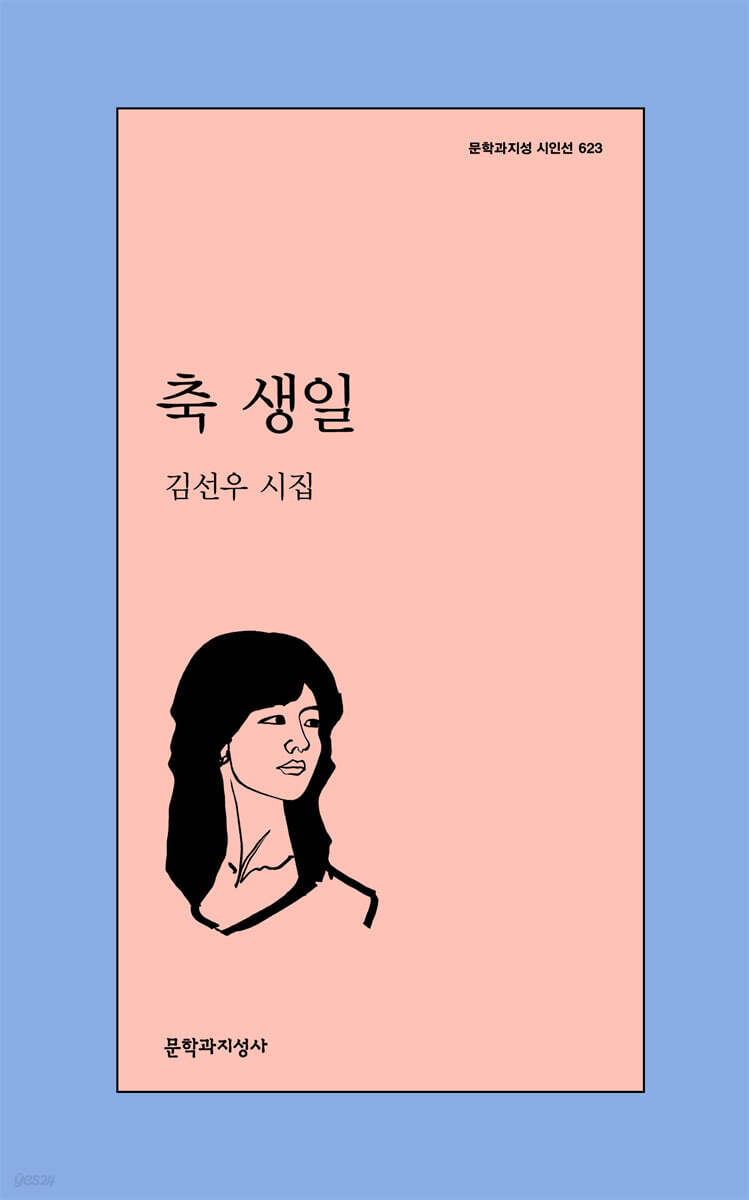 |
Description
Book Introduction
“Love wants to love almost forever.”
When our breaths touch each other
The time of the birthday celebration lit like a candle
Kim Seon-woo's seventh poetry collection delicately depicts the warmth of existence.
The seventh poetry collection of poet Kim Seon-woo, who began his career in 1996 with “Creation and Criticism” and has been deeply exploring the knots of life, love, and relationships for 30 years, has been published by Munhak-kwa-Jiseongsa.
This new work, presented four years after the previous work, “My Warm Ghosts,” continues the critical acclaim of “subversive languages of femininity that symbolize circular circulation” (Park Su-yeon, commentary on “Who is this sleeping inside my body”), and contains a total of 53 poems divided into three parts, with the theme of a celebratory birthday time that admires all beings.
From boys kicking a ball to the stillness of an empty boat to a bird walking along a river, poetic reflections drawn from the minutiae of everyday life open up moments of deeper emotion and broader resonance for the reader, calling forth anew the small, concrete objects that have arrived before us.
Literary critic Park Su-yeon, who wrote the commentary, praised this poetry collection as “a collection of poems that brings to light, allows us to converse with, and recognize beings that were previously invisible in the human world.” In “Congratulatory Birthday,” we can see the new horizons and expanded spectrum of perception that Kim Seon-woo’s poetry has reached.
When our breaths touch each other
The time of the birthday celebration lit like a candle
Kim Seon-woo's seventh poetry collection delicately depicts the warmth of existence.
The seventh poetry collection of poet Kim Seon-woo, who began his career in 1996 with “Creation and Criticism” and has been deeply exploring the knots of life, love, and relationships for 30 years, has been published by Munhak-kwa-Jiseongsa.
This new work, presented four years after the previous work, “My Warm Ghosts,” continues the critical acclaim of “subversive languages of femininity that symbolize circular circulation” (Park Su-yeon, commentary on “Who is this sleeping inside my body”), and contains a total of 53 poems divided into three parts, with the theme of a celebratory birthday time that admires all beings.
From boys kicking a ball to the stillness of an empty boat to a bird walking along a river, poetic reflections drawn from the minutiae of everyday life open up moments of deeper emotion and broader resonance for the reader, calling forth anew the small, concrete objects that have arrived before us.
Literary critic Park Su-yeon, who wrote the commentary, praised this poetry collection as “a collection of poems that brings to light, allows us to converse with, and recognize beings that were previously invisible in the human world.” In “Congratulatory Birthday,” we can see the new horizons and expanded spectrum of perception that Kim Seon-woo’s poetry has reached.
- You can preview some of the book's contents.
Preview
index
Poet's words
Part 1
Are you fluttering? | Poetry of straw | May I touch you? | You at the crossroads | The blue chicken sisters | Mountain village, fluttering | Moon-gazing party | Fluttering, in the meadow | Flat | The reason poets fold their book wings and follow the tails of butterflies | Look at the moon | From an empty boat | From a leaf boat floating on the autumn river | The birthplace of a village's poetry | The origin of happiness | Splendor, girls | A certain day | Bird
Part 2
The sorrow of looking at hands | The creator of time | The song of the vine | The solitude of Maitreya 1 | The solitude of Maitreya 2 | From the sagebrush | Fatalism learned from the tree on the edge of the cliff | The journey of the night | Don't be too anxious | The poet will place the petals of a young man here | The rose of a nobody | Look at the moon 2 | Wolf's ankle | The horn, crackle crackle | Why ice cells grow on winter trees | Fig | Adagio and rondo for glass harmonica
Part 3
Happy Birthday | Mom | Mom's Belly Button | A Person in Poetry | Dawn | The Age of Father | Mangbaek | Self-esteem | Shall We Grow Clouds? | Menstruation | Shall We Go Digging Mugwort? | Thoughts of Chohee | What the Night Whispers Beside the Leaves of the Gardenia Tree | A Great Delusion | A Ripe Peach | Happy Birthday 2 | What I Learned in the Winter Forest | Seasonal Change
commentary
Three Worlds, One Line · Park Soo-yeon
Part 1
Are you fluttering? | Poetry of straw | May I touch you? | You at the crossroads | The blue chicken sisters | Mountain village, fluttering | Moon-gazing party | Fluttering, in the meadow | Flat | The reason poets fold their book wings and follow the tails of butterflies | Look at the moon | From an empty boat | From a leaf boat floating on the autumn river | The birthplace of a village's poetry | The origin of happiness | Splendor, girls | A certain day | Bird
Part 2
The sorrow of looking at hands | The creator of time | The song of the vine | The solitude of Maitreya 1 | The solitude of Maitreya 2 | From the sagebrush | Fatalism learned from the tree on the edge of the cliff | The journey of the night | Don't be too anxious | The poet will place the petals of a young man here | The rose of a nobody | Look at the moon 2 | Wolf's ankle | The horn, crackle crackle | Why ice cells grow on winter trees | Fig | Adagio and rondo for glass harmonica
Part 3
Happy Birthday | Mom | Mom's Belly Button | A Person in Poetry | Dawn | The Age of Father | Mangbaek | Self-esteem | Shall We Grow Clouds? | Menstruation | Shall We Go Digging Mugwort? | Thoughts of Chohee | What the Night Whispers Beside the Leaves of the Gardenia Tree | A Great Delusion | A Ripe Peach | Happy Birthday 2 | What I Learned in the Winter Forest | Seasonal Change
commentary
Three Worlds, One Line · Park Soo-yeon
Into the book
I was once a small seed
I once built a green body by piling up sunlight
I once grew a handful of grains and fed some to someone.
I have been dipped in the sunset over a frosty field
I have seen red-headed cuckoos raise large cuckoos with their tiny beaks and wings.
I once wanted to wipe the thin spine of a young tree that was wet from the wind and rain.
[······]
and······
and······
It was a heart beating hotly in the palm of a boy's hand
I somehow hate the life of floating on the river
I was wondering why I had to fall here like a rag.
I supported the boy with all my might, though he was only a rag.
Rainbow······I wanted to be a heart like a rainbow
After the boy who vomited water was taken away in an ambulance
Lying on the bank of a distant river
I didn't save the boy
I knew the boy had saved me
and······
and······
The wind is blowing
--- From "Poem of Rag"
I like small circles
I like small gatherings without a central focus.
To the moon
To the moon
Plant the seeds
Singing a song
Moon moon, what moon, round like a seed
[······]
Looking closely
I also like growing as if I'm floating through space.
Even with just a little bit
To the moon
To the moon
It's also wonderful to feel your insides brighten up as if you've swallowed the moon.
Look at the moon, you
You, the moon looks
Moon moon what moon round like you
--- From "Look at the Moon"
I once met a deer while walking along a mountain path.
The moment our eyes met, he
It bounces like a big drop of light
disappeared into the forest
I saw it then
How can the whole body of a beast that has never stepped back become time?
--- From "The Creator of Time"
The wind
Isn't it a memory of where the wind passed?
The ripples on the lake
Isn't it a memory of where stones, water beetles, and ducks passed by?
The ripples last longer than the sunken stone,
Eventually it gets quiet
Another memory will begin
I'm going to say this with a different face
Love wants to love almost forever
--- From "Adagio and Rondo for Glass Harmonica"
Today is the day the moon gets fat
The day when the soles of your feet become chubby
The day my belly button bulges
The day I clench my fists
Jump
Jump
From the pores of my whole body
Until the ripe sunlight flows out
Congratulations on your belly button day
Hahaha, you idiot!
Happy umbilical cord day
Hahaha, sprout of sunshine!
Jump
Jump
Jump
The umbilical cord grows from the belly button
Until I reach my mother
I once built a green body by piling up sunlight
I once grew a handful of grains and fed some to someone.
I have been dipped in the sunset over a frosty field
I have seen red-headed cuckoos raise large cuckoos with their tiny beaks and wings.
I once wanted to wipe the thin spine of a young tree that was wet from the wind and rain.
[······]
and······
and······
It was a heart beating hotly in the palm of a boy's hand
I somehow hate the life of floating on the river
I was wondering why I had to fall here like a rag.
I supported the boy with all my might, though he was only a rag.
Rainbow······I wanted to be a heart like a rainbow
After the boy who vomited water was taken away in an ambulance
Lying on the bank of a distant river
I didn't save the boy
I knew the boy had saved me
and······
and······
The wind is blowing
--- From "Poem of Rag"
I like small circles
I like small gatherings without a central focus.
To the moon
To the moon
Plant the seeds
Singing a song
Moon moon, what moon, round like a seed
[······]
Looking closely
I also like growing as if I'm floating through space.
Even with just a little bit
To the moon
To the moon
It's also wonderful to feel your insides brighten up as if you've swallowed the moon.
Look at the moon, you
You, the moon looks
Moon moon what moon round like you
--- From "Look at the Moon"
I once met a deer while walking along a mountain path.
The moment our eyes met, he
It bounces like a big drop of light
disappeared into the forest
I saw it then
How can the whole body of a beast that has never stepped back become time?
--- From "The Creator of Time"
The wind
Isn't it a memory of where the wind passed?
The ripples on the lake
Isn't it a memory of where stones, water beetles, and ducks passed by?
The ripples last longer than the sunken stone,
Eventually it gets quiet
Another memory will begin
I'm going to say this with a different face
Love wants to love almost forever
--- From "Adagio and Rondo for Glass Harmonica"
Today is the day the moon gets fat
The day when the soles of your feet become chubby
The day my belly button bulges
The day I clench my fists
Jump
Jump
From the pores of my whole body
Until the ripe sunlight flows out
Congratulations on your belly button day
Hahaha, you idiot!
Happy umbilical cord day
Hahaha, sprout of sunshine!
Jump
Jump
Jump
The umbilical cord grows from the belly button
Until I reach my mother
--- From "Happy Birthday"
Publisher's Review
Awakened by the elasticity of the lively language,
Kim Seon-woo's ontology that embraces the lament of life
Where did our flutter begin?
From a single seed of grass, drifting on the wind and curious about the well's depths, that entered? From the sky, sunlight, and wind outside, conveyed by the grass? From the soft green smile of the grass, which clenches its fists and repeats, "Is that so? Is that really so?" as I clench my fists and repeat, "I don't care about the outside at all, all meaning lies in the well, I am happy here?"
I'm jumping too, I'm jumping too
"Are you a flustered person?" part
In 『Happy Birthday』, the sunlight shines brightly, a blue chicken pecks at the sun, and the moonlight strokes the moon with a tap tap tap (“Blue Chicken Sister”).
The liveliness of language expressed through onomatopoeia and mimetic words in each poem not only reveals the poet's attitude toward a vibrant world, but, at a more fundamental level, is sufficient to be read as a poetic strategy that "makes invisible beings in the human world appear, converse with them, and make them aware of them."
So the poet does not stop at describing the world, but approaches the source of life by highlighting the secret dwelling that lies beyond the visible world.
He runs away from the “days of the big city” where he “struggled to exist as myself” and “jumps out of the city, jumps out, jumps into the mountains!” (“Mountains, Jumps”).
So, the place where the poet arrived is a place where he can give strength to the small and finite beings, “the eagles, the wind, the grass seeds” (“Flutter, in the Meadow”).
Here, the poet “jumps over” the joints of logic and personally experiences the rhythm and vitality of the world.
In particular, rather than insisting on the individuality of a single person when walking “tak-tak-tak,” it depicts a relationship in which they lean on each other and connect, as if “one supports the other” (literally “tak-tak, tak-tak”).
Those who quietly walk their own path will never be able to experience such scenes.
In this way, 『Happy Birthday』 is saying out loud that only in moments of “jumping between wells” (“Are you jumping?”) can one empathize with and communicate with others.
Shining anew in the repetition of life,
The song of beginnings created by "Happy Birthday"
Congratulations on your belly button day
Hahaha, you idiot!
Happy umbilical cord day
Hahaha, sprout of sunshine!
Jump
Jump
Jump
The umbilical cord grows from the belly button
Until I reach my mother
"Happy Birthday" section
The poetry collection, which spoke of a sense of connection with existence in parts 1 and 2, takes a slightly different turn in part 3.
His mother, who “collapsed for the first time at sixty” (“Mother”), is “in her eighties” and has gone to a “nursing home,” and the poet intuitively senses that there is not much time left to say goodbye to her.
But in this moment of farewell, the poet suddenly overcomes his fear and gains a new realization.
He is “no longer afraid of that side of his mother” (“Mother’s Belly Button”) and has a “clear feeling that this is not the end” (“Dawn”).
Moreover, in the poet's eyes, the mother appears as extremely precious and valuable, like "our precious baby/who is about to be born and go somewhere", "like a baby before learning to walk" ("Mother's Belly Button").
This is closer to the poet developing a kind of 'chronology' that recognizes death and birth as overlapping, complex flows, rather than establishing a self-comforting logic that physically reverses the clock of existence.
“The law of life, that we are born and then die,” does not mean that life is a one-time event, but rather emphasizes that we must actively invent moments that “ennoble” it (from “Song of the Hwansamdenggul”) through constant repetition and renewal.
So the poet accepts his mother's death not as the end but as a new beginning, and completes a deep insight into time and existence.
Only then can we accurately understand the meaning contained in the title poem.
“When the new is revealed to be in fact ancient/It is not easy to understand a birthday/But I want to have an identity that has no end” (“Happy Birthday 2”).
For a poet who reinvents existence and time, poetry is not simply the use of language, but rather a practical will to resonate with life.
Therefore, the poet expresses his will to “continuously move the central axis/towards the small and light/until the gap between the already tilted existences becomes even/even” (“Towards Level”).
According to the poet's expression, the poet's job is to "invent/when even the beauty to be discovered is fading away" ("Song of the Hwansamdenggul"), and "the place where a village's poetry is born" does not come from "the language of law," "the language of scriptures," or "the language of numbers," but from "the heart of the morning glow," "neighbors you can meet on foot in a day," and "the affection that observes each and every person's today" ("The Place where a Village's Poetry is Born").
The poetry collection reaches its conclusion by harvesting new poetry that sprouts on the poet's act of leveling the surface of poetry, and further, the soil of the world, as if leveling rough ground.
At that moment, a poetic landscape, not unlike the world outside our window, appears before our eyes.
“This whole universe has reached a good/transitional period” (“Transitional Period”).
Poet's words
Every morning, the light and wind that peels off the skin, and
You gave me the strength to live as a poet
Dedicated to my mother
September 2025
Kim Seon-woo
Kim Seon-woo's ontology that embraces the lament of life
Where did our flutter begin?
From a single seed of grass, drifting on the wind and curious about the well's depths, that entered? From the sky, sunlight, and wind outside, conveyed by the grass? From the soft green smile of the grass, which clenches its fists and repeats, "Is that so? Is that really so?" as I clench my fists and repeat, "I don't care about the outside at all, all meaning lies in the well, I am happy here?"
I'm jumping too, I'm jumping too
"Are you a flustered person?" part
In 『Happy Birthday』, the sunlight shines brightly, a blue chicken pecks at the sun, and the moonlight strokes the moon with a tap tap tap (“Blue Chicken Sister”).
The liveliness of language expressed through onomatopoeia and mimetic words in each poem not only reveals the poet's attitude toward a vibrant world, but, at a more fundamental level, is sufficient to be read as a poetic strategy that "makes invisible beings in the human world appear, converse with them, and make them aware of them."
So the poet does not stop at describing the world, but approaches the source of life by highlighting the secret dwelling that lies beyond the visible world.
He runs away from the “days of the big city” where he “struggled to exist as myself” and “jumps out of the city, jumps out, jumps into the mountains!” (“Mountains, Jumps”).
So, the place where the poet arrived is a place where he can give strength to the small and finite beings, “the eagles, the wind, the grass seeds” (“Flutter, in the Meadow”).
Here, the poet “jumps over” the joints of logic and personally experiences the rhythm and vitality of the world.
In particular, rather than insisting on the individuality of a single person when walking “tak-tak-tak,” it depicts a relationship in which they lean on each other and connect, as if “one supports the other” (literally “tak-tak, tak-tak”).
Those who quietly walk their own path will never be able to experience such scenes.
In this way, 『Happy Birthday』 is saying out loud that only in moments of “jumping between wells” (“Are you jumping?”) can one empathize with and communicate with others.
Shining anew in the repetition of life,
The song of beginnings created by "Happy Birthday"
Congratulations on your belly button day
Hahaha, you idiot!
Happy umbilical cord day
Hahaha, sprout of sunshine!
Jump
Jump
Jump
The umbilical cord grows from the belly button
Until I reach my mother
"Happy Birthday" section
The poetry collection, which spoke of a sense of connection with existence in parts 1 and 2, takes a slightly different turn in part 3.
His mother, who “collapsed for the first time at sixty” (“Mother”), is “in her eighties” and has gone to a “nursing home,” and the poet intuitively senses that there is not much time left to say goodbye to her.
But in this moment of farewell, the poet suddenly overcomes his fear and gains a new realization.
He is “no longer afraid of that side of his mother” (“Mother’s Belly Button”) and has a “clear feeling that this is not the end” (“Dawn”).
Moreover, in the poet's eyes, the mother appears as extremely precious and valuable, like "our precious baby/who is about to be born and go somewhere", "like a baby before learning to walk" ("Mother's Belly Button").
This is closer to the poet developing a kind of 'chronology' that recognizes death and birth as overlapping, complex flows, rather than establishing a self-comforting logic that physically reverses the clock of existence.
“The law of life, that we are born and then die,” does not mean that life is a one-time event, but rather emphasizes that we must actively invent moments that “ennoble” it (from “Song of the Hwansamdenggul”) through constant repetition and renewal.
So the poet accepts his mother's death not as the end but as a new beginning, and completes a deep insight into time and existence.
Only then can we accurately understand the meaning contained in the title poem.
“When the new is revealed to be in fact ancient/It is not easy to understand a birthday/But I want to have an identity that has no end” (“Happy Birthday 2”).
For a poet who reinvents existence and time, poetry is not simply the use of language, but rather a practical will to resonate with life.
Therefore, the poet expresses his will to “continuously move the central axis/towards the small and light/until the gap between the already tilted existences becomes even/even” (“Towards Level”).
According to the poet's expression, the poet's job is to "invent/when even the beauty to be discovered is fading away" ("Song of the Hwansamdenggul"), and "the place where a village's poetry is born" does not come from "the language of law," "the language of scriptures," or "the language of numbers," but from "the heart of the morning glow," "neighbors you can meet on foot in a day," and "the affection that observes each and every person's today" ("The Place where a Village's Poetry is Born").
The poetry collection reaches its conclusion by harvesting new poetry that sprouts on the poet's act of leveling the surface of poetry, and further, the soil of the world, as if leveling rough ground.
At that moment, a poetic landscape, not unlike the world outside our window, appears before our eyes.
“This whole universe has reached a good/transitional period” (“Transitional Period”).
Poet's words
Every morning, the light and wind that peels off the skin, and
You gave me the strength to live as a poet
Dedicated to my mother
September 2025
Kim Seon-woo
GOODS SPECIFICS
- Date of issue: September 23, 2025
- Page count, weight, size: 192 pages | 266g | 128*205*13mm
- ISBN13: 9788932044590
You may also like
카테고리
korean


korean

![GQ KOREA Mark (Monthly): December [2025]](http://librairie.coreenne.fr/cdn/shop/files/8ef265dbbfbf186523ed75ba7319009d.jpg?v=1765340328&width=3840)


