

Fall
 |
Description
Book Introduction
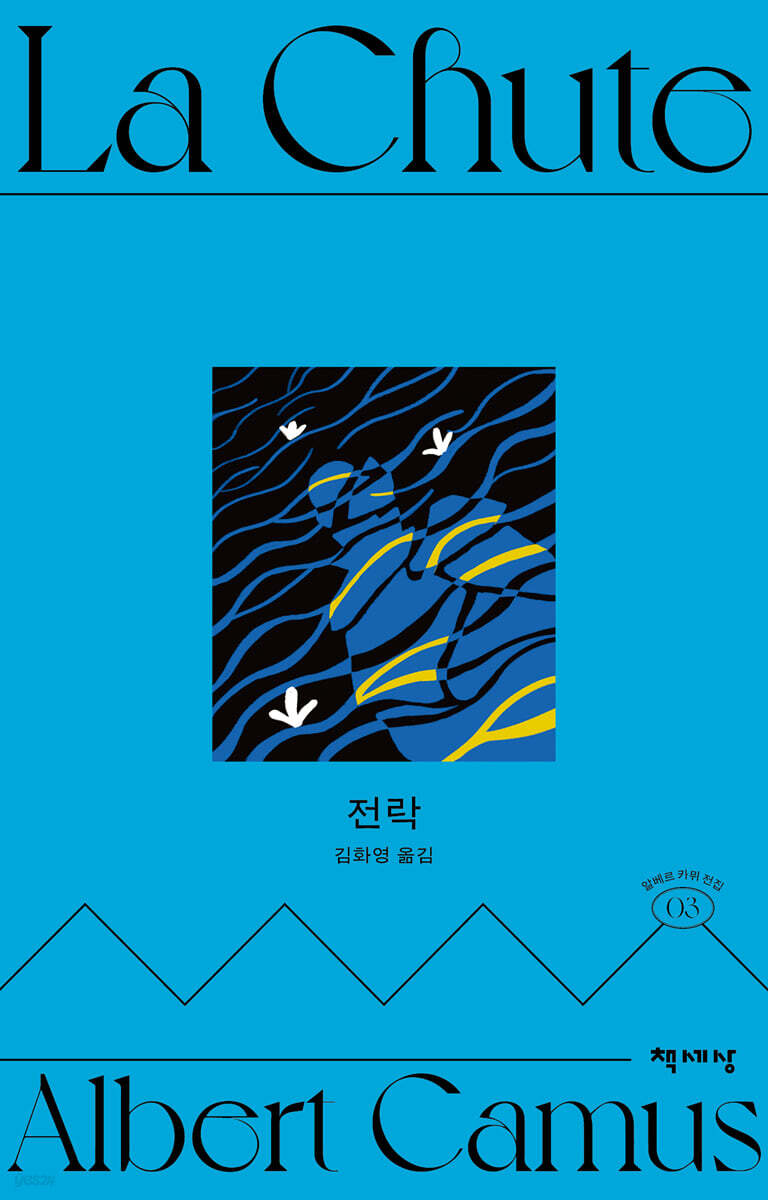
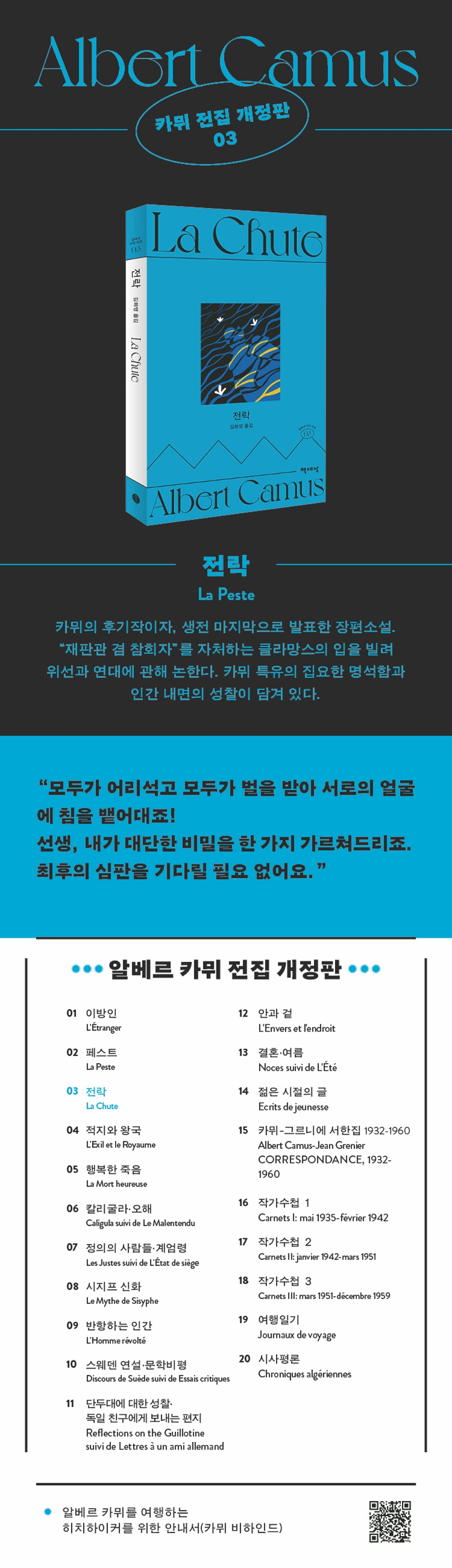
The three volumes of the "ChaekseSang Camus Complete Works Revised Edition" are being released with new bindings and translations to commemorate the 110th anniversary of Albert Camus's birth in 2023. Camus's later masterpiece, which illuminates the inherent hypocrisy and absurdity of human nature with his characteristically sharp gaze, rather than a clash with the absurd world. This is an autobiographical novel in which Camus condenses his pain and despair after the publication of "The Rebel", his debate with Sartre, and the Algerian War. |
- You can preview some of the book's contents.
Preview
index
introduction
Fall
Commentary: A Portrait of Modern Man Reflected in the Mirror of Confession
Commentary: The Structure of "The Fall" and the Image of Water
Author's chronology
Translator's Note (2023)
Translator's Note (1989)
Fall
Commentary: A Portrait of Modern Man Reflected in the Mirror of Confession
Commentary: The Structure of "The Fall" and the Image of Water
Author's chronology
Translator's Note (2023)
Translator's Note (1989)
Detailed image
Into the book
I am also a person with a good grasp of the world.
But I'm just looking at your appearance and I'm pouring my heart out without paying attention.
In short, no matter how polite my attitude and how refined my speech, I'm just a regular at the sailor's bar on Jaydake Street.
Well, there's no need to dig any further than that.
In short, like all humans, my job is dual.
As I have already said, I am both a judge and a confessor.
--- p.19
You're surprised by my honesty.
No, sir, haven't there been times when you suddenly needed someone's sympathy, help, or friendship? Of course.
I mean, I've just learned to be content with empathy.
Empathy is easy to obtain and has no binding force.
“I really sympathize with you,” you say, but inside you immediately say, “Okay, let’s talk about something else.”
--- p.41
Yes, one day we will all be able to do that.
So that will be the day of salvation.
But that's not an easy task.
Because friendship is distracting, or at least powerless.
I want to do it in my heart, but I don't have the strength.
But if you think about it, perhaps it's just a lack of desire? Perhaps we don't love life enough? Have you ever thought that only death awakens emotions? How much do we love the friend who just left us? Don't you think so?
--- p.43
Everyone's stupid, everyone's getting punished, spitting in each other's faces! Go to Malconfort and get kicked out! That's it.
The point is, it's just a question of who spits first.
Teacher, let me tell you a great secret.
There is no need to wait for the final judgment.
Because every day is the final judgment.
--- p.122
There's no champagne, no friends to look at you affectionately and raise a glass to you.
Alone in a gloomy room, alone in the dock before the judges, alone, facing yourself or the judgment of others, you have to make decisions.
At the end of every freedom, judgment awaits.
That is precisely why freedom is such a heavy burden, especially when you have a fever, are sick, or have no one to love you.
--- p.144
Well then, please, tell me.
Tell me what happened to you one evening on the banks of the Seine, and how you handled it so that your life was never in danger.
Say out loud the words that have been ringing in my ears through countless nights for years, and now, finally, the words I am about to say through your mouth.
“Oh! Miss, throw yourself into the water again, so that I may have a second chance to save us both!”
But I'm just looking at your appearance and I'm pouring my heart out without paying attention.
In short, no matter how polite my attitude and how refined my speech, I'm just a regular at the sailor's bar on Jaydake Street.
Well, there's no need to dig any further than that.
In short, like all humans, my job is dual.
As I have already said, I am both a judge and a confessor.
--- p.19
You're surprised by my honesty.
No, sir, haven't there been times when you suddenly needed someone's sympathy, help, or friendship? Of course.
I mean, I've just learned to be content with empathy.
Empathy is easy to obtain and has no binding force.
“I really sympathize with you,” you say, but inside you immediately say, “Okay, let’s talk about something else.”
--- p.41
Yes, one day we will all be able to do that.
So that will be the day of salvation.
But that's not an easy task.
Because friendship is distracting, or at least powerless.
I want to do it in my heart, but I don't have the strength.
But if you think about it, perhaps it's just a lack of desire? Perhaps we don't love life enough? Have you ever thought that only death awakens emotions? How much do we love the friend who just left us? Don't you think so?
--- p.43
Everyone's stupid, everyone's getting punished, spitting in each other's faces! Go to Malconfort and get kicked out! That's it.
The point is, it's just a question of who spits first.
Teacher, let me tell you a great secret.
There is no need to wait for the final judgment.
Because every day is the final judgment.
--- p.122
There's no champagne, no friends to look at you affectionately and raise a glass to you.
Alone in a gloomy room, alone in the dock before the judges, alone, facing yourself or the judgment of others, you have to make decisions.
At the end of every freedom, judgment awaits.
That is precisely why freedom is such a heavy burden, especially when you have a fever, are sick, or have no one to love you.
--- p.144
Well then, please, tell me.
Tell me what happened to you one evening on the banks of the Seine, and how you handled it so that your life was never in danger.
Say out loud the words that have been ringing in my ears through countless nights for years, and now, finally, the words I am about to say through your mouth.
“Oh! Miss, throw yourself into the water again, so that I may have a second chance to save us both!”
--- p.159
Publisher's Review
Albert Camus, the intellectual of the 20th century
Experience the spirit of absurdity and rebellion vividly conveyed to modern readers of the 21st century!
In the 20th century, after two world wars, the world was left materially devastated, and the belief that science and reason could benefit humanity collapsed, leaving many people feeling disillusioned with life.
Camus acknowledged the finiteness of life ('absurdity'), but recommended 'rebellion' that affirms life as fiercely as possible within its boundaries.
In the 21st century, material abundance has increased and science and reason have advanced, but with materialism and social conflict deepening, many people still feel disillusioned with life.
That is why Camus's 'rebellious optimism' of the 20th century is still relevant to modern readers of the 21st century.
“How honest can we be with ourselves?”
Fallen morals, rampant hypocrisy, a blurred sense of guilt…
Camus' autobiographical novel that sharply dissects the inherent absurdity of humanity!
At the time he was writing The Fall, Camus was in a difficult situation.
In 1952, he solidified his anti-Stalinist stance in The Rebel, engaging in fierce debates with Sartre and his followers, and eventually broke away from Sartre.
And when the Algerian War broke out in 1954, Camus was branded a traitor by both sides, as he did not support either the suppression of the Algerian uprising or the terrorism of the Algerian national liberation movement.
This period was certainly painful for Camus, who dreamed of solidarity within the community, moving from the discovery of absurdity to rebellion and the philosophy of love.
The Fall, published at this time, is a work that reflects not only Camus's thoughts but also his life, and is, to borrow Roger Grenier's expression, like the "bitter fruit" of a painful transitional period.
After publishing The Fall in 1956, Camus was awarded the Nobel Prize in Literature the following year, in 1957.
The Fall is set in Amsterdam and is driven by a series of confessions by Clamence, a lawyer who is both “judge and confessor.”
For Camus, confession is the confluence of the three forms of 'novel', 'essay', and 'play' (which bind together his previous works).
Although it has a narrative form, the obsessive memory takes the form of a confession in a five-act play, and this confession has the character of an essay, that is, a work of consciousness-raising about sin.
In other words, 『The Fall』 can be said to be a work that embodies the author's ambition to combine essays, novels, and plays into one work.
Moreover, 『The Fall』 is a rare work of Camus's that, like 『The Territory and the Kingdom』, has strong autobiographical elements.
Through Clamence's words, Camus critically and satirically describes the human condition obsessed with the chronic ills of contemporary thought.
By taking the ambivalent position of being both a judge and a penitent, a judge of others, he criticizes the inherent duality and hypocrisy of human beings, including Camus himself.
In 『The Fall』, which was Camus's last publication before his death, we can see the mature thinker and novelist Camus was, and the true human being he was.
In that sense, it could be said to be the final destination of Camus' journey that began with 'A Happy Death' and 'The Stranger'.
The original, the complete, the fundamental!
The Complete Works of Albert Camus, a book that contains everything about Camus.
The most complete way to experience Camus's essence would be to read his works in French, but this is realistically difficult for Korean readers.
The complete works of Albert Camus, published by Chaeksesang, were translated by Professor Kim Hwa-young, Korea's foremost Camus expert, and the Pleiades edition of the complete works (Œuvres completes) published by the French publisher Gallimard, recognized as the definitive edition of Camus's works, was used as the script, focusing on fully conveying the world of Camus's works to Korean readers.
Among the complete works of Camus translated into many languages around the world, the edition published by Professor Emeritus Kim Hwa-young's Chaeksesang is the only one in which a single translator translated all the volumes.
In 1987, Book World signed an exclusive publishing contract with France's Gallimard for the complete works of Albert Camus, and published a total of 20 volumes of the complete works of Albert Camus over 23 years, from "Marriage and Summer" (1987) to "Current Affairs Review" (2009), translated by Professor Kim Hwa-young, Korea's leading Camus expert.
Since Camus's posthumous copyright expired in 2011, various domestic publishers have published his representative works in various translations, but as of 2023, only Chaeksesang has published a complete collection.
The revised edition of the Complete Works of Albert Camus, which was launched in 2023 to mark the 110th anniversary of the birth of Albert Camus, is a complete translation of the original text and depicts the most accurate path to approaching Camus' fundamental themes.
· The Hitchhiker's Guide to Albert Camus
https://bit.ly/3S80INr
Experience the spirit of absurdity and rebellion vividly conveyed to modern readers of the 21st century!
In the 20th century, after two world wars, the world was left materially devastated, and the belief that science and reason could benefit humanity collapsed, leaving many people feeling disillusioned with life.
Camus acknowledged the finiteness of life ('absurdity'), but recommended 'rebellion' that affirms life as fiercely as possible within its boundaries.
In the 21st century, material abundance has increased and science and reason have advanced, but with materialism and social conflict deepening, many people still feel disillusioned with life.
That is why Camus's 'rebellious optimism' of the 20th century is still relevant to modern readers of the 21st century.
“How honest can we be with ourselves?”
Fallen morals, rampant hypocrisy, a blurred sense of guilt…
Camus' autobiographical novel that sharply dissects the inherent absurdity of humanity!
At the time he was writing The Fall, Camus was in a difficult situation.
In 1952, he solidified his anti-Stalinist stance in The Rebel, engaging in fierce debates with Sartre and his followers, and eventually broke away from Sartre.
And when the Algerian War broke out in 1954, Camus was branded a traitor by both sides, as he did not support either the suppression of the Algerian uprising or the terrorism of the Algerian national liberation movement.
This period was certainly painful for Camus, who dreamed of solidarity within the community, moving from the discovery of absurdity to rebellion and the philosophy of love.
The Fall, published at this time, is a work that reflects not only Camus's thoughts but also his life, and is, to borrow Roger Grenier's expression, like the "bitter fruit" of a painful transitional period.
After publishing The Fall in 1956, Camus was awarded the Nobel Prize in Literature the following year, in 1957.
The Fall is set in Amsterdam and is driven by a series of confessions by Clamence, a lawyer who is both “judge and confessor.”
For Camus, confession is the confluence of the three forms of 'novel', 'essay', and 'play' (which bind together his previous works).
Although it has a narrative form, the obsessive memory takes the form of a confession in a five-act play, and this confession has the character of an essay, that is, a work of consciousness-raising about sin.
In other words, 『The Fall』 can be said to be a work that embodies the author's ambition to combine essays, novels, and plays into one work.
Moreover, 『The Fall』 is a rare work of Camus's that, like 『The Territory and the Kingdom』, has strong autobiographical elements.
Through Clamence's words, Camus critically and satirically describes the human condition obsessed with the chronic ills of contemporary thought.
By taking the ambivalent position of being both a judge and a penitent, a judge of others, he criticizes the inherent duality and hypocrisy of human beings, including Camus himself.
In 『The Fall』, which was Camus's last publication before his death, we can see the mature thinker and novelist Camus was, and the true human being he was.
In that sense, it could be said to be the final destination of Camus' journey that began with 'A Happy Death' and 'The Stranger'.
The original, the complete, the fundamental!
The Complete Works of Albert Camus, a book that contains everything about Camus.
The most complete way to experience Camus's essence would be to read his works in French, but this is realistically difficult for Korean readers.
The complete works of Albert Camus, published by Chaeksesang, were translated by Professor Kim Hwa-young, Korea's foremost Camus expert, and the Pleiades edition of the complete works (Œuvres completes) published by the French publisher Gallimard, recognized as the definitive edition of Camus's works, was used as the script, focusing on fully conveying the world of Camus's works to Korean readers.
Among the complete works of Camus translated into many languages around the world, the edition published by Professor Emeritus Kim Hwa-young's Chaeksesang is the only one in which a single translator translated all the volumes.
In 1987, Book World signed an exclusive publishing contract with France's Gallimard for the complete works of Albert Camus, and published a total of 20 volumes of the complete works of Albert Camus over 23 years, from "Marriage and Summer" (1987) to "Current Affairs Review" (2009), translated by Professor Kim Hwa-young, Korea's leading Camus expert.
Since Camus's posthumous copyright expired in 2011, various domestic publishers have published his representative works in various translations, but as of 2023, only Chaeksesang has published a complete collection.
The revised edition of the Complete Works of Albert Camus, which was launched in 2023 to mark the 110th anniversary of the birth of Albert Camus, is a complete translation of the original text and depicts the most accurate path to approaching Camus' fundamental themes.
· The Hitchhiker's Guide to Albert Camus
https://bit.ly/3S80INr
GOODS SPECIFICS
- Date of issue: November 7, 2023
- Page count, weight, size: 268 pages | 302g | 128*200*20mm
- ISBN13: 9791159319167
- ISBN10: 1159319162
You may also like
카테고리
korean


korean

![GQ KOREA Mark (Monthly): December [2025]](http://librairie.coreenne.fr/cdn/shop/files/8ef265dbbfbf186523ed75ba7319009d.jpg?v=1765340328&width=3840)


