

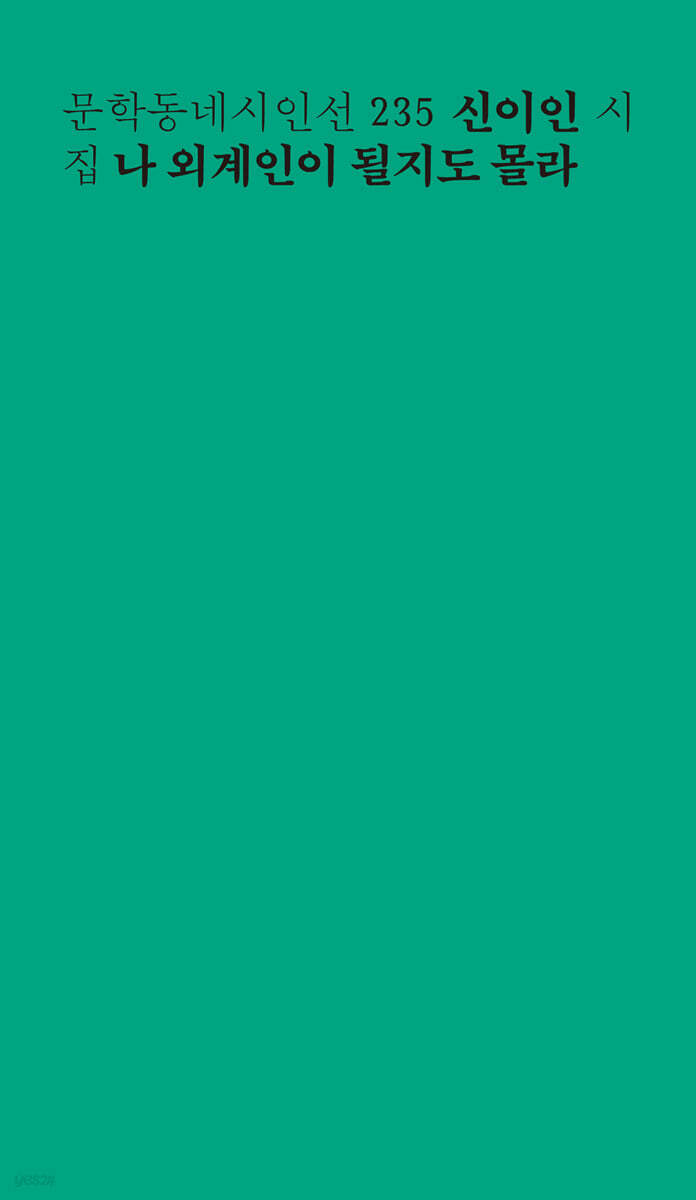
I might be an alien
 |
Description
Book Introduction
“Focus on your two feet
Feel the floor
Next
“Push the floor”
Born after shedding the superficial shell of the world
A new species of human called Shin-i-in
I often became a strange kid.
When I was in elementary school, I was often called by the nickname 'Alien' rather than my name.
My middle school homeroom teacher thanked the kids in my class for getting along well with me as their teacher.
When I went up to high school and was introducing myself, someone shouted, "That's weird!"
Some people told me not to act weird, some said it was good that I was weird, and some sighed and said that I couldn't be like everyone else.
I didn't know English.
_From the 2021 Hankook Ilbo New Year's Literary Contest 'Award Speech'
Poet Shin I-in, who began his career through the 2021 Hankook Ilbo New Year's Literary Contest, is publishing his second poetry collection, "I Might Become an Alien," as the 235th issue of the Munhakdongne Poet Selection.
The young poet, who entered the literary world with the strong support of those who said, “I believe you will write while embracing things that do not belong anywhere,” submitted his work to the Jaum and Moeum “2022 Summer Poetry” the following year, receiving the comment, “A calm and plain riot” (critic Cho Dae-han), and was nominated for the 2022 and 2024 Munji Literary Award, along with the titles, “A beautiful, subversive, and strange ‘growth-poem’” (poet Kim Haeng-sook) and “A gaze that sings the world raw and honest and cheekily” (critic Kang Dong-ho), proving that he is building a unique and trustworthy world.
In his first poetry collection, 『Dictionary of Black-Haired Beasts』, he described himself as “naturally jumping across the multiverse of humans and non-humans” (literary critic Jeon Seung-min, commentary). In this new poetry collection, published after two years, he unfolds an independent universe in which each human species belongs.
The poetry collection consists of 52 poems, tightly divided into nine parts.
The title of each section is a one-character word that represents the poem it contains.
From 'road', 'clothes', 'house', 'dance', 'sword', 'star', 'blood', 'night', and 'dream', the simple words that an alien who crash-lands on Earth would learn for the first time stimulate the imagination.
Moreover, the title of this poetry collection, which brings to mind the poet's acceptance speech for the New Year's Literary Contest, "I've become a strange kid all of a sudden," suggests that he has come one step closer to the true nature of the voice he wanted to articulate as a poet.
A poet who decided to become an 'alien' wandering a shining planet rather than a 'strange child' living on Earth.
How about borrowing the three characters of his name and calling him ‘Shin-i-in (新異人)’, that is, a new species of human?
Feel the floor
Next
“Push the floor”
Born after shedding the superficial shell of the world
A new species of human called Shin-i-in
I often became a strange kid.
When I was in elementary school, I was often called by the nickname 'Alien' rather than my name.
My middle school homeroom teacher thanked the kids in my class for getting along well with me as their teacher.
When I went up to high school and was introducing myself, someone shouted, "That's weird!"
Some people told me not to act weird, some said it was good that I was weird, and some sighed and said that I couldn't be like everyone else.
I didn't know English.
_From the 2021 Hankook Ilbo New Year's Literary Contest 'Award Speech'
Poet Shin I-in, who began his career through the 2021 Hankook Ilbo New Year's Literary Contest, is publishing his second poetry collection, "I Might Become an Alien," as the 235th issue of the Munhakdongne Poet Selection.
The young poet, who entered the literary world with the strong support of those who said, “I believe you will write while embracing things that do not belong anywhere,” submitted his work to the Jaum and Moeum “2022 Summer Poetry” the following year, receiving the comment, “A calm and plain riot” (critic Cho Dae-han), and was nominated for the 2022 and 2024 Munji Literary Award, along with the titles, “A beautiful, subversive, and strange ‘growth-poem’” (poet Kim Haeng-sook) and “A gaze that sings the world raw and honest and cheekily” (critic Kang Dong-ho), proving that he is building a unique and trustworthy world.
In his first poetry collection, 『Dictionary of Black-Haired Beasts』, he described himself as “naturally jumping across the multiverse of humans and non-humans” (literary critic Jeon Seung-min, commentary). In this new poetry collection, published after two years, he unfolds an independent universe in which each human species belongs.
The poetry collection consists of 52 poems, tightly divided into nine parts.
The title of each section is a one-character word that represents the poem it contains.
From 'road', 'clothes', 'house', 'dance', 'sword', 'star', 'blood', 'night', and 'dream', the simple words that an alien who crash-lands on Earth would learn for the first time stimulate the imagination.
Moreover, the title of this poetry collection, which brings to mind the poet's acceptance speech for the New Year's Literary Contest, "I've become a strange kid all of a sudden," suggests that he has come one step closer to the true nature of the voice he wanted to articulate as a poet.
A poet who decided to become an 'alien' wandering a shining planet rather than a 'strange child' living on Earth.
How about borrowing the three characters of his name and calling him ‘Shin-i-in (新異人)’, that is, a new species of human?
- You can preview some of the book's contents.
Preview
index
Poet's words
Part 1 Road
Young Days - Space Station/Dream Machine/Price/Snake/Escape
Part 2 clothes
Luxury/ Threads/ Boxes/ Dream Clothes/ Car Wash and Junk Yard/ Prosperity of the Fireplace
Part 3 House
Dream House/ Companion/ Dream Confession/ Alien Family Poem/ Correction
Part 4 Dance
Farewell 1/ Jellyfish/ Justification/ It was worth it/ Salvation/ Pattern of Dreams
Part 5 Sword
Bird/Rootless Arrow/Dream Roulette/Easter/Maturity
Part 6 Star
Space Oddity / Dream Shape / Ark / Dream Screening / Kaonashi's Poem / Lies / Encounter
Part 7 Blood
Garbage Bird/Ugly Trash/Memorial Park/Expert's Love/Easy Poem/Amulet/The Walker's Poem
Part 8 Night
The Watchman's Poem/The Alien's Poem/The Stone 2/Spring/The Gun Room/The Boundary of Dreams/Dream Dialogue/Geureko Nan
Part 9 Dream
Poem of young love/ Dream garden/ Without paradise
Commentary | They say minors are scary
Seong Hyeon-ah (literary critic)
Part 1 Road
Young Days - Space Station/Dream Machine/Price/Snake/Escape
Part 2 clothes
Luxury/ Threads/ Boxes/ Dream Clothes/ Car Wash and Junk Yard/ Prosperity of the Fireplace
Part 3 House
Dream House/ Companion/ Dream Confession/ Alien Family Poem/ Correction
Part 4 Dance
Farewell 1/ Jellyfish/ Justification/ It was worth it/ Salvation/ Pattern of Dreams
Part 5 Sword
Bird/Rootless Arrow/Dream Roulette/Easter/Maturity
Part 6 Star
Space Oddity / Dream Shape / Ark / Dream Screening / Kaonashi's Poem / Lies / Encounter
Part 7 Blood
Garbage Bird/Ugly Trash/Memorial Park/Expert's Love/Easy Poem/Amulet/The Walker's Poem
Part 8 Night
The Watchman's Poem/The Alien's Poem/The Stone 2/Spring/The Gun Room/The Boundary of Dreams/Dream Dialogue/Geureko Nan
Part 9 Dream
Poem of young love/ Dream garden/ Without paradise
Commentary | They say minors are scary
Seong Hyeon-ah (literary critic)
Into the book
Knowing how to be picked up
Shape and pattern
and
I want to pick up something I like
Light and Hand
(……)
Broken bottles and shards of musical instruments
A child's shoe that fell off
Moving subtly
hey
This was my heart
I can choose
It was my home
--- From "Getting Out"
The moment I put on my silk dress, I became a naked person. In this country, I became too cold, ugly, strange, and burdensome. I became dressed in a way that I couldn't go to Siberia, where we were going, without going crazy. I went into the cheapest room possible, clinging to the fact that I was shiny, and I lived looking in the mirror, unable to give up the fact that I had traded you, Siberia, and my dreams. People called me a narcissist.
--- From "Luxury"
Boxes that seem like they will never be opened…
Let's get together and play a game of truth or dare.
They say that as we go back, we should talk about what we have.
That's not fun, I've been doing it my whole life and I'll keep doing it.
How about taking them out one by one from here? I, the shallow one who makes the suggestion,
(……)
Does it look rusty?
My master
Tell me the truth
Before this devil breaks
Open me up and take out what's left inside, one by one
Let's put it on display
Hate hate hate
Love love… …
stuffiness
It's stuffy... ...
--- From "Boxes"
My older sister bought me a pizza, fed me a slice, and said, "I might be an alien."
No, maybe he was an alien from the beginning
I looked down at the pizza calmly. It had a familiar, delicious taste.
But today I didn't want to eat it
(……)
Very common
Torn to shreds
dead circle
Earth is funny, families can be of different races.
Even if I'm lonely, I'd rather be alone than be a different species.
Understanding without asking or questioning
The greatest understanding called misunderstanding
If the absurdity of launching into space is our uneven Earthly affection,
You may feel wronged even after receiving understanding and acceptance.
--- From "Confession of a Dream"
All the hands I wanted to hold were far away
I somehow managed to stretch out my arm
I couldn't do it once as I pleased
Once
The waves dancing as far as the eye could see were truly beautiful.
It felt alive
I just looked at it
I like this sight so much that I want to keep watching it.
He was a stranger to me
If it wasn't me but someone else
If I were outside of myself, I would have held onto myself and shaken myself to tell myself not to do that.
If I weren't me...
--- From "Space Oddity"
Now here I am as easy as possible
It's not scary to be an easy person
For my love, who is neither a poet, a critic, nor a sophisticated reader
Just call love love
Without any misunderstanding
Simply
I choose to go into the forest
Not scary
A cloud that resembles a rabbit
Knock softly around the head
First
Night is coming
hi
You laugh while tickling me
We're in big trouble
It's a forest that I can't get through no matter what.
Shape and pattern
and
I want to pick up something I like
Light and Hand
(……)
Broken bottles and shards of musical instruments
A child's shoe that fell off
Moving subtly
hey
This was my heart
I can choose
It was my home
--- From "Getting Out"
The moment I put on my silk dress, I became a naked person. In this country, I became too cold, ugly, strange, and burdensome. I became dressed in a way that I couldn't go to Siberia, where we were going, without going crazy. I went into the cheapest room possible, clinging to the fact that I was shiny, and I lived looking in the mirror, unable to give up the fact that I had traded you, Siberia, and my dreams. People called me a narcissist.
--- From "Luxury"
Boxes that seem like they will never be opened…
Let's get together and play a game of truth or dare.
They say that as we go back, we should talk about what we have.
That's not fun, I've been doing it my whole life and I'll keep doing it.
How about taking them out one by one from here? I, the shallow one who makes the suggestion,
(……)
Does it look rusty?
My master
Tell me the truth
Before this devil breaks
Open me up and take out what's left inside, one by one
Let's put it on display
Hate hate hate
Love love… …
stuffiness
It's stuffy... ...
--- From "Boxes"
My older sister bought me a pizza, fed me a slice, and said, "I might be an alien."
No, maybe he was an alien from the beginning
I looked down at the pizza calmly. It had a familiar, delicious taste.
But today I didn't want to eat it
(……)
Very common
Torn to shreds
dead circle
Earth is funny, families can be of different races.
Even if I'm lonely, I'd rather be alone than be a different species.
Understanding without asking or questioning
The greatest understanding called misunderstanding
If the absurdity of launching into space is our uneven Earthly affection,
You may feel wronged even after receiving understanding and acceptance.
--- From "Confession of a Dream"
All the hands I wanted to hold were far away
I somehow managed to stretch out my arm
I couldn't do it once as I pleased
Once
The waves dancing as far as the eye could see were truly beautiful.
It felt alive
I just looked at it
I like this sight so much that I want to keep watching it.
He was a stranger to me
If it wasn't me but someone else
If I were outside of myself, I would have held onto myself and shaken myself to tell myself not to do that.
If I weren't me...
--- From "Space Oddity"
Now here I am as easy as possible
It's not scary to be an easy person
For my love, who is neither a poet, a critic, nor a sophisticated reader
Just call love love
Without any misunderstanding
Simply
I choose to go into the forest
Not scary
A cloud that resembles a rabbit
Knock softly around the head
First
Night is coming
hi
You laugh while tickling me
We're in big trouble
It's a forest that I can't get through no matter what.
--- From "Poems of Young Love"
Publisher's Review
How old is the expression, "Once upon a time we were"?
The word "we" too
How old are we
I'm so embarrassed by everything that I sleep alone.
For example, the blanket is old-fashioned
It was once a brand new blanket for us.
I haven't become a new person yet
Sometimes I write old poems
It seems like it would have been popular in the past
It's like something someone who's just starting out writing poetry would write
Write poetry without fear
Because I miss the old days
I keep saying I miss you
and
I'm happy
unfortunately
_「Dream Dialogue」 section
The muttering, “How old is the word ‘we’ to us?” points out the futility of the word ‘we’.
As someone who “has not yet become a new person,” I sometimes miss the old days and fall into a paradoxical happiness, but that too is a moment of reconciliation possible because I have moved on from the past.
This is in line with the poet's words, who recalls that "happiness was there in the old days/ where nothing was visible" but asks that "you do not look for me/ but remember the old days."
In that case, the poet's words, "living hard and becoming ugly" (the poet's words), would be proof that the poet, who realized that the difference between humans and non-humans, which causes them to be "treated as transparent/ or treated specially" (from "Lies"), actually exists even between individual humans, has existed as himself while at odds with the world.
The speaker of the world that says, “We can never be together no matter what” (“Young Days - Space Station”) converges on ‘me.’
When we recall that the “rectangular forest” created by Shin In-in (“Dream Garden”), which has the physical properties of a poetry collection, is always filled with non-human beings, it is natural that the subject of “I” extends beyond the human speaker to animals, objects, and even letters.
What is interesting is that the subject of the poetic speaker 'I', who appears in place of the poet, suddenly changes into "an old, broken machine" ("The Dream Machine"), "a potted cyclamen I bought at a flower shop" ("The Price"), "an easy thread" ("The Threads"), and "a true box" ("The Boxes") within a single poem.
This poetic device, reminiscent of a trance, suggests that the shallow flaws that humans have worn will be shed throughout this collection of poems.
According to "The Serpent," "the word 'slough' has two meanings, and the owners of the slough tolerate both."
As you know, the first one means 'a shell covering the skin' and the second one means 'a mistake made'.
The realization that the shell that covers the skin is a mistake can be read as an awareness of human existence being born with original sin from the beginning.
‘Clothes,’ which is also the title of Part 2, plays the role of protecting and hiding the body.
If my naked body is my strange and strange true self, then clothes are a means of conforming to the order of this world.
The speaker, who enjoys “the joy, warmth, pride, and comfort of wearing this for the first time” (“Dream Clothes”), feels ashamed when “all of my clothes are taken away” (“Expert’s Love”), but thinks “I bought this ridiculous outfit that I don’t normally wear or even desire, and it’s all over” (“Luxury”).
be empty.
Rain.
Their newly trimmed long hair was wet, their dry-cleaned cardigan was wet, their genuine leather shoes were wet, their underwear and socks were wet… … They were miserable.
Because it rained.
The rain has made a mess of us.
They began to reminisce.
At one time they were bald, clothless, covered in water-resistant paint, and ran around green rooftops in non-slip rubber slippers.
The rooftop was neat and tidy.
It was managed so that it could completely absorb the transparent rain that was just falling.
They danced on the polished linoleum floor, hooting and hooting, every single day without fail.
People reported it to the police.
"That's funny, let's just leave it at that," the policeman said.
It was a rain ceremony that seemed like it would last forever.
Maybe I wanted it to last forever.
Because I was happy.
With such a happy heart, praying for days on end is useless.
We are making false wishes.
After realizing this, they soon stopped praying for rain and went back home.
_Excerpt from "Poem of the Alien Family"
As rain falls from the sky, the alien family's clothes and hair become unsightly wet.
They recall a time when they were “a mess” and “wow, wow” dancing with their bald heads and no clothes.
Soon after finishing the prayer service, they return to their respective roles.
If we take our focus away from the seemingly harmonious role-playing of the fake family, we see a brief moment of cheerfulness discovered by Shin I-in.
The police in the city respond to people's reports by saying, "Let's just leave it."
The dance of the alien family, protected from even public intervention, leaves a deep impression as a contrast to the smooth daily life that follows.
Capturing the moments when “I might have seen something sparkling for a moment” (“Escape”), “I tried to hold on to it for a moment, but it flowed away” (“Kaonashi’s Poem”), or “the time I tried to understand it for a moment passed” (“Spring”) is another pleasure in reading this collection of poems.
The poet wants to enjoy that moment to the fullest, even if it is “nothing more than a play that will soothe me for a while while I live” (“Dream Figures”).
As he said in his prose collection, “with a true heart that is not an eternal fake but withers away like a flower” (『The Next Spring』).
“The poetic moments in which the obedient yet impudent, clumsy yet rebellious speaker is at odds with the world yet fits into it, present an unbearably uncomfortable and yet unbearably exhilarating experience.” (Literary critic Seong Hyeon-a, commentary)
The poems that start from 'I' and gain a fleeting moment of cheerfulness end with the sentence, "But I can love" (from "Jellyfish").
The fireplace, the speaker of “The Prosperity of the Fireplace,” is born with the fate of “melting away, driving out, or turning to ashes” everything it “loved fiercely.”
Just as a fireplace that loves ashes suffers so much that it “wants to lie down and burn alive”, loving a being different from oneself is inevitably harmful.
However, Shin In-in continues his love “even though his eyes are swollen/ while bumping into things, struggling, and hurting.”
The floor, which “pulls viciously” at him as he tries to “push the floor away,” “likes” him very much, so he considers it “a bruise/to be proud” (“Spring”).
The love of a god directed toward a distant object is always mixed with a certain amount of shame and pride.
Even when I am discouraged by my overflowing heart, I rise up with the pride that I still love.
A chaotic, messy, and noisy world teeming with harmful beings who dream of harmless love.
A world where one easily wants to fall in love with someone who exists on the other side, as in “A beauty’s lover is a comedian, / A poet’s lover is someone who doesn’t distinguish between right and wrong.”
The poet seems to be heading towards “a far, far place / where one would not dare to go home alone” (“Easy Poetry”), “carrying the reader who has casually opened the book of poems on his back / and crossing the long road so easily.”
This poetry collection, which faithfully lives up to the initial expectation of “embracing things that don’t belong anywhere,” will be an old greeting filled with timid love to you, who “maybe you were an alien from the beginning” (“Confession of a Dream”).
“Hello, I’m a fan…” (From ‘Interview’)
I hope that the useless poet, the useless poetry, the useless god, and our useless god, who is so lovable, will continue to write noisily.
An immature object that has found its own rhythm by mischievously shaking up everything fixed, an inhuman object that causes all sorts of things with its trembling power.
He is criticized as bad for not being the normal human being that society demands, and he is cursed to be bad, and he chews on the badness and takes on the appearance of a delinquent juvenile animal. I hope he will erase the boundaries and fly forever.
_Seonghyeon, in the commentary
A Mini-Interview with Poet Shin I-in
Q1.
This is a new poetry collection published two years after his first collection, 『Dictionary of Black-Haired Beasts』.
If the previous collection of poems explored the human existence, often referred to as a "black-haired beast," this collection seems to boldly affirm the possibility of becoming a different kind of being.
I'm curious about what you thought while preparing this poetry collection.
Just like my first collection of poems, I feel like my second collection of poems is more like a simple record of life.
Rather than considering a specific topic for writing poetry, I tried to write whatever came to me each day.
In the past, I think we internalized the gaze of others toward people with ambiguous identities, while also rebelling against it, and called them "black-haired beasts." Now, we may be calling them "aliens" while maintaining a more distant and positive perspective.
It seems like I write about alienation often, then and now.
Q2.
This collection of poems consists of nine parts.
Compared to a typical poetry collection, it is divided into several parts. What kind of flow did you have in mind?
When I collected a volume of poems, I felt like I could see the stories that were important in my life.
However, the storylines were diverse, and the methods and colors of expression were also diverse, so it was difficult to divide it into the typical 4 or 5 parts.
As I read my first poetry collection, I felt that my poems had a lot of density, so I thought that I should cut the verses short for my next collection to increase readability.
Q3.
A series of poems titled ‘Dream ○○’ stands out.
What happens in the dream world created by Shinin?
Things happen that can't be done.
I wanted to write a fantasy series that was both fiction and non-fiction, with the same essence but different circumstances, about me in a parallel world.
That's what dreams are like.
Actually, I was having a hard time coming up with a title, so I tried to use a trick, but it ended up becoming my favorite series.
Q4.
If there is a poem in this collection that you particularly cherish, please tell us which one it is and why.
I like the poem "The Prosperity of the Fireplace House."
Since I was little, I liked to light a fire in my grandmother's fireplace, so I wanted to write a poem about fireplaces and fireplaces.
Eventually, through the fireplace, we ended up talking about human nature, love, and the inescapable laws of the world.
Q5.
Please say hello to any aliens who might crash-land on Earth and pick up this poetry collection.
Hello, I'm a fan... ... Poetry is an alien language for humans.
Enjoy!
Poet's words
At that time, we could not see ahead
I followed the words of those with two eyes,
But I moved forward
We parted ways at a crossroads
Now from here
I think I can convey it to you
Happiness is in the old days
I was in a place where I couldn't see anything
I lived hard and became ugly.
Three or four eyes
Maybe with more
I wrote down what I saw like this
Don't understand
Don't look for me
Please remember the old days
June 2025
God
The word "we" too
How old are we
I'm so embarrassed by everything that I sleep alone.
For example, the blanket is old-fashioned
It was once a brand new blanket for us.
I haven't become a new person yet
Sometimes I write old poems
It seems like it would have been popular in the past
It's like something someone who's just starting out writing poetry would write
Write poetry without fear
Because I miss the old days
I keep saying I miss you
and
I'm happy
unfortunately
_「Dream Dialogue」 section
The muttering, “How old is the word ‘we’ to us?” points out the futility of the word ‘we’.
As someone who “has not yet become a new person,” I sometimes miss the old days and fall into a paradoxical happiness, but that too is a moment of reconciliation possible because I have moved on from the past.
This is in line with the poet's words, who recalls that "happiness was there in the old days/ where nothing was visible" but asks that "you do not look for me/ but remember the old days."
In that case, the poet's words, "living hard and becoming ugly" (the poet's words), would be proof that the poet, who realized that the difference between humans and non-humans, which causes them to be "treated as transparent/ or treated specially" (from "Lies"), actually exists even between individual humans, has existed as himself while at odds with the world.
The speaker of the world that says, “We can never be together no matter what” (“Young Days - Space Station”) converges on ‘me.’
When we recall that the “rectangular forest” created by Shin In-in (“Dream Garden”), which has the physical properties of a poetry collection, is always filled with non-human beings, it is natural that the subject of “I” extends beyond the human speaker to animals, objects, and even letters.
What is interesting is that the subject of the poetic speaker 'I', who appears in place of the poet, suddenly changes into "an old, broken machine" ("The Dream Machine"), "a potted cyclamen I bought at a flower shop" ("The Price"), "an easy thread" ("The Threads"), and "a true box" ("The Boxes") within a single poem.
This poetic device, reminiscent of a trance, suggests that the shallow flaws that humans have worn will be shed throughout this collection of poems.
According to "The Serpent," "the word 'slough' has two meanings, and the owners of the slough tolerate both."
As you know, the first one means 'a shell covering the skin' and the second one means 'a mistake made'.
The realization that the shell that covers the skin is a mistake can be read as an awareness of human existence being born with original sin from the beginning.
‘Clothes,’ which is also the title of Part 2, plays the role of protecting and hiding the body.
If my naked body is my strange and strange true self, then clothes are a means of conforming to the order of this world.
The speaker, who enjoys “the joy, warmth, pride, and comfort of wearing this for the first time” (“Dream Clothes”), feels ashamed when “all of my clothes are taken away” (“Expert’s Love”), but thinks “I bought this ridiculous outfit that I don’t normally wear or even desire, and it’s all over” (“Luxury”).
be empty.
Rain.
Their newly trimmed long hair was wet, their dry-cleaned cardigan was wet, their genuine leather shoes were wet, their underwear and socks were wet… … They were miserable.
Because it rained.
The rain has made a mess of us.
They began to reminisce.
At one time they were bald, clothless, covered in water-resistant paint, and ran around green rooftops in non-slip rubber slippers.
The rooftop was neat and tidy.
It was managed so that it could completely absorb the transparent rain that was just falling.
They danced on the polished linoleum floor, hooting and hooting, every single day without fail.
People reported it to the police.
"That's funny, let's just leave it at that," the policeman said.
It was a rain ceremony that seemed like it would last forever.
Maybe I wanted it to last forever.
Because I was happy.
With such a happy heart, praying for days on end is useless.
We are making false wishes.
After realizing this, they soon stopped praying for rain and went back home.
_Excerpt from "Poem of the Alien Family"
As rain falls from the sky, the alien family's clothes and hair become unsightly wet.
They recall a time when they were “a mess” and “wow, wow” dancing with their bald heads and no clothes.
Soon after finishing the prayer service, they return to their respective roles.
If we take our focus away from the seemingly harmonious role-playing of the fake family, we see a brief moment of cheerfulness discovered by Shin I-in.
The police in the city respond to people's reports by saying, "Let's just leave it."
The dance of the alien family, protected from even public intervention, leaves a deep impression as a contrast to the smooth daily life that follows.
Capturing the moments when “I might have seen something sparkling for a moment” (“Escape”), “I tried to hold on to it for a moment, but it flowed away” (“Kaonashi’s Poem”), or “the time I tried to understand it for a moment passed” (“Spring”) is another pleasure in reading this collection of poems.
The poet wants to enjoy that moment to the fullest, even if it is “nothing more than a play that will soothe me for a while while I live” (“Dream Figures”).
As he said in his prose collection, “with a true heart that is not an eternal fake but withers away like a flower” (『The Next Spring』).
“The poetic moments in which the obedient yet impudent, clumsy yet rebellious speaker is at odds with the world yet fits into it, present an unbearably uncomfortable and yet unbearably exhilarating experience.” (Literary critic Seong Hyeon-a, commentary)
The poems that start from 'I' and gain a fleeting moment of cheerfulness end with the sentence, "But I can love" (from "Jellyfish").
The fireplace, the speaker of “The Prosperity of the Fireplace,” is born with the fate of “melting away, driving out, or turning to ashes” everything it “loved fiercely.”
Just as a fireplace that loves ashes suffers so much that it “wants to lie down and burn alive”, loving a being different from oneself is inevitably harmful.
However, Shin In-in continues his love “even though his eyes are swollen/ while bumping into things, struggling, and hurting.”
The floor, which “pulls viciously” at him as he tries to “push the floor away,” “likes” him very much, so he considers it “a bruise/to be proud” (“Spring”).
The love of a god directed toward a distant object is always mixed with a certain amount of shame and pride.
Even when I am discouraged by my overflowing heart, I rise up with the pride that I still love.
A chaotic, messy, and noisy world teeming with harmful beings who dream of harmless love.
A world where one easily wants to fall in love with someone who exists on the other side, as in “A beauty’s lover is a comedian, / A poet’s lover is someone who doesn’t distinguish between right and wrong.”
The poet seems to be heading towards “a far, far place / where one would not dare to go home alone” (“Easy Poetry”), “carrying the reader who has casually opened the book of poems on his back / and crossing the long road so easily.”
This poetry collection, which faithfully lives up to the initial expectation of “embracing things that don’t belong anywhere,” will be an old greeting filled with timid love to you, who “maybe you were an alien from the beginning” (“Confession of a Dream”).
“Hello, I’m a fan…” (From ‘Interview’)
I hope that the useless poet, the useless poetry, the useless god, and our useless god, who is so lovable, will continue to write noisily.
An immature object that has found its own rhythm by mischievously shaking up everything fixed, an inhuman object that causes all sorts of things with its trembling power.
He is criticized as bad for not being the normal human being that society demands, and he is cursed to be bad, and he chews on the badness and takes on the appearance of a delinquent juvenile animal. I hope he will erase the boundaries and fly forever.
_Seonghyeon, in the commentary
A Mini-Interview with Poet Shin I-in
Q1.
This is a new poetry collection published two years after his first collection, 『Dictionary of Black-Haired Beasts』.
If the previous collection of poems explored the human existence, often referred to as a "black-haired beast," this collection seems to boldly affirm the possibility of becoming a different kind of being.
I'm curious about what you thought while preparing this poetry collection.
Just like my first collection of poems, I feel like my second collection of poems is more like a simple record of life.
Rather than considering a specific topic for writing poetry, I tried to write whatever came to me each day.
In the past, I think we internalized the gaze of others toward people with ambiguous identities, while also rebelling against it, and called them "black-haired beasts." Now, we may be calling them "aliens" while maintaining a more distant and positive perspective.
It seems like I write about alienation often, then and now.
Q2.
This collection of poems consists of nine parts.
Compared to a typical poetry collection, it is divided into several parts. What kind of flow did you have in mind?
When I collected a volume of poems, I felt like I could see the stories that were important in my life.
However, the storylines were diverse, and the methods and colors of expression were also diverse, so it was difficult to divide it into the typical 4 or 5 parts.
As I read my first poetry collection, I felt that my poems had a lot of density, so I thought that I should cut the verses short for my next collection to increase readability.
Q3.
A series of poems titled ‘Dream ○○’ stands out.
What happens in the dream world created by Shinin?
Things happen that can't be done.
I wanted to write a fantasy series that was both fiction and non-fiction, with the same essence but different circumstances, about me in a parallel world.
That's what dreams are like.
Actually, I was having a hard time coming up with a title, so I tried to use a trick, but it ended up becoming my favorite series.
Q4.
If there is a poem in this collection that you particularly cherish, please tell us which one it is and why.
I like the poem "The Prosperity of the Fireplace House."
Since I was little, I liked to light a fire in my grandmother's fireplace, so I wanted to write a poem about fireplaces and fireplaces.
Eventually, through the fireplace, we ended up talking about human nature, love, and the inescapable laws of the world.
Q5.
Please say hello to any aliens who might crash-land on Earth and pick up this poetry collection.
Hello, I'm a fan... ... Poetry is an alien language for humans.
Enjoy!
Poet's words
At that time, we could not see ahead
I followed the words of those with two eyes,
But I moved forward
We parted ways at a crossroads
Now from here
I think I can convey it to you
Happiness is in the old days
I was in a place where I couldn't see anything
I lived hard and became ugly.
Three or four eyes
Maybe with more
I wrote down what I saw like this
Don't understand
Don't look for me
Please remember the old days
June 2025
God
GOODS SPECIFICS
- Date of issue: June 16, 2025
- Page count, weight, size: 184 pages | 130*224*20mm
- ISBN13: 9791141602178
- ISBN10: 1141602172
You may also like
카테고리
korean


korean

![GQ KOREA Mark (Monthly): December [2025]](http://librairie.coreenne.fr/cdn/shop/files/8ef265dbbfbf186523ed75ba7319009d.jpg?v=1765340328&width=3840)


