

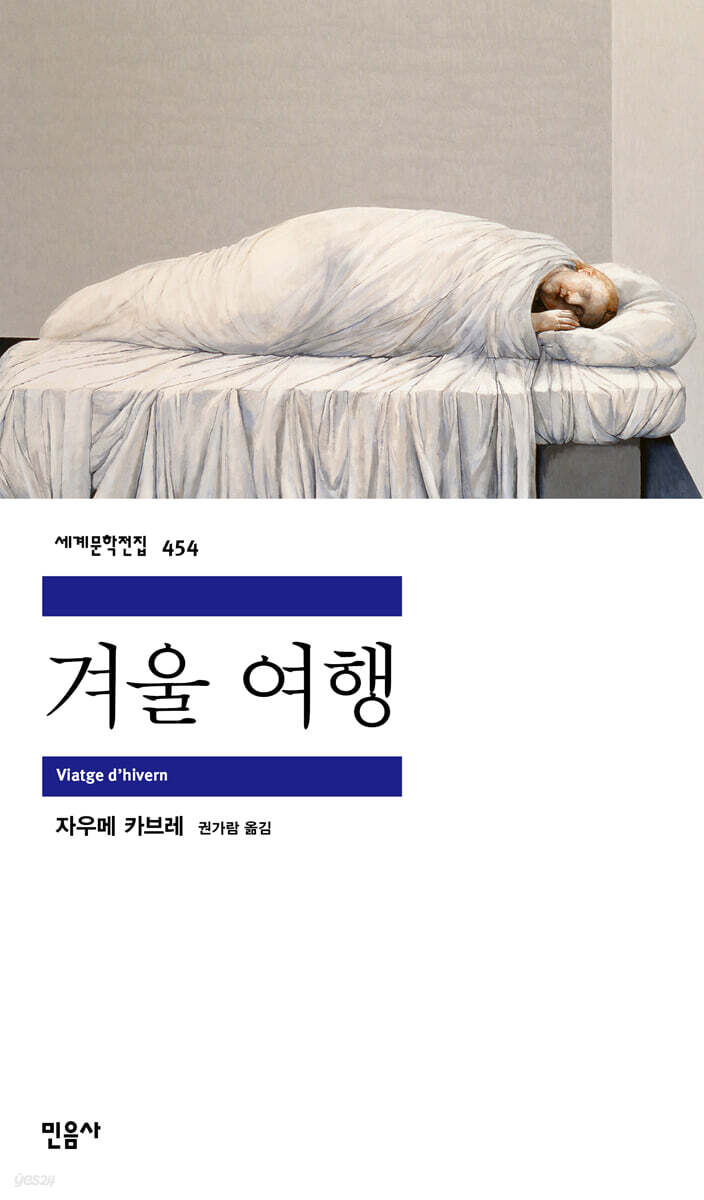
Winter travel
 |
Description
Book Introduction
“But that’s fate.
Only a part of the narrative, not the whole story, is arbitrarily chosen
“They try to deceive us by showing us and pretending not to know, with an ambiguous smile.”
Jaume Cabré, a representative writer of modern Catalan literature
A maestro who creates unique melodies through the multi-layered intertwining of stories.
- 『Winter Journey』 is a counterpoint work of pan-vocal music that evokes the fragility of love and beauty in the shadow of death, combining various motifs such as a lost Rembrandt, an unfinished text, and unrequited love like memories.
─ 《World Literature Review》
The short story collection "Winter Journey" by Jaume Cabré, a master of Catalan literature, has been published in Minumsa's World Literature Collection.
Born in Barcelona in 1947, Jaume Cabré is a high school teacher, screenwriter, opera composer, and parliamentary candidate, defining the modernity of Catalan culture.
He is expanding the horizons of Catalan literature in the world by winning the Sant Jordi Cross, awarded to a person who has brought honor to Catalonia, and the Curie Internationale Award for Best Foreign Literature in France.
Cabret, who left a deep impression on readers with his masterpiece 『J'Confess』, which traces the chronicle of evil and was first introduced in Korea, is a writer who has occupied a pioneering position in modern literature with his unique narrative and writing style that explores the inner self of human beings.
"Winter Journey" is a collection of short stories that condenses his world of work. Fourteen stories where time, space, and human fate intersect are organically connected like a symphony.
Each short story explores human desire, sin, salvation, and the meaning of art against the backdrop of various themes such as music, art, and philosophy.
While each tells a story independently, they are connected to each other through detailed literary devices to form another narrative.
This collection of works serves as the foundation for Cabreman's artistic narrative technique, in which characters discover secrets at the intersection of stories, like weaving warp and weft.
Cabret took the title of the collection from Schubert's song cycle "Die Winterreise", which was inspired by Müller's poem.
In Korea, it is widely known by the paraphrased title 'Winter Wanderer', which focuses on a man who embarks on a journey of wandering after suffering the loss of a romantic relationship.
Cabret's collection of works not only directly borrows the title of Schubert's work, but also places emphasis on travel as a metaphor for life, so it was directly translated as 'Winter Journey' to fully capture the meaning.
Only a part of the narrative, not the whole story, is arbitrarily chosen
“They try to deceive us by showing us and pretending not to know, with an ambiguous smile.”
Jaume Cabré, a representative writer of modern Catalan literature
A maestro who creates unique melodies through the multi-layered intertwining of stories.
- 『Winter Journey』 is a counterpoint work of pan-vocal music that evokes the fragility of love and beauty in the shadow of death, combining various motifs such as a lost Rembrandt, an unfinished text, and unrequited love like memories.
─ 《World Literature Review》
The short story collection "Winter Journey" by Jaume Cabré, a master of Catalan literature, has been published in Minumsa's World Literature Collection.
Born in Barcelona in 1947, Jaume Cabré is a high school teacher, screenwriter, opera composer, and parliamentary candidate, defining the modernity of Catalan culture.
He is expanding the horizons of Catalan literature in the world by winning the Sant Jordi Cross, awarded to a person who has brought honor to Catalonia, and the Curie Internationale Award for Best Foreign Literature in France.
Cabret, who left a deep impression on readers with his masterpiece 『J'Confess』, which traces the chronicle of evil and was first introduced in Korea, is a writer who has occupied a pioneering position in modern literature with his unique narrative and writing style that explores the inner self of human beings.
"Winter Journey" is a collection of short stories that condenses his world of work. Fourteen stories where time, space, and human fate intersect are organically connected like a symphony.
Each short story explores human desire, sin, salvation, and the meaning of art against the backdrop of various themes such as music, art, and philosophy.
While each tells a story independently, they are connected to each other through detailed literary devices to form another narrative.
This collection of works serves as the foundation for Cabreman's artistic narrative technique, in which characters discover secrets at the intersection of stories, like weaving warp and weft.
Cabret took the title of the collection from Schubert's song cycle "Die Winterreise", which was inspired by Müller's poem.
In Korea, it is widely known by the paraphrased title 'Winter Wanderer', which focuses on a man who embarks on a journey of wandering after suffering the loss of a romantic relationship.
Cabret's collection of works not only directly borrows the title of Schubert's work, but also places emphasis on travel as a metaphor for life, so it was directly translated as 'Winter Journey' to fully capture the meaning.
- You can preview some of the book's contents.
Preview
index
Posthumous Works 9
Will 32
Hope in Your Hands 43
This person is 62
Dust 74
Jewel Eyes 101
The Dream of Gottfried Heinrich 134
I remember 149
Results Make All the Difference 169
Ballad 190
Bread! 196
Trace 212
Negotiation 232
Winter Travel 253
Epilogue 287
Commentary on the work 293
Author's Chronology 302
Will 32
Hope in Your Hands 43
This person is 62
Dust 74
Jewel Eyes 101
The Dream of Gottfried Heinrich 134
I remember 149
Results Make All the Difference 169
Ballad 190
Bread! 196
Trace 212
Negotiation 232
Winter Travel 253
Epilogue 287
Commentary on the work 293
Author's Chronology 302
Detailed image

Into the book
“Tell them that the only thing I’ve ever dedicated my life to is playing as well as I do.”
--- p.18 From “Posthumous Works”
The music is beautiful.
It's definitely not Schubert, you're right, but isn't it very beautiful?
--- p.18 From “Posthumous Works”
But that's fate.
They try to deceive us by showing us only a part of the narrative, not the whole story, and pretending with an ambiguous smile that it is not true.
--- p.49 From “Hope in Your Hands”
“Because I pursue knowledge…….
Because knowledge is timid, it has a habit of hiding somewhere and wanting to be left alone.
I seek knowledge that is always hidden and undiscovered… … .”
--- p.86 From "Dust"
Despite so many recorded instances, Mr. Adria experienced real jealousy for the first time in his life.
Dark, tireless, misleading, sour, cruel, bitter jealousy.
--- p.89 From "Dust"
Isaac, my son, you will survive.
Will live for us.
You will be our eyes and our memory.
Go to Palestine, settle down there, and we will all live for you in Israel.
Get married and have children, so that we all may live through you.
--- p.165 From "I Remember"
It's not that I'm particularly interested in Sibelius.
But if the problem is that you're born with a talent for music that's almost torture-like, then that's a problem, dammit.
Any music I hear, I can't do anything else and I have to listen to it.
And then you memorize it and you memorize it forever.
There's so much music inside me that I try to keep it in my stomach as much as possible.
But when those songs turn into melodies and pop out of my head, all I can do is go crazy.
--- p.212 From "Traces"
Only then did he understand that there was no other way, that he could not leave Vienna, that life was a journey, not a path or a destination, and that when we disappear, wherever we may be, we are always halfway along the journey.
His misfortune was that he was chosen for a winter trip of the utmost cruelty, and his soul was completely destroyed.
--- p.18 From “Posthumous Works”
The music is beautiful.
It's definitely not Schubert, you're right, but isn't it very beautiful?
--- p.18 From “Posthumous Works”
But that's fate.
They try to deceive us by showing us only a part of the narrative, not the whole story, and pretending with an ambiguous smile that it is not true.
--- p.49 From “Hope in Your Hands”
“Because I pursue knowledge…….
Because knowledge is timid, it has a habit of hiding somewhere and wanting to be left alone.
I seek knowledge that is always hidden and undiscovered… … .”
--- p.86 From "Dust"
Despite so many recorded instances, Mr. Adria experienced real jealousy for the first time in his life.
Dark, tireless, misleading, sour, cruel, bitter jealousy.
--- p.89 From "Dust"
Isaac, my son, you will survive.
Will live for us.
You will be our eyes and our memory.
Go to Palestine, settle down there, and we will all live for you in Israel.
Get married and have children, so that we all may live through you.
--- p.165 From "I Remember"
It's not that I'm particularly interested in Sibelius.
But if the problem is that you're born with a talent for music that's almost torture-like, then that's a problem, dammit.
Any music I hear, I can't do anything else and I have to listen to it.
And then you memorize it and you memorize it forever.
There's so much music inside me that I try to keep it in my stomach as much as possible.
But when those songs turn into melodies and pop out of my head, all I can do is go crazy.
--- p.212 From "Traces"
Only then did he understand that there was no other way, that he could not leave Vienna, that life was a journey, not a path or a destination, and that when we disappear, wherever we may be, we are always halfway along the journey.
His misfortune was that he was chosen for a winter trip of the utmost cruelty, and his soul was completely destroyed.
--- p.285 From "Winter Journey"
Publisher's Review
Maestro who played the multi-layered melody of the narrative
Cabret moves freely between the present and the past, allowing each story to be read as an independent narrative, while also creating hidden connections between the fragments, turning the entire work into a vast puzzle.
In the first short story, “Posthumous Works,” the pianist’s impulsive performance of Fischer’s variations also makes glimpses into the following independent short stories, providing readers with a new narrative.
In "Dream of Gottfried Heinrich," we can guess how the main motif of the variations, 'si b, la, re b, si, do', was created.
The title and final short story, "Winter Journey," introduces the process by which the protagonist Zoltan discovers and introduces Fischer's only variation to the world.
I thought I was creating a collection of entirely independent stories.
This was because the atmosphere of each story clamored for such independence.
But towards the end, during that very period, the very act of writing allowed me to discover some hidden or more explicit connections, to realize that everything was interconnected.
-From the "Epilogue"
As you follow the melody, the chronology of the birth, recording, performance, and appreciation of the theme melody is outlined as a coherent narrative.
In addition, various artistic devices are hidden throughout the fourteen short stories, such as Rembrandt's paintings, the family history of the great musician Bach, and the Ardevol family from "J'Confess."
"Winter Journey" is a work of art that brilliantly captures both the formal experimentation of multi-layered narrative intertwining in the process of answering these questions and the author's unique insight that "everything in life is connected."
Winter travelers walking the lonely road of life
Schubert's song cycle "Winterreise" depicts a man who, after experiencing a broken heart, becomes a cold winter wanderer and nearly dies.
Jaume Cabré's "Winter Journey" is a work that expresses this melodic impression through his own linguistic art. Like a traveler walking alone through a snow-covered forest, the characters in "Winter Journey" each carry their own loneliness and pain.
The film features a man who discovers that his sons are not his blood after his wife dies, a seemingly successful musicologist who is abandoned by the lover he has waited for his entire life, a survivor of the Shoah who dreams of rebuilding his life but whose only hope is suicide, a mother who was robbed of her children in the Yugoslav War, and a misogynist who resorts to extreme violence after being abandoned by his lover and having his masculinity attacked.
All of these protagonists walk through life as a journey, not a single path or destination, and must each endure loneliness, despair, and sorrow in their own way.
The author said, “I wrote stories about ordinary lives that already exist, but are so ordinary that they are not often told.”
Cabret revealed that when he first conceived the collection of short stories, he had no intention of connecting the stories, but as he continued to write, organic connections that he had not even imagined began to emerge and expand, as if the stories were speaking to each other.
It clearly reveals the contradictory fate of humans who must walk their own path in life alone, but cannot stand alone without love, friendship, art, and solidarity.
Cabret, who has been praised for his meticulous compositions and profound insights into human existence, explores the universal themes of art, morality, and time with his signature literary sensibility in this work.
I sat down in front of the attic door, not moving, and when a story passed by, he grabbed me by the scruff of the neck and urged me to explain.
Thus, with tremendous patience as the cornerstone, I began to unravel the secrets of each individual story, and thus began to conjure up clear or vague ideas about the literary ending that would connect to the first sentence or word of the story, or the beginning of a story that even I had no idea how it would turn out.
-From the "Epilogue"
Cabret moves freely between the present and the past, allowing each story to be read as an independent narrative, while also creating hidden connections between the fragments, turning the entire work into a vast puzzle.
In the first short story, “Posthumous Works,” the pianist’s impulsive performance of Fischer’s variations also makes glimpses into the following independent short stories, providing readers with a new narrative.
In "Dream of Gottfried Heinrich," we can guess how the main motif of the variations, 'si b, la, re b, si, do', was created.
The title and final short story, "Winter Journey," introduces the process by which the protagonist Zoltan discovers and introduces Fischer's only variation to the world.
I thought I was creating a collection of entirely independent stories.
This was because the atmosphere of each story clamored for such independence.
But towards the end, during that very period, the very act of writing allowed me to discover some hidden or more explicit connections, to realize that everything was interconnected.
-From the "Epilogue"
As you follow the melody, the chronology of the birth, recording, performance, and appreciation of the theme melody is outlined as a coherent narrative.
In addition, various artistic devices are hidden throughout the fourteen short stories, such as Rembrandt's paintings, the family history of the great musician Bach, and the Ardevol family from "J'Confess."
"Winter Journey" is a work of art that brilliantly captures both the formal experimentation of multi-layered narrative intertwining in the process of answering these questions and the author's unique insight that "everything in life is connected."
Winter travelers walking the lonely road of life
Schubert's song cycle "Winterreise" depicts a man who, after experiencing a broken heart, becomes a cold winter wanderer and nearly dies.
Jaume Cabré's "Winter Journey" is a work that expresses this melodic impression through his own linguistic art. Like a traveler walking alone through a snow-covered forest, the characters in "Winter Journey" each carry their own loneliness and pain.
The film features a man who discovers that his sons are not his blood after his wife dies, a seemingly successful musicologist who is abandoned by the lover he has waited for his entire life, a survivor of the Shoah who dreams of rebuilding his life but whose only hope is suicide, a mother who was robbed of her children in the Yugoslav War, and a misogynist who resorts to extreme violence after being abandoned by his lover and having his masculinity attacked.
All of these protagonists walk through life as a journey, not a single path or destination, and must each endure loneliness, despair, and sorrow in their own way.
The author said, “I wrote stories about ordinary lives that already exist, but are so ordinary that they are not often told.”
Cabret revealed that when he first conceived the collection of short stories, he had no intention of connecting the stories, but as he continued to write, organic connections that he had not even imagined began to emerge and expand, as if the stories were speaking to each other.
It clearly reveals the contradictory fate of humans who must walk their own path in life alone, but cannot stand alone without love, friendship, art, and solidarity.
Cabret, who has been praised for his meticulous compositions and profound insights into human existence, explores the universal themes of art, morality, and time with his signature literary sensibility in this work.
I sat down in front of the attic door, not moving, and when a story passed by, he grabbed me by the scruff of the neck and urged me to explain.
Thus, with tremendous patience as the cornerstone, I began to unravel the secrets of each individual story, and thus began to conjure up clear or vague ideas about the literary ending that would connect to the first sentence or word of the story, or the beginning of a story that even I had no idea how it would turn out.
-From the "Epilogue"
GOODS SPECIFICS
- Date of issue: January 31, 2025
- Page count, weight, size: 308 pages | 354g | 132*225*15mm
- ISBN13: 9788937464546
- ISBN10: 8937464543
You may also like
카테고리
korean


korean

![GQ KOREA Mark (Monthly): December [2025]](http://librairie.coreenne.fr/cdn/shop/files/8ef265dbbfbf186523ed75ba7319009d.jpg?v=1765340328&width=3840)


