

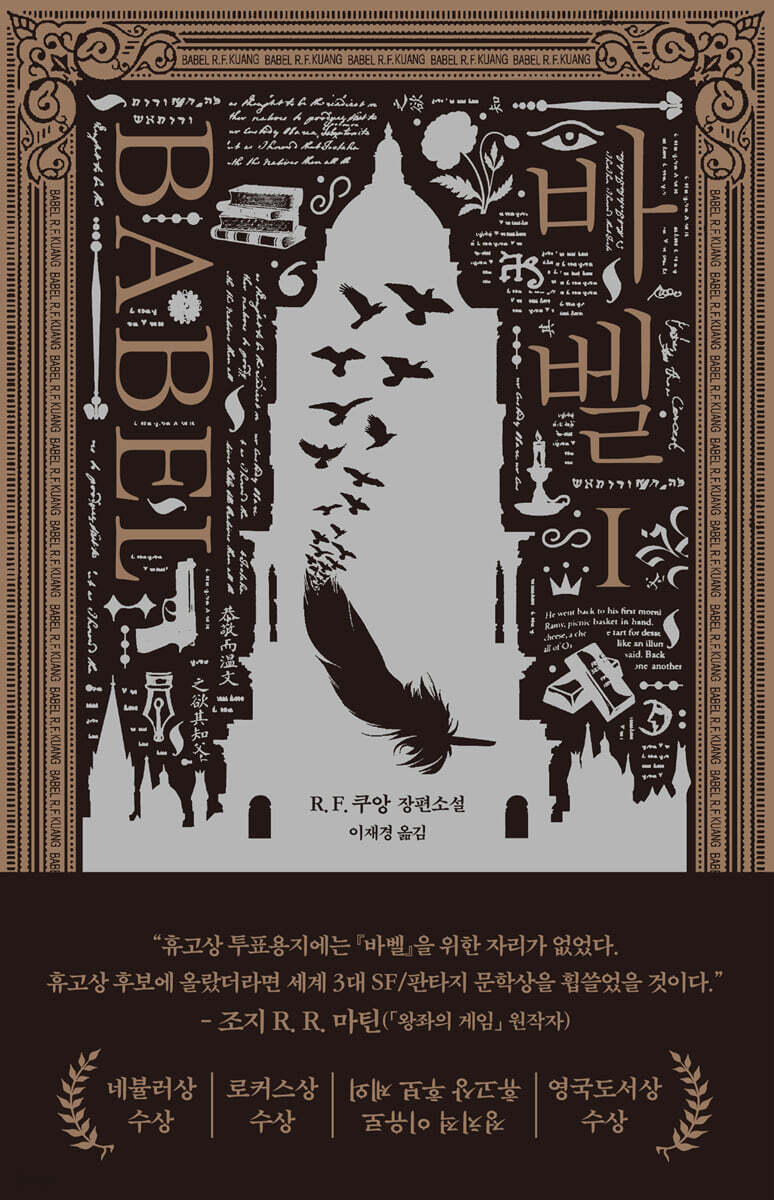
Babel 1
 |
Description
Book Introduction
“She woke up.
Revolution is in fact always unthinkable.
Revolution destroys the world we know.
“The future is full of possibilities because it is unwritten.”
The expansion of imperialism and capitalism at Oxford University in the early 19th century,
And a steampunk & dark academia masterpiece dealing with academic conspiracies.
He won the Nebula Award and the Locus Award in his mid-20s.
『Yellow Face』 author R.
F. Kuang's masterpiece
★★★Winner of the Nebula Award, Locus Award, British Book Award, and Alex Award★★★
★★★Fantasy master George R.
Alfie Award, personally selected by R. Martin★★★
★★★#1 New York Times and Sunday Times Bestseller★★★
★★★[Twilight] Production Company Temple Hill Acquires Film Rights★★★
At the age of twenty-six, R. won the Nebula Award and the Locus Award, two of the world's top three science fiction literary awards.
F. Kuang's masterpiece.
If he had won the Hugo Award, which was one of the strongest candidates but was excluded from the list of nominees for dubious political reasons (censorship scandal), he would have set a record of sweeping the world's three major science fiction literary awards with just one work, Babel.
The 2023 Hugo Awards ceremony was held in Chengdu, China, and leaked internal emails from the organizing committee indicate that Babel was excluded from the shortlist because it contained material and narrative that could offend China.
The fact that 『Babel』 strongly criticizes the imperialistic invasion of Western powers that even plot wars for their own interests has provoked the outrage of many science fiction/fantasy enthusiasts, and fantasy master George R.
This became even more of a topic of conversation when R. Martin, in protest, awarded the Alfie Prize, which he had established, to Babel.
"Babel" is a steampunk, alternative history novel set in Oxford University, England, which became the world's most powerful nation in the early 19th century thanks to the success of the Silver Industrial Revolution, and deals with the expansion of imperialism and capitalism, as well as the collusion of academia.
It recreates the circumstances of the time with astonishing precision and vividness, with little difference from actual history, except for the fantasy setting that Britain's global economic hegemony was achieved by a magic 'silver rod'.
The magic of the silver rod comes not from the silver rod itself, but from the translation pairs of words engraved on it.
The power comes from the difference that is lost when words are translated from one language to another, and silver captures that loss and manifests its power.
Silver rods engraved with Matchpair can dramatically improve the functionality of steam-powered trains, ships, and looms, increase the power and accuracy of gunshots, heal injuries, and even distort reality, such as making people invisible.
The institution that specializes in this work, or silverwork, is the Royal Institute of Translation (Babel) at Oxford University.
Revolution is in fact always unthinkable.
Revolution destroys the world we know.
“The future is full of possibilities because it is unwritten.”
The expansion of imperialism and capitalism at Oxford University in the early 19th century,
And a steampunk & dark academia masterpiece dealing with academic conspiracies.
He won the Nebula Award and the Locus Award in his mid-20s.
『Yellow Face』 author R.
F. Kuang's masterpiece
★★★Winner of the Nebula Award, Locus Award, British Book Award, and Alex Award★★★
★★★Fantasy master George R.
Alfie Award, personally selected by R. Martin★★★
★★★#1 New York Times and Sunday Times Bestseller★★★
★★★[Twilight] Production Company Temple Hill Acquires Film Rights★★★
At the age of twenty-six, R. won the Nebula Award and the Locus Award, two of the world's top three science fiction literary awards.
F. Kuang's masterpiece.
If he had won the Hugo Award, which was one of the strongest candidates but was excluded from the list of nominees for dubious political reasons (censorship scandal), he would have set a record of sweeping the world's three major science fiction literary awards with just one work, Babel.
The 2023 Hugo Awards ceremony was held in Chengdu, China, and leaked internal emails from the organizing committee indicate that Babel was excluded from the shortlist because it contained material and narrative that could offend China.
The fact that 『Babel』 strongly criticizes the imperialistic invasion of Western powers that even plot wars for their own interests has provoked the outrage of many science fiction/fantasy enthusiasts, and fantasy master George R.
This became even more of a topic of conversation when R. Martin, in protest, awarded the Alfie Prize, which he had established, to Babel.
"Babel" is a steampunk, alternative history novel set in Oxford University, England, which became the world's most powerful nation in the early 19th century thanks to the success of the Silver Industrial Revolution, and deals with the expansion of imperialism and capitalism, as well as the collusion of academia.
It recreates the circumstances of the time with astonishing precision and vividness, with little difference from actual history, except for the fantasy setting that Britain's global economic hegemony was achieved by a magic 'silver rod'.
The magic of the silver rod comes not from the silver rod itself, but from the translation pairs of words engraved on it.
The power comes from the difference that is lost when words are translated from one language to another, and silver captures that loss and manifests its power.
Silver rods engraved with Matchpair can dramatically improve the functionality of steam-powered trains, ships, and looms, increase the power and accuracy of gunshots, heal injuries, and even distort reality, such as making people invisible.
The institution that specializes in this work, or silverwork, is the Royal Institute of Translation (Babel) at Oxford University.
- You can preview some of the book's contents.
Preview
index
Author's Note
Part 1 (Chapters 1-4)
Part 2 (Chapters 5-12)
Part 3 (Chapters 13-15)
Part 1 (Chapters 1-4)
Part 2 (Chapters 5-12)
Part 3 (Chapters 13-15)
Into the book
"Babel" is a speculative novel.
That is, it is set in a fantasy version of Oxford in the 1830s.
The history of Oxford in the novel differs significantly from reality due to the silverworks (more on this soon).
However, the life in Oxford in the early Victorian era was depicted as faithfully as possible to the historical record, with fiction introduced only when necessary for the narrative.
--- p.11
The place where Robin would live was University College.
According to the guidebook, this place was commonly called Univ, and all students enrolled at the Royal Institute of Translators lived here.
Aesthetically, it was “a place of solemn and virtuous appearance, befitting its status as the eldest daughter of Oxford.”
--- p.88
The professor opened the left drawer with a key and took out a blank silver bar with no engraving on it.
“That’s not entirely wrong.
Actually, silver has special properties.
Silver is an ideal medium for what we do.
I believe silver is a material blessed by the gods.
Silver is refined with mercury, the messenger god, whose Greek name is Hermes.
If we look at it this way, wouldn't it be possible to see silver as inseparable from hermeneutics? Okay, let's avoid overly romanticizing things.
In fact, the power of the silver bar lies in the words.
More specifically, the power comes from what cannot be expressed in words, from what is lost when words are transferred from one language to another.
“Eun-i captures what was lost and manifests it.”
--- pp.142-143
It wasn't an unfamiliar magic.
They had all experienced the effects of silverwork.
In Britain, this was more difficult to avoid.
However, simply knowing that the Silver Rod's function, that is, Silverwork, is the foundation of a highly functional, advanced society, and directly witnessing the distortion of reality caused by Silverwork are entirely different things.
It was a whole other thing to see Eun-i capture the indescribable and actually make something happen that reality wouldn't allow.
--- p.144
“By now you know that London is the heart of a vast empire that shows no signs of stopping its expansion.
The most important driving force that makes this growth possible is the barbell.
Just as Babel hoards silver, it also collects foreign languages and talents, using them to create translation magic that only benefits England.
The overwhelming majority of silver bars used in the world are concentrated in London.
The newest and most powerful of the silver bars in use today are those that work in Chinese, Sanskrit, and Arabic.
But in the countries where these languages are actually used, there are less than a thousand silver bars.
And it's only gathered in the homes of the wealthy and powerful.
That's wrong.
“That is plunder, and it is fundamentally unjust.”
--- p.170
“Magic.” The professor placed his hand on his chest.
“What we do is magic.
It may not always feel that way, though.
Even the task you'll be doing tonight will feel more like folding laundry than a fleeting pursuit.
But never forget what a daring undertaking you are undertaking.
You are up against a curse from God.
“Don’t forget that.”
That is, it is set in a fantasy version of Oxford in the 1830s.
The history of Oxford in the novel differs significantly from reality due to the silverworks (more on this soon).
However, the life in Oxford in the early Victorian era was depicted as faithfully as possible to the historical record, with fiction introduced only when necessary for the narrative.
--- p.11
The place where Robin would live was University College.
According to the guidebook, this place was commonly called Univ, and all students enrolled at the Royal Institute of Translators lived here.
Aesthetically, it was “a place of solemn and virtuous appearance, befitting its status as the eldest daughter of Oxford.”
--- p.88
The professor opened the left drawer with a key and took out a blank silver bar with no engraving on it.
“That’s not entirely wrong.
Actually, silver has special properties.
Silver is an ideal medium for what we do.
I believe silver is a material blessed by the gods.
Silver is refined with mercury, the messenger god, whose Greek name is Hermes.
If we look at it this way, wouldn't it be possible to see silver as inseparable from hermeneutics? Okay, let's avoid overly romanticizing things.
In fact, the power of the silver bar lies in the words.
More specifically, the power comes from what cannot be expressed in words, from what is lost when words are transferred from one language to another.
“Eun-i captures what was lost and manifests it.”
--- pp.142-143
It wasn't an unfamiliar magic.
They had all experienced the effects of silverwork.
In Britain, this was more difficult to avoid.
However, simply knowing that the Silver Rod's function, that is, Silverwork, is the foundation of a highly functional, advanced society, and directly witnessing the distortion of reality caused by Silverwork are entirely different things.
It was a whole other thing to see Eun-i capture the indescribable and actually make something happen that reality wouldn't allow.
--- p.144
“By now you know that London is the heart of a vast empire that shows no signs of stopping its expansion.
The most important driving force that makes this growth possible is the barbell.
Just as Babel hoards silver, it also collects foreign languages and talents, using them to create translation magic that only benefits England.
The overwhelming majority of silver bars used in the world are concentrated in London.
The newest and most powerful of the silver bars in use today are those that work in Chinese, Sanskrit, and Arabic.
But in the countries where these languages are actually used, there are less than a thousand silver bars.
And it's only gathered in the homes of the wealthy and powerful.
That's wrong.
“That is plunder, and it is fundamentally unjust.”
--- p.170
“Magic.” The professor placed his hand on his chest.
“What we do is magic.
It may not always feel that way, though.
Even the task you'll be doing tonight will feel more like folding laundry than a fleeting pursuit.
But never forget what a daring undertaking you are undertaking.
You are up against a curse from God.
“Don’t forget that.”
--- p.184
Publisher's Review
“The question arises as to how to resist the global system,
Babel becomes a merciless laboratory of history.” (LA Times)
A fascinating magical steampunk tale about imperialism and globalization.
However, as European languages become closer through exchange and expansion, and word connotations change and merge, the available match pairs become increasingly exhausted, and the need for new languages that are similar but not identical becomes more urgent.
To address this, Babel focuses on finding strong match pairs in non-European (especially Chinese and Indian) languages.
Babel's students, including the protagonist Robin Swift, are language geniuses selected from around the world for this very purpose.
Robin steadily develops his skills as an elite translator who will take charge of Silverworks, the foundation of the British Empire, but one day, his peaceful school life is thrown into crisis when he meets his half-brother Griffin.
Griffin is also of Chinese descent and from Babel. When Griffin rebelled against Babel and went into hiding, Professor Lovell chose Robin as his replacement.
Griffin explains to Robin how Babel is using foreign languages to advance the British Empire's colonial invasion, and persuades him to join the Hermetic Society, a secret society that opposes this.
Robin breaks off her relationship with Griffin, torn between her identity as a Chinese and her comfortable future as an Imperial translator.
Because they were afraid that if they were discovered, they would return to their miserable past of poverty and hunger.
However, Robin, who was sent to Guangdong, China with his classmates as part of a practical training course in his fourth year, witnessed the imperialistic ambitions of Britain, which forced free trade (centered on the sale of opium) on the Qing Dynasty in order to obtain large amounts of silver, and the miserable lives of the Chinese people who lived like ruins, addicted to smuggled opium.
It was just before the Opium War broke out.
Robin learns that Babel is a front for colonial invasion, and that the British government is plotting war to monopolize the Chinese silver needed for the Silverworks.
But this wasn't limited to the colonies.
Even within the empire, the only people who benefited from the Silver Industrial Revolution were the already wealthy and a select few who had the cunning and luck to become wealthy.
At that moment, a huge spider web appeared in Robin's mind.
Cotton flowing from India to England, opium flowing from India to China, silver being turned into tea and porcelain in China, and then everything flowing back into England.
At first it sounded very abstract.
They were just categories of use, exchange, and value.
But now what was abstract is not abstract.
The moment I realized how the world was woven like a spider's web, and how my own lifestyle was causing exploitation within that web, I saw the specter of colonial labor and colonial suffering hanging like a dark cloud over that vast web.
(Volume 2, page 62)
All of these incidents were caught in the same web of oppression and exploitation.
What happens to the Lancashire spinners happened to the Indian weavers first.
Silver-armored, sweaty, and tired workers in British textile mills spun yarn from cotton harvested by American slaves.
The Industrial Revolution brought poverty, inequality, and suffering everywhere, and the only ones who benefited from it were those in power at the center of the empire.
(Volume 2, pages 331-332)
Ultimately, Robin decides to side with the Hermes Society along with his fellow colonists in similar circumstances, thus raising the curtain on the Oxford Translators' Revolution against the Empire.
“To reconstruct the dominant narrative of what the West calls civilization,
That is, let's retranslate it." (Chicago Review of Books)
A Humanistic Exploration of the Proposition that "Translation is Treason"
Beyond its sharp political and social critique of imperialism and globalization, which continue to cause suffering and misery to countless people today, "Babel" further enriches the reader's intellectual enjoyment and reading pleasure with its rich knowledge and interpretation of language and translation. With languages so vastly different from one another, how can accuracy and fidelity in translation be ensured? Is translation value-neutral? In the novel, Professor Playfair explains to his students that translation is not simply about conveying a message, but rather a rewriting of the original text.
“This is where our trouble lies.
Rewriting is also writing, and writing always reflects the writer's ideology and prejudices.
The Latin word translatio means to move.
That is, translation includes spatial dimensions.
It's literally about transporting text across occupied territory, carrying words like you're carrying foreign spices.
Words take on very different meanings as they travel from the courts of Rome to the tea houses of modern England.”
Another problem arises here.
That is, the politics of translation.
As is well-documented in the novel, translation studies developed into an independent discipline during the heyday of imperialism, beginning with the 19th-century German Romantic era.
The global modernization led by Western imperialism was nothing more than a scramble for colonies against non-European countries, and in this process, translation played a crucial role as an essential tool of colonization.
It was only natural that Robin and his friends, who were from the colony, raised the banner of revolution against Babel (Royal Institute of Translators), the vanguard of this colonization.
Professors pretend that Babel is an ivory tower of knowledge, above worldly concerns like business and commerce, but in reality it is not.
Babel is closely intertwined with the colonial enterprise.
No, Babel itself is a colonial enterprise.
Think about it.
Have you ever wondered why the Department of Literature only translates works into English and not vice versa? What do interpreters do when they're sent overseas? Everything Babel does is for the expansion of the empire.
(Volume 1, page 171)
The goal of the revolution led by Robin and his Oxford translator friends was to complete translations that served not the unilateral colonization of imperialism, but rather those that promoted true globalization through mutual communication and understanding.
Therefore, it is only natural that they, who were struggling between violence and non-violence, ended up blowing up Babel with translation magic.
“Isn’t that translation? The same goes for conversation.
Listening to what the other person has to say, trying to overcome the wall of prejudice and understand what the other person is trying to say.
“Putting yourself out into the world and hoping that someone will understand.” (Volume 2, page 423)
“A rich description of an ever-expanding empire, with linguistics, history, politics and
“A close examination of Victorian England.” (Library Journal)
A vivid recreation of Oxford, the mecca of fantasy literature, and the Victorian era.
Oxford University, one of the world's most prestigious universities and a cradle of English literature, has lived up to its reputation by producing numerous writers and serving as the backdrop for literary works.
Even in the fantasy genre, Oxford graduate J.
RR
Tolkien and C.
S. Lewis and Lewis Carroll taught here and wrote their immortal masterpieces, and Philip Pullman's "The Golden Compass" and J.
K. Rowling's Harry Potter series created a wonderful fantasy world set in the ancient city of Oxford.
In line with this Oxford fantasy, Babel vividly portrays life in Oxford in the early Victorian era, that is, in the 19th century, like a movie, based on the author's study abroad experience, where he received a master's degree in Chinese studies from Oxford University, and details from various historical records and literary works.
Following the protagonists' paths as they crisscross the main stages of University College, the Radcliffe Camera, the Bodleian Library, and the High Street and Broad Street, which are lined with various shops, it feels as if you are taking a city tour of Oxford. This is why 'Babel' is called the most notable masterpiece in the dark academia genre since the 'Harry Potter' series.
A revolution for the future or a comfortable present?
Colonial children selected as agents of imperialism
The protagonists of this novel, with the exception of Letitia Price, have one thing in common: they are of colonial origin.
Because the Silver Rod magic, which was the foundation of the British Empire's mighty superpower, required users of various languages, Babel (the Royal Institute of Translators) selected children with exceptional linguistic talents from colonies such as China and India as scholarship students.
Robin Swift: The illegitimate child of Professor Lovell, the leader of Babel, through a political relationship with a Chinese woman in Guangdong, China.
She grew up learning English from a British maid hired by Professor Lovell, and after her mother died from an epidemic, she was taken to England by Professor Lovell, who came to visit her home.
Ramiz Rafi Mirza: A linguistic genius from Calcutta, India, fluent in Urdu, Arabic, Persian, English, Latin, Greek, Spanish, and Italian.
Rami's family worked as servants in the home of Lord Wilson, a British aristocrat. He was noticed by Lord Wilson for his extraordinary memory and eloquence, and received an elite education.
Victoire Degrave: Haitian in the West Indies, fluent in Kreyol, French, Greek and Latin.
After working as a maid (effectively a slave) for an elite family in France via England, she entered Babel through an introduction by her employer.
Letty (Letitia Price): The daughter of a British Navy admiral, she has a great talent for languages, but due to gender discrimination, she is scheduled to marry against her will. After the suicide of her brother, an Oxford student, she barely manages to enter Babel.
Griffin Swift: Professor Lovell's son from a political relationship with a Chinese woman in Macau, China, before Robin.
That is, Robin's half-brother.
Realizing that Babel is a puppet of the British Empire, he joins the anti-establishment organization Hermes Society and leads a violent struggle.
Babel becomes a merciless laboratory of history.” (LA Times)
A fascinating magical steampunk tale about imperialism and globalization.
However, as European languages become closer through exchange and expansion, and word connotations change and merge, the available match pairs become increasingly exhausted, and the need for new languages that are similar but not identical becomes more urgent.
To address this, Babel focuses on finding strong match pairs in non-European (especially Chinese and Indian) languages.
Babel's students, including the protagonist Robin Swift, are language geniuses selected from around the world for this very purpose.
Robin steadily develops his skills as an elite translator who will take charge of Silverworks, the foundation of the British Empire, but one day, his peaceful school life is thrown into crisis when he meets his half-brother Griffin.
Griffin is also of Chinese descent and from Babel. When Griffin rebelled against Babel and went into hiding, Professor Lovell chose Robin as his replacement.
Griffin explains to Robin how Babel is using foreign languages to advance the British Empire's colonial invasion, and persuades him to join the Hermetic Society, a secret society that opposes this.
Robin breaks off her relationship with Griffin, torn between her identity as a Chinese and her comfortable future as an Imperial translator.
Because they were afraid that if they were discovered, they would return to their miserable past of poverty and hunger.
However, Robin, who was sent to Guangdong, China with his classmates as part of a practical training course in his fourth year, witnessed the imperialistic ambitions of Britain, which forced free trade (centered on the sale of opium) on the Qing Dynasty in order to obtain large amounts of silver, and the miserable lives of the Chinese people who lived like ruins, addicted to smuggled opium.
It was just before the Opium War broke out.
Robin learns that Babel is a front for colonial invasion, and that the British government is plotting war to monopolize the Chinese silver needed for the Silverworks.
But this wasn't limited to the colonies.
Even within the empire, the only people who benefited from the Silver Industrial Revolution were the already wealthy and a select few who had the cunning and luck to become wealthy.
At that moment, a huge spider web appeared in Robin's mind.
Cotton flowing from India to England, opium flowing from India to China, silver being turned into tea and porcelain in China, and then everything flowing back into England.
At first it sounded very abstract.
They were just categories of use, exchange, and value.
But now what was abstract is not abstract.
The moment I realized how the world was woven like a spider's web, and how my own lifestyle was causing exploitation within that web, I saw the specter of colonial labor and colonial suffering hanging like a dark cloud over that vast web.
(Volume 2, page 62)
All of these incidents were caught in the same web of oppression and exploitation.
What happens to the Lancashire spinners happened to the Indian weavers first.
Silver-armored, sweaty, and tired workers in British textile mills spun yarn from cotton harvested by American slaves.
The Industrial Revolution brought poverty, inequality, and suffering everywhere, and the only ones who benefited from it were those in power at the center of the empire.
(Volume 2, pages 331-332)
Ultimately, Robin decides to side with the Hermes Society along with his fellow colonists in similar circumstances, thus raising the curtain on the Oxford Translators' Revolution against the Empire.
“To reconstruct the dominant narrative of what the West calls civilization,
That is, let's retranslate it." (Chicago Review of Books)
A Humanistic Exploration of the Proposition that "Translation is Treason"
Beyond its sharp political and social critique of imperialism and globalization, which continue to cause suffering and misery to countless people today, "Babel" further enriches the reader's intellectual enjoyment and reading pleasure with its rich knowledge and interpretation of language and translation. With languages so vastly different from one another, how can accuracy and fidelity in translation be ensured? Is translation value-neutral? In the novel, Professor Playfair explains to his students that translation is not simply about conveying a message, but rather a rewriting of the original text.
“This is where our trouble lies.
Rewriting is also writing, and writing always reflects the writer's ideology and prejudices.
The Latin word translatio means to move.
That is, translation includes spatial dimensions.
It's literally about transporting text across occupied territory, carrying words like you're carrying foreign spices.
Words take on very different meanings as they travel from the courts of Rome to the tea houses of modern England.”
Another problem arises here.
That is, the politics of translation.
As is well-documented in the novel, translation studies developed into an independent discipline during the heyday of imperialism, beginning with the 19th-century German Romantic era.
The global modernization led by Western imperialism was nothing more than a scramble for colonies against non-European countries, and in this process, translation played a crucial role as an essential tool of colonization.
It was only natural that Robin and his friends, who were from the colony, raised the banner of revolution against Babel (Royal Institute of Translators), the vanguard of this colonization.
Professors pretend that Babel is an ivory tower of knowledge, above worldly concerns like business and commerce, but in reality it is not.
Babel is closely intertwined with the colonial enterprise.
No, Babel itself is a colonial enterprise.
Think about it.
Have you ever wondered why the Department of Literature only translates works into English and not vice versa? What do interpreters do when they're sent overseas? Everything Babel does is for the expansion of the empire.
(Volume 1, page 171)
The goal of the revolution led by Robin and his Oxford translator friends was to complete translations that served not the unilateral colonization of imperialism, but rather those that promoted true globalization through mutual communication and understanding.
Therefore, it is only natural that they, who were struggling between violence and non-violence, ended up blowing up Babel with translation magic.
“Isn’t that translation? The same goes for conversation.
Listening to what the other person has to say, trying to overcome the wall of prejudice and understand what the other person is trying to say.
“Putting yourself out into the world and hoping that someone will understand.” (Volume 2, page 423)
“A rich description of an ever-expanding empire, with linguistics, history, politics and
“A close examination of Victorian England.” (Library Journal)
A vivid recreation of Oxford, the mecca of fantasy literature, and the Victorian era.
Oxford University, one of the world's most prestigious universities and a cradle of English literature, has lived up to its reputation by producing numerous writers and serving as the backdrop for literary works.
Even in the fantasy genre, Oxford graduate J.
RR
Tolkien and C.
S. Lewis and Lewis Carroll taught here and wrote their immortal masterpieces, and Philip Pullman's "The Golden Compass" and J.
K. Rowling's Harry Potter series created a wonderful fantasy world set in the ancient city of Oxford.
In line with this Oxford fantasy, Babel vividly portrays life in Oxford in the early Victorian era, that is, in the 19th century, like a movie, based on the author's study abroad experience, where he received a master's degree in Chinese studies from Oxford University, and details from various historical records and literary works.
Following the protagonists' paths as they crisscross the main stages of University College, the Radcliffe Camera, the Bodleian Library, and the High Street and Broad Street, which are lined with various shops, it feels as if you are taking a city tour of Oxford. This is why 'Babel' is called the most notable masterpiece in the dark academia genre since the 'Harry Potter' series.
A revolution for the future or a comfortable present?
Colonial children selected as agents of imperialism
The protagonists of this novel, with the exception of Letitia Price, have one thing in common: they are of colonial origin.
Because the Silver Rod magic, which was the foundation of the British Empire's mighty superpower, required users of various languages, Babel (the Royal Institute of Translators) selected children with exceptional linguistic talents from colonies such as China and India as scholarship students.
Robin Swift: The illegitimate child of Professor Lovell, the leader of Babel, through a political relationship with a Chinese woman in Guangdong, China.
She grew up learning English from a British maid hired by Professor Lovell, and after her mother died from an epidemic, she was taken to England by Professor Lovell, who came to visit her home.
Ramiz Rafi Mirza: A linguistic genius from Calcutta, India, fluent in Urdu, Arabic, Persian, English, Latin, Greek, Spanish, and Italian.
Rami's family worked as servants in the home of Lord Wilson, a British aristocrat. He was noticed by Lord Wilson for his extraordinary memory and eloquence, and received an elite education.
Victoire Degrave: Haitian in the West Indies, fluent in Kreyol, French, Greek and Latin.
After working as a maid (effectively a slave) for an elite family in France via England, she entered Babel through an introduction by her employer.
Letty (Letitia Price): The daughter of a British Navy admiral, she has a great talent for languages, but due to gender discrimination, she is scheduled to marry against her will. After the suicide of her brother, an Oxford student, she barely manages to enter Babel.
Griffin Swift: Professor Lovell's son from a political relationship with a Chinese woman in Macau, China, before Robin.
That is, Robin's half-brother.
Realizing that Babel is a puppet of the British Empire, he joins the anti-establishment organization Hermes Society and leads a violent struggle.
GOODS SPECIFICS
- Date of issue: August 18, 2025
- Page count, weight, size: 448 pages | 134*208*30mm
- ISBN13: 9788970121796
- ISBN10: 897012179X
You may also like
카테고리
korean


korean

![GQ KOREA Mark (Monthly): December [2025]](http://librairie.coreenne.fr/cdn/shop/files/8ef265dbbfbf186523ed75ba7319009d.jpg?v=1765340328&width=3840)


