

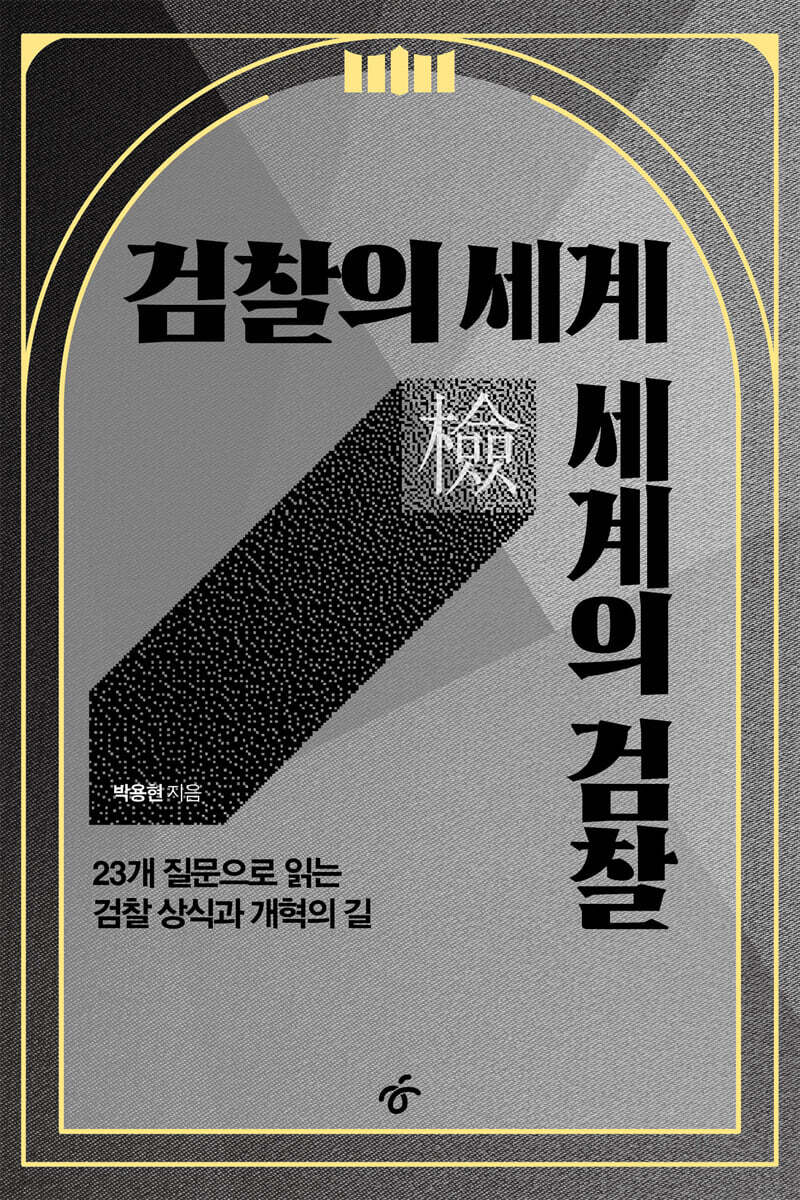
The world of prosecutors The world of prosecutors
 |
Description
Book Introduction
Is our prosecution the only one with this problem?
What about prosecutors in other countries?
The path that prosecutors around the world have taken is the path that our prosecutors will take.
Global Prosecutorial Common Sense and Reform Issues: A General Knowledge Guide
The prosecution is the most powerful group in the country, outside of the military during wartime.
Prosecutors have more power over the lives, liberty, and reputations of citizens than any other group.
(…) When prosecutors exercise this power properly, they can be one of the most beneficial influences on our society, but if they act with malicious or immoral motives, they can be one of the most evil.
This is an excerpt from a speech given by U.S. Attorney General Robert Jackson to a conference of federal prosecutors on April 1, 1940.
This passage clearly shows the duality of the prosecution, which can be both an implementer and a destroyer of justice.
The rise and fall of the South Korean prosecution service has unfolded in a dramatic manner unparalleled worldwide, and the brutality that has plunged the entire nation into chaos is still ongoing.
Faced with the challenge of the times, namely, prosecution reform, this question suddenly arises.
"Is this problem only with our prosecution? What about prosecutions in other countries?"
Author Yong-Hyeon Park, who served as editor-in-chief of the Hankyoreh and is currently an editorial writer and is licensed as a lawyer in New York, turned his eyes to the world to find the answer.
And I wrote this book to convey the results of my long-term thinking and research to readers in a more accessible and convenient way.
"The World of Prosecutors: Prosecutors of the World" introduces the history and characteristics of prosecutors from around the world, including the United States, the United Kingdom, Germany, France, and Japan, through various episodes, and broadly examines the trial and error they went through to develop and reform their systems.
And through this, we explore where and how the Korean prosecution should move forward.
This book, consisting of three parts, begins with Part 1, "How Different Are Prosecutors Around the World from Us?" and explores the history and characteristics of global prosecutors through the French Revolution and examining judges, the U.S. prosecutorial election system and the multiple-member prosecutor system, the U.K.'s Office of the Prosecutor and Germany's objective duty.
Part 2, "The Dark History of the Prosecution Republic that Swallowed the Republic of Korea," examines issues such as the unity of prosecutors, legal techniques, procedural justice, political prosecution, and immunity from arrest that arose after the Yoon Seok-yeol administration and the December 3rd civil war, and reveals the indiscriminate abuse of prosecutorial power by our prosecution and the shameful face of political prosecution.
Part 3, "Issues for Prosecutorial Reform Discovered in Global Cases," examines each country's means of monitoring, checks, punishment, and reform of the prosecution system, including the progressive prosecutorial movement and grand jury system in the United States, the Prosecutorial Review Board in Japan and the crime of distortion of law in Germany, and the warrant request systems and prosecutor disciplinary mechanisms of each country.
The process by which each country has developed its own unique prosecution system is to create a just and humane social community.
Many of the questions we face as we grapple with the issue of the prosecution system are ones that countries that created and developed their prosecution systems before us have pondered for as long as 200 years, and some are still being discussed today.
What is clear from this is that the power that brings about change in the prosecution system is the will of the sovereign people.
Now is the time to break away from the prosecution system we are familiar with, broaden our horizons of understanding of the prosecution, and cultivate institutional imagination.
Examining the history and experience of foreign prosecutors provides the foundation for this imagination.
In an era where common sense about the prosecution has become essential knowledge, this book will serve as an excellent "prosecution textbook" and "reform reference book" as the new criminal justice system is formed and established.
What about prosecutors in other countries?
The path that prosecutors around the world have taken is the path that our prosecutors will take.
Global Prosecutorial Common Sense and Reform Issues: A General Knowledge Guide
The prosecution is the most powerful group in the country, outside of the military during wartime.
Prosecutors have more power over the lives, liberty, and reputations of citizens than any other group.
(…) When prosecutors exercise this power properly, they can be one of the most beneficial influences on our society, but if they act with malicious or immoral motives, they can be one of the most evil.
This is an excerpt from a speech given by U.S. Attorney General Robert Jackson to a conference of federal prosecutors on April 1, 1940.
This passage clearly shows the duality of the prosecution, which can be both an implementer and a destroyer of justice.
The rise and fall of the South Korean prosecution service has unfolded in a dramatic manner unparalleled worldwide, and the brutality that has plunged the entire nation into chaos is still ongoing.
Faced with the challenge of the times, namely, prosecution reform, this question suddenly arises.
"Is this problem only with our prosecution? What about prosecutions in other countries?"
Author Yong-Hyeon Park, who served as editor-in-chief of the Hankyoreh and is currently an editorial writer and is licensed as a lawyer in New York, turned his eyes to the world to find the answer.
And I wrote this book to convey the results of my long-term thinking and research to readers in a more accessible and convenient way.
"The World of Prosecutors: Prosecutors of the World" introduces the history and characteristics of prosecutors from around the world, including the United States, the United Kingdom, Germany, France, and Japan, through various episodes, and broadly examines the trial and error they went through to develop and reform their systems.
And through this, we explore where and how the Korean prosecution should move forward.
This book, consisting of three parts, begins with Part 1, "How Different Are Prosecutors Around the World from Us?" and explores the history and characteristics of global prosecutors through the French Revolution and examining judges, the U.S. prosecutorial election system and the multiple-member prosecutor system, the U.K.'s Office of the Prosecutor and Germany's objective duty.
Part 2, "The Dark History of the Prosecution Republic that Swallowed the Republic of Korea," examines issues such as the unity of prosecutors, legal techniques, procedural justice, political prosecution, and immunity from arrest that arose after the Yoon Seok-yeol administration and the December 3rd civil war, and reveals the indiscriminate abuse of prosecutorial power by our prosecution and the shameful face of political prosecution.
Part 3, "Issues for Prosecutorial Reform Discovered in Global Cases," examines each country's means of monitoring, checks, punishment, and reform of the prosecution system, including the progressive prosecutorial movement and grand jury system in the United States, the Prosecutorial Review Board in Japan and the crime of distortion of law in Germany, and the warrant request systems and prosecutor disciplinary mechanisms of each country.
The process by which each country has developed its own unique prosecution system is to create a just and humane social community.
Many of the questions we face as we grapple with the issue of the prosecution system are ones that countries that created and developed their prosecution systems before us have pondered for as long as 200 years, and some are still being discussed today.
What is clear from this is that the power that brings about change in the prosecution system is the will of the sovereign people.
Now is the time to break away from the prosecution system we are familiar with, broaden our horizons of understanding of the prosecution, and cultivate institutional imagination.
Examining the history and experience of foreign prosecutors provides the foundation for this imagination.
In an era where common sense about the prosecution has become essential knowledge, this book will serve as an excellent "prosecution textbook" and "reform reference book" as the new criminal justice system is formed and established.
- You can preview some of the book's contents.
Preview
index
Introduction: How did prosecutorial common sense become essential knowledge in our society?
Part 1: How do prosecutors around the world differ from ours?
Can a "good person" also be a "good prosecutor"? The dangers of "selective investigations."
Why Westerns Only Feature Sheriffs and Not Prosecutors: The Architects of the Prosecutorial System Are the "Sovereign People"
Look closer: The Okay Ranch Duel: What will be the outcome of the trial?
Is a Prosecutor General Really Necessary?: There Is No "One Prosecutor" in the US, Germany, or France
Read more: Why did France abandon its plan to create a one-man prosecutor general?
Why were investigation and prosecution separated during the French Revolution?: Investigation and prosecution: "Give everything away and you'll have a tyrant."
A closer look: The history of the prosecution system's transfer from France to Germany to Japan to Korea
Why Did the UK Crown Prosecution Service Only Arise in 1986?: What the UK's Turbulent Criminal Justice Reforms Indicate
What does it mean to conduct an investigation "objectively"?: A preliminary examination judge who "doesn't hunt"
A Closer Look: The "Utro Incident," a Historic Scandal, and the Continuation of the Pretrial Judge System
Can a prosecutor conceal evidence of innocence?: How to prevent 'indictment' from becoming 'persecution'
What will be the fate of the "American Yoon Seok-yeol" who used his investigative powers for political revenge? How US courts punish prosecutorial tyranny.
A Closer Look: The Prosecutor General's Disciplinary Action and His "Determination to Lose"
Which country has the world's worst prosecutors? The former Soviet Union's monstrous "Procuratura" prosecutors.
Read More: The Prosecutor General Should Be Banned from Political Entrepreneurship
Part 2: The Dark History of the Prosecutor's Republic That Swallowed South Korea
Prosecutors Who Sabotaged the Internal Rebellion Investigation: Are They Supporting a Coup?: The Prosecutors' Dark History of Pandering to Unjust Power
Why did the prosecution abandon its "legal skills" in front of Yoon Seok-yeol?: Prosecutors and Yoon Seok-yeol, both enemies of the Democratic Republic.
Look Further: Chameleon Prosecutors: Is Cancellation of Detention and Suspension of Detention the Same Thing?
Did you think the military and the Secret Service would be as infinitely obedient as prosecutors? The fatal anachronism of "prosecutors as one"
Can you talk about the rule of law while refusing to enforce it?: The "Yoon Seok-yeol-style sanctuary" that undermines the legitimacy of the prosecution.
Read more: Can a prosecutor hide his phone password?
Why is 'procedural justice' only reserved for the powerful?: The noble due process corrupted by Yoon Seok-yeol.
The Lee Jae-myung Indictment Under the US "Political Indictment" Statute: The Prosecution's Political Weaponization and the "Banana Republic"
How is the immunity from arrest for members of the National Assembly justified? The judiciary can also be complicit in "political oppression."
Look further: A judge can't hold the country hostage.
Issues in Prosecutorial Reform Discovered in Part 3 Global Cases
What if the prosecutors who betrayed the people could be ousted through elections? The "Prosecutor Election System" and Direct Democratic Control of the Prosecution Service
Look closer: Judges are also elected.
The "Progressive Prosecutor Movement": Are Elected Prosecutors Different?: There's No One-Shot Solution to Preventing Prosecutorial Autocracy
What if the citizens could decide on the indictment of Kim Gun-hee? Grand Jury and Prosecution Review Boards Reflect Citizens' Perspectives on Indictments
Look further: Citizens can file their own lawsuits.
Should the prosecution have the exclusive right to request warrants? The "May 16 Coup" was exploited to "protect the December 3 Rebellion."
Is impeaching a prosecutor more difficult than impeaching a president?: Enforcing the law with "dirty hands" defiles the rule of law.
Look Closer: US Prosecutors Strip Off for Minor(?) Misconduct
Can Prosecutors Who Distort the Law Be Criminalized?: German Prosecutors Punished for "Distorting the Law"
Were there judges who were dragged down before the king?: Prosecutorial reform and judicial reform must go hand in hand.
Concluding remarks: Following the compass of ‘public trust’
Appendix: Federal Prosecutors
References
Part 1: How do prosecutors around the world differ from ours?
Can a "good person" also be a "good prosecutor"? The dangers of "selective investigations."
Why Westerns Only Feature Sheriffs and Not Prosecutors: The Architects of the Prosecutorial System Are the "Sovereign People"
Look closer: The Okay Ranch Duel: What will be the outcome of the trial?
Is a Prosecutor General Really Necessary?: There Is No "One Prosecutor" in the US, Germany, or France
Read more: Why did France abandon its plan to create a one-man prosecutor general?
Why were investigation and prosecution separated during the French Revolution?: Investigation and prosecution: "Give everything away and you'll have a tyrant."
A closer look: The history of the prosecution system's transfer from France to Germany to Japan to Korea
Why Did the UK Crown Prosecution Service Only Arise in 1986?: What the UK's Turbulent Criminal Justice Reforms Indicate
What does it mean to conduct an investigation "objectively"?: A preliminary examination judge who "doesn't hunt"
A Closer Look: The "Utro Incident," a Historic Scandal, and the Continuation of the Pretrial Judge System
Can a prosecutor conceal evidence of innocence?: How to prevent 'indictment' from becoming 'persecution'
What will be the fate of the "American Yoon Seok-yeol" who used his investigative powers for political revenge? How US courts punish prosecutorial tyranny.
A Closer Look: The Prosecutor General's Disciplinary Action and His "Determination to Lose"
Which country has the world's worst prosecutors? The former Soviet Union's monstrous "Procuratura" prosecutors.
Read More: The Prosecutor General Should Be Banned from Political Entrepreneurship
Part 2: The Dark History of the Prosecutor's Republic That Swallowed South Korea
Prosecutors Who Sabotaged the Internal Rebellion Investigation: Are They Supporting a Coup?: The Prosecutors' Dark History of Pandering to Unjust Power
Why did the prosecution abandon its "legal skills" in front of Yoon Seok-yeol?: Prosecutors and Yoon Seok-yeol, both enemies of the Democratic Republic.
Look Further: Chameleon Prosecutors: Is Cancellation of Detention and Suspension of Detention the Same Thing?
Did you think the military and the Secret Service would be as infinitely obedient as prosecutors? The fatal anachronism of "prosecutors as one"
Can you talk about the rule of law while refusing to enforce it?: The "Yoon Seok-yeol-style sanctuary" that undermines the legitimacy of the prosecution.
Read more: Can a prosecutor hide his phone password?
Why is 'procedural justice' only reserved for the powerful?: The noble due process corrupted by Yoon Seok-yeol.
The Lee Jae-myung Indictment Under the US "Political Indictment" Statute: The Prosecution's Political Weaponization and the "Banana Republic"
How is the immunity from arrest for members of the National Assembly justified? The judiciary can also be complicit in "political oppression."
Look further: A judge can't hold the country hostage.
Issues in Prosecutorial Reform Discovered in Part 3 Global Cases
What if the prosecutors who betrayed the people could be ousted through elections? The "Prosecutor Election System" and Direct Democratic Control of the Prosecution Service
Look closer: Judges are also elected.
The "Progressive Prosecutor Movement": Are Elected Prosecutors Different?: There's No One-Shot Solution to Preventing Prosecutorial Autocracy
What if the citizens could decide on the indictment of Kim Gun-hee? Grand Jury and Prosecution Review Boards Reflect Citizens' Perspectives on Indictments
Look further: Citizens can file their own lawsuits.
Should the prosecution have the exclusive right to request warrants? The "May 16 Coup" was exploited to "protect the December 3 Rebellion."
Is impeaching a prosecutor more difficult than impeaching a president?: Enforcing the law with "dirty hands" defiles the rule of law.
Look Closer: US Prosecutors Strip Off for Minor(?) Misconduct
Can Prosecutors Who Distort the Law Be Criminalized?: German Prosecutors Punished for "Distorting the Law"
Were there judges who were dragged down before the king?: Prosecutorial reform and judicial reform must go hand in hand.
Concluding remarks: Following the compass of ‘public trust’
Appendix: Federal Prosecutors
References
Detailed image
.jpg)
Into the book
Can simply advising people to become "good prosecutors" prevent the inherent dangers of the prosecution? No.
The only way is to decentralize the prosecution's excessive power and establish an institutional structure that ensures that any unjust exercise of that power can be punished.
Only then can a 'good person' become a 'good prosecutor', and even a 'bad person' can become a 'good prosecutor'.
(Omitted) We must start from the premise that the prosecution is unfair, political, prone to corruption, and mired in organizational egoism.
We must design a system that will ensure that even the worst prosecutors are forced to properly exercise their prosecutorial power.
The reason why the grand jury system, in which citizens decide whether to indict or not, was designed in common law countries was to prevent the possibility of those with the power to indict harassing innocent people for political or personal reasons.
--- p.26~27
In France, examining judge Renaud Van Rumbeck, who pushed for investigations into the "living power" regardless of whether it was a progressive or conservative administration and became a role model for many examining judges, passed away in May 2024.
He uncovered allegations of corruption against the Minister of Labor, who was considered a prime ministerial candidate during the conservative regime of President Giscard d'Estaing in the 1970s.
This became the occasion for attacks from the right-wing camp, calling him a “red judge.”
On the other hand, during the 1990s, when François Mitterrand was president, he investigated corruption within the ruling Socialist Party, which drew criticism from the left wing.
French media published lengthy obituaries.
Among them, there is this passage:
Despite his stern appearance, he had a cheerful personality. It is said that he put up a poster of the character 'Lucky Luke' (a French cartoon character) in one corner of his room and added this caption.
"I am a poor, lonely presiding judge! I am a poor, lonely presiding judge!"
--- p.82~83
Which country's prosecution is considered the worst in the world? It's difficult to give a definitive answer, as there's no comprehensive survey of all prosecutions worldwide.
However, there is a country that the Venice Commission, an advisory body to the Council of Europe, has identified as having a “dangerous prosecution” in several reports.
Prosecutors of the former Soviet Union and Russia.
For reference, the Venice Commission is an organization that provides legal advice to member states to help them realize international standards in the fields of democracy, human rights, and the rule of law. Its official name is the 'European Commission for Democracy through Law'.
It has 61 member countries, including European countries as well as non-European countries such as Korea and the United States.
The prosecution system is one of the main areas covered by this committee.
--- p.132
The Supreme Court resolved this issue by establishing a new legal principle.
If it is highly probable that the evidence (the girl's body) would have been discovered through other lawful means (the police search team's own search) even if there had been no violation of due process (interrogation without a lawyer), then the evidence was declared lawful despite the procedural flaw.
The reason was that prohibiting the use of evidence on the grounds of violation of due process in such cases would be grossly inconsistent with substantive justice.
This is called the 'inevitable discovery rule'.
This is a representative ruling that seeks to achieve balance and harmony between substantive justice and procedural justice.
It is evaluated as “creating a legal safety net to prevent criminals who commit heinous crimes from slipping through the cracks of due process.”
--- p.163~164
A similar controversy has erupted in the United States.
US President Trump was indicted on four counts before his election, which he has denounced as a political “witch hunt” and “election interference.”
Among these, the case prosecuted by the Manhattan District Attorney's Office in New York resulted in a guilty verdict from the jury in May 2004.
The allegations are that Trump, while running for president in 2016, paid hush money to a porn star with whom he had a past sexual encounter and then falsely accounted for the money as legal expenses for his company.
However, with the presidential election taking place, the court's final sentencing was postponed several times, and the New York court ultimately indefinitely postponed the sentencing, which was originally scheduled for November 26, 2024.
Trump's argument appears to have had legal success.
As the controversy surrounding Trump's indictment intensifies, voices are emerging in American legal circles and civil society, warning against the "political weaponization" of prosecutorial power and seeking institutional alternatives.
--- p.170~171
In France, immunity from arrest was introduced with a different historical context and logic.
Unlike England, where the king and parliament gradually developed democracy through conflict and compromise, France, after a revolution that overthrew the absolute monarchy, established the principle in 1790 through a law that "members of parliament cannot be arrested or prosecuted without the consent of parliament."
(Omitted) In this way, the privilege of immunity from arrest was created with the purpose of ensuring that democracy can function without interference by preventing the powerful powers of punishment, whether the monarch of a monarchy or the executive branch of a republic, from arbitrarily oppressing the representatives of the people.
If so, then the more imperfect a democracy is in a country and the more frequent the abuse of power by public power, the greater the value of this privilege becomes.
--- p.181~182
In the United States, not only prosecutors but also judges are elected.
To be precise, the introduction of a judicial election system was the main issue when each state amended its constitution in the mid-to-late 19th century, and the prosecutorial election system was a secondary issue.
However, for judges, many states have since reverted to appointment.
Currently, only 22 states hold judicial elections.
Eight states use a party-based nomination system, while 13 states do not.
Michigan uses a hybrid election system, where each party holds primaries to select its candidate, but the general election is held without a party nomination.
--- p.203
In many foreign countries, there are systems in which prosecutors do not have a monopoly on the right to prosecute, and ordinary citizens also have the right to prosecute.
It is a private prosecution system.
Some states in the United States have a "citizen-initiated grand jury" system.
Six states—Kansas, New Mexico, North Dakota, Nebraska, Nevada, and Oklahoma—require a court to convene a grand jury if a certain number of citizens petition the court for a particular case.
The grand jury investigates the case and decides whether to indict.
This provides a path for citizens to take the initiative in investigating and prosecuting cases that the prosecution or police have ignored or dismissed as not guilty.
France also has a system (plainte avec constitution partie civile) where crime victims or related groups directly request an investigating judge to investigate and prosecute.
If such a request is made, the trial judge must investigate whether a criminal charge exists and decide whether to prosecute.
Even cases previously ruled not guilty by the prosecutor are no exception.
This system is considered a strong check against prosecutors abusing their discretion to prosecute.
--- p.224~225
There is also a counterargument that if the crime of distortion of law is applied excessively, it could infringe on the independence of judges and prosecutors.
Therefore, the German Federal Supreme Court also strictly sets the requirements for the crime of distorting the law.
In addition to the requirement that “the judge’s (prosecutor’s) decision must be unacceptable,” two other criteria must be met in order to be punished: “if it is so serious as to constitute a fundamental infringement on the judicial function, thereby shaking the public’s trust in the inviolability of the judicial function,” and “if such a decision was made in a conscious and serious manner and by arbitrary standards rather than the standards of the law.”
Conversely, it makes no sense that the prosecutor's actions do not lead to criminal punishment even though they meet these standards.
If such acts are tolerated, the rule of law itself will lose its raison d'être.
The only way is to decentralize the prosecution's excessive power and establish an institutional structure that ensures that any unjust exercise of that power can be punished.
Only then can a 'good person' become a 'good prosecutor', and even a 'bad person' can become a 'good prosecutor'.
(Omitted) We must start from the premise that the prosecution is unfair, political, prone to corruption, and mired in organizational egoism.
We must design a system that will ensure that even the worst prosecutors are forced to properly exercise their prosecutorial power.
The reason why the grand jury system, in which citizens decide whether to indict or not, was designed in common law countries was to prevent the possibility of those with the power to indict harassing innocent people for political or personal reasons.
--- p.26~27
In France, examining judge Renaud Van Rumbeck, who pushed for investigations into the "living power" regardless of whether it was a progressive or conservative administration and became a role model for many examining judges, passed away in May 2024.
He uncovered allegations of corruption against the Minister of Labor, who was considered a prime ministerial candidate during the conservative regime of President Giscard d'Estaing in the 1970s.
This became the occasion for attacks from the right-wing camp, calling him a “red judge.”
On the other hand, during the 1990s, when François Mitterrand was president, he investigated corruption within the ruling Socialist Party, which drew criticism from the left wing.
French media published lengthy obituaries.
Among them, there is this passage:
Despite his stern appearance, he had a cheerful personality. It is said that he put up a poster of the character 'Lucky Luke' (a French cartoon character) in one corner of his room and added this caption.
"I am a poor, lonely presiding judge! I am a poor, lonely presiding judge!"
--- p.82~83
Which country's prosecution is considered the worst in the world? It's difficult to give a definitive answer, as there's no comprehensive survey of all prosecutions worldwide.
However, there is a country that the Venice Commission, an advisory body to the Council of Europe, has identified as having a “dangerous prosecution” in several reports.
Prosecutors of the former Soviet Union and Russia.
For reference, the Venice Commission is an organization that provides legal advice to member states to help them realize international standards in the fields of democracy, human rights, and the rule of law. Its official name is the 'European Commission for Democracy through Law'.
It has 61 member countries, including European countries as well as non-European countries such as Korea and the United States.
The prosecution system is one of the main areas covered by this committee.
--- p.132
The Supreme Court resolved this issue by establishing a new legal principle.
If it is highly probable that the evidence (the girl's body) would have been discovered through other lawful means (the police search team's own search) even if there had been no violation of due process (interrogation without a lawyer), then the evidence was declared lawful despite the procedural flaw.
The reason was that prohibiting the use of evidence on the grounds of violation of due process in such cases would be grossly inconsistent with substantive justice.
This is called the 'inevitable discovery rule'.
This is a representative ruling that seeks to achieve balance and harmony between substantive justice and procedural justice.
It is evaluated as “creating a legal safety net to prevent criminals who commit heinous crimes from slipping through the cracks of due process.”
--- p.163~164
A similar controversy has erupted in the United States.
US President Trump was indicted on four counts before his election, which he has denounced as a political “witch hunt” and “election interference.”
Among these, the case prosecuted by the Manhattan District Attorney's Office in New York resulted in a guilty verdict from the jury in May 2004.
The allegations are that Trump, while running for president in 2016, paid hush money to a porn star with whom he had a past sexual encounter and then falsely accounted for the money as legal expenses for his company.
However, with the presidential election taking place, the court's final sentencing was postponed several times, and the New York court ultimately indefinitely postponed the sentencing, which was originally scheduled for November 26, 2024.
Trump's argument appears to have had legal success.
As the controversy surrounding Trump's indictment intensifies, voices are emerging in American legal circles and civil society, warning against the "political weaponization" of prosecutorial power and seeking institutional alternatives.
--- p.170~171
In France, immunity from arrest was introduced with a different historical context and logic.
Unlike England, where the king and parliament gradually developed democracy through conflict and compromise, France, after a revolution that overthrew the absolute monarchy, established the principle in 1790 through a law that "members of parliament cannot be arrested or prosecuted without the consent of parliament."
(Omitted) In this way, the privilege of immunity from arrest was created with the purpose of ensuring that democracy can function without interference by preventing the powerful powers of punishment, whether the monarch of a monarchy or the executive branch of a republic, from arbitrarily oppressing the representatives of the people.
If so, then the more imperfect a democracy is in a country and the more frequent the abuse of power by public power, the greater the value of this privilege becomes.
--- p.181~182
In the United States, not only prosecutors but also judges are elected.
To be precise, the introduction of a judicial election system was the main issue when each state amended its constitution in the mid-to-late 19th century, and the prosecutorial election system was a secondary issue.
However, for judges, many states have since reverted to appointment.
Currently, only 22 states hold judicial elections.
Eight states use a party-based nomination system, while 13 states do not.
Michigan uses a hybrid election system, where each party holds primaries to select its candidate, but the general election is held without a party nomination.
--- p.203
In many foreign countries, there are systems in which prosecutors do not have a monopoly on the right to prosecute, and ordinary citizens also have the right to prosecute.
It is a private prosecution system.
Some states in the United States have a "citizen-initiated grand jury" system.
Six states—Kansas, New Mexico, North Dakota, Nebraska, Nevada, and Oklahoma—require a court to convene a grand jury if a certain number of citizens petition the court for a particular case.
The grand jury investigates the case and decides whether to indict.
This provides a path for citizens to take the initiative in investigating and prosecuting cases that the prosecution or police have ignored or dismissed as not guilty.
France also has a system (plainte avec constitution partie civile) where crime victims or related groups directly request an investigating judge to investigate and prosecute.
If such a request is made, the trial judge must investigate whether a criminal charge exists and decide whether to prosecute.
Even cases previously ruled not guilty by the prosecutor are no exception.
This system is considered a strong check against prosecutors abusing their discretion to prosecute.
--- p.224~225
There is also a counterargument that if the crime of distortion of law is applied excessively, it could infringe on the independence of judges and prosecutors.
Therefore, the German Federal Supreme Court also strictly sets the requirements for the crime of distorting the law.
In addition to the requirement that “the judge’s (prosecutor’s) decision must be unacceptable,” two other criteria must be met in order to be punished: “if it is so serious as to constitute a fundamental infringement on the judicial function, thereby shaking the public’s trust in the inviolability of the judicial function,” and “if such a decision was made in a conscious and serious manner and by arbitrary standards rather than the standards of the law.”
Conversely, it makes no sense that the prosecutor's actions do not lead to criminal punishment even though they meet these standards.
If such acts are tolerated, the rule of law itself will lose its raison d'être.
--- p.254
Publisher's Review
Expanding institutional imagination through the history and characteristics of global prosecutors.
The prosecution system is an invention created in each country based on historical experience and the demands of its citizens, and its blueprint has been constantly revised, sometimes through chance events.
A look into the origins and history of each country's prosecution system clearly reveals that the sovereign people are the ones who determine how the prosecution is organized and what authority is granted to it, and that the prosecution must be under the control of the people.
The modern prosecutorial system originated in France.
Before the French Revolution, crimes were prosecuted by the "Coroner of the King," the office that legally represented the king.
However, during the revolutionary period, a shift in perception occurred that "prosecutions must be carried out in the name of the people," and the prototype for the criminal procedure and prosecution system was established through the 1808 Criminal Code (p. 62).
Additionally, France currently prevents concentration of power through devices such as having multiple examining judges and prosecutors general (chief prosecutors of the High Public Prosecutor's Office).
Until the 19th century, Germany had courts overseeing both prosecution and trial. However, after the Napoleonic Wars, the French prosecution system was imported, and prosecution and trial became separate. (p. 63) Germany is also the birthplace of the "objective duty," which requires prosecutors to strive to uncover objective truth from a neutral standpoint, rather than obsess over securing a guilty verdict.
Therefore, German prosecutors must actively investigate and collect not only the facts of the defendant's charges but also evidence supporting his innocence and his favor (p. 94).
In the early days of the United States, prosecutors were merely low-ranking officials in the courts and assistants to judges, and it was the sheriff's job to arrest and prosecute lawbreakers.
However, in the mid-to-late 19th century, as the wave of democratization swept across American society, the 'prosecutor election system' was introduced, in which prosecutors were elected.
The role and authority of prosecutors elected by the citizens have become increasingly powerful, and now they have the harmful effect of ruling over the citizens. (Page 28) On the other hand, in the UK, there was no prosecutorial system until 1986, and the police were responsible for both investigation and prosecution.
However, a murder case that occurred in 1972 and the resulting unjust imprisonment of three boys caused a huge social uproar, leading to criminal justice reform that divided the powers of investigation and prosecution.
Accordingly, the Prosecution Service was established in 1986, and the Prosecution Service Inspection Service was established in 2000, establishing multiple layers of institutional mechanisms to prevent abuse of power. (p. 66)
Japan adopted the modern French criminal justice system in 1872, but later revised its criminal procedure law to strengthen the status and authority of prosecutors under the influence of the German criminal justice system.
The formation of an investigative structure that allowed prosecutors to directly arrest and detain suspects and conduct searches and seizures was also intended to enable Japan to effectively colonize Korea.
This prosecution-centered system was transplanted to Korea during the Japanese colonial period.
After liberation, the prosecution system became more solid to keep the oppressive police in check, and after the democratization in the 1980s, when the military and intelligence agencies, which had been the core of violent public power, were weakened, the prosecution filled the vacuum created.
While there have been some partial changes to our prosecution system to date, these have been driven solely by the needs and demands of past dictatorships or the prosecution itself. (p. 64) Because the will of the sovereign people was not actively reflected in the formation and changes of the prosecution system, the prosecution in South Korea has become an entity far removed from democratic control.
The risk of corruption within the prosecution is inherent in the system, and this can manifest in extreme forms at any time if the conditions are right, as we have clearly seen through "Yoon Seok-yeol's Prosecutor's Republic."
Therefore, we must design a system that will ensure that even the worst prosecutors can properly exercise their prosecutorial power.
What systems and devices do other countries have in place to minimize the harm caused by the prosecution?
What systems have each country established to prevent abuse of prosecutorial power?
To prevent the prosecution's abuses, we must decentralize its excessive powers and establish an institutional structure that ensures that any unjust exercise of power can be punished.
One of the representative systems that embodies the idea of democratic self-governance, which seeks to place the prosecution under citizens' control, is the United States' prosecutorial election system.
In the United States, 45 states have implemented a system where prosecutors who go against the will of the people can be directly judged or reappointed through elections and recall votes.
As a result, prosecutors have no choice but to listen to the public's voice and be mindful of their reactions. (p. 195)
Choosing who to investigate and prosecute is the prosecutor's most powerful and dangerous power.
France's examining magistrate system is a check against this danger.
Although the preliminary examination judge belongs to the court, he or she is not involved in the trial and is assigned the task of investigation. Unlike the prosecution in our country, he or she does not hold the power of investigation and prosecution in his or her own hands.
This is because if one agency leads the investigation and prosecution, ‘targeted investigation and targeted prosecution’ may occur.
Therefore, in France, the prosecutor and the examining judge share investigative and prosecutorial powers, and exercise these powers under double and triple layers of constraints and oversight. (p. 77)
The prosecution's absurd decisions to indict or not to indict are making the public furious.
The grand jury in the United States and the prosecutorial review committee in Japan are systems that ensure that the "public's perspective" is "actually" reflected in the decision on whether to indict.
The grand jury system allows ordinary citizens to directly investigate and determine the validity of prosecutors' attempts to indict criminal suspects.
A grand jury is convened by a court at the request of a prosecutor and is composed of 12 to 23 randomly selected citizens. A majority vote determines whether to indict or not to indict.
The grand jury system is an independent body that does not belong to any of the legislative, executive, or judicial branches and serves as a buffer and referee between the government and citizens.
As ordinary citizens, jurors are free from political pressure or personnel favoritism, and thus can be more impartial than judges or other decision-makers (p. 214).
One weakness of this grand jury system is that it cannot handle cases where prosecutors have unfairly "decided not to indict."
Japan's Public Prosecutors' Office is a system that allows prosecutors to reexamine and indict cases that were not indicted.
The Prosecution Review Board is established in 165 local courts and branches, and is composed of 11 members randomly selected from voters in the respective regions every six months.
The decision of the Prosecution Review Board was not binding, but in 2009, 50 years after the system was implemented, the system was reformed and gained the effect of forcing prosecution.
Thanks to this, prosecutors, who are reluctant to indict public officials and politicians, can be more effectively monitored and restrained. (p. 219)
It is a clear democratic principle that criminal justice should be in line with the public's expectations.
When the prosecution fails to follow this principle, the people should not only demand it in words, but also step forward and correct it.
However, in reality, there is no system of sovereign participation in South Korea.
The only entity that can check the prosecution's 'unfair indictment' is the judiciary, and the only entity that can check 'unfair non-indictment' is the National Assembly.
The only way for the prosecution, an unelected and powerful force, to gain democratic legitimacy is to gain the trust of the people.
If the prosecution fails to gain trust, the process of rectifying the prosecution through the will of the sovereign people begins.
That is the prosecution reform.
Issues in Prosecutorial Reform: A Global Case Study
The American prosecutorial election system introduced above also has vulnerabilities.
If prosecutors were elected, it would seem that they would listen to the will of the citizens, but in reality, there were negative consequences, such as them focusing only on major cases out of election considerations or becoming obsessed with obtaining guilty verdicts by any means necessary.
Additionally, minority groups were treated unequally and the focus was on harsh punishment rather than crime prevention and reform.
Moreover, the election competition was not very fierce, so the re-election of the incumbent prosecutor was prominent.
In the end, even the elected prosecutors ended up abusing their power.
That's how the 'Progressive Prosecution Movement', the American version of the prosecutorial reform movement, began.
In 2015, billionaire investor George Soros partnered with civic groups to support reform-minded prosecutorial candidates, resulting in progressive prosecutors being elected in 13 districts as of December 2023.
Another significant achievement is the advancement of many women of color into the prosecutorial profession, previously considered the exclusive domain of white men. (p. 205)
Just because public officials are elected doesn't mean they all exercise their power democratically.
If you wield power arbitrarily without communicating or interacting with the people, it is very likely to become a sword that stabs democracy.
What about the South Korean prosecution, which possesses unprecedented power and discretion? It neither secures democratic legitimacy through popular election nor is it subject to democratic control by the people.
No matter how much a prosecutor abuses his power, the people have no way to replace him.
To prevent the prosecution from becoming a dictatorship, we need institutional mechanisms to reflect public opinion in the exercise of prosecutorial power, as well as clear means of punishing unfair exercise of prosecutorial power.
The domestic prosecutor disciplinary system is ineffective because disciplinary action is carried out by the prosecution itself.
The amendment to the Prosecutors' Disciplinary Act, intended to improve this irrationality, passed the National Assembly on June 5, 2025, marking the beginning of change.
Overseas, it is much more thorough and active than this.
In the United States, not only are the courts in charge of disciplining prosecutors who abuse their power, but the Department of Justice also has independent agencies, the Office of the Inspector General and the Office of Legal Ethics, to provide double oversight.
The UK has its own strict disciplinary system for prosecutors, while also establishing a separate Office of the Inspector General whose primary task is to oversee prosecutors.
In France, the Supreme Court of the Judiciary, a constitutional body, is responsible for disciplinary action against prosecutors, but a 2008 constitutional amendment allowed ordinary citizens to request disciplinary action against prosecutors.
Our country's Supreme Prosecutors' Office has an inspection department that monitors prosecutorial misconduct, but it is not effective.
Therefore, the only realistic disciplinary system for prosecutors is the impeachment system involving the National Assembly and the Constitutional Court. (p. 237)
What if prosecutors who make unjust or unlawful indictments or non-indictments could be subject to criminal punishment, not just disciplinary action or impeachment? In 2018, the German Federal Supreme Court found a prosecutor at the Freiburg Public Prosecutor's Office guilty of perverting the law for not prosecuting despite ample evidence.
Likewise, Germany has a crime of distorting the law stipulated in Article 339 of its criminal code, and countries such as Spain and Norway also punish public officials for distorting the law.
Additionally, countries such as Austria, Switzerland, and France can punish judges who distort the law through abuse of power.
In Korea, there are limitations to punishing acts of legal distortion through abuse of power and dereliction of duty, and calls for the creation of new crimes of legal distortion have been consistently raised (p. 251).
No country's prosecution system is a perfect 'model'.
Therefore, you cannot blindly follow it.
However, if we can figure out what principles and values are embedded in it and apply them to our reality, we will be able to create our own rational and creative system.
It's time to find areas for improvement in the existing prosecution system and to use our imagination to create a new prosecution system that suits us.
The author emphasizes that we must remember that we are all the designers of the new prosecution system.
The prosecution system is an invention created in each country based on historical experience and the demands of its citizens, and its blueprint has been constantly revised, sometimes through chance events.
A look into the origins and history of each country's prosecution system clearly reveals that the sovereign people are the ones who determine how the prosecution is organized and what authority is granted to it, and that the prosecution must be under the control of the people.
The modern prosecutorial system originated in France.
Before the French Revolution, crimes were prosecuted by the "Coroner of the King," the office that legally represented the king.
However, during the revolutionary period, a shift in perception occurred that "prosecutions must be carried out in the name of the people," and the prototype for the criminal procedure and prosecution system was established through the 1808 Criminal Code (p. 62).
Additionally, France currently prevents concentration of power through devices such as having multiple examining judges and prosecutors general (chief prosecutors of the High Public Prosecutor's Office).
Until the 19th century, Germany had courts overseeing both prosecution and trial. However, after the Napoleonic Wars, the French prosecution system was imported, and prosecution and trial became separate. (p. 63) Germany is also the birthplace of the "objective duty," which requires prosecutors to strive to uncover objective truth from a neutral standpoint, rather than obsess over securing a guilty verdict.
Therefore, German prosecutors must actively investigate and collect not only the facts of the defendant's charges but also evidence supporting his innocence and his favor (p. 94).
In the early days of the United States, prosecutors were merely low-ranking officials in the courts and assistants to judges, and it was the sheriff's job to arrest and prosecute lawbreakers.
However, in the mid-to-late 19th century, as the wave of democratization swept across American society, the 'prosecutor election system' was introduced, in which prosecutors were elected.
The role and authority of prosecutors elected by the citizens have become increasingly powerful, and now they have the harmful effect of ruling over the citizens. (Page 28) On the other hand, in the UK, there was no prosecutorial system until 1986, and the police were responsible for both investigation and prosecution.
However, a murder case that occurred in 1972 and the resulting unjust imprisonment of three boys caused a huge social uproar, leading to criminal justice reform that divided the powers of investigation and prosecution.
Accordingly, the Prosecution Service was established in 1986, and the Prosecution Service Inspection Service was established in 2000, establishing multiple layers of institutional mechanisms to prevent abuse of power. (p. 66)
Japan adopted the modern French criminal justice system in 1872, but later revised its criminal procedure law to strengthen the status and authority of prosecutors under the influence of the German criminal justice system.
The formation of an investigative structure that allowed prosecutors to directly arrest and detain suspects and conduct searches and seizures was also intended to enable Japan to effectively colonize Korea.
This prosecution-centered system was transplanted to Korea during the Japanese colonial period.
After liberation, the prosecution system became more solid to keep the oppressive police in check, and after the democratization in the 1980s, when the military and intelligence agencies, which had been the core of violent public power, were weakened, the prosecution filled the vacuum created.
While there have been some partial changes to our prosecution system to date, these have been driven solely by the needs and demands of past dictatorships or the prosecution itself. (p. 64) Because the will of the sovereign people was not actively reflected in the formation and changes of the prosecution system, the prosecution in South Korea has become an entity far removed from democratic control.
The risk of corruption within the prosecution is inherent in the system, and this can manifest in extreme forms at any time if the conditions are right, as we have clearly seen through "Yoon Seok-yeol's Prosecutor's Republic."
Therefore, we must design a system that will ensure that even the worst prosecutors can properly exercise their prosecutorial power.
What systems and devices do other countries have in place to minimize the harm caused by the prosecution?
What systems have each country established to prevent abuse of prosecutorial power?
To prevent the prosecution's abuses, we must decentralize its excessive powers and establish an institutional structure that ensures that any unjust exercise of power can be punished.
One of the representative systems that embodies the idea of democratic self-governance, which seeks to place the prosecution under citizens' control, is the United States' prosecutorial election system.
In the United States, 45 states have implemented a system where prosecutors who go against the will of the people can be directly judged or reappointed through elections and recall votes.
As a result, prosecutors have no choice but to listen to the public's voice and be mindful of their reactions. (p. 195)
Choosing who to investigate and prosecute is the prosecutor's most powerful and dangerous power.
France's examining magistrate system is a check against this danger.
Although the preliminary examination judge belongs to the court, he or she is not involved in the trial and is assigned the task of investigation. Unlike the prosecution in our country, he or she does not hold the power of investigation and prosecution in his or her own hands.
This is because if one agency leads the investigation and prosecution, ‘targeted investigation and targeted prosecution’ may occur.
Therefore, in France, the prosecutor and the examining judge share investigative and prosecutorial powers, and exercise these powers under double and triple layers of constraints and oversight. (p. 77)
The prosecution's absurd decisions to indict or not to indict are making the public furious.
The grand jury in the United States and the prosecutorial review committee in Japan are systems that ensure that the "public's perspective" is "actually" reflected in the decision on whether to indict.
The grand jury system allows ordinary citizens to directly investigate and determine the validity of prosecutors' attempts to indict criminal suspects.
A grand jury is convened by a court at the request of a prosecutor and is composed of 12 to 23 randomly selected citizens. A majority vote determines whether to indict or not to indict.
The grand jury system is an independent body that does not belong to any of the legislative, executive, or judicial branches and serves as a buffer and referee between the government and citizens.
As ordinary citizens, jurors are free from political pressure or personnel favoritism, and thus can be more impartial than judges or other decision-makers (p. 214).
One weakness of this grand jury system is that it cannot handle cases where prosecutors have unfairly "decided not to indict."
Japan's Public Prosecutors' Office is a system that allows prosecutors to reexamine and indict cases that were not indicted.
The Prosecution Review Board is established in 165 local courts and branches, and is composed of 11 members randomly selected from voters in the respective regions every six months.
The decision of the Prosecution Review Board was not binding, but in 2009, 50 years after the system was implemented, the system was reformed and gained the effect of forcing prosecution.
Thanks to this, prosecutors, who are reluctant to indict public officials and politicians, can be more effectively monitored and restrained. (p. 219)
It is a clear democratic principle that criminal justice should be in line with the public's expectations.
When the prosecution fails to follow this principle, the people should not only demand it in words, but also step forward and correct it.
However, in reality, there is no system of sovereign participation in South Korea.
The only entity that can check the prosecution's 'unfair indictment' is the judiciary, and the only entity that can check 'unfair non-indictment' is the National Assembly.
The only way for the prosecution, an unelected and powerful force, to gain democratic legitimacy is to gain the trust of the people.
If the prosecution fails to gain trust, the process of rectifying the prosecution through the will of the sovereign people begins.
That is the prosecution reform.
Issues in Prosecutorial Reform: A Global Case Study
The American prosecutorial election system introduced above also has vulnerabilities.
If prosecutors were elected, it would seem that they would listen to the will of the citizens, but in reality, there were negative consequences, such as them focusing only on major cases out of election considerations or becoming obsessed with obtaining guilty verdicts by any means necessary.
Additionally, minority groups were treated unequally and the focus was on harsh punishment rather than crime prevention and reform.
Moreover, the election competition was not very fierce, so the re-election of the incumbent prosecutor was prominent.
In the end, even the elected prosecutors ended up abusing their power.
That's how the 'Progressive Prosecution Movement', the American version of the prosecutorial reform movement, began.
In 2015, billionaire investor George Soros partnered with civic groups to support reform-minded prosecutorial candidates, resulting in progressive prosecutors being elected in 13 districts as of December 2023.
Another significant achievement is the advancement of many women of color into the prosecutorial profession, previously considered the exclusive domain of white men. (p. 205)
Just because public officials are elected doesn't mean they all exercise their power democratically.
If you wield power arbitrarily without communicating or interacting with the people, it is very likely to become a sword that stabs democracy.
What about the South Korean prosecution, which possesses unprecedented power and discretion? It neither secures democratic legitimacy through popular election nor is it subject to democratic control by the people.
No matter how much a prosecutor abuses his power, the people have no way to replace him.
To prevent the prosecution from becoming a dictatorship, we need institutional mechanisms to reflect public opinion in the exercise of prosecutorial power, as well as clear means of punishing unfair exercise of prosecutorial power.
The domestic prosecutor disciplinary system is ineffective because disciplinary action is carried out by the prosecution itself.
The amendment to the Prosecutors' Disciplinary Act, intended to improve this irrationality, passed the National Assembly on June 5, 2025, marking the beginning of change.
Overseas, it is much more thorough and active than this.
In the United States, not only are the courts in charge of disciplining prosecutors who abuse their power, but the Department of Justice also has independent agencies, the Office of the Inspector General and the Office of Legal Ethics, to provide double oversight.
The UK has its own strict disciplinary system for prosecutors, while also establishing a separate Office of the Inspector General whose primary task is to oversee prosecutors.
In France, the Supreme Court of the Judiciary, a constitutional body, is responsible for disciplinary action against prosecutors, but a 2008 constitutional amendment allowed ordinary citizens to request disciplinary action against prosecutors.
Our country's Supreme Prosecutors' Office has an inspection department that monitors prosecutorial misconduct, but it is not effective.
Therefore, the only realistic disciplinary system for prosecutors is the impeachment system involving the National Assembly and the Constitutional Court. (p. 237)
What if prosecutors who make unjust or unlawful indictments or non-indictments could be subject to criminal punishment, not just disciplinary action or impeachment? In 2018, the German Federal Supreme Court found a prosecutor at the Freiburg Public Prosecutor's Office guilty of perverting the law for not prosecuting despite ample evidence.
Likewise, Germany has a crime of distorting the law stipulated in Article 339 of its criminal code, and countries such as Spain and Norway also punish public officials for distorting the law.
Additionally, countries such as Austria, Switzerland, and France can punish judges who distort the law through abuse of power.
In Korea, there are limitations to punishing acts of legal distortion through abuse of power and dereliction of duty, and calls for the creation of new crimes of legal distortion have been consistently raised (p. 251).
No country's prosecution system is a perfect 'model'.
Therefore, you cannot blindly follow it.
However, if we can figure out what principles and values are embedded in it and apply them to our reality, we will be able to create our own rational and creative system.
It's time to find areas for improvement in the existing prosecution system and to use our imagination to create a new prosecution system that suits us.
The author emphasizes that we must remember that we are all the designers of the new prosecution system.
GOODS SPECIFICS
- Date of issue: September 15, 2025
- Page count, weight, size: 288 pages | 384g | 141*210*18mm
- ISBN13: 9791172133108
You may also like
카테고리
korean


korean

![GQ KOREA Mark (Monthly): December [2025]](http://librairie.coreenne.fr/cdn/shop/files/8ef265dbbfbf186523ed75ba7319009d.jpg?v=1765340328&width=3840)


