

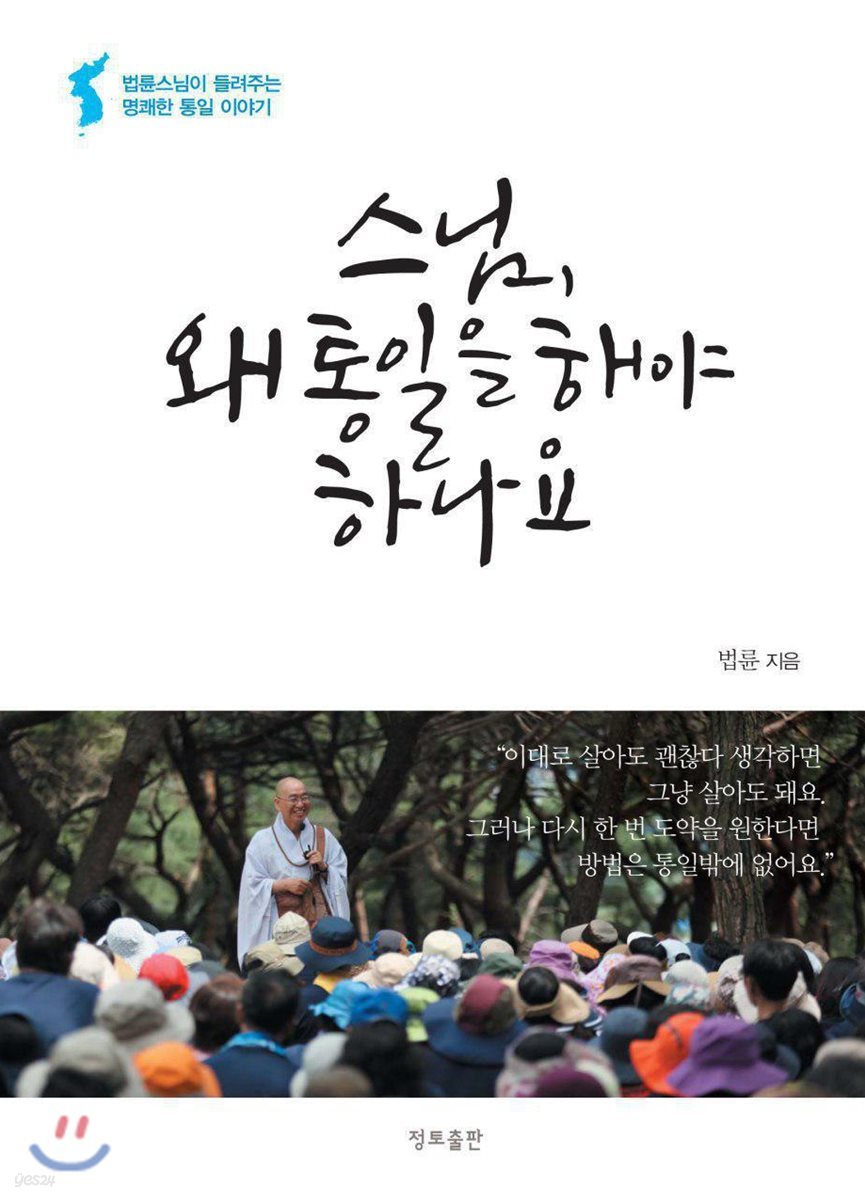
Monk, why do we need unification?
 |
Description
Book Introduction
If you think it's okay to live like this, then just live like this.
But if we want to make another leap forward, the only way is unification.
Monk Beopryun is a YouTube star known for his impromptu Q&A and a happiness evangelist who spreads happiness, but he is also known as a peace activist and unification activist.
For a long time, I have been dedicated to establishing peace in this land and advancing unification.
Even when the Korean government showed a negative attitude toward peace, exchange, and unification in the past, the monk continued to call for peace and unification.
When a great famine broke out in North Korea in 1998, we continued to provide humanitarian aid despite misunderstandings and criticism from those around us, and we also took the lead in supporting North Korean defectors.
We have also met with domestic and international experts and persuaded relevant parties to achieve reconciliation and peace.
This book is the product of such efforts and time, and is a record of conversations directly with North Korean defectors and the Unification Army organized by the monk.
But if we want to make another leap forward, the only way is unification.
Monk Beopryun is a YouTube star known for his impromptu Q&A and a happiness evangelist who spreads happiness, but he is also known as a peace activist and unification activist.
For a long time, I have been dedicated to establishing peace in this land and advancing unification.
Even when the Korean government showed a negative attitude toward peace, exchange, and unification in the past, the monk continued to call for peace and unification.
When a great famine broke out in North Korea in 1998, we continued to provide humanitarian aid despite misunderstandings and criticism from those around us, and we also took the lead in supporting North Korean defectors.
We have also met with domestic and international experts and persuaded relevant parties to achieve reconciliation and peace.
This book is the product of such efforts and time, and is a record of conversations directly with North Korean defectors and the Unification Army organized by the monk.
- You can preview some of the book's contents.
Preview
index
Entering
Ⅰ Why unification?
Unification depends on our choice.
Why do we need unification?
Young people are not interested in unification.
Will unification solve Korea's social problems?
The Berlin Miracle, Created by the Aspirations of the Government and Citizens
How should we interpret North Korea's military demonstrations?
Ⅱ The future of the Korean Peninsula begins with unification
The key to unification lies in the Republic of Korea.
How can we guide children toward unification?
South Korea's path toward unification
What if we collected a unification tax?
What can we do as citizens?
What is the Unification Army?
We need to create a government that promotes unification.
Ⅲ Now, it has become a harbinger of unification
We must bring about a change in perception in the international community.
What the North Korean regime can do
Inter-Korean Peace Agreement for Peace and Prosperity on the Korean Peninsula
Should humanitarian aid to North Korea continue?
How much should we give to North Korea?
Economic and human exchanges are the beginning of unification.
They say the goods sent to North Korea are going to the military.
If North Korean defectors want to contribute to unification,
Ⅳ The Path Beyond Me to Unification
I thought Korea was paradise on earth
I hate the prejudice against North Korean defectors.
How to overcome sadness
I am dissatisfied with the job I was introduced to.
I miss my mother in North Korea
I'm so tired I want to die
As a transplanted tree takes root
I get so upset when I hear people call me a traitor.
I feel uneasy
Young Koreans don't know about Seosan Daesa.
Appendix: The Establishment and Activities of "Good Friends" - A Happy World Where South and North Korea Become Neighbors
Ⅰ Why unification?
Unification depends on our choice.
Why do we need unification?
Young people are not interested in unification.
Will unification solve Korea's social problems?
The Berlin Miracle, Created by the Aspirations of the Government and Citizens
How should we interpret North Korea's military demonstrations?
Ⅱ The future of the Korean Peninsula begins with unification
The key to unification lies in the Republic of Korea.
How can we guide children toward unification?
South Korea's path toward unification
What if we collected a unification tax?
What can we do as citizens?
What is the Unification Army?
We need to create a government that promotes unification.
Ⅲ Now, it has become a harbinger of unification
We must bring about a change in perception in the international community.
What the North Korean regime can do
Inter-Korean Peace Agreement for Peace and Prosperity on the Korean Peninsula
Should humanitarian aid to North Korea continue?
How much should we give to North Korea?
Economic and human exchanges are the beginning of unification.
They say the goods sent to North Korea are going to the military.
If North Korean defectors want to contribute to unification,
Ⅳ The Path Beyond Me to Unification
I thought Korea was paradise on earth
I hate the prejudice against North Korean defectors.
How to overcome sadness
I am dissatisfied with the job I was introduced to.
I miss my mother in North Korea
I'm so tired I want to die
As a transplanted tree takes root
I get so upset when I hear people call me a traitor.
I feel uneasy
Young Koreans don't know about Seosan Daesa.
Appendix: The Establishment and Activities of "Good Friends" - A Happy World Where South and North Korea Become Neighbors
Into the book
There are concerns that unification will be expensive, but this isn't simply a question of whether it will cost a lot of money.
Sending our children to college costs more than not sending them at all, right? But is educating children a consumption or an investment? It's an investment.
We go into debt to educate our children because in the long run, it is more productive.
From this perspective, we should view development costs, such as laying railroads and building roads in North Korea, as investments rather than consumption.
In the past, when we were developing, we made all kinds of investments, even by attracting foreign capital.
That investment became the foundation for the development our country has achieved today. … … … … … … … … … … … … … … … … … … … Page 13
If the US and China compete while divided, South Korea will become subordinate to the US-Japan alliance, and North Korea will become subordinate to the China-Russia alliance, becoming a buffer zone for great power conflict.
The fate of the Korean Peninsula has become a dependent variable of the US-China competition.
So, it becomes difficult to maintain peace in a state of division, let alone unification.
However, a unified Korea can conduct independent diplomacy as a buffer zone between the competition between the two countries without leaning towards either the US or China. … ...
West Germany reportedly paid a significant amount of taxes during the unification process because of East Germany. However, when comparing the current share of the unified German economy in Europe and its influence within the EU to that of the divided Germany, would unification be beneficial or detrimental? Would it be in China's interest to temporarily tolerate the "one country, two systems" policy with Taiwan and Hong Kong, or would it be more beneficial to maximize the conflict and engage in a mutually beneficial war? Reflecting on these considerations will help us determine how we should best navigate inter-Korean relations going forward. … … … … … … … … … … … … Page 15
During the Korean War, North Korea was stronger than South Korea in terms of economy and military.
So we felt very threatened.
But now, South Korea has the upper hand in military power, economic power, and political stability.
So, now we can say that North Korea is not a 'threatening entity' but a 'dangerous entity' to us.
In the past, North Korea was a threat to us, so it was natural for us to focus all our efforts on defense and to be afraid.
But now, North Korea is simply a danger to us, so we just have to manage that danger well. … ...
There is only one way to achieve peaceful unification, with South Korea at the center.
This is a way to make the North Korean people themselves want to unite with South Korea.
So, in order to achieve unification, we need to gain the support of the North Korean people.
If unification is to be possible with South Korea at the center, and if it is to be possible in a peaceful manner, the will of the North Korean people is crucial.
The North Korean people's hearts must tilt towards the South.
Peaceful unification is possible if North Korea chooses to unite with South Korea.
… … … … … … … … … … … … … … … … … Page 51
During the period of change in power between the Yuan and Ming dynasties, the new powers of Goryeo joined hands with the Ming dynasty to oust the vested interests centered on the Yuan dynasty and cooperated in their rise to power, so there was no conflict with the Ming dynasty after the founding of Joseon.
This is similar to how, in the early days of division, North Korea was stronger than South Korea, but when the US won the US-Soviet competition, we benefited greatly by lining up with them.
America played a big role in our growth.
If China wins and the United States declines in the future US-China competition, we, as a pro-American country, may decline, while North Korea, riding on China's back, may grow significantly.
In a period of power transition, so many possibilities for change are open. … … … … … … … … … … … … … … … Page 62
We are now at a critical juncture.
If the two Koreas move toward cooperation here, it will be an opportunity to achieve unification by taking advantage of the shift in power between the US and China. Otherwise, the Korean Peninsula could be swept up in the changing international situation and fall into a dangerous situation. … ...
We need to strengthen the ROK-US alliance, but its nature needs to be slightly changed.
The ROK-US alliance must adhere to the following principles: 'Korea takes the initiative in unification issues, and the US supports it as an ally' and 'Korea's interests take priority in Korean Peninsula issues.'
Instead, we must prioritize American interests outside the Korean Peninsula and actively cooperate with America's global strategy.
This can be called a transition from a dependent ROK-US alliance to an independent ROK-US alliance.
This requires considerable diplomatic skill, but it can be accomplished with a leader who has a clear philosophy and perspective on unification.
… ...
If something happens in North Korea, the country that can intervene under international law is China.
This is because North Korea and China are allies under the Treaty of Friendship, Cooperation and Mutual Assistance between North Korea and China.
There is also the possibility that the United States will push in by force, regardless of the law, under the pretext of “preventing the proliferation of weapons of mass destruction.”
However, Korea has no basis for intervention under international law, and it does not have the power to simply push in and interfere.
So, if we are to intervene in the event of a sudden change in North Korea, we must establish a legal basis.
To achieve this, North and South Korea should adopt the form of a ‘state union.’
Then, we will be given the legal basis to be the first to govern North Korea… … … … … … … … … … … … … … … … Page 103
South Korea's economy is about 45 times larger than North Korea's, so there's no comparison to the extent to which North Korea had an advantage over South Korea immediately after the division.
It is a situation where the situation is overwhelming, beyond a reversal.
On the issue of unification, we can now take an offensive stance, but some people still have a habit of fearing being taken over by a communist system, a karma, as Buddhists call it.
… … … … … … … … … … … … … … … … … … … … … … Page 125
Sending our children to college costs more than not sending them at all, right? But is educating children a consumption or an investment? It's an investment.
We go into debt to educate our children because in the long run, it is more productive.
From this perspective, we should view development costs, such as laying railroads and building roads in North Korea, as investments rather than consumption.
In the past, when we were developing, we made all kinds of investments, even by attracting foreign capital.
That investment became the foundation for the development our country has achieved today. … … … … … … … … … … … … … … … … … … … Page 13
If the US and China compete while divided, South Korea will become subordinate to the US-Japan alliance, and North Korea will become subordinate to the China-Russia alliance, becoming a buffer zone for great power conflict.
The fate of the Korean Peninsula has become a dependent variable of the US-China competition.
So, it becomes difficult to maintain peace in a state of division, let alone unification.
However, a unified Korea can conduct independent diplomacy as a buffer zone between the competition between the two countries without leaning towards either the US or China. … ...
West Germany reportedly paid a significant amount of taxes during the unification process because of East Germany. However, when comparing the current share of the unified German economy in Europe and its influence within the EU to that of the divided Germany, would unification be beneficial or detrimental? Would it be in China's interest to temporarily tolerate the "one country, two systems" policy with Taiwan and Hong Kong, or would it be more beneficial to maximize the conflict and engage in a mutually beneficial war? Reflecting on these considerations will help us determine how we should best navigate inter-Korean relations going forward. … … … … … … … … … … … … Page 15
During the Korean War, North Korea was stronger than South Korea in terms of economy and military.
So we felt very threatened.
But now, South Korea has the upper hand in military power, economic power, and political stability.
So, now we can say that North Korea is not a 'threatening entity' but a 'dangerous entity' to us.
In the past, North Korea was a threat to us, so it was natural for us to focus all our efforts on defense and to be afraid.
But now, North Korea is simply a danger to us, so we just have to manage that danger well. … ...
There is only one way to achieve peaceful unification, with South Korea at the center.
This is a way to make the North Korean people themselves want to unite with South Korea.
So, in order to achieve unification, we need to gain the support of the North Korean people.
If unification is to be possible with South Korea at the center, and if it is to be possible in a peaceful manner, the will of the North Korean people is crucial.
The North Korean people's hearts must tilt towards the South.
Peaceful unification is possible if North Korea chooses to unite with South Korea.
… … … … … … … … … … … … … … … … … Page 51
During the period of change in power between the Yuan and Ming dynasties, the new powers of Goryeo joined hands with the Ming dynasty to oust the vested interests centered on the Yuan dynasty and cooperated in their rise to power, so there was no conflict with the Ming dynasty after the founding of Joseon.
This is similar to how, in the early days of division, North Korea was stronger than South Korea, but when the US won the US-Soviet competition, we benefited greatly by lining up with them.
America played a big role in our growth.
If China wins and the United States declines in the future US-China competition, we, as a pro-American country, may decline, while North Korea, riding on China's back, may grow significantly.
In a period of power transition, so many possibilities for change are open. … … … … … … … … … … … … … … … Page 62
We are now at a critical juncture.
If the two Koreas move toward cooperation here, it will be an opportunity to achieve unification by taking advantage of the shift in power between the US and China. Otherwise, the Korean Peninsula could be swept up in the changing international situation and fall into a dangerous situation. … ...
We need to strengthen the ROK-US alliance, but its nature needs to be slightly changed.
The ROK-US alliance must adhere to the following principles: 'Korea takes the initiative in unification issues, and the US supports it as an ally' and 'Korea's interests take priority in Korean Peninsula issues.'
Instead, we must prioritize American interests outside the Korean Peninsula and actively cooperate with America's global strategy.
This can be called a transition from a dependent ROK-US alliance to an independent ROK-US alliance.
This requires considerable diplomatic skill, but it can be accomplished with a leader who has a clear philosophy and perspective on unification.
… ...
If something happens in North Korea, the country that can intervene under international law is China.
This is because North Korea and China are allies under the Treaty of Friendship, Cooperation and Mutual Assistance between North Korea and China.
There is also the possibility that the United States will push in by force, regardless of the law, under the pretext of “preventing the proliferation of weapons of mass destruction.”
However, Korea has no basis for intervention under international law, and it does not have the power to simply push in and interfere.
So, if we are to intervene in the event of a sudden change in North Korea, we must establish a legal basis.
To achieve this, North and South Korea should adopt the form of a ‘state union.’
Then, we will be given the legal basis to be the first to govern North Korea… … … … … … … … … … … … … … … … Page 103
South Korea's economy is about 45 times larger than North Korea's, so there's no comparison to the extent to which North Korea had an advantage over South Korea immediately after the division.
It is a situation where the situation is overwhelming, beyond a reversal.
On the issue of unification, we can now take an offensive stance, but some people still have a habit of fearing being taken over by a communist system, a karma, as Buddhists call it.
… … … … … … … … … … … … … … … … … … … … … … Page 125
--- From the text
Publisher's Review
▶ An era of upheaval
This year, we have witnessed profound changes in inter-Korean relations and North Korea-US relations that we have never experienced since the division of the Korean Peninsula.
History may one day record the events of this year as the beginning of a great transformation.
The scenes of the leaders of North and South Korea meeting at the Military Demarcation Line and the reclusive North Korean leader setting foot on South Korean soil for the first time brought excitement and emotion to many people.
This was an event that filled my heart with hope and expectation that the long, drawn-out ceasefire might finally end and peace might come to this land, and that, although vague, unification might happen someday.
But it is true that there are worries and doubts in a corner of my heart.
Aren't you already too far from North Korea to get close to?
Although we are of the same blood and ethnicity, our systems are different, our national sentiments are different, and the economic gap is so large, how far can we go in exchange? Won't we be suffering unnecessarily?
At this point, we start to wonder again where we should go and what we should do.
▶ Unification expert, Venerable Pomnyun
Monk Beopryun is a YouTube star known for his impromptu Q&A and a happiness evangelist who spreads happiness, but he is also known as a peace activist and unification activist.
For a long time, I have been dedicated to establishing peace in this land and advancing unification.
Even when the Korean government showed a negative attitude toward peace, exchange, and unification in the past, the monk continued to call for peace and unification.
When a great famine broke out in North Korea in 1998, we continued to provide humanitarian aid despite misunderstandings and criticism from those around us, and we also took the lead in supporting North Korean defectors.
We have also met with domestic and international experts and persuaded relevant parties to achieve reconciliation and peace.
This book is the product of such efforts and time, and is a record of conversations directly with North Korean defectors and the Unification Army organized by the monk.
▶ Unification is an upgrade
In this book the monk says:
There is no upgrade of the Republic of Korea without unification.
Our country achieved economic development and democratization while still divided.
Because it has been growing for decades, people unconsciously think that if they just change policies and do well in business, once this period passes, growth will continue.
But our imitation compression growth has already lost its growth momentum.
The economy is in a prolonged recession, and both society and individuals are in a state of general lethargy.
Here, the security instability and threats of war that have persisted for years have not only negatively impacted the economy, but have also plunged society into conflict and fear, lowering the quality of life.
We have experienced that if peace is not established, we may face a crisis situation where we cannot even talk about tomorrow's well-being, let alone development.
The only options for gaining new momentum for development and reviving our stifled spirit are peace and unification.
It's not about blindly shouting, 'Our wish is unification.'
The book faithfully explains why unification is our only path and how we should work together with North Korea from the perspectives of politics, economics, international relations, society, history, and culture.
If you read analyses of current international relations or diplomatic examples from other countries, you will realize how passive and irresponsible the vague idea that unification would be a loss was.
Imagine taking a train from Busan to Paris, passing through North Korea and Siberia, on your vacation.
Imagine the Korean Peninsula becoming a logistics hub connecting the Eurasian continent and the Pacific Ocean.
Imagine South Korea acting as a balancer of peace in Northeast Asia, where the interests of the United States and China clash.
It's not impossible.
It's a long road, but it's one we can take, and it's the road we must take.
Are you worried about the future? Do you believe South Korea has no answers?
If so, read this book.
This is the story of unification told by Monk Beopryun.
This year, we have witnessed profound changes in inter-Korean relations and North Korea-US relations that we have never experienced since the division of the Korean Peninsula.
History may one day record the events of this year as the beginning of a great transformation.
The scenes of the leaders of North and South Korea meeting at the Military Demarcation Line and the reclusive North Korean leader setting foot on South Korean soil for the first time brought excitement and emotion to many people.
This was an event that filled my heart with hope and expectation that the long, drawn-out ceasefire might finally end and peace might come to this land, and that, although vague, unification might happen someday.
But it is true that there are worries and doubts in a corner of my heart.
Aren't you already too far from North Korea to get close to?
Although we are of the same blood and ethnicity, our systems are different, our national sentiments are different, and the economic gap is so large, how far can we go in exchange? Won't we be suffering unnecessarily?
At this point, we start to wonder again where we should go and what we should do.
▶ Unification expert, Venerable Pomnyun
Monk Beopryun is a YouTube star known for his impromptu Q&A and a happiness evangelist who spreads happiness, but he is also known as a peace activist and unification activist.
For a long time, I have been dedicated to establishing peace in this land and advancing unification.
Even when the Korean government showed a negative attitude toward peace, exchange, and unification in the past, the monk continued to call for peace and unification.
When a great famine broke out in North Korea in 1998, we continued to provide humanitarian aid despite misunderstandings and criticism from those around us, and we also took the lead in supporting North Korean defectors.
We have also met with domestic and international experts and persuaded relevant parties to achieve reconciliation and peace.
This book is the product of such efforts and time, and is a record of conversations directly with North Korean defectors and the Unification Army organized by the monk.
▶ Unification is an upgrade
In this book the monk says:
There is no upgrade of the Republic of Korea without unification.
Our country achieved economic development and democratization while still divided.
Because it has been growing for decades, people unconsciously think that if they just change policies and do well in business, once this period passes, growth will continue.
But our imitation compression growth has already lost its growth momentum.
The economy is in a prolonged recession, and both society and individuals are in a state of general lethargy.
Here, the security instability and threats of war that have persisted for years have not only negatively impacted the economy, but have also plunged society into conflict and fear, lowering the quality of life.
We have experienced that if peace is not established, we may face a crisis situation where we cannot even talk about tomorrow's well-being, let alone development.
The only options for gaining new momentum for development and reviving our stifled spirit are peace and unification.
It's not about blindly shouting, 'Our wish is unification.'
The book faithfully explains why unification is our only path and how we should work together with North Korea from the perspectives of politics, economics, international relations, society, history, and culture.
If you read analyses of current international relations or diplomatic examples from other countries, you will realize how passive and irresponsible the vague idea that unification would be a loss was.
Imagine taking a train from Busan to Paris, passing through North Korea and Siberia, on your vacation.
Imagine the Korean Peninsula becoming a logistics hub connecting the Eurasian continent and the Pacific Ocean.
Imagine South Korea acting as a balancer of peace in Northeast Asia, where the interests of the United States and China clash.
It's not impossible.
It's a long road, but it's one we can take, and it's the road we must take.
Are you worried about the future? Do you believe South Korea has no answers?
If so, read this book.
This is the story of unification told by Monk Beopryun.
GOODS SPECIFICS
- Date of publication: October 15, 2018
- Page count, weight, size: 216 pages | 268g | 153*224*20mm
- ISBN13: 9791187297154
- ISBN10: 1187297151
You may also like
카테고리
korean


korean

![GQ KOREA Mark (Monthly): December [2025]](http://librairie.coreenne.fr/cdn/shop/files/8ef265dbbfbf186523ed75ba7319009d.jpg?v=1765340328&width=3840)


