

Don't give up on the world
 |
Description
Book Introduction
A book has been published to share the precious records of the flames of the 'Resignation Square' on the first anniversary of the December 3 martial law, four seasons after the 'Night of Civil War' when martial law forces aimed their guns at the people.
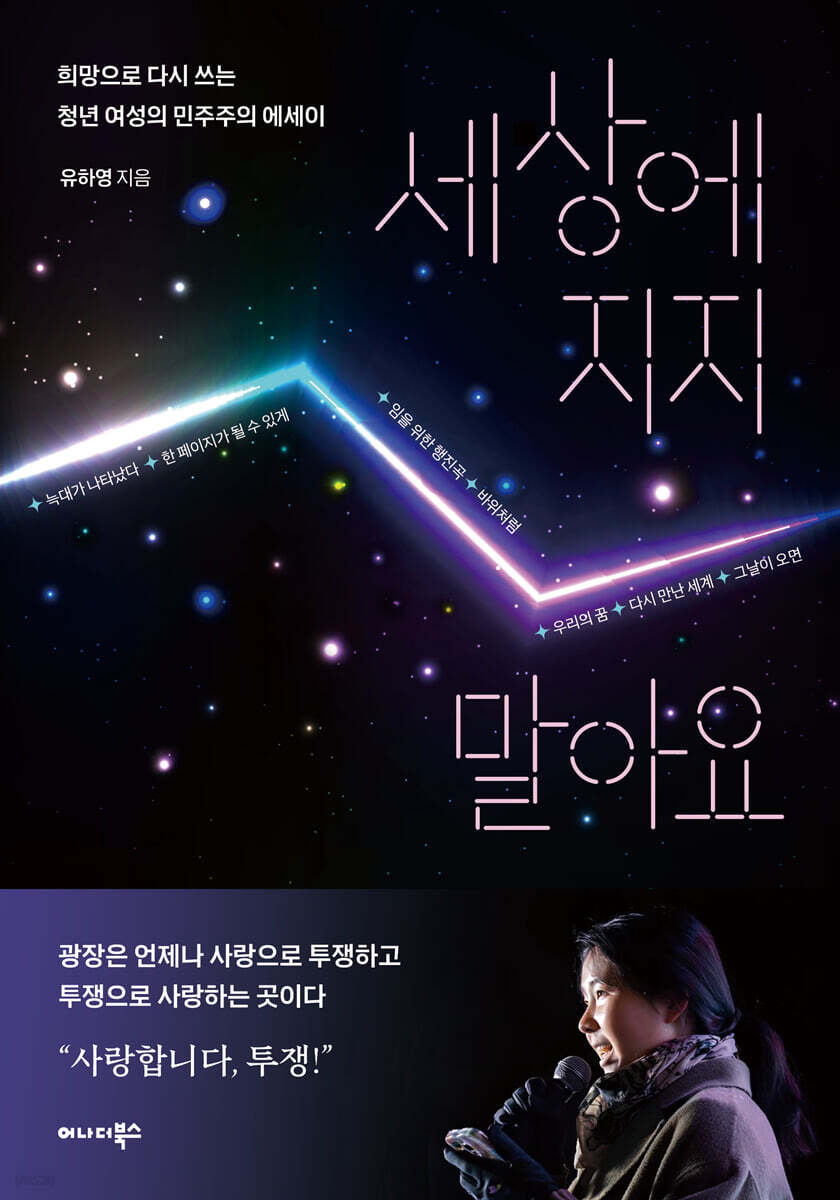
This book, "Don't Give Up on the World," contains the vivid narrative of a 28-year-old young woman who ran through the streets of the plaza democracy scene after the impeachment of Yoon Seok-yeol, as well as the long 123-day journey of the "Revolution of Light" starting from the "Night of Seoul" on the day of martial law.
The author says that this book is not intended to reminisce about his experiences in the square over the past year.
“The starting point of this book is a commitment to ending all discrimination and hatred.
Don't give up on the world! I love you.
As can be seen from this cry of “Fight!!”, the point this book points to is connected to the ongoing cry to protect plaza democracy with “the tenacity of hope that does not give up even in despair.”
It is also the will to overcome all kinds of ideologies of exclusion and hatred and open up a future for democracy.
This overlaps with the perspective that has been observing the launch of the Lee Jae-myung People's Sovereignty Government and asking, "Are we properly achieving the great social reforms that will end the era of barbarism and liquidate the civil war?"
This book, "Don't Give Up on the World," contains the vivid narrative of a 28-year-old young woman who ran through the streets of the plaza democracy scene after the impeachment of Yoon Seok-yeol, as well as the long 123-day journey of the "Revolution of Light" starting from the "Night of Seoul" on the day of martial law.
The author says that this book is not intended to reminisce about his experiences in the square over the past year.
“The starting point of this book is a commitment to ending all discrimination and hatred.
Don't give up on the world! I love you.
As can be seen from this cry of “Fight!!”, the point this book points to is connected to the ongoing cry to protect plaza democracy with “the tenacity of hope that does not give up even in despair.”
It is also the will to overcome all kinds of ideologies of exclusion and hatred and open up a future for democracy.
This overlaps with the perspective that has been observing the launch of the Lee Jae-myung People's Sovereignty Government and asking, "Are we properly achieving the great social reforms that will end the era of barbarism and liquidate the civil war?"
- You can preview some of the book's contents.
Preview
index
Prologue: The Wolf Appears
It can be one page per chapter
To be honest, it wasn't always smooth sailing until now/ Thank you for enduring just for today/ Let's write a beautiful chapter of youth together
March for the 2nd Chapter
Without leaving behind love, honor, or name/ Time passes, but the mountains and rivers know/ I go ahead, so follow me, you who are alive
Chapter 3 Like a Rock
Let us all not give in to despair/ Let us awaken ourselves through trials/ And finally, let us become the cornerstones of the liberated world.
Chapter 4 Our Dream
An unbelievable phrase I overheard in my childhood/ The world belongs to those who dream, have courage, you can do it/ The countless trials that unfold endlessly are for a bright tomorrow
Chapter 5: The World We Met Again
Close your eyes and feel the moving heart My gaze directed at you / Don't wait for a special miracle Our rough road before your eyes / The sadness that repeats in this world Goodbye now
Chapter 6 Don't Give Up on the World
They tell us not to come forward no matter what happens/ Breaking the uncomfortable prejudice called custom/ The world is not easy, but neither are we.
Epilogue When that day comes
The greatest fruit we gained from the Balmun Square was that 'people who are different yet the same' came to recognize each other's existence.
It can be one page per chapter
To be honest, it wasn't always smooth sailing until now/ Thank you for enduring just for today/ Let's write a beautiful chapter of youth together
March for the 2nd Chapter
Without leaving behind love, honor, or name/ Time passes, but the mountains and rivers know/ I go ahead, so follow me, you who are alive
Chapter 3 Like a Rock
Let us all not give in to despair/ Let us awaken ourselves through trials/ And finally, let us become the cornerstones of the liberated world.
Chapter 4 Our Dream
An unbelievable phrase I overheard in my childhood/ The world belongs to those who dream, have courage, you can do it/ The countless trials that unfold endlessly are for a bright tomorrow
Chapter 5: The World We Met Again
Close your eyes and feel the moving heart My gaze directed at you / Don't wait for a special miracle Our rough road before your eyes / The sadness that repeats in this world Goodbye now
Chapter 6 Don't Give Up on the World
They tell us not to come forward no matter what happens/ Breaking the uncomfortable prejudice called custom/ The world is not easy, but neither are we.
Epilogue When that day comes
The greatest fruit we gained from the Balmun Square was that 'people who are different yet the same' came to recognize each other's existence.
Detailed image

Publisher's Review
“I thought, ‘I won’t die if I’m next to a foreign reporter.’”
Filled with fear, I walked to the National Assembly, becoming a representative of the 2030 young women who brightened the plaza.
What was the shock felt by the 2030 generation, who experienced martial law for the first time, something they'd only seen in history books? The author, a 27-year-old graduate student at the time, said he was a coward, and was overcome with fear, wondering, "Will I die if I go to the National Assembly?"
After much hesitation, he arrived in front of the National Assembly and saw a foreign correspondent heading to the National Assembly. He said he ran after him, thinking, “I won’t die if I stay next to a foreign correspondent.”
12.3 'Seoul Night' was the starting point of the author's long journey to experience democracy in the square firsthand.
The atmosphere in Impeachment Square was intense, and when the cheering stick demonstration led by young women in their 20s and 30s lit up the night sky, melting the winter chill, the author attended every rally and soon transformed into a speaker who lit up the square.
Following in the footsteps of his mother, who was a labor activist, he participated in various rallies from a young age, and with the help of 'advance learning', he developed his talent of 'writing and speaking', transforming from a coward to a brave citizen.
The author went up on stage and addressed the citizens five times in March alone.
As the number of speeches increased, his will to contribute to the square became more concrete, and he became a famous speaker with his 'nuclear cider' remarks that soothed the hearts of citizens.
They did not hesitate to make bold changes to deliver a more interesting and poignant message.
He also elicited an explosive response through a speech that sharply criticized the insurgents and their accomplices through satire and ridicule.
Of the nearly 20 speeches he gave at various rallies, the one he remembers most was the "roundabout" speech he gave at Namtaeryeong entitled "Advice to the Police."
“A police officer without a union is nothing more than a mold of the people and a crutch for those in power.
If you all unite, the person you'll fear most is the insurgent leader of the prosecutorial dictatorship! Surely, Mr. Yoon Seok-yeol? With a union, all acts of disobedience and strikes are protected as labor rights.
If you don't know how to make it, you can ask the Korean Confederation of Trade Unions here.
If you take out the car, I will accept you as a comrade.
Right? The reason I'm devoting this precious time to giving advice to you, the people's bears... or rather, the canes, is because I think it would be a good idea for the police to go on a general strike after the farmers.
Tuesday for the peasants, Wednesday for the police, Thursday for all workers! The people, united, will not be defeated.”
This statement by Nam Tae-ryeong was met with enthusiastic cheers from the citizens and became famous as it was introduced through various channels and word of mouth spread.
Regarding this, the author said, “I enjoy speaking on stage, but preparing for it is a hassle and tiring.
Still, if it has contributed even a little to the democracy of the square, it is an honor in itself.
Democracy is not something grand.
Our story, every day in the square, was a stage for realizing sovereignty.
“Every moment in which each person spoke out from their own place was democracy,” he said.
This book, "Don't Give Up on the World," introduces the journey from the day of martial law to the April 4th announcement of Yoon Seok-yeol's dismissal, as well as his various activities and impressions of the turbulent moments he experienced while participating in various rallies following the dismissal.
Additionally, the speech content and on-site photos are added to vividly recall the fierce 'Revolution of Light' process.
Additionally, she is honestly revealing her personal history, such as her family history and dating experiences, which would otherwise be difficult to talk about, and is confidently revealing her identity as a feminist and an otaku.
This passage can provide a glimpse into the intimate emotions of young women in their 20s and 30s.
“We didn’t win because we were strong.
I never gave up until the end because I wanted to protect the world I loved.
If you unite with love, you can never be defeated.
Isn't democracy about loving freely and equally, transcending borders, gender, and dimensions? Enduring censorship and ridicule, we pledged to love what we love.
If this isn't resistance and democracy, then what is? Love has always been politics, and we created democracy through virtue."
〈B〉“The song we sang together in the square is connected to the aspirations of the citizens.”
The meaning of a plaza where folk songs and K-pop blend, where people are different but communicate and move forward.
The composition of this book stands out for its creative ideas that reflect the sensibilities of people in their 20s.
The titles of the prologue, epilogue, and chapters 1-6 are songs that were sung in the Resignation Square.
These eight songs are a mix of traditional sports songs and K-pop, popular among the 2030 generation.
In order, they are “A Wolf Appeared,” “So That It Can Be a Page,” “March for the Beloved,” “Like a Rock,” “Our Dream,” “The World We Met Again,” “Don’t Give Up on the World,” and “When That Day Comes.”
The author arranged each chapter's scenes of democracy and his own experiences around songs that citizens sang together in the square.
This composition is intended to reveal that the fervent aspirations of the citizens gathered in the square are connected to the songs, and that the meaning and resonance of those songs are connected to the essence of 'square democracy.'
This points to the true values of democracy, a place where people of different backgrounds come together and where no one is excluded, being communicated and integrated through these songs.
The author adds that even in the middle of winter, the hope of a green spring blossomed beyond the flags held up in the square and by the citizens.
It also means that socially vulnerable groups such as women, sexual minorities, the disabled, farmers, workers, and youth each expressed their own identities, and these mixed and blended to create a 'revolution of light' through a higher level of harmony.
In addition to the eight songs, this book also introduces songs that were sung and enjoyed at every gathering.
Among these are songs that the author himself sang while going up to the podium and giving a speech.
It will be a great pleasure to read this book and imagine the song you sang resonating and spreading throughout the winter square.
Furthermore, while reading this book, you will be able to empathize with the meaning of a square that is different but communicates and moves forward through these songs.
〈B〉The voice of a 28-year-old woman who confidently shouted into the microphone in a cold square!
And the final greeting is always a beautiful one, “I love you.”
fight!!"
The sparkling cheering sticks, the smiles of the young women in their 20s and 30s dancing to the rhythm, and the shouts of desperation and excitement mixed together are a spectacle that perfectly captures the true nature of the 'Revolution of Light.'
The author, who gave nearly 20 speeches at the Resignation Square, always said his final words, “I love you.”
“Fight!!”
This can be said to reflect the desire and will to create a "democracy of love" that goes beyond exclusion and purge, rather than the political demands of Yoon Seok-yeol's impeachment and the elimination of internal strife.
It is also a wish that we keep the 'Promise of the Square' of moving forward together toward the dream of great social reform.
“To avoid being pushed back later, we once again imagine the world after Yoon Seok-yeol.
A world where transgender people can safely use the bathroom, immigrants can receive consumption coupons for the recovery of their livelihoods, workers whose lives are threatened by the climate crisis disappear, and women don't die...
Will such a world ever come? No, it won't.
We make it.
“Because democracy is something we create.”
The real world, as seen through the eyes of the author, a 20-something with no social experience, is still blocked by thick walls of discrimination and oppression.
The concerns of citizens who, despite the despair, raised the flag of will and solidarity and called for democracy in the square are not unrelated to this.
The author's perspective on this matter is firm and displays youthful determination and a spirit of resistance.
“I am here as a strong adult, a subject of the square, to end the old order and the Yoon Seok-yeol administration, which is riddled with misogyny hegemony.
Even if Yoon Seok-yeol is ousted, the People Power Party is disbanded, and a new government takes over, if they turn their backs on us, we will return to the streets.
“We will definitely return to destroy discrimination and hatred.”
“In the plaza, we advocated not only for Yoon Seok-yeol’s immediate resignation, but also for major social reform.
All the things that have been taken up as tasks for social reform are true democracy.
Anti-discrimination laws, eradication of sexual exploitation industries, food sovereignty, revision of Articles 2 and 3 of the Trade Union Act, etc.
If we don't eliminate the blind spots in democracy, this will soon become "your" story. (Omitted) Not erasing our presence from the political stage is the foundation of true democracy.
Women, young people, and minorities are no longer standing still.
We are a generation that has decided not to listen to adults telling us to stay still.”
Kim Hu-ju, a member of the same generation as the author, said in the preface to the book “Don’t Give Up on the World”, “I hope that more and more diverse fellow citizens who read this book will roam the world louder and noisier, and continue to sing their own songs anytime, anywhere.
“I hope that by telling the story of what we have been through, we will not be defeated by the world.”
The point of interest in reading this book will be sharing the memories of the square, written with the heart of a young man, while chatting noisily like this.
Filled with fear, I walked to the National Assembly, becoming a representative of the 2030 young women who brightened the plaza.
What was the shock felt by the 2030 generation, who experienced martial law for the first time, something they'd only seen in history books? The author, a 27-year-old graduate student at the time, said he was a coward, and was overcome with fear, wondering, "Will I die if I go to the National Assembly?"
After much hesitation, he arrived in front of the National Assembly and saw a foreign correspondent heading to the National Assembly. He said he ran after him, thinking, “I won’t die if I stay next to a foreign correspondent.”
12.3 'Seoul Night' was the starting point of the author's long journey to experience democracy in the square firsthand.
The atmosphere in Impeachment Square was intense, and when the cheering stick demonstration led by young women in their 20s and 30s lit up the night sky, melting the winter chill, the author attended every rally and soon transformed into a speaker who lit up the square.
Following in the footsteps of his mother, who was a labor activist, he participated in various rallies from a young age, and with the help of 'advance learning', he developed his talent of 'writing and speaking', transforming from a coward to a brave citizen.
The author went up on stage and addressed the citizens five times in March alone.
As the number of speeches increased, his will to contribute to the square became more concrete, and he became a famous speaker with his 'nuclear cider' remarks that soothed the hearts of citizens.
They did not hesitate to make bold changes to deliver a more interesting and poignant message.
He also elicited an explosive response through a speech that sharply criticized the insurgents and their accomplices through satire and ridicule.
Of the nearly 20 speeches he gave at various rallies, the one he remembers most was the "roundabout" speech he gave at Namtaeryeong entitled "Advice to the Police."
“A police officer without a union is nothing more than a mold of the people and a crutch for those in power.
If you all unite, the person you'll fear most is the insurgent leader of the prosecutorial dictatorship! Surely, Mr. Yoon Seok-yeol? With a union, all acts of disobedience and strikes are protected as labor rights.
If you don't know how to make it, you can ask the Korean Confederation of Trade Unions here.
If you take out the car, I will accept you as a comrade.
Right? The reason I'm devoting this precious time to giving advice to you, the people's bears... or rather, the canes, is because I think it would be a good idea for the police to go on a general strike after the farmers.
Tuesday for the peasants, Wednesday for the police, Thursday for all workers! The people, united, will not be defeated.”
This statement by Nam Tae-ryeong was met with enthusiastic cheers from the citizens and became famous as it was introduced through various channels and word of mouth spread.
Regarding this, the author said, “I enjoy speaking on stage, but preparing for it is a hassle and tiring.
Still, if it has contributed even a little to the democracy of the square, it is an honor in itself.
Democracy is not something grand.
Our story, every day in the square, was a stage for realizing sovereignty.
“Every moment in which each person spoke out from their own place was democracy,” he said.
This book, "Don't Give Up on the World," introduces the journey from the day of martial law to the April 4th announcement of Yoon Seok-yeol's dismissal, as well as his various activities and impressions of the turbulent moments he experienced while participating in various rallies following the dismissal.
Additionally, the speech content and on-site photos are added to vividly recall the fierce 'Revolution of Light' process.
Additionally, she is honestly revealing her personal history, such as her family history and dating experiences, which would otherwise be difficult to talk about, and is confidently revealing her identity as a feminist and an otaku.
This passage can provide a glimpse into the intimate emotions of young women in their 20s and 30s.
“We didn’t win because we were strong.
I never gave up until the end because I wanted to protect the world I loved.
If you unite with love, you can never be defeated.
Isn't democracy about loving freely and equally, transcending borders, gender, and dimensions? Enduring censorship and ridicule, we pledged to love what we love.
If this isn't resistance and democracy, then what is? Love has always been politics, and we created democracy through virtue."
〈B〉“The song we sang together in the square is connected to the aspirations of the citizens.”
The meaning of a plaza where folk songs and K-pop blend, where people are different but communicate and move forward.
The composition of this book stands out for its creative ideas that reflect the sensibilities of people in their 20s.
The titles of the prologue, epilogue, and chapters 1-6 are songs that were sung in the Resignation Square.
These eight songs are a mix of traditional sports songs and K-pop, popular among the 2030 generation.
In order, they are “A Wolf Appeared,” “So That It Can Be a Page,” “March for the Beloved,” “Like a Rock,” “Our Dream,” “The World We Met Again,” “Don’t Give Up on the World,” and “When That Day Comes.”
The author arranged each chapter's scenes of democracy and his own experiences around songs that citizens sang together in the square.
This composition is intended to reveal that the fervent aspirations of the citizens gathered in the square are connected to the songs, and that the meaning and resonance of those songs are connected to the essence of 'square democracy.'
This points to the true values of democracy, a place where people of different backgrounds come together and where no one is excluded, being communicated and integrated through these songs.
The author adds that even in the middle of winter, the hope of a green spring blossomed beyond the flags held up in the square and by the citizens.
It also means that socially vulnerable groups such as women, sexual minorities, the disabled, farmers, workers, and youth each expressed their own identities, and these mixed and blended to create a 'revolution of light' through a higher level of harmony.
In addition to the eight songs, this book also introduces songs that were sung and enjoyed at every gathering.
Among these are songs that the author himself sang while going up to the podium and giving a speech.
It will be a great pleasure to read this book and imagine the song you sang resonating and spreading throughout the winter square.
Furthermore, while reading this book, you will be able to empathize with the meaning of a square that is different but communicates and moves forward through these songs.
〈B〉The voice of a 28-year-old woman who confidently shouted into the microphone in a cold square!
And the final greeting is always a beautiful one, “I love you.”
fight!!"
The sparkling cheering sticks, the smiles of the young women in their 20s and 30s dancing to the rhythm, and the shouts of desperation and excitement mixed together are a spectacle that perfectly captures the true nature of the 'Revolution of Light.'
The author, who gave nearly 20 speeches at the Resignation Square, always said his final words, “I love you.”
“Fight!!”
This can be said to reflect the desire and will to create a "democracy of love" that goes beyond exclusion and purge, rather than the political demands of Yoon Seok-yeol's impeachment and the elimination of internal strife.
It is also a wish that we keep the 'Promise of the Square' of moving forward together toward the dream of great social reform.
“To avoid being pushed back later, we once again imagine the world after Yoon Seok-yeol.
A world where transgender people can safely use the bathroom, immigrants can receive consumption coupons for the recovery of their livelihoods, workers whose lives are threatened by the climate crisis disappear, and women don't die...
Will such a world ever come? No, it won't.
We make it.
“Because democracy is something we create.”
The real world, as seen through the eyes of the author, a 20-something with no social experience, is still blocked by thick walls of discrimination and oppression.
The concerns of citizens who, despite the despair, raised the flag of will and solidarity and called for democracy in the square are not unrelated to this.
The author's perspective on this matter is firm and displays youthful determination and a spirit of resistance.
“I am here as a strong adult, a subject of the square, to end the old order and the Yoon Seok-yeol administration, which is riddled with misogyny hegemony.
Even if Yoon Seok-yeol is ousted, the People Power Party is disbanded, and a new government takes over, if they turn their backs on us, we will return to the streets.
“We will definitely return to destroy discrimination and hatred.”
“In the plaza, we advocated not only for Yoon Seok-yeol’s immediate resignation, but also for major social reform.
All the things that have been taken up as tasks for social reform are true democracy.
Anti-discrimination laws, eradication of sexual exploitation industries, food sovereignty, revision of Articles 2 and 3 of the Trade Union Act, etc.
If we don't eliminate the blind spots in democracy, this will soon become "your" story. (Omitted) Not erasing our presence from the political stage is the foundation of true democracy.
Women, young people, and minorities are no longer standing still.
We are a generation that has decided not to listen to adults telling us to stay still.”
Kim Hu-ju, a member of the same generation as the author, said in the preface to the book “Don’t Give Up on the World”, “I hope that more and more diverse fellow citizens who read this book will roam the world louder and noisier, and continue to sing their own songs anytime, anywhere.
“I hope that by telling the story of what we have been through, we will not be defeated by the world.”
The point of interest in reading this book will be sharing the memories of the square, written with the heart of a young man, while chatting noisily like this.
GOODS SPECIFICS
- Date of issue: December 3, 2025
- Page count, weight, size: 224 pages | 140*200*15mm
- ISBN13: 9791193539132
- ISBN10: 1193539137
You may also like
카테고리
korean


korean

![GQ KOREA Mark (Monthly): December [2025]](http://librairie.coreenne.fr/cdn/shop/files/8ef265dbbfbf186523ed75ba7319009d.jpg?v=1765340328&width=3840)


