

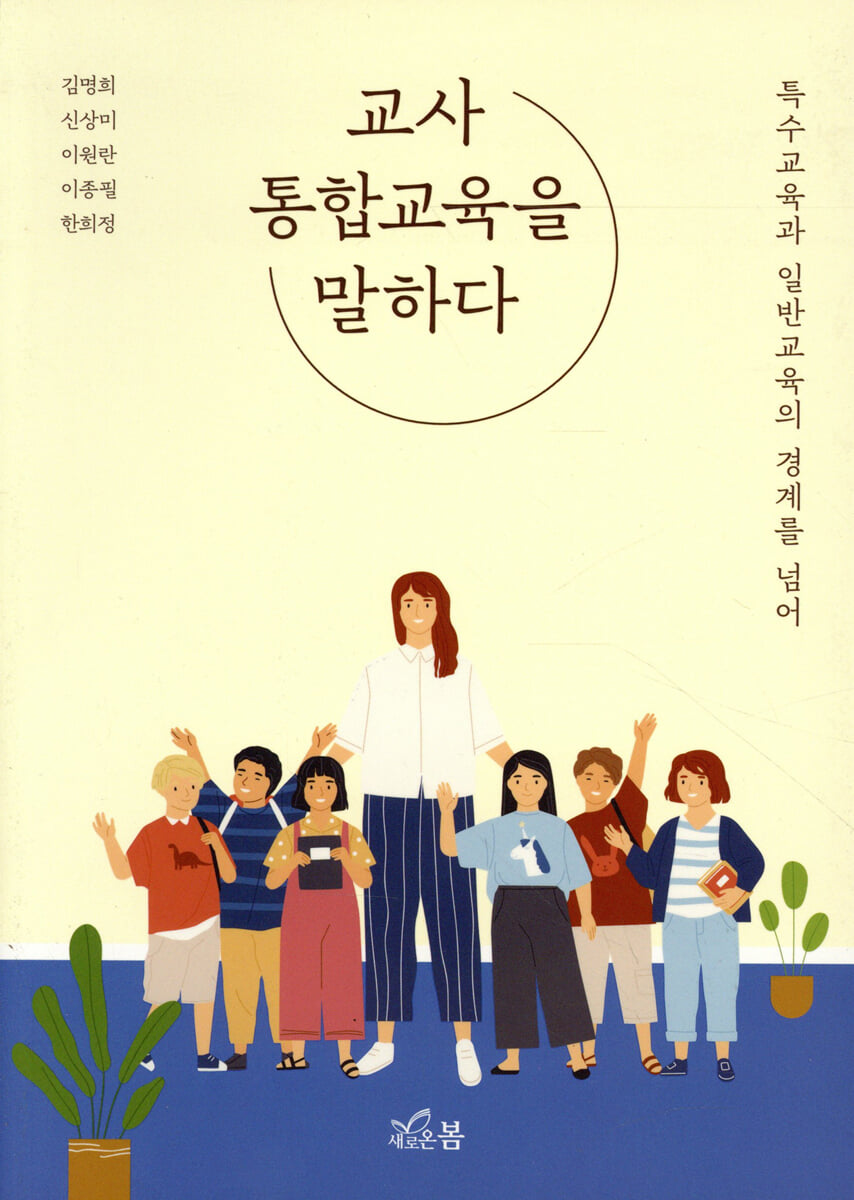
Talking about integrated teacher education
 |
Description
Book Introduction
Children, teachers, and classrooms are all different, but good inclusive classrooms are all similar.
“All of this would have been difficult to know if I hadn’t been in charge of the integrated classroom.
“If I hadn’t looked at the children individually, I would have just thought it was a difficult class or spent the year without understanding the children’s characteristics.” These words from the author, obtained after a year of trial and error in an integrated classroom, give me a lot to think about.
As of 2020, there are 58,246 integrated classes and 11,661 special classes in 11,548 general schools.
Considering that integrated education began in earnest in 1994 when the term “integrated education” was specified in the revised [Special Education Promotion Act], it has been approximately 30 years, or one generation, since then.
As the statistics show, integrated education has now become universal and natural.
Physical and social integration into regular schools has been somewhat successful, and various attempts are being made to integrate the curriculum.
However, the burden on teachers regarding integrated classes is still great.
Sometimes they volunteer, but sometimes they avoid it.
When there are students with special needs in the class, they may feel burdened and fearful about education, relationships, rules, classes, and parent-child relationships, such as how to respond to the disability, teach, and run the class.
It is also because I have to take responsibility for the classroom and the children in my class all by myself.
First, the vivid examples of integrated classrooms from teachers who have experienced them can give teachers who are thinking about better education the courage to take on the challenge of integrated classrooms and provide guidance on the direction.
We tried to find out together through trial and error and reflection what problems we would face in integrated classes, how to approach and solve them, what is important, and how to prepare.
It also includes guidance for special education teachers on how to build relationships with children, communicate with them, and create lessons.
Although it may not be a foolproof solution, you will find important principles and methods.
Many teachers say that their experience in inclusive classrooms was a time of growth for them as teachers and a leap forward in their understanding of all students, not just those with disabilities.
The situations and approaches of the four authors in the book are as different as each child and classroom, but they also have something in common.
I hope this book will help reduce the burden of integrated classrooms and serve as a stepping stone for integrating various challenges and curricula.
I hope you can find the good teacher within you, the key and strength to good inclusive education.
“All of this would have been difficult to know if I hadn’t been in charge of the integrated classroom.
“If I hadn’t looked at the children individually, I would have just thought it was a difficult class or spent the year without understanding the children’s characteristics.” These words from the author, obtained after a year of trial and error in an integrated classroom, give me a lot to think about.
As of 2020, there are 58,246 integrated classes and 11,661 special classes in 11,548 general schools.
Considering that integrated education began in earnest in 1994 when the term “integrated education” was specified in the revised [Special Education Promotion Act], it has been approximately 30 years, or one generation, since then.
As the statistics show, integrated education has now become universal and natural.
Physical and social integration into regular schools has been somewhat successful, and various attempts are being made to integrate the curriculum.
However, the burden on teachers regarding integrated classes is still great.
Sometimes they volunteer, but sometimes they avoid it.
When there are students with special needs in the class, they may feel burdened and fearful about education, relationships, rules, classes, and parent-child relationships, such as how to respond to the disability, teach, and run the class.
It is also because I have to take responsibility for the classroom and the children in my class all by myself.
First, the vivid examples of integrated classrooms from teachers who have experienced them can give teachers who are thinking about better education the courage to take on the challenge of integrated classrooms and provide guidance on the direction.
We tried to find out together through trial and error and reflection what problems we would face in integrated classes, how to approach and solve them, what is important, and how to prepare.
It also includes guidance for special education teachers on how to build relationships with children, communicate with them, and create lessons.
Although it may not be a foolproof solution, you will find important principles and methods.
Many teachers say that their experience in inclusive classrooms was a time of growth for them as teachers and a leap forward in their understanding of all students, not just those with disabilities.
The situations and approaches of the four authors in the book are as different as each child and classroom, but they also have something in common.
I hope this book will help reduce the burden of integrated classrooms and serve as a stepping stone for integrating various challenges and curricula.
I hope you can find the good teacher within you, the key and strength to good inclusive education.
- You can preview some of the book's contents.
Preview
index
Recommendation
Entering
Chapter 1.
A year spent as a homeroom teacher for an integrated class
1.
I'll take care of it
2.
Who are you
3.
Please read my language
4.
I need time to adjust
5.
Let's find a way to get along
6.
Should I just stay still after being hit?
7.
I wish someone could help me
8.
You're our homeroom teacher.
9.
Every action has a reason
10.
We've all changed a little bit
Chapter 2.
Kim Dong-woo, the popular kid
1.
First meeting
2.
I am your homeroom teacher
3.
Teacher, can you fix Dongwoo?
4.
What will Dongwoo be like when he grows up?
5.
Teacher, who said Dongwoo was disabled?
6.
I like you, I love you, happy birthday!
7.
Tuesday is playing with dirt, Thursday is painting with light
8.
Separately yet together
9.
Do you like me better or do you like the teacher from Haeoreum class better?
10.
Kim Dong-woo, the popular kid
Chapter 3.
The children I met, the children who raised me
1.
rumor
2.
Open
3.
boundary
4.
fence
5.
gap
6.
Outcast
7.
standard
8.
balance
9.
mistake
10.
prejudice
Chapter 4.
My Integrated Education Chronicle
1.
Meet Special Education
2.
Not a single student is given up
3.
Becoming a rural school teacher
4.
Becoming a city school teacher
Chapter 5.
A Journey Through Integrated Education
1.
First departure
2.
Strength is the clue
3.
Even a small change can have a big effect
4.
The first hurdle: the integrated classroom adaptation period.
5.
For individualized education support team meetings to be useful:
6.
A relationship that can be communicated without words
7.
Actions speak louder than words
8.
Creating classes where everyone can participate meaningfully
9.
Inclusive Education: What Should We Learn and Teach?
Entering
Chapter 1.
A year spent as a homeroom teacher for an integrated class
1.
I'll take care of it
2.
Who are you
3.
Please read my language
4.
I need time to adjust
5.
Let's find a way to get along
6.
Should I just stay still after being hit?
7.
I wish someone could help me
8.
You're our homeroom teacher.
9.
Every action has a reason
10.
We've all changed a little bit
Chapter 2.
Kim Dong-woo, the popular kid
1.
First meeting
2.
I am your homeroom teacher
3.
Teacher, can you fix Dongwoo?
4.
What will Dongwoo be like when he grows up?
5.
Teacher, who said Dongwoo was disabled?
6.
I like you, I love you, happy birthday!
7.
Tuesday is playing with dirt, Thursday is painting with light
8.
Separately yet together
9.
Do you like me better or do you like the teacher from Haeoreum class better?
10.
Kim Dong-woo, the popular kid
Chapter 3.
The children I met, the children who raised me
1.
rumor
2.
Open
3.
boundary
4.
fence
5.
gap
6.
Outcast
7.
standard
8.
balance
9.
mistake
10.
prejudice
Chapter 4.
My Integrated Education Chronicle
1.
Meet Special Education
2.
Not a single student is given up
3.
Becoming a rural school teacher
4.
Becoming a city school teacher
Chapter 5.
A Journey Through Integrated Education
1.
First departure
2.
Strength is the clue
3.
Even a small change can have a big effect
4.
The first hurdle: the integrated classroom adaptation period.
5.
For individualized education support team meetings to be useful:
6.
A relationship that can be communicated without words
7.
Actions speak louder than words
8.
Creating classes where everyone can participate meaningfully
9.
Inclusive Education: What Should We Learn and Teach?
Into the book
I wasn't fully prepared with the skills or abilities to run an integrated classroom, but I didn't want to be pushed around by anyone else any longer.
So after much thought, I decided to say this this time.
"I'll take care of it."
--- p.24
In fact, expressions intended to be received positively were much more effective than expressions intended to be negative, restrictive, or controlling.
After looking into it, I found that each child has a different way of expressing themselves, so finding a way of expressing themselves that suits the child was an effective approach.
Communication is a two-way process, not just about conveying my thoughts, but also about understanding and accepting the other person's intentions.
We all know this obvious fact, but it takes a conscious effort to make it truly interactive.
--- p.32
Finding ways to get along wasn't just about having a disabled student in the class.
Broadly speaking, the children were all different in personality, disposition, speech, and attitude.
So, different people come together and clash and conflict with each other in the classroom for a year.
All children struggle with their friendships, regret their actions, and struggle with unexpected reactions from their friends.
Through that process, most people's hearts became stronger and they grew.
--- p.47
The experience of looking closely at one person like this changed the way I looked at the other children in the class.
Each and every child in my class came into my eyes vividly.
The more we look into it, the wider and more complex the world surrounding children becomes: lethargy, ADHD tendencies, anxiety, stealing, low self-esteem, poor basic learning, unstable home environments and upbringing, multiculturalism, and grandparent-headed families.
--- p.71
All of this would have been difficult to know if I hadn't been in charge of the integrated classroom.
If I hadn't looked at each child individually, I would have just thought it was a difficult class or spent the year without understanding their unique characteristics.
When someone understands their behavior, the child opens up.
Growing up by opening your heart.
There was no such thing as a 'strange child' who acted without reason.
It was the role of parents and teachers to find out the reason and guide them in the right direction.
--- p.73
Dongwoo doesn't need to be fixed.
Because you will grow up to be wonderful just like you are now.
Because you will focus on the areas you are interested in and use your strengths.
--- p.104
Dongwoo observed and imitated the behavior of regular students in the classroom, and there was a significant change over the course of a year.
This would never have been possible if I had only communicated with the teacher or spent time with a small group of disabled students.
For regular students, Dongwoo may be an unfamiliar figure they haven't encountered in their daily lives, but I think he was a good stimulus for them to learn how to get along with people with different characteristics.
I believe that the ultimate goal of inclusive education is to enable people with and without disabilities to live together in society through constant contact, consistent relationships, and mutual understanding.
The more you know, the more you can see, and the more you can feel and act, the more you can see. So, the children in our class will have a good foundation through the time they spent with Dongwoo, and they will grow into adults who deeply understand and act on social and cultural diversity.
--- p.107
Whether the children are aware of it or not, every student with a disability in an inclusive classroom receives twice as much love from two homeroom teachers each year.
I hope that the love and effort will accumulate and grow and bear fruit.
It goes without saying that the more people there are in school who love and express that love, the better.
Not only Dongwoo, but all the other kids will be like that too.
Wouldn't a truly inclusive classroom be one where there are no children who are marginalized or treated as if they were invisible?
--- p.141
I believe that believing that children change and grow is the shortcut and foundation for creating good relationships.
I believe that a teacher's job is to be a fence that believes in and supports a child's potential for growth.
What children need is not special treatment or attention.
What we need is a teacher who treats us without prejudice.
--- p.157
Looking back, I realize I could have gotten a lot more out of it if I had been open and asked for help.
Whether it was a parent, a special education teacher, or anyone else who had a child's attention, affection, or work to do, when I opened my boundaries, they opened their hearts to me.
And he wanted to help me, even if it was just a little thing.
Maybe the help is not for me, but for the child.
It may be a wish for the child to grow even a little more.
--- p.164
If we focus only on the lack, there is not much we can do.
There is only pain and unhappiness.
If we, as teachers, focus on children's strengths while leaving deficiencies and treatment to doctors, we can create an environment where they can develop their strengths.
A neurodiversity perspective can inspire positive energy and hope in teachers and parents.
Teachers, rather than doctors, can provide a more balanced, socially conscious perspective and consider neurodiversity.
Because education is about finding possibilities for growth.
--- p.298
The class, which included movement activities and the use of gym balls, standing desks, and balance pads, started out as a way to create a neurodiverse classroom for Cheolmin, but everyone in our class loved it.
The kids always waited for their group's turn to get the gym ball and standing desk.
It is well suited for children at the elementary level of development.
Most elementary school children have a strong desire to move.
Among them, Cheolmin had a particularly strong desire to move.
So, a neurodiversity classroom had to be a good fit for all children.
Here again, we realized that universal design for learning can be a meaningful lesson design for all students.
--- p.301
I think inclusive education in 2020 should be defined as follows:
'Inclusive education is education that includes all diverse students in the classroom, including general students, students with disabilities, multicultural students, settler students, and at-risk students.'
If inclusive education is to include all students in this diverse way, it also means that it is time for general education-led inclusive education to be implemented.
--- p.313
A good approach to inclusive learning is to create rules that everyone can participate in and that apply equally to everyone.
--- p.372
Inclusive education is not about focusing on disabilities and providing special education, but rather about making it possible for everyone to participate universally.
Inclusive education is about creating experiences where all students, not just those with disabilities, are recognized for their own existence and respect each other's differences.
--- p.373
True inclusive education is about waiting, adjusting, acknowledging, and encouraging each student to find their own unique style, learn in their own way, and grow at their own pace.
What we must teach students through integrated education is this attitude and awareness of life that goes beyond academic knowledge.
Through this, we aim to foster citizens with the capacity to embrace and integrate diversity.
So after much thought, I decided to say this this time.
"I'll take care of it."
--- p.24
In fact, expressions intended to be received positively were much more effective than expressions intended to be negative, restrictive, or controlling.
After looking into it, I found that each child has a different way of expressing themselves, so finding a way of expressing themselves that suits the child was an effective approach.
Communication is a two-way process, not just about conveying my thoughts, but also about understanding and accepting the other person's intentions.
We all know this obvious fact, but it takes a conscious effort to make it truly interactive.
--- p.32
Finding ways to get along wasn't just about having a disabled student in the class.
Broadly speaking, the children were all different in personality, disposition, speech, and attitude.
So, different people come together and clash and conflict with each other in the classroom for a year.
All children struggle with their friendships, regret their actions, and struggle with unexpected reactions from their friends.
Through that process, most people's hearts became stronger and they grew.
--- p.47
The experience of looking closely at one person like this changed the way I looked at the other children in the class.
Each and every child in my class came into my eyes vividly.
The more we look into it, the wider and more complex the world surrounding children becomes: lethargy, ADHD tendencies, anxiety, stealing, low self-esteem, poor basic learning, unstable home environments and upbringing, multiculturalism, and grandparent-headed families.
--- p.71
All of this would have been difficult to know if I hadn't been in charge of the integrated classroom.
If I hadn't looked at each child individually, I would have just thought it was a difficult class or spent the year without understanding their unique characteristics.
When someone understands their behavior, the child opens up.
Growing up by opening your heart.
There was no such thing as a 'strange child' who acted without reason.
It was the role of parents and teachers to find out the reason and guide them in the right direction.
--- p.73
Dongwoo doesn't need to be fixed.
Because you will grow up to be wonderful just like you are now.
Because you will focus on the areas you are interested in and use your strengths.
--- p.104
Dongwoo observed and imitated the behavior of regular students in the classroom, and there was a significant change over the course of a year.
This would never have been possible if I had only communicated with the teacher or spent time with a small group of disabled students.
For regular students, Dongwoo may be an unfamiliar figure they haven't encountered in their daily lives, but I think he was a good stimulus for them to learn how to get along with people with different characteristics.
I believe that the ultimate goal of inclusive education is to enable people with and without disabilities to live together in society through constant contact, consistent relationships, and mutual understanding.
The more you know, the more you can see, and the more you can feel and act, the more you can see. So, the children in our class will have a good foundation through the time they spent with Dongwoo, and they will grow into adults who deeply understand and act on social and cultural diversity.
--- p.107
Whether the children are aware of it or not, every student with a disability in an inclusive classroom receives twice as much love from two homeroom teachers each year.
I hope that the love and effort will accumulate and grow and bear fruit.
It goes without saying that the more people there are in school who love and express that love, the better.
Not only Dongwoo, but all the other kids will be like that too.
Wouldn't a truly inclusive classroom be one where there are no children who are marginalized or treated as if they were invisible?
--- p.141
I believe that believing that children change and grow is the shortcut and foundation for creating good relationships.
I believe that a teacher's job is to be a fence that believes in and supports a child's potential for growth.
What children need is not special treatment or attention.
What we need is a teacher who treats us without prejudice.
--- p.157
Looking back, I realize I could have gotten a lot more out of it if I had been open and asked for help.
Whether it was a parent, a special education teacher, or anyone else who had a child's attention, affection, or work to do, when I opened my boundaries, they opened their hearts to me.
And he wanted to help me, even if it was just a little thing.
Maybe the help is not for me, but for the child.
It may be a wish for the child to grow even a little more.
--- p.164
If we focus only on the lack, there is not much we can do.
There is only pain and unhappiness.
If we, as teachers, focus on children's strengths while leaving deficiencies and treatment to doctors, we can create an environment where they can develop their strengths.
A neurodiversity perspective can inspire positive energy and hope in teachers and parents.
Teachers, rather than doctors, can provide a more balanced, socially conscious perspective and consider neurodiversity.
Because education is about finding possibilities for growth.
--- p.298
The class, which included movement activities and the use of gym balls, standing desks, and balance pads, started out as a way to create a neurodiverse classroom for Cheolmin, but everyone in our class loved it.
The kids always waited for their group's turn to get the gym ball and standing desk.
It is well suited for children at the elementary level of development.
Most elementary school children have a strong desire to move.
Among them, Cheolmin had a particularly strong desire to move.
So, a neurodiversity classroom had to be a good fit for all children.
Here again, we realized that universal design for learning can be a meaningful lesson design for all students.
--- p.301
I think inclusive education in 2020 should be defined as follows:
'Inclusive education is education that includes all diverse students in the classroom, including general students, students with disabilities, multicultural students, settler students, and at-risk students.'
If inclusive education is to include all students in this diverse way, it also means that it is time for general education-led inclusive education to be implemented.
--- p.313
A good approach to inclusive learning is to create rules that everyone can participate in and that apply equally to everyone.
--- p.372
Inclusive education is not about focusing on disabilities and providing special education, but rather about making it possible for everyone to participate universally.
Inclusive education is about creating experiences where all students, not just those with disabilities, are recognized for their own existence and respect each other's differences.
--- p.373
True inclusive education is about waiting, adjusting, acknowledging, and encouraging each student to find their own unique style, learn in their own way, and grow at their own pace.
What we must teach students through integrated education is this attitude and awareness of life that goes beyond academic knowledge.
Through this, we aim to foster citizens with the capacity to embrace and integrate diversity.
--- p.373
Publisher's Review
This book vividly portrays today's integrated classroom landscape.
It contains the full range of concerns teachers face in inclusive classrooms, including diverse children, various incidents, difficult communication, and classroom management and rules.
There is a one-year record of one child, as well as a record of several years of integrated classroom experience.
This record of trial and error and reflection will serve as a touchstone for some, and a stepping stone for those contemplating their life and role as teachers.
Above all, it will be a catalyst that turns fear into courage.
Inclusive education is not education that takes care of students with disabilities.
It's 'Education for Every Child' in the classroom.
The authors' experience with inclusive classrooms begins with students with disabilities.
The process of fully understanding and communicating with a student with disabilities, including paying attention, observing, communicating, and changing classes and curriculum, vividly unfolds.
This process ultimately transforms into 'education for all children', which focuses on each child, understands them, and guides them to grow, resulting in change and growth for all children and the teacher's own growth.
Inclusive education transcends the boundaries between special education and general education, and is ‘education for all children.’
Education is about developing people.
However, raising each student to live independently is an extremely difficult task.
It's not something just anyone can do.
The reality and practice of integrated education are neither noble nor simple.
It is a complex and diverse mix of relationships, events, conflicts, problems and noise.
So, for teachers in charge of the classroom, inclusive education is both a burden and a fear.
The effort to alleviate this burden and fear is the starting point and purpose of this book.
Although it is difficult and challenging, it will give courage and strength to teachers who seek to find fulfillment, growth, and happiness in life through the work of nurturing people.
I believe this book will serve as a stepping stone for you to positively design and create the integrated classrooms you are or will be responsible for.
It contains the full range of concerns teachers face in inclusive classrooms, including diverse children, various incidents, difficult communication, and classroom management and rules.
There is a one-year record of one child, as well as a record of several years of integrated classroom experience.
This record of trial and error and reflection will serve as a touchstone for some, and a stepping stone for those contemplating their life and role as teachers.
Above all, it will be a catalyst that turns fear into courage.
Inclusive education is not education that takes care of students with disabilities.
It's 'Education for Every Child' in the classroom.
The authors' experience with inclusive classrooms begins with students with disabilities.
The process of fully understanding and communicating with a student with disabilities, including paying attention, observing, communicating, and changing classes and curriculum, vividly unfolds.
This process ultimately transforms into 'education for all children', which focuses on each child, understands them, and guides them to grow, resulting in change and growth for all children and the teacher's own growth.
Inclusive education transcends the boundaries between special education and general education, and is ‘education for all children.’
Education is about developing people.
However, raising each student to live independently is an extremely difficult task.
It's not something just anyone can do.
The reality and practice of integrated education are neither noble nor simple.
It is a complex and diverse mix of relationships, events, conflicts, problems and noise.
So, for teachers in charge of the classroom, inclusive education is both a burden and a fear.
The effort to alleviate this burden and fear is the starting point and purpose of this book.
Although it is difficult and challenging, it will give courage and strength to teachers who seek to find fulfillment, growth, and happiness in life through the work of nurturing people.
I believe this book will serve as a stepping stone for you to positively design and create the integrated classrooms you are or will be responsible for.
GOODS SPECIFICS
- Date of issue: September 1, 2020
- Page count, weight, size: 368 pages | 150*210*30mm
- ISBN13: 9791195699681
- ISBN10: 1195699689
You may also like
카테고리
korean


korean

![GQ KOREA Mark (Monthly): December [2025]](http://librairie.coreenne.fr/cdn/shop/files/8ef265dbbfbf186523ed75ba7319009d.jpg?v=1765340328&width=3840)


