

The collapse of civilization
 |
Description
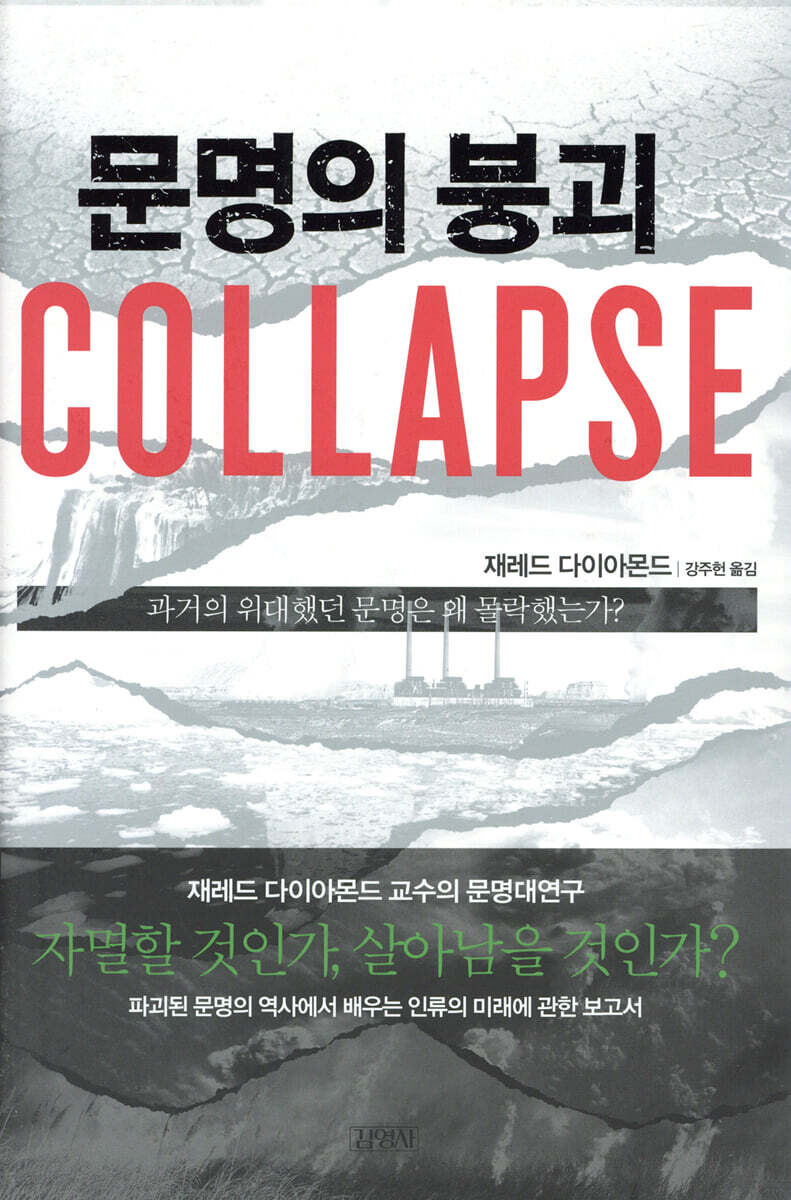
Book Introduction
Jared Diamond, winner of the Pulitzer Prize for Guns, Germs, and Steel, now tackles the question: "Why did the great civilizations of the past collapse and fall, and what can we learn from their fates?"
In other words, this book is a report on the future of humanity learned from the history of destroyed civilizations.
In this book, Jared Diamond defines the concept of collapse as "a rapid decline in population size, political, social, and economic phenomena that occurs over a relatively large area over a long period of time."
The areas of civilizational collapse he chose were not simply areas where the ruling class had been overthrown and replaced, but places that had now completely disappeared or were slowly showing signs of collapse.
Rather than the fall of the Roman Empire or the Ottoman Empire, the book primarily compares and analyzes societies that have completely collapsed rather than simply declined, such as the Mayan civilization, Easter Island in the South Pacific, and Angkor Wat in Asia.
And we're also looking at places where signs of collapse are showing in the 20th century: Rwanda, Haiti, China, and Australia.
He observes five major reasons why these societies collapsed.
These include environmental destruction, climate change, hostile relations with neighboring countries, decreased cooperation among allies, and the deterioration of the members' ability to respond to social problems.
It is said that these factors work together in a complex manner, ultimately leading to the collapse or downfall of a society or civilization.
However, this book does not only contain cases of failure, but also introduces success stories of societies that 'survived even in difficult environments.'
These are the success stories of Iceland, where people worked together despite facing harsh environmental challenges, the highlands of New Guinea, small islands in the South Pacific, and Japan, which was facing a serious crisis due to deforestation.
Diamond suggests that we use these past success stories to overcome today's problems.
In other words, this book is a report on the future of humanity learned from the history of destroyed civilizations.
In this book, Jared Diamond defines the concept of collapse as "a rapid decline in population size, political, social, and economic phenomena that occurs over a relatively large area over a long period of time."
The areas of civilizational collapse he chose were not simply areas where the ruling class had been overthrown and replaced, but places that had now completely disappeared or were slowly showing signs of collapse.
Rather than the fall of the Roman Empire or the Ottoman Empire, the book primarily compares and analyzes societies that have completely collapsed rather than simply declined, such as the Mayan civilization, Easter Island in the South Pacific, and Angkor Wat in Asia.
And we're also looking at places where signs of collapse are showing in the 20th century: Rwanda, Haiti, China, and Australia.
He observes five major reasons why these societies collapsed.
These include environmental destruction, climate change, hostile relations with neighboring countries, decreased cooperation among allies, and the deterioration of the members' ability to respond to social problems.
It is said that these factors work together in a complex manner, ultimately leading to the collapse or downfall of a society or civilization.
However, this book does not only contain cases of failure, but also introduces success stories of societies that 'survived even in difficult environments.'
These are the success stories of Iceland, where people worked together despite facing harsh environmental challenges, the highlands of New Guinea, small islands in the South Pacific, and Japan, which was facing a serious crisis due to deforestation.
Diamond suggests that we use these past success stories to overcome today's problems.
- You can preview some of the book's contents.
Preview
index
Prologue: A Tale of Two Ranches
The Success and Failure of a Society / Collapse, Past and Present / Lost Eden? / Five Factors of Collapse / Business and the Environment / Comparative Methodology / Structure of this Book
1 Montana's Reality
Chapter 1 Under the Vast Skies of Montana
Stan Falco's Story / Montana and Me / Why Start in Montana? / Montana's Economic History / Mining / Forests / Land / Water / Native and Invasive Species / Different Perspectives on Montana Issues / Positions on Regulation / Rick Labelle's Story / Chip Pigman's Story / Tim Hulse's Story / John Cook's Story / Montana, a Model for the World
2 The collapse of past societies
Chapter 2: The Spider that Landed on Easter Island
The Mystery of the Quarry / The Geography and History of Easter Island / People and Food / Chiefs, Clans, and Commoners / Staircases and Statues / Carving, Transport, and Erecting / The Lost Forest / Consequences for Society / Europeans and Interpretation / Why Was Easter Island Vulnerable? / What Does Easter Island Mean?
Chapter 3: The Story of Pitcairn and Henderson Islands: How Did They Disappear?
Pitcairn Island before the Mutiny on the Bounty / A Tale of Three Islands / Trade as a Means of Survival / The Ultimate Downfall
Chapter 4: The Anasazi Civilization and Their Neighbors
Desert Farmers / Naite / Agricultural Strategies / Chaco's Problems and Factories / Regional Integration / Chaco's Decline and End / Lessons from Chaco
Chapter 5: The Collapse of the Maya
The Mystery of the Lost Cities / The Maya Environment / Maya Agriculture / Maya History / Why Copán Fell / Complex Factors of Collapse / War and Drought / Collapse of the Southern Lowlands / Lessons from the Maya
Chapter 6: Viking Expansion
Experiments in the Atlantic / The Vikings' southward advance / Autocatalysis / Viking agriculture / What iron meant / Viking chieftains / Viking religion / Orkney, Shetland, and Faroe Islands / Iceland's environment / Iceland's history / Iceland's surroundings / Why it failed in Vinland
Chapter 7: The Beginnings and Development of Norwegian Greenland
European outpost / Greenland's present climate / Past climate / Native plants and animals / Norse settlement / Livestock farming / Hunting and fishing / Integrated economy / Eurocentric society / Trade with Europe / European or Greenlander?
Chapter 8: The End of Norwegian Greenland
Prelude to the End / Deforestation / Destruction of Soil and Herds / Those Who Came Before the Inuit / How the Inuit Survive / The Relationship Between the Inuit and the Norse / The End / The Ultimate Causes of the End
Chapter 9: Two Paths to Success
Bottoms up, tops down / New Guinea Highlands / Tikopia / Tokugawa Problem / Tokugawa Solution / Why Japan Succeeded / Other Success Stories
3. The crisis of modern society
Chapter 10 Africa and the Disaster Malthus Foresaw: The Genocide in Rwanda
The Dilemma / What Happened in Rwanda / More Than 'Tribal Hatred' / Kanama Village: The Worsening Situation / Kanama Village: The Explosion / The Root Cause of the Incident
Chapter 11: One Island, Two Peoples, Two Histories: The Dominican Republic and Haiti
Differences between the two countries / History / Causes of differences between the two countries / Environmental damage in the Dominican Republic / Balaguer's beliefs / The Dominican Republic's present / Is there hope?
Chapter 12: The Staggering Giant, China
The Importance of China / Population, Economy, and the Environment / Air, Water, and Soil Pollution / Habitat Destruction, Species Decline, and Large-Scale Development Projects / The Impact of Environmental Destruction / Relations with Foreign Countries / China's Future is the Future of the World
Chapter 13: Mining in Australia
The Importance of Australia / Low Soil Productivity / Water Salinization / The Tyranny of the Streets / Early History / Deep-rooted British Values / Trade and Immigration / Soil Deterioration / Other Environmental Issues / Signs of Hope and Change
4 For the future of the Earth
Chapter 14: What Was the Man Who Chopped Down the Last Tree Thinking?: Why Societies Collapse
Roadmap to Success / Failure of Prediction / Failure of Perception of Past and Future / Rational but Wrong Bad Behavior / Catastrophic Values / Other Irrational Failures / Unsuccessful Solutions / Signs of Hope
Chapter 15: Big Business and the Environment: Different Conditions, Different Results
Resource Development / The Oil Industry / Motivations of Oil Companies / Mining / Motivations of Mining Companies / Differences Between Mining Companies / Logging Industry / Forest Stewardship Council / Fisheries / Business and the Public
Chapter 16 The World is a Folder
Introduction / Urgent Problems / If These Problems Are Not Solved / Life in Los Angeles / Opposition / Past and Present / Still, There Is Hope
Acknowledgements
Translator's Note
References
Search
The Success and Failure of a Society / Collapse, Past and Present / Lost Eden? / Five Factors of Collapse / Business and the Environment / Comparative Methodology / Structure of this Book
1 Montana's Reality
Chapter 1 Under the Vast Skies of Montana
Stan Falco's Story / Montana and Me / Why Start in Montana? / Montana's Economic History / Mining / Forests / Land / Water / Native and Invasive Species / Different Perspectives on Montana Issues / Positions on Regulation / Rick Labelle's Story / Chip Pigman's Story / Tim Hulse's Story / John Cook's Story / Montana, a Model for the World
2 The collapse of past societies
Chapter 2: The Spider that Landed on Easter Island
The Mystery of the Quarry / The Geography and History of Easter Island / People and Food / Chiefs, Clans, and Commoners / Staircases and Statues / Carving, Transport, and Erecting / The Lost Forest / Consequences for Society / Europeans and Interpretation / Why Was Easter Island Vulnerable? / What Does Easter Island Mean?
Chapter 3: The Story of Pitcairn and Henderson Islands: How Did They Disappear?
Pitcairn Island before the Mutiny on the Bounty / A Tale of Three Islands / Trade as a Means of Survival / The Ultimate Downfall
Chapter 4: The Anasazi Civilization and Their Neighbors
Desert Farmers / Naite / Agricultural Strategies / Chaco's Problems and Factories / Regional Integration / Chaco's Decline and End / Lessons from Chaco
Chapter 5: The Collapse of the Maya
The Mystery of the Lost Cities / The Maya Environment / Maya Agriculture / Maya History / Why Copán Fell / Complex Factors of Collapse / War and Drought / Collapse of the Southern Lowlands / Lessons from the Maya
Chapter 6: Viking Expansion
Experiments in the Atlantic / The Vikings' southward advance / Autocatalysis / Viking agriculture / What iron meant / Viking chieftains / Viking religion / Orkney, Shetland, and Faroe Islands / Iceland's environment / Iceland's history / Iceland's surroundings / Why it failed in Vinland
Chapter 7: The Beginnings and Development of Norwegian Greenland
European outpost / Greenland's present climate / Past climate / Native plants and animals / Norse settlement / Livestock farming / Hunting and fishing / Integrated economy / Eurocentric society / Trade with Europe / European or Greenlander?
Chapter 8: The End of Norwegian Greenland
Prelude to the End / Deforestation / Destruction of Soil and Herds / Those Who Came Before the Inuit / How the Inuit Survive / The Relationship Between the Inuit and the Norse / The End / The Ultimate Causes of the End
Chapter 9: Two Paths to Success
Bottoms up, tops down / New Guinea Highlands / Tikopia / Tokugawa Problem / Tokugawa Solution / Why Japan Succeeded / Other Success Stories
3. The crisis of modern society
Chapter 10 Africa and the Disaster Malthus Foresaw: The Genocide in Rwanda
The Dilemma / What Happened in Rwanda / More Than 'Tribal Hatred' / Kanama Village: The Worsening Situation / Kanama Village: The Explosion / The Root Cause of the Incident
Chapter 11: One Island, Two Peoples, Two Histories: The Dominican Republic and Haiti
Differences between the two countries / History / Causes of differences between the two countries / Environmental damage in the Dominican Republic / Balaguer's beliefs / The Dominican Republic's present / Is there hope?
Chapter 12: The Staggering Giant, China
The Importance of China / Population, Economy, and the Environment / Air, Water, and Soil Pollution / Habitat Destruction, Species Decline, and Large-Scale Development Projects / The Impact of Environmental Destruction / Relations with Foreign Countries / China's Future is the Future of the World
Chapter 13: Mining in Australia
The Importance of Australia / Low Soil Productivity / Water Salinization / The Tyranny of the Streets / Early History / Deep-rooted British Values / Trade and Immigration / Soil Deterioration / Other Environmental Issues / Signs of Hope and Change
4 For the future of the Earth
Chapter 14: What Was the Man Who Chopped Down the Last Tree Thinking?: Why Societies Collapse
Roadmap to Success / Failure of Prediction / Failure of Perception of Past and Future / Rational but Wrong Bad Behavior / Catastrophic Values / Other Irrational Failures / Unsuccessful Solutions / Signs of Hope
Chapter 15: Big Business and the Environment: Different Conditions, Different Results
Resource Development / The Oil Industry / Motivations of Oil Companies / Mining / Motivations of Mining Companies / Differences Between Mining Companies / Logging Industry / Forest Stewardship Council / Fisheries / Business and the Public
Chapter 16 The World is a Folder
Introduction / Urgent Problems / If These Problems Are Not Solved / Life in Los Angeles / Opposition / Past and Present / Still, There Is Hope
Acknowledgements
Translator's Note
References
Search
Into the book
Perhaps the key to a society's success or failure lies in its ability to wisely decide which values to uphold over time and which to discard and replace with new ones.
Over the past 60 years, the world's great powers have abandoned some of the values that have long dominated their national image, while preserving others.
Britain and France abandoned their roles as world powers, having operated independently for centuries.
Japan has abandoned its militaristic traditions and its military power.
The long experiment of rushing communism was over.
The United States has also effectively retreated (though not completely) from its previous values of legalizing racial discrimination, criminalizing homosexuality, subordinated roles for women, and sexual repression.
Australia has begun to reassess its status as a pastoral society with a British identity.
Over the past 60 years, the world's great powers have abandoned some of the values that have long dominated their national image, while preserving others.
Britain and France abandoned their roles as world powers, having operated independently for centuries.
Japan has abandoned its militaristic traditions and its military power.
The long experiment of rushing communism was over.
The United States has also effectively retreated (though not completely) from its previous values of legalizing racial discrimination, criminalizing homosexuality, subordinated roles for women, and sexual repression.
Australia has begun to reassess its status as a pastoral society with a British identity.
--- p.593
Publisher's Review
New Orleans disaster, the tsunami nightmare, the Iraq war… the Earth is no longer safe!
Will you fall or will you survive?
A report on the future of humanity: lessons learned from the history of destroyed civilizations.
The Future of Earth's Civilization as Seen Through the Process of Civilization Collapse
How can we avoid the path to self-destruction?
The abandoned temples of Angkor Wat, Mayan cities hidden in the jungle, the giant stone statues of Easter Island…
Is there anything more unsettling than the traces left behind by the collapse of civilization? If such a thing were to happen to us, who would survive to see our legacy?
Jared Diamond, the Pulitzer Prize-winning bestselling author of Guns, Germs, and Steel, a critique of civilization, now addresses the question, “Why did the great civilizations of the past collapse and fall, and what can we learn from their fate?”
In this book, Diamond comprehensively addresses a global issue through a fascinating historical and cultural narrative.
Diamond traces the basic patterns of disaster, beginning with the Polynesian cultures of Easter Island, through the Native American cultures of the Anasazi and Maya, through the misfortunes of the Vikings who colonized Greenland, and on to the modern world.
And it details what happens when we waste resources, when we ignore the warnings the environment sends us, and when we regenerate or cut down too many trees in a short period of time.
However, there were societies that faced the same problem and found solutions and survived bravely.
So what is the difference between a surviving society and one that collapses? Why do societies make the mistakes that hasten their own self-destruction? We face similar problems today.
These problems have already caused great disasters in Rwanda and Haiti, and China and Australia are trying to deal with them in revolutionary ways.
America is not safe.
On the surface, it seemed like a country with boundless resources and absolute political power, but ominous signs began to appear, like the disaster that struck New Orleans.
What economic, social, and political path should we take to avoid the tragedy of collapse?
This book, which poses the urgent question, “How can our world avoid its own self-destruction?” and which explores a vast area with passionate clarity, is a must-read for our time.
A must-read for the future of the planet!
Spending a day with this book can change the future of humanity!
In this book, Jared Diamond defines the concept of collapse as “a rapid decline in population size, political, social, and economic phenomena over a relatively large area over a long period of time.”
The areas of civilizational collapse he chose were not simply areas where the ruling class had been overthrown and replaced, but places that had now completely disappeared or were slowly showing signs of collapse.
Rather than the fall of the Roman Empire or the Ottoman Empire, the book primarily compares and analyzes societies that have completely collapsed rather than simply declined, such as the Mayan civilization, Easter Island in the South Pacific, and Angkor Wat in Asia.
And we're also looking at places where signs of collapse are showing in the 20th century: Rwanda, Haiti, China, and Australia.
He observes five major reasons why these societies collapsed.
These include environmental destruction, climate change, hostile relations with neighboring countries, decreased cooperation among allies, and the deterioration of the members' ability to respond to social problems.
It is said that these factors work together in a complex manner, ultimately leading to the collapse or downfall of a society or civilization.
His views on environmental damage are particularly suggestive.
It is not necessarily the case that environmental damage is the sole reason for the decline of a society or civilization, but it is said that this problem leads to the emergence of various social problems and ultimately leads to collapse.
This applies directly to the world we live in now.
The global disaster that began with the tsunami late last year has continued with Hurricane Katrina in the United States, torrential rains in Central America, and a massive earthquake in Pakistan.
The scale of natural disasters is growing by the day, and each time they occur, tens of thousands or even hundreds of thousands of people lose their lives in an instant.
This is not simply a natural phenomenon that occurred, but is related to the environmental destruction that we humans are indiscriminately committing.
Soon, what Diamond has been warning about throughout this book is gradually being revealed in the society we live in.
This is precisely why Easter Island in the past went down the path of decline, and modern-day Somalia and Rwanda also ended up in a serious state due to environmental damage as the main reason.
As the author states in the prologue, the precise title of this book would be 'The Collapse of Society Due to Environmental Factors and Four Other Problems.'
To that extent, the author points out that environmental problems were serious in the past and are still serious problems today.
The world is one folder, the world is one destiny
The present age is a global village era.
When one society shows signs of collapse, it soon affects wealthy societies on other continents in one way or another.
So for the first time in history, we face the possibility of global collapse.
That is why the author is observing the situation in modern Australia, China, and Montana, USA.
If that world gets even a little closer to collapse, not only that country will collapse, but the entire world will be seriously affected.
But this book contains 'hope'.
It not only contains cases of failure, but also introduces success stories of societies that 'survived even in difficult environments.'
Success stories are presented from Iceland, the highlands of New Guinea, small islands in the South Pacific, and Japan, which faced serious threats from deforestation, where members worked together to achieve success despite facing harsh environmental challenges.
The example of Finland, which survived steadfastly even in the midst of great powers, is also mentioned here and there.
Jared Diamond suggests that we use these past success stories to overcome today's problems.
And that is the significance of this book.
Current Environmental Issues in the United States and Montana
Montana is the third-largest state in the lower 48 United States by area, but the sixth-least populous.
Half of the income of Montana residents comes not from within Montana, but from other states in the country.
Montana is one of the most beautiful natural places in the United States.
However, it is suffering from serious environmental problems such as toxic waste, forests, soil, water, climate change, and the introduction of harmful alien species.
These problems lead directly to economic problems.
This has caused what was once one of the wealthiest areas in America to become one of the poorest.
At first glance, Montana still appears safe.
This is because the United States is one of the wealthiest states in the world, its environmental problems are still relatively mild compared to other states in the country, and its residents appear to be determined to improve the situation.
Yet, the reason Diamond is so wary of this region is because other civilizations that have collapsed have also experienced the same fate that Montana finds itself in today.
It is an example of whether Montana will soon follow the path of collapse of now-defunct civilizations or the path of success of surviving societies.
A romantic mystery? The collapse of Easter Island
The stone statues of Easter Island are often referred to as a world mystery.
There are still many theories about why the Easter Island civilization collapsed.
Although it is mostly portrayed as a romantic fantasy, Jared Diamond is adamant that it has collapsed due to environmental damage.
The fate of Easter Island could be said to be 'purely' ecological collapse.
In other words, ruthless deforestation led to war, and with the overthrow of the ruling class, even the famous megalithic culture disappeared.
And the population naturally decreased significantly.
As far as is known, the Polynesian society of Easter Island has been isolated ever since its establishment.
Therefore, neither enemies nor allies had any influence on the rise and fall of Easter.
There was also no evidence that climate change played any role.
Easter Island and the modern world are eerily similar.
Thanks to globalization, international trade, aviation, and the Internet, all nations today share resources and influence one another.
Just like the 11 tribes that lived on Easter Island.
Just as Earth is isolated from space today, Polynesia's Easter Island was isolated from the Pacific Ocean.
The Easter Islanders were in trouble, but had nowhere to go.
There was nowhere to turn for salvation.
If we, the people of Earth today, were in trouble, where and who would we turn to? For this reason, the collapse of Easter Island seems like a worst-case scenario for our future.
The Fall of Pitcairn and Henderson Islands
Pitcairn and Henderson Islands, settled by Polynesians, are examples of collapse caused by the fourth of the five factors: the loss of support from friendly neighbors.
Although there was localised environmental damage on Pitcairn and Henderson Islands, the fatal blow was the environmental collapse of Mangareva Island, their main trading partner.
On Mangareva Island, horrific incidents occurred repeatedly and the standard of living plummeted, but the large population allowed some to survive in some form.
On the other hand, the people of Pitcairn and Henderson Islands have depended on Mangareva for agricultural products, technology, stones, oyster shells, and even people since the beginning, before environmental damage accumulated.
But as Mangareva declined and lost the ability to export to them, the Pitcairn and Henderson Islanders put up a heroic struggle to adapt to their new environment, but every last one died on the island.
The tragedy of these islands mirrors the pros and cons of today's globalization and the resulting economic dependence.
How much does the Middle East, an economically important but environmentally vulnerable region like our oil-rich home, impact us all?
Just as Mangareva Island was the lifeline of Pitcairn Island and Henderson Island!
The fall of the Maya due to overpopulation and environmental destruction
Like Easter Island, the cause of the Maya's collapse is shrouded in romantic mystery.
But Diamond's argument stands firm.
Soon, environmental destruction and overpopulation led to war and eventual collapse.
If we look at it in more detail, it can be analyzed into five points.
In other words, population growth exceeds available resources.
The Maya faced a dilemma similar to the one Thomas Malthus foresaw in 1798 and which is seen today in places like Rwanda and Haiti.
Soon too many farmers were growing too much grain on too much land.
Efforts to address the mismatch between population and resources have developed into a second factor.
That is, there was deforestation and erosion of hillsides, which reduced the available farmland when more was needed.
Moreover, drought, soil depletion, and the spread of ferns due to deforestation have further reduced the available farmland.
The third factor was the increase in war.
Because the population was large but resources were scarce, war was inevitable.
The factor that pushed the crisis into a dead end was climate change.
In the past, there were places to take refuge when drought struck, but due to deforestation, there was no longer any land to live on.
Finally, the leadership lacked the wisdom to overcome this crisis.
They accumulated wealth, waged war, built monuments competitively, and extorted food from farmers to support these activities.
Like most leaders throughout human history, the Mayan kings and nobles lacked long-term vision.
This is one of the most telling examples in a time when wealth polarization is deepening and the wealthy are becoming increasingly indifferent to society.
Norwegian Greenland, a steadfast adherence to European values
Norwegian Greenland is one of the most complex examples of ancient societies.
However, because it was part of the European society that had a written language, it is also the society with the most accumulated information and the most actively discussed.
All five factors of collapse apply to this society.
The collapse was caused by environmental destruction, climate change, the withdrawal of friendly Norwegian aid, hostile relations with the Inuit, and the political, economic, social, and cultural background of Norwegian Greenland.
The Norwegians in particular ignored the Inuit, the indigenous people of the region.
If they had accepted their lifestyle and learned their wisdom, they would have survived, but they insisted on European values.
Thus, Greenland's history teaches us that even in harsh environments, collapse is not inevitable; it depends on the choices a society makes.
Comparing Norwegian Greenland with the five North Atlantic societies also conquered by the Norwegians helps us understand why Orkney succeeded while Greenland failed.
Moreover, Iceland, one of the five territories conquered by the Norwegians, is a prime example of a country that rose from a vulnerable environment to become one of the most prosperous.
The Chinese crisis will also cause us great harm.
China, home to 1.3 billion people, one-fifth of the world's population! The already massive Chinese economy is growing at a rate of 10 percent annually, four times the growth rate of First World economies.
However, these achievements are overshadowed by China's environmental problems, which are the most serious among major countries and continue to worsen.
China's environmental problems are numerous, ranging from the decline of biological species, the decline of arable land, desertification, loss of wetlands, declining grassland quality, and the frequent occurrence of man-made disasters to the introduction of alien species, the devastation of pastures, stagnation of river flow, salinization, soil erosion, waste, water pollution, and water shortages.
These various environmental problems are causing enormous economic losses, social conflicts, and health problems within China, which makes us realize that the impact of China's environmental problems on its own citizens is very serious.
China is also aware of these problems and is gradually implementing environmental policies.
But no one can predict what the outcome of all this will be.
Given China's population and economic size, its fate, not only its own but also the entire world's, will depend on which direction it takes.
Surviving in a harsh environment in Australia
Australia has been 'mining' renewable resources as if they were minerals buried underground.
In other words, the amount is now decreasing because we have been consuming it at a faster rate than the rate of reproduction.
If mining continues at the current rate, Australia's forest and fisheries resources will be depleted long before coal and iron reserves are depleted.
It is ironic that renewable resources are depleted before non-renewable resources.
And their European values also destroyed their environment.
There were also absurd incidents where rabbits and sheep imported from Europe eroded the soil.
And with various environmental problems overlapping, we are now in a serious crisis, and we are struggling in every way to improve this.
We are introduced to the painful reality of Australia, a country known only as a wealthy and environmentally affluent country.
Why do civilizations collapse?
Why do people make disastrous decisions?
Why do societies fail and ultimately collapse? What choices did its members make that led to such a result? Jared Diamond analyzes the causes of social collapse, proposing six reasons.
The first is a failure of prediction.
It's about a group failing to anticipate a real problem before it becomes a reality, leading to disastrous decisions.
The second is a failure to recognize the problem.
This is because there are frequent cases where the root cause of the problem is not detected and cannot even be resolved.
The third is a bad act that is rational but wrong.
This refers to an action that is beneficial to a certain group (individual, country, etc.) but harmful to the majority, and there are many cases where the majority suffers damage as a result.
The fourth is irrational behavior, that is, catastrophic values.
It refers to long-held values, such as Japanese militarism, and points out that success or failure can vary depending on how such values are revised.
It also analyzes that irrational decisions lead to tragedy, and ultimately, unsuccessful solutions lead to the collapse of a society or civilization.
Will you fall or will you survive?
A report on the future of humanity: lessons learned from the history of destroyed civilizations.
The Future of Earth's Civilization as Seen Through the Process of Civilization Collapse
How can we avoid the path to self-destruction?
The abandoned temples of Angkor Wat, Mayan cities hidden in the jungle, the giant stone statues of Easter Island…
Is there anything more unsettling than the traces left behind by the collapse of civilization? If such a thing were to happen to us, who would survive to see our legacy?
Jared Diamond, the Pulitzer Prize-winning bestselling author of Guns, Germs, and Steel, a critique of civilization, now addresses the question, “Why did the great civilizations of the past collapse and fall, and what can we learn from their fate?”
In this book, Diamond comprehensively addresses a global issue through a fascinating historical and cultural narrative.
Diamond traces the basic patterns of disaster, beginning with the Polynesian cultures of Easter Island, through the Native American cultures of the Anasazi and Maya, through the misfortunes of the Vikings who colonized Greenland, and on to the modern world.
And it details what happens when we waste resources, when we ignore the warnings the environment sends us, and when we regenerate or cut down too many trees in a short period of time.
However, there were societies that faced the same problem and found solutions and survived bravely.
So what is the difference between a surviving society and one that collapses? Why do societies make the mistakes that hasten their own self-destruction? We face similar problems today.
These problems have already caused great disasters in Rwanda and Haiti, and China and Australia are trying to deal with them in revolutionary ways.
America is not safe.
On the surface, it seemed like a country with boundless resources and absolute political power, but ominous signs began to appear, like the disaster that struck New Orleans.
What economic, social, and political path should we take to avoid the tragedy of collapse?
This book, which poses the urgent question, “How can our world avoid its own self-destruction?” and which explores a vast area with passionate clarity, is a must-read for our time.
A must-read for the future of the planet!
Spending a day with this book can change the future of humanity!
In this book, Jared Diamond defines the concept of collapse as “a rapid decline in population size, political, social, and economic phenomena over a relatively large area over a long period of time.”
The areas of civilizational collapse he chose were not simply areas where the ruling class had been overthrown and replaced, but places that had now completely disappeared or were slowly showing signs of collapse.
Rather than the fall of the Roman Empire or the Ottoman Empire, the book primarily compares and analyzes societies that have completely collapsed rather than simply declined, such as the Mayan civilization, Easter Island in the South Pacific, and Angkor Wat in Asia.
And we're also looking at places where signs of collapse are showing in the 20th century: Rwanda, Haiti, China, and Australia.
He observes five major reasons why these societies collapsed.
These include environmental destruction, climate change, hostile relations with neighboring countries, decreased cooperation among allies, and the deterioration of the members' ability to respond to social problems.
It is said that these factors work together in a complex manner, ultimately leading to the collapse or downfall of a society or civilization.
His views on environmental damage are particularly suggestive.
It is not necessarily the case that environmental damage is the sole reason for the decline of a society or civilization, but it is said that this problem leads to the emergence of various social problems and ultimately leads to collapse.
This applies directly to the world we live in now.
The global disaster that began with the tsunami late last year has continued with Hurricane Katrina in the United States, torrential rains in Central America, and a massive earthquake in Pakistan.
The scale of natural disasters is growing by the day, and each time they occur, tens of thousands or even hundreds of thousands of people lose their lives in an instant.
This is not simply a natural phenomenon that occurred, but is related to the environmental destruction that we humans are indiscriminately committing.
Soon, what Diamond has been warning about throughout this book is gradually being revealed in the society we live in.
This is precisely why Easter Island in the past went down the path of decline, and modern-day Somalia and Rwanda also ended up in a serious state due to environmental damage as the main reason.
As the author states in the prologue, the precise title of this book would be 'The Collapse of Society Due to Environmental Factors and Four Other Problems.'
To that extent, the author points out that environmental problems were serious in the past and are still serious problems today.
The world is one folder, the world is one destiny
The present age is a global village era.
When one society shows signs of collapse, it soon affects wealthy societies on other continents in one way or another.
So for the first time in history, we face the possibility of global collapse.
That is why the author is observing the situation in modern Australia, China, and Montana, USA.
If that world gets even a little closer to collapse, not only that country will collapse, but the entire world will be seriously affected.
But this book contains 'hope'.
It not only contains cases of failure, but also introduces success stories of societies that 'survived even in difficult environments.'
Success stories are presented from Iceland, the highlands of New Guinea, small islands in the South Pacific, and Japan, which faced serious threats from deforestation, where members worked together to achieve success despite facing harsh environmental challenges.
The example of Finland, which survived steadfastly even in the midst of great powers, is also mentioned here and there.
Jared Diamond suggests that we use these past success stories to overcome today's problems.
And that is the significance of this book.
Current Environmental Issues in the United States and Montana
Montana is the third-largest state in the lower 48 United States by area, but the sixth-least populous.
Half of the income of Montana residents comes not from within Montana, but from other states in the country.
Montana is one of the most beautiful natural places in the United States.
However, it is suffering from serious environmental problems such as toxic waste, forests, soil, water, climate change, and the introduction of harmful alien species.
These problems lead directly to economic problems.
This has caused what was once one of the wealthiest areas in America to become one of the poorest.
At first glance, Montana still appears safe.
This is because the United States is one of the wealthiest states in the world, its environmental problems are still relatively mild compared to other states in the country, and its residents appear to be determined to improve the situation.
Yet, the reason Diamond is so wary of this region is because other civilizations that have collapsed have also experienced the same fate that Montana finds itself in today.
It is an example of whether Montana will soon follow the path of collapse of now-defunct civilizations or the path of success of surviving societies.
A romantic mystery? The collapse of Easter Island
The stone statues of Easter Island are often referred to as a world mystery.
There are still many theories about why the Easter Island civilization collapsed.
Although it is mostly portrayed as a romantic fantasy, Jared Diamond is adamant that it has collapsed due to environmental damage.
The fate of Easter Island could be said to be 'purely' ecological collapse.
In other words, ruthless deforestation led to war, and with the overthrow of the ruling class, even the famous megalithic culture disappeared.
And the population naturally decreased significantly.
As far as is known, the Polynesian society of Easter Island has been isolated ever since its establishment.
Therefore, neither enemies nor allies had any influence on the rise and fall of Easter.
There was also no evidence that climate change played any role.
Easter Island and the modern world are eerily similar.
Thanks to globalization, international trade, aviation, and the Internet, all nations today share resources and influence one another.
Just like the 11 tribes that lived on Easter Island.
Just as Earth is isolated from space today, Polynesia's Easter Island was isolated from the Pacific Ocean.
The Easter Islanders were in trouble, but had nowhere to go.
There was nowhere to turn for salvation.
If we, the people of Earth today, were in trouble, where and who would we turn to? For this reason, the collapse of Easter Island seems like a worst-case scenario for our future.
The Fall of Pitcairn and Henderson Islands
Pitcairn and Henderson Islands, settled by Polynesians, are examples of collapse caused by the fourth of the five factors: the loss of support from friendly neighbors.
Although there was localised environmental damage on Pitcairn and Henderson Islands, the fatal blow was the environmental collapse of Mangareva Island, their main trading partner.
On Mangareva Island, horrific incidents occurred repeatedly and the standard of living plummeted, but the large population allowed some to survive in some form.
On the other hand, the people of Pitcairn and Henderson Islands have depended on Mangareva for agricultural products, technology, stones, oyster shells, and even people since the beginning, before environmental damage accumulated.
But as Mangareva declined and lost the ability to export to them, the Pitcairn and Henderson Islanders put up a heroic struggle to adapt to their new environment, but every last one died on the island.
The tragedy of these islands mirrors the pros and cons of today's globalization and the resulting economic dependence.
How much does the Middle East, an economically important but environmentally vulnerable region like our oil-rich home, impact us all?
Just as Mangareva Island was the lifeline of Pitcairn Island and Henderson Island!
The fall of the Maya due to overpopulation and environmental destruction
Like Easter Island, the cause of the Maya's collapse is shrouded in romantic mystery.
But Diamond's argument stands firm.
Soon, environmental destruction and overpopulation led to war and eventual collapse.
If we look at it in more detail, it can be analyzed into five points.
In other words, population growth exceeds available resources.
The Maya faced a dilemma similar to the one Thomas Malthus foresaw in 1798 and which is seen today in places like Rwanda and Haiti.
Soon too many farmers were growing too much grain on too much land.
Efforts to address the mismatch between population and resources have developed into a second factor.
That is, there was deforestation and erosion of hillsides, which reduced the available farmland when more was needed.
Moreover, drought, soil depletion, and the spread of ferns due to deforestation have further reduced the available farmland.
The third factor was the increase in war.
Because the population was large but resources were scarce, war was inevitable.
The factor that pushed the crisis into a dead end was climate change.
In the past, there were places to take refuge when drought struck, but due to deforestation, there was no longer any land to live on.
Finally, the leadership lacked the wisdom to overcome this crisis.
They accumulated wealth, waged war, built monuments competitively, and extorted food from farmers to support these activities.
Like most leaders throughout human history, the Mayan kings and nobles lacked long-term vision.
This is one of the most telling examples in a time when wealth polarization is deepening and the wealthy are becoming increasingly indifferent to society.
Norwegian Greenland, a steadfast adherence to European values
Norwegian Greenland is one of the most complex examples of ancient societies.
However, because it was part of the European society that had a written language, it is also the society with the most accumulated information and the most actively discussed.
All five factors of collapse apply to this society.
The collapse was caused by environmental destruction, climate change, the withdrawal of friendly Norwegian aid, hostile relations with the Inuit, and the political, economic, social, and cultural background of Norwegian Greenland.
The Norwegians in particular ignored the Inuit, the indigenous people of the region.
If they had accepted their lifestyle and learned their wisdom, they would have survived, but they insisted on European values.
Thus, Greenland's history teaches us that even in harsh environments, collapse is not inevitable; it depends on the choices a society makes.
Comparing Norwegian Greenland with the five North Atlantic societies also conquered by the Norwegians helps us understand why Orkney succeeded while Greenland failed.
Moreover, Iceland, one of the five territories conquered by the Norwegians, is a prime example of a country that rose from a vulnerable environment to become one of the most prosperous.
The Chinese crisis will also cause us great harm.
China, home to 1.3 billion people, one-fifth of the world's population! The already massive Chinese economy is growing at a rate of 10 percent annually, four times the growth rate of First World economies.
However, these achievements are overshadowed by China's environmental problems, which are the most serious among major countries and continue to worsen.
China's environmental problems are numerous, ranging from the decline of biological species, the decline of arable land, desertification, loss of wetlands, declining grassland quality, and the frequent occurrence of man-made disasters to the introduction of alien species, the devastation of pastures, stagnation of river flow, salinization, soil erosion, waste, water pollution, and water shortages.
These various environmental problems are causing enormous economic losses, social conflicts, and health problems within China, which makes us realize that the impact of China's environmental problems on its own citizens is very serious.
China is also aware of these problems and is gradually implementing environmental policies.
But no one can predict what the outcome of all this will be.
Given China's population and economic size, its fate, not only its own but also the entire world's, will depend on which direction it takes.
Surviving in a harsh environment in Australia
Australia has been 'mining' renewable resources as if they were minerals buried underground.
In other words, the amount is now decreasing because we have been consuming it at a faster rate than the rate of reproduction.
If mining continues at the current rate, Australia's forest and fisheries resources will be depleted long before coal and iron reserves are depleted.
It is ironic that renewable resources are depleted before non-renewable resources.
And their European values also destroyed their environment.
There were also absurd incidents where rabbits and sheep imported from Europe eroded the soil.
And with various environmental problems overlapping, we are now in a serious crisis, and we are struggling in every way to improve this.
We are introduced to the painful reality of Australia, a country known only as a wealthy and environmentally affluent country.
Why do civilizations collapse?
Why do people make disastrous decisions?
Why do societies fail and ultimately collapse? What choices did its members make that led to such a result? Jared Diamond analyzes the causes of social collapse, proposing six reasons.
The first is a failure of prediction.
It's about a group failing to anticipate a real problem before it becomes a reality, leading to disastrous decisions.
The second is a failure to recognize the problem.
This is because there are frequent cases where the root cause of the problem is not detected and cannot even be resolved.
The third is a bad act that is rational but wrong.
This refers to an action that is beneficial to a certain group (individual, country, etc.) but harmful to the majority, and there are many cases where the majority suffers damage as a result.
The fourth is irrational behavior, that is, catastrophic values.
It refers to long-held values, such as Japanese militarism, and points out that success or failure can vary depending on how such values are revised.
It also analyzes that irrational decisions lead to tragedy, and ultimately, unsuccessful solutions lead to the collapse of a society or civilization.
GOODS SPECIFICS
- Date of issue: November 3, 2005
- Format: Hardcover book binding method guide
- Page count, weight, size: 788 pages | 1,280g | 153*224*40mm
- ISBN13: 9788934919766
- ISBN10: 8934919760
You may also like
카테고리
korean


korean

![GQ KOREA Mark (Monthly): December [2025]](http://librairie.coreenne.fr/cdn/shop/files/8ef265dbbfbf186523ed75ba7319009d.jpg?v=1765340328&width=3840)


