

Chatter of Resistance
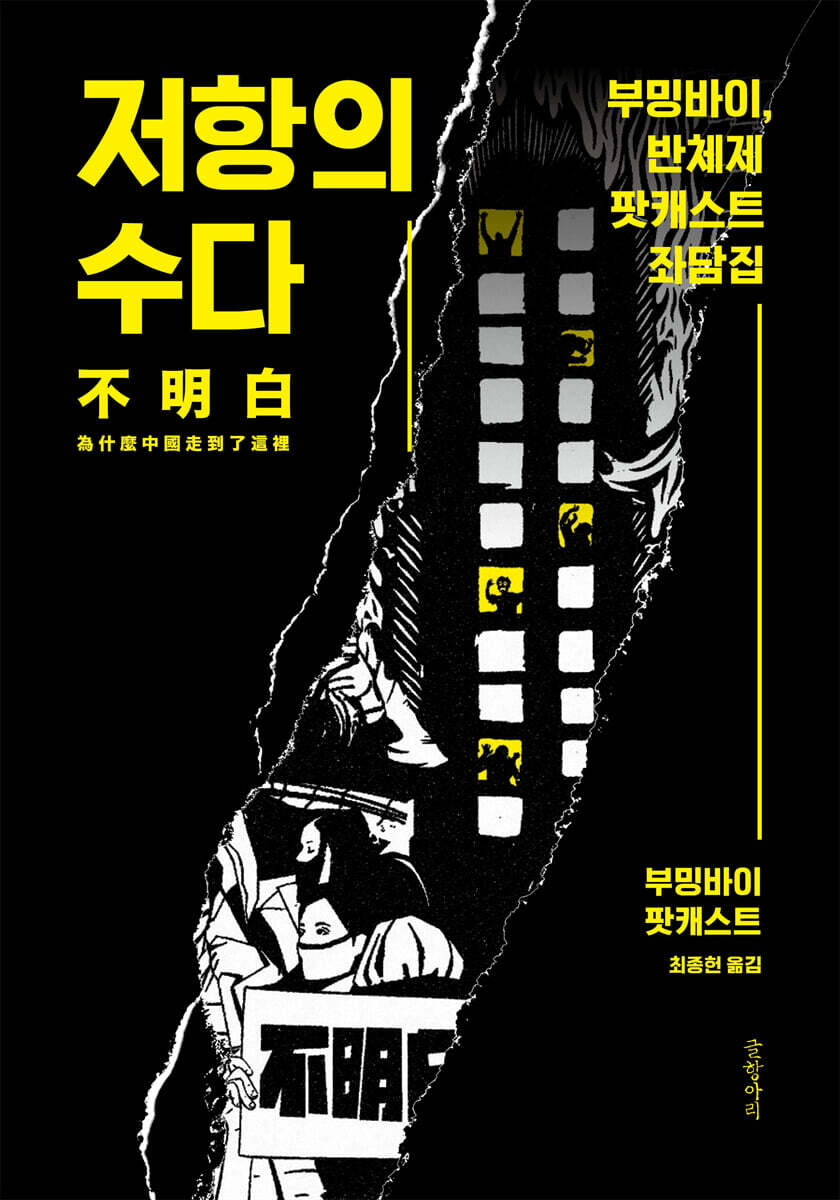 |
Description
Book Introduction
The most interesting conversation in China is
It's all done in secret
'That podcast' that Chinese people secretly listen to,
Twenty-five pieces of resistance chatter carefully selected by Boomingbae.
Is "Xi Jinping" a taboo word? Okay, let's do that.
But how do you tell when people call you "roujiamo" (Chinese hamburger) or "Shanxi people"? What about the hamburgers people eat every day!
'Booming Bye' is a podcast planned and hosted by New York Times columnist Yuan Li.
When the first episode aired on May 27, 2022, no one could have predicted the huge response it would receive.
The world was reeling from the unforeseen humanitarian disaster of COVID-19, and despite expectations of a gradual endemic outbreak, Shanghai remained under full lockdown due to a surge in Omicron virus infections.
A whopping 25 million people were unable to step outside their homes for two months.
Rather than just sitting at home looking at her phone and crying, Yuan Li started 'Booming Bye' to communicate with people and escape her feelings of helplessness.
'Boomingbai 不明白' means 'I don't know at all'.
The "Zero Corona" policy that the Xi Jinping government adopted as a response to COVID-19 was a strict lockdown policy that was enforced with complete disregard for the situation of its own citizens under the pretext of achieving a zero infection rate.
During the three years the policy was in effect, people were infected and died or were completely isolated.
One morning, I woke up to find the building I was living in was sealed off, and there were many cases where I was trapped in my house and starved.
The game was ruined in an instant, and anxiety and discontent about survival began to stir throughout the country.
In other words, it was the public life itself that the Chinese people could discuss, the reality, and the desperate cry of 'I don't know at all'.
The Chinese wanted to know how on earth China had come to this state.
How could a system of government that tied down the feet of 25 million people work? How long would a big data surveillance system that collects real-time personal information through a location tracking program called "health code" function? I had to question the exercise of power.
'Booming Bye' responded to that aspiration with sharp social analysis and scathing political criticism.
He interpreted politics and society together with experts such as political scientists Cai Xia, Pei Minxin, and Wu Guoguang, and did not hesitate to harshly criticize "Zero Corona" as "a crazy policy and an irrational policy" that was no different from the "Great Leap Forward" of 1958.
In addition, ordinary small business owners who have been hit hard by the economic downturn and migrant workers who are in the blind spot of China's welfare system appeared, exposing the current state of affairs in China without reservation.
Because of the broadcast content, Boomingby was censored by the authorities from the second episode onwards, and the government completely blocked the site's hosting company.
With this, 'Boomingbai' has become 'that podcast' that all Chinese people know, even though it is not heard in China.
People used it as a tangential code, secretly and meticulously conveying their voices of resistance.
'The Podcast' is still broadcasting, with 180 episodes as of November 16, 2025.
This book is a compilation of 17 episodes selected from over 100 episodes and a total of 25 interviews, commemorating the podcast's second anniversary.
In fact, many Chinese people listen to podcasts more as "reading" excerpts than as "listening" to the broadcast.
Just as Bumingbai became a base for the resistance movement by disseminating voices critical of the regime, this book is also being published in Chinese by a Taiwanese publisher (banned from publication in China), conveying the voices of dissidents and the younger generation supporting democracy in China.
The most interesting conversations in China still continue in 'Boomingbai'.
It's all done in secret
'That podcast' that Chinese people secretly listen to,
Twenty-five pieces of resistance chatter carefully selected by Boomingbae.
Is "Xi Jinping" a taboo word? Okay, let's do that.
But how do you tell when people call you "roujiamo" (Chinese hamburger) or "Shanxi people"? What about the hamburgers people eat every day!
'Booming Bye' is a podcast planned and hosted by New York Times columnist Yuan Li.
When the first episode aired on May 27, 2022, no one could have predicted the huge response it would receive.
The world was reeling from the unforeseen humanitarian disaster of COVID-19, and despite expectations of a gradual endemic outbreak, Shanghai remained under full lockdown due to a surge in Omicron virus infections.
A whopping 25 million people were unable to step outside their homes for two months.
Rather than just sitting at home looking at her phone and crying, Yuan Li started 'Booming Bye' to communicate with people and escape her feelings of helplessness.
'Boomingbai 不明白' means 'I don't know at all'.
The "Zero Corona" policy that the Xi Jinping government adopted as a response to COVID-19 was a strict lockdown policy that was enforced with complete disregard for the situation of its own citizens under the pretext of achieving a zero infection rate.
During the three years the policy was in effect, people were infected and died or were completely isolated.
One morning, I woke up to find the building I was living in was sealed off, and there were many cases where I was trapped in my house and starved.
The game was ruined in an instant, and anxiety and discontent about survival began to stir throughout the country.
In other words, it was the public life itself that the Chinese people could discuss, the reality, and the desperate cry of 'I don't know at all'.
The Chinese wanted to know how on earth China had come to this state.
How could a system of government that tied down the feet of 25 million people work? How long would a big data surveillance system that collects real-time personal information through a location tracking program called "health code" function? I had to question the exercise of power.
'Booming Bye' responded to that aspiration with sharp social analysis and scathing political criticism.
He interpreted politics and society together with experts such as political scientists Cai Xia, Pei Minxin, and Wu Guoguang, and did not hesitate to harshly criticize "Zero Corona" as "a crazy policy and an irrational policy" that was no different from the "Great Leap Forward" of 1958.
In addition, ordinary small business owners who have been hit hard by the economic downturn and migrant workers who are in the blind spot of China's welfare system appeared, exposing the current state of affairs in China without reservation.
Because of the broadcast content, Boomingby was censored by the authorities from the second episode onwards, and the government completely blocked the site's hosting company.
With this, 'Boomingbai' has become 'that podcast' that all Chinese people know, even though it is not heard in China.
People used it as a tangential code, secretly and meticulously conveying their voices of resistance.
'The Podcast' is still broadcasting, with 180 episodes as of November 16, 2025.
This book is a compilation of 17 episodes selected from over 100 episodes and a total of 25 interviews, commemorating the podcast's second anniversary.
In fact, many Chinese people listen to podcasts more as "reading" excerpts than as "listening" to the broadcast.
Just as Bumingbai became a base for the resistance movement by disseminating voices critical of the regime, this book is also being published in Chinese by a Taiwanese publisher (banned from publication in China), conveying the voices of dissidents and the younger generation supporting democracy in China.
The most interesting conversations in China still continue in 'Boomingbai'.
- You can preview some of the book's contents.
Preview
index
Preface - Let's be brave, starting with me
Editor's Note
Chapter 1: The Return of Dictatorship He Changed China
[Chaisha] How could one person's will control the entire Communist Party?
[Pei Minxin] Understanding the Chinese Communist Party's Political Logic and Surveillance System
Interview 1: The Political Logic of "Dynamic Zero Corona"
Interview 2: China's State Surveillance System
[Wu Guoguang] Political order and the possibility of resistance after the "20s"
Interview 1: The Possibility of Resistance in a Dictatorship
Interview 2: The Political Order After the "20s" and China's Future Direction
[Zhang Xue, Zhang Jieping] From a Golden Age to an Era of Silence: What Happened to Chinese Journalism?
Chapter 2: The Chinese Economy Reverts to the Soviet System by Reversing Reforms
[Xu Qingjiang] Is there any hope for the Chinese economy?
Interview 1: The Origins of Land Finance and the Mystery of China's Rapid Economic Growth
Interview 2: China's Deflation: Is It Following the Path of the Former Soviet Union?
Interview 3: Is there any hope for the Chinese economy?
[Sun Junli] From Rich to Poor Again: Small Businesses Take a Critical Hit as China's Economy Sloughs
Young people who can't find jobs
Steven - What are the possibilities for the future?
Gloria: I'm afraid of the changes my work life will bring.
Miles - I want to live a peaceful and free life in a land where individual rights are guaranteed.
Young migrant workers struggling in the midst of a recession
Chapter 1: You must be happy to have children.
Guan - This is the reality right in front of us, so passion is useless.
Hunter G - I pray that you will leave China as soon as possible.
Room - Hope that China will get better
Chapter 3: A Little Light in the Darkness: Hope in a Time of Historical Decline
Who is the 'Pyungjeongsu Prime Minister'?
[Participants of the 'White Paper Movement'] Why did we take to the streets?
Serena - I took a piece of paper that wasn't so white.
Miranda - I felt like I could never go back to the way things were.
Blues - Records Make Sense
A protester was arrested—any resistance must begin first.
[Mr. Lee is not your teacher] The 'Blank Paper Movement' is not the end, but the beginning.
Narration 'Boomingbai' Behind the Scenes "Can I say Xi Jinping's name carelessly?"
Translator's Note
Editor's Note
Chapter 1: The Return of Dictatorship He Changed China
[Chaisha] How could one person's will control the entire Communist Party?
[Pei Minxin] Understanding the Chinese Communist Party's Political Logic and Surveillance System
Interview 1: The Political Logic of "Dynamic Zero Corona"
Interview 2: China's State Surveillance System
[Wu Guoguang] Political order and the possibility of resistance after the "20s"
Interview 1: The Possibility of Resistance in a Dictatorship
Interview 2: The Political Order After the "20s" and China's Future Direction
[Zhang Xue, Zhang Jieping] From a Golden Age to an Era of Silence: What Happened to Chinese Journalism?
Chapter 2: The Chinese Economy Reverts to the Soviet System by Reversing Reforms
[Xu Qingjiang] Is there any hope for the Chinese economy?
Interview 1: The Origins of Land Finance and the Mystery of China's Rapid Economic Growth
Interview 2: China's Deflation: Is It Following the Path of the Former Soviet Union?
Interview 3: Is there any hope for the Chinese economy?
[Sun Junli] From Rich to Poor Again: Small Businesses Take a Critical Hit as China's Economy Sloughs
Young people who can't find jobs
Steven - What are the possibilities for the future?
Gloria: I'm afraid of the changes my work life will bring.
Miles - I want to live a peaceful and free life in a land where individual rights are guaranteed.
Young migrant workers struggling in the midst of a recession
Chapter 1: You must be happy to have children.
Guan - This is the reality right in front of us, so passion is useless.
Hunter G - I pray that you will leave China as soon as possible.
Room - Hope that China will get better
Chapter 3: A Little Light in the Darkness: Hope in a Time of Historical Decline
Who is the 'Pyungjeongsu Prime Minister'?
[Participants of the 'White Paper Movement'] Why did we take to the streets?
Serena - I took a piece of paper that wasn't so white.
Miranda - I felt like I could never go back to the way things were.
Blues - Records Make Sense
A protester was arrested—any resistance must begin first.
[Mr. Lee is not your teacher] The 'Blank Paper Movement' is not the end, but the beginning.
Narration 'Boomingbai' Behind the Scenes "Can I say Xi Jinping's name carelessly?"
Translator's Note
Detailed image

Into the book
I agree with what Mr. Lee said at the end of the interview: “The question of what China will become is something that the people living in China must ask and answer for themselves.
I really like "What kind of country do you want China to become? The answer lies in your hands, and the future lies in your hands."
I think this is what 'Booming Bye' and this book want to convey.
--- p.17
This is fundamentally nonsensical.
Why? Because the separation of powers he talks about is a false proposition.
If we practice democracy, we must share power and exercise mutual control.
Power should not be concentrated in the hands of one person and allowed to become a dictator.
On the surface, decentralization and power sharing appear similar.
But if you look a little deeper, these two are completely different.
Therefore, what needs to be solved is not the problem of decentralization of power, but the problem of sharing power.
The solution to power-sharing is not to concentrate all power in the hands of one person, but to establish decentralization and mutual control, and to ensure that power operates within the framework of the rule of law.
Only in this way can we truly resolve the various problems within the Chinese Communist Party.
--- p.29~31
The Communist Party is no longer a political party.
It is normal for a political party to have diverse opinions within the party, but Xi Jinping has clearly shown the people through the "20th Great Party" that he does not need any balance and that he intends to create a standing committee with only his secretaries.
Since then, there has been no real discussion in the Standing Committee of the Chinese Communist Party.
The Standing Committee meetings have become like the CEO lecturing his employees, and the Party has fallen into Xi Jinping's hands and become his tool.
--- p.39
I've been thinking about it all along.
I wonder if China could become like North Korea.
This is a very interesting problem.
What legitimacy does the North Korean regime have?
They are only resorting to violence, cruelty and oppression.
In a country with a population of 1.4 billion, implementing a governing system like North Korea was only possible during the Mao Zedong era.
Moreover, we have experienced 40 years of reform and opening up.
If a regime based on economic development relies solely on blockades, violence, secret police, and high-tech surveillance to regain its legitimacy, will it survive?
--- p.53
There have been countless tragedies in Chinese history, especially since 1949, but we have always forgotten them.
Of course, this is because the Chinese government has erased our collective memory so that we forget this.
I love art and literature, and I think we should remember this Shanghai blockade in various ways.
After paying such a huge price, we can't just forget about it.
--- p.56
Comfort - Some say that under Xi Jinping's rule, China is becoming more and more like a totalitarian state, or at least moving towards totalitarianism.
What was your perspective, teacher?
China is not moving towards totalitarianism, but in many respects has already reached a level of totalitarianism unprecedented in history.
--- p.85~86
However, while I am fundamentally very pessimistic when discussing the public situation, I don't think life at this moment is all that messed up.
I definitely think there are alternative spaces.
I think many young people in the mainland have begun to take a closer look at their surroundings.
The concept of 'periphery' has become very popular, at least in civil society communities, in the last year or two.
Even if you create a grand discourse, there is no way to spread it to people, so it is better to return to the community you belong to and take good care of your surroundings.
All of these events are putting into practice in our daily lives the words that cannot be spoken out loud: 'democracy and freedom.'
I think this change is a visible trend.
Although this is a relatively small trend compared to the collapse of the environment, it is still a trend.
Even though I am pessimistic, I still think that we need to find something to be strong about.
I really like "What kind of country do you want China to become? The answer lies in your hands, and the future lies in your hands."
I think this is what 'Booming Bye' and this book want to convey.
--- p.17
This is fundamentally nonsensical.
Why? Because the separation of powers he talks about is a false proposition.
If we practice democracy, we must share power and exercise mutual control.
Power should not be concentrated in the hands of one person and allowed to become a dictator.
On the surface, decentralization and power sharing appear similar.
But if you look a little deeper, these two are completely different.
Therefore, what needs to be solved is not the problem of decentralization of power, but the problem of sharing power.
The solution to power-sharing is not to concentrate all power in the hands of one person, but to establish decentralization and mutual control, and to ensure that power operates within the framework of the rule of law.
Only in this way can we truly resolve the various problems within the Chinese Communist Party.
--- p.29~31
The Communist Party is no longer a political party.
It is normal for a political party to have diverse opinions within the party, but Xi Jinping has clearly shown the people through the "20th Great Party" that he does not need any balance and that he intends to create a standing committee with only his secretaries.
Since then, there has been no real discussion in the Standing Committee of the Chinese Communist Party.
The Standing Committee meetings have become like the CEO lecturing his employees, and the Party has fallen into Xi Jinping's hands and become his tool.
--- p.39
I've been thinking about it all along.
I wonder if China could become like North Korea.
This is a very interesting problem.
What legitimacy does the North Korean regime have?
They are only resorting to violence, cruelty and oppression.
In a country with a population of 1.4 billion, implementing a governing system like North Korea was only possible during the Mao Zedong era.
Moreover, we have experienced 40 years of reform and opening up.
If a regime based on economic development relies solely on blockades, violence, secret police, and high-tech surveillance to regain its legitimacy, will it survive?
--- p.53
There have been countless tragedies in Chinese history, especially since 1949, but we have always forgotten them.
Of course, this is because the Chinese government has erased our collective memory so that we forget this.
I love art and literature, and I think we should remember this Shanghai blockade in various ways.
After paying such a huge price, we can't just forget about it.
--- p.56
Comfort - Some say that under Xi Jinping's rule, China is becoming more and more like a totalitarian state, or at least moving towards totalitarianism.
What was your perspective, teacher?
China is not moving towards totalitarianism, but in many respects has already reached a level of totalitarianism unprecedented in history.
--- p.85~86
However, while I am fundamentally very pessimistic when discussing the public situation, I don't think life at this moment is all that messed up.
I definitely think there are alternative spaces.
I think many young people in the mainland have begun to take a closer look at their surroundings.
The concept of 'periphery' has become very popular, at least in civil society communities, in the last year or two.
Even if you create a grand discourse, there is no way to spread it to people, so it is better to return to the community you belong to and take good care of your surroundings.
All of these events are putting into practice in our daily lives the words that cannot be spoken out loud: 'democracy and freedom.'
I think this change is a visible trend.
Although this is a relatively small trend compared to the collapse of the environment, it is still a trend.
Even though I am pessimistic, I still think that we need to find something to be strong about.
--- p.156~158
Publisher's Review
Diagnosis and Prospects for China's Malo
An irreversible, one-way flow
“I really like what Lu Xun said about vanity and hope: ‘Despair is as vain as hope.’
I'm not sure if I understand correctly, but it probably means something like this.
“When everyone feels there is no hope, that is when hope arises.”
Today, China is facing a complex and accumulating crisis: a real estate bubble caused by state land finance, bad debts stemming from collateralized lending, isolation from developed countries, a decline in international trade and domestic aggregate demand, and an unemployment rate that far exceeds the employment rate.
Signs of unease are felt across the economy, politics, the military, and society in general.
Economist Xu Qinggang predicts that China will find it difficult to overcome this problem.
Although China has partially adopted elements of a market economy, it is ultimately a communist country, and this structure inevitably leads to the concentration of power in the hands of one person.
The rule of law, not inches, can only lead to the deterioration of communism into communist totalitarianism.
Shi Qinggang points out that under this system, once private economic development reaches a certain level, the government will impose strong restrictions on enterprises, so China will also end up following the path of the former Soviet Union.
Meanwhile, political scientist Wu Guoguang also has a gloomy outlook on the current situation in China.
He said, “Crisis does not cause reform, nor does reform compete with revolution.
Rather, he says, “the authorities are fostering a revolution in an irreversible direction, and reform is simply waiting for the revolution to open the way.”
China's current situation is not a series of temporary problems that have suddenly surfaced, but rather a situation that has been festering for a very long time and is only now becoming more apparent. A structure that is incapable of self-reform is accumulating crises, which will only lead to a full-scale revolution.
They all agree that China's only way out is to fix the system itself.
Otherwise, the only future that will come is revolution.
Shi Qinggang asks a question.
Why did Eastern Europe collapse in 1989 and the Soviet Union in 1991?
The answer is one: repeated reform failures and long-standing abuses.
This has created a common understanding among economists, social elites, and even the Communist Party elite.
There was a sense of crisis that if reform was not possible under the current system, this had to be changed first.
At this very moment, China desperately needs critical thinking and a shared sense of resistance that can overturn the entire system and institutions.
Wu Guoguang says that people have an ontological nature that does not want to accept helplessness.
When we say, "Let's do something," that's where an individual's rebellion begins.
And, as he said, we can find in this book the stirrings of transformation even in times of historical decline.
'Kneeling Rebellion' and 'Standing Resistance'
Anyone who says there are no answers in China today should read this book.
“Even if the real world abandons us, we can create our own new little world.
By doing so, we can throw ourselves into that world, change it, and create something new.”
People outside of China tend to dismiss all Chinese people under the communist system as helpless Chinese.
In particular, the common memory and sensibility of Koreans, who gathered in the square to restore democracy and directly change the government, makes it difficult to understand the communist country leaning toward dictatorship, and fails to grasp the fact that even within it, there are those who rise up to achieve freedom.
We cannot imagine a movement that continues the resistance of everyday life by doing nothing or immigrating.
Journalist Zhang Jieping, who runs a creative and discussion platform for decentralization, explains how journalists bound by government repression overcome their limitations, talking about "getting down on their knees and rebelling" and "standing up and resisting."
People often say that imperfect freedom is no different from service or obedience, but she asks us to see the two forms of resistance and the as-yet-unnamed movement between them.
In 2022, while the zero-corona policy was in effect, a fire broke out in a building, but citizens who were unable to escape due to lockdown measures were killed or injured.
People who heard the news took to the streets and organized a 'white paper movement'.
The part where they talk about the reasons for their participation in the protest and their thoughts on it brings to mind familiar faces.
Some people went to a protest for the first time in their lives, some insisted on a silent protest, and some shouted radical slogans.
The Chinese government quickly deployed a powerful propaganda machine, turning even the disaster into a propaganda opportunity and turning the tragedy into a celebration.
People again cried out against this, demanding that civil society and freedom of the press be guaranteed, and some even expressed pessimism, saying that it would be better to just leave China.
“We are the last generation” and “We won’t even have children” are slogans that fill the scene while expressing pessimism about the future. They are the everyday feeling of helplessness that even we, living in this era, are not unaware of, and they are also a resistance that will never yield.
We certainly encounter some familiar faces in this book.
This book coldly confronts China's festering problems, but it does not ignore the courage of those who despaired but were reawakened.
Some fragments end up meaningless, while others become signs of change creeping up from the foundations of society.
We can be indifferent to it, or we can figure out together what to call it.
So it could be a 'rebellion', a 'response', or nothing at all.
To an eye that does not read the signs, the fragment is meaningless.
But when resignation does not spurn courage, fragments of meaninglessness open up new worlds for us to plunge into.
This is why anyone who says there are no answers in China today should read this book.
An irreversible, one-way flow
“I really like what Lu Xun said about vanity and hope: ‘Despair is as vain as hope.’
I'm not sure if I understand correctly, but it probably means something like this.
“When everyone feels there is no hope, that is when hope arises.”
Today, China is facing a complex and accumulating crisis: a real estate bubble caused by state land finance, bad debts stemming from collateralized lending, isolation from developed countries, a decline in international trade and domestic aggregate demand, and an unemployment rate that far exceeds the employment rate.
Signs of unease are felt across the economy, politics, the military, and society in general.
Economist Xu Qinggang predicts that China will find it difficult to overcome this problem.
Although China has partially adopted elements of a market economy, it is ultimately a communist country, and this structure inevitably leads to the concentration of power in the hands of one person.
The rule of law, not inches, can only lead to the deterioration of communism into communist totalitarianism.
Shi Qinggang points out that under this system, once private economic development reaches a certain level, the government will impose strong restrictions on enterprises, so China will also end up following the path of the former Soviet Union.
Meanwhile, political scientist Wu Guoguang also has a gloomy outlook on the current situation in China.
He said, “Crisis does not cause reform, nor does reform compete with revolution.
Rather, he says, “the authorities are fostering a revolution in an irreversible direction, and reform is simply waiting for the revolution to open the way.”
China's current situation is not a series of temporary problems that have suddenly surfaced, but rather a situation that has been festering for a very long time and is only now becoming more apparent. A structure that is incapable of self-reform is accumulating crises, which will only lead to a full-scale revolution.
They all agree that China's only way out is to fix the system itself.
Otherwise, the only future that will come is revolution.
Shi Qinggang asks a question.
Why did Eastern Europe collapse in 1989 and the Soviet Union in 1991?
The answer is one: repeated reform failures and long-standing abuses.
This has created a common understanding among economists, social elites, and even the Communist Party elite.
There was a sense of crisis that if reform was not possible under the current system, this had to be changed first.
At this very moment, China desperately needs critical thinking and a shared sense of resistance that can overturn the entire system and institutions.
Wu Guoguang says that people have an ontological nature that does not want to accept helplessness.
When we say, "Let's do something," that's where an individual's rebellion begins.
And, as he said, we can find in this book the stirrings of transformation even in times of historical decline.
'Kneeling Rebellion' and 'Standing Resistance'
Anyone who says there are no answers in China today should read this book.
“Even if the real world abandons us, we can create our own new little world.
By doing so, we can throw ourselves into that world, change it, and create something new.”
People outside of China tend to dismiss all Chinese people under the communist system as helpless Chinese.
In particular, the common memory and sensibility of Koreans, who gathered in the square to restore democracy and directly change the government, makes it difficult to understand the communist country leaning toward dictatorship, and fails to grasp the fact that even within it, there are those who rise up to achieve freedom.
We cannot imagine a movement that continues the resistance of everyday life by doing nothing or immigrating.
Journalist Zhang Jieping, who runs a creative and discussion platform for decentralization, explains how journalists bound by government repression overcome their limitations, talking about "getting down on their knees and rebelling" and "standing up and resisting."
People often say that imperfect freedom is no different from service or obedience, but she asks us to see the two forms of resistance and the as-yet-unnamed movement between them.
In 2022, while the zero-corona policy was in effect, a fire broke out in a building, but citizens who were unable to escape due to lockdown measures were killed or injured.
People who heard the news took to the streets and organized a 'white paper movement'.
The part where they talk about the reasons for their participation in the protest and their thoughts on it brings to mind familiar faces.
Some people went to a protest for the first time in their lives, some insisted on a silent protest, and some shouted radical slogans.
The Chinese government quickly deployed a powerful propaganda machine, turning even the disaster into a propaganda opportunity and turning the tragedy into a celebration.
People again cried out against this, demanding that civil society and freedom of the press be guaranteed, and some even expressed pessimism, saying that it would be better to just leave China.
“We are the last generation” and “We won’t even have children” are slogans that fill the scene while expressing pessimism about the future. They are the everyday feeling of helplessness that even we, living in this era, are not unaware of, and they are also a resistance that will never yield.
We certainly encounter some familiar faces in this book.
This book coldly confronts China's festering problems, but it does not ignore the courage of those who despaired but were reawakened.
Some fragments end up meaningless, while others become signs of change creeping up from the foundations of society.
We can be indifferent to it, or we can figure out together what to call it.
So it could be a 'rebellion', a 'response', or nothing at all.
To an eye that does not read the signs, the fragment is meaningless.
But when resignation does not spurn courage, fragments of meaninglessness open up new worlds for us to plunge into.
This is why anyone who says there are no answers in China today should read this book.
GOODS SPECIFICS
- Date of issue: November 24, 2025
- Page count, weight, size: 456 pages | 636g | 140*200*27mm
- ISBN13: 9791169094467
You may also like
카테고리
korean


korean

![GQ KOREA Mark (Monthly): December [2025]](http://librairie.coreenne.fr/cdn/shop/files/8ef265dbbfbf186523ed75ba7319009d.jpg?v=1765340328&width=3840)


