

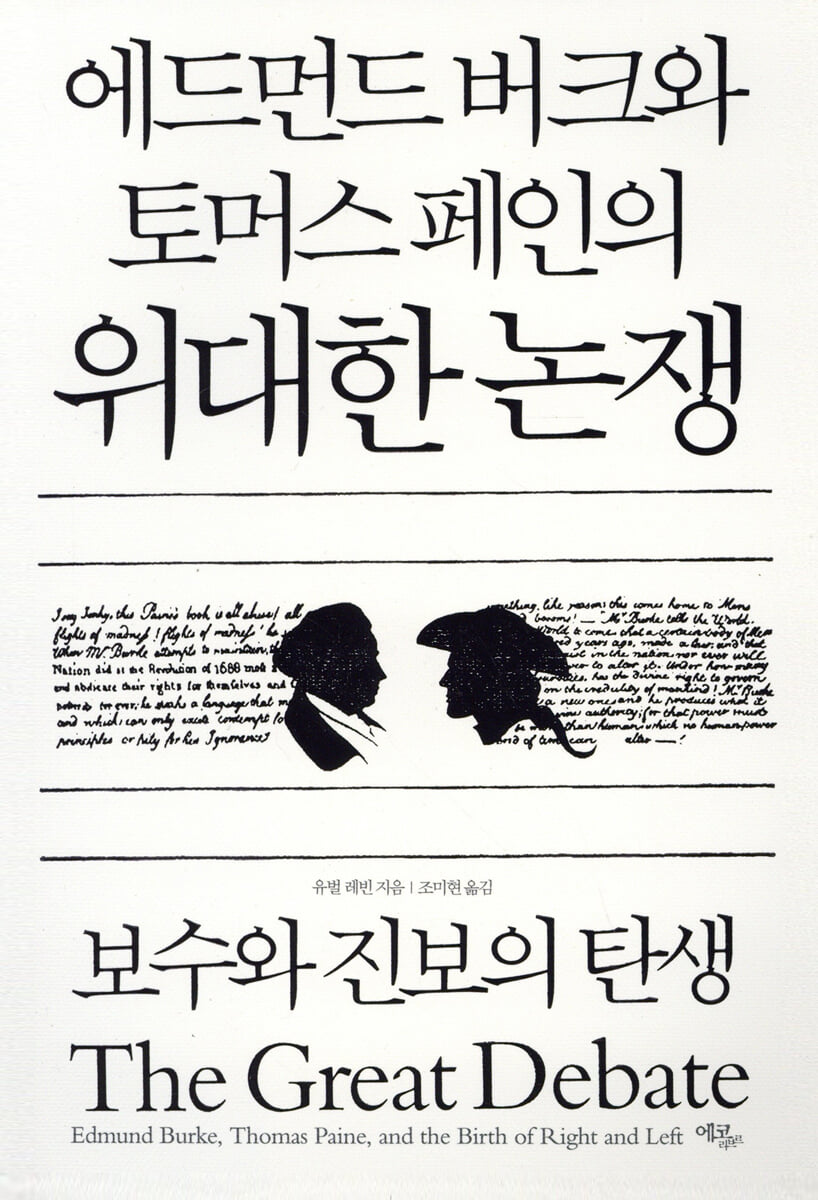
The Great Debate Between Edmund Burke and Thomas Paine
 |
Description
Book Introduction
What is the birth of conservatism and progressivism?
We just had the US presidential election.
Of course, the result was different from what was expected.
The reason I brought up the US presidential election so early is to introduce a book that is essential for fundamentally understanding American society.
This book, "The Great Debate Between Edmund Burke and Thomas Paine," deals with the two main ideologies of the United States, conservative and progressive, which are the essence of elections.
As the title suggests, this book focuses on two thinkers who have had the greatest influence on contemporary American politics: Edmund Burke and Thomas Paine, in order to understand the intellectual origins of American society, or in other words, its essence.
Edmund Burke is relatively well known, as he is always cited as the starting point when discussing the conservative origins of modern thought, but Thomas Paine is known only to experts, and in other words, he carries less weight than Burke.
But that doesn't seem to be the case for understanding American society.
Here, we will briefly introduce their importance in current American society and how their arguments have influenced American society.
We just had the US presidential election.
Of course, the result was different from what was expected.
The reason I brought up the US presidential election so early is to introduce a book that is essential for fundamentally understanding American society.
This book, "The Great Debate Between Edmund Burke and Thomas Paine," deals with the two main ideologies of the United States, conservative and progressive, which are the essence of elections.
As the title suggests, this book focuses on two thinkers who have had the greatest influence on contemporary American politics: Edmund Burke and Thomas Paine, in order to understand the intellectual origins of American society, or in other words, its essence.
Edmund Burke is relatively well known, as he is always cited as the starting point when discussing the conservative origins of modern thought, but Thomas Paine is known only to experts, and in other words, he carries less weight than Burke.
But that doesn't seem to be the case for understanding American society.
Here, we will briefly introduce their importance in current American society and how their arguments have influenced American society.
- You can preview some of the book's contents.
Preview
index
preface
introduction
Two Lives in the Stadium
2 Nature and History
3 Justice and Order
4 Choice and Obligation
5 Reason and Prescription
6 Revolution and Reform
7th Generation and the Living
conclusion
Acknowledgements
main
References
Search
introduction
Two Lives in the Stadium
2 Nature and History
3 Justice and Order
4 Choice and Obligation
5 Reason and Prescription
6 Revolution and Reform
7th Generation and the Living
conclusion
Acknowledgements
main
References
Search
Publisher's Review
Historically, the French Revolution can be cited as an event that marked a turning point in modern times.
It contains both conservative and progressive ideologies.
And the American independence is the best embodiment of the Enlightenment ideas that became the intellectual origin of the French Revolution.
It is often said that philosophy moves history.
This means that political events are tied to political ideologies, and that looking at that knot can illuminate both events and ideologies simultaneously.
This is especially true in times of profound change.
It is certainly such a time now, and it was the same in the times in which Burke and Paine lived.
Therefore, in order to reflect on the current society, it is very meaningful to recall and analyze the ideology that formed its foundation.
This is especially true because examining how these ideologies have changed and evolved can be a useful tool for predicting the future.
As the author preaches:
“Burke and Paine agreed that politics is always fluid, and that the challenge for politicians is to manage change for the good of society.
From this fundamental reality arise the practical questions that divide them and shape all their theoretical explorations and assertions.
But for what purpose and by what means should a people change its political and cultural institutions? While the debate between Burke and Paine may not provide a definitive answer, it does force us to consider deeply and seriously the questions we must still confront.”
Burke and Paine, and the Goals of This Book
Burke was an Irish-born British politician and writer who possessed both powerful and influential views and a unique talent for expressing them in political rhetoric.
He was one of the most dedicated and capable defenders of British constitutional traditions of his time.
Burke, who sought to reform his country gradually and patiently, was among the first, and certainly the most decisive and effective, critics of the radicalism of the French Revolution in British politics.
Paine, a British-born American immigrant, was one of the most eloquent and important voices fighting for the cause of colonial independence, and later, as the French Revolution broke out, he became a prominent advocate for the revolutionaries' cause in Paris and London, where he worked as an essayist and activist.
And he believed fervently in the potential of Enlightenment liberalism to advance the cause of justice and peace by uprooting corrupt, oppressive regimes and replacing them with governments accountable to the people.
He was a brilliant and passionate advocate of freedom and equality.
Both men were men of both ideology and practice.
They also captured much more than the details of the events that sparked the controversies of the time.
The two knew each other well.
We met several times, exchanged letters, and responded publicly to each other's publications.
Their private and public debates surrounding the French Revolution have been called "perhaps the most important ideological debate ever conducted in the English language."
But their profound disagreements extended beyond direct confrontation.
The two also revealed deeply conflicting worldviews regarding the most important issues of liberal democratic political thought.
Of course, the debate between Burke and Paine could not fully capture the major arguments of the period, but even so, their differences of opinion (especially regarding the French Revolution) remain surprisingly understudied.
Therefore, the author sets out to begin this book with the goal of examining the differences between Burke and Paine's views and learning from them about the politics of both their time and our own.
In doing so, I try to demonstrate that, particularly in political life, differences of opinion about the given past authority bind together the diverse claims of Burke and Paine, and that these differences go far beyond the simplistic and simplistic conflict between tradition and progress.
Burke's reforming conservatism and Paine's restorative progressivism are much more complex and consistent.
And when we seriously consider both sides, we can clarify the term "dividing line," which is at the heart of American politics.
In fact, as Burke and Paine show, the distinction between liberals and conservatives divides two types of liberals and two different perspectives within a liberal society.
The basics this book provides
Throughout the 19th and 20th centuries, and even into the 21st century, both men were frequently featured in various political movements.
Thus, their arguments were sometimes worsened or softened by later generations.
But the important thing is to consider the arguments of both men as they originally developed them, not as various factions have sought to exploit them, and to see how the worldviews of Burke and Paine still explain two broad and fundamental tendencies toward political life and political change in our own liberal age.
The tension between those two tendencies ultimately boils down to a few very basic questions:
The fundamental question the author raises in this book is:
In short, should our society conform to the demands of cold, abstract commitments to ideals like social equality, or to the patterns of its concrete political traditions and foundations? Is the relationship between citizen and society primarily defined by the individual right of free choice, or by a web of obligations and customs we have not entirely chosen? Are major public problems best addressed by institutions designed to apply the solid technical knowledge of experts, or by institutions designed to transmit the social knowledge inherent in communities? Should we view our society's flaws as one grand problem, solvable through comprehensive transformation, or as a series of discontinuous faults, with what works well as a foundation for addressing what doesn't? What power should the characteristics of the given world exert over the vision of the world we desire?
The author asserts that these questions accumulate to form a sum total of different ways of thinking about politics, and that people observe their countries and discover a mixture of good and bad.
So when we face the society that surrounds us, we decide whether we will move toward strengthening and accumulating it while being grateful for what is well-functioning in that society, or whether we will move toward uprooting and changing it while being angry at what is poorly functioning.
Of course, this ultimate action depends on the people's inherent notion of what exactly our political order—modern liberalism—actually is.
Finally, we must bear in mind that while Burke and Paine provide us with a window into the birth of the Right and the Left, seeing the birth of an ideology does not mean seeing its development; rather, we must understand as accurately as possible how it has evolved from the perspectives these two men articulated.
While this book can only scratch the surface of that complex evolution, I believe even a broad overview will help us see how Burke and Paine remain a valuable starting point and a useful solution for both the right and the left today.
It contains both conservative and progressive ideologies.
And the American independence is the best embodiment of the Enlightenment ideas that became the intellectual origin of the French Revolution.
It is often said that philosophy moves history.
This means that political events are tied to political ideologies, and that looking at that knot can illuminate both events and ideologies simultaneously.
This is especially true in times of profound change.
It is certainly such a time now, and it was the same in the times in which Burke and Paine lived.
Therefore, in order to reflect on the current society, it is very meaningful to recall and analyze the ideology that formed its foundation.
This is especially true because examining how these ideologies have changed and evolved can be a useful tool for predicting the future.
As the author preaches:
“Burke and Paine agreed that politics is always fluid, and that the challenge for politicians is to manage change for the good of society.
From this fundamental reality arise the practical questions that divide them and shape all their theoretical explorations and assertions.
But for what purpose and by what means should a people change its political and cultural institutions? While the debate between Burke and Paine may not provide a definitive answer, it does force us to consider deeply and seriously the questions we must still confront.”
Burke and Paine, and the Goals of This Book
Burke was an Irish-born British politician and writer who possessed both powerful and influential views and a unique talent for expressing them in political rhetoric.
He was one of the most dedicated and capable defenders of British constitutional traditions of his time.
Burke, who sought to reform his country gradually and patiently, was among the first, and certainly the most decisive and effective, critics of the radicalism of the French Revolution in British politics.
Paine, a British-born American immigrant, was one of the most eloquent and important voices fighting for the cause of colonial independence, and later, as the French Revolution broke out, he became a prominent advocate for the revolutionaries' cause in Paris and London, where he worked as an essayist and activist.
And he believed fervently in the potential of Enlightenment liberalism to advance the cause of justice and peace by uprooting corrupt, oppressive regimes and replacing them with governments accountable to the people.
He was a brilliant and passionate advocate of freedom and equality.
Both men were men of both ideology and practice.
They also captured much more than the details of the events that sparked the controversies of the time.
The two knew each other well.
We met several times, exchanged letters, and responded publicly to each other's publications.
Their private and public debates surrounding the French Revolution have been called "perhaps the most important ideological debate ever conducted in the English language."
But their profound disagreements extended beyond direct confrontation.
The two also revealed deeply conflicting worldviews regarding the most important issues of liberal democratic political thought.
Of course, the debate between Burke and Paine could not fully capture the major arguments of the period, but even so, their differences of opinion (especially regarding the French Revolution) remain surprisingly understudied.
Therefore, the author sets out to begin this book with the goal of examining the differences between Burke and Paine's views and learning from them about the politics of both their time and our own.
In doing so, I try to demonstrate that, particularly in political life, differences of opinion about the given past authority bind together the diverse claims of Burke and Paine, and that these differences go far beyond the simplistic and simplistic conflict between tradition and progress.
Burke's reforming conservatism and Paine's restorative progressivism are much more complex and consistent.
And when we seriously consider both sides, we can clarify the term "dividing line," which is at the heart of American politics.
In fact, as Burke and Paine show, the distinction between liberals and conservatives divides two types of liberals and two different perspectives within a liberal society.
The basics this book provides
Throughout the 19th and 20th centuries, and even into the 21st century, both men were frequently featured in various political movements.
Thus, their arguments were sometimes worsened or softened by later generations.
But the important thing is to consider the arguments of both men as they originally developed them, not as various factions have sought to exploit them, and to see how the worldviews of Burke and Paine still explain two broad and fundamental tendencies toward political life and political change in our own liberal age.
The tension between those two tendencies ultimately boils down to a few very basic questions:
The fundamental question the author raises in this book is:
In short, should our society conform to the demands of cold, abstract commitments to ideals like social equality, or to the patterns of its concrete political traditions and foundations? Is the relationship between citizen and society primarily defined by the individual right of free choice, or by a web of obligations and customs we have not entirely chosen? Are major public problems best addressed by institutions designed to apply the solid technical knowledge of experts, or by institutions designed to transmit the social knowledge inherent in communities? Should we view our society's flaws as one grand problem, solvable through comprehensive transformation, or as a series of discontinuous faults, with what works well as a foundation for addressing what doesn't? What power should the characteristics of the given world exert over the vision of the world we desire?
The author asserts that these questions accumulate to form a sum total of different ways of thinking about politics, and that people observe their countries and discover a mixture of good and bad.
So when we face the society that surrounds us, we decide whether we will move toward strengthening and accumulating it while being grateful for what is well-functioning in that society, or whether we will move toward uprooting and changing it while being angry at what is poorly functioning.
Of course, this ultimate action depends on the people's inherent notion of what exactly our political order—modern liberalism—actually is.
Finally, we must bear in mind that while Burke and Paine provide us with a window into the birth of the Right and the Left, seeing the birth of an ideology does not mean seeing its development; rather, we must understand as accurately as possible how it has evolved from the perspectives these two men articulated.
While this book can only scratch the surface of that complex evolution, I believe even a broad overview will help us see how Burke and Paine remain a valuable starting point and a useful solution for both the right and the left today.
GOODS SPECIFICS
- Date of publication: November 11, 2016
- Page count, weight, size: 352 pages | 494g | 148*217*30mm
- ISBN13: 9788962631524
- ISBN10: 8962631520
You may also like
카테고리
korean


korean

![GQ KOREA Mark (Monthly): December [2025]](http://librairie.coreenne.fr/cdn/shop/files/8ef265dbbfbf186523ed75ba7319009d.jpg?v=1765340328&width=3840)


