

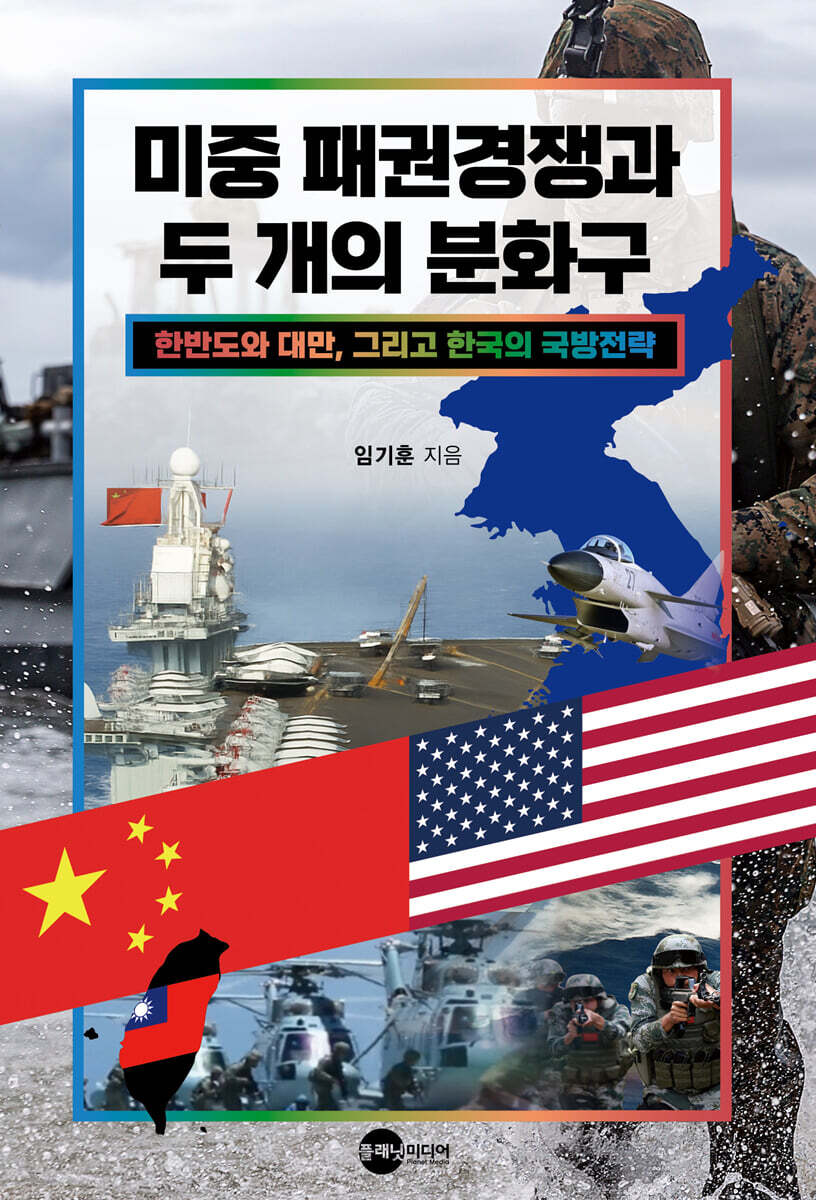
The US-China Hegemony Competition and Two Craters
 |
Description
Book Introduction
The Korean Peninsula and Taiwan: Two Craters That Could Erupt at Any Time
The Taiwan crisis and the Korean Peninsula brought about by the US-China hegemony competition
The Asia-Pacific region, which includes the Korean Peninsula, is a key stage for the US-China hegemony competition.
American political scientist Graham T.
According to Allison, since the 15th century, 16 great powers have fought for hegemony, resulting in 12 wars.
The US-China hegemony competition also has a high possibility of leading to war, and the most dangerous crater in this case is Taiwan.
Recently, China and Japan have been in a sharp conflict over the Japanese Prime Minister's remark that "Japan could intervene militarily in the event of an emergency in Taiwan," which is also a branch of the US-China hegemony competition.
These conflicts and confrontations among the major countries of the Asia-Pacific region are bound to continue in the future, and they could escalate into war at any time.
The Korean Peninsula is no exception, and the confrontation with North Korea, another crater, is also in an unstable state, with no end in sight.
This book clearly organizes and presents where and how the crises in the Asia-Pacific region, including the Taiwan crisis, began and where they are heading.
We are deeply exploring how the US-China hegemony competition will change the status of US forces in Korea and Japan, what challenges politics and national defense on the Korean Peninsula will ultimately face, and what our means of response will be and to what extent.
The Taiwan crisis and the Korean Peninsula brought about by the US-China hegemony competition
The Asia-Pacific region, which includes the Korean Peninsula, is a key stage for the US-China hegemony competition.
American political scientist Graham T.
According to Allison, since the 15th century, 16 great powers have fought for hegemony, resulting in 12 wars.
The US-China hegemony competition also has a high possibility of leading to war, and the most dangerous crater in this case is Taiwan.
Recently, China and Japan have been in a sharp conflict over the Japanese Prime Minister's remark that "Japan could intervene militarily in the event of an emergency in Taiwan," which is also a branch of the US-China hegemony competition.
These conflicts and confrontations among the major countries of the Asia-Pacific region are bound to continue in the future, and they could escalate into war at any time.
The Korean Peninsula is no exception, and the confrontation with North Korea, another crater, is also in an unstable state, with no end in sight.
This book clearly organizes and presents where and how the crises in the Asia-Pacific region, including the Taiwan crisis, began and where they are heading.
We are deeply exploring how the US-China hegemony competition will change the status of US forces in Korea and Japan, what challenges politics and national defense on the Korean Peninsula will ultimately face, and what our means of response will be and to what extent.
- You can preview some of the book's contents.
Preview
index
When publishing a book
Abbreviation table
Introduction
CHAPTER 1 Defense Strategies of Major Countries in the Asia-Pacific Region
1.
USA
(1) National Defense Strategy: Security Strategy System / Top Priorities of National Defense Strategy / Indo-Pacific Strategy
(2) Unified Combat Command: Regional Unified Combat Command (7) / Functional Unified Combat Command (4) / Subordinate Unified Combat Command
(3) Indo-Pacific Command: Indo-Pacific Command composition / Indo-Pacific Command military power
2.
china
(1) National Defense Strategy: Threat Perception / National Security Strategy / National Defense Strategy / Military Strategy / War Theory
(2) Military power of the Chinese People's Liberation Army
(3) China's Overseas Military Network: Joint Military Activities with Russia / China's Overseas Military Bases
3.
japan
(1) Security Policy: Interpretation of Article 9 of the Constitution / Basic Principles of Defense Policy
(2) Defense Strategy: Defense Strategy 3 Documents / Japan's Defense Objectives and Approaches
(3) Japan's military power: Self-Defense Forces / Major joint exercises and training
4.
russia
(1) National Defense Strategy
(2) Military power
5.
australia
(1) National Defense Strategy
(2) Military power
CHAPTER 2 Two Craters
1.
North Korea's nuclear program and the Korean Peninsula
(1) North Korea's Nuclear Threat: Progress of North Korea's Nuclear Advancement / North Korea's Nuclear Strategy / Outlook for North Korea's Nuclear Capability Advancement
(2) Prediction of the Korean Peninsula War
(3) U.S. nuclear policy: U.S. nuclear use principles / U.S. nuclear declaration policy / U.S. nuclear triad system / NATO nuclear posture
(4) ROK-US Alliance Response Strategy: Korean Triad System / Extended Deterrence
2.
Taiwan and the US-China conflict
(1) China's policy toward Taiwan
(2) U.S. policy toward Taiwan
(3) Taiwan Strait Crisis: First Taiwan Strait Crisis / Second Taiwan Strait Crisis / Third Taiwan Strait Crisis
(4) Recent US-China Military Confrontation in the Taiwan Strait: The Taiwan Situation in August 2022/Joint Sword-2024 A/B Exercise (Taiwan Encirclement Training)
(5) Possible scenarios in the event of a Taiwan crisis: Gray Zone strategy + escalation of the crisis through hybrid warfare / Occupation of Taiwan's outer islands / Complete blockade of Taiwan / Invasion of Taiwan's main island
(6) Status of US-China Military Power in the Indo-Pacific Region: US / China and Taiwan
(7) Strategic options for neighboring countries in the event of a Chinese threat to Taiwan: cooperative strategy / conflict strategy
CHAPTER 3 Redesigning Korea's Defense Strategy
1.
Redesigning the National Defense Strategy
(1) The strategic environment facing our military
(2) Direction of redesign of national defense strategy
2.
A paradigm shift in military power building
3.
Strengthening North Korea deterrence and response capabilities
(1) Expansion of the concept and capabilities of the Korean three-axis system
(2) Establishment of a cognitive operations execution system
(3) Reorganization of the upper command structure
(4) Introduction of the Korean PWRM system
(5) Introduction of a standing reserve force system to refine reserve forces.
4.
Reform of the defense talent training system
(1) Innovation in the defense education system to foster strategic leaders
(2) National Security and Science and Technology in the AI Era
5.
Strengthening the ROK-US alliance and multilateral security cooperation
(1) Modernization of the ROK-US alliance
(2) Strategic flexibility of US forces in Korea
(3) Transfer of wartime operational control
(4) Defense cost sharing
(5) Korea-US-Japan security cooperation
(6) UN Command and multilateral security cooperation
conclusion
Note
References
Abbreviation table
Introduction
CHAPTER 1 Defense Strategies of Major Countries in the Asia-Pacific Region
1.
USA
(1) National Defense Strategy: Security Strategy System / Top Priorities of National Defense Strategy / Indo-Pacific Strategy
(2) Unified Combat Command: Regional Unified Combat Command (7) / Functional Unified Combat Command (4) / Subordinate Unified Combat Command
(3) Indo-Pacific Command: Indo-Pacific Command composition / Indo-Pacific Command military power
2.
china
(1) National Defense Strategy: Threat Perception / National Security Strategy / National Defense Strategy / Military Strategy / War Theory
(2) Military power of the Chinese People's Liberation Army
(3) China's Overseas Military Network: Joint Military Activities with Russia / China's Overseas Military Bases
3.
japan
(1) Security Policy: Interpretation of Article 9 of the Constitution / Basic Principles of Defense Policy
(2) Defense Strategy: Defense Strategy 3 Documents / Japan's Defense Objectives and Approaches
(3) Japan's military power: Self-Defense Forces / Major joint exercises and training
4.
russia
(1) National Defense Strategy
(2) Military power
5.
australia
(1) National Defense Strategy
(2) Military power
CHAPTER 2 Two Craters
1.
North Korea's nuclear program and the Korean Peninsula
(1) North Korea's Nuclear Threat: Progress of North Korea's Nuclear Advancement / North Korea's Nuclear Strategy / Outlook for North Korea's Nuclear Capability Advancement
(2) Prediction of the Korean Peninsula War
(3) U.S. nuclear policy: U.S. nuclear use principles / U.S. nuclear declaration policy / U.S. nuclear triad system / NATO nuclear posture
(4) ROK-US Alliance Response Strategy: Korean Triad System / Extended Deterrence
2.
Taiwan and the US-China conflict
(1) China's policy toward Taiwan
(2) U.S. policy toward Taiwan
(3) Taiwan Strait Crisis: First Taiwan Strait Crisis / Second Taiwan Strait Crisis / Third Taiwan Strait Crisis
(4) Recent US-China Military Confrontation in the Taiwan Strait: The Taiwan Situation in August 2022/Joint Sword-2024 A/B Exercise (Taiwan Encirclement Training)
(5) Possible scenarios in the event of a Taiwan crisis: Gray Zone strategy + escalation of the crisis through hybrid warfare / Occupation of Taiwan's outer islands / Complete blockade of Taiwan / Invasion of Taiwan's main island
(6) Status of US-China Military Power in the Indo-Pacific Region: US / China and Taiwan
(7) Strategic options for neighboring countries in the event of a Chinese threat to Taiwan: cooperative strategy / conflict strategy
CHAPTER 3 Redesigning Korea's Defense Strategy
1.
Redesigning the National Defense Strategy
(1) The strategic environment facing our military
(2) Direction of redesign of national defense strategy
2.
A paradigm shift in military power building
3.
Strengthening North Korea deterrence and response capabilities
(1) Expansion of the concept and capabilities of the Korean three-axis system
(2) Establishment of a cognitive operations execution system
(3) Reorganization of the upper command structure
(4) Introduction of the Korean PWRM system
(5) Introduction of a standing reserve force system to refine reserve forces.
4.
Reform of the defense talent training system
(1) Innovation in the defense education system to foster strategic leaders
(2) National Security and Science and Technology in the AI Era
5.
Strengthening the ROK-US alliance and multilateral security cooperation
(1) Modernization of the ROK-US alliance
(2) Strategic flexibility of US forces in Korea
(3) Transfer of wartime operational control
(4) Defense cost sharing
(5) Korea-US-Japan security cooperation
(6) UN Command and multilateral security cooperation
conclusion
Note
References
Into the book
In this book, the author examines the defense strategies of major countries to navigate the security uncertainties in the Asia-Pacific region and predicts crises on the Korean Peninsula and Taiwan that could spread across the entire Asia-Pacific region.
And he described the national defense strategy of 'self-reliance and innovation' that the ROK military must pursue to overcome the enormous security challenges we face.
Chapter 1 introduces the defense strategies of major countries in the Asia-Pacific region: the United States, China, Japan, Russia, and Australia.
These five countries are key countries leading the international order in the Asia-Pacific region and are central countries in the Asia-Pacific region that also have a significant impact on the security of the Republic of Korea.
It is very meaningful to understand how these countries view the strategic environment of the Asia-Pacific region and what national defense strategy concepts and military force development directions they are pursuing based on their threat perceptions.
Currently, the United States, Japan, and Australia are seeking to unite liberal nations in the vast Asia-Pacific region to create an international order favorable to them, and are demanding Korea's participation.
Russia, based on its perception that "Russia is a great power," criticizes the United States' actions and, by aligning with North Korea, challenges the security order in the Asia-Pacific region.
China is pressuring Korea and forcing strategic choices by pursuing a strategy of internalizing not only the East and South China Seas but also the West Sea.
Chapter 2 is about the crisis situations in two craters, namely the Korean Peninsula and Taiwan.
The first crater is the Korean Peninsula.
We examined North Korea's nuclear capabilities, the response capabilities of the ROK-US alliance, and the US nuclear posture, and presented various patterns of North Korea's provocations.
The second crater is Taiwan.
It describes the US-China rivalry surrounding Taiwan, the Taiwan Strait crisis, and a scenario of a Chinese invasion of Taiwan.
It also describes the strategic options that neighboring countries, including South Korea, could take if China threatens or invades Taiwan.
Currently, leading think tanks in the United States, including the Center for Strategic and International Studies (CSIS), are discussing scenarios for simultaneous crises on the Korean Peninsula and Taiwan and how the United States and its allies should respond.
As many Korean security experts are also participating, we must recognize that the possibility of simultaneous conflicts on the Korean Peninsula and Taiwan is no longer an issue beyond discussion but a reality we will face.
Chapter 3 explains Korea's defense strategy.
Recognizing the crisis before us, we must redesign our defense strategy to ensure our military can overcome the formidable challenges.
We must innovate the concept of military force operation and the paradigm of military force construction.
This paper presents my views on key issues that must be considered in redesigning the national defense strategy, including the core capabilities required to become a "self-reliant, elite military," approaches to strengthening the ROK-US alliance and multilateral security cooperation, and plans to innovate the education system to cultivate defense talent.
And he described the national defense strategy of 'self-reliance and innovation' that the ROK military must pursue to overcome the enormous security challenges we face.
Chapter 1 introduces the defense strategies of major countries in the Asia-Pacific region: the United States, China, Japan, Russia, and Australia.
These five countries are key countries leading the international order in the Asia-Pacific region and are central countries in the Asia-Pacific region that also have a significant impact on the security of the Republic of Korea.
It is very meaningful to understand how these countries view the strategic environment of the Asia-Pacific region and what national defense strategy concepts and military force development directions they are pursuing based on their threat perceptions.
Currently, the United States, Japan, and Australia are seeking to unite liberal nations in the vast Asia-Pacific region to create an international order favorable to them, and are demanding Korea's participation.
Russia, based on its perception that "Russia is a great power," criticizes the United States' actions and, by aligning with North Korea, challenges the security order in the Asia-Pacific region.
China is pressuring Korea and forcing strategic choices by pursuing a strategy of internalizing not only the East and South China Seas but also the West Sea.
Chapter 2 is about the crisis situations in two craters, namely the Korean Peninsula and Taiwan.
The first crater is the Korean Peninsula.
We examined North Korea's nuclear capabilities, the response capabilities of the ROK-US alliance, and the US nuclear posture, and presented various patterns of North Korea's provocations.
The second crater is Taiwan.
It describes the US-China rivalry surrounding Taiwan, the Taiwan Strait crisis, and a scenario of a Chinese invasion of Taiwan.
It also describes the strategic options that neighboring countries, including South Korea, could take if China threatens or invades Taiwan.
Currently, leading think tanks in the United States, including the Center for Strategic and International Studies (CSIS), are discussing scenarios for simultaneous crises on the Korean Peninsula and Taiwan and how the United States and its allies should respond.
As many Korean security experts are also participating, we must recognize that the possibility of simultaneous conflicts on the Korean Peninsula and Taiwan is no longer an issue beyond discussion but a reality we will face.
Chapter 3 explains Korea's defense strategy.
Recognizing the crisis before us, we must redesign our defense strategy to ensure our military can overcome the formidable challenges.
We must innovate the concept of military force operation and the paradigm of military force construction.
This paper presents my views on key issues that must be considered in redesigning the national defense strategy, including the core capabilities required to become a "self-reliant, elite military," approaches to strengthening the ROK-US alliance and multilateral security cooperation, and plans to innovate the education system to cultivate defense talent.
--- From the text
Publisher's Review
A Glance at the Asia-Pacific Region's Security Topography
The author, who has dedicated himself to academic research based on his experience in the military and government, views Korea's national defense issues not from the narrow perspective of confrontation between North and South Korea, but from a world historical context and global perspective.
By presenting how the recent Russo-Russian War and the Israeli War will impact the political and military confrontations between South Korea, the US, and Japan, and North Korea, China, and Russia, and how the US's strategic shifts in the Asia and Indo-Pacific regions, which determine the global order, began and in what direction, it provides a three-dimensional view of the true dangers facing the Korean Peninsula.
By objectively examining the situations and options available to other countries in the Asia-Pacific region, including the four major powers surrounding the Korean Peninsula, we clearly present the positions we can choose and the associated risks.
National defense is a matter that affects the lives of the nation itself and all its citizens, and therefore should not be influenced by the political preferences of any particular individual or group, or by religious or philosophical beliefs.
Without a cool-headed assessment of the situation and a realistic strategy, the volcano could erupt first on the Korean Peninsula, not Taiwan.
Practical Strategies and Tactics for Survival on the Korean Peninsula
Taiwan's crisis is by no means someone else's problem.
In the event of a contingency in Taiwan, US forces stationed in Korea will be moved out of the Korean Peninsula, and liberal countries, including the US and Japan, will strongly demand that our country participate in the war.
In this case, North Korea could seize a golden opportunity, and China, its largest trading partner, and South Korea would become parties to the war.
If we reject America's demands, greater problems and threats await us, and the survival of the Korean Peninsula and its people could be in immediate danger.
As everyone knows, our country also faces an extraordinary threat: North Korea's nuclear weapons.
This issue, which is squeezing our choices and position, is closely linked to the hegemonic competition between North and South Korea, as well as between the US and China, and it is difficult to find a solution at present.
Beyond seeking a political solution, this is an issue that requires thorough preparation in the defense sector to protect the lives and safety of the people.
The author presents the current status of this acute problem, the best military options available, and practical and realistic strategies and tactics to achieve them.
It clearly presents strategies and tactics for how our military should prepare for a future battlefield dominated by AI, drones, and robots, as well as countermeasures against North Korea's nuclear program, including the Kill Chain.
A must-read for anyone concerned about the security and future of the Korean Peninsula.
The author, who has dedicated himself to academic research based on his experience in the military and government, views Korea's national defense issues not from the narrow perspective of confrontation between North and South Korea, but from a world historical context and global perspective.
By presenting how the recent Russo-Russian War and the Israeli War will impact the political and military confrontations between South Korea, the US, and Japan, and North Korea, China, and Russia, and how the US's strategic shifts in the Asia and Indo-Pacific regions, which determine the global order, began and in what direction, it provides a three-dimensional view of the true dangers facing the Korean Peninsula.
By objectively examining the situations and options available to other countries in the Asia-Pacific region, including the four major powers surrounding the Korean Peninsula, we clearly present the positions we can choose and the associated risks.
National defense is a matter that affects the lives of the nation itself and all its citizens, and therefore should not be influenced by the political preferences of any particular individual or group, or by religious or philosophical beliefs.
Without a cool-headed assessment of the situation and a realistic strategy, the volcano could erupt first on the Korean Peninsula, not Taiwan.
Practical Strategies and Tactics for Survival on the Korean Peninsula
Taiwan's crisis is by no means someone else's problem.
In the event of a contingency in Taiwan, US forces stationed in Korea will be moved out of the Korean Peninsula, and liberal countries, including the US and Japan, will strongly demand that our country participate in the war.
In this case, North Korea could seize a golden opportunity, and China, its largest trading partner, and South Korea would become parties to the war.
If we reject America's demands, greater problems and threats await us, and the survival of the Korean Peninsula and its people could be in immediate danger.
As everyone knows, our country also faces an extraordinary threat: North Korea's nuclear weapons.
This issue, which is squeezing our choices and position, is closely linked to the hegemonic competition between North and South Korea, as well as between the US and China, and it is difficult to find a solution at present.
Beyond seeking a political solution, this is an issue that requires thorough preparation in the defense sector to protect the lives and safety of the people.
The author presents the current status of this acute problem, the best military options available, and practical and realistic strategies and tactics to achieve them.
It clearly presents strategies and tactics for how our military should prepare for a future battlefield dominated by AI, drones, and robots, as well as countermeasures against North Korea's nuclear program, including the Kill Chain.
A must-read for anyone concerned about the security and future of the Korean Peninsula.
GOODS SPECIFICS
- Date of issue: November 27, 2025
- Page count, weight, size: 336 pages | 153*224*30mm
- ISBN13: 9791124129005
- ISBN10: 1124129006
You may also like
카테고리
korean


korean

![GQ KOREA Mark (Monthly): December [2025]](http://librairie.coreenne.fr/cdn/shop/files/8ef265dbbfbf186523ed75ba7319009d.jpg?v=1765340328&width=3840)


