

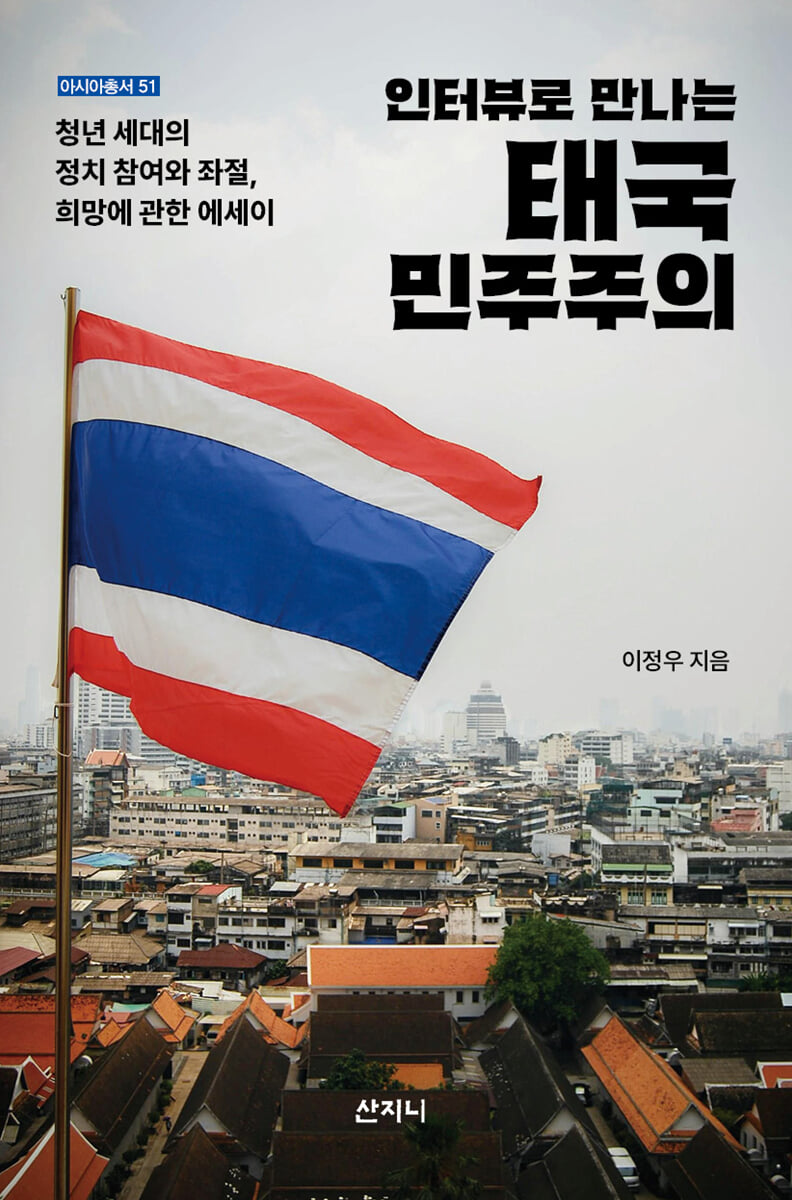
Thai Democracy Through Interviews
 |
Description
Book Introduction
Hidden behind the glamorous tourist attractions
Thailand's political reality
Thailand has been recognized as a representative travel destination for Koreans.
However, in October 2025, following the death of Queen Dowager Sirikit, a period of national mourning was declared, with alcohol sales curtailed and the wearing of black clothing virtually enforced for all citizens, with tourists also having to be cautious.
A political reality quite different from the tourist destination image has surfaced.
To truly understand Thailand, it is necessary to pay attention to its power structures and political conflicts.
"Thai Democracy Through Interviews" is a book that sheds light on Thailand's democracy movement and the voices of the young political generation based on this awareness of the problem.
Author Lee Jeong-woo focused on the successive dissolutions of progressive political parties by the Thai Constitutional Court in 2020 and 2024, and interviewed Thai youth directly to study the stark differences in public reaction between the two periods.
This book vividly records the present and future of Thai democracy and the political participation of young people.
Thailand's political reality
Thailand has been recognized as a representative travel destination for Koreans.
However, in October 2025, following the death of Queen Dowager Sirikit, a period of national mourning was declared, with alcohol sales curtailed and the wearing of black clothing virtually enforced for all citizens, with tourists also having to be cautious.
A political reality quite different from the tourist destination image has surfaced.
To truly understand Thailand, it is necessary to pay attention to its power structures and political conflicts.
"Thai Democracy Through Interviews" is a book that sheds light on Thailand's democracy movement and the voices of the young political generation based on this awareness of the problem.
Author Lee Jeong-woo focused on the successive dissolutions of progressive political parties by the Thai Constitutional Court in 2020 and 2024, and interviewed Thai youth directly to study the stark differences in public reaction between the two periods.
This book vividly records the present and future of Thai democracy and the political participation of young people.
- You can preview some of the book's contents.
Preview
index
Opening remarks
Thailand's political background
Unexpected collapse
A future we can't give up
Interview preparation
The first interview: The decline of the royal reform movement was brought about by the very party we supported.
Don't give up on the second interview and get involved in politics.
Third Interview: Meet Natanit Duangmusit
Fourth Interview: About Life After Being Released from Prison
Fifth Interview: Perhaps democratization will be achieved within 20 years.
Interview Six: Shouldn't adults do this to their students?
Interview Seven: When I grow up, I want to be a protest leader.
Interview Eighth: The Royal Family Doesn't Try to Communicate with the Public
Interview 9: Meet an Ordinary Thai Couple
Interview 10: Thai society remains unchanged, past and present.
The Eleventh Interview: How to Survive
Special Interview: Meet the Godfather of Labor, Mr. Somyot Prueksakassuk
What Thailand's Royal Reform Movement Means for Korea
Closing remarks
main
References
Thailand's political background
Unexpected collapse
A future we can't give up
Interview preparation
The first interview: The decline of the royal reform movement was brought about by the very party we supported.
Don't give up on the second interview and get involved in politics.
Third Interview: Meet Natanit Duangmusit
Fourth Interview: About Life After Being Released from Prison
Fifth Interview: Perhaps democratization will be achieved within 20 years.
Interview Six: Shouldn't adults do this to their students?
Interview Seven: When I grow up, I want to be a protest leader.
Interview Eighth: The Royal Family Doesn't Try to Communicate with the Public
Interview 9: Meet an Ordinary Thai Couple
Interview 10: Thai society remains unchanged, past and present.
The Eleventh Interview: How to Survive
Special Interview: Meet the Godfather of Labor, Mr. Somyot Prueksakassuk
What Thailand's Royal Reform Movement Means for Korea
Closing remarks
main
References
Into the book
Looking back to February 2020, following the dissolution of the Anakotmai Party, protests by young people erupted across Thailand.
However, despite the dissolution of its successor, the Kauklai Party, no protests took place.
And the Kawklai Party was re-established under the name of Prachachat Party, just as the Anakotmai Party was re-established.
But I was curious.
Why didn't protests occur in 2024, unlike in 2020? Could something have happened to the activists?
--- p.9
Carrying on the spirit of the democratization movements of October 14, 1973, and October 6, 1976 remains a task for the younger generation in Thailand.
And I, too, continue to watch over their past and present, cheer for their future, and sometimes even engage in activities that can provide some help.
Still, we all move forward together into the future.
Finding a free life and daily life against authoritarianism is a difficult process.
Still, we have to be together.
--- p.40
I think youth is not limited to age.
I think people with open minds are young.
A young person is someone who is open to change.
It is also connected to the values of democracy.
Thai tradition does not tolerate differing opinions.
If you have a different opinion, you will be oppressed or imprisoned.
Different opinions must be able to coexist and must be based on the principles of human rights.
--- p.81
He was a boy, a high school student, no doubt.
I thought he would be a really mature friend because he was introduced as a high school student who actively participated in protests and was very interested in politics.
My first impression was that he was a young male student.
He has a pretty smile and I think it would be reassuring as a parent to have a son like him, but it breaks my heart to see him so passionate about protests.
Of course, age and gender have no place in the democratization movement.
But what kind of society is this where growing students have no choice but to protest?
--- p.130
When the Yellow Shirt movement started, I actually participated in it.
But when the Yellow Shirts proposed appointing a cabinet from above rather than through elections, I thought, oh, this is not democracy.
It is necessary to return power back to those above, who appoint the government.
So I started to suspect that this wasn't democracy, and I decided not to participate in the Yellow Shirt movement anymore.
And then there was a coup in 2006.
I saw that coup and was convinced that it was connected.
The coup was actually to protect the higher-ups.
However, despite the dissolution of its successor, the Kauklai Party, no protests took place.
And the Kawklai Party was re-established under the name of Prachachat Party, just as the Anakotmai Party was re-established.
But I was curious.
Why didn't protests occur in 2024, unlike in 2020? Could something have happened to the activists?
--- p.9
Carrying on the spirit of the democratization movements of October 14, 1973, and October 6, 1976 remains a task for the younger generation in Thailand.
And I, too, continue to watch over their past and present, cheer for their future, and sometimes even engage in activities that can provide some help.
Still, we all move forward together into the future.
Finding a free life and daily life against authoritarianism is a difficult process.
Still, we have to be together.
--- p.40
I think youth is not limited to age.
I think people with open minds are young.
A young person is someone who is open to change.
It is also connected to the values of democracy.
Thai tradition does not tolerate differing opinions.
If you have a different opinion, you will be oppressed or imprisoned.
Different opinions must be able to coexist and must be based on the principles of human rights.
--- p.81
He was a boy, a high school student, no doubt.
I thought he would be a really mature friend because he was introduced as a high school student who actively participated in protests and was very interested in politics.
My first impression was that he was a young male student.
He has a pretty smile and I think it would be reassuring as a parent to have a son like him, but it breaks my heart to see him so passionate about protests.
Of course, age and gender have no place in the democratization movement.
But what kind of society is this where growing students have no choice but to protest?
--- p.130
When the Yellow Shirt movement started, I actually participated in it.
But when the Yellow Shirts proposed appointing a cabinet from above rather than through elections, I thought, oh, this is not democracy.
It is necessary to return power back to those above, who appoint the government.
So I started to suspect that this wasn't democracy, and I decided not to participate in the Yellow Shirt movement anymore.
And then there was a coup in 2006.
I saw that coup and was convinced that it was connected.
The coup was actually to protect the higher-ups.
--- p.214
Publisher's Review
The Dissolution of the Progressive Party and Street Protests: The Difference Between 2020 and 2024
The Thai royal family and the military have maintained a close relationship for a long time, and have maintained power by staging coups whenever a political force unfavorable to them has emerged.
Since the rise of Thaksin Shinawatra, a politician who emerged as an alternative to the monarchy with the support of rural voters, Thai politics in the 2000s and 2010s has been marked by conflict between conservative forces supporting the monarchy (Yellow Shirts) and forces supporting Thaksin (Red Shirts).
The Anakotmai Party (Future Forward Party), which emerged within this framework, became a symbol of reform and was called the "Orange Party" due to the enthusiastic support of the younger generation. However, after political retaliation following the 2019 general election, it was dissolved by a Constitutional Court decision in 2020.
Angered by this, young people took to the streets and staged large-scale protests.
The Kawklai Party (Forward Party), re-established by members of the Anakhotmai Party, advanced to become the largest party in the 2023 general election, but failed to establish power due to opposition from the military and the royal family, and was ordered to be dissolved again in 2024.
However, unlike 2020, there were no large-scale protests this time, and author Lee Jeong-woo drew attention to this very difference between 2020 and 2024.
The book analyzes what changes occurred over the past four years that prevented protests from occurring.
Political Engagement of Thailand's Youth: Their Grief? Anger? Hope
Today's Thai youth are the most dynamic players in the fight for democracy.
The author met and interviewed many young people in person, vividly recording their sorrow, frustration, anger, and hope.
This book contains information on how young Thai people perceive the current political situation in Thailand, their views on the ruling and opposition parties, and their views on the future of Thai democracy.
This record is important at a time when political pressures are weakening the power base of Thai democracy activists.
Activists are now faced with two options: imprisonment for "lese majeste" or exile to avoid it.
In this reality, Thailand could not be a place for tourism for the author, but rather a real space where friends were fighting for democracy.
The author has supported Thai activists in various ways during and after the writing process, and the publication of this book is part of that solidarity.
The author emphasizes the need for international solidarity to protect democracy in Thailand.
Solidarity with citizens of neighboring countries will be another means of preserving our own democracy, and when we think about democracy transnationally, we can protect and reconstruct democracy on a broader horizon.
The fight over Article 112 of Thailand's Criminal Code, the crime of lese majeste.
At the heart of the Thai democracy movement is the crime of lese majeste (Article 112 of the Thai Penal Code).
“Anyone who slanders or threatens the King, Queen, or Crown Prince shall be punished by imprisonment for not less than three years but not more than fifteen years.” This provision legally guarantees the absolute authority of the royal family, and has long created a taboo area where even criticism of the royal family is not permitted.
But in 2020, Thailand's younger generation challenged that silence head-on.
Many of the participants, from the research assistant who assisted the author in conducting the interviews to the interviewees themselves, have been investigated or served time in prison for this crime.
The author interprets the emergence of questions about the royal family as a question about the final sanctuary that democracy must ultimately reach.
Thai youth recognize that democracy will only mature when they can speak out about the monarchy.
These questions also require important reflection in Korean society.
What are we still unable to talk about?
"Thai Democracy Through Interviews" also allows us to reflect on the blind spots of Korean democracy through the mirror reflecting Thailand.
The Thai royal family and the military have maintained a close relationship for a long time, and have maintained power by staging coups whenever a political force unfavorable to them has emerged.
Since the rise of Thaksin Shinawatra, a politician who emerged as an alternative to the monarchy with the support of rural voters, Thai politics in the 2000s and 2010s has been marked by conflict between conservative forces supporting the monarchy (Yellow Shirts) and forces supporting Thaksin (Red Shirts).
The Anakotmai Party (Future Forward Party), which emerged within this framework, became a symbol of reform and was called the "Orange Party" due to the enthusiastic support of the younger generation. However, after political retaliation following the 2019 general election, it was dissolved by a Constitutional Court decision in 2020.
Angered by this, young people took to the streets and staged large-scale protests.
The Kawklai Party (Forward Party), re-established by members of the Anakhotmai Party, advanced to become the largest party in the 2023 general election, but failed to establish power due to opposition from the military and the royal family, and was ordered to be dissolved again in 2024.
However, unlike 2020, there were no large-scale protests this time, and author Lee Jeong-woo drew attention to this very difference between 2020 and 2024.
The book analyzes what changes occurred over the past four years that prevented protests from occurring.
Political Engagement of Thailand's Youth: Their Grief? Anger? Hope
Today's Thai youth are the most dynamic players in the fight for democracy.
The author met and interviewed many young people in person, vividly recording their sorrow, frustration, anger, and hope.
This book contains information on how young Thai people perceive the current political situation in Thailand, their views on the ruling and opposition parties, and their views on the future of Thai democracy.
This record is important at a time when political pressures are weakening the power base of Thai democracy activists.
Activists are now faced with two options: imprisonment for "lese majeste" or exile to avoid it.
In this reality, Thailand could not be a place for tourism for the author, but rather a real space where friends were fighting for democracy.
The author has supported Thai activists in various ways during and after the writing process, and the publication of this book is part of that solidarity.
The author emphasizes the need for international solidarity to protect democracy in Thailand.
Solidarity with citizens of neighboring countries will be another means of preserving our own democracy, and when we think about democracy transnationally, we can protect and reconstruct democracy on a broader horizon.
The fight over Article 112 of Thailand's Criminal Code, the crime of lese majeste.
At the heart of the Thai democracy movement is the crime of lese majeste (Article 112 of the Thai Penal Code).
“Anyone who slanders or threatens the King, Queen, or Crown Prince shall be punished by imprisonment for not less than three years but not more than fifteen years.” This provision legally guarantees the absolute authority of the royal family, and has long created a taboo area where even criticism of the royal family is not permitted.
But in 2020, Thailand's younger generation challenged that silence head-on.
Many of the participants, from the research assistant who assisted the author in conducting the interviews to the interviewees themselves, have been investigated or served time in prison for this crime.
The author interprets the emergence of questions about the royal family as a question about the final sanctuary that democracy must ultimately reach.
Thai youth recognize that democracy will only mature when they can speak out about the monarchy.
These questions also require important reflection in Korean society.
What are we still unable to talk about?
"Thai Democracy Through Interviews" also allows us to reflect on the blind spots of Korean democracy through the mirror reflecting Thailand.
GOODS SPECIFICS
- Date of issue: November 7, 2025
- Page count, weight, size: 248 pages | 140*212*15mm
- ISBN13: 9791168615304
You may also like
카테고리
korean


korean

![GQ KOREA Mark (Monthly): December [2025]](http://librairie.coreenne.fr/cdn/shop/files/8ef265dbbfbf186523ed75ba7319009d.jpg?v=1765340328&width=3840)


