

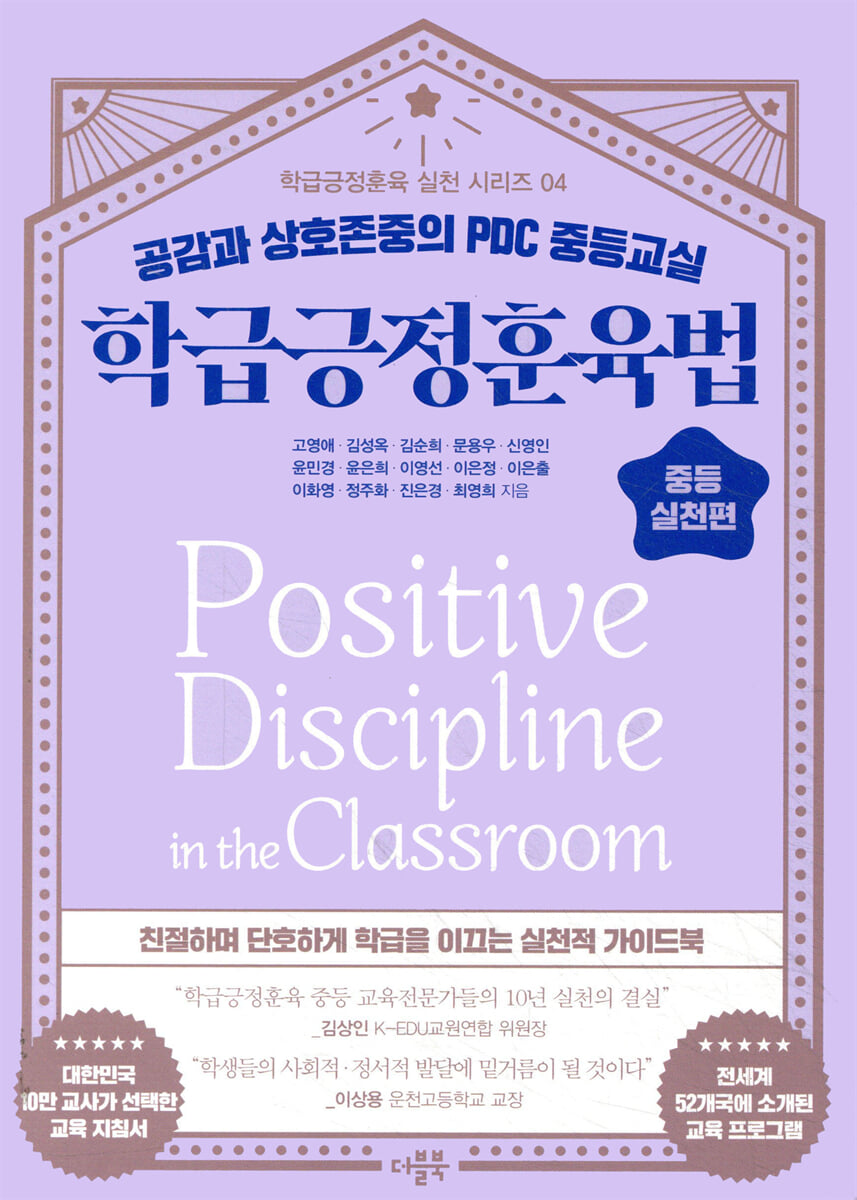
Positive Discipline in the Classroom: Middle School Practice
 |
Description
Book Introduction
A practical guidebook for leading classes with kindness and firmness.
Contains the process of positive discipline that involves mutual empathy and respect!
A Guide to Healthy Growth and Communication in Middle and High School Students
The middle and high school years, when students go through puberty, are an important time for remodeling their lives.
During this time, children explore themselves, make decisions, and form beliefs through experiences.
They also grow through experiencing successes and failures as they learn academic and social skills.
The classroom environment where middle school students live each day is as dynamic as the rapid changes in their hormones.
"Positive Discipline for Middle School Students" presents educational methods to help our children grow into healthy members of society.
An education based on mutual respect and cooperation allows children to learn responsibility for their privileges and develop the skills necessary to become active citizens in a democracy.
This book covers how to develop a sense of community and self-regulation, techniques for managing emotions through positive time-outs, the importance of encouragement, the process of recovering from mistakes, how to understand others and your own heart, and various positive discipline techniques that understand and respect others like animals in the jungle.
With 10 years of experience in the educational field and the practice of positive discipline, we help teachers and parents encourage and grow their children.
For all those who desire the holistic growth of children, and for all teachers who aspire to be "walking textbooks of life" for their students, this book will be a guidebook that offers fresh, vibrant, yet reliable secrets.
Contains the process of positive discipline that involves mutual empathy and respect!
A Guide to Healthy Growth and Communication in Middle and High School Students
The middle and high school years, when students go through puberty, are an important time for remodeling their lives.
During this time, children explore themselves, make decisions, and form beliefs through experiences.
They also grow through experiencing successes and failures as they learn academic and social skills.
The classroom environment where middle school students live each day is as dynamic as the rapid changes in their hormones.
"Positive Discipline for Middle School Students" presents educational methods to help our children grow into healthy members of society.
An education based on mutual respect and cooperation allows children to learn responsibility for their privileges and develop the skills necessary to become active citizens in a democracy.
This book covers how to develop a sense of community and self-regulation, techniques for managing emotions through positive time-outs, the importance of encouragement, the process of recovering from mistakes, how to understand others and your own heart, and various positive discipline techniques that understand and respect others like animals in the jungle.
With 10 years of experience in the educational field and the practice of positive discipline, we help teachers and parents encourage and grow their children.
For all those who desire the holistic growth of children, and for all teachers who aspire to be "walking textbooks of life" for their students, this book will be a guidebook that offers fresh, vibrant, yet reliable secrets.
- You can preview some of the book's contents.
Preview
index
Recommendation
The Fruit of 10 Years of Practice by Secondary Education Experts in Positive Classroom Discipline
Kim Sang-in (Chairman of the K-EDU Teachers' Union)
A practical guidebook for guiding students and teachers toward growth.
Lee Myeong-seop (author of ‘Integration of Curriculum-Class-Evaluation-Record’)
(Former) Gyeonggi-do Middle School Senior Teacher, Inha University Graduate School of Education Lecturer)
We hope that this will serve as a foundation for children's social and emotional development.
Lee Sang-yong (former scholarship officer at Gyeonggi Provincial Education and Training Institute, principal of Uncheon High School)
A Korean version of positive classroom discipline practice tailored to your classroom situation.
Kim Seong-hwan (Yangpyeong Elementary School teacher, Chairman of the Korea Positive Discipline Association)
Opening remarks: Would you like to remodel secondary education with positive classroom discipline?
Part 1 - Perspectives and Principles of Positive Discipline
Chapter 1│Can children change?
Chapter 2│I Want to Be Meaningful and Connected
Chapter 3│It's hard to be kind, but easy to be firm?
Chapter 4: Come, Conflict! Let's Resolve It Together
Chapter 5: Hidden Messages in Problem Behaviors
Part 2 - Practice: Discipline in Problem Situations
Chapter 1│Solving Problems with Moving Cards
Chapter 2: Find the Beliefs Hidden Under Actions
Chapter 3: Communication Skills that Untangle Tangled Emotions
Chapter 4: Checking to Prevent Bigger Problems
Chapter 5│Why did you choose silence?
Chapter 6 │ The Child Who Tries to Manipulate the Teacher
Part 3 - Prevention: Daily Discipline
Chapter 1│I want to be a friend like this!
Chapter 2│Can Empathy Be Developed?
Chapter 3: The Magic of Respectful Communication
Chapter 4: Creating a Workday Where Teachers and Students Smile Together
Chapter 5: Overcoming Mistakes and Taking a Step Toward Growth
Chapter 6: Becoming a Leading Example
Chapter 7│Respect differences!
Chapter 8│I'm happy when everyone agrees on the rules.
Chapter 9: Emotional Control to Grow the Mind
Chapter 10: A Class Meeting That Blossomes While Shaking
Chapter 11: Using Do Instead of Don't: Positive Expressions
Part 4 - Restoring Teacher Self-Esteem
Chapter 1: Maintaining Relationships with Students Without Getting Hurt
Chapter 2│A Teacher's Diary Transformed into an Encouragement Passbook
Chapter 3: Modifying Motivation by Separating Tasks
Chapter 4│“Heart, are you okay?”
Chapter 5: Building Wise Relationships with Fellow Teachers
Chapter 6: Connecting with Parents Without Getting Hurt
Chapter 7: Connecting Teachers, Students, and Parents: Starting with the Easy Steps
About the author
References
The Fruit of 10 Years of Practice by Secondary Education Experts in Positive Classroom Discipline
Kim Sang-in (Chairman of the K-EDU Teachers' Union)
A practical guidebook for guiding students and teachers toward growth.
Lee Myeong-seop (author of ‘Integration of Curriculum-Class-Evaluation-Record’)
(Former) Gyeonggi-do Middle School Senior Teacher, Inha University Graduate School of Education Lecturer)
We hope that this will serve as a foundation for children's social and emotional development.
Lee Sang-yong (former scholarship officer at Gyeonggi Provincial Education and Training Institute, principal of Uncheon High School)
A Korean version of positive classroom discipline practice tailored to your classroom situation.
Kim Seong-hwan (Yangpyeong Elementary School teacher, Chairman of the Korea Positive Discipline Association)
Opening remarks: Would you like to remodel secondary education with positive classroom discipline?
Part 1 - Perspectives and Principles of Positive Discipline
Chapter 1│Can children change?
Chapter 2│I Want to Be Meaningful and Connected
Chapter 3│It's hard to be kind, but easy to be firm?
Chapter 4: Come, Conflict! Let's Resolve It Together
Chapter 5: Hidden Messages in Problem Behaviors
Part 2 - Practice: Discipline in Problem Situations
Chapter 1│Solving Problems with Moving Cards
Chapter 2: Find the Beliefs Hidden Under Actions
Chapter 3: Communication Skills that Untangle Tangled Emotions
Chapter 4: Checking to Prevent Bigger Problems
Chapter 5│Why did you choose silence?
Chapter 6 │ The Child Who Tries to Manipulate the Teacher
Part 3 - Prevention: Daily Discipline
Chapter 1│I want to be a friend like this!
Chapter 2│Can Empathy Be Developed?
Chapter 3: The Magic of Respectful Communication
Chapter 4: Creating a Workday Where Teachers and Students Smile Together
Chapter 5: Overcoming Mistakes and Taking a Step Toward Growth
Chapter 6: Becoming a Leading Example
Chapter 7│Respect differences!
Chapter 8│I'm happy when everyone agrees on the rules.
Chapter 9: Emotional Control to Grow the Mind
Chapter 10: A Class Meeting That Blossomes While Shaking
Chapter 11: Using Do Instead of Don't: Positive Expressions
Part 4 - Restoring Teacher Self-Esteem
Chapter 1: Maintaining Relationships with Students Without Getting Hurt
Chapter 2│A Teacher's Diary Transformed into an Encouragement Passbook
Chapter 3: Modifying Motivation by Separating Tasks
Chapter 4│“Heart, are you okay?”
Chapter 5: Building Wise Relationships with Fellow Teachers
Chapter 6: Connecting with Parents Without Getting Hurt
Chapter 7: Connecting Teachers, Students, and Parents: Starting with the Easy Steps
About the author
References
Detailed image
.jpg)
Into the book
Each one is equipped with survival mode.
It must be because it is scary and frightening.
As it has been said that tragedy begins when children start to wonder whether or not they belong to a certain group, especially during adolescence, a sense of belonging is very important for children.
It should not be viewed as a misbehavior or as a problem behavior.
They only develop misguided beliefs to ensure their safety and survival.
If you try to focus on the behavior rather than the child, all problems will be easier to solve.
It is a very noble thing to stay here now, accept the child as he is, understand him, and talk to him about the future together.
--- p.101∼102
I think it was resolved well because I learned positive classroom discipline, so I was able to keep my thoughts in my head for a while and then ask the child what he or she thought first.
There was no need for adults to pass the buck.
The child's answer to my question was enough.
That alone allowed me to understand the child's thoughts and, furthermore, to bring about changes in the child's behavior.
--- p.104
Teenagers value recognition from their friends more than from adults.
When such a teenager asks a teacher for help, it is likely because he or she can no longer handle his or her fears on his or her own.
Let's not be too afraid of mistakes or failures, but trust that those experiences will help us grow stronger.
Rather than scolding them for their problem behavior, let's help them develop the courage to calmly admit failure, as many people do at that age.
What we can do is to fully understand and empathize with the child's experience.
Only then can we give our children the courage to overcome their circumstances.
--- p.115
We are all imperfect.
Therefore, each of us also needs the ‘courage to be imperfect.’
So, I recall the mistakes I made in each moment of my life, have the courage to be imperfect, and reflect on the meaning of mistakes.
Positive discipline teaches children to reflect on their own actions as right or wrong and to learn responsibility for themselves.
The consequences of mistakes are not punishment, but a path to growth by learning what you did wrong, filling in what you missed, and so on.
--- p.153
“At first, I felt uncomfortable admitting my mistake, but after talking to my friend, I felt better.
Because I acknowledged and accepted my mistakes, I realized that mistakes aren't just mistakes, but opportunities to learn.
And I was determined not to make the same mistake.
“I look forward to a better future for me.”
--- p.162
A teacher's exemplary attitude and behavior have a very important influence on students.
First, thoroughly prepare for class and learn the latest teaching methods to develop your expertise as a teacher.
In terms of learning, I answer each student's questions accurately and kindly, and in terms of life, I take interest in what students find difficult.
Also, keep your appearance neat, including your clothes, and treat students with respect.
All of these are fundamental elements of gaining trust and respect from students.
--- p.166
Every morning, I greet the morning students at the time of going to school.
In such cases, the negative aspects of clothing or attitude are usually noticed first.
However, rather than pointing out flaws and making negative comments, it is better to read facial expressions or feelings.
Likewise, a word of affirmation given during morning assembly can make a child's day happier.
Anyone can learn and put these skills into practice.
If so, it would be ideal if teachers practice first and students follow suit.
--- p.169∼170
If traditional class meetings are passive meetings where rewards and punishments are applied based on goals and results, positive discipline class meetings are a process where children make suggestions and solve problems on their own.
By volunteering to propose agendas, co-opting community goals, and demonstrating a sense of community to find solutions, children learn cooperation and develop a sense of belonging and self-esteem.
In particular, cooperation is the most important element that can be learned through class meetings.
--- p.201∼202
When a teacher stands in front of his students, he becomes a moving textbook.
It has been said that the most effective education is through modeling.
Students unknowingly imitate and become like their teachers as they watch and listen to their words and actions.
If you use a lot of positive language like “It’s okay,” “That’s possible,” “Thank you,” and “That’s great,” at some point your students will start to follow suit.
Words also have temperature.
--- p.227
If you are not in good health, meeting children is not fun.
Life can't always be fun, but there should be hidden joys and emotions in everyday life.
Because, as a teacher, I need to have a fun and exciting daily life in order to have a positive influence on the children.
Just as a farmer sows seeds in the spring, teaching teenagers is like sowing seeds in the ground.
Teenagers dream of and learn about themselves as adults by observing the adults around them.
In addition to academics, students acquire social skills that they will use as adults and members of society.
So, to students, teachers are walking textbooks on life.
It must be because it is scary and frightening.
As it has been said that tragedy begins when children start to wonder whether or not they belong to a certain group, especially during adolescence, a sense of belonging is very important for children.
It should not be viewed as a misbehavior or as a problem behavior.
They only develop misguided beliefs to ensure their safety and survival.
If you try to focus on the behavior rather than the child, all problems will be easier to solve.
It is a very noble thing to stay here now, accept the child as he is, understand him, and talk to him about the future together.
--- p.101∼102
I think it was resolved well because I learned positive classroom discipline, so I was able to keep my thoughts in my head for a while and then ask the child what he or she thought first.
There was no need for adults to pass the buck.
The child's answer to my question was enough.
That alone allowed me to understand the child's thoughts and, furthermore, to bring about changes in the child's behavior.
--- p.104
Teenagers value recognition from their friends more than from adults.
When such a teenager asks a teacher for help, it is likely because he or she can no longer handle his or her fears on his or her own.
Let's not be too afraid of mistakes or failures, but trust that those experiences will help us grow stronger.
Rather than scolding them for their problem behavior, let's help them develop the courage to calmly admit failure, as many people do at that age.
What we can do is to fully understand and empathize with the child's experience.
Only then can we give our children the courage to overcome their circumstances.
--- p.115
We are all imperfect.
Therefore, each of us also needs the ‘courage to be imperfect.’
So, I recall the mistakes I made in each moment of my life, have the courage to be imperfect, and reflect on the meaning of mistakes.
Positive discipline teaches children to reflect on their own actions as right or wrong and to learn responsibility for themselves.
The consequences of mistakes are not punishment, but a path to growth by learning what you did wrong, filling in what you missed, and so on.
--- p.153
“At first, I felt uncomfortable admitting my mistake, but after talking to my friend, I felt better.
Because I acknowledged and accepted my mistakes, I realized that mistakes aren't just mistakes, but opportunities to learn.
And I was determined not to make the same mistake.
“I look forward to a better future for me.”
--- p.162
A teacher's exemplary attitude and behavior have a very important influence on students.
First, thoroughly prepare for class and learn the latest teaching methods to develop your expertise as a teacher.
In terms of learning, I answer each student's questions accurately and kindly, and in terms of life, I take interest in what students find difficult.
Also, keep your appearance neat, including your clothes, and treat students with respect.
All of these are fundamental elements of gaining trust and respect from students.
--- p.166
Every morning, I greet the morning students at the time of going to school.
In such cases, the negative aspects of clothing or attitude are usually noticed first.
However, rather than pointing out flaws and making negative comments, it is better to read facial expressions or feelings.
Likewise, a word of affirmation given during morning assembly can make a child's day happier.
Anyone can learn and put these skills into practice.
If so, it would be ideal if teachers practice first and students follow suit.
--- p.169∼170
If traditional class meetings are passive meetings where rewards and punishments are applied based on goals and results, positive discipline class meetings are a process where children make suggestions and solve problems on their own.
By volunteering to propose agendas, co-opting community goals, and demonstrating a sense of community to find solutions, children learn cooperation and develop a sense of belonging and self-esteem.
In particular, cooperation is the most important element that can be learned through class meetings.
--- p.201∼202
When a teacher stands in front of his students, he becomes a moving textbook.
It has been said that the most effective education is through modeling.
Students unknowingly imitate and become like their teachers as they watch and listen to their words and actions.
If you use a lot of positive language like “It’s okay,” “That’s possible,” “Thank you,” and “That’s great,” at some point your students will start to follow suit.
Words also have temperature.
--- p.227
If you are not in good health, meeting children is not fun.
Life can't always be fun, but there should be hidden joys and emotions in everyday life.
Because, as a teacher, I need to have a fun and exciting daily life in order to have a positive influence on the children.
Just as a farmer sows seeds in the spring, teaching teenagers is like sowing seeds in the ground.
Teenagers dream of and learn about themselves as adults by observing the adults around them.
In addition to academics, students acquire social skills that they will use as adults and members of society.
So, to students, teachers are walking textbooks on life.
--- p.256∼257
Publisher's Review
PDC Middle School Classroom of Empathy and Mutual Respect
Suitable for our middle school classroom situation
Introduction to classroom positive discipline examples and tips
Based on Adlerian psychology, positive discipline, introduced by Jane Nelson, contains several important educational methods and application techniques.
Positive discipline focuses on developing the kindness and firmness that teachers need, identifying misaligned goals, fostering a sense of community, and developing self-regulation.
We also support students through a variety of techniques, such as positive time-outs, encouragement, recovery from mistakes, understanding and respecting others, and class meetings.
The fruit of ten years of research, 『Classroom Positive Discipline: Middle School Practice Edition』 is filled with examples of practice in our classrooms and schools.
Our children need to learn not only academic achievement at school, but also social skills to grow into healthy members of society.
This book covers all these elements in a detailed and comprehensive manner.
Teachers meet diverse students in educational settings.
A child who builds walls and remains silent in relationships with friends, teachers, and parents; a child who disrupts the class atmosphere and steals things from classmates or younger students; a child who uses foul language toward teachers; a child who becomes listless and relies solely on sleep; a child who is hurt because their parents do not acknowledge their dreams; and a child who experiences conflict because they cannot read the emotions of others.
This book, "Positive Discipline in the Classroom: Middle School Practice," presents specific situations and solutions for how to approach students struggling with various problems and how to heal their wounds and pain.
The fundamental principles of positive discipline: self-esteem and a sense of belonging.
Part 1 contains the perspectives and philosophy of positive discipline necessary for children's education.
The need for discipline that maintains a sense of belonging and self-esteem that values oneself was constructed through various materials.
The most important principle of positive discipline is to be 'kind but firm.'
By approaching students in a kind and firm manner, guided by these principles, we propose ways to resolve conflicts and support student growth by uncovering the hidden messages behind problematic behavior.
Additionally, it helps children understand their desire to feel a sense of presence in the classroom and helps them feel secure, thereby helping them acquire academic achievement and social skills more effectively.
Just as a tree with roots that extend deep and far into the ground is not easily broken by wind and rain, this book deeply introduces the philosophies essential to those in charge of discipline.
ㆍTechniques for positive classroom discipline that resolve issues through mutual respect
Part 2 contains the process and results of resolving various conflicts that arise in school life as mentioned above using classroom positive discipline techniques.
It vividly contains practical examples from secondary education and teachers' experience in solving problems, providing clear solutions to many educators facing educational difficulties.
The secondary education landscape has seen generational shifts between pre- and post-COVID-19 times, with youth shifting their perceptions of community, leading to a tendency to prioritize individual time over community activities.
This has led to a greater emphasis on individual achievements than on the results of collaboration.
We provide guidance on how to build community awareness to address these issues.
The 'Wear Your Friend's Shoes' activity provides an opportunity to understand the impact of one's actions on others and the feelings of one's friends.
You can find real-life examples of problem-solving based on the foundation of mutual respect.
ㆍProvide vivid activity materials related to class lessons.
Part 3 presents preventative life skills.
This course introduces how to create a community where children get along well with their peers, respect each other, and cooperate. It covers positive discipline techniques that foster empathy and the positive changes brought about by respectful communication.
For those middle and high school students who don't know what to do while coming to school, we also suggest creating a 'routine where teachers and students laugh together.'
It contains the process of students establishing their own class order and school rules through class meetings, and establishing agreements and guidelines to follow them.
Under the motto, "If you want students to change, teachers must change first," 14 teachers are leading the way in bringing about change.
Instead of using negative language like 'don't do it', we suggest 'let's do it' and guide you through practicing various programs and putting them into practice in your daily life.
Activity materials, especially those linked to secondary school curriculum content, are a key part of this section.
ㆍTime to restore self-esteem
Part 4 addresses the teacher's position and self-esteem issues in the educational field.
This chapter, which adds to the meaning of "Classroom Positive Discipline: Secondary School Practice," encourages teachers who live 365 days a year, dealing with various issues with steadfastness and affection, and sometimes with firmness and wisdom.
It suggests ways for teachers to reflect on and nurture themselves, encouraging themselves as they would encourage students, and empowering them to recover from mistakes and move forward.
Additionally, it provides detailed guidance on connecting with parents to understand their students, and shares helpful tips from the authors' own experience.
Through this, teachers will be able to understand their own difficult emotions and reach a turning point in restoring their self-esteem while solving problems with students, fellow teachers, and parents.
Suitable for our middle school classroom situation
Introduction to classroom positive discipline examples and tips
Based on Adlerian psychology, positive discipline, introduced by Jane Nelson, contains several important educational methods and application techniques.
Positive discipline focuses on developing the kindness and firmness that teachers need, identifying misaligned goals, fostering a sense of community, and developing self-regulation.
We also support students through a variety of techniques, such as positive time-outs, encouragement, recovery from mistakes, understanding and respecting others, and class meetings.
The fruit of ten years of research, 『Classroom Positive Discipline: Middle School Practice Edition』 is filled with examples of practice in our classrooms and schools.
Our children need to learn not only academic achievement at school, but also social skills to grow into healthy members of society.
This book covers all these elements in a detailed and comprehensive manner.
Teachers meet diverse students in educational settings.
A child who builds walls and remains silent in relationships with friends, teachers, and parents; a child who disrupts the class atmosphere and steals things from classmates or younger students; a child who uses foul language toward teachers; a child who becomes listless and relies solely on sleep; a child who is hurt because their parents do not acknowledge their dreams; and a child who experiences conflict because they cannot read the emotions of others.
This book, "Positive Discipline in the Classroom: Middle School Practice," presents specific situations and solutions for how to approach students struggling with various problems and how to heal their wounds and pain.
The fundamental principles of positive discipline: self-esteem and a sense of belonging.
Part 1 contains the perspectives and philosophy of positive discipline necessary for children's education.
The need for discipline that maintains a sense of belonging and self-esteem that values oneself was constructed through various materials.
The most important principle of positive discipline is to be 'kind but firm.'
By approaching students in a kind and firm manner, guided by these principles, we propose ways to resolve conflicts and support student growth by uncovering the hidden messages behind problematic behavior.
Additionally, it helps children understand their desire to feel a sense of presence in the classroom and helps them feel secure, thereby helping them acquire academic achievement and social skills more effectively.
Just as a tree with roots that extend deep and far into the ground is not easily broken by wind and rain, this book deeply introduces the philosophies essential to those in charge of discipline.
ㆍTechniques for positive classroom discipline that resolve issues through mutual respect
Part 2 contains the process and results of resolving various conflicts that arise in school life as mentioned above using classroom positive discipline techniques.
It vividly contains practical examples from secondary education and teachers' experience in solving problems, providing clear solutions to many educators facing educational difficulties.
The secondary education landscape has seen generational shifts between pre- and post-COVID-19 times, with youth shifting their perceptions of community, leading to a tendency to prioritize individual time over community activities.
This has led to a greater emphasis on individual achievements than on the results of collaboration.
We provide guidance on how to build community awareness to address these issues.
The 'Wear Your Friend's Shoes' activity provides an opportunity to understand the impact of one's actions on others and the feelings of one's friends.
You can find real-life examples of problem-solving based on the foundation of mutual respect.
ㆍProvide vivid activity materials related to class lessons.
Part 3 presents preventative life skills.
This course introduces how to create a community where children get along well with their peers, respect each other, and cooperate. It covers positive discipline techniques that foster empathy and the positive changes brought about by respectful communication.
For those middle and high school students who don't know what to do while coming to school, we also suggest creating a 'routine where teachers and students laugh together.'
It contains the process of students establishing their own class order and school rules through class meetings, and establishing agreements and guidelines to follow them.
Under the motto, "If you want students to change, teachers must change first," 14 teachers are leading the way in bringing about change.
Instead of using negative language like 'don't do it', we suggest 'let's do it' and guide you through practicing various programs and putting them into practice in your daily life.
Activity materials, especially those linked to secondary school curriculum content, are a key part of this section.
ㆍTime to restore self-esteem
Part 4 addresses the teacher's position and self-esteem issues in the educational field.
This chapter, which adds to the meaning of "Classroom Positive Discipline: Secondary School Practice," encourages teachers who live 365 days a year, dealing with various issues with steadfastness and affection, and sometimes with firmness and wisdom.
It suggests ways for teachers to reflect on and nurture themselves, encouraging themselves as they would encourage students, and empowering them to recover from mistakes and move forward.
Additionally, it provides detailed guidance on connecting with parents to understand their students, and shares helpful tips from the authors' own experience.
Through this, teachers will be able to understand their own difficult emotions and reach a turning point in restoring their self-esteem while solving problems with students, fellow teachers, and parents.
GOODS SPECIFICS
- Date of issue: February 21, 2025
- Page count, weight, size: 288 pages | 148*210*20mm
- ISBN13: 9791193153574
- ISBN10: 1193153573
You may also like
카테고리
korean


korean

![GQ KOREA Mark (Monthly): December [2025]](http://librairie.coreenne.fr/cdn/shop/files/8ef265dbbfbf186523ed75ba7319009d.jpg?v=1765340328&width=3840)


