

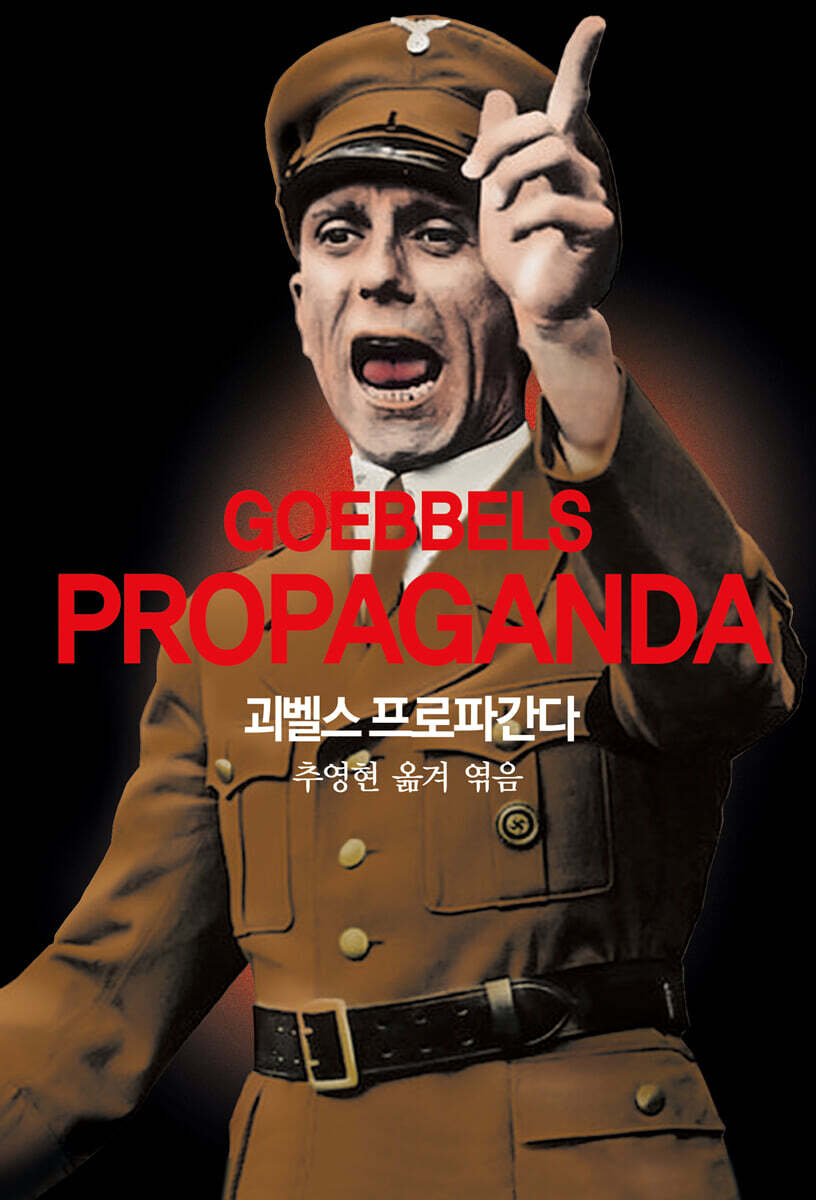
Goebbels propaganda
 |
Description
Book Introduction
"Public opinion is manufactured" through clever manipulation of the public.
Mao Zedong! Trump! Kim Il-sung! A Guide to Using Propaganda Politics
Uniforms, speeches, marches… a propaganda technique that makes the masses forget themselves!
Goebbels' outstanding propaganda and rhetorical skills, a masterpiece of secrets!
Goebbels' propaganda is still alive and well in the 21st century!
After explaining the propaganda strategies of Goebbels and Hitler, "Goebbels' Propaganda" clearly describes how they divided us and me, the order in which we had to brainwash the inside to make the outside world believe, how they organized propaganda, and how they began to align politics and propaganda techniques.
Hitler and Goebbels' propaganda strategies have since been refined to be softer and more democratic, but their essence remains largely the same, used as a commonplace tool taken for granted in modern media society.
This book examines Nazi politics from the perspective of propaganda and focuses on how the various political and cultural phenomena they created, such as uniforms, marches, party conventions, speeches, broadcasts, and films, attracted people of the time.
Mao Zedong! Trump! Kim Il-sung! A Guide to Using Propaganda Politics
Uniforms, speeches, marches… a propaganda technique that makes the masses forget themselves!
Goebbels' outstanding propaganda and rhetorical skills, a masterpiece of secrets!
Goebbels' propaganda is still alive and well in the 21st century!
After explaining the propaganda strategies of Goebbels and Hitler, "Goebbels' Propaganda" clearly describes how they divided us and me, the order in which we had to brainwash the inside to make the outside world believe, how they organized propaganda, and how they began to align politics and propaganda techniques.
Hitler and Goebbels' propaganda strategies have since been refined to be softer and more democratic, but their essence remains largely the same, used as a commonplace tool taken for granted in modern media society.
This book examines Nazi politics from the perspective of propaganda and focuses on how the various political and cultural phenomena they created, such as uniforms, marches, party conventions, speeches, broadcasts, and films, attracted people of the time.
- You can preview some of the book's contents.
Preview
index
Captivate the crowd! … 39
Nazi ideology and its reality
1.
Arrogant contempt for reality, surrendering to fantasy… 43
2.
A journey with a flawed map… 55
3.
What kind of empire did Hitler dream of building?… 63
4.
A new nationalism hidden within the Republic… 71
5.
Nazi Ideology and Its Reality… 79
6.
German economic policy aimed at preparing for war… 84
7.
The carrot of a comfortable life and the stick of a managed society… 88
8.
The Truth About Nazi Mass Murder and Forced Labor… 93
Nazi propaganda and incitement
1.
From the birth of the Weimar Republic in Germany to the collapse of the Third Reich… 97
2.
Adolf Hitler's World War I… 108
3.
The German Revolution and its Reaction… 118
4.
The chaos of the Weimar Republic in Germany… 129
5.
From the stability of the Republic to the Great Depression… 141
6.
The Beginning of Hitler's Nazi Dictatorship… 155
7.
Nazi rearmament and foreign expansion… 174
8.
The outbreak of World War II… 184
9.
Bolshevik War against the Soviet Union… 195
10.
A World War for the Holocaust… 204
11.
The collapse of Hitler's Third Reich… 216
12.
The Truth Behind Nazi Propaganda Myths… 230
Slogans and propaganda
1.
Uniform design… 253
2.
Symbol, Hakenkreuz… 258
3.
Hitler's speech… 272
4.
Slogan… 285
5.
Incitement 1 - Rumors That Are Waving… 298
6.
Incitement 2 - Hitler's Assassination... 304
7.
Election campaign… 316
8.
Funeral… 347
9.
Incitement to defeat… 381
Absolute propaganda
1.
Commemorative Stamp - The Holy Hitler Demanded Portrait Rights… 389
2.
Advertising—Nihilism that leaves a hole for the viewer to escape… 397
3.
Cartoon - Churchill is a liar, but a great man… 400
4.
Movie - Lame Duck Violent Means… 406
5.
Broadcast - The Devil's Smile, the Devil of Information... 410
6.
Olympics - Hitler only missed one day of watching… 416
7.
Literature - Ignore literature that doesn't even serve as a guide to Dokdo... 419
8.
The masses surge in like an avalanche… 421
9.
Forming a assault team… 442
10.
The backlash and counterpropaganda of speech bans… 462
11.
It took 45 minutes to get ready in the morning… 477
Hitler's evil remarks
1.
Incitement… 485
2.
Enthusiasm… 493
3.
Struggle… 502
4.
Editing Mania… 511
5.
Love and hate… 516
The propaganda of Paul Joseph Goebbels, the greatest agitator of all time… 522
Nazi ideology and its reality
1.
Arrogant contempt for reality, surrendering to fantasy… 43
2.
A journey with a flawed map… 55
3.
What kind of empire did Hitler dream of building?… 63
4.
A new nationalism hidden within the Republic… 71
5.
Nazi Ideology and Its Reality… 79
6.
German economic policy aimed at preparing for war… 84
7.
The carrot of a comfortable life and the stick of a managed society… 88
8.
The Truth About Nazi Mass Murder and Forced Labor… 93
Nazi propaganda and incitement
1.
From the birth of the Weimar Republic in Germany to the collapse of the Third Reich… 97
2.
Adolf Hitler's World War I… 108
3.
The German Revolution and its Reaction… 118
4.
The chaos of the Weimar Republic in Germany… 129
5.
From the stability of the Republic to the Great Depression… 141
6.
The Beginning of Hitler's Nazi Dictatorship… 155
7.
Nazi rearmament and foreign expansion… 174
8.
The outbreak of World War II… 184
9.
Bolshevik War against the Soviet Union… 195
10.
A World War for the Holocaust… 204
11.
The collapse of Hitler's Third Reich… 216
12.
The Truth Behind Nazi Propaganda Myths… 230
Slogans and propaganda
1.
Uniform design… 253
2.
Symbol, Hakenkreuz… 258
3.
Hitler's speech… 272
4.
Slogan… 285
5.
Incitement 1 - Rumors That Are Waving… 298
6.
Incitement 2 - Hitler's Assassination... 304
7.
Election campaign… 316
8.
Funeral… 347
9.
Incitement to defeat… 381
Absolute propaganda
1.
Commemorative Stamp - The Holy Hitler Demanded Portrait Rights… 389
2.
Advertising—Nihilism that leaves a hole for the viewer to escape… 397
3.
Cartoon - Churchill is a liar, but a great man… 400
4.
Movie - Lame Duck Violent Means… 406
5.
Broadcast - The Devil's Smile, the Devil of Information... 410
6.
Olympics - Hitler only missed one day of watching… 416
7.
Literature - Ignore literature that doesn't even serve as a guide to Dokdo... 419
8.
The masses surge in like an avalanche… 421
9.
Forming a assault team… 442
10.
The backlash and counterpropaganda of speech bans… 462
11.
It took 45 minutes to get ready in the morning… 477
Hitler's evil remarks
1.
Incitement… 485
2.
Enthusiasm… 493
3.
Struggle… 502
4.
Editing Mania… 511
5.
Love and hate… 516
The propaganda of Paul Joseph Goebbels, the greatest agitator of all time… 522
Into the book
History is not simple, as it can be said that the rise of the Nazis was inevitable in the flow of the times in Germany, which had lost World War I, and in a society overflowing with unemployed people due to the Great Depression.
To illuminate the unclear areas, it is necessary to consider the period before the Nazi Party was active, to consider other political forces besides the Nazis, and furthermore, to consider Hitler's personality and ideology, and then to reexamine his propaganda and the Nazis' ideology and actions.
--- p.40
Nazism is Nationalsozialismus in German.
It is translated as national socialism, national socialism, and national socialism.
The question is how to interpret National, but linguistically, all are possible.
However, it is correct to interpret this as national socialism.
Because Nazism is an ideology that advocates socialism for the German people, not the German nation or the German people.
--- p.78
Thus, the Third Reich collapsed, and even today, the early days of the Nazi Third Reich are considered to have been a time of prosperity for Germany.
The Nazi Party established its policies legally with the support of an overwhelming majority of the German people.
There are still many Nazi propaganda myths, such as that Hitler would have been a first-class politician if he had not started a war, and that Germany still produced new weapons with the highest level of technology.
--- p.107
The 6th National Party Congress, held in Nuremberg from September 4 to 10, 1934, was meticulously prepared.
In Zeppelinfeld, 28-year-old architect Albert Speer built a stone conference hall measuring 440 meters long and 27 meters high.
130 anti-aircraft searchlights were deployed and a temple of light was created during the night assembly.
Another 32-year-old female film director, Leni Riefenstahl, led a production crew of 200 people, including 16 cameramen, to produce a party propaganda film two weeks before the event.
According to Leni's "Memoirs," in February 1932, at the moment Hitler began his speech at the Berlin Sports Palace, he had a vision of the ground splitting open, water gushing out, and shaking.
Leni, who worshipped Hitler, was able to approach Hitler and receive support from Propaganda Minister Goebbels.
Leni's film Triumph of the Will won the gold medal at the 1935 Venice Biennale and the Grand Prix at the 1937 Paris World's Fair.
--- pp.170~171
Some of the Soviet residents of the occupied territories welcomed the German army as liberators, as they had been under Stalin's dictatorship and the oppression of the Communist Party until then.
If the Germans had allowed autonomy to Ukrainians, Russians, Chechens, etc., they could have created German puppet states, just as they had during World War I.
However, the German army regarded the Slavs (Poles, Russians, etc.) in the occupied territories as an inferior or lower race and plundered their food, resources, and energy.
Because this harsh occupation policy turned the population toward sabotage and resistance movements against Germany, Stalin was able to obtain partisans and volunteers in German-occupied territories.
--- p.197
The German people felt humiliated and suffering under the constraints of the Treaty of Versailles, which stipulated reparations payments and limitations on armaments.
Moreover, because of the hardship caused by the Great Depression, people were disappointed by the ineffectiveness of the parliamentary democracy of the Weimar Republic.
At this time, the Nazi Party, led by Adolf Hitler, a leader with absolute power, claimed that it would destroy the Treaty of Versailles and the Weimar Republic and revive a new Germany, and the people began to have high expectations.
On the other hand, conservative politicians and businessmen, who had both power and money, but lacked popular support and feared the expansion of communist power following the Great Depression, used the Nazi Party, which advocated for the suppression of communists.
The plan was to put Hitler, a mass agitator, forward as chancellor and control him from behind the scenes.
In this way, Hitler, a member of the Nazi Party, was able to become chancellor through political deals between conservative politicians and businessmen, despite the support of about half of the people.
--- p.
230
The ability to evaluate, identify, and utilize information provided by media such as video is called 'media literacy', and based on this, it is necessary to understand the intentions of the managers of information media.
When information coming from propaganda does not match the facts, the ability to emphasize it based on facts, promote a particular view, and critically review a large amount of information is media literacy.
But propaganda uses not only power and authority, but also violence and terror to combat media literacy.
Nazi propaganda was the management of information by the authorities to induce thoughts and public opinion, and in wartime it expanded into information warfare and psychological warfare. Due to the management of the press, there was no direct criticism, and if criticism was discovered, it was arrested and punished.
--- p.241
Propaganda is the act of spreading information that is favorable to the sender in a larger way and information that is unfavorable in a smaller way, while simultaneously spreading information that is favorable to the enemy in a smaller way and information that is unfavorable in a larger way and louder.
And to ensure the credibility of the information being conveyed, the truth chosen by the sender is mixed with lies.
In other words, the Nazis possessed extensive information, but they did not explicitly state confidential information and only conveyed limited information to the sender.
Because of this, there was information asymmetry between the sender and the receiver.
--- p.242
At one time, there was a rumor going around that Mao Zedong was dead.
People who wished they were dead, people who thought it would be difficult for them to die, and people who were curious about what would happen if they died all believed the rumor.
And considering the impact of the rumor both internally and externally, a rumor-busting operation was carried out.
The result of this operation was more to raise doubts about whether Mao Zedong was actually alive than to make people believe he was.
Even if you published a picture of a healthy Mao Zedong swimming, people thought it was fake, and even if you had a conversation with Nixon, people thought it was fake.
There was no way to deal with people I had once trusted.
--- p.303
The reason why the principle that it is difficult to control rumors once they have started can be established is because, as Goebbels said, 'rumors are our daily bread.'
This does not mean that Nazi propaganda used rumors as its greatest weapon, but also that the "we" of which Goebbels speaks does not only refer to the Nazis, but is also the "daily bread" for all mankind.
--- p.315
The march is a production.
It creates a sense of order.
Just as confusion makes men stupid, so order makes men's heads as hollow as caves.
So, even though these two methods are different, they are the same in that they cause people to lose their minds.
--- p.327
Political propaganda cleverly captured people's dreams and longings for good fortune about their lineage or their future.
Instead of making myth their medium, political propaganda has expanded upon it, and by borrowing the power of myth, it has brought desire and hatred, as in a dream, comically close to those whom, in the waking state, man would not deliberately touch or even reach out to.
This type of dreaming is not necessarily unhealthy.
All living people harbor such dreams.
But it turns into a nightmare, fueled by clever Machiavellianism.
--- p.346
A declaration can accomplish a lot.
Propaganda can package a system.
Propaganda is a dye.
But if you turn the facts upside down, you are helping the enemy.
If that happens, propaganda becomes 'antiganda', as the people say.
It's like putting makeup on a critically ill patient's face instead of bringing a doctor to the patient.
To illuminate the unclear areas, it is necessary to consider the period before the Nazi Party was active, to consider other political forces besides the Nazis, and furthermore, to consider Hitler's personality and ideology, and then to reexamine his propaganda and the Nazis' ideology and actions.
--- p.40
Nazism is Nationalsozialismus in German.
It is translated as national socialism, national socialism, and national socialism.
The question is how to interpret National, but linguistically, all are possible.
However, it is correct to interpret this as national socialism.
Because Nazism is an ideology that advocates socialism for the German people, not the German nation or the German people.
--- p.78
Thus, the Third Reich collapsed, and even today, the early days of the Nazi Third Reich are considered to have been a time of prosperity for Germany.
The Nazi Party established its policies legally with the support of an overwhelming majority of the German people.
There are still many Nazi propaganda myths, such as that Hitler would have been a first-class politician if he had not started a war, and that Germany still produced new weapons with the highest level of technology.
--- p.107
The 6th National Party Congress, held in Nuremberg from September 4 to 10, 1934, was meticulously prepared.
In Zeppelinfeld, 28-year-old architect Albert Speer built a stone conference hall measuring 440 meters long and 27 meters high.
130 anti-aircraft searchlights were deployed and a temple of light was created during the night assembly.
Another 32-year-old female film director, Leni Riefenstahl, led a production crew of 200 people, including 16 cameramen, to produce a party propaganda film two weeks before the event.
According to Leni's "Memoirs," in February 1932, at the moment Hitler began his speech at the Berlin Sports Palace, he had a vision of the ground splitting open, water gushing out, and shaking.
Leni, who worshipped Hitler, was able to approach Hitler and receive support from Propaganda Minister Goebbels.
Leni's film Triumph of the Will won the gold medal at the 1935 Venice Biennale and the Grand Prix at the 1937 Paris World's Fair.
--- pp.170~171
Some of the Soviet residents of the occupied territories welcomed the German army as liberators, as they had been under Stalin's dictatorship and the oppression of the Communist Party until then.
If the Germans had allowed autonomy to Ukrainians, Russians, Chechens, etc., they could have created German puppet states, just as they had during World War I.
However, the German army regarded the Slavs (Poles, Russians, etc.) in the occupied territories as an inferior or lower race and plundered their food, resources, and energy.
Because this harsh occupation policy turned the population toward sabotage and resistance movements against Germany, Stalin was able to obtain partisans and volunteers in German-occupied territories.
--- p.197
The German people felt humiliated and suffering under the constraints of the Treaty of Versailles, which stipulated reparations payments and limitations on armaments.
Moreover, because of the hardship caused by the Great Depression, people were disappointed by the ineffectiveness of the parliamentary democracy of the Weimar Republic.
At this time, the Nazi Party, led by Adolf Hitler, a leader with absolute power, claimed that it would destroy the Treaty of Versailles and the Weimar Republic and revive a new Germany, and the people began to have high expectations.
On the other hand, conservative politicians and businessmen, who had both power and money, but lacked popular support and feared the expansion of communist power following the Great Depression, used the Nazi Party, which advocated for the suppression of communists.
The plan was to put Hitler, a mass agitator, forward as chancellor and control him from behind the scenes.
In this way, Hitler, a member of the Nazi Party, was able to become chancellor through political deals between conservative politicians and businessmen, despite the support of about half of the people.
--- p.
230
The ability to evaluate, identify, and utilize information provided by media such as video is called 'media literacy', and based on this, it is necessary to understand the intentions of the managers of information media.
When information coming from propaganda does not match the facts, the ability to emphasize it based on facts, promote a particular view, and critically review a large amount of information is media literacy.
But propaganda uses not only power and authority, but also violence and terror to combat media literacy.
Nazi propaganda was the management of information by the authorities to induce thoughts and public opinion, and in wartime it expanded into information warfare and psychological warfare. Due to the management of the press, there was no direct criticism, and if criticism was discovered, it was arrested and punished.
--- p.241
Propaganda is the act of spreading information that is favorable to the sender in a larger way and information that is unfavorable in a smaller way, while simultaneously spreading information that is favorable to the enemy in a smaller way and information that is unfavorable in a larger way and louder.
And to ensure the credibility of the information being conveyed, the truth chosen by the sender is mixed with lies.
In other words, the Nazis possessed extensive information, but they did not explicitly state confidential information and only conveyed limited information to the sender.
Because of this, there was information asymmetry between the sender and the receiver.
--- p.242
At one time, there was a rumor going around that Mao Zedong was dead.
People who wished they were dead, people who thought it would be difficult for them to die, and people who were curious about what would happen if they died all believed the rumor.
And considering the impact of the rumor both internally and externally, a rumor-busting operation was carried out.
The result of this operation was more to raise doubts about whether Mao Zedong was actually alive than to make people believe he was.
Even if you published a picture of a healthy Mao Zedong swimming, people thought it was fake, and even if you had a conversation with Nixon, people thought it was fake.
There was no way to deal with people I had once trusted.
--- p.303
The reason why the principle that it is difficult to control rumors once they have started can be established is because, as Goebbels said, 'rumors are our daily bread.'
This does not mean that Nazi propaganda used rumors as its greatest weapon, but also that the "we" of which Goebbels speaks does not only refer to the Nazis, but is also the "daily bread" for all mankind.
--- p.315
The march is a production.
It creates a sense of order.
Just as confusion makes men stupid, so order makes men's heads as hollow as caves.
So, even though these two methods are different, they are the same in that they cause people to lose their minds.
--- p.327
Political propaganda cleverly captured people's dreams and longings for good fortune about their lineage or their future.
Instead of making myth their medium, political propaganda has expanded upon it, and by borrowing the power of myth, it has brought desire and hatred, as in a dream, comically close to those whom, in the waking state, man would not deliberately touch or even reach out to.
This type of dreaming is not necessarily unhealthy.
All living people harbor such dreams.
But it turns into a nightmare, fueled by clever Machiavellianism.
--- p.346
A declaration can accomplish a lot.
Propaganda can package a system.
Propaganda is a dye.
But if you turn the facts upside down, you are helping the enemy.
If that happens, propaganda becomes 'antiganda', as the people say.
It's like putting makeup on a critically ill patient's face instead of bringing a doctor to the patient.
--- p.384
Publisher's Review
The Birth of Nazi Propaganda: Goebbels
Paul Joseph Goebbels was a prominent figure in the propaganda of Hitler's Nazi regime.
He served as Minister of Public Enlightenment and Propaganda under the German Nazi regime, and contributed greatly to the expansion of the party in the 1930s through the use of new propaganda methods and clever agitational politics, and was responsible for Nazi propaganda and glorification.
It is believed that the reason the German people came to accept the Nazi regime favorably was because of Goebbels' propaganda.
Goebbels was exempted from military service in World War I because of his bowed legs, which triggered a strong desire for compensation and became the spark that led to his unfortunate life.
After receiving a doctorate in German literature from the University of Heidelberg, Goebbels was active in the fields of literature, theater, and journalism, but joined the Nazi Party when Hitler appointed him as the Berlin district party chairman.
Eventually he took control of the state propaganda apparatus and created almost all of Nazi propaganda.
To understand the Hitler era and Nazi propaganda, one cannot leave out Goebbels.
Were the Nazis a fanatic group? Were they Germany's savior?
Many people today consider the Nazis to be a fanatical political group.
They say it is the result of abnormal political ideas being spread through clever propaganda.
But the Nazis were an absolute propaganda group.
It means that it is a group that has chosen the material that the public will most accept as its political ideology.
It is not that a fanatical political group is forcing the masses along.
The absolute propaganda group has thoroughly amplified the latent desires of the masses.
What was the process like, what was the outcome, this book analyzes the great stream of Goebbels' Nazi propaganda.
As long as a society that combines mass society and democracy continues, the ideas discussed in this book will never fade.
Because the things I write about on the subject of Nazism are still happening all over the world today.
They put propaganda before politics!
Usually, 'Nazi propaganda' refers to the propaganda of the Nazi party.
It's the party's propaganda.
Of course, it is a political party, so it will have a political purpose.
Politicians who belong to a political party clearly have some political beliefs.
Have a policy.
These are the things that actually constitute politics.
Political propaganda is used to support those practical elements.
Propaganda is a tool and means of politics.
Nazi propaganda represents the absoluteness of propaganda.
In other words, the main premise of this book is that the Nazis, as a political party, had a political goal they wanted to achieve first, and it is difficult to view them as a group that wanted to propagate it.
For them, propaganda came first.
Nazi propaganda was not a political technique.
Politics was a relative tool for accomplishing propaganda.
They looked for content that would inevitably have an overwhelming effect and gain immense popularity, and made it the party's ideology or policy.
Goebbels chose political content for effective propaganda.
Propaganda came first, not politics.
That's the true nature of the Nazis.
Today, too, we face little Goebbels, little Hitler!
Hitler came to power in 1933, and the Nazi regime, known as the Third Reich, collapsed in 1945, a mere 12 years later.
In the meantime, there was a horrific reality, including Auschwitz, engulfed in madness.
This book summarizes the core function of that system as propaganda.
A group of propagandists, starting with Goebbels, manipulated the people as they pleased.
But how did a nation of great thinkers and poets degenerate into a nation of such brutal executioners and judges? How did they meekly become incorporated into the Nazi cult? The complexities of both psychological and social issues make it nearly impossible to study Nazi propaganda holistically, let alone individual cases.
But what makes this book so fascinating is that while it exposes the Nazis' brilliant propaganda strategies and rhetoric, it also touches deeply on how we perceive people who are very close to us.
Although times and countries are different, everyone has encountered or is encountering a little Goebbels or a little Hitler while living in the world.
The public loves propaganda and inflammatory rumors!
When we hear the words Nazi propaganda, we immediately think of the unique symbol of the swastika, the unified uniform design, election slogans or flags, the magnificent processions at party congresses, the exquisite use of searchlights and bonfires, Hitler's captivating speeches and gestures, and the magnificent architecture like Albert Speer's Zeppelin airfield.
We have a strong impression that the Nazis were a political movement that succeeded in making politics into a spectacle-filled art form.
Therefore, this book's perspective of viewing Goebbels' diary as a form of propaganda provides a different and more exciting experience than the existing perspective.
The book's unique perspective can only be fully understood if one reads propaganda not as mere spectacle, but as the self-aggrandizement of an empty political movement.
Exploring the depths of the human abyss!
However, this book seeks to express not only the system in which such empty political propaganda successfully expanded, but also the moment when such propaganda's self-aggrandizing function loses its balance and stops moving.
No matter how much the government tries to control information through propaganda, the public has the potential to spread rumors based on their own anxieties and hopes, rendering the government's propaganda ineffective.
After the end of World War II, rumors arose everywhere that Hitler was still alive, and conversely, rumors that Hitler had died during the war. This book analyzes the system by which such rumors undermined Nazi propaganda.
The empty political movement that grew through the power of propaganda revealed its emptiness through the power of propaganda.
Propaganda is not necessarily absolute.
The political specter of being swayed by propaganda will not disappear!
Was the Nazis' behavior unusual? No, far from being unusual, it was as perfectly normal, almost purely normal, as democratic politics can be condensed.
As political democratization progresses, voting rights expand.
Politics becomes popular.
To participate in state affairs, you must win an election.
Winning an election means gaining popular support.
You can't take power without mobilizing the masses.
The issue here is how well the public understands politics and their level of education.
But the public doesn't see the complexities of politics.
To win public support, politics must be understandable.
You can win an election by presenting many policy cards that are easy to appeal to the public and promote.
A policy that is easy to propagate is a policy that is easy to accept at the time.
Acceptable policies come from marketing rather than politicians' ideals.
If you choose a political topic or political story that has a great propaganda effect at that time as a policy, you can seize power.
From propaganda for politics to politics for propaganda.
In fact, that route is not a strange route that only the Nazis took.
The trend of modern democracy has created this and can be seen in more or less every corner of the world today.
The Nazis were a prime example of someone who followed this path very faithfully.
Nazi propaganda is one of the ends to which democratic politics leads.
Towards that goal, the Nazis quickly ran first, forcibly tying together the three cards of nationalism, socialism, and anti-Semitism.
Goebbels' propaganda is still alive and well in the 21st century!
After explaining the propaganda strategies of Goebbels and Hitler, Goebbels clearly describes how they divided us and me, the order in which we had to brainwash the inside to make the outside world believe, how they organized propaganda, and how they began to align politics and propaganda techniques.
Hitler and Goebbels' propaganda strategies have since been refined to be softer and more democratic, but their essence remains largely the same, used as a commonplace tool taken for granted in modern media society.
This book examines Nazi politics from the perspective of propaganda and focuses on how the various political and cultural phenomena they created, such as uniforms, marches, party conventions, speeches, broadcasts, and films, attracted people of the time.
Mao Zedong! Kim Il-sung! Trump! Must-reads and Uses!
This book follows a critical format in which author Chu Young-hyun uses various materials to examine the Nazi political propaganda methods revealed through research after World War II, presenting them from the vivid perspectives of his contemporaries.
Because of this, it vividly and dynamically portrays the atmosphere of the era when Nazi propaganda was effective in politics and the public was captivated by it.
By reading this book, readers can properly understand Nazi propaganda from the early 20th century and reflect on the meaning of propaganda today.
Furthermore, while realizing the illusion of Nazi propaganda, we will also be able to face the truth about how democracy is in crisis when we are unknowingly swayed by modern public opinion manipulation and various forms of propaganda and agitation, such as mass gatherings.
Paul Joseph Goebbels was a prominent figure in the propaganda of Hitler's Nazi regime.
He served as Minister of Public Enlightenment and Propaganda under the German Nazi regime, and contributed greatly to the expansion of the party in the 1930s through the use of new propaganda methods and clever agitational politics, and was responsible for Nazi propaganda and glorification.
It is believed that the reason the German people came to accept the Nazi regime favorably was because of Goebbels' propaganda.
Goebbels was exempted from military service in World War I because of his bowed legs, which triggered a strong desire for compensation and became the spark that led to his unfortunate life.
After receiving a doctorate in German literature from the University of Heidelberg, Goebbels was active in the fields of literature, theater, and journalism, but joined the Nazi Party when Hitler appointed him as the Berlin district party chairman.
Eventually he took control of the state propaganda apparatus and created almost all of Nazi propaganda.
To understand the Hitler era and Nazi propaganda, one cannot leave out Goebbels.
Were the Nazis a fanatic group? Were they Germany's savior?
Many people today consider the Nazis to be a fanatical political group.
They say it is the result of abnormal political ideas being spread through clever propaganda.
But the Nazis were an absolute propaganda group.
It means that it is a group that has chosen the material that the public will most accept as its political ideology.
It is not that a fanatical political group is forcing the masses along.
The absolute propaganda group has thoroughly amplified the latent desires of the masses.
What was the process like, what was the outcome, this book analyzes the great stream of Goebbels' Nazi propaganda.
As long as a society that combines mass society and democracy continues, the ideas discussed in this book will never fade.
Because the things I write about on the subject of Nazism are still happening all over the world today.
They put propaganda before politics!
Usually, 'Nazi propaganda' refers to the propaganda of the Nazi party.
It's the party's propaganda.
Of course, it is a political party, so it will have a political purpose.
Politicians who belong to a political party clearly have some political beliefs.
Have a policy.
These are the things that actually constitute politics.
Political propaganda is used to support those practical elements.
Propaganda is a tool and means of politics.
Nazi propaganda represents the absoluteness of propaganda.
In other words, the main premise of this book is that the Nazis, as a political party, had a political goal they wanted to achieve first, and it is difficult to view them as a group that wanted to propagate it.
For them, propaganda came first.
Nazi propaganda was not a political technique.
Politics was a relative tool for accomplishing propaganda.
They looked for content that would inevitably have an overwhelming effect and gain immense popularity, and made it the party's ideology or policy.
Goebbels chose political content for effective propaganda.
Propaganda came first, not politics.
That's the true nature of the Nazis.
Today, too, we face little Goebbels, little Hitler!
Hitler came to power in 1933, and the Nazi regime, known as the Third Reich, collapsed in 1945, a mere 12 years later.
In the meantime, there was a horrific reality, including Auschwitz, engulfed in madness.
This book summarizes the core function of that system as propaganda.
A group of propagandists, starting with Goebbels, manipulated the people as they pleased.
But how did a nation of great thinkers and poets degenerate into a nation of such brutal executioners and judges? How did they meekly become incorporated into the Nazi cult? The complexities of both psychological and social issues make it nearly impossible to study Nazi propaganda holistically, let alone individual cases.
But what makes this book so fascinating is that while it exposes the Nazis' brilliant propaganda strategies and rhetoric, it also touches deeply on how we perceive people who are very close to us.
Although times and countries are different, everyone has encountered or is encountering a little Goebbels or a little Hitler while living in the world.
The public loves propaganda and inflammatory rumors!
When we hear the words Nazi propaganda, we immediately think of the unique symbol of the swastika, the unified uniform design, election slogans or flags, the magnificent processions at party congresses, the exquisite use of searchlights and bonfires, Hitler's captivating speeches and gestures, and the magnificent architecture like Albert Speer's Zeppelin airfield.
We have a strong impression that the Nazis were a political movement that succeeded in making politics into a spectacle-filled art form.
Therefore, this book's perspective of viewing Goebbels' diary as a form of propaganda provides a different and more exciting experience than the existing perspective.
The book's unique perspective can only be fully understood if one reads propaganda not as mere spectacle, but as the self-aggrandizement of an empty political movement.
Exploring the depths of the human abyss!
However, this book seeks to express not only the system in which such empty political propaganda successfully expanded, but also the moment when such propaganda's self-aggrandizing function loses its balance and stops moving.
No matter how much the government tries to control information through propaganda, the public has the potential to spread rumors based on their own anxieties and hopes, rendering the government's propaganda ineffective.
After the end of World War II, rumors arose everywhere that Hitler was still alive, and conversely, rumors that Hitler had died during the war. This book analyzes the system by which such rumors undermined Nazi propaganda.
The empty political movement that grew through the power of propaganda revealed its emptiness through the power of propaganda.
Propaganda is not necessarily absolute.
The political specter of being swayed by propaganda will not disappear!
Was the Nazis' behavior unusual? No, far from being unusual, it was as perfectly normal, almost purely normal, as democratic politics can be condensed.
As political democratization progresses, voting rights expand.
Politics becomes popular.
To participate in state affairs, you must win an election.
Winning an election means gaining popular support.
You can't take power without mobilizing the masses.
The issue here is how well the public understands politics and their level of education.
But the public doesn't see the complexities of politics.
To win public support, politics must be understandable.
You can win an election by presenting many policy cards that are easy to appeal to the public and promote.
A policy that is easy to propagate is a policy that is easy to accept at the time.
Acceptable policies come from marketing rather than politicians' ideals.
If you choose a political topic or political story that has a great propaganda effect at that time as a policy, you can seize power.
From propaganda for politics to politics for propaganda.
In fact, that route is not a strange route that only the Nazis took.
The trend of modern democracy has created this and can be seen in more or less every corner of the world today.
The Nazis were a prime example of someone who followed this path very faithfully.
Nazi propaganda is one of the ends to which democratic politics leads.
Towards that goal, the Nazis quickly ran first, forcibly tying together the three cards of nationalism, socialism, and anti-Semitism.
Goebbels' propaganda is still alive and well in the 21st century!
After explaining the propaganda strategies of Goebbels and Hitler, Goebbels clearly describes how they divided us and me, the order in which we had to brainwash the inside to make the outside world believe, how they organized propaganda, and how they began to align politics and propaganda techniques.
Hitler and Goebbels' propaganda strategies have since been refined to be softer and more democratic, but their essence remains largely the same, used as a commonplace tool taken for granted in modern media society.
This book examines Nazi politics from the perspective of propaganda and focuses on how the various political and cultural phenomena they created, such as uniforms, marches, party conventions, speeches, broadcasts, and films, attracted people of the time.
Mao Zedong! Kim Il-sung! Trump! Must-reads and Uses!
This book follows a critical format in which author Chu Young-hyun uses various materials to examine the Nazi political propaganda methods revealed through research after World War II, presenting them from the vivid perspectives of his contemporaries.
Because of this, it vividly and dynamically portrays the atmosphere of the era when Nazi propaganda was effective in politics and the public was captivated by it.
By reading this book, readers can properly understand Nazi propaganda from the early 20th century and reflect on the meaning of propaganda today.
Furthermore, while realizing the illusion of Nazi propaganda, we will also be able to face the truth about how democracy is in crisis when we are unknowingly swayed by modern public opinion manipulation and various forms of propaganda and agitation, such as mass gatherings.
GOODS SPECIFICS
- Date of issue: February 1, 2023
- Page count, weight, size: 551 pages | 820g | 152*225*27mm
- ISBN13: 9788949718200
- ISBN10: 8949718200
You may also like
카테고리
korean


korean

![GQ KOREA Mark (Monthly): December [2025]](http://librairie.coreenne.fr/cdn/shop/files/8ef265dbbfbf186523ed75ba7319009d.jpg?v=1765340328&width=3840)


