

Core Concepts of Sociology
 |
Description
Book Introduction
『Core Concepts of Sociology』, which has been consistently loved by sociology students,
Reborn as a third edition reflecting the latest research trends.
Anthony Giddens and Philip W., giants of modern sociology.
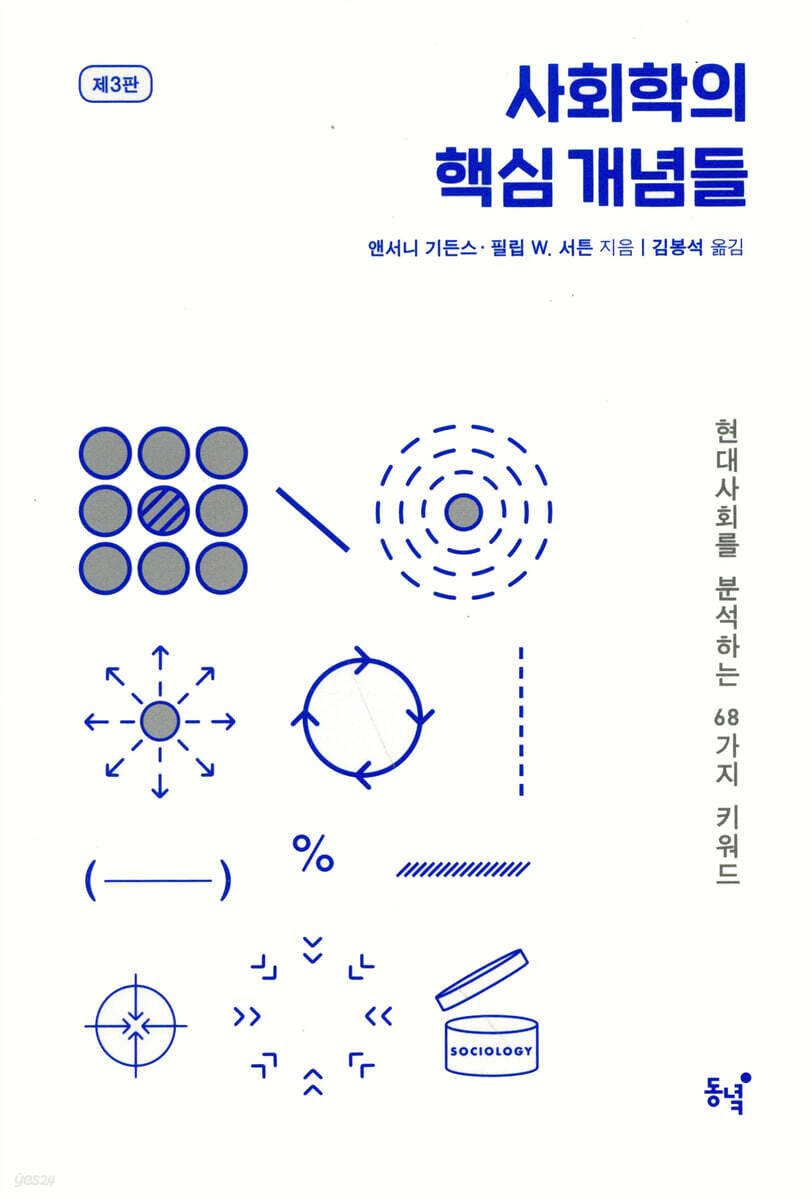
Sutton's culmination of sociological theory, "Core Concepts of Sociology," which has long been loved by sociology students around the world, has been republished in its third edition.
In this book, the two authors select and introduce 68 core concepts that capture the essence of contemporary sociological discussions, and arrange these concepts under ten topics to help readers systematically understand the overall landscape of contemporary sociology.
The 68 concepts contained in this book encompass a wide range of topics, from classic sociological concepts like power, ideology, and culture, to gender, consumerism, and identity, which have reconstructed existing discussions and broadened the horizons of sociology, to intersectionality and the digital revolution, which have recently emerged and are generating innovative research, allowing for a comprehensive understanding of our complex society.
Moreover, this book goes beyond simply defining concepts and provides a rich explanation of their origins, meanings, criticisms, and significance, making it a great help in developing a foundation for sociological thinking and discussion.
This third edition is the result of the authors' sincere efforts to build a theory that most accurately reflects the ever-changing modern society. It has been revised and expanded to reflect the latest discussions.
Taking into account today's social changes, we added new concepts (digital revolution, decolonization), deleted old concepts (restorative justice), and changed the names and order of some concepts.
We have also added new research findings based on the latest trends across the concepts, and have also significantly revised the basic explanations for each concept.
Through this, the book provides a more relevant and sophisticated explanation to readers seeking to understand today's society, and achieves the authors' goal of "providing an accurate and up-to-date conceptual map of modern sociology."
Reborn as a third edition reflecting the latest research trends.
Anthony Giddens and Philip W., giants of modern sociology.
Sutton's culmination of sociological theory, "Core Concepts of Sociology," which has long been loved by sociology students around the world, has been republished in its third edition.
In this book, the two authors select and introduce 68 core concepts that capture the essence of contemporary sociological discussions, and arrange these concepts under ten topics to help readers systematically understand the overall landscape of contemporary sociology.
The 68 concepts contained in this book encompass a wide range of topics, from classic sociological concepts like power, ideology, and culture, to gender, consumerism, and identity, which have reconstructed existing discussions and broadened the horizons of sociology, to intersectionality and the digital revolution, which have recently emerged and are generating innovative research, allowing for a comprehensive understanding of our complex society.
Moreover, this book goes beyond simply defining concepts and provides a rich explanation of their origins, meanings, criticisms, and significance, making it a great help in developing a foundation for sociological thinking and discussion.
This third edition is the result of the authors' sincere efforts to build a theory that most accurately reflects the ever-changing modern society. It has been revised and expanded to reflect the latest discussions.
Taking into account today's social changes, we added new concepts (digital revolution, decolonization), deleted old concepts (restorative justice), and changed the names and order of some concepts.
We have also added new research findings based on the latest trends across the concepts, and have also significantly revised the basic explanations for each concept.
Through this, the book provides a more relevant and sophisticated explanation to readers seeking to understand today's society, and achieves the authors' goal of "providing an accurate and up-to-date conceptual map of modern sociology."
- You can preview some of the book's contents.
Preview
index
Introduction
Topic 1: Thinking Sociologically
modernity
digital revolution
society
globalization
postmodernity
postcolonialism
rationalization
Topic 2: Doing Sociology
science
structure/agency
social constructionism
reflexivity
Realism
quantitative/qualitative methods
ideal type
Topic 3: Environment and Urbanism
urbanism
industrialization
alienation
risk
migration
sustainable development
environment
Topic 4: Structures of Society
bureaucracy
education
division of labor
consumerism
capitalism
organization
religion
Topic 5: Unequal Life Chances
patriarchy
class
poverty
social mobility
intersectionality
race and ethnicity
gender
status
Topic 6: Relationships and the Life Course
family
community
socialization
life course
sexuality
network
Topic 7: Interaction and Communication
public sphere
discourse
culture
mass media
interaction
ideology
identity
Topic 8: Health, Illness, and the Body
social self
biomedicine
medicalization
social model of disability
sick role
Topic 9: Crime and Social Control
labeling
moral panic
social control
anomie
stigma
Deviance
Topic 10: Political Sociology
conflict
nation state
power
authority
democracy
social movement
citizenship
civil society
Translator's Note
Search
Topic 1: Thinking Sociologically
modernity
digital revolution
society
globalization
postmodernity
postcolonialism
rationalization
Topic 2: Doing Sociology
science
structure/agency
social constructionism
reflexivity
Realism
quantitative/qualitative methods
ideal type
Topic 3: Environment and Urbanism
urbanism
industrialization
alienation
risk
migration
sustainable development
environment
Topic 4: Structures of Society
bureaucracy
education
division of labor
consumerism
capitalism
organization
religion
Topic 5: Unequal Life Chances
patriarchy
class
poverty
social mobility
intersectionality
race and ethnicity
gender
status
Topic 6: Relationships and the Life Course
family
community
socialization
life course
sexuality
network
Topic 7: Interaction and Communication
public sphere
discourse
culture
mass media
interaction
ideology
identity
Topic 8: Health, Illness, and the Body
social self
biomedicine
medicalization
social model of disability
sick role
Topic 9: Crime and Social Control
labeling
moral panic
social control
anomie
stigma
Deviance
Topic 10: Political Sociology
conflict
nation state
power
authority
democracy
social movement
citizenship
civil society
Translator's Note
Search
Publisher's Review
Anthony Giddens, a master of sociological theory,
The Topography and Flow of Modern Sociology, Organized into 68 Core Concepts
Anthony Giddens, a leading British sociologist and a world-renowned scholar in modern sociology.
He has established his own theoretical system that integrates macro and micro perspectives, including structuralism theory, reflexive modernization theory, The Third Way, and Capitalism and Modern Social Theory, and has been regarded as a living master of sociological theory, presenting sociological insights that transcend classical and modern times.
He also worked hard to accumulate and systematize sociological theories for future generations, contributing greatly to the creation of high-quality sociology textbooks, including this book, “Modern Sociology,” and “Sociology: A Beginner’s Guide.”
In this representative introductory book to sociology, Giddens and Sutton select and connect the core concepts that have formed the various subfields of sociology, providing a conceptual map encompassing modern sociology.
Sociological concepts are constantly being created to study and understand new social phenomena, but they also disappear as society changes.
In addition, terms used in everyday life can be transferred to sociological concepts, concepts developed in specific studies can permeate everyday life, and concepts discovered from one theoretical perspective can be used from another theoretical perspective.
In this way, concepts in sociology are inherently open to change and are deeply involved in the two-way process of formation between the academic world and the everyday social world that is the object of its study.
The authors identify 68 key concepts that have served as milestones in the development of sociological theory and organize them into 10 themes (e.g., unequal life opportunities, interaction and communication, political sociology) that encompass the overall landscape of modern sociology.
This systematically organizes the broad range of sociological discussions, while also helping to understand where each core concept is positioned within the theoretical landscape of modern sociology.
The 68 concepts selected by the authors cover a wide range of topics, from classic concepts in sociology (class, power, ideology, society, culture, etc.) that have stood the test of time and continue to stimulate debate and lead research, to concepts that have reconstructed existing discussions and broadened the horizons of sociology (gender, consumerism, identity, etc.), and to concepts that have emerged recently and produced innovative research and whose importance is expected to grow even more in the future (intersectionality, globalization, digital revolution, etc.).
This list of concepts is a 'productive mixture' of long-established and more recent concepts, and provides a valuable resource for understanding how sociological research topics have evolved over time.
From sociology majors to general readers seeking to understand social issues
Provide a theoretical framework for widespread use
While this book concisely presents only the main discussions of key concepts, it goes beyond basic definitions to provide in-depth explanations.
Each concept is explained in the flow of 'Basic Definition, Origin of the Concept, Meaning and Interpretation, Critical Issues, and Contemporary Significance,' and 'References and Further Reading' provides a list of research that guides readers who wish to engage in in-depth discussions into a broader academic field.
Through this structure, we discuss where each concept comes from, what its specific meaning is, how it is applied, what criticisms there are, how it is useful today, and how it is being reinterpreted and used in recent research.
By comprehensively organizing the history and present of these concepts, this book will not only facilitate a more accurate understanding of the concepts, but also help readers grasp the overall flow of sociology and foresee its future prospects, serving as an effective guide for many sociology majors.
Meanwhile, this book is relatively easy to read for non-specialist readers as well, thanks to its systematic approach to sociological theory and its comprehensive yet rich explanations.
It will provide a useful theoretical framework for readers seeking a more analytical understanding of everyday social issues, particularly those related to patriarchy, disability, risk, environment, class, and power.
The Topography and Flow of Modern Sociology, Organized into 68 Core Concepts
Anthony Giddens, a leading British sociologist and a world-renowned scholar in modern sociology.
He has established his own theoretical system that integrates macro and micro perspectives, including structuralism theory, reflexive modernization theory, The Third Way, and Capitalism and Modern Social Theory, and has been regarded as a living master of sociological theory, presenting sociological insights that transcend classical and modern times.
He also worked hard to accumulate and systematize sociological theories for future generations, contributing greatly to the creation of high-quality sociology textbooks, including this book, “Modern Sociology,” and “Sociology: A Beginner’s Guide.”
In this representative introductory book to sociology, Giddens and Sutton select and connect the core concepts that have formed the various subfields of sociology, providing a conceptual map encompassing modern sociology.
Sociological concepts are constantly being created to study and understand new social phenomena, but they also disappear as society changes.
In addition, terms used in everyday life can be transferred to sociological concepts, concepts developed in specific studies can permeate everyday life, and concepts discovered from one theoretical perspective can be used from another theoretical perspective.
In this way, concepts in sociology are inherently open to change and are deeply involved in the two-way process of formation between the academic world and the everyday social world that is the object of its study.
The authors identify 68 key concepts that have served as milestones in the development of sociological theory and organize them into 10 themes (e.g., unequal life opportunities, interaction and communication, political sociology) that encompass the overall landscape of modern sociology.
This systematically organizes the broad range of sociological discussions, while also helping to understand where each core concept is positioned within the theoretical landscape of modern sociology.
The 68 concepts selected by the authors cover a wide range of topics, from classic concepts in sociology (class, power, ideology, society, culture, etc.) that have stood the test of time and continue to stimulate debate and lead research, to concepts that have reconstructed existing discussions and broadened the horizons of sociology (gender, consumerism, identity, etc.), and to concepts that have emerged recently and produced innovative research and whose importance is expected to grow even more in the future (intersectionality, globalization, digital revolution, etc.).
This list of concepts is a 'productive mixture' of long-established and more recent concepts, and provides a valuable resource for understanding how sociological research topics have evolved over time.
From sociology majors to general readers seeking to understand social issues
Provide a theoretical framework for widespread use
While this book concisely presents only the main discussions of key concepts, it goes beyond basic definitions to provide in-depth explanations.
Each concept is explained in the flow of 'Basic Definition, Origin of the Concept, Meaning and Interpretation, Critical Issues, and Contemporary Significance,' and 'References and Further Reading' provides a list of research that guides readers who wish to engage in in-depth discussions into a broader academic field.
Through this structure, we discuss where each concept comes from, what its specific meaning is, how it is applied, what criticisms there are, how it is useful today, and how it is being reinterpreted and used in recent research.
By comprehensively organizing the history and present of these concepts, this book will not only facilitate a more accurate understanding of the concepts, but also help readers grasp the overall flow of sociology and foresee its future prospects, serving as an effective guide for many sociology majors.
Meanwhile, this book is relatively easy to read for non-specialist readers as well, thanks to its systematic approach to sociological theory and its comprehensive yet rich explanations.
It will provide a useful theoretical framework for readers seeking a more analytical understanding of everyday social issues, particularly those related to patriarchy, disability, risk, environment, class, and power.
GOODS SPECIFICS
- Publication date: November 5, 2022
- Page count, weight, size: 520 pages | 530g | 128*188*25mm
- ISBN13: 9788972970637
- ISBN10: 8972970638
You may also like
카테고리
korean


korean

![GQ KOREA Mark (Monthly): December [2025]](http://librairie.coreenne.fr/cdn/shop/files/8ef265dbbfbf186523ed75ba7319009d.jpg?v=1765340328&width=3840)


