

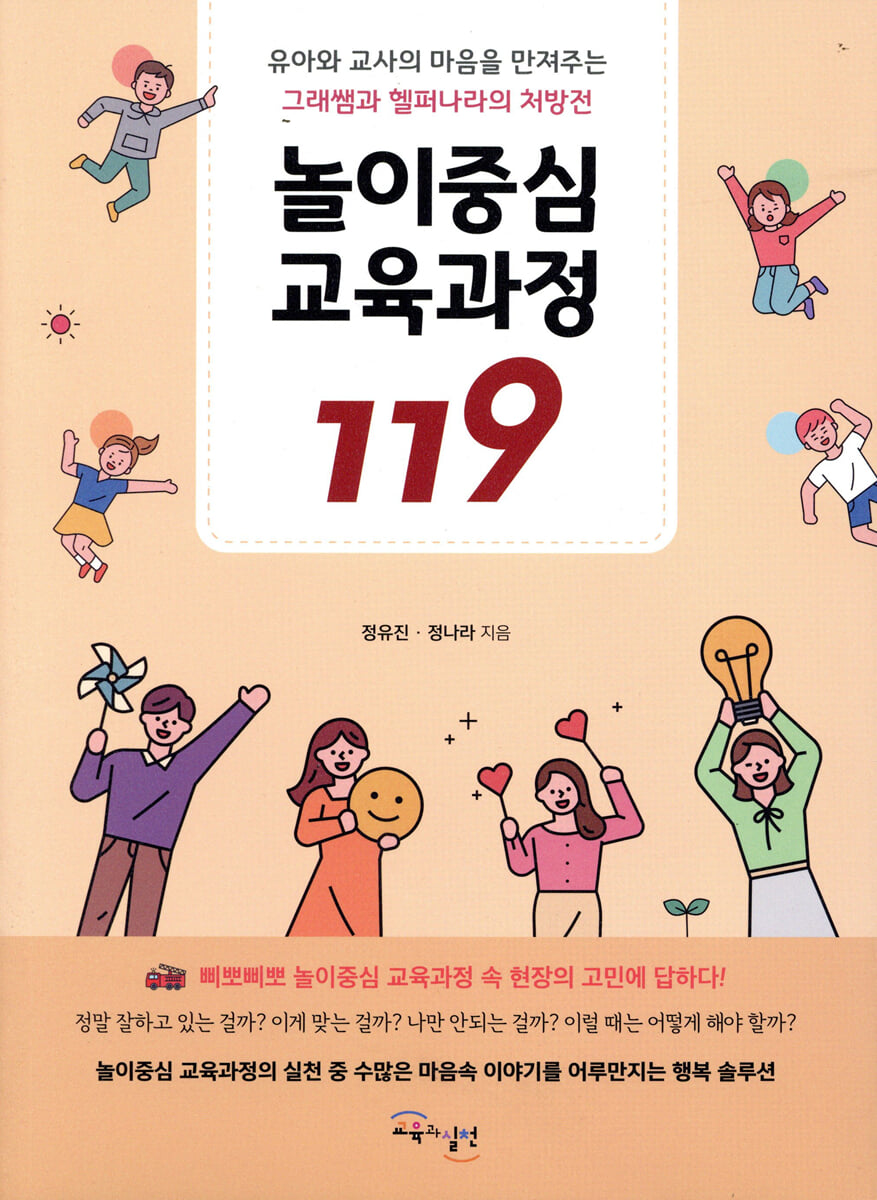
Play-Centered Curriculum 119
 |
Description
Book Introduction
Play is the process by which children grow.
Especially for young children, play is their own special experience and their own life.
The experience of learning while playing and thinking in a fun way becomes the foundation for learning through play in the subsequent educational process.
It is the responsibility of adults, including teachers, to observe what children experience through play and how play develops into a learning process, and to seek expansion.
In particular, teachers observe children's play and try to understand the overall context of what children are curious about and how they experience learning in their own way.
The two authors, who breathe with children in the field, view play from a child's perspective and candidly reveal their secrets for finding meaning and value in play.
Especially for young children, play is their own special experience and their own life.
The experience of learning while playing and thinking in a fun way becomes the foundation for learning through play in the subsequent educational process.
It is the responsibility of adults, including teachers, to observe what children experience through play and how play develops into a learning process, and to seek expansion.
In particular, teachers observe children's play and try to understand the overall context of what children are curious about and how they experience learning in their own way.
The two authors, who breathe with children in the field, view play from a child's perspective and candidly reveal their secrets for finding meaning and value in play.
- You can preview some of the book's contents.
Preview
index
Ⅰ.
Play support
They only play the same routine every day | Can they do the activities the teacher has planned? | I don't know how to support their play | Am I a bad teacher because I can't allow them to play? | It's hard to provide materials immediately | What should I do with children who aren't interested in play? | What should I do with children who don't participate in group activities? | Mind map activities that reflect children's opinions aren't working well | Is it okay for a few children to lead play in our class? | What should I do with 3-year-olds who ask the teacher every time they play? | I feel like my 3-year-old won't learn anything from just playing | How should I guide children who act aggressively? | Why is it so hard to clean up? Is there a secret to getting them to be organized? | It's so messy that I can't stand it, but I'm wondering if I should clean up frequently | They keep asking me to display or store things | They don't clean up during clean-up time and just play or sit still | They drink water or go to the bathroom as soon as it's clean-up time | How can I implement a play-centered curriculum in an inclusive classroom?
Ⅱ.
A curriculum created together by teachers and children
I feel like it's going to be difficult to run a classroom with my own brand now. It's really hard to establish a teaching philosophy. My colleagues and I disagree about the annual curriculum. The weekly curriculum makes it difficult to support child-led play. It's difficult to write a monthly curriculum. There are so many things to consider when including photos in the after-school playlists, so it's difficult. I want to include special activities related to the theme in the after-school playlists.
Ⅲ.
Play record
What are your concerns about records? | Finding your own play records | My own reasons for keeping play records | I want to find learning in play records.
Ⅳ.
Open classes
Teachers' Concerns About Open Classes | Teacher A's Real-Life Case Study | Helper Nara's Story of Child-Led Play Open Classes | Open Classes as Teacher Activities | Parents' Open Classes: Child-Led Play VS.
What activities should I do among the ones planned by the teacher?
V.
Reading Parents' Minds
How can I make my parents understand that I'm just playing?
Ⅵ.
Nuri Curriculum Evaluation: Play Comes to Life
Nuri Curriculum Operation Evaluation | Early Childhood Evaluation
Play support
They only play the same routine every day | Can they do the activities the teacher has planned? | I don't know how to support their play | Am I a bad teacher because I can't allow them to play? | It's hard to provide materials immediately | What should I do with children who aren't interested in play? | What should I do with children who don't participate in group activities? | Mind map activities that reflect children's opinions aren't working well | Is it okay for a few children to lead play in our class? | What should I do with 3-year-olds who ask the teacher every time they play? | I feel like my 3-year-old won't learn anything from just playing | How should I guide children who act aggressively? | Why is it so hard to clean up? Is there a secret to getting them to be organized? | It's so messy that I can't stand it, but I'm wondering if I should clean up frequently | They keep asking me to display or store things | They don't clean up during clean-up time and just play or sit still | They drink water or go to the bathroom as soon as it's clean-up time | How can I implement a play-centered curriculum in an inclusive classroom?
Ⅱ.
A curriculum created together by teachers and children
I feel like it's going to be difficult to run a classroom with my own brand now. It's really hard to establish a teaching philosophy. My colleagues and I disagree about the annual curriculum. The weekly curriculum makes it difficult to support child-led play. It's difficult to write a monthly curriculum. There are so many things to consider when including photos in the after-school playlists, so it's difficult. I want to include special activities related to the theme in the after-school playlists.
Ⅲ.
Play record
What are your concerns about records? | Finding your own play records | My own reasons for keeping play records | I want to find learning in play records.
Ⅳ.
Open classes
Teachers' Concerns About Open Classes | Teacher A's Real-Life Case Study | Helper Nara's Story of Child-Led Play Open Classes | Open Classes as Teacher Activities | Parents' Open Classes: Child-Led Play VS.
What activities should I do among the ones planned by the teacher?
V.
Reading Parents' Minds
How can I make my parents understand that I'm just playing?
Ⅵ.
Nuri Curriculum Evaluation: Play Comes to Life
Nuri Curriculum Operation Evaluation | Early Childhood Evaluation
Into the book
From a teacher's perspective, there is an aspect of the play that has become familiar to me because it is a play scene that I have observed countless times.
But for children, every play is a new and special playtime.
Children are exploring and thinking about games that no one has told them about, making small changes, and creating games with their friends.
Just because a game is familiar to the teacher doesn't mean it's familiar to the children.
Rather than thinking, "Today too?", we need to make an effort to look at play from the children's perspective.
--- p.22
Children cannot live their lives doing everything they want to do.
In the early childhood and play-centered curriculum, children can choose what they want, but they also need to learn what to do when their choice is rejected.
It's also important to learn how to persevere when you really want to do something but can't.
--- p.39
Children cannot live their lives doing everything they want to do.
In the early childhood and play-centered curriculum, children can choose what they want, but they also need to learn what to do when their choice is rejected.
It's also important to learn how to persevere when you really want to do something but can't.
--- p.85
If teachers' efforts and power are concentrated on creating documents, discussion within the educational community is essential.
When creating a curriculum plan, check to see if there are any difficulties, whether it is efficient compared to the time required to write it, and whether play support is being provided effectively through the current curriculum plan. Then, look for areas for change.
If you are sharing this week's play with your family through the after-school play plan, you can use the class SNS or app as an alternative method.
--- p.141
Depending on the teacher's preference, play records can be kept in handwriting or on tablets.
When recording on a tablet, you can take a picture and add it directly to the record, and you can freely edit it.
You can also freely rearrange the order of the pages and jump to any page you want via hyperlinks.
In addition to this, you can easily keep a record of your play by using various functions.
--- p.181
There is too much focus on learning through play, so I try to find learning by connecting 'play' with 'the five areas of the curriculum'.
As a result, we miss out on or fail to see the real learning that children are accumulating every day.
It's a great learning experience for those kids, but the teacher already knows a lot and has a lot of experience, so he can't look at it from the kids' perspective.
So, teachers need to reflect on whether they are only conscious of learning that is constantly revealed.
--- p.203
Once trust has been established, we must now help parents accept the early childhood and play-centered curriculum.
We know the importance of play, but it can be difficult to observe the natural learning process of children through play or to observe everyday play as it is.
Therefore, we frequently share videos of children playing and teachers participating in activities using class SNS or apps to help parents understand.
Parents who were initially anxious about the early childhood and play-centered curriculum gradually broadened their understanding and were able to observe their children's learning and growth.
But for children, every play is a new and special playtime.
Children are exploring and thinking about games that no one has told them about, making small changes, and creating games with their friends.
Just because a game is familiar to the teacher doesn't mean it's familiar to the children.
Rather than thinking, "Today too?", we need to make an effort to look at play from the children's perspective.
--- p.22
Children cannot live their lives doing everything they want to do.
In the early childhood and play-centered curriculum, children can choose what they want, but they also need to learn what to do when their choice is rejected.
It's also important to learn how to persevere when you really want to do something but can't.
--- p.39
Children cannot live their lives doing everything they want to do.
In the early childhood and play-centered curriculum, children can choose what they want, but they also need to learn what to do when their choice is rejected.
It's also important to learn how to persevere when you really want to do something but can't.
--- p.85
If teachers' efforts and power are concentrated on creating documents, discussion within the educational community is essential.
When creating a curriculum plan, check to see if there are any difficulties, whether it is efficient compared to the time required to write it, and whether play support is being provided effectively through the current curriculum plan. Then, look for areas for change.
If you are sharing this week's play with your family through the after-school play plan, you can use the class SNS or app as an alternative method.
--- p.141
Depending on the teacher's preference, play records can be kept in handwriting or on tablets.
When recording on a tablet, you can take a picture and add it directly to the record, and you can freely edit it.
You can also freely rearrange the order of the pages and jump to any page you want via hyperlinks.
In addition to this, you can easily keep a record of your play by using various functions.
--- p.181
There is too much focus on learning through play, so I try to find learning by connecting 'play' with 'the five areas of the curriculum'.
As a result, we miss out on or fail to see the real learning that children are accumulating every day.
It's a great learning experience for those kids, but the teacher already knows a lot and has a lot of experience, so he can't look at it from the kids' perspective.
So, teachers need to reflect on whether they are only conscious of learning that is constantly revealed.
--- p.203
Once trust has been established, we must now help parents accept the early childhood and play-centered curriculum.
We know the importance of play, but it can be difficult to observe the natural learning process of children through play or to observe everyday play as it is.
Therefore, we frequently share videos of children playing and teachers participating in activities using class SNS or apps to help parents understand.
Parents who were initially anxious about the early childhood and play-centered curriculum gradually broadened their understanding and were able to observe their children's learning and growth.
--- p.281
Publisher's Review
Answering On-site Concerns in the Pippo Pippo Play-Centered Curriculum
A prescription from Teacher Grae and Helper Nara, following the "Play-Centered Curriculum for Fun, Learning, and Growth"
A vivid prescription for the all-too-familiar concerns we face in the field.
: From curriculum planning to play support, observation and recording, and open classes, we will discuss the overall learning operation.
Play gives children the opportunity to practice what they are learning.
Play is the process by which children grow.
Especially for young children, play is their own special experience and their own life.
The experience of learning while playing and thinking in a fun way becomes the foundation for learning through play in the subsequent educational process.
It is the responsibility of adults, including teachers, to observe what children experience through play and how play develops into a learning process, and to seek expansion.
In particular, teachers observe children's play and try to understand the overall context of what children are curious about and how they experience learning in their own way.
The two authors, who breathe with children in the field, view play from a child's perspective and candidly reveal their secrets for finding meaning and value in play.
Play is our brain's favorite way to learn.
The revised Nuri Curriculum emphasizes children's learning through play.
Discovering the meaning and value of play and determining the direction and content to support play are very important roles assigned to teachers.
Teachers must constantly listen and observe children's thoughts and how their interests and concerns expand into learning.
The core of the early childhood and play-centered curriculum is to find out what children want through continuous communication, advise them to do 'that', and fill in the gaps together.
“Children are birds that fly in the sky.
Keeping Trugenev's words in mind, "If you like something, it flies away; if you don't like it, it flies away," I breathe and live with children.
Through a cycle of learning experiences through play and teacher support for play, children acquire learning that will serve as lifelong nourishment.
It is a bonus that in this process, not only the children but also the teachers learn and grow together.
Just because things don't go as planned doesn't mean they're unnecessary.
Nothing can be accomplished all at once.
In particular, 'education' is like a hundred-year plan, so we need to prepare for the future in advance and establish methods and procedures.
The "2019 Revised Nuri Curriculum," which may feel sudden, has brought about many trials and errors in actual educational settings.
In the early childhood and play-centered curriculum, it is important to find a ‘direction’ rather than a ‘correct answer.’
Still, in the field, we often feel lost in many situations that do not go as planned, and no one can give us an answer as to what is the right answer.
Nevertheless, just as many people have made a path by passing through there, even if it was not a path at first, many people who are thinking and studying are making a path one by one.
At the center of this path of sharing and creating their own experiences and knowledge is this book, "Play-Centered Curriculum 119."
We grow together with happy children who learn through play and thinking.
"Play-Centered Curriculum 119" covers both the theory and practice of play by including anecdotes from the vivid experiences of two teachers who work with young children in the field.
It also contains vivid examples to help parents understand the early childhood and play-centered curriculum from the perspectives of children and teachers, as well as parents.
It provides a starting point for resonating with content filled with the "real" concerns of the field and for improving the direction of a better early childhood and play-centered curriculum.
A prescription from Teacher Grae and Helper Nara, following the "Play-Centered Curriculum for Fun, Learning, and Growth"
A vivid prescription for the all-too-familiar concerns we face in the field.
: From curriculum planning to play support, observation and recording, and open classes, we will discuss the overall learning operation.
Play gives children the opportunity to practice what they are learning.
Play is the process by which children grow.
Especially for young children, play is their own special experience and their own life.
The experience of learning while playing and thinking in a fun way becomes the foundation for learning through play in the subsequent educational process.
It is the responsibility of adults, including teachers, to observe what children experience through play and how play develops into a learning process, and to seek expansion.
In particular, teachers observe children's play and try to understand the overall context of what children are curious about and how they experience learning in their own way.
The two authors, who breathe with children in the field, view play from a child's perspective and candidly reveal their secrets for finding meaning and value in play.
Play is our brain's favorite way to learn.
The revised Nuri Curriculum emphasizes children's learning through play.
Discovering the meaning and value of play and determining the direction and content to support play are very important roles assigned to teachers.
Teachers must constantly listen and observe children's thoughts and how their interests and concerns expand into learning.
The core of the early childhood and play-centered curriculum is to find out what children want through continuous communication, advise them to do 'that', and fill in the gaps together.
“Children are birds that fly in the sky.
Keeping Trugenev's words in mind, "If you like something, it flies away; if you don't like it, it flies away," I breathe and live with children.
Through a cycle of learning experiences through play and teacher support for play, children acquire learning that will serve as lifelong nourishment.
It is a bonus that in this process, not only the children but also the teachers learn and grow together.
Just because things don't go as planned doesn't mean they're unnecessary.
Nothing can be accomplished all at once.
In particular, 'education' is like a hundred-year plan, so we need to prepare for the future in advance and establish methods and procedures.
The "2019 Revised Nuri Curriculum," which may feel sudden, has brought about many trials and errors in actual educational settings.
In the early childhood and play-centered curriculum, it is important to find a ‘direction’ rather than a ‘correct answer.’
Still, in the field, we often feel lost in many situations that do not go as planned, and no one can give us an answer as to what is the right answer.
Nevertheless, just as many people have made a path by passing through there, even if it was not a path at first, many people who are thinking and studying are making a path one by one.
At the center of this path of sharing and creating their own experiences and knowledge is this book, "Play-Centered Curriculum 119."
We grow together with happy children who learn through play and thinking.
"Play-Centered Curriculum 119" covers both the theory and practice of play by including anecdotes from the vivid experiences of two teachers who work with young children in the field.
It also contains vivid examples to help parents understand the early childhood and play-centered curriculum from the perspectives of children and teachers, as well as parents.
It provides a starting point for resonating with content filled with the "real" concerns of the field and for improving the direction of a better early childhood and play-centered curriculum.
GOODS SPECIFICS
- Publication date: December 24, 2021
- Page count, weight, size: 328 pages | 680g | 172*235*30mm
- ISBN13: 9791191724073
- ISBN10: 1191724077
You may also like
카테고리
korean


korean

![GQ KOREA Mark (Monthly): December [2025]](http://librairie.coreenne.fr/cdn/shop/files/8ef265dbbfbf186523ed75ba7319009d.jpg?v=1765340328&width=3840)


