

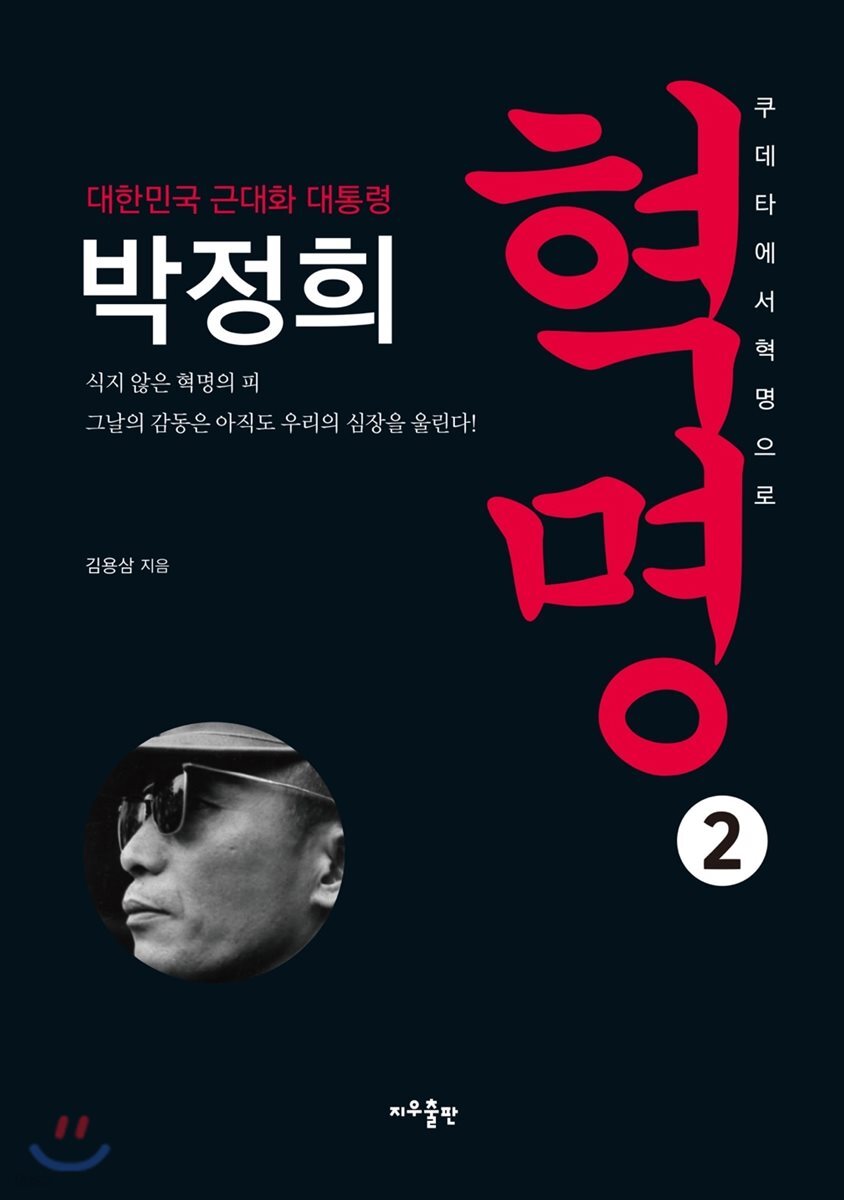
Park Chung-hee, the President of the Modernization of the Republic of Korea, Revolution 2
 |
Description
Book Introduction
Meet a revolutionary like you've never seen before!
Appeared on the stage of history through a 'coup d'état'
A record of 18 years under President Park Chung-hee, a modernizing president who ended his life with a "revolution."
This book is the most detailed report on a great revolutionary who brought about the industrial revolution that modernized South Korea.
Park Chung-hee, a revolutionary who risked his life fighting against incompetence and corruption to feed the hungry people and protect this country with our own strength.
His wish was to establish an independent and self-reliant Korea based on a society of simple, hard-working, honest, and sincere people.
This book contains the testimonies of countless people who participated in the modernization process, including the process by which Park Chung-hee, through his legs and eyes rather than his ears and mouth, confirmed and supervised the nation, ultimately succeeding in modernizing the country in a way no one else had been able to do, and in establishing a material foundation and a middle class.
The surprising fact that Park Chung-hee carried out three multi-stage coups during his lifetime to achieve liberal democracy through self-reliant national defense and a self-sufficient economy is the keyword and core of this book.
And the result of those three coups was revolution.
Appeared on the stage of history through a 'coup d'état'
A record of 18 years under President Park Chung-hee, a modernizing president who ended his life with a "revolution."
This book is the most detailed report on a great revolutionary who brought about the industrial revolution that modernized South Korea.
Park Chung-hee, a revolutionary who risked his life fighting against incompetence and corruption to feed the hungry people and protect this country with our own strength.
His wish was to establish an independent and self-reliant Korea based on a society of simple, hard-working, honest, and sincere people.
This book contains the testimonies of countless people who participated in the modernization process, including the process by which Park Chung-hee, through his legs and eyes rather than his ears and mouth, confirmed and supervised the nation, ultimately succeeding in modernizing the country in a way no one else had been able to do, and in establishing a material foundation and a middle class.
The surprising fact that Park Chung-hee carried out three multi-stage coups during his lifetime to achieve liberal democracy through self-reliant national defense and a self-sufficient economy is the keyword and core of this book.
And the result of those three coups was revolution.
index
preface
01 The New Community Movement begins
Heaven helps those who help themselves
02 Introduction of an integrated development approach
All administrative departments should participate
03 Hedgehog Theory
“If a fire breaks out in your own house, your family members must put it out first.”
04 It's not agriculture, it's industry
Build a steel mill and develop automobiles.
05 The Nixon Doctrine and the Withdrawal of US Forces from Korea
"I'll give everything for your security."
06 Park Chung-hee, the United States, and North Korea
What kind of country is America to us?
07 All roads lead to heavy chemical industrialization
The best policy that determined the fate of the nation
08 Develop domestically produced weapons
"Let's just make it, even if the bullet doesn't go out."
09 Machiavellian Politics
Divide and rule
10 Codenamed 'Plan 890'
Top secret directive: "Develop nuclear weapons."
11. Failure of nuclear development, Park Chung-hee's death
Park Chung-hee's revolution ended in incompleteness
12 Epilogue
The 'Park Chung-hee Revolution' was about building a self-reliant national defense and self-sufficient economy.
References
01 The New Community Movement begins
Heaven helps those who help themselves
02 Introduction of an integrated development approach
All administrative departments should participate
03 Hedgehog Theory
“If a fire breaks out in your own house, your family members must put it out first.”
04 It's not agriculture, it's industry
Build a steel mill and develop automobiles.
05 The Nixon Doctrine and the Withdrawal of US Forces from Korea
"I'll give everything for your security."
06 Park Chung-hee, the United States, and North Korea
What kind of country is America to us?
07 All roads lead to heavy chemical industrialization
The best policy that determined the fate of the nation
08 Develop domestically produced weapons
"Let's just make it, even if the bullet doesn't go out."
09 Machiavellian Politics
Divide and rule
10 Codenamed 'Plan 890'
Top secret directive: "Develop nuclear weapons."
11. Failure of nuclear development, Park Chung-hee's death
Park Chung-hee's revolution ended in incompleteness
12 Epilogue
The 'Park Chung-hee Revolution' was about building a self-reliant national defense and self-sufficient economy.
References
Into the book
A leader who cannot even feed his people three proper meals is not a true leader.
When formulating any policy or law, you must always connect your thinking to a methodology that will feed the people. (Volume 2, page 29)
We will actively help villages that work hard and cooperate, but we will not help villages that do not work hard or cooperate.
This is the only way to eradicate the dependence that has been passed down for thousands of years and awaken the spirit of self-deprecation.
With this policy, even if I lose the election and have to give up power, I will not change this principle of punishment for those who are not rewarded. (Volume 2, page 32) --- From "Kicking Off the New Community Movement"
We don't need military power to invade other countries, but we must secure self-defense capabilities that allow us to curl up like a hedgehog and take an offensive stance if an enemy attempts to devour us. (Volume 2, page 69)
In this era of ruthless competition for survival, where all nations of the world, for the sake of their national interests, turn yesterday's enemies into today's allies and advocate the ruthless logic of survival of the fittest, we must deeply bear in mind that powerless nations will be forever left behind on the world stage.
(Omitted) Of course, support and cooperation from allies are also important in overcoming this ordeal.
But more importantly, our people's unwavering resolve, drive, and unity, and their blood, sweat, and tears, are cultivating national strength. (Volume 2, p. 98)
--- From "The Hedgehog Theory"
President Park Chung-hee's heavy chemical industrialization policy, declared in January 1973, was an inevitable choice given the national security situation facing South Korea.
The United States, mired in the Vietnam War, tried to escape its predicament by announcing the Nixon Doctrine.
The Nixon Doctrine contained the shocking content of the withdrawal of US troops from Korea.
South Korea, facing the repeated threat of invasion by North Korea's communist regime, desperately needed to build a defense industry for self-defense. (Volume 2, p. 139)
--- From "It's not agriculture, it's industry"
3.
Third coup
Park Chung-hee was in trouble.
Fostering the heavy chemical industry required more than 10 years and astronomical investments.
However, his term of office was extended by four years through a third constitutional amendment, but only three years remained until 1975.
To overcome this, extraordinary political determination was required.
At 7:00 PM on October 17, 1972, the regular broadcast was suddenly interrupted and a caption saying "Breaking News" appeared.
After martial law was declared nationwide, President Park Chung-hee simultaneously dissolved the National Assembly, suspended political activities of political parties, and announced a special address suspending some of the Constitution's provisions, with the Emergency State Council performing the functions of the suspended Constitutional provisions.
The framework of the Yushin Constitution stipulates that the president appoints one-third of the National Assembly members and all judges, has the power to issue emergency decrees and dissolve the National Assembly, and the president's term of office is six years and can be extended.
The presidential election system changed from a direct election by the people to an indirect election by the National Conference for Unification.
The basic democratic framework of separation of powers has collapsed, and the three powers of legislature, judiciary, and executive have been concentrated in the hands of the president.
In fact, the October Yushin was a kind of quasi-wartime mobilization system. Park Chung-hee's declaration of it was based on the historical fact that he fostered the defense and heavy chemical industries. (Volume 2, p. 181)
--- From "The Nixon Doctrine and the Withdrawal of US Forces from Korea"
In his memo, President Park Chung-hee presented three basic policies for the development of domestic missiles.
First, we will establish an independent development system.
Second, develop surface-to-surface missiles, with the first stage aiming for domestic production before 1975.
Third, we will mobilize domestic and international technical staff to develop technology, invite foreign experts, and form technological partnerships with foreign countries.
This secret project was disguised as the "Aviation Industry Promotion Plan," and later dubbed "White Bear." (Volume 2, p. 282) --- From "Develop Domestic Weapons"
In early 1972, Park Chung-hee called Chief Secretary Kim Jeong-ryeol and Senior Secretary for Economic Affairs Oh Won-cheol, a leading figure in the development of domestic weapons, to his office and said, “We need nuclear weapons to protect peace.
By the late 1970s, the nuclear weapons project was nearing completion, with the top secret order to “secure the technology.” (Volume 2, page 327)
The United States began to apply persistent pressure on South Korea, believing that its possession of nuclear weapons would be a major factor in undermining stability in Northeast Asia.
Not only at sites like the Atomic Energy Research Institute, the Agency for Defense Development, and the Daejeon Machinery Factory, but also at the Blue House, the Office of the Prime Minister, the Ministry of Science and Technology, and the Ministry of Finance, department heads were closely monitored by agents from the U.S. Embassy in Korea and the CIA, and they explicitly pressured them to halt nuclear development. (Volume 2, p. 349)
--- From "Project Codenamed '890'"
4.
And 'revolution'
The United States dispatched a scientific attaché to the U.S. Embassy in South Korea to monitor Park Chung-hee's nuclear development.
(syncopation)
“If Korea is not to perish, it must abandon nuclear development.” (Volume 2, p. 374)
--- From "Failure of Nuclear Development, Death of Park Chung-hee"
Although the Park Chung-hee regime suppressed the democratization movement, it contributed significantly to Korean democracy by paradoxically creating a middle class that forms the foundation of today's pluralism through economic development. (Volume 2, p. 409)
When formulating any policy or law, you must always connect your thinking to a methodology that will feed the people. (Volume 2, page 29)
We will actively help villages that work hard and cooperate, but we will not help villages that do not work hard or cooperate.
This is the only way to eradicate the dependence that has been passed down for thousands of years and awaken the spirit of self-deprecation.
With this policy, even if I lose the election and have to give up power, I will not change this principle of punishment for those who are not rewarded. (Volume 2, page 32) --- From "Kicking Off the New Community Movement"
We don't need military power to invade other countries, but we must secure self-defense capabilities that allow us to curl up like a hedgehog and take an offensive stance if an enemy attempts to devour us. (Volume 2, page 69)
In this era of ruthless competition for survival, where all nations of the world, for the sake of their national interests, turn yesterday's enemies into today's allies and advocate the ruthless logic of survival of the fittest, we must deeply bear in mind that powerless nations will be forever left behind on the world stage.
(Omitted) Of course, support and cooperation from allies are also important in overcoming this ordeal.
But more importantly, our people's unwavering resolve, drive, and unity, and their blood, sweat, and tears, are cultivating national strength. (Volume 2, p. 98)
--- From "The Hedgehog Theory"
President Park Chung-hee's heavy chemical industrialization policy, declared in January 1973, was an inevitable choice given the national security situation facing South Korea.
The United States, mired in the Vietnam War, tried to escape its predicament by announcing the Nixon Doctrine.
The Nixon Doctrine contained the shocking content of the withdrawal of US troops from Korea.
South Korea, facing the repeated threat of invasion by North Korea's communist regime, desperately needed to build a defense industry for self-defense. (Volume 2, p. 139)
--- From "It's not agriculture, it's industry"
3.
Third coup
Park Chung-hee was in trouble.
Fostering the heavy chemical industry required more than 10 years and astronomical investments.
However, his term of office was extended by four years through a third constitutional amendment, but only three years remained until 1975.
To overcome this, extraordinary political determination was required.
At 7:00 PM on October 17, 1972, the regular broadcast was suddenly interrupted and a caption saying "Breaking News" appeared.
After martial law was declared nationwide, President Park Chung-hee simultaneously dissolved the National Assembly, suspended political activities of political parties, and announced a special address suspending some of the Constitution's provisions, with the Emergency State Council performing the functions of the suspended Constitutional provisions.
The framework of the Yushin Constitution stipulates that the president appoints one-third of the National Assembly members and all judges, has the power to issue emergency decrees and dissolve the National Assembly, and the president's term of office is six years and can be extended.
The presidential election system changed from a direct election by the people to an indirect election by the National Conference for Unification.
The basic democratic framework of separation of powers has collapsed, and the three powers of legislature, judiciary, and executive have been concentrated in the hands of the president.
In fact, the October Yushin was a kind of quasi-wartime mobilization system. Park Chung-hee's declaration of it was based on the historical fact that he fostered the defense and heavy chemical industries. (Volume 2, p. 181)
--- From "The Nixon Doctrine and the Withdrawal of US Forces from Korea"
In his memo, President Park Chung-hee presented three basic policies for the development of domestic missiles.
First, we will establish an independent development system.
Second, develop surface-to-surface missiles, with the first stage aiming for domestic production before 1975.
Third, we will mobilize domestic and international technical staff to develop technology, invite foreign experts, and form technological partnerships with foreign countries.
This secret project was disguised as the "Aviation Industry Promotion Plan," and later dubbed "White Bear." (Volume 2, p. 282) --- From "Develop Domestic Weapons"
In early 1972, Park Chung-hee called Chief Secretary Kim Jeong-ryeol and Senior Secretary for Economic Affairs Oh Won-cheol, a leading figure in the development of domestic weapons, to his office and said, “We need nuclear weapons to protect peace.
By the late 1970s, the nuclear weapons project was nearing completion, with the top secret order to “secure the technology.” (Volume 2, page 327)
The United States began to apply persistent pressure on South Korea, believing that its possession of nuclear weapons would be a major factor in undermining stability in Northeast Asia.
Not only at sites like the Atomic Energy Research Institute, the Agency for Defense Development, and the Daejeon Machinery Factory, but also at the Blue House, the Office of the Prime Minister, the Ministry of Science and Technology, and the Ministry of Finance, department heads were closely monitored by agents from the U.S. Embassy in Korea and the CIA, and they explicitly pressured them to halt nuclear development. (Volume 2, p. 349)
--- From "Project Codenamed '890'"
4.
And 'revolution'
The United States dispatched a scientific attaché to the U.S. Embassy in South Korea to monitor Park Chung-hee's nuclear development.
(syncopation)
“If Korea is not to perish, it must abandon nuclear development.” (Volume 2, p. 374)
--- From "Failure of Nuclear Development, Death of Park Chung-hee"
Although the Park Chung-hee regime suppressed the democratization movement, it contributed significantly to Korean democracy by paradoxically creating a middle class that forms the foundation of today's pluralism through economic development. (Volume 2, p. 409)
--- From "Epilogue"
Publisher's Review
A populist politician can't even imagine
Park Chung-hee was not a "celebrity president" who was swayed by "popularity" or approval ratings, but he also took a path that was the complete opposite of populism.
Rather than pursuing a “society where everyone lives well by sharing what they have” to receive applause from countless people, he aimed for a “society where more benefits go to those who work hard” while being prepared for criticism.
This was the philosophy of leadership that Park Chung-hee consistently pursued from the beginning of his term in office until his death.
The dispatch of Korean troops to Vietnam, the normalization of diplomatic relations between Korea and Japan, the creation of a homeland reserve force, and the construction of highways and steel mills were all historical tasks that had to be carried out to protect and increase the lives and property of the people. However, on the other hand, they were also policies that were deeply unpopular with the people.
Instead of distributing the funds provided by Japan in exchange for normalizing diplomatic relations to those who had suffered under Japanese colonial rule, 70 percent of the funds were invested in the construction of steel mills, highways, and the Soyang River Dam for national development.
It was a 'big decision' that no populist politician could have imagined.
As a great leader
During the 18 years of Park Chung-hee's presidency, the foundation of the country was revolutionarily transformed, to borrow the expression of economist Jo Seung-hee, from an agricultural society dominated by horse-drawn carriages and forklifts to an industrial society dominated by automobiles and airplanes.
However, just because a leader of an era devoted himself to the welfare of his country and people does not necessarily mean that he will be evaluated positively and rationally.
President de Gaulle, who wrote a new history for post-war France, must have been quite annoyed by the criticism of the ignorant people, as he once said, “The French people are like a herd of cattle that do not look far into the horizon, but only look down at the grass in front of them.”
Since humans are not gods, they may have made numerous failures, mistakes, and errors while building up their achievements.
He is called a 'great leader' because he overcame his mistakes, failures, and errors and found success.
Developed countries, including Japan, are actively seeking out examples of success, greatness, positive images, and emulation from the lives of those who brought glory to their country, and dressing them up in the wonderful costume of storytelling to spread the "DNA of success."
On the contrary, in our society, no matter how great a person's achievements, we spend all our time, effort, and money on stripping them bare and then relentlessly digging up only their failures, mistakes, and wrongdoings, and then amplifying and reproducing them.
As a result, the 'DNA of curses' such as insulting, defiling, belittling, and spitting on a person are being reproduced and expanded, and self-harm, self-deprecation, and self-torture are being carried out on a national scale, distorting, belittling, and fabricating modern history.
Finally proving the Glorious Revolution
About 40 percent of the revolutionary army officers who participated in the May 16th Incident were from poor peasant families or from Vietnam.
They succeeded in making the majority of the population middle class by providing educational opportunities to people in similar situations and encouraging them to acquire skills.
In this respect, the May 16 coup proves that it was not a simple military coup, but a glorious revolution that overthrew the “country of the yangban” and established a “country of the common people and technicians.”
Park Chung-hee achieved national modernization, which would have been impossible without revolutionary ideas, not through his "ruling actions" as a politician, but through revolutionary "construction."
By equally distributing the achievements thus obtained to the people of the Republic of Korea, the cause of the revolution was successful.
However, in return, Park Chung-hee is still being branded a 'dictator who destroyed democracy' and a 'force that must be eliminated' from our society as soon as possible.
Before it was a 'miracle', it was closer to a mystery
A strong leader who drove economic development
The only record containing Park Chung-hee's insights and strategies!
The 18 years of Park Chung-hee's rule, during which he had to chase three rabbits with limited national power: national security, economic modernization, and liberal democracy.
Instead of chasing three rabbits in a hurry, he wrote an impossible myth with strong determination and conviction.
Park Chung-hee, who navigated the harsh international relations by ‘reversing’ the economic development formula advocated by Western intellectuals and spearheaded by international organizations.
The 'reverse' formula and his announced retirement date of '1981'.
This book contains the world-historical significance of the Park Chung-hee revolution in his insights and strategies contained in 'Backwards' and '1981'.
This is a book that will allow you to encounter the great leader Park Chung-hee, who can only be seen clearly when you look closely.
Park Chung-hee was not a "celebrity president" who was swayed by "popularity" or approval ratings, but he also took a path that was the complete opposite of populism.
Rather than pursuing a “society where everyone lives well by sharing what they have” to receive applause from countless people, he aimed for a “society where more benefits go to those who work hard” while being prepared for criticism.
This was the philosophy of leadership that Park Chung-hee consistently pursued from the beginning of his term in office until his death.
The dispatch of Korean troops to Vietnam, the normalization of diplomatic relations between Korea and Japan, the creation of a homeland reserve force, and the construction of highways and steel mills were all historical tasks that had to be carried out to protect and increase the lives and property of the people. However, on the other hand, they were also policies that were deeply unpopular with the people.
Instead of distributing the funds provided by Japan in exchange for normalizing diplomatic relations to those who had suffered under Japanese colonial rule, 70 percent of the funds were invested in the construction of steel mills, highways, and the Soyang River Dam for national development.
It was a 'big decision' that no populist politician could have imagined.
As a great leader
During the 18 years of Park Chung-hee's presidency, the foundation of the country was revolutionarily transformed, to borrow the expression of economist Jo Seung-hee, from an agricultural society dominated by horse-drawn carriages and forklifts to an industrial society dominated by automobiles and airplanes.
However, just because a leader of an era devoted himself to the welfare of his country and people does not necessarily mean that he will be evaluated positively and rationally.
President de Gaulle, who wrote a new history for post-war France, must have been quite annoyed by the criticism of the ignorant people, as he once said, “The French people are like a herd of cattle that do not look far into the horizon, but only look down at the grass in front of them.”
Since humans are not gods, they may have made numerous failures, mistakes, and errors while building up their achievements.
He is called a 'great leader' because he overcame his mistakes, failures, and errors and found success.
Developed countries, including Japan, are actively seeking out examples of success, greatness, positive images, and emulation from the lives of those who brought glory to their country, and dressing them up in the wonderful costume of storytelling to spread the "DNA of success."
On the contrary, in our society, no matter how great a person's achievements, we spend all our time, effort, and money on stripping them bare and then relentlessly digging up only their failures, mistakes, and wrongdoings, and then amplifying and reproducing them.
As a result, the 'DNA of curses' such as insulting, defiling, belittling, and spitting on a person are being reproduced and expanded, and self-harm, self-deprecation, and self-torture are being carried out on a national scale, distorting, belittling, and fabricating modern history.
Finally proving the Glorious Revolution
About 40 percent of the revolutionary army officers who participated in the May 16th Incident were from poor peasant families or from Vietnam.
They succeeded in making the majority of the population middle class by providing educational opportunities to people in similar situations and encouraging them to acquire skills.
In this respect, the May 16 coup proves that it was not a simple military coup, but a glorious revolution that overthrew the “country of the yangban” and established a “country of the common people and technicians.”
Park Chung-hee achieved national modernization, which would have been impossible without revolutionary ideas, not through his "ruling actions" as a politician, but through revolutionary "construction."
By equally distributing the achievements thus obtained to the people of the Republic of Korea, the cause of the revolution was successful.
However, in return, Park Chung-hee is still being branded a 'dictator who destroyed democracy' and a 'force that must be eliminated' from our society as soon as possible.
Before it was a 'miracle', it was closer to a mystery
A strong leader who drove economic development
The only record containing Park Chung-hee's insights and strategies!
The 18 years of Park Chung-hee's rule, during which he had to chase three rabbits with limited national power: national security, economic modernization, and liberal democracy.
Instead of chasing three rabbits in a hurry, he wrote an impossible myth with strong determination and conviction.
Park Chung-hee, who navigated the harsh international relations by ‘reversing’ the economic development formula advocated by Western intellectuals and spearheaded by international organizations.
The 'reverse' formula and his announced retirement date of '1981'.
This book contains the world-historical significance of the Park Chung-hee revolution in his insights and strategies contained in 'Backwards' and '1981'.
This is a book that will allow you to encounter the great leader Park Chung-hee, who can only be seen clearly when you look closely.
GOODS SPECIFICS
- Date of issue: May 16, 2019
- Page count, weight, size: 416 pages | 570g | 148*210*20mm
- ISBN13: 9788991622685
- ISBN10: 8991622682
You may also like
카테고리
korean


korean

![GQ KOREA Mark (Monthly): December [2025]](http://librairie.coreenne.fr/cdn/shop/files/8ef265dbbfbf186523ed75ba7319009d.jpg?v=1765340328&width=3840)


