

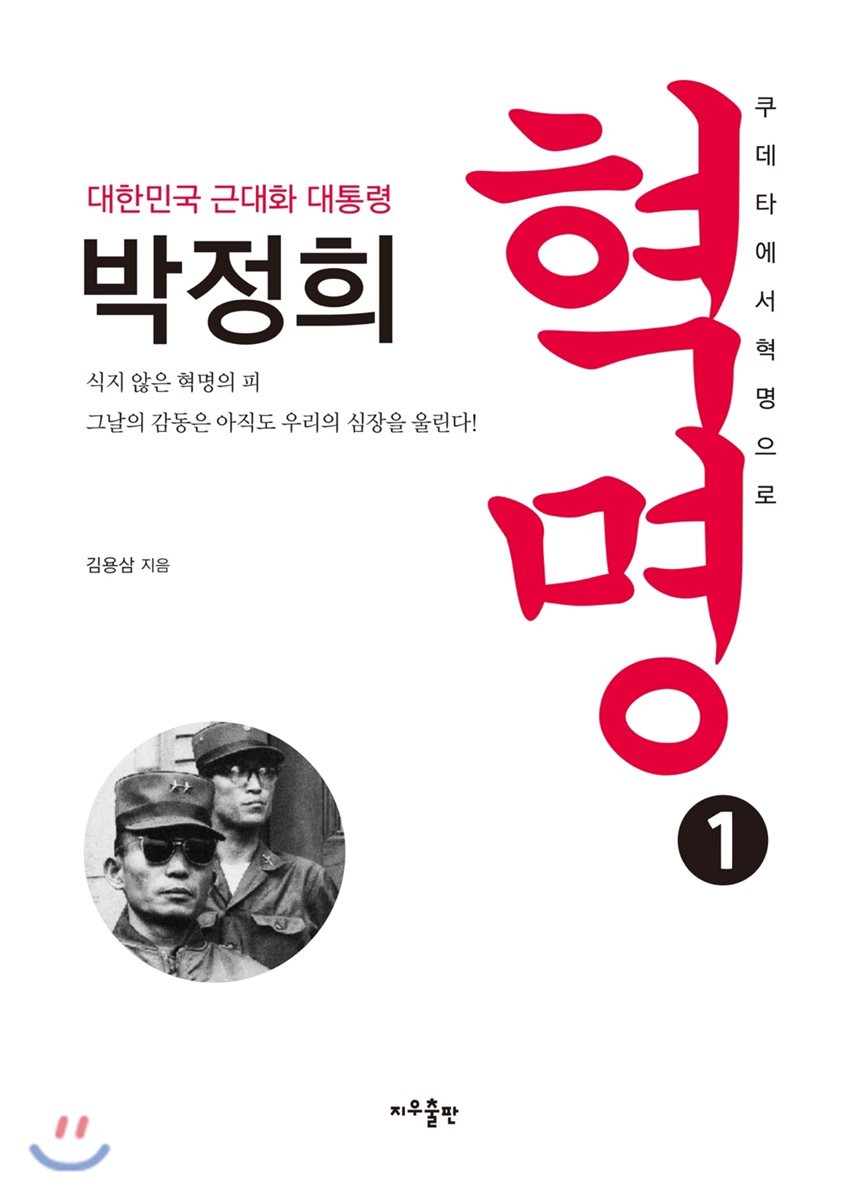
Park Chung-hee, the modernizing president of the Republic of Korea, revolution 1
 |
Description
Book Introduction
Meet a revolutionary like you've never seen before!
Appeared on the stage of history through a 'coup d'état'
A record of 18 years under President Park Chung-hee, a modernizing president who ended his life with a "revolution."
This book is the most detailed report on a great revolutionary who brought about the industrial revolution that modernized South Korea.
Park Chung-hee, a revolutionary who risked his life fighting against incompetence and corruption to feed the hungry people and protect this country with our own strength.
His wish was to establish an independent and self-reliant Korea based on a society of simple, hard-working, honest, and sincere people.
This book contains the testimonies of countless people who participated in the modernization process, including the process by which Park Chung-hee, through his legs and eyes rather than his ears and mouth, confirmed and supervised the nation, ultimately succeeding in modernizing the country in a way no one else had been able to do, and in establishing a material foundation and a middle class.
The surprising fact that Park Chung-hee carried out three multi-stage coups during his lifetime to achieve liberal democracy through self-reliant national defense and a self-sufficient economy is the keyword and core of this book.
And the result of those three coups was revolution.
Appeared on the stage of history through a 'coup d'état'
A record of 18 years under President Park Chung-hee, a modernizing president who ended his life with a "revolution."
This book is the most detailed report on a great revolutionary who brought about the industrial revolution that modernized South Korea.
Park Chung-hee, a revolutionary who risked his life fighting against incompetence and corruption to feed the hungry people and protect this country with our own strength.
His wish was to establish an independent and self-reliant Korea based on a society of simple, hard-working, honest, and sincere people.
This book contains the testimonies of countless people who participated in the modernization process, including the process by which Park Chung-hee, through his legs and eyes rather than his ears and mouth, confirmed and supervised the nation, ultimately succeeding in modernizing the country in a way no one else had been able to do, and in establishing a material foundation and a middle class.
The surprising fact that Park Chung-hee carried out three multi-stage coups during his lifetime to achieve liberal democracy through self-reliant national defense and a self-sufficient economy is the keyword and core of this book.
And the result of those three coups was revolution.
index
preface
01 From Teacher to Soldier
The boy who wanted to wield a long sword becomes a soldier.
02 Becoming an officer in the Manchurian Army
Disarmed by defeat, a shabby journey home
03 Standing at the crossroads of life and death
President Syngman Rhee rescues Park Chung-hee from death row
04 Open your eyes to real politics
Conspiracy to plot a coup to overthrow Syngman Rhee
05 Three Coup Attempts
"let's go.
“Let’s go even if we die.”
06 May 16, that fateful day
"Honey, General Kim, just push it."
07 Coup succeeds
Power cannot be divided into two.
08 Improving the quality of national governance
revolution from above
09 Master of State Administration
On-site administration, check and check again…
10. Normalization of diplomatic relations between Korea and Japan
Even if I get criticized as ‘the second Lee Wan-yong’…
11. Attempt a second military coup
What if diplomatic relations with Japan had been postponed?
December Vietnam War and South Korea
"America, you must help South Vietnam."
13 Korean troops deployed to Vietnam
The US President was brought up in the troop deployment negotiations…
? References
01 From Teacher to Soldier
The boy who wanted to wield a long sword becomes a soldier.
02 Becoming an officer in the Manchurian Army
Disarmed by defeat, a shabby journey home
03 Standing at the crossroads of life and death
President Syngman Rhee rescues Park Chung-hee from death row
04 Open your eyes to real politics
Conspiracy to plot a coup to overthrow Syngman Rhee
05 Three Coup Attempts
"let's go.
“Let’s go even if we die.”
06 May 16, that fateful day
"Honey, General Kim, just push it."
07 Coup succeeds
Power cannot be divided into two.
08 Improving the quality of national governance
revolution from above
09 Master of State Administration
On-site administration, check and check again…
10. Normalization of diplomatic relations between Korea and Japan
Even if I get criticized as ‘the second Lee Wan-yong’…
11. Attempt a second military coup
What if diplomatic relations with Japan had been postponed?
December Vietnam War and South Korea
"America, you must help South Vietnam."
13 Korean troops deployed to Vietnam
The US President was brought up in the troop deployment negotiations…
? References
Into the book
1.
First coup
We are not rising up because we want to take power.
Our goal is to reform the foundations of the country and rise up to eradicate its rotten corruption. So what if it's a revolution or a coup?
If we achieve the national modernization that previous regimes failed to achieve, future historians will be the ones to judge us. (Volume 1, page 10)
The April 19th Revolution occurred, leading to the collapse of the Syngman Rhee government, and on August 23 of that year, the Yun Bo-seon and Chang Myon governments were launched under a cabinet system, but it was a series of disappointments.
At the time, politicians and the public agreed that the root of all evil was the 'imperial presidency', so they changed the power structure from a presidential system to a parliamentary cabinet system through a constitutional amendment.
However, it did not take long for true democracy to realize the truth that simply changing the power structure does not automatically solve the fundamental problem of a system that allows the people to eat their fill and build a wealthy and strong country.
This country has turned into a 'republic of protests', with even elementary school students taking to the streets to protest, and even police officers who are supposed to suppress the demonstrations taking to the streets in groups.
In the absence of a political group that could give hope to the people, the most prominent power political group was the military.
Not only was the quantitative expansion of the army of 600,000 strong, but the advanced American education and modern scientific knowledge, administrative skills, and trained leadership acquired by a large number of people studying abroad in the United States made them the most advanced power elite group, incomparable to any other group in the country.
(Volume 1, page 129) --- From "Opening Your Eyes to Real Politics"
Ham Seok-heon, who was in opposition to the Park Chung-hee regime, published the following article in the magazine Sasanggye.
'We need to revolutionize again.
There is no other way than revolution.
If you have a stomachache... Even if it means dying, you have to cut open your stomach and have surgery. That's the only way.' (Volume 1, page 140)
We are not rising up because we want to take power.
Our goal is to reform the foundations of the country and rise up to eradicate its rotten corruption. So what if it's a revolution or a coup?
If we achieve national development that previous regimes failed to achieve, future historians will be the ones to judge us. (Volume 1, page 145)
Professor Scalapino predicted the possibility of a military coup in Korea through the 'Colón Report', but he strongly provoked the young officers of Korea by writing that "the possibility is slim for the time being."
Perhaps this insulting expression by Scalapino served as a catalyst for the Korean junior officers to stage a coup. (Volume 1, p. 154) --- From "Three Coup Plots"
2.
Second coup
After the Park Chung-hee regime came to power, the normalization of diplomatic relations between Korea and Japan was proposed for three realistic reasons.
First, securing the funds necessary for Korea's economic development and security.
Second, the level of promotion of the US global Cold War strategy.
Third, it began to emerge as an extremely urgent and realistic task in terms of Japan's economic needs.
(Volume 1, page 321)
If Park Chung-hee had been obsessed with public support and popularity as a popular politician, the right course of action would have been to give up or postpone the Korea-Japan negotiations.
But he didn't back down.
Park Chung-hee judged that the illegal protests had gone too far and, instead of pursuing his popularity as a politician, he fully displayed his revolutionary spirit.
With the intention of carrying out a second May 16th incident, he declared martial law in Seoul at 10:00 PM on June 3rd.
(Volume 1, page 346)
The then-national leadership, including Park Chung-hee, established strict standards and principles that required that the claims funds be used for "meaningful investments" that would benefit all citizens equally and pass on memorable projects to future generations.
As a result, the 『Claims Funds White Paper』 (December 1976) was a comprehensive record of the execution performance of claims funds over the 10 years from 1966 to 1975.
According to this white paper, a total of $119.48 million was invested in the construction of POSCO, including $30.8 million out of $300 million in grants (10.8 percent of grant funds) and $88.68 million out of $200 million in grants (44.3 percent of grant funds).
The construction of POSCO is a miraculous event that cannot be overlooked in the history of Korea's industrialization in the 1970s.
In particular, during the construction of the heavy chemical industry in the 1970s, it was a decisive factor in significantly upgrading Korea's level of industrialization by enabling the self-supply of materials and intermediate goods required by the machine tool and industrial machinery industries, as well as the automobile, shipbuilding, and electronics industries.
The construction of the Gyeongbu Expressway, which served as the main artery of Korea's industrialization, was also made possible by Japanese claims funds.
Also, the construction of the Soyang River Dam, which can be considered a symbol of the comprehensive national development project, was financed entirely with claims funds, totaling $21,613,000.
This large-scale civil engineering project, the largest in Asia and the fourth largest in the world, took a whopping six and a half years to build (April 1967 - October 1973), and enabled flood control in the Han River basin, prevented drought damage, and solved the problems of water for domestic use and agricultural and industrial use all at once.
(Omitted) Park Chung-hee invested nearly 70 percent of the funds, which were the blood and sweat of the entire nation, into the construction of the Pohang Iron and Steel Company and the Gyeongbu Expressway, which were so strongly opposed by experts around the world and the domestic opposition party and students.
If he were a politician who thrived on popularity, would he have been able to invest so boldly, defying the opposition of countless citizens, under the guise of a century-long national plan? (Volume 1, p. 357) --- From "Normalization of Korea-Japan Diplomatic Relations"
The Korean military's participation in the Vietnam War was a security-oriented approach, but the resulting economic benefits were also enormous.
Korean companies were given the opportunity to supply goods to Vietnam, Korean service companies were given the opportunity to participate in supporting Korean and U.S. military operations, and Korean construction companies were able to participate in various construction projects.
Thanks to this, 94 percent of Korea's steel exports and 52 percent of its transport equipment exports at the time were to Vietnam.
(Volume 1, page 405)
As Korea's participation in the Vietnam War strengthened the relationship between the US and South Korea, the US significantly increased its loans to support South Korea's economic development and opened its market to Korean products.
In 1964, the share of exports to the United States in Korea's total exports exceeded 30 percent, and in 1968, it reached a whopping 52 percent.
(Volume 1, page 407)
First coup
We are not rising up because we want to take power.
Our goal is to reform the foundations of the country and rise up to eradicate its rotten corruption. So what if it's a revolution or a coup?
If we achieve the national modernization that previous regimes failed to achieve, future historians will be the ones to judge us. (Volume 1, page 10)
The April 19th Revolution occurred, leading to the collapse of the Syngman Rhee government, and on August 23 of that year, the Yun Bo-seon and Chang Myon governments were launched under a cabinet system, but it was a series of disappointments.
At the time, politicians and the public agreed that the root of all evil was the 'imperial presidency', so they changed the power structure from a presidential system to a parliamentary cabinet system through a constitutional amendment.
However, it did not take long for true democracy to realize the truth that simply changing the power structure does not automatically solve the fundamental problem of a system that allows the people to eat their fill and build a wealthy and strong country.
This country has turned into a 'republic of protests', with even elementary school students taking to the streets to protest, and even police officers who are supposed to suppress the demonstrations taking to the streets in groups.
In the absence of a political group that could give hope to the people, the most prominent power political group was the military.
Not only was the quantitative expansion of the army of 600,000 strong, but the advanced American education and modern scientific knowledge, administrative skills, and trained leadership acquired by a large number of people studying abroad in the United States made them the most advanced power elite group, incomparable to any other group in the country.
(Volume 1, page 129) --- From "Opening Your Eyes to Real Politics"
Ham Seok-heon, who was in opposition to the Park Chung-hee regime, published the following article in the magazine Sasanggye.
'We need to revolutionize again.
There is no other way than revolution.
If you have a stomachache... Even if it means dying, you have to cut open your stomach and have surgery. That's the only way.' (Volume 1, page 140)
We are not rising up because we want to take power.
Our goal is to reform the foundations of the country and rise up to eradicate its rotten corruption. So what if it's a revolution or a coup?
If we achieve national development that previous regimes failed to achieve, future historians will be the ones to judge us. (Volume 1, page 145)
Professor Scalapino predicted the possibility of a military coup in Korea through the 'Colón Report', but he strongly provoked the young officers of Korea by writing that "the possibility is slim for the time being."
Perhaps this insulting expression by Scalapino served as a catalyst for the Korean junior officers to stage a coup. (Volume 1, p. 154) --- From "Three Coup Plots"
2.
Second coup
After the Park Chung-hee regime came to power, the normalization of diplomatic relations between Korea and Japan was proposed for three realistic reasons.
First, securing the funds necessary for Korea's economic development and security.
Second, the level of promotion of the US global Cold War strategy.
Third, it began to emerge as an extremely urgent and realistic task in terms of Japan's economic needs.
(Volume 1, page 321)
If Park Chung-hee had been obsessed with public support and popularity as a popular politician, the right course of action would have been to give up or postpone the Korea-Japan negotiations.
But he didn't back down.
Park Chung-hee judged that the illegal protests had gone too far and, instead of pursuing his popularity as a politician, he fully displayed his revolutionary spirit.
With the intention of carrying out a second May 16th incident, he declared martial law in Seoul at 10:00 PM on June 3rd.
(Volume 1, page 346)
The then-national leadership, including Park Chung-hee, established strict standards and principles that required that the claims funds be used for "meaningful investments" that would benefit all citizens equally and pass on memorable projects to future generations.
As a result, the 『Claims Funds White Paper』 (December 1976) was a comprehensive record of the execution performance of claims funds over the 10 years from 1966 to 1975.
According to this white paper, a total of $119.48 million was invested in the construction of POSCO, including $30.8 million out of $300 million in grants (10.8 percent of grant funds) and $88.68 million out of $200 million in grants (44.3 percent of grant funds).
The construction of POSCO is a miraculous event that cannot be overlooked in the history of Korea's industrialization in the 1970s.
In particular, during the construction of the heavy chemical industry in the 1970s, it was a decisive factor in significantly upgrading Korea's level of industrialization by enabling the self-supply of materials and intermediate goods required by the machine tool and industrial machinery industries, as well as the automobile, shipbuilding, and electronics industries.
The construction of the Gyeongbu Expressway, which served as the main artery of Korea's industrialization, was also made possible by Japanese claims funds.
Also, the construction of the Soyang River Dam, which can be considered a symbol of the comprehensive national development project, was financed entirely with claims funds, totaling $21,613,000.
This large-scale civil engineering project, the largest in Asia and the fourth largest in the world, took a whopping six and a half years to build (April 1967 - October 1973), and enabled flood control in the Han River basin, prevented drought damage, and solved the problems of water for domestic use and agricultural and industrial use all at once.
(Omitted) Park Chung-hee invested nearly 70 percent of the funds, which were the blood and sweat of the entire nation, into the construction of the Pohang Iron and Steel Company and the Gyeongbu Expressway, which were so strongly opposed by experts around the world and the domestic opposition party and students.
If he were a politician who thrived on popularity, would he have been able to invest so boldly, defying the opposition of countless citizens, under the guise of a century-long national plan? (Volume 1, p. 357) --- From "Normalization of Korea-Japan Diplomatic Relations"
The Korean military's participation in the Vietnam War was a security-oriented approach, but the resulting economic benefits were also enormous.
Korean companies were given the opportunity to supply goods to Vietnam, Korean service companies were given the opportunity to participate in supporting Korean and U.S. military operations, and Korean construction companies were able to participate in various construction projects.
Thanks to this, 94 percent of Korea's steel exports and 52 percent of its transport equipment exports at the time were to Vietnam.
(Volume 1, page 405)
As Korea's participation in the Vietnam War strengthened the relationship between the US and South Korea, the US significantly increased its loans to support South Korea's economic development and opened its market to Korean products.
In 1964, the share of exports to the United States in Korea's total exports exceeded 30 percent, and in 1968, it reached a whopping 52 percent.
(Volume 1, page 407)
--- From the text
Publisher's Review
A populist politician can't even imagine
Park Chung-hee was not a "celebrity president" who was swayed by "popularity" or approval ratings, but he also took a path that was the complete opposite of populism.
Rather than pursuing a “society where everyone lives well by sharing what they have” to receive applause from countless people, he aimed for a “society where more benefits go to those who work hard” while being prepared for criticism.
This was the philosophy of leadership that Park Chung-hee consistently pursued from the beginning of his term in office until his death.
The dispatch of Korean troops to Vietnam, the normalization of diplomatic relations between Korea and Japan, the creation of a homeland reserve force, and the construction of highways and steel mills were all historical tasks that had to be carried out to protect and increase the lives and property of the people. However, on the other hand, they were also policies that were deeply unpopular with the people.
Instead of distributing the funds provided by Japan in exchange for normalizing diplomatic relations to those who had suffered under Japanese colonial rule, 70 percent of the funds were invested in the construction of steel mills, highways, and the Soyang River Dam for national development.
It was a 'big decision' that no populist politician could have imagined.
As a great leader
During the 18 years of Park Chung-hee's presidency, the foundation of the country was revolutionarily transformed, to borrow the expression of economist Jo Seung-hee, from an agricultural society dominated by horse-drawn carriages and forklifts to an industrial society dominated by automobiles and airplanes.
However, just because a leader of an era devoted himself to the welfare of his country and people does not necessarily mean that he will be evaluated positively and rationally.
President de Gaulle, who wrote a new history for post-war France, must have been quite annoyed by the criticism of the ignorant people, as he once said, “The French people are like a herd of cattle that do not look far into the horizon, but only look down at the grass in front of them.”
Since humans are not gods, they may have made numerous failures, mistakes, and errors while building up their achievements.
He is called a 'great leader' because he overcame his mistakes, failures, and errors and found success.
Developed countries, including Japan, are actively seeking out examples of success, greatness, positive images, and emulation from the lives of those who brought glory to their country, and dressing them up in the wonderful costume of storytelling to spread the "DNA of success."
On the contrary, in our society, no matter how great a person's achievements, we spend all our time, effort, and money on stripping them bare and then relentlessly digging up only their failures, mistakes, and wrongdoings, and then amplifying and reproducing them.
As a result, the 'DNA of curses' such as insulting, defiling, belittling, and spitting on a person are being reproduced and expanded, and self-harm, self-deprecation, and self-torture are being carried out on a national scale, distorting, belittling, and fabricating modern history.
Finally proving the Glorious Revolution
About 40 percent of the revolutionary army officers who participated in the May 16th Incident were from poor peasant families or from Vietnam.
They succeeded in making the majority of the population middle class by providing educational opportunities to people in similar situations and encouraging them to acquire skills.
In this respect, the May 16 coup proves that it was not a simple military coup, but a glorious revolution that overthrew the “country of the yangban” and established a “country of the common people and technicians.”
Park Chung-hee achieved national modernization, which would have been impossible without revolutionary ideas, not through his "ruling actions" as a politician, but through revolutionary "construction."
By equally distributing the achievements thus obtained to the people of the Republic of Korea, the cause of the revolution was successful.
However, in return, Park Chung-hee is still being branded a 'dictator who destroyed democracy' and a 'force that must be eliminated' from our society as soon as possible.
Before it was a 'miracle', it was closer to a mystery
A strong leader who drove economic development
The only record containing Park Chung-hee's insights and strategies!
The 18 years of Park Chung-hee's rule, during which he had to chase three rabbits with limited national power: national security, economic modernization, and liberal democracy.
Instead of chasing three rabbits in a hurry, he wrote an impossible myth with strong determination and conviction.
Park Chung-hee, who navigated the harsh international relations by ‘reversing’ the economic development formula advocated by Western intellectuals and spearheaded by international organizations.
The 'reverse' formula and his announced retirement date of '1981'.
This book contains the world-historical significance of the Park Chung-hee revolution in his insights and strategies contained in 'Backwards' and '1981'.
This is a book that will allow you to encounter the great leader Park Chung-hee, who can only be seen clearly when you look closely.
Park Chung-hee was not a "celebrity president" who was swayed by "popularity" or approval ratings, but he also took a path that was the complete opposite of populism.
Rather than pursuing a “society where everyone lives well by sharing what they have” to receive applause from countless people, he aimed for a “society where more benefits go to those who work hard” while being prepared for criticism.
This was the philosophy of leadership that Park Chung-hee consistently pursued from the beginning of his term in office until his death.
The dispatch of Korean troops to Vietnam, the normalization of diplomatic relations between Korea and Japan, the creation of a homeland reserve force, and the construction of highways and steel mills were all historical tasks that had to be carried out to protect and increase the lives and property of the people. However, on the other hand, they were also policies that were deeply unpopular with the people.
Instead of distributing the funds provided by Japan in exchange for normalizing diplomatic relations to those who had suffered under Japanese colonial rule, 70 percent of the funds were invested in the construction of steel mills, highways, and the Soyang River Dam for national development.
It was a 'big decision' that no populist politician could have imagined.
As a great leader
During the 18 years of Park Chung-hee's presidency, the foundation of the country was revolutionarily transformed, to borrow the expression of economist Jo Seung-hee, from an agricultural society dominated by horse-drawn carriages and forklifts to an industrial society dominated by automobiles and airplanes.
However, just because a leader of an era devoted himself to the welfare of his country and people does not necessarily mean that he will be evaluated positively and rationally.
President de Gaulle, who wrote a new history for post-war France, must have been quite annoyed by the criticism of the ignorant people, as he once said, “The French people are like a herd of cattle that do not look far into the horizon, but only look down at the grass in front of them.”
Since humans are not gods, they may have made numerous failures, mistakes, and errors while building up their achievements.
He is called a 'great leader' because he overcame his mistakes, failures, and errors and found success.
Developed countries, including Japan, are actively seeking out examples of success, greatness, positive images, and emulation from the lives of those who brought glory to their country, and dressing them up in the wonderful costume of storytelling to spread the "DNA of success."
On the contrary, in our society, no matter how great a person's achievements, we spend all our time, effort, and money on stripping them bare and then relentlessly digging up only their failures, mistakes, and wrongdoings, and then amplifying and reproducing them.
As a result, the 'DNA of curses' such as insulting, defiling, belittling, and spitting on a person are being reproduced and expanded, and self-harm, self-deprecation, and self-torture are being carried out on a national scale, distorting, belittling, and fabricating modern history.
Finally proving the Glorious Revolution
About 40 percent of the revolutionary army officers who participated in the May 16th Incident were from poor peasant families or from Vietnam.
They succeeded in making the majority of the population middle class by providing educational opportunities to people in similar situations and encouraging them to acquire skills.
In this respect, the May 16 coup proves that it was not a simple military coup, but a glorious revolution that overthrew the “country of the yangban” and established a “country of the common people and technicians.”
Park Chung-hee achieved national modernization, which would have been impossible without revolutionary ideas, not through his "ruling actions" as a politician, but through revolutionary "construction."
By equally distributing the achievements thus obtained to the people of the Republic of Korea, the cause of the revolution was successful.
However, in return, Park Chung-hee is still being branded a 'dictator who destroyed democracy' and a 'force that must be eliminated' from our society as soon as possible.
Before it was a 'miracle', it was closer to a mystery
A strong leader who drove economic development
The only record containing Park Chung-hee's insights and strategies!
The 18 years of Park Chung-hee's rule, during which he had to chase three rabbits with limited national power: national security, economic modernization, and liberal democracy.
Instead of chasing three rabbits in a hurry, he wrote an impossible myth with strong determination and conviction.
Park Chung-hee, who navigated the harsh international relations by ‘reversing’ the economic development formula advocated by Western intellectuals and spearheaded by international organizations.
The 'reverse' formula and his announced retirement date of '1981'.
This book contains the world-historical significance of the Park Chung-hee revolution in his insights and strategies contained in 'Backwards' and '1981'.
This is a book that will allow you to encounter the great leader Park Chung-hee, who can only be seen clearly when you look closely.
GOODS SPECIFICS
- Date of issue: May 16, 2019
- Page count, weight, size: 416 pages | 571g | 148*210*20mm
- ISBN13: 9788991622678
- ISBN10: 8991622674
You may also like
카테고리
korean


korean

![GQ KOREA Mark (Monthly): December [2025]](http://librairie.coreenne.fr/cdn/shop/files/8ef265dbbfbf186523ed75ba7319009d.jpg?v=1765340328&width=3840)


