

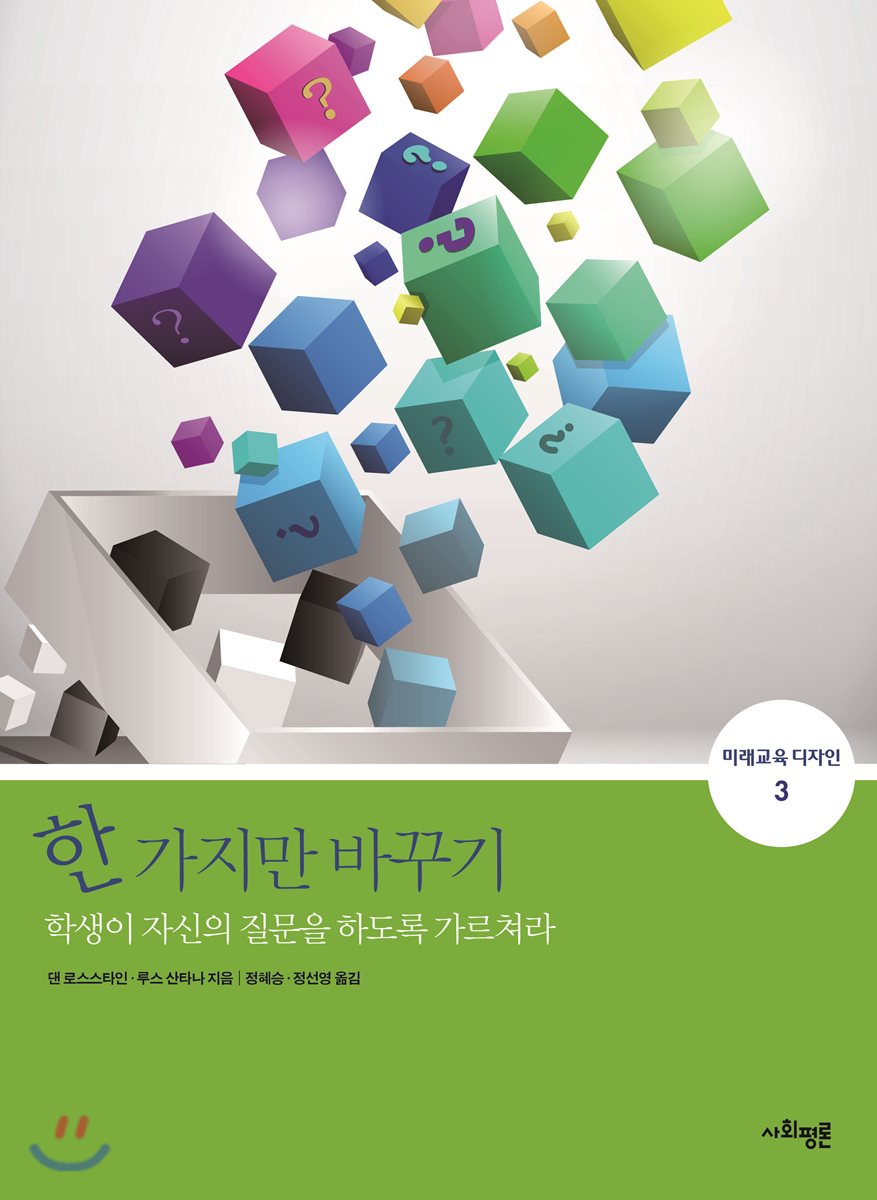
Change just one thing
 |
Description
Book Introduction
From the teacher's questions to the students' own questions
It has been several years since "questioning classrooms" and "student-participatory classes" became hot topics in schools, emphasizing the importance of dynamic learning that involves independent thinking, exploration, questioning, and discussion.
However, creating an active classroom remains challenging.
"Change One Thing - Teach Students to Ask Their Own Questions" is not a book that helps teachers create better questions.
This book provides simple yet powerful methods that teachers can use to develop students' ability to ask their own questions.
As the title suggests, 'Change Just One Thing', you will be able to see the amazing results that can be achieved by simply changing 'the teacher's questions' to 'the student's own questions'.
It has been several years since "questioning classrooms" and "student-participatory classes" became hot topics in schools, emphasizing the importance of dynamic learning that involves independent thinking, exploration, questioning, and discussion.
However, creating an active classroom remains challenging.
"Change One Thing - Teach Students to Ask Their Own Questions" is not a book that helps teachers create better questions.
This book provides simple yet powerful methods that teachers can use to develop students' ability to ask their own questions.
As the title suggests, 'Change Just One Thing', you will be able to see the amazing results that can be achieved by simply changing 'the teacher's questions' to 'the student's own questions'.
index
Preface to the Korean edition
Translator's Preface
Recommendation
Introduction “Why didn’t I learn this in school?”
1.
What if students learned to ask questions?
2.
Question formation technique
3.
Structure of this book
4.
Change just one thing—and make a big difference.
Chapter 1: Question Formulation Techniques: Teaching Complex Thinking Skills in a Single Process
1.
Three wise thinking skills
2.
Question formation technique
3.
The Art and Science of Question Formulation
Chapter 2 Question Focus: Choosing a Starting Point for Student Questions
1.
Teacher Questions as Stimuli: A Time-honored Tradition
2.
From traditional stimulus presentations to a new question focus
3.
What is an effective question focus?
4.
Designing a Question Focus
5.
Solving the Problem of Designing a Question Focus
6.
conclusion
Chapter 3: Introducing Question Generation Rules: Metacognitive Exercises
1.
Discovering the Challenges and Values of Discussing Question Generation Rules
2.
Introducing and discussing question generation rules
3.
Troubleshooting the introduction and discussion of rules
4.
conclusion
Chapter 4: Students Generate Questions: Triggering Divergent Thinking
1.
The teacher's role: to encourage students to generate their own questions.
2.
Case Study: Generating Questions in an Urban High School
3.
Case Study: Generating Questions in an Urban High School Biology Class
4.
Case Study: Generating Questions in a Suburban Middle School Science Class
5.
Troubleshooting question generation
6.
conclusion
Chapter 5: Students, Improving Your Questions: Closed and Open-Ended Questions
1.
Why stop now?
2.
Introducing Closed and Open-Ended Questions
3.
Case Study: What Happens When Students Classify Questions as Closed and Open-Ended
4.
Discuss the pros and cons of each type of question.
5.
Change the question type from one to another
6.
Solving the Problem of Asking Closed and Open-Ended Questions
7.
conclusion
Chapter 6: Students Prioritize Questions: Analysis and Convergence
1.
Process for selecting priority questions? Overview
2.
Setting clear priorities
3.
Steps in the Prioritization Process
4.
Case Study: Prioritizing Questions in an Urban High School
5.
Case Study: Prioritizing Questions in a Middle School Science Class
6.
Solving the problem of prioritizing questions
7.
conclusion
Chapter 7: Next Steps: “What do I do with all these questions?”
1.
Many options for using questions
2.
Lesson Example: Using Questions to Start a Project
3.
Case Study: Thinking Like a Mathematician
4.
Case Study: Student Questions Shape Research Topics
5.
Student questions hit the 'open button'
6.
Case Study: Opening the Door to Speech Writing with Volunteer Help
7.
conclusion
Chapter 8: Students Reflect on Their Learning: Cognition, Emotion, and Behavior
1.
Ensuring learning promotion, metacognitive enhancement, and continuous application
2.
Reflection process
3.
Designing a Reflection Activity
4.
Solving Reflection Problems
5.
conclusion
Chapter 9: A Note to My Fellow Teachers: What I Learned from Using Question Formulation Techniques
1.
One big change: Students become questioners.
2.
Change begins with a focus on questions!
3.
Remind students of the rules!
4.
Incorporate a reflective element into the process.
5.
Recognize each other equally and don't judge.
6.
Try it!
Chapter 10: Students and Classes, Transformed: A Community of Self-Directed Learners
1.
Changes that occur in students
2.
Changes that occur in class
Conclusion: Questions and Education, Questions and Democracy
1.
Improving Education through Discovery, Engagement, and Achievement
2.
Student Questions and Better Teaching
3.
Students who learn how to ask questions can help realize democracy.
4.
A call to action
Americas
Author's Note
Search
About the Author
Translator's Preface
Recommendation
Introduction “Why didn’t I learn this in school?”
1.
What if students learned to ask questions?
2.
Question formation technique
3.
Structure of this book
4.
Change just one thing—and make a big difference.
Chapter 1: Question Formulation Techniques: Teaching Complex Thinking Skills in a Single Process
1.
Three wise thinking skills
2.
Question formation technique
3.
The Art and Science of Question Formulation
Chapter 2 Question Focus: Choosing a Starting Point for Student Questions
1.
Teacher Questions as Stimuli: A Time-honored Tradition
2.
From traditional stimulus presentations to a new question focus
3.
What is an effective question focus?
4.
Designing a Question Focus
5.
Solving the Problem of Designing a Question Focus
6.
conclusion
Chapter 3: Introducing Question Generation Rules: Metacognitive Exercises
1.
Discovering the Challenges and Values of Discussing Question Generation Rules
2.
Introducing and discussing question generation rules
3.
Troubleshooting the introduction and discussion of rules
4.
conclusion
Chapter 4: Students Generate Questions: Triggering Divergent Thinking
1.
The teacher's role: to encourage students to generate their own questions.
2.
Case Study: Generating Questions in an Urban High School
3.
Case Study: Generating Questions in an Urban High School Biology Class
4.
Case Study: Generating Questions in a Suburban Middle School Science Class
5.
Troubleshooting question generation
6.
conclusion
Chapter 5: Students, Improving Your Questions: Closed and Open-Ended Questions
1.
Why stop now?
2.
Introducing Closed and Open-Ended Questions
3.
Case Study: What Happens When Students Classify Questions as Closed and Open-Ended
4.
Discuss the pros and cons of each type of question.
5.
Change the question type from one to another
6.
Solving the Problem of Asking Closed and Open-Ended Questions
7.
conclusion
Chapter 6: Students Prioritize Questions: Analysis and Convergence
1.
Process for selecting priority questions? Overview
2.
Setting clear priorities
3.
Steps in the Prioritization Process
4.
Case Study: Prioritizing Questions in an Urban High School
5.
Case Study: Prioritizing Questions in a Middle School Science Class
6.
Solving the problem of prioritizing questions
7.
conclusion
Chapter 7: Next Steps: “What do I do with all these questions?”
1.
Many options for using questions
2.
Lesson Example: Using Questions to Start a Project
3.
Case Study: Thinking Like a Mathematician
4.
Case Study: Student Questions Shape Research Topics
5.
Student questions hit the 'open button'
6.
Case Study: Opening the Door to Speech Writing with Volunteer Help
7.
conclusion
Chapter 8: Students Reflect on Their Learning: Cognition, Emotion, and Behavior
1.
Ensuring learning promotion, metacognitive enhancement, and continuous application
2.
Reflection process
3.
Designing a Reflection Activity
4.
Solving Reflection Problems
5.
conclusion
Chapter 9: A Note to My Fellow Teachers: What I Learned from Using Question Formulation Techniques
1.
One big change: Students become questioners.
2.
Change begins with a focus on questions!
3.
Remind students of the rules!
4.
Incorporate a reflective element into the process.
5.
Recognize each other equally and don't judge.
6.
Try it!
Chapter 10: Students and Classes, Transformed: A Community of Self-Directed Learners
1.
Changes that occur in students
2.
Changes that occur in class
Conclusion: Questions and Education, Questions and Democracy
1.
Improving Education through Discovery, Engagement, and Achievement
2.
Student Questions and Better Teaching
3.
Students who learn how to ask questions can help realize democracy.
4.
A call to action
Americas
Author's Note
Search
About the Author
Publisher's Review
Classrooms change when students, not teachers, ask questions.
Teach students how to create their own questions.
From the teacher's questions to the students' own questions
It has been several years since "questioning classrooms" and "student-participatory classes" became hot topics in schools, emphasizing the importance of dynamic learning that involves independent thinking, exploration, questioning, and discussion.
However, creating an active classroom remains challenging.
"Change One Thing - Teach Students to Ask Their Own Questions" is not a book that helps teachers create better questions.
This book provides simple yet powerful methods that teachers can use to develop students' ability to ask their own questions.
As the title suggests, 'Change Just One Thing', you will be able to see the amazing results that can be achieved by simply changing 'the teacher's questions' to 'the student's own questions'.
Teaching Questioning Skills: Using Question Formulation Techniques
Students learn that they have the right to ask questions.
But they never learned how to ask questions.
The authors present the Question Formulation Technique, a rigorous, step-by-step, and simple process for developing students' questioning skills.
The question formation technique is a series of processes developed by the authors through years of rigorous testing, practice, and refinement.
Students generate questions without teacher intervention or interference, categorize questions based on the type of answer they expect, prioritize questions among multiple questions, and then use the selected questions for their intended purpose.
Finally, tell yourself what you learned from your studies.
The role of a teacher using question-forming techniques is simply to create an environment where students can freely generate and express their own questions, without evaluating the quality of the questions or demanding answers, and where participation is equally recognized.
In this way, question formation techniques include teaching strategies that encourage students to have the courage to ask their own questions and recognize their autonomy.
So, students who learn how to ask questions through question formation techniques not only become skilled at asking questions, but also enjoy doing so.
The authors say that using question-forming techniques is not difficult.
This is because the question-forming technique is not meant to replace all of the teacher's activities, but rather simply adds a new element to the activities that teachers are already performing (designing lesson plans, planning learning activities, guiding learning, facilitating discussions, etc.).
The Amazing Changes That Changing Just One Thing Can Bring
The authors have learned the importance of asking questions from 20 years of working with parents, students, teachers, and community members across the United States.
So they argue that “every student must learn how to form his or her own questions.”
To learn better, to understand ourselves and the world, to solve problems for ourselves and our communities, we need to learn how to ask questions, and to communicate and share those questions effectively.
Students develop a deeper understanding of what they are learning and take ownership of their own learning by creating and asking their own questions.
The questioning skills developed in this way go beyond a single class or school setting and become a lifelong thinking skill.
Furthermore, the authors argue that questioning can strengthen democracy because it is a process of practicing democratic deliberation—listening, learning, debating, and collaborating—and learning how to participate in decisions that affect us.
Try it!
This book vividly illustrates classroom examples using the question-forming technique.
Breaking away from the traditional classroom format of teacher asking questions and students answering questions can be unfamiliar and awkward for both teachers and students, but students soon find themselves looking at each other with expressions like, "This is fun!" as if wondering why they've never done this before.
If you're a teacher looking to create an engaging classroom with questions, try the question-forming technique.
The experiences of change and achievement that the teachers and students in the book testify to can be realized in real life.
This book is the third in the Social Criticism Academy's 'Future Education Design' series.
The first book is 'Key Questions: Opening the Doors of Understanding for Students' (Jay McThai and Grant Wiggins), which answers the question 'What questions should we ask?', and the second book is 'Student Inquiry-Centered Instruction and the Question Continuum' (Robert Marzano and Julia Sims), which answers the question 'How should we ask questions?'
We hope that these books will contribute to creating a classroom where teachers systematically present important and meaningful questions for students to explore, and where students generate and solve their own questions.
Teach students how to create their own questions.
From the teacher's questions to the students' own questions
It has been several years since "questioning classrooms" and "student-participatory classes" became hot topics in schools, emphasizing the importance of dynamic learning that involves independent thinking, exploration, questioning, and discussion.
However, creating an active classroom remains challenging.
"Change One Thing - Teach Students to Ask Their Own Questions" is not a book that helps teachers create better questions.
This book provides simple yet powerful methods that teachers can use to develop students' ability to ask their own questions.
As the title suggests, 'Change Just One Thing', you will be able to see the amazing results that can be achieved by simply changing 'the teacher's questions' to 'the student's own questions'.
Teaching Questioning Skills: Using Question Formulation Techniques
Students learn that they have the right to ask questions.
But they never learned how to ask questions.
The authors present the Question Formulation Technique, a rigorous, step-by-step, and simple process for developing students' questioning skills.
The question formation technique is a series of processes developed by the authors through years of rigorous testing, practice, and refinement.
Students generate questions without teacher intervention or interference, categorize questions based on the type of answer they expect, prioritize questions among multiple questions, and then use the selected questions for their intended purpose.
Finally, tell yourself what you learned from your studies.
The role of a teacher using question-forming techniques is simply to create an environment where students can freely generate and express their own questions, without evaluating the quality of the questions or demanding answers, and where participation is equally recognized.
In this way, question formation techniques include teaching strategies that encourage students to have the courage to ask their own questions and recognize their autonomy.
So, students who learn how to ask questions through question formation techniques not only become skilled at asking questions, but also enjoy doing so.
The authors say that using question-forming techniques is not difficult.
This is because the question-forming technique is not meant to replace all of the teacher's activities, but rather simply adds a new element to the activities that teachers are already performing (designing lesson plans, planning learning activities, guiding learning, facilitating discussions, etc.).
The Amazing Changes That Changing Just One Thing Can Bring
The authors have learned the importance of asking questions from 20 years of working with parents, students, teachers, and community members across the United States.
So they argue that “every student must learn how to form his or her own questions.”
To learn better, to understand ourselves and the world, to solve problems for ourselves and our communities, we need to learn how to ask questions, and to communicate and share those questions effectively.
Students develop a deeper understanding of what they are learning and take ownership of their own learning by creating and asking their own questions.
The questioning skills developed in this way go beyond a single class or school setting and become a lifelong thinking skill.
Furthermore, the authors argue that questioning can strengthen democracy because it is a process of practicing democratic deliberation—listening, learning, debating, and collaborating—and learning how to participate in decisions that affect us.
Try it!
This book vividly illustrates classroom examples using the question-forming technique.
Breaking away from the traditional classroom format of teacher asking questions and students answering questions can be unfamiliar and awkward for both teachers and students, but students soon find themselves looking at each other with expressions like, "This is fun!" as if wondering why they've never done this before.
If you're a teacher looking to create an engaging classroom with questions, try the question-forming technique.
The experiences of change and achievement that the teachers and students in the book testify to can be realized in real life.
This book is the third in the Social Criticism Academy's 'Future Education Design' series.
The first book is 'Key Questions: Opening the Doors of Understanding for Students' (Jay McThai and Grant Wiggins), which answers the question 'What questions should we ask?', and the second book is 'Student Inquiry-Centered Instruction and the Question Continuum' (Robert Marzano and Julia Sims), which answers the question 'How should we ask questions?'
We hope that these books will contribute to creating a classroom where teachers systematically present important and meaningful questions for students to explore, and where students generate and solve their own questions.
GOODS SPECIFICS
- Date of publication: October 30, 2017
- Page count, weight, size: 262 pages | 576g | 188*257*20mm
- ISBN13: 9791188108329
- ISBN10: 1188108328
You may also like
카테고리
korean


korean

![GQ KOREA Mark (Monthly): December [2025]](http://librairie.coreenne.fr/cdn/shop/files/8ef265dbbfbf186523ed75ba7319009d.jpg?v=1765340328&width=3840)


