

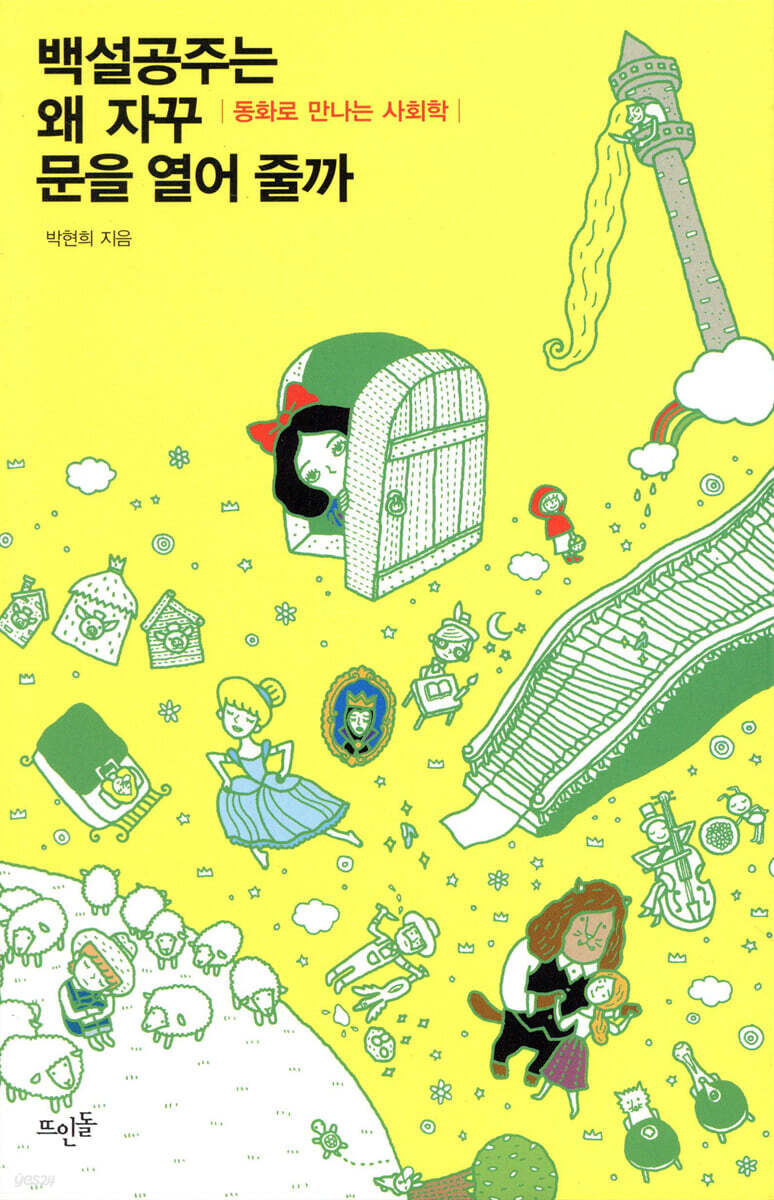
Why does Snow White keep opening doors?
 |
Description
Book Introduction
It is written as "lesson" and read as "bad education"
A new sociological essay on the secrets hidden in fairy tales and the true meaning of fairy tales.
There is a woman reading a fairy tale with a lot of doubt.
When you look at the characters in fairy tales, you say you can't believe how they "lived happily ever after."
The girl who danced in pink shoes meets a horrific end, and Pinocchio receives a harsh punishment for refusing to go to school.
Is that all?
I wonder how the extremely filial daughters like the beautiful protagonists in "Beauty and the Beast" will ever face their parents who sent their children to their deaths to save themselves.
Why do fairy tale writers put their protagonists through so much suffering, trying to instill something in us? We already know the answer.
To have fun and learn something.
But are the lessons learned truly fair? Have the norms established through fairy tales contributed to a better world? Do they truly embody values worthy of being passed down to future generations without question? "Why Does Snow White Keep Opening Doors? - Sociology Through Fairy Tales" is a sociological essay that questions the dubious aspects of fairy tales and imagines new relationships and solidarity.
A new sociological essay on the secrets hidden in fairy tales and the true meaning of fairy tales.
There is a woman reading a fairy tale with a lot of doubt.
When you look at the characters in fairy tales, you say you can't believe how they "lived happily ever after."
The girl who danced in pink shoes meets a horrific end, and Pinocchio receives a harsh punishment for refusing to go to school.
Is that all?
I wonder how the extremely filial daughters like the beautiful protagonists in "Beauty and the Beast" will ever face their parents who sent their children to their deaths to save themselves.
Why do fairy tale writers put their protagonists through so much suffering, trying to instill something in us? We already know the answer.
To have fun and learn something.
But are the lessons learned truly fair? Have the norms established through fairy tales contributed to a better world? Do they truly embody values worthy of being passed down to future generations without question? "Why Does Snow White Keep Opening Doors? - Sociology Through Fairy Tales" is a sociological essay that questions the dubious aspects of fairy tales and imagines new relationships and solidarity.
- You can preview some of the book's contents.
Preview
index
preface
Chapter 1: The Village of Tolerance
We have the right to hate those we have every reason to hate | The Fox and the Crane
Why Did the Boy Lie? | The Wolf and the Shepherd Boy
Was Pinocchio happy when he became human? | Pinocchio
Are Strong Houses Always Good Houses? | The Three Little Pigs
Chapter 2: The Village of Deviance
Ridicule the Unfair Rules | The Tortoise and the Hare
We owe it to those who took the shortcut | Little Red Riding Hood
How fortunate it is to have cut open the goose's belly | The goose that lays golden eggs
What's wrong with wanting the pink shoes? | Pink Shoes
Shouldn't there be a life where one sings a song for a season? | The Ant and the Grasshopper
Chapter 3: The Village of Wisdom
Why Does Snow White Keep Opening Doors? | Snow White
Why Did the Queen Keep Looking in the Mirror? | Snow White
Why Did the Prince Find Cinderella Through the Slipper? | Cinderella
Who Will Wake the Blanket Princess? | Sleeping Beauty
Who does she grow her hair for? | Rapunzel
Did Beauty Love the Beast Who Turned into a Prince? | Beauty and the Beast
Conclusion
Chapter 1: The Village of Tolerance
We have the right to hate those we have every reason to hate | The Fox and the Crane
Why Did the Boy Lie? | The Wolf and the Shepherd Boy
Was Pinocchio happy when he became human? | Pinocchio
Are Strong Houses Always Good Houses? | The Three Little Pigs
Chapter 2: The Village of Deviance
Ridicule the Unfair Rules | The Tortoise and the Hare
We owe it to those who took the shortcut | Little Red Riding Hood
How fortunate it is to have cut open the goose's belly | The goose that lays golden eggs
What's wrong with wanting the pink shoes? | Pink Shoes
Shouldn't there be a life where one sings a song for a season? | The Ant and the Grasshopper
Chapter 3: The Village of Wisdom
Why Does Snow White Keep Opening Doors? | Snow White
Why Did the Queen Keep Looking in the Mirror? | Snow White
Why Did the Prince Find Cinderella Through the Slipper? | Cinderella
Who Will Wake the Blanket Princess? | Sleeping Beauty
Who does she grow her hair for? | Rapunzel
Did Beauty Love the Beast Who Turned into a Prince? | Beauty and the Beast
Conclusion
Detailed image
Into the book
Forced reconciliation between people who have no reason to reconcile is bad.
It is wrong to view reconciliation as only positive.
Asking people to be friendly with each other when there is no reason to be is violence in disguise.
Do foxes and cranes have to get along? Why do they have to sit around the same table and eat? There are plenty of friends who can happily and comfortably share a meal without having to bother with the hassle of scrutinizing the shape of each other's bowls. So, why must foxes and cranes be friends? | Page 19
Schools teach what society needs rather than what it takes to become fully self-sufficient leaders.
This is strikingly similar to the workplace in industrial society, where people come to work at a set time and do a set job at a set location.
What people do at this time is not to satisfy their own needs, but to satisfy social needs.
A worker in a shoe factory produces tens of millions of pairs of shoes in his lifetime, but no one needs tens of millions of pairs of shoes in his lifetime.
| Page 41
As more and more people mock the rules of the game, some sleep on it and others ignore it, this game will never get any bigger.
| Page 78
Why did he tell Little Red Riding Hood to go straight on the main road instead of taking the side road? … In the end, Little Red Riding Hood defeated the wolf, and now anyone could walk any path in the field without worry.
If you are tempted by pretty flowers, you can go pick them, and if you want to pick wild strawberries, you can go pick them.
Thanks to the red hat, the world opens up its doors to us in all directions.
| Page 88
Since there is happiness that can come from lack, a life lacking in lack is also a kind of lack.
It is a fatal deficiency.
| Page 98
If you've already made enough money, there's no reason to bother writing a financial management book that will fade from people's memory within a few years.
The books of truly successful people are not in the financial management corner.
So, turn around and go to the humanities, philosophy, or social sciences corner.
These books teach us about the structure of our society, which makes it impossible for a goose to lay golden eggs to exist, and suggest a path to a happy life because there is no goose that lays golden eggs.
Why are schools so keen on banning various "pink shoes"? First, if the capitalist world expects schools to cultivate obedient individuals who silently follow unjust regulations, then schools are responding to this world's demands through dress codes.
Children who are trained to endure unfair regulations without complaint, or even to suppress their complaints and endure them, will grow up to be optimized workers who will silently work despite unfair corporate policies.
The more unfair the regulation and the more oppressive the enforcement method, the greater the effect.
It is impossible to live without causing trouble to anyone.
We live that way, causing harm to some and giving grace to others.
Shouldn't even ants and grasshoppers live, both burdening and benefiting each other? And for our world to be a livable place, shouldn't there also be people who sing for a season?
Having relationships, but also restoring the imagination for good relationships, is the way out of loneliness.
Imagine and put into practice stories that would be good to share and things that would be good to do together.
Building good relationships requires imagination.
The imagination of sharing a meal, the imagination of sharing and relieving worries, the imagination of filling the emptiness of the soul together.
All humans are imperfect beings with limitations and contradictions, and in order to grow, they must go through a stage where they face their imperfections rather than avoid them.
…no one can survive with a schedule like theirs.
But if they survived, the secret lies in 'sabotage', that is, slowdown.
If they had done their best at every moment, they would have collapsed from exhaustion.
If they had been proactive at every moment, their heads would have exploded.
I survived by following the schedule my parents gave me, but never giving my all.
Parents who believe that their children's grades do not improve as much as they put in effort create schedules that require more effort, and their children end up spending more time neglecting themselves.
It's all about trying to survive.
If you do that 'properly', anyone will fall.
It is wrong to view reconciliation as only positive.
Asking people to be friendly with each other when there is no reason to be is violence in disguise.
Do foxes and cranes have to get along? Why do they have to sit around the same table and eat? There are plenty of friends who can happily and comfortably share a meal without having to bother with the hassle of scrutinizing the shape of each other's bowls. So, why must foxes and cranes be friends? | Page 19
Schools teach what society needs rather than what it takes to become fully self-sufficient leaders.
This is strikingly similar to the workplace in industrial society, where people come to work at a set time and do a set job at a set location.
What people do at this time is not to satisfy their own needs, but to satisfy social needs.
A worker in a shoe factory produces tens of millions of pairs of shoes in his lifetime, but no one needs tens of millions of pairs of shoes in his lifetime.
| Page 41
As more and more people mock the rules of the game, some sleep on it and others ignore it, this game will never get any bigger.
| Page 78
Why did he tell Little Red Riding Hood to go straight on the main road instead of taking the side road? … In the end, Little Red Riding Hood defeated the wolf, and now anyone could walk any path in the field without worry.
If you are tempted by pretty flowers, you can go pick them, and if you want to pick wild strawberries, you can go pick them.
Thanks to the red hat, the world opens up its doors to us in all directions.
| Page 88
Since there is happiness that can come from lack, a life lacking in lack is also a kind of lack.
It is a fatal deficiency.
| Page 98
If you've already made enough money, there's no reason to bother writing a financial management book that will fade from people's memory within a few years.
The books of truly successful people are not in the financial management corner.
So, turn around and go to the humanities, philosophy, or social sciences corner.
These books teach us about the structure of our society, which makes it impossible for a goose to lay golden eggs to exist, and suggest a path to a happy life because there is no goose that lays golden eggs.
Why are schools so keen on banning various "pink shoes"? First, if the capitalist world expects schools to cultivate obedient individuals who silently follow unjust regulations, then schools are responding to this world's demands through dress codes.
Children who are trained to endure unfair regulations without complaint, or even to suppress their complaints and endure them, will grow up to be optimized workers who will silently work despite unfair corporate policies.
The more unfair the regulation and the more oppressive the enforcement method, the greater the effect.
It is impossible to live without causing trouble to anyone.
We live that way, causing harm to some and giving grace to others.
Shouldn't even ants and grasshoppers live, both burdening and benefiting each other? And for our world to be a livable place, shouldn't there also be people who sing for a season?
Having relationships, but also restoring the imagination for good relationships, is the way out of loneliness.
Imagine and put into practice stories that would be good to share and things that would be good to do together.
Building good relationships requires imagination.
The imagination of sharing a meal, the imagination of sharing and relieving worries, the imagination of filling the emptiness of the soul together.
All humans are imperfect beings with limitations and contradictions, and in order to grow, they must go through a stage where they face their imperfections rather than avoid them.
…no one can survive with a schedule like theirs.
But if they survived, the secret lies in 'sabotage', that is, slowdown.
If they had done their best at every moment, they would have collapsed from exhaustion.
If they had been proactive at every moment, their heads would have exploded.
I survived by following the schedule my parents gave me, but never giving my all.
Parents who believe that their children's grades do not improve as much as they put in effort create schedules that require more effort, and their children end up spending more time neglecting themselves.
It's all about trying to survive.
If you do that 'properly', anyone will fall.
---From the text
Publisher's Review
We invite you to a fairytale village filled with questionable events.
When I look at the characters in fairy tales, I can't believe how they "lived happily ever after."
The girl who danced in pink shoes meets a horrific end, and Pinocchio receives a harsh punishment for refusing to go to school.
Is that all?
I wonder how the extremely filial daughters like the beautiful protagonists in "Beauty and the Beast" will ever face their parents who sent their children to their deaths to save themselves.
Why do fairy tale writers put their protagonists through so much suffering, trying to instill something in us? We already know the answer.
To have fun and learn something.
But are the lessons learned truly fair? Have the norms established through fairy tales contributed to a better world? Do they truly embody values worthy of being passed down to future generations without question? A sociological essay titled "Why Does Snow White Keep Opening Doors - Sociology Through Fairy Tales" (hereafter "Snow White") has been published, questioning the dubious aspects of fairy tales and imagining new relationships and solidarity.
There are many readers who ask if Snow White is too stupid because she keeps getting into trouble by doing things she is told not to do.
Some parents say that they do not read classic fairy tales to their children because their children keep asking such questions.
But was Snow White really that stupid? The author thinks differently.
I don't know how kind the seven dwarfs were to Snow White, but I can only imagine how lonely she must have been, locked up all day without a single friend.
How many people in the world are unable to form good relationships and continue to make foolish choices like Snow White?
So I think Snow White was so lonely that she had no choice but to open the door, and she would have to open it again ten, twenty times.
The author uses familiar fairy tale characters to talk about the deficiencies, lack of relationships, imagination and deviation, solidarity, and friendship that modern people have.
Sharp questions and fresh interpretations of dubious fairy tales (something we may have cherished as children but forgotten as adults) lead to the protagonists living in the villages of tolerance, deviance, and wisdom.
Introducing three villages where stupid protagonists live.
The first village of tolerance is inhabited by protagonists who either did not live according to the teachings of the 'adults' or who got into trouble despite following the teachings.
The fox from "The Fox and the Crane," the shepherd boy who kept lying, Pinocchio who refused to go to school, and the two older brothers from "The Three Little Pigs" who were falsely accused of building a haphazard house live in this village.
Although they are typical fairy tale troublemakers, the author defends these silent characters with a healthy skepticism.
The second village of deviation is home to those who have thrown off the norm.
There is a rabbit who escaped the unfair rules by sleeping during the game, a turtle who accepted the rabbit's deviation as it was, a girl with a red hat who constantly went astray so that people could walk freely through the forest, a farmer who killed with his own hands the goose that laid golden eggs that everyone in the world envied, and a girl who chose to dance in pink shoes and fall over after breaking a taboo.
The author believes that their deviation from the world of 'of course' has diversified our choices.
In the third village of wisdom, there live an unhappy princess and queen who are awkward at forming relationships.
This is the town where Snow White, who kept opening the door to the queen to her frustration, Sleeping Beauty, who waited endlessly for the prince, Rapunzel, who gave her well-grown hair to the prince, and Snow White's stepmother, who became unhappy because she only talked to the mirror, live.
Through them, we learn how good relationships, friendship, and solidarity can be a powerful force in life.
It's written as a lesson, but read as bad education.
The purpose of fairy tales, from the time they were first written, was to teach and entertain, that is, to teach moral lessons and social restraints.
It was made to be sweet.
-The True Nature of Fairy Tales (Jack Zypes, Munhakdongne, 1999, p. 26)
Fairy tales aren't just filled with innocence.
There is no doubt that fairy tales have been deeply involved in establishing the coercive norms necessary for the maintenance of society.
Most people have been socialized from childhood through classic fairy tales. From "The Ant and the Grasshopper," we learned to live diligently like an ant; from "Little Red Riding Hood," we learned not to enter the forbidden path; and from "The Tortoise and the Hare," we learned to proceed steadily, even if slowly.
However, the right to interpretation has always been held by textbooks or adults.
The children were just taught lessons unilaterally.
Wouldn't that have allowed us, as adults, to accept the uniform structure and absurdity without any resistance?
"Snow White" draws new guidelines for our times from familiar fairy tales.
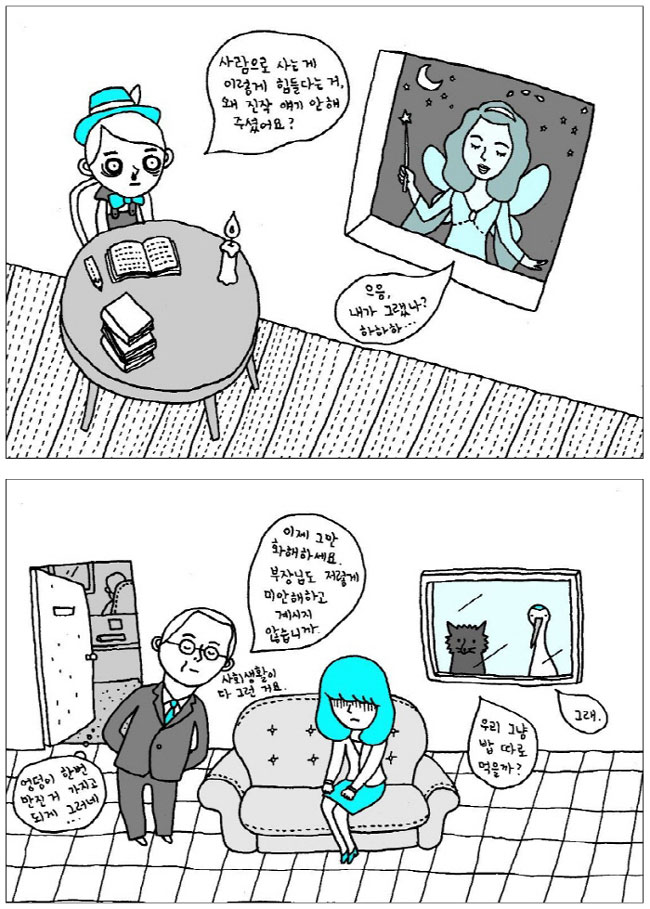
Cartoons by Woo-yeol Jeong, famous for 'Old Dog', are a bonus.
#1 Pinocchio was written to effectively standardize the workers needed in an industrial society.
- Pinocchio showed the difficulties faced by children who do not want to go to school.
“…What was the secret of the wooden puppet being able to transform into a human? Because Pinocchio became a good boy.
So, what kind of child is a good child? In this story, it boils down to two things.
First, listen to your parents carefully.
Second, do well in school.
However, since what parents expect from a good child is to do well in school, the secret to being a good child can be summarized in one thing.
All you have to do is go to school well.
The late 19th century, when Carlo Collodi published Pinocchio, was a time when modern schools were being established and expanded.
As the Industrial Revolution reorganized society from the ground up, people who had been farming now worked as laborers in factories.
Farming skills are learned by following your father into the fields and working, but factory work cannot be learned that way.
Factory owners basically wanted workers who could read, write, and do math.
The modern school was born out of a social need to teach the children of workers how to read, write, and calculate, thereby preparing them to become tomorrow's workers.
…There is no reason to hesitate to institutionalize education through schools, as emphasizing rationality and pursuing standardization are essential norms for the workplaces these children will eventually work in.”
From the text [Was Pinocchio happy when he became human? - Pinocchio]
#2 Instead of questioning unfair rules, the tortoise and the hare say that everything depends on effort.
- The hare and the tortoise taught us to despise laziness before we questioned the fairness of the structure.
"Why did the rabbit participate in that race? Let's think about the race against the turtle from the rabbit's perspective.
The rabbit is fast.
Speed is the essence of a rabbit and at the same time the source of its pride.
A rabbit races against a turtle, who is known for being slow.
… For the rabbit, this game is a game where winning doesn’t bring anything, but losing only brings shame. It’s a game where there’s really no benefit whatsoever.
…I think there must be a third party involved in the race between the tortoise and the hare.
Who would have benefited most from this game? The obvious answer would be the unknown third party who created the tortoise-hare race.
No matter how the outcome is, there is always someone who benefits.
These are the immutable 'rules of the game'.
…see the tortoise and the hare again.
Look at this rabbit enjoying a comfortable nap in the middle of a game.
That freedom belongs to the enlightened.
The composure of one who has realized and accepted that winning or losing is no longer important.
But I think the cooler one is the turtle.
The turtle could have woken the rabbit up with a bang.
I could have scolded him for taking such a leisurely nap at this hour.
However, the turtle respected the rabbit's choice to leave the group and take a nap.
That understanding belongs to those who fully understand the structure of the game.
…if more and more people start mocking the rules of the game while others sleep on it and leave it alone, this game will never get any bigger.
From the text [Mock the Unfair Rules - The Tortoise and the Hare]
#3 Instead of asking about the background of the conflict, the fox and the crane suggest reconciliation first.
Even for those with opposing views, fairy tales offer a clear solution.
Didn't you learn that from "The Fox and the Crane"?
Treat others the way you want to be treated, and reconciliation is absolutely essential.
But how many people in the world are simply irreconcilable? How many times have we seen people insist on shaking hands before addressing the root of the problem?
- Could the moral sense learned from the fox and the crane have been used in this situation?
“There is no reason for these people to get along.
Recognizing the negative consequences of violence and committing to not resorting to violence to solve problems in the future are two entirely different things.
We have the right to dislike anyone who has every reason to dislike us.
You have the right not to forgive someone you don't want to forgive.
Our notion that reconciliation is always a good thing sometimes leaves indelible scars on someone's heart and continues to cause problems.
How foolish is the desire to get along with everyone?
“How unreasonable is it to ask everyone to get along with each other?”
From the text [We have the right to hate those who have sufficient reasons to hate - The Fox and the Crane]
In an age where the sensitivity to ask why has diminished
The world is uncomfortable with those who ask 'why'.
As it turns out, we are trapped by far more norms than we realize, and these norms either lack any persuasive logic or are based solely on the logic of the rulers.
The answer is bound to be vague, so the world tells us to just go with the established ? without further ado.
The author often witnesses this kind of thing both inside and outside of school.
What about regulating students' hair or skirt length?
Is it justified to prohibit slippers and limit the amount of time a child can spend freely during the day? The author believes that the pink shoes in the fairy tale "The Pink Shoes" represent the sum total of "taboos."
And he sees all the school-created norms, such as the ban on pink shoes, as “a cultural force created by a mixture of political, economic, and biological needs.”
And sigh.
“There are so many things in school that pretend to be education when they really aren’t.”
We owe it to all the red hats in the world who took the shortcut (and boldly stepped forward toward what they believed was right) despite their mothers' strong warnings (and society's strong opposition).
Thanks to that, the world has opened up paths in all directions to welcome us… .
“It is thanks to the people who took to the streets to resist dictatorship when we gave up and asked if we ever had democracy that we are able to live to this extent today.”
In this era, the sensitivity to ask 'why?' has become weak, and those who ask 'why?' are suppressed.
The author wrote this book with the intention of sharing friendship and solidarity with those who, by asking "why," have abandoned the easy path taken by others, those who resist one-sided teachings, and those who lead the world to a brighter place with their sparkling imagination.
When I look at the characters in fairy tales, I can't believe how they "lived happily ever after."
The girl who danced in pink shoes meets a horrific end, and Pinocchio receives a harsh punishment for refusing to go to school.
Is that all?
I wonder how the extremely filial daughters like the beautiful protagonists in "Beauty and the Beast" will ever face their parents who sent their children to their deaths to save themselves.
Why do fairy tale writers put their protagonists through so much suffering, trying to instill something in us? We already know the answer.
To have fun and learn something.
But are the lessons learned truly fair? Have the norms established through fairy tales contributed to a better world? Do they truly embody values worthy of being passed down to future generations without question? A sociological essay titled "Why Does Snow White Keep Opening Doors - Sociology Through Fairy Tales" (hereafter "Snow White") has been published, questioning the dubious aspects of fairy tales and imagining new relationships and solidarity.
There are many readers who ask if Snow White is too stupid because she keeps getting into trouble by doing things she is told not to do.
Some parents say that they do not read classic fairy tales to their children because their children keep asking such questions.
But was Snow White really that stupid? The author thinks differently.
I don't know how kind the seven dwarfs were to Snow White, but I can only imagine how lonely she must have been, locked up all day without a single friend.
How many people in the world are unable to form good relationships and continue to make foolish choices like Snow White?
So I think Snow White was so lonely that she had no choice but to open the door, and she would have to open it again ten, twenty times.
The author uses familiar fairy tale characters to talk about the deficiencies, lack of relationships, imagination and deviation, solidarity, and friendship that modern people have.
Sharp questions and fresh interpretations of dubious fairy tales (something we may have cherished as children but forgotten as adults) lead to the protagonists living in the villages of tolerance, deviance, and wisdom.
Introducing three villages where stupid protagonists live.
The first village of tolerance is inhabited by protagonists who either did not live according to the teachings of the 'adults' or who got into trouble despite following the teachings.
The fox from "The Fox and the Crane," the shepherd boy who kept lying, Pinocchio who refused to go to school, and the two older brothers from "The Three Little Pigs" who were falsely accused of building a haphazard house live in this village.
Although they are typical fairy tale troublemakers, the author defends these silent characters with a healthy skepticism.
The second village of deviation is home to those who have thrown off the norm.
There is a rabbit who escaped the unfair rules by sleeping during the game, a turtle who accepted the rabbit's deviation as it was, a girl with a red hat who constantly went astray so that people could walk freely through the forest, a farmer who killed with his own hands the goose that laid golden eggs that everyone in the world envied, and a girl who chose to dance in pink shoes and fall over after breaking a taboo.
The author believes that their deviation from the world of 'of course' has diversified our choices.
In the third village of wisdom, there live an unhappy princess and queen who are awkward at forming relationships.
This is the town where Snow White, who kept opening the door to the queen to her frustration, Sleeping Beauty, who waited endlessly for the prince, Rapunzel, who gave her well-grown hair to the prince, and Snow White's stepmother, who became unhappy because she only talked to the mirror, live.
Through them, we learn how good relationships, friendship, and solidarity can be a powerful force in life.
It's written as a lesson, but read as bad education.
The purpose of fairy tales, from the time they were first written, was to teach and entertain, that is, to teach moral lessons and social restraints.
It was made to be sweet.
-The True Nature of Fairy Tales (Jack Zypes, Munhakdongne, 1999, p. 26)
Fairy tales aren't just filled with innocence.
There is no doubt that fairy tales have been deeply involved in establishing the coercive norms necessary for the maintenance of society.
Most people have been socialized from childhood through classic fairy tales. From "The Ant and the Grasshopper," we learned to live diligently like an ant; from "Little Red Riding Hood," we learned not to enter the forbidden path; and from "The Tortoise and the Hare," we learned to proceed steadily, even if slowly.
However, the right to interpretation has always been held by textbooks or adults.
The children were just taught lessons unilaterally.
Wouldn't that have allowed us, as adults, to accept the uniform structure and absurdity without any resistance?
"Snow White" draws new guidelines for our times from familiar fairy tales.
Cartoons by Woo-yeol Jeong, famous for 'Old Dog', are a bonus.
#1 Pinocchio was written to effectively standardize the workers needed in an industrial society.
- Pinocchio showed the difficulties faced by children who do not want to go to school.
“…What was the secret of the wooden puppet being able to transform into a human? Because Pinocchio became a good boy.
So, what kind of child is a good child? In this story, it boils down to two things.
First, listen to your parents carefully.
Second, do well in school.
However, since what parents expect from a good child is to do well in school, the secret to being a good child can be summarized in one thing.
All you have to do is go to school well.
The late 19th century, when Carlo Collodi published Pinocchio, was a time when modern schools were being established and expanded.
As the Industrial Revolution reorganized society from the ground up, people who had been farming now worked as laborers in factories.
Farming skills are learned by following your father into the fields and working, but factory work cannot be learned that way.
Factory owners basically wanted workers who could read, write, and do math.
The modern school was born out of a social need to teach the children of workers how to read, write, and calculate, thereby preparing them to become tomorrow's workers.
…There is no reason to hesitate to institutionalize education through schools, as emphasizing rationality and pursuing standardization are essential norms for the workplaces these children will eventually work in.”
From the text [Was Pinocchio happy when he became human? - Pinocchio]
#2 Instead of questioning unfair rules, the tortoise and the hare say that everything depends on effort.
- The hare and the tortoise taught us to despise laziness before we questioned the fairness of the structure.
"Why did the rabbit participate in that race? Let's think about the race against the turtle from the rabbit's perspective.
The rabbit is fast.
Speed is the essence of a rabbit and at the same time the source of its pride.
A rabbit races against a turtle, who is known for being slow.
… For the rabbit, this game is a game where winning doesn’t bring anything, but losing only brings shame. It’s a game where there’s really no benefit whatsoever.
…I think there must be a third party involved in the race between the tortoise and the hare.
Who would have benefited most from this game? The obvious answer would be the unknown third party who created the tortoise-hare race.
No matter how the outcome is, there is always someone who benefits.
These are the immutable 'rules of the game'.
…see the tortoise and the hare again.
Look at this rabbit enjoying a comfortable nap in the middle of a game.
That freedom belongs to the enlightened.
The composure of one who has realized and accepted that winning or losing is no longer important.
But I think the cooler one is the turtle.
The turtle could have woken the rabbit up with a bang.
I could have scolded him for taking such a leisurely nap at this hour.
However, the turtle respected the rabbit's choice to leave the group and take a nap.
That understanding belongs to those who fully understand the structure of the game.
…if more and more people start mocking the rules of the game while others sleep on it and leave it alone, this game will never get any bigger.
From the text [Mock the Unfair Rules - The Tortoise and the Hare]
#3 Instead of asking about the background of the conflict, the fox and the crane suggest reconciliation first.
Even for those with opposing views, fairy tales offer a clear solution.
Didn't you learn that from "The Fox and the Crane"?
Treat others the way you want to be treated, and reconciliation is absolutely essential.
But how many people in the world are simply irreconcilable? How many times have we seen people insist on shaking hands before addressing the root of the problem?
- Could the moral sense learned from the fox and the crane have been used in this situation?
“There is no reason for these people to get along.
Recognizing the negative consequences of violence and committing to not resorting to violence to solve problems in the future are two entirely different things.
We have the right to dislike anyone who has every reason to dislike us.
You have the right not to forgive someone you don't want to forgive.
Our notion that reconciliation is always a good thing sometimes leaves indelible scars on someone's heart and continues to cause problems.
How foolish is the desire to get along with everyone?
“How unreasonable is it to ask everyone to get along with each other?”
From the text [We have the right to hate those who have sufficient reasons to hate - The Fox and the Crane]
In an age where the sensitivity to ask why has diminished
The world is uncomfortable with those who ask 'why'.
As it turns out, we are trapped by far more norms than we realize, and these norms either lack any persuasive logic or are based solely on the logic of the rulers.
The answer is bound to be vague, so the world tells us to just go with the established ? without further ado.
The author often witnesses this kind of thing both inside and outside of school.
What about regulating students' hair or skirt length?
Is it justified to prohibit slippers and limit the amount of time a child can spend freely during the day? The author believes that the pink shoes in the fairy tale "The Pink Shoes" represent the sum total of "taboos."
And he sees all the school-created norms, such as the ban on pink shoes, as “a cultural force created by a mixture of political, economic, and biological needs.”
And sigh.
“There are so many things in school that pretend to be education when they really aren’t.”
We owe it to all the red hats in the world who took the shortcut (and boldly stepped forward toward what they believed was right) despite their mothers' strong warnings (and society's strong opposition).
Thanks to that, the world has opened up paths in all directions to welcome us… .
“It is thanks to the people who took to the streets to resist dictatorship when we gave up and asked if we ever had democracy that we are able to live to this extent today.”
In this era, the sensitivity to ask 'why?' has become weak, and those who ask 'why?' are suppressed.
The author wrote this book with the intention of sharing friendship and solidarity with those who, by asking "why," have abandoned the easy path taken by others, those who resist one-sided teachings, and those who lead the world to a brighter place with their sparkling imagination.
GOODS SPECIFICS
- Date of issue: June 30, 2011
- Page count, weight, size: 208 pages | 324g | 210*136*20mm
- ISBN13: 9788958073345
- ISBN10: 8958073349
You may also like
카테고리
korean


korean

![GQ KOREA Mark (Monthly): December [2025]](http://librairie.coreenne.fr/cdn/shop/files/8ef265dbbfbf186523ed75ba7319009d.jpg?v=1765340328&width=3840)


