

A bold question about state power
 |
Description
Book Introduction
“The surest way to forget about politics is to take an interest in it.”
From Thomas Hobbes's Leviathan to Francis Fukuyama's The End of History,
Through 12 major works that permeate the flow of modern political thought
Let's take a closer look at the social and political issues we face!
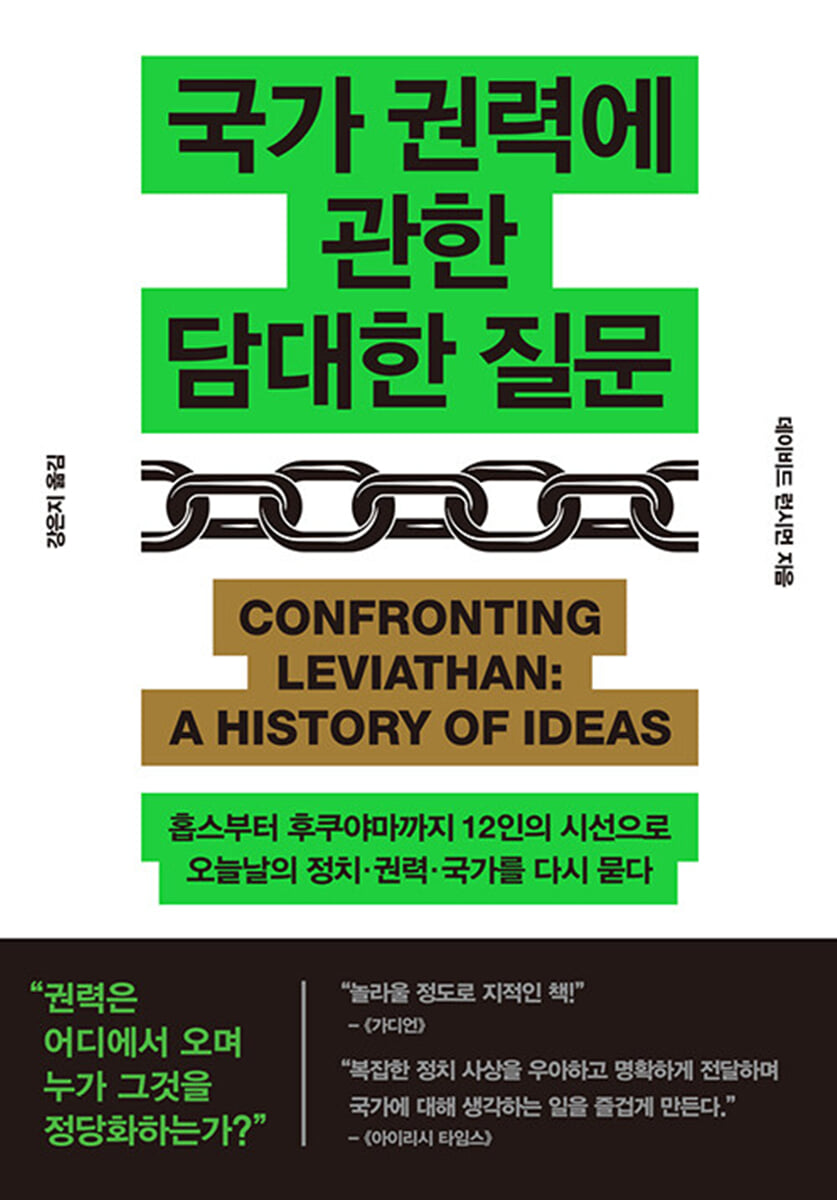
"Bold Questions about State Power" is a book by David Runciman, a professor of politics at Cambridge University and a leading figure in British political science.
He reflected on the meaning of nation, power, and politics during the lockdown period of the COVID-19 pandemic.
And he clearly expressed these reflections in his major works on the history of political thought.
The twelve works introduced in this book are meaningful books that still have a profound influence on shaping the world we live in today.
Focusing on Thomas Hobbes's Leviathan, which theoretically established the concept of the modern state and sovereignty, we look back at the lives and thoughts of thinkers who intertwined and sometimes conflicted with each other, such as Mary Wollstonecraft, Benjamin Constant, Marx and Engels, Max Weber, and Hannah Arendt, to see what they meant at the time and what they can mean for us today.
This book explores the most important thinkers in modern political thought, one by one, linking their ideas to key keywords.
It consists of 12 chapters: Hobbes - concept of the state, Wollstonecraft - sexual politics, Constant - freedom, Tocqueville - democracy, Marx and Engels - revolution, Gandhi - self-government, Weber - leadership, Hayek - market, Arendt - action, Fanon - violence, MacKinnon - sexual repression, and Fukuyama - history.
Although each chapter reads independently, the author skillfully illustrates how these ideas relate to one another and how they collectively form a narrative that explains the nature of the modern state.
“To achieve modern freedom, that is, freedom from interference, one must engage politically.
“This is the paradox of modern life.” (p. 108) In this irony that one must be interested in politics in order to forget politics and live in peace, this book will serve as a good starting point for thinking about politics, power, and the state in our time.
From Thomas Hobbes's Leviathan to Francis Fukuyama's The End of History,
Through 12 major works that permeate the flow of modern political thought
Let's take a closer look at the social and political issues we face!
"Bold Questions about State Power" is a book by David Runciman, a professor of politics at Cambridge University and a leading figure in British political science.
He reflected on the meaning of nation, power, and politics during the lockdown period of the COVID-19 pandemic.
And he clearly expressed these reflections in his major works on the history of political thought.
The twelve works introduced in this book are meaningful books that still have a profound influence on shaping the world we live in today.
Focusing on Thomas Hobbes's Leviathan, which theoretically established the concept of the modern state and sovereignty, we look back at the lives and thoughts of thinkers who intertwined and sometimes conflicted with each other, such as Mary Wollstonecraft, Benjamin Constant, Marx and Engels, Max Weber, and Hannah Arendt, to see what they meant at the time and what they can mean for us today.
This book explores the most important thinkers in modern political thought, one by one, linking their ideas to key keywords.
It consists of 12 chapters: Hobbes - concept of the state, Wollstonecraft - sexual politics, Constant - freedom, Tocqueville - democracy, Marx and Engels - revolution, Gandhi - self-government, Weber - leadership, Hayek - market, Arendt - action, Fanon - violence, MacKinnon - sexual repression, and Fukuyama - history.
Although each chapter reads independently, the author skillfully illustrates how these ideas relate to one another and how they collectively form a narrative that explains the nature of the modern state.
“To achieve modern freedom, that is, freedom from interference, one must engage politically.
“This is the paradox of modern life.” (p. 108) In this irony that one must be interested in politics in order to forget politics and live in peace, this book will serve as a good starting point for thinking about politics, power, and the state in our time.
- You can preview some of the book's contents.
Preview
index
preface
Chapter 1 | Hobbes and the State: Leviathan, 1651
What is needed to prevent chaos and disorder in society and maintain peace?
Why start with Hobbes's Leviathan? | What is a modern state? | Do we live in a monarchy or a republic? | The cases of Britain and the United States | How was Leviathan born? | Hobbes's life and skepticism | The race of life running on a steep slope | The one and only principle: pursue peace and follow it | The sovereign's 'existence itself' is more important | Was Hobbes a cynical person about humans? | The social contract and Hobbes' 'agreement' | Totalitarianism and absolutism | The duality of the sovereign | The paradox of Hobbes's political thought
Chapter 2 | Wollstonecraft and Sexual Politics: A Vindication of the Rights of Woman, 1792
Why are women not treated equally as citizens, even though they are rational beings?
The French Revolution, Hobbes, and Wollstonecraft | Wollstonecraft's Life and Thought | A Journey of Reason and Passion | A Corrupt State and New Politics | Men's Reason, Women's Emotions | Absolute Power Corrupts All | Women's Education and Educational Reform | The Conditions of an Ideal Marriage
Chapter 3 | Constant and Liberty: "Ancient Freedom Compared to Modern Freedom," 1819
Is it possible to live while protecting individual freedom and fulfilling community responsibilities?
Constant's Romanticism and Freedom | Constant's Liberalism and the State | Lessons from the French Revolution | Ancient Freedom and Modern Freedom | What is Modern Freedom? | The Dangers of Freedom | Negative Freedom and Positive Freedom | How Destructive Is Irresponsible Freedom? | Private Space and the Public World
Chapter 4 | Tocqueville and Democracy: Democracy in America, 1835–1840
How actively do we engage in politics to protect our rights?
Ancient and Modern Democracy | Representative Democracy and the American Experiment | Why New Political Experiments Were Possible in the United States | American Beliefs and Paradoxes | The Two Faces of Democracy: Populism and Conformism | Tocqueville's Outlook on the Era of Polarization | What Will Become the Fate of Democracy?
Chapter 5 | Marx, Engels, and Revolution: The Communist Manifesto, 1848
How can we preserve a humane life in a world dominated by capital?
Which comes first: politics or economics? | The history of the Communist Manifesto, born during a period of explosive revolution | The modern state is a liar | The vicious cycle of capitalist society | What is revolution according to Marx and Engels? | Marxist thought and internationalism | The emergence of a new class | How can we overcome the crisis of modern capitalism?
Chapter 6 | Gandhi and Self-Government: Hindu Swaraj, 1909
Can I leave my life and community solely to the government and its institutions?
Hindu Swaraj and Gandhi's Thought | Gandhi Predicted the World of Uber and Deliveroo | Strive for Rights Through Personal Suffering | The Most Effective Political Movement in Modern History | Gandhi's Struggle and Its Legacy | Passive Resistance and Civil Disobedience | The Goals and Limits of Passive Resistance | Can Gandhi's Thought Still Provide Answers in the 21st Century?
Chapter 7 | Weber and Leadership: "Politics as a Vocation," 1919
What qualities should a national leader have?
Uncertainty and Weber's political thought | The development and conclusion of World War I | The postwar German system and Weber's politics and state | Who should be the sovereign? | Mechanical party politics and the leader who stands above it | Politics must be done with both the head and the heart | Politics is both a dangerous and evil thing | The most ideal leader according to Weber
Chapter 8 | Hayek and the Market: The Road to Serfdom, 1944
How easily can state power threaten freedom?
Can economists predict the future? | Government control leads to a loss of all information. | What if the government uses technology as a tool of control? | Once you're on a slippery slope, there's no stopping you. | Why constitutional limits on democratic government power are necessary. | Crises don't end in one fell swoop. | Hayek vs. Keynes. | Is state intervention the solution?
Chapter 9 | Arendt and Action: The Human Condition, 1958
Why should we engage in political action other than labor and work?
Why people are particularly interested in Arendt | The Human Condition, which anticipated the age of machine technology | The three types of human activity: labor, work, and action | Work and labor, artificial and natural | Technology growing in scale and humans becoming fragmented | Humans who resemble machines, machines who resemble humans
Chapter 10 | Fanon and Violence: The Damned of the Earth, 1961
How can the oppressed become the subject of their own lives?
There is no order in the international order | Imperialism and Colonialism | Fanon's Two Colonial Experiences | Orwell, the Imperialist Police, and the Duality of Modern Politics | The Justification of Violence in Colonial Societies | The Desire for a New State Beyond the Modern State
Chapter 11 | MacKinnon and Sexual Oppression: Toward a Feminist Theory of the State, 1989
Is the oppression women experience a personal misfortune or the result of structural inequality and institutional acquiescence?
The Challenges Wollstonecraft Left Behind | How to Correct Everyday Injustice | On Liberal Feminism | On Marxist Feminism | Fairness Is Not Fair, and Equality Is Not Equal | Pornography Is Not a Matter of Freedom
Chapter 12 | Fukuyama and History: The End of History: The Last Man Standing at the End of History, 1992
If democracy is the 'end point of history,' where should we go now?
Misconceptions about the 'End of History' | History and Contemporary Liberal Democratic Politics | The 'Last Man' and the Future of Democracy | Fukuyama's Model of the Future of Democracy | Prosperity and Peace, Respect and Dignity | Challenges Facing Liberal Democracy | To Stay or to Move Forward | Have We Really Faced the End of History?
Chapter 1 | Hobbes and the State: Leviathan, 1651
What is needed to prevent chaos and disorder in society and maintain peace?
Why start with Hobbes's Leviathan? | What is a modern state? | Do we live in a monarchy or a republic? | The cases of Britain and the United States | How was Leviathan born? | Hobbes's life and skepticism | The race of life running on a steep slope | The one and only principle: pursue peace and follow it | The sovereign's 'existence itself' is more important | Was Hobbes a cynical person about humans? | The social contract and Hobbes' 'agreement' | Totalitarianism and absolutism | The duality of the sovereign | The paradox of Hobbes's political thought
Chapter 2 | Wollstonecraft and Sexual Politics: A Vindication of the Rights of Woman, 1792
Why are women not treated equally as citizens, even though they are rational beings?
The French Revolution, Hobbes, and Wollstonecraft | Wollstonecraft's Life and Thought | A Journey of Reason and Passion | A Corrupt State and New Politics | Men's Reason, Women's Emotions | Absolute Power Corrupts All | Women's Education and Educational Reform | The Conditions of an Ideal Marriage
Chapter 3 | Constant and Liberty: "Ancient Freedom Compared to Modern Freedom," 1819
Is it possible to live while protecting individual freedom and fulfilling community responsibilities?
Constant's Romanticism and Freedom | Constant's Liberalism and the State | Lessons from the French Revolution | Ancient Freedom and Modern Freedom | What is Modern Freedom? | The Dangers of Freedom | Negative Freedom and Positive Freedom | How Destructive Is Irresponsible Freedom? | Private Space and the Public World
Chapter 4 | Tocqueville and Democracy: Democracy in America, 1835–1840
How actively do we engage in politics to protect our rights?
Ancient and Modern Democracy | Representative Democracy and the American Experiment | Why New Political Experiments Were Possible in the United States | American Beliefs and Paradoxes | The Two Faces of Democracy: Populism and Conformism | Tocqueville's Outlook on the Era of Polarization | What Will Become the Fate of Democracy?
Chapter 5 | Marx, Engels, and Revolution: The Communist Manifesto, 1848
How can we preserve a humane life in a world dominated by capital?
Which comes first: politics or economics? | The history of the Communist Manifesto, born during a period of explosive revolution | The modern state is a liar | The vicious cycle of capitalist society | What is revolution according to Marx and Engels? | Marxist thought and internationalism | The emergence of a new class | How can we overcome the crisis of modern capitalism?
Chapter 6 | Gandhi and Self-Government: Hindu Swaraj, 1909
Can I leave my life and community solely to the government and its institutions?
Hindu Swaraj and Gandhi's Thought | Gandhi Predicted the World of Uber and Deliveroo | Strive for Rights Through Personal Suffering | The Most Effective Political Movement in Modern History | Gandhi's Struggle and Its Legacy | Passive Resistance and Civil Disobedience | The Goals and Limits of Passive Resistance | Can Gandhi's Thought Still Provide Answers in the 21st Century?
Chapter 7 | Weber and Leadership: "Politics as a Vocation," 1919
What qualities should a national leader have?
Uncertainty and Weber's political thought | The development and conclusion of World War I | The postwar German system and Weber's politics and state | Who should be the sovereign? | Mechanical party politics and the leader who stands above it | Politics must be done with both the head and the heart | Politics is both a dangerous and evil thing | The most ideal leader according to Weber
Chapter 8 | Hayek and the Market: The Road to Serfdom, 1944
How easily can state power threaten freedom?
Can economists predict the future? | Government control leads to a loss of all information. | What if the government uses technology as a tool of control? | Once you're on a slippery slope, there's no stopping you. | Why constitutional limits on democratic government power are necessary. | Crises don't end in one fell swoop. | Hayek vs. Keynes. | Is state intervention the solution?
Chapter 9 | Arendt and Action: The Human Condition, 1958
Why should we engage in political action other than labor and work?
Why people are particularly interested in Arendt | The Human Condition, which anticipated the age of machine technology | The three types of human activity: labor, work, and action | Work and labor, artificial and natural | Technology growing in scale and humans becoming fragmented | Humans who resemble machines, machines who resemble humans
Chapter 10 | Fanon and Violence: The Damned of the Earth, 1961
How can the oppressed become the subject of their own lives?
There is no order in the international order | Imperialism and Colonialism | Fanon's Two Colonial Experiences | Orwell, the Imperialist Police, and the Duality of Modern Politics | The Justification of Violence in Colonial Societies | The Desire for a New State Beyond the Modern State
Chapter 11 | MacKinnon and Sexual Oppression: Toward a Feminist Theory of the State, 1989
Is the oppression women experience a personal misfortune or the result of structural inequality and institutional acquiescence?
The Challenges Wollstonecraft Left Behind | How to Correct Everyday Injustice | On Liberal Feminism | On Marxist Feminism | Fairness Is Not Fair, and Equality Is Not Equal | Pornography Is Not a Matter of Freedom
Chapter 12 | Fukuyama and History: The End of History: The Last Man Standing at the End of History, 1992
If democracy is the 'end point of history,' where should we go now?
Misconceptions about the 'End of History' | History and Contemporary Liberal Democratic Politics | The 'Last Man' and the Future of Democracy | Fukuyama's Model of the Future of Democracy | Prosperity and Peace, Respect and Dignity | Challenges Facing Liberal Democracy | To Stay or to Move Forward | Have We Really Faced the End of History?
Detailed image

Into the book
Even in modern states, the role of the sovereign remains intact.
A sovereign always has all these elements.
Politicians who wield the power of the sovereign are still quite fearsome, but their role is to ensure that everyone feels safer and lives with greater peace of mind.
Hobbes sought to eliminate fear in politics by, if not by eliminating it, then by at least concentrating it in a place where it could be clearly identified.
If we knew where it was, perhaps in the ideal form of this system, we could gradually forget that fear over time.
The fear will lessen.
The feeling of relief will last a long time.
This was Hobbes' hope.
--- From “Chapter 1: Hobbes and the State”
To achieve modern freedom, that is, freedom from interference, one must engage politically.
This is the paradox of modern life.
If we truly do not want to participate in politics, we should participate in politics to protect our right not to participate in politics.
If we abandon politics, politics will soon catch up with us.
--- From "Chapter 3 Constant and Freedom"
Hindu Swaraj, which advocates for Indian independence, is based on the ideas of individual independence, individual self-sufficiency, and individual autonomy.
We must be able to master ourselves before we can assume that we can master anyone else.
Gandhi believed that politics had no meaning unless it was deeply rooted in the decisions individuals made for themselves.
Later, in the 20th century, the feminist movement coined the slogan “the personal is political.”
Gandhi believed that the political was personal.
--- From Chapter 6, Gandhi and Self-Government
The theme of Weber's lecture was that there is no leadership for everyone.
It was also true that political leadership in modern states might be reserved for only a very small group of people who could bear the psychological stain of a double life.
It is a double life, living as a good person and a bad person at the same time.
It is a life of achieving noble goals through violence.
It is a life that does not try to start anew with blood on its hands.
Beaver said it was a deal with the devil.
He thought most people would go crazy because of this.
But very few will survive this situation.
Lincoln was driven to the brink of madness during the Civil War.
But he saved himself.
He even overcame the grief of losing his son.
And finally, before his death, Lincoln accomplished something that proved that he truly understood the profession and calling of politics.
This was what Beaver thought politicians should do.
He won.
--- From Chapter 7, Weber and Leadership
Arendt tried to find a much more human concept of politics.
It had to exist on a human scale, on a scale where humans could think, act, and speak.
Politics is necessary to save individuals from forces that seek to diminish or divide them.
Arendt believed that politics was an essential sphere of human action and that Hobbes had eliminated it.
Politics is a space where people can be themselves.
Human beings must become writers who tell their own stories.
Political action is how we empower our lives.
A sovereign always has all these elements.
Politicians who wield the power of the sovereign are still quite fearsome, but their role is to ensure that everyone feels safer and lives with greater peace of mind.
Hobbes sought to eliminate fear in politics by, if not by eliminating it, then by at least concentrating it in a place where it could be clearly identified.
If we knew where it was, perhaps in the ideal form of this system, we could gradually forget that fear over time.
The fear will lessen.
The feeling of relief will last a long time.
This was Hobbes' hope.
--- From “Chapter 1: Hobbes and the State”
To achieve modern freedom, that is, freedom from interference, one must engage politically.
This is the paradox of modern life.
If we truly do not want to participate in politics, we should participate in politics to protect our right not to participate in politics.
If we abandon politics, politics will soon catch up with us.
--- From "Chapter 3 Constant and Freedom"
Hindu Swaraj, which advocates for Indian independence, is based on the ideas of individual independence, individual self-sufficiency, and individual autonomy.
We must be able to master ourselves before we can assume that we can master anyone else.
Gandhi believed that politics had no meaning unless it was deeply rooted in the decisions individuals made for themselves.
Later, in the 20th century, the feminist movement coined the slogan “the personal is political.”
Gandhi believed that the political was personal.
--- From Chapter 6, Gandhi and Self-Government
The theme of Weber's lecture was that there is no leadership for everyone.
It was also true that political leadership in modern states might be reserved for only a very small group of people who could bear the psychological stain of a double life.
It is a double life, living as a good person and a bad person at the same time.
It is a life of achieving noble goals through violence.
It is a life that does not try to start anew with blood on its hands.
Beaver said it was a deal with the devil.
He thought most people would go crazy because of this.
But very few will survive this situation.
Lincoln was driven to the brink of madness during the Civil War.
But he saved himself.
He even overcame the grief of losing his son.
And finally, before his death, Lincoln accomplished something that proved that he truly understood the profession and calling of politics.
This was what Beaver thought politicians should do.
He won.
--- From Chapter 7, Weber and Leadership
Arendt tried to find a much more human concept of politics.
It had to exist on a human scale, on a scale where humans could think, act, and speak.
Politics is necessary to save individuals from forces that seek to diminish or divide them.
Arendt believed that politics was an essential sphere of human action and that Hobbes had eliminated it.
Politics is a space where people can be themselves.
Human beings must become writers who tell their own stories.
Political action is how we empower our lives.
--- From “Chapter 9 Arendt and Action”
Publisher's Review
When all power is delegated to the sovereign
Will he be our savior or our destroyer?
Most people don't normally think deeply about their country, government, or politics.
Even if they are interested, they usually go about their daily lives freely, just trying not to miss the big picture by occasionally looking at news or newspaper articles.
Then, at some point, the moment comes when you face the reality of the enormous power of the state.
For the book's author, British political scientist David Runciman, that moment came during the COVID-19 pandemic.
We experienced a lockdown where free movement was impossible and we could not even meet our families.
The state is forcing citizens into quarantine for their safety and asking them to give up their freedom to save lives.
He thinks.
"Will the nation we built to protect our safety be our savior or our destroyer? Or will it be both our savior and our destroyer?" And on December 3, 2024, the unbelievable event of the Republic of Korea's declaration of martial law occurred.
Instead, the power delegated to them by the people has caused fear and confusion among the people.
Even now, months later, we are still confronted with the bare face of the omnipotent state power.
It is a time to ask ourselves, 'What is a nation and what is politics?'
From Hobbes's Leviathan to Fukuyama's The End of History
The 12 works that occupy an important place in the history of political thought
Can it also provide answers to the problems we face today?
"A Bold Question About State Power" is a story about the state, power, and politics that the author revisited during the pandemic.
From the mid-17th century to the late 20th century, this book explores twelve major works on the history of political thought published over the past 400 years that are worth revisiting from a contemporary perspective.
Centering on Thomas Hobbes's Leviathan, which theoretically established the concept of the modern state and sovereignty, this book explains the meaning of twelve intertwined and conflicting thinkers, including Mary Wollstonecraft, Benjamin Constant, Marx and Engels, Max Weber, and Hannah Arendt, at the time and what their thoughts can mean to us today.
Author David Runciman is an emeritus professor of politics at the University of Cambridge and an influential political theorist.
He hosts a podcast where he strives to provide the public with a fresher and more accessible perspective on politics.
This book is also a compilation of some of the lectures given on the podcast “Talking Politics.”
Therefore, I tried to minimize academic debates and detailed interpretations of each book, and to explain things in an easily understandable way based on my own understanding from a modern perspective.
Readers will discover how the twelve books, previously known only individually, are interconnected and how they come together to form a single narrative that explains the nature of the modern nation.
Freedom, democracy, revolution, self-government, leadership, markets, action, sexual repression, etc.
Still meaningful as time goes by
Reinterpreting the core themes of political thought from a contemporary perspective
This book explores the most important thinkers in modern political thought, one by one, linking their ideas to key keywords.
It consists of 12 chapters: Hobbes - concept of the state, Wollstonecraft - sexual politics, Constant - freedom, Tocqueville - democracy, Marx and Engels - revolution, Gandhi - self-government, Weber - leadership, Hayek - market, Arendt - action, Fanon - violence, MacKinnon - sexual repression, and Fukuyama - history.
The most important topic is ‘Hobbes and the view of the state’, which is covered in Chapter 1.
Hobbes's Leviathan, which likens the sea monster Leviathan from the Bible to a sovereign with absolute power, has special significance in that it is the beginning of a narrative that explains our politics and world today.
The political notion that governments owe their power to the people, and that the people are consequently subject to the power and authority of the government, is undoubtedly a modern concept.
The author traces the reasons and processes through which Hobbes came to write Leviathan.
To escape the natural state of 'war of all against all', people create a sovereign with absolute power.
But what if that power actually threatens peace? The author asks, "Herein lies the dilemma of the modern state."
“The only thing that can save us from politics is politics itself, which means we will never be saved from politics” (p. 57).
This is a sentence that will not be easily erased from the mind of anyone who has had sleepless nights in the months since martial law was declared.
Also noteworthy is Chapter 3, “Constant and Freedom,” which explores the theme of “modern freedom” through “A Comparison of Ancient and Modern Freedom” by 19th-century novelist Benjamin Constant.
Constant understood ancient liberty as 'being a member of a free nation and having the right to participate in public life.'
On the other hand, modern freedom is seen as 'the right to protect private life and guarantee an individual's privacy.'
But what's important is that Constant believed that in order to survive in modern society, the two must be combined and balanced.
In this regard, the author says, “To achieve modern freedom, that is, to be free from interference, one must participate politically.
This is the paradox of modern life.
“If we truly do not want to participate in politics, we must participate in politics to protect our right not to participate in politics” (p. 108).
It has great implications for modern people who value individual freedom and rights above all else.
There are over 200 years between A Vindication of the Rights of Woman (1792), discussed in Chapter 2, “Wollstonecraft and Sexual Politics,” and Towards a Feminist Theory of the State (1989), discussed in Chapter 11, “MacKinnon and Sexual Repression.”
Nevertheless, there is continuity in the questions raised by the two works.
Mary Wollstonecraft, an 18th-century British thinker, advocated for women's right to be educated as rational beings and to participate as citizens.
He said, “I thought it was as absurd to say that women cannot be rational as it was to say that men cannot feel emotions” (p. 73). He argued that society forces only reason on men and only emotion on women, and that in reality, reason and emotion should be in harmony.
Two hundred years later, American jurist and radical feminist Catherine MacKinnon traced the oppression of women to structures of sexual domination.
He argued that existing laws and the state itself reflect male power, implicitly legitimizing the state's control and violence against women.
The aspirations of these two thinkers to expose and change the workings of unjust power have thus transcended time.
The more you are interested in politics, power, and the state,
We will increasingly think less about politics.
The twelve thinkers featured in "Bold Questions About State Power" pose sharp and bold questions about the state, power, and politics.
In The Communist Manifesto, Marx and Engels ask, “Is a human life possible in a world ruled by capital?” and in Hindu Swaraj, Gandhi makes us think about, “What is true independence and freedom?”
In his book “Politics as a Vocation,” which summarizes lectures given at the University of Berlin immediately after Germany’s defeat in 1919, Weber answers the question, “What qualities should a true politician possess?” by saying that only those who can shoulder both conviction and responsibility can pursue the path of politics.
The Human Condition, which warned in 1958 that humans would be reduced to machines and that a world would be dominated by machines in the age of machine technology, shows a new political and philosophical perspective from Hannah Arendt, who was trapped by the phrase “the banality of evil.”
『Bold Questions about State Power』 does not aim to provide a complete explanation of the outstanding works and ideas of the history of political thought.
There is already a lot of such data available.
Author David Runciman examines current issues by inviting important thinkers and ideas from history that continue to shape the world we live in today.
He explained the paradox of Hobbes's thought as follows:
“If the country is functioning well, we will increasingly not have to think about politics.
“The law exists in the background, and as long as we don’t break it, we can live our own lives and do what’s best for us.” (p. 56) In this irony that we must be interested in politics in order to live peacefully, the ideas in this book, although different in time and situation, will serve as a good starting point for thinking about politics, power, and the state in our time.
Will he be our savior or our destroyer?
Most people don't normally think deeply about their country, government, or politics.
Even if they are interested, they usually go about their daily lives freely, just trying not to miss the big picture by occasionally looking at news or newspaper articles.
Then, at some point, the moment comes when you face the reality of the enormous power of the state.
For the book's author, British political scientist David Runciman, that moment came during the COVID-19 pandemic.
We experienced a lockdown where free movement was impossible and we could not even meet our families.
The state is forcing citizens into quarantine for their safety and asking them to give up their freedom to save lives.
He thinks.
"Will the nation we built to protect our safety be our savior or our destroyer? Or will it be both our savior and our destroyer?" And on December 3, 2024, the unbelievable event of the Republic of Korea's declaration of martial law occurred.
Instead, the power delegated to them by the people has caused fear and confusion among the people.
Even now, months later, we are still confronted with the bare face of the omnipotent state power.
It is a time to ask ourselves, 'What is a nation and what is politics?'
From Hobbes's Leviathan to Fukuyama's The End of History
The 12 works that occupy an important place in the history of political thought
Can it also provide answers to the problems we face today?
"A Bold Question About State Power" is a story about the state, power, and politics that the author revisited during the pandemic.
From the mid-17th century to the late 20th century, this book explores twelve major works on the history of political thought published over the past 400 years that are worth revisiting from a contemporary perspective.
Centering on Thomas Hobbes's Leviathan, which theoretically established the concept of the modern state and sovereignty, this book explains the meaning of twelve intertwined and conflicting thinkers, including Mary Wollstonecraft, Benjamin Constant, Marx and Engels, Max Weber, and Hannah Arendt, at the time and what their thoughts can mean to us today.
Author David Runciman is an emeritus professor of politics at the University of Cambridge and an influential political theorist.
He hosts a podcast where he strives to provide the public with a fresher and more accessible perspective on politics.
This book is also a compilation of some of the lectures given on the podcast “Talking Politics.”
Therefore, I tried to minimize academic debates and detailed interpretations of each book, and to explain things in an easily understandable way based on my own understanding from a modern perspective.
Readers will discover how the twelve books, previously known only individually, are interconnected and how they come together to form a single narrative that explains the nature of the modern nation.
Freedom, democracy, revolution, self-government, leadership, markets, action, sexual repression, etc.
Still meaningful as time goes by
Reinterpreting the core themes of political thought from a contemporary perspective
This book explores the most important thinkers in modern political thought, one by one, linking their ideas to key keywords.
It consists of 12 chapters: Hobbes - concept of the state, Wollstonecraft - sexual politics, Constant - freedom, Tocqueville - democracy, Marx and Engels - revolution, Gandhi - self-government, Weber - leadership, Hayek - market, Arendt - action, Fanon - violence, MacKinnon - sexual repression, and Fukuyama - history.
The most important topic is ‘Hobbes and the view of the state’, which is covered in Chapter 1.
Hobbes's Leviathan, which likens the sea monster Leviathan from the Bible to a sovereign with absolute power, has special significance in that it is the beginning of a narrative that explains our politics and world today.
The political notion that governments owe their power to the people, and that the people are consequently subject to the power and authority of the government, is undoubtedly a modern concept.
The author traces the reasons and processes through which Hobbes came to write Leviathan.
To escape the natural state of 'war of all against all', people create a sovereign with absolute power.
But what if that power actually threatens peace? The author asks, "Herein lies the dilemma of the modern state."
“The only thing that can save us from politics is politics itself, which means we will never be saved from politics” (p. 57).
This is a sentence that will not be easily erased from the mind of anyone who has had sleepless nights in the months since martial law was declared.
Also noteworthy is Chapter 3, “Constant and Freedom,” which explores the theme of “modern freedom” through “A Comparison of Ancient and Modern Freedom” by 19th-century novelist Benjamin Constant.
Constant understood ancient liberty as 'being a member of a free nation and having the right to participate in public life.'
On the other hand, modern freedom is seen as 'the right to protect private life and guarantee an individual's privacy.'
But what's important is that Constant believed that in order to survive in modern society, the two must be combined and balanced.
In this regard, the author says, “To achieve modern freedom, that is, to be free from interference, one must participate politically.
This is the paradox of modern life.
“If we truly do not want to participate in politics, we must participate in politics to protect our right not to participate in politics” (p. 108).
It has great implications for modern people who value individual freedom and rights above all else.
There are over 200 years between A Vindication of the Rights of Woman (1792), discussed in Chapter 2, “Wollstonecraft and Sexual Politics,” and Towards a Feminist Theory of the State (1989), discussed in Chapter 11, “MacKinnon and Sexual Repression.”
Nevertheless, there is continuity in the questions raised by the two works.
Mary Wollstonecraft, an 18th-century British thinker, advocated for women's right to be educated as rational beings and to participate as citizens.
He said, “I thought it was as absurd to say that women cannot be rational as it was to say that men cannot feel emotions” (p. 73). He argued that society forces only reason on men and only emotion on women, and that in reality, reason and emotion should be in harmony.
Two hundred years later, American jurist and radical feminist Catherine MacKinnon traced the oppression of women to structures of sexual domination.
He argued that existing laws and the state itself reflect male power, implicitly legitimizing the state's control and violence against women.
The aspirations of these two thinkers to expose and change the workings of unjust power have thus transcended time.
The more you are interested in politics, power, and the state,
We will increasingly think less about politics.
The twelve thinkers featured in "Bold Questions About State Power" pose sharp and bold questions about the state, power, and politics.
In The Communist Manifesto, Marx and Engels ask, “Is a human life possible in a world ruled by capital?” and in Hindu Swaraj, Gandhi makes us think about, “What is true independence and freedom?”
In his book “Politics as a Vocation,” which summarizes lectures given at the University of Berlin immediately after Germany’s defeat in 1919, Weber answers the question, “What qualities should a true politician possess?” by saying that only those who can shoulder both conviction and responsibility can pursue the path of politics.
The Human Condition, which warned in 1958 that humans would be reduced to machines and that a world would be dominated by machines in the age of machine technology, shows a new political and philosophical perspective from Hannah Arendt, who was trapped by the phrase “the banality of evil.”
『Bold Questions about State Power』 does not aim to provide a complete explanation of the outstanding works and ideas of the history of political thought.
There is already a lot of such data available.
Author David Runciman examines current issues by inviting important thinkers and ideas from history that continue to shape the world we live in today.
He explained the paradox of Hobbes's thought as follows:
“If the country is functioning well, we will increasingly not have to think about politics.
“The law exists in the background, and as long as we don’t break it, we can live our own lives and do what’s best for us.” (p. 56) In this irony that we must be interested in politics in order to live peacefully, the ideas in this book, although different in time and situation, will serve as a good starting point for thinking about politics, power, and the state in our time.
GOODS SPECIFICS
- Date of issue: August 28, 2025
- Page count, weight, size: 392 pages | 478g | 152*210*25mm
- ISBN13: 9791192706382
- ISBN10: 1192706382
You may also like
카테고리
korean


korean

![GQ KOREA Mark (Monthly): December [2025]](http://librairie.coreenne.fr/cdn/shop/files/8ef265dbbfbf186523ed75ba7319009d.jpg?v=1765340328&width=3840)


