

Overhauling the Democratic Party's DNA
 |
Description
Book Introduction
"The Democratic Party: Innovate or Fail?"
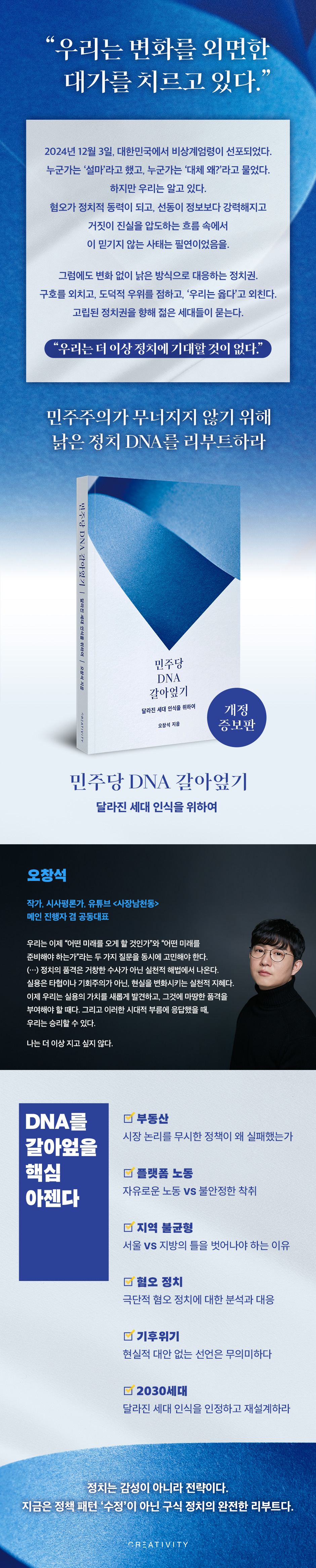
Reboot the old political DNA to prevent democracy from collapsing.
★YouTube channel "Sajangnamcheondong" with 420,000 subscribers★
A key agenda proposed by main host and co-representative Oh Chang-seok that will overhaul the Democratic Party's DNA.
There are fundamental problems facing the Democratic Party at a turning point in Korean politics.
It is a one-sided political pattern of responding in the same old way without change, shouting only one's own slogans, checking one's moral superiority, and saying only, "We are right."
This book coldly examines the structural limitations currently facing the Democratic Party.
It presents, through concrete data and logic, the reasons why political party reform is necessary, ways to restore voter trust, and the need for policy adjustments in line with changing times.
Compared to the first edition of "Overhauling the Democratic Party's DNA," we've added issues and alternatives related to real-world politics, and updated outdated examples to reflect the changing times.
This book is not simply a political critique.
We analyze the Democratic Party's repeated mistakes and clarify the necessary strategies to avoid repeating the same mistakes.
It also closely analyzes the consequences of policies that ignore reality, such as failed real estate policies, inadequate responses to labor market changes, and generational differences in perception, and presents practical alternatives.
Rather than emotional rhetoric, we discuss the Democratic Party's sustainability through thorough analysis based on a cool-headed understanding of reality.
Ignoring change is regression.
"Overhauling the Democratic Party's DNA" will be a must-read for all voters who are concerned about what the Democratic Party must do to achieve true reform, and furthermore, the direction in which Korean politics should advance.
Reboot the old political DNA to prevent democracy from collapsing.
★YouTube channel "Sajangnamcheondong" with 420,000 subscribers★
A key agenda proposed by main host and co-representative Oh Chang-seok that will overhaul the Democratic Party's DNA.
There are fundamental problems facing the Democratic Party at a turning point in Korean politics.
It is a one-sided political pattern of responding in the same old way without change, shouting only one's own slogans, checking one's moral superiority, and saying only, "We are right."
This book coldly examines the structural limitations currently facing the Democratic Party.
It presents, through concrete data and logic, the reasons why political party reform is necessary, ways to restore voter trust, and the need for policy adjustments in line with changing times.
Compared to the first edition of "Overhauling the Democratic Party's DNA," we've added issues and alternatives related to real-world politics, and updated outdated examples to reflect the changing times.
This book is not simply a political critique.
We analyze the Democratic Party's repeated mistakes and clarify the necessary strategies to avoid repeating the same mistakes.
It also closely analyzes the consequences of policies that ignore reality, such as failed real estate policies, inadequate responses to labor market changes, and generational differences in perception, and presents practical alternatives.
Rather than emotional rhetoric, we discuss the Democratic Party's sustainability through thorough analysis based on a cool-headed understanding of reality.
Ignoring change is regression.
"Overhauling the Democratic Party's DNA" will be a must-read for all voters who are concerned about what the Democratic Party must do to achieve true reform, and furthermore, the direction in which Korean politics should advance.
- You can preview some of the book's contents.
Preview
index
Prologue | That Dawn, I Saw Gwangju from Yeouido
Chapter 1.
Overhauling core keywords
Let's acknowledge human nature when it comes to real estate.
Let's create a proper working environment for platform workers.
Let's make food in the provinces and a nest in Seoul.
Let's find realistic alternatives to address the climate crisis.
Let's think about unification and unification together.
Let's build a ladder to climb to the ceiling
Chapter 2.
Overcoming limits and taboos
Now let's talk about science high schools
Let's throw away patriotic pay
Let's break through the ceiling of 85 million won
Let's make it possible for anyone to ring the Democratic Party's bell.
Think Beyond Japan
Net right-wingers take to the streets, condemning extreme hate.
Chapter 3.
Overturning failure
Don't follow the numbers game
Let's carefully design the language of our promises.
Let's build a talent acquisition system.
Let's listen more closely to the voices of Honam.
Chapter 4.
Transforming attitudes beyond policies
Stop cosplaying as commoners
Let's talk a little more easily
Let's speak to reality through Kim Dae-jung and Roh Moo-hyun.
Let's not ignore human instincts
Chapter 5.
Things that were overturned together
Declaration of the end of commuting hell
Declaration of corporate tax cut
Declaration of securing electric vehicle parking spaces
Epilogue | I Don't Want to Lose Again
Chapter 1.
Overhauling core keywords
Let's acknowledge human nature when it comes to real estate.
Let's create a proper working environment for platform workers.
Let's make food in the provinces and a nest in Seoul.
Let's find realistic alternatives to address the climate crisis.
Let's think about unification and unification together.
Let's build a ladder to climb to the ceiling
Chapter 2.
Overcoming limits and taboos
Now let's talk about science high schools
Let's throw away patriotic pay
Let's break through the ceiling of 85 million won
Let's make it possible for anyone to ring the Democratic Party's bell.
Think Beyond Japan
Net right-wingers take to the streets, condemning extreme hate.
Chapter 3.
Overturning failure
Don't follow the numbers game
Let's carefully design the language of our promises.
Let's build a talent acquisition system.
Let's listen more closely to the voices of Honam.
Chapter 4.
Transforming attitudes beyond policies
Stop cosplaying as commoners
Let's talk a little more easily
Let's speak to reality through Kim Dae-jung and Roh Moo-hyun.
Let's not ignore human instincts
Chapter 5.
Things that were overturned together
Declaration of the end of commuting hell
Declaration of corporate tax cut
Declaration of securing electric vehicle parking spaces
Epilogue | I Don't Want to Lose Again
Detailed image
Into the book
In the past, in Gwangju, the truth was distorted due to information control and media censorship, but in modern Seoul, the truth is conveyed in real time, yet there is an insensitive reaction.
This shows how easily we can settle for a 'cruel peace'.
It is shocking that a similar situation could recur in just a few years, despite the Supreme Court ruling in 2018 that the Yushin regime was unlawful.
Moreover, the fact that this happened despite the presence of the current Chief Justice, who was involved in the ruling at the time, clearly shows how fragile the foundations of the rule of law and democracy are.
--- From "I saw Gwangju from Yeouido that morning"
The problem of real estate goes beyond the question of where to live and the disappearance of lifetime employment.
This is the problem of 'inheritance of wealth'.
Parents' financial power does not simply affect their children's progress through elementary, middle, and high school, university entrance exam preparation, and even the process from studying abroad to graduation.
In the end, it's real estate.
It also has an absolute impact on ‘owning a home,’ which has become a de facto prerequisite for marriage.
--- From "Let's Acknowledge Human Nature Regarding Real Estate"
If attracting quality jobs is difficult right now, we need to prepare an international airport that will allow export-focused large companies to export directly after manufacturing without worrying about domestic logistics costs.
To achieve this, we need to categorize non-metropolitan areas into several megacities, designate and foster specialized and key industries, and support the creation of an industrial ecosystem.
Additionally, corporate taxes should be lowered for companies relocating to the region, and for companies already operating in the region, to encourage new hiring and raise the salaries of existing employees.
--- From "Let's make food in the provinces and a nest in Seoul"
Now is the time for a change in thinking.
We must break away from the practice of taking for granted low treatment, which is expressed as 'patriotic pay.'
We must introduce a groundbreaking compensation system commensurate with the contributions of those who play a key role in national security and scientific and technological advancement.
This means comprehensive improvement in treatment, including not only financial compensation but also research environment, autonomy, and growth opportunities.
--- From "Let's Throw Away Patriotic Pay"
What we need is not emotional responses that dwell on the past, but strategic thinking toward the future.
Our relationship with Japan is important, but we need to look beyond that to see a bigger picture.
Beyond Japan should not simply deny or exclude Japan, but should be an active vision that advances into the wider world.
--- From "Let's Think Beyond Japan"
The problem with numerical promises isn't simply that they're unrealistic.
The more fundamental problem is that these promises ignore the real challenges facing our society.
The structural problems facing Korean society, such as income inequality, polarization, youth unemployment, low birth rates, and an aging population, cannot be solved with simple numerical goals.
Rather, this obsession with macro indicators can deepen inequality and hinder social integration.
This shows how easily we can settle for a 'cruel peace'.
It is shocking that a similar situation could recur in just a few years, despite the Supreme Court ruling in 2018 that the Yushin regime was unlawful.
Moreover, the fact that this happened despite the presence of the current Chief Justice, who was involved in the ruling at the time, clearly shows how fragile the foundations of the rule of law and democracy are.
--- From "I saw Gwangju from Yeouido that morning"
The problem of real estate goes beyond the question of where to live and the disappearance of lifetime employment.
This is the problem of 'inheritance of wealth'.
Parents' financial power does not simply affect their children's progress through elementary, middle, and high school, university entrance exam preparation, and even the process from studying abroad to graduation.
In the end, it's real estate.
It also has an absolute impact on ‘owning a home,’ which has become a de facto prerequisite for marriage.
--- From "Let's Acknowledge Human Nature Regarding Real Estate"
If attracting quality jobs is difficult right now, we need to prepare an international airport that will allow export-focused large companies to export directly after manufacturing without worrying about domestic logistics costs.
To achieve this, we need to categorize non-metropolitan areas into several megacities, designate and foster specialized and key industries, and support the creation of an industrial ecosystem.
Additionally, corporate taxes should be lowered for companies relocating to the region, and for companies already operating in the region, to encourage new hiring and raise the salaries of existing employees.
--- From "Let's make food in the provinces and a nest in Seoul"
Now is the time for a change in thinking.
We must break away from the practice of taking for granted low treatment, which is expressed as 'patriotic pay.'
We must introduce a groundbreaking compensation system commensurate with the contributions of those who play a key role in national security and scientific and technological advancement.
This means comprehensive improvement in treatment, including not only financial compensation but also research environment, autonomy, and growth opportunities.
--- From "Let's Throw Away Patriotic Pay"
What we need is not emotional responses that dwell on the past, but strategic thinking toward the future.
Our relationship with Japan is important, but we need to look beyond that to see a bigger picture.
Beyond Japan should not simply deny or exclude Japan, but should be an active vision that advances into the wider world.
--- From "Let's Think Beyond Japan"
The problem with numerical promises isn't simply that they're unrealistic.
The more fundamental problem is that these promises ignore the real challenges facing our society.
The structural problems facing Korean society, such as income inequality, polarization, youth unemployment, low birth rates, and an aging population, cannot be solved with simple numerical goals.
Rather, this obsession with macro indicators can deepen inequality and hinder social integration.
--- From "Let's not follow the numbers game"
Publisher's Review
Should we stick to the old ways or change?
We have repeated the same pattern over and over again.
The more this happens, the more hatred grows, the more incitement becomes stronger, and the faster fake news spreads.
But each time, the political world responded in the same way.
'We are right and they are wrong', 'the people are misunderstanding'.
As a result, Korean net-rightists took to the streets, hate politics became a huge force, and martial law was declared on December 3, 2024.
South Korea's politics are still stuck in the past, but the world is changing much faster and more frighteningly.
At such times, we must implement logical and realistic solutions based on data, not emotional politics.
The era of politics driven by 'good intentions' is over.
A complete reboot of sentimental, old-fashioned politics.
At one point, the Democratic Party tried to over-regulate the real estate market, which ended up frustrating the dreams of middle-class homeowners in their 30s.
Policies that suppress supply and limit lending have led to a housing bubble and a surge in real estate prices.
This is not simply a failure of policy, the author says, but a failure of an approach that ignores human nature.
While the Democratic Party remains stuck in the old mold, it also highlights how wide the generational gap has become.
Just as the vague slogan of "unification" has lost its practical meaning for the younger generation, the Democratic Party's message is no longer conveyed in the voters' language.
Now, we must face the reality that perceptions differ across generations and actively change.
It is the key to opening a new window for Democratic Party politics.
A Political Manual for Everyone Who Wants to Change Democracy
“Overturning the Democratic Party’s DNA” is not a book of political criticism.
This book presents why the Democratic Party can no longer rely on its past legacy, what changes are essential to survive in the new political environment, and specific action plans to achieve this.
Politics ultimately depends on gaining the trust of voters.
But trust is not earned by past glory, but by present achievements.
What the Democratic Party needs to win back the people's vote is not a "past success story," but a "new vision" that faces reality and leads change.
This book is the starting point for that change.
We have repeated the same pattern over and over again.
The more this happens, the more hatred grows, the more incitement becomes stronger, and the faster fake news spreads.
But each time, the political world responded in the same way.
'We are right and they are wrong', 'the people are misunderstanding'.
As a result, Korean net-rightists took to the streets, hate politics became a huge force, and martial law was declared on December 3, 2024.
South Korea's politics are still stuck in the past, but the world is changing much faster and more frighteningly.
At such times, we must implement logical and realistic solutions based on data, not emotional politics.
The era of politics driven by 'good intentions' is over.
A complete reboot of sentimental, old-fashioned politics.
At one point, the Democratic Party tried to over-regulate the real estate market, which ended up frustrating the dreams of middle-class homeowners in their 30s.
Policies that suppress supply and limit lending have led to a housing bubble and a surge in real estate prices.
This is not simply a failure of policy, the author says, but a failure of an approach that ignores human nature.
While the Democratic Party remains stuck in the old mold, it also highlights how wide the generational gap has become.
Just as the vague slogan of "unification" has lost its practical meaning for the younger generation, the Democratic Party's message is no longer conveyed in the voters' language.
Now, we must face the reality that perceptions differ across generations and actively change.
It is the key to opening a new window for Democratic Party politics.
A Political Manual for Everyone Who Wants to Change Democracy
“Overturning the Democratic Party’s DNA” is not a book of political criticism.
This book presents why the Democratic Party can no longer rely on its past legacy, what changes are essential to survive in the new political environment, and specific action plans to achieve this.
Politics ultimately depends on gaining the trust of voters.
But trust is not earned by past glory, but by present achievements.
What the Democratic Party needs to win back the people's vote is not a "past success story," but a "new vision" that faces reality and leads change.
This book is the starting point for that change.
GOODS SPECIFICS
- Date of issue: March 31, 2025
- Page count, weight, size: 188 pages | 240g | 128*188*15mm
- ISBN13: 9791198896407
- ISBN10: 119889640X
You may also like
카테고리
korean


korean

![GQ KOREA Mark (Monthly): December [2025]](http://librairie.coreenne.fr/cdn/shop/files/8ef265dbbfbf186523ed75ba7319009d.jpg?v=1765340328&width=3840)


