

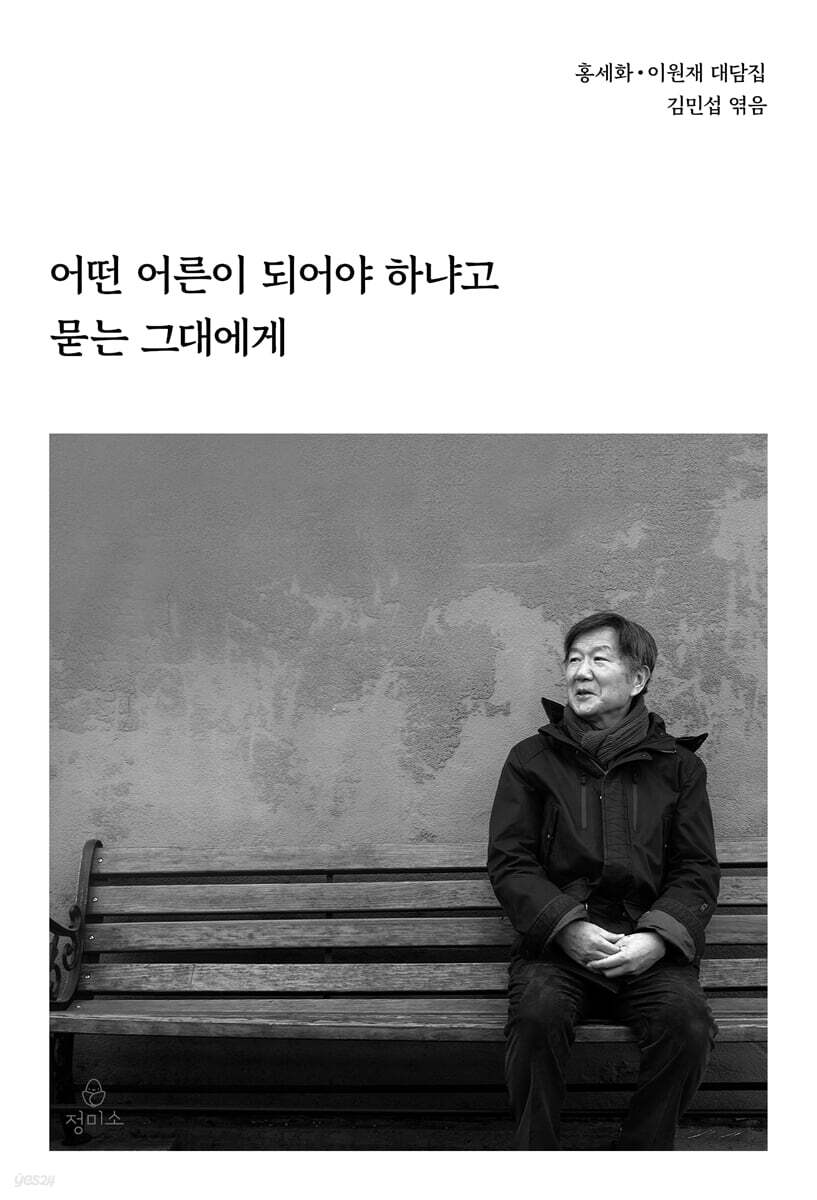
To you who asks what kind of adult you should become
 |
Description
Book Introduction
- A word from MD
- Author Hong Se-hwa, who stood against state violence, inequality, and hatred until the very end, passed away on April 18, 2024.
This book contains the author's final message.
In a time when the values of the times have become victory and money, we ask what constitutes a good society and good adults.
Let us humbly reflect on the deceased's will.
- Son Min-gyu, Social and Political PD
Teacher, how should we live?
I think it's humility
The last word that author Hong Se-hwa conveyed to our society was ‘humility.’
Author Kim Min-seop, who visited him three days before he passed away, asked him how we should live and received one word: 'humility.'
That was the word he held onto at the end of his life, as he introduced the European style of tolerance and consideration to Korea.
According to author Kim Min-seop, he was a good adult, had a boyish face more than anyone else, and knew how to smile shyly.
This book is a compilation of a conversation between author Hong Se-hwa and author Lee Won-jae, author of “Reading Gym Clothes in the Morning,” held in May 2023.
We have published the current revised edition with content to commemorate him.
I think it's humility
The last word that author Hong Se-hwa conveyed to our society was ‘humility.’
Author Kim Min-seop, who visited him three days before he passed away, asked him how we should live and received one word: 'humility.'
That was the word he held onto at the end of his life, as he introduced the European style of tolerance and consideration to Korea.
According to author Kim Min-seop, he was a good adult, had a boyish face more than anyone else, and knew how to smile shyly.
This book is a compilation of a conversation between author Hong Se-hwa and author Lee Won-jae, author of “Reading Gym Clothes in the Morning,” held in May 2023.
We have published the current revised edition with content to commemorate him.
- You can preview some of the book's contents.
Preview
index
In memory of Mr. Hong Se-hwa, a shy and humble adult - 7
Prologue - 21
PART 1.
Children coming to school in gym uniforms - 27
PART 2.
Dad, why don't French kids hit me? - 45
PART 3.
I don't know why you have to do that - 67
PART 4.
From the In-Self to the For-Self - 81
PART 5.
A Good Adult is an Incomplete Being - 101
Epilogue - 131
Farewell to Professor Hong Se-hwa - 141
Prologue - 21
PART 1.
Children coming to school in gym uniforms - 27
PART 2.
Dad, why don't French kids hit me? - 45
PART 3.
I don't know why you have to do that - 67
PART 4.
From the In-Self to the For-Self - 81
PART 5.
A Good Adult is an Incomplete Being - 101
Epilogue - 131
Farewell to Professor Hong Se-hwa - 141
Into the book
Who is a good adult?
I'm such a pessimistic person that this question immediately makes me think of a world where good adults are becoming a rare species.
In reality, the world made me chew on the words that I should not become a monster, even if I cannot become a good adult or a human being.
--- From the "Prologue"
The year I went to France was 1979.
The children were five and two years old.
When my wife and children joined me, it was summer vacation season, not the time for them to go to kindergarten.
The environment had completely changed, so the kids were timid and wouldn't leave the apartment. But after about a week, they got so bored that they started going to the bakery together, and their activities gradually expanded. Finally, my five-year-old daughter went to the neighborhood park by herself.
There were white kids, black kids, and kids from North Africa at the park, and after playing for a while, I still remember what they said to my mom when they got home.
“Why don’t the kids here hit me?”
--- From "Dad, why don't French kids hit me?"
In Europe, too, schools existed like barracks during the era of militarism, but with the advent of the so-called liberal democratic era, the school structure also changed. However, we spent time without such changes, and around 1990, neoliberalism infiltrated the education sector.
Because neoliberalism was added on top of the existing new education system, it ended up looking like a monster, to put it bluntly.
One of those things is that students have become customers, consumers, instead of citizens.
--- From "I don't know why I have to do that"
There is a saying I often quote.
Reading enriches people, and writing refines people.
This is true.
Victor Hugo, the author of Les Miserables, said, “Just as a body that does not eat dries up, a mind that does not read dries up.” It is easy to understand that reading enriches people.
So why does writing make us more sophisticated? We claim to be thinking beings, but our thoughts are largely shrouded in fog.
As the teacher said, through the process of organizing and reflecting on one's thoughts through writing, one can look into oneself.
Writing is very important in that it allows us to move from the immediate self to the interpersonal self.
The problem is that in Korean schools and classrooms, this important writing skill is relegated to the margins.
--- From "From the Self to the Self"
So what are we to do? We still need to explore and put it into practice.
Because it is a difficult situation, we have no choice but to work harder.
There are some quotes that I often quote, and they are actually things I say to myself.
“It’s not that the road we take is difficult, but that it is difficult, and that’s why we must take it.” In reality, the world is becoming increasingly pessimistic.
Humans are said to be rational animals, but which animal wages war? When will humans, who are currently waging war, stop? We're talking about climate justice, but can humans waging war ever overcome the climate crisis? Even in the face of such pessimistic prospects, we must never give up, never be cynical, but seek, participate, and act—this is the task, akin to our destiny, given to us.
I'm such a pessimistic person that this question immediately makes me think of a world where good adults are becoming a rare species.
In reality, the world made me chew on the words that I should not become a monster, even if I cannot become a good adult or a human being.
--- From the "Prologue"
The year I went to France was 1979.
The children were five and two years old.
When my wife and children joined me, it was summer vacation season, not the time for them to go to kindergarten.
The environment had completely changed, so the kids were timid and wouldn't leave the apartment. But after about a week, they got so bored that they started going to the bakery together, and their activities gradually expanded. Finally, my five-year-old daughter went to the neighborhood park by herself.
There were white kids, black kids, and kids from North Africa at the park, and after playing for a while, I still remember what they said to my mom when they got home.
“Why don’t the kids here hit me?”
--- From "Dad, why don't French kids hit me?"
In Europe, too, schools existed like barracks during the era of militarism, but with the advent of the so-called liberal democratic era, the school structure also changed. However, we spent time without such changes, and around 1990, neoliberalism infiltrated the education sector.
Because neoliberalism was added on top of the existing new education system, it ended up looking like a monster, to put it bluntly.
One of those things is that students have become customers, consumers, instead of citizens.
--- From "I don't know why I have to do that"
There is a saying I often quote.
Reading enriches people, and writing refines people.
This is true.
Victor Hugo, the author of Les Miserables, said, “Just as a body that does not eat dries up, a mind that does not read dries up.” It is easy to understand that reading enriches people.
So why does writing make us more sophisticated? We claim to be thinking beings, but our thoughts are largely shrouded in fog.
As the teacher said, through the process of organizing and reflecting on one's thoughts through writing, one can look into oneself.
Writing is very important in that it allows us to move from the immediate self to the interpersonal self.
The problem is that in Korean schools and classrooms, this important writing skill is relegated to the margins.
--- From "From the Self to the Self"
So what are we to do? We still need to explore and put it into practice.
Because it is a difficult situation, we have no choice but to work harder.
There are some quotes that I often quote, and they are actually things I say to myself.
“It’s not that the road we take is difficult, but that it is difficult, and that’s why we must take it.” In reality, the world is becoming increasingly pessimistic.
Humans are said to be rational animals, but which animal wages war? When will humans, who are currently waging war, stop? We're talking about climate justice, but can humans waging war ever overcome the climate crisis? Even in the face of such pessimistic prospects, we must never give up, never be cynical, but seek, participate, and act—this is the task, akin to our destiny, given to us.
--- From "A Good Adult is an Incomplete Being"
Publisher's Review
A good adult must be an incomplete being.
In response to Kim Min-seop's question about who a good adult is, author Hong Se-hwa emphasizes that a good adult must be an incomplete being.
According to him, the perception that adults in Korea must be complete beings is presupposed.
But adults need endless change and maturity.
If we must become adults, we must always keep in mind the room for self-change and self-maturity.
Needless to say, the possibility opens up when I acknowledge that my present existence is incomplete.
There are many people around us who say that they are good adults, that they are already complete adults.
However, it is difficult to meet someone who can be called an adult among them.
They usually romanticize and reminisce about their accomplishments.
And to the next generation, it tells them, “I did it, so you should do it too.”
However, author Hong Se-hwa says that a person cannot be perfected until the moment of death, and so it is essential to maintain the tension of constantly reflecting on one's mistakes and shortcomings to correct or supplement them.
Ultimately, the attitude of looking in the mirror every morning to check your appearance and living with a mirror that reflects your inner self just as you go out is absolutely necessary for those who want to become true adults.
Become citizens, not customers
Wherever we go, we exist as customers.
It's sad, but when you divide the hierarchy among your peers and take a slightly higher position, you feel like you're being treated as a complete adult.
Author Hong Se-hwa diagnoses that the reason we have become such monsters today is because neoliberalism came in without overcoming the Japanese colonial rule's new education system, and as a result, instead of transforming from subjects into citizens, we have become customers and consumers.
Author Lee Won-jae asks:
What kind of place should school be, and what kind of person should a teacher be?
Author Hong Se-hwa answers.
We must become citizens, not subjects.
Schools should be places that cultivate democratic citizens, and teachers should be people who provide such education.
Reading enriches people
Writing makes people sophisticated.
Author Hong Se-hwa responds to author Lee Won-jae's statement that he is making efforts to provide more writing education in schools.
For European teachers, it's a daily routine.
According to him, writing enables people to move from the immediate self to the interpersonal self.
We are thinking beings, but in reality, most of our thoughts are shrouded in fog, and writing allows us to organize and reflect on our thoughts, and to look closely at ourselves.
Author Lee Won-jae responds to him by saying that he will become an adult who treats students with his heart, not just his shoulders.
Not only will I continue to receive feedback on my writing, but I will also turn around and face anyone who comes to me.
In the end, whether at school or anywhere else, I will continue on my path to becoming a good adult as an unfinished being.
Recommendation
The first time I met Professor Hong Se-hwa was in my father's study.
After my father came home from work, he always read something in his room.
One day, I saw a book he was reading on his desk called "I Am a Taxi Driver in Paris" and after reading a few pages, I stopped reading.
It probably wasn't a book that I, an elementary school student, could understand.
I think my father said, “That guy is a great guy,” but I don’t remember it clearly.
Maybe I want to believe that's what happened.
Professor Hong Se-hwa wrote a recommendation for my book, “Surrogate Society.”
After the Namminjeon incident, he found a job as a taxi driver after going into exile in Paris, and after graduating from college, I found a job as a designated driver, so it seems like our lives were quite compatible, transcending time and space.
He did not ignore my request, and our relationship began from then on.
He brought meat to my house in Ilsan and we grilled it together when I visited my friends.
He would bring out some good wine, we would have long conversations that would not hurt anyone, and after we finished eating, he would always try to do the dishes himself, so we had to drag him out and say, "Please, do it ourselves."
He respected everyone in that space, regardless of age.
Indeed, it was so.
When I first visited him at his home in Ilsan, holding a plate of pork belly, the square in South Korea was packed with people.
The so-called state affairs scandal, candlelight protests, and impeachment of the president.
Many people held candles and everyone with a mouth said something about it.
We were exchanging congratulations on the publication and various jokes, and at some point the conversation shifted to that.
And as the few young people who had found him together looked at him, expecting to hear what he would say, his first words were something no one had ever heard before.
“I should say I’m sorry first.
It's because people my age can't do anything right that we have ended up on a day like today.
“I am so sorry to you young people.” There was a brief silence, and soon everyone said, “Teacher, that’s not right, don’t apologize,” but soon we replied, “Thank you.”
The president didn't apologize, those who led the impeachment didn't apologize, and no adult ever apologized to us.
At a time when everyone was busy finding, demonizing, and condemning someone, Mr. Hong Se-hwa was the only adult I had.
Teacher Hong Se-hwa was not a man of many words.
I often found myself smiling shyly as I watched young people chatting away at the dinner table.
For some reason, I haven't seen many people who fit the expression 'shy' so well.
As far as I remember, he always had a boyish face.
Many people are losing their faces.
Whether in politics or business, there are many cases where people who started out with a boyish face end up feeling disappointed and wondering why they ended up with such a face.
But Mr. Hong Se-hwa kept that face.
I don't know how that was possible or how difficult it would have been.
Three days before Mr. Hong Se-hwa passed away, I received a call from a friend who was caring for him.
Minseop, I hope you come because this might be the last time I get to talk to you, teacher.
The teacher was battling cancer.
As I was leaving after visiting him, I had something I really wanted to ask him, and I felt like I had to ask him now, so I asked him.
“Teacher, I have never asked anyone this question, but I really want to ask you.
How should people live?
How should I live?
“You can say it in one sentence, or even one word.” He was in a state where he could not answer at length, but he took a deep breath and answered in a clear and powerful voice.
“That’s not difficult at all.
“I think it is humility.” He returned to Korea, spreading the word tolerance, European tolerance and consideration, and the word he conveyed to me/us in the last moments of his life was ‘humility.’
After hearing that, I closed my eyes for a long time.
Otherwise, I felt like the tears I had been holding back would spill out.
I had my eyes closed for a long time in front of the teacher.
I wanted to answer, "I'll live like that," but I couldn't say anything because I felt like I would burst into tears.
My friend said, “I’m going out with Minseop for a bit,” so I went out.
I brought you out because I thought you might cry.
I cried outside, went back into the hospital room, and barely managed to hold back my tears, saying, "Doctor, I will live like that," and said goodbye to the doctor, saying that I would come back again.
I am now sending off the best adult I know, the one with the shy boy's face who has never changed for a single moment.
The coordinates of his life were so clear, and he left everything behind with one word he said at the end of his life.
But I want to say to him, "Teacher, you were really cool. I'll try to live like that too," and have a drink with him, smiling.
It's so sad that that can't happen.
This book is a compilation of a conversation I had with him last year titled “What Kind of Adult Should a Teacher Be?”
The reason I specifically mentioned the profession of teacher was because my best friend who participated in the conversation is a teacher, and the truth is, I wanted to ask, “What kind of adults should we become?”
And the teacher responded to him.
The teacher always said.
We must move from ownership to relationships, from growth to maturity.
And in that process, we must become citizens, not subjects or customers.
The day I visited Mr. Hong Se-hwa for the last time, I said to my friend:
I asked the teacher if he could personally accept just one word, humility.
A few hours later, he received a photo.
That's the teacher's handwriting on the cover of this book.
And two days later, I received news of my teacher's death.
This book is a memorial sent to you by Kim Min-seop, Lee Won-jae, and everyone I know.
I will live my whole life holding on to the word humility that my teacher left behind.
I will place humility next to the word affection that I have cherished.
May the soul of Professor Hong Se-hwa rest in peace.
Kim Min-seop, CEO of Jeongmiso Publishing
In response to Kim Min-seop's question about who a good adult is, author Hong Se-hwa emphasizes that a good adult must be an incomplete being.
According to him, the perception that adults in Korea must be complete beings is presupposed.
But adults need endless change and maturity.
If we must become adults, we must always keep in mind the room for self-change and self-maturity.
Needless to say, the possibility opens up when I acknowledge that my present existence is incomplete.
There are many people around us who say that they are good adults, that they are already complete adults.
However, it is difficult to meet someone who can be called an adult among them.
They usually romanticize and reminisce about their accomplishments.
And to the next generation, it tells them, “I did it, so you should do it too.”
However, author Hong Se-hwa says that a person cannot be perfected until the moment of death, and so it is essential to maintain the tension of constantly reflecting on one's mistakes and shortcomings to correct or supplement them.
Ultimately, the attitude of looking in the mirror every morning to check your appearance and living with a mirror that reflects your inner self just as you go out is absolutely necessary for those who want to become true adults.
Become citizens, not customers
Wherever we go, we exist as customers.
It's sad, but when you divide the hierarchy among your peers and take a slightly higher position, you feel like you're being treated as a complete adult.
Author Hong Se-hwa diagnoses that the reason we have become such monsters today is because neoliberalism came in without overcoming the Japanese colonial rule's new education system, and as a result, instead of transforming from subjects into citizens, we have become customers and consumers.
Author Lee Won-jae asks:
What kind of place should school be, and what kind of person should a teacher be?
Author Hong Se-hwa answers.
We must become citizens, not subjects.
Schools should be places that cultivate democratic citizens, and teachers should be people who provide such education.
Reading enriches people
Writing makes people sophisticated.
Author Hong Se-hwa responds to author Lee Won-jae's statement that he is making efforts to provide more writing education in schools.
For European teachers, it's a daily routine.
According to him, writing enables people to move from the immediate self to the interpersonal self.
We are thinking beings, but in reality, most of our thoughts are shrouded in fog, and writing allows us to organize and reflect on our thoughts, and to look closely at ourselves.
Author Lee Won-jae responds to him by saying that he will become an adult who treats students with his heart, not just his shoulders.
Not only will I continue to receive feedback on my writing, but I will also turn around and face anyone who comes to me.
In the end, whether at school or anywhere else, I will continue on my path to becoming a good adult as an unfinished being.
Recommendation
The first time I met Professor Hong Se-hwa was in my father's study.
After my father came home from work, he always read something in his room.
One day, I saw a book he was reading on his desk called "I Am a Taxi Driver in Paris" and after reading a few pages, I stopped reading.
It probably wasn't a book that I, an elementary school student, could understand.
I think my father said, “That guy is a great guy,” but I don’t remember it clearly.
Maybe I want to believe that's what happened.
Professor Hong Se-hwa wrote a recommendation for my book, “Surrogate Society.”
After the Namminjeon incident, he found a job as a taxi driver after going into exile in Paris, and after graduating from college, I found a job as a designated driver, so it seems like our lives were quite compatible, transcending time and space.
He did not ignore my request, and our relationship began from then on.
He brought meat to my house in Ilsan and we grilled it together when I visited my friends.
He would bring out some good wine, we would have long conversations that would not hurt anyone, and after we finished eating, he would always try to do the dishes himself, so we had to drag him out and say, "Please, do it ourselves."
He respected everyone in that space, regardless of age.
Indeed, it was so.
When I first visited him at his home in Ilsan, holding a plate of pork belly, the square in South Korea was packed with people.
The so-called state affairs scandal, candlelight protests, and impeachment of the president.
Many people held candles and everyone with a mouth said something about it.
We were exchanging congratulations on the publication and various jokes, and at some point the conversation shifted to that.
And as the few young people who had found him together looked at him, expecting to hear what he would say, his first words were something no one had ever heard before.
“I should say I’m sorry first.
It's because people my age can't do anything right that we have ended up on a day like today.
“I am so sorry to you young people.” There was a brief silence, and soon everyone said, “Teacher, that’s not right, don’t apologize,” but soon we replied, “Thank you.”
The president didn't apologize, those who led the impeachment didn't apologize, and no adult ever apologized to us.
At a time when everyone was busy finding, demonizing, and condemning someone, Mr. Hong Se-hwa was the only adult I had.
Teacher Hong Se-hwa was not a man of many words.
I often found myself smiling shyly as I watched young people chatting away at the dinner table.
For some reason, I haven't seen many people who fit the expression 'shy' so well.
As far as I remember, he always had a boyish face.
Many people are losing their faces.
Whether in politics or business, there are many cases where people who started out with a boyish face end up feeling disappointed and wondering why they ended up with such a face.
But Mr. Hong Se-hwa kept that face.
I don't know how that was possible or how difficult it would have been.
Three days before Mr. Hong Se-hwa passed away, I received a call from a friend who was caring for him.
Minseop, I hope you come because this might be the last time I get to talk to you, teacher.
The teacher was battling cancer.
As I was leaving after visiting him, I had something I really wanted to ask him, and I felt like I had to ask him now, so I asked him.
“Teacher, I have never asked anyone this question, but I really want to ask you.
How should people live?
How should I live?
“You can say it in one sentence, or even one word.” He was in a state where he could not answer at length, but he took a deep breath and answered in a clear and powerful voice.
“That’s not difficult at all.
“I think it is humility.” He returned to Korea, spreading the word tolerance, European tolerance and consideration, and the word he conveyed to me/us in the last moments of his life was ‘humility.’
After hearing that, I closed my eyes for a long time.
Otherwise, I felt like the tears I had been holding back would spill out.
I had my eyes closed for a long time in front of the teacher.
I wanted to answer, "I'll live like that," but I couldn't say anything because I felt like I would burst into tears.
My friend said, “I’m going out with Minseop for a bit,” so I went out.
I brought you out because I thought you might cry.
I cried outside, went back into the hospital room, and barely managed to hold back my tears, saying, "Doctor, I will live like that," and said goodbye to the doctor, saying that I would come back again.
I am now sending off the best adult I know, the one with the shy boy's face who has never changed for a single moment.
The coordinates of his life were so clear, and he left everything behind with one word he said at the end of his life.
But I want to say to him, "Teacher, you were really cool. I'll try to live like that too," and have a drink with him, smiling.
It's so sad that that can't happen.
This book is a compilation of a conversation I had with him last year titled “What Kind of Adult Should a Teacher Be?”
The reason I specifically mentioned the profession of teacher was because my best friend who participated in the conversation is a teacher, and the truth is, I wanted to ask, “What kind of adults should we become?”
And the teacher responded to him.
The teacher always said.
We must move from ownership to relationships, from growth to maturity.
And in that process, we must become citizens, not subjects or customers.
The day I visited Mr. Hong Se-hwa for the last time, I said to my friend:
I asked the teacher if he could personally accept just one word, humility.
A few hours later, he received a photo.
That's the teacher's handwriting on the cover of this book.
And two days later, I received news of my teacher's death.
This book is a memorial sent to you by Kim Min-seop, Lee Won-jae, and everyone I know.
I will live my whole life holding on to the word humility that my teacher left behind.
I will place humility next to the word affection that I have cherished.
May the soul of Professor Hong Se-hwa rest in peace.
Kim Min-seop, CEO of Jeongmiso Publishing
GOODS SPECIFICS
- Date of issue: September 8, 2023
- Page count, weight, size: 152 pages | 128*188*20mm
- ISBN13: 9791198518217
- ISBN10: 1198518219
You may also like
카테고리
korean


korean

![GQ KOREA Mark (Monthly): December [2025]](http://librairie.coreenne.fr/cdn/shop/files/8ef265dbbfbf186523ed75ba7319009d.jpg?v=1765340328&width=3840)


