

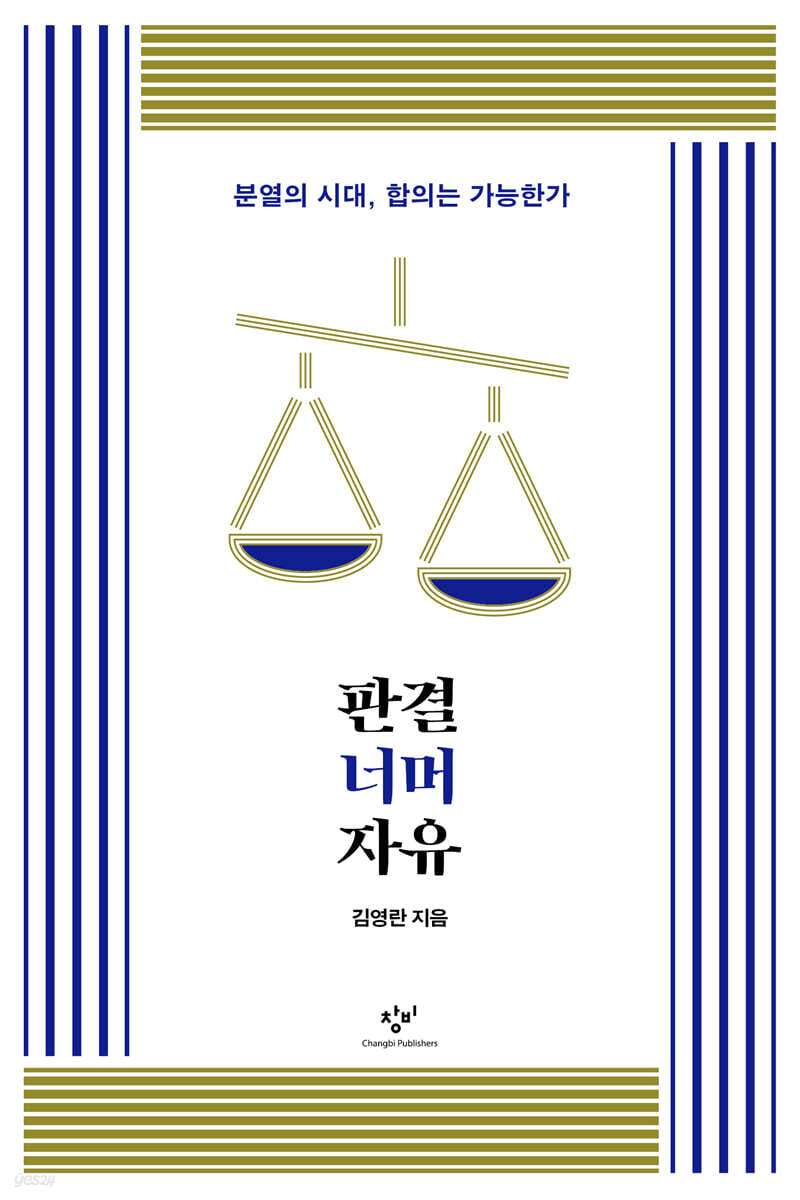
Freedom Beyond Judgment
 |
Description
Book Introduction
In an age of division, the only question is, "Whose side are you on?"
Can legitimate but conflicting beliefs coexist?
South Korea's first female Supreme Court Justice
Kim Young-ran's new "Judgment" series
Kim Young-ran, the first female Supreme Court Justice in Korea and known as the “Justice of Minorities,” and the author of the Anti-Corruption Act, who has greatly contributed to eradicating corruption in our society, has published her new book, “Freedom Beyond Judgment,” the third book in the “Judgment” series.
The author, who has consistently published books that review the decisions of the Supreme Court's full bench, such as "Rethinking the Judgment," poses the question in this book: "Is consensus possible in an age of division?"
While we feel that we have entered an era in which the voices of more diverse people are reflected than ever before thanks to the advancement of democracy, the reality is that public opinion on many issues is heading towards extreme confrontation, narrowing the space for diverse voices. This is a paradoxical situation.
Now, when the value and potential of consensus are more urgent than ever, Kim Young-ran finds a clue in the process by which the full bench makes its decision.
This is because the path through which judges deliberated and debated to arrive at the ‘most correct conclusion’ for our society is fully reflected in the decision.
Furthermore, it explores how a society in which conflicting but equally valid beliefs coexist, a society that achieves harmony in disagreement, is possible.
Can legitimate but conflicting beliefs coexist?
South Korea's first female Supreme Court Justice
Kim Young-ran's new "Judgment" series
Kim Young-ran, the first female Supreme Court Justice in Korea and known as the “Justice of Minorities,” and the author of the Anti-Corruption Act, who has greatly contributed to eradicating corruption in our society, has published her new book, “Freedom Beyond Judgment,” the third book in the “Judgment” series.
The author, who has consistently published books that review the decisions of the Supreme Court's full bench, such as "Rethinking the Judgment," poses the question in this book: "Is consensus possible in an age of division?"
While we feel that we have entered an era in which the voices of more diverse people are reflected than ever before thanks to the advancement of democracy, the reality is that public opinion on many issues is heading towards extreme confrontation, narrowing the space for diverse voices. This is a paradoxical situation.
Now, when the value and potential of consensus are more urgent than ever, Kim Young-ran finds a clue in the process by which the full bench makes its decision.
This is because the path through which judges deliberated and debated to arrive at the ‘most correct conclusion’ for our society is fully reflected in the decision.
Furthermore, it explores how a society in which conflicting but equally valid beliefs coexist, a society that achieves harmony in disagreement, is possible.
- You can preview some of the book's contents.
Preview
index
Prologue: A Wall of Flashlight and Rumors
Introduction: Rawls's Political Liberalism
Part 1: A Consensus Between Conflicting but Reasonable Beliefs and the Supreme Court's Ruling
Chapter 1: Rawls's Political Justice and Overlapping Agreements
Chapter 2: Traditional Values and Overlapping Agreements: Grave Site Rights and the Case of the Ceremonial Ceremony Supervisor
Chapter 3: Traditional Values and Public Reason: The Case of the Widow's Child's Limitations
Chapter 4: Application of the Principle of Justice and the Four-Step Theory: The Korean Teachers and Education Workers Union Illegal Union Case
Part 2: Fundamental Freedoms and Supreme Court Rulings
Chapter 1: The Priority of Basic Freedoms According to Rawls
Chapter 2 Freedom of Conscience: Cases of Conscientious Objection to Military Service
Chapter 3: Fundamental Rights of Minorities: Gender Reassignment for Transgender People, Military Sexual Self-Determination Cases
Chapter 4: Scope of Property Rights Protection: Cases Surrounding Real Estate Trusts
Chapter 5: Family System and Principles of Justice: Adoption of Grandchildren and Special Cases of Recognition of Minors
Epilogue If you look for different books in different rooms
main
Introduction: Rawls's Political Liberalism
Part 1: A Consensus Between Conflicting but Reasonable Beliefs and the Supreme Court's Ruling
Chapter 1: Rawls's Political Justice and Overlapping Agreements
Chapter 2: Traditional Values and Overlapping Agreements: Grave Site Rights and the Case of the Ceremonial Ceremony Supervisor
Chapter 3: Traditional Values and Public Reason: The Case of the Widow's Child's Limitations
Chapter 4: Application of the Principle of Justice and the Four-Step Theory: The Korean Teachers and Education Workers Union Illegal Union Case
Part 2: Fundamental Freedoms and Supreme Court Rulings
Chapter 1: The Priority of Basic Freedoms According to Rawls
Chapter 2 Freedom of Conscience: Cases of Conscientious Objection to Military Service
Chapter 3: Fundamental Rights of Minorities: Gender Reassignment for Transgender People, Military Sexual Self-Determination Cases
Chapter 4: Scope of Property Rights Protection: Cases Surrounding Real Estate Trusts
Chapter 5: Family System and Principles of Justice: Adoption of Grandchildren and Special Cases of Recognition of Minors
Epilogue If you look for different books in different rooms
main
Detailed image

Into the book
While we realize that we have entered an era where diverse voices must be reflected, we are also confronted with a contradictory situation in which public opinion on many issues is heading towards extreme confrontation, narrowing the space for diverse voices. This is the state of our society today.
(…) A reasonable pluralistic society is not a society that recognizes only one uniform belief system, but a society in which ‘contrasting but reasonable’ belief systems coexist.
So how should we establish institutions for social cooperation in a reasonable pluralistic society where people with different belief systems must coexist?
(…) A reasonable pluralistic society is not a society that recognizes only one uniform belief system, but a society in which ‘contrasting but reasonable’ belief systems coexist.
So how should we establish institutions for social cooperation in a reasonable pluralistic society where people with different belief systems must coexist?
---From the "Prologue"
Publisher's Review
When the law fails, everything fails.
The most rational institution in our society, the court
A full bench is a body in which all or most of the judges of a court participate in hearing a case.
It is done in cases where the trial is very complex or has important implications, or when the panel of judges cannot reach a consensus.
Following his previous works, the author meticulously analyzes the Supreme Court's full bench decision based on his concerns as a judge and his keen perspective on justice.
Part 1 examines the agreement between conflicting but reasonable beliefs, such as the case of the officiating priest and the illegal Korean Teachers and Education Workers Union, through Supreme Court rulings.
In Part 2, the fundamental freedoms that must be considered first in the process of such overlapping agreements are explained, divided into freedom of conscience and the fundamental rights of minorities.
The rulings on cases covered in this book, such as conscientious objection to military service, gender correction for transgender people, and inheritance by minors, are by no means simple.
The process by which our society's diverse beliefs and values are fiercely debated in court through judges' opinions, including majority opinions, dissenting opinions, separate opinions, and supplementary opinions on each issue, gives us an idea of how difficult it is to achieve "overlapping agreement."
However, Kim Young-ran emphasizes that the court, which is a product of 'public reason' and the most rational institution, must become a model for society by bringing about overlapping agreements.
In an era of polarized public opinion and partisanship, his observation that the judiciary, including the Supreme Court and the Constitutional Court, is the only government branch comprised solely of public reason and thus responsible for compromise, coordination, and agreement rather than choice, will provide a starting point for reflection for the judiciary and an opportunity for those contemplating the path of democratic citizenship to look anew at the countless events occurring in reality.
Taking Rawls' political liberalism as a milestone
Exploring the Method of Agreement and the Role of Law
John Rawls, the most important political philosopher of the late 20th century who left behind classics such as “Political Liberalism” and “A Theory of Justice,” is the figure that Kim Young-ran examines in detail in “Liberty Beyond Judgment.”
The concepts that are mainly dealt with in the book, such as ‘overlapping agreement’ and ‘public reason’, are also taken from Rawls.
However, the author does not simply quote old theories confined to thick books; he applies them to the most pressing issues of our time.
In particular, since the issues addressed in this book have been fiercely debated until recently, such as the 2022 gender reassignment permit for transgender people with minor children and the 2023 ruling that male heirs cannot be given priority as presiding over ancestral rites, Rawls's theory has been reborn as a new framework for thinking about current issues.
Rolls' theory, which arrived at us through Kim Young-ran, is all the more valuable in that respect.
For all those struggling to move our society toward a "reasonable pluralism" where consensus can be reached despite differing belief systems, "Freedom Beyond Judgment" will serve as a profoundly faithful example and textbook on political freedom.
The most rational institution in our society, the court
A full bench is a body in which all or most of the judges of a court participate in hearing a case.
It is done in cases where the trial is very complex or has important implications, or when the panel of judges cannot reach a consensus.
Following his previous works, the author meticulously analyzes the Supreme Court's full bench decision based on his concerns as a judge and his keen perspective on justice.
Part 1 examines the agreement between conflicting but reasonable beliefs, such as the case of the officiating priest and the illegal Korean Teachers and Education Workers Union, through Supreme Court rulings.
In Part 2, the fundamental freedoms that must be considered first in the process of such overlapping agreements are explained, divided into freedom of conscience and the fundamental rights of minorities.
The rulings on cases covered in this book, such as conscientious objection to military service, gender correction for transgender people, and inheritance by minors, are by no means simple.
The process by which our society's diverse beliefs and values are fiercely debated in court through judges' opinions, including majority opinions, dissenting opinions, separate opinions, and supplementary opinions on each issue, gives us an idea of how difficult it is to achieve "overlapping agreement."
However, Kim Young-ran emphasizes that the court, which is a product of 'public reason' and the most rational institution, must become a model for society by bringing about overlapping agreements.
In an era of polarized public opinion and partisanship, his observation that the judiciary, including the Supreme Court and the Constitutional Court, is the only government branch comprised solely of public reason and thus responsible for compromise, coordination, and agreement rather than choice, will provide a starting point for reflection for the judiciary and an opportunity for those contemplating the path of democratic citizenship to look anew at the countless events occurring in reality.
Taking Rawls' political liberalism as a milestone
Exploring the Method of Agreement and the Role of Law
John Rawls, the most important political philosopher of the late 20th century who left behind classics such as “Political Liberalism” and “A Theory of Justice,” is the figure that Kim Young-ran examines in detail in “Liberty Beyond Judgment.”
The concepts that are mainly dealt with in the book, such as ‘overlapping agreement’ and ‘public reason’, are also taken from Rawls.
However, the author does not simply quote old theories confined to thick books; he applies them to the most pressing issues of our time.
In particular, since the issues addressed in this book have been fiercely debated until recently, such as the 2022 gender reassignment permit for transgender people with minor children and the 2023 ruling that male heirs cannot be given priority as presiding over ancestral rites, Rawls's theory has been reborn as a new framework for thinking about current issues.
Rolls' theory, which arrived at us through Kim Young-ran, is all the more valuable in that respect.
For all those struggling to move our society toward a "reasonable pluralism" where consensus can be reached despite differing belief systems, "Freedom Beyond Judgment" will serve as a profoundly faithful example and textbook on political freedom.
GOODS SPECIFICS
- Date of issue: March 11, 2024
- Page count, weight, size: 248 pages | 328g | 140*210*20mm
- ISBN13: 9788936480189
- ISBN10: 8936480189
You may also like
카테고리
korean


korean

![GQ KOREA Mark (Monthly): December [2025]](http://librairie.coreenne.fr/cdn/shop/files/8ef265dbbfbf186523ed75ba7319009d.jpg?v=1765340328&width=3840)


