

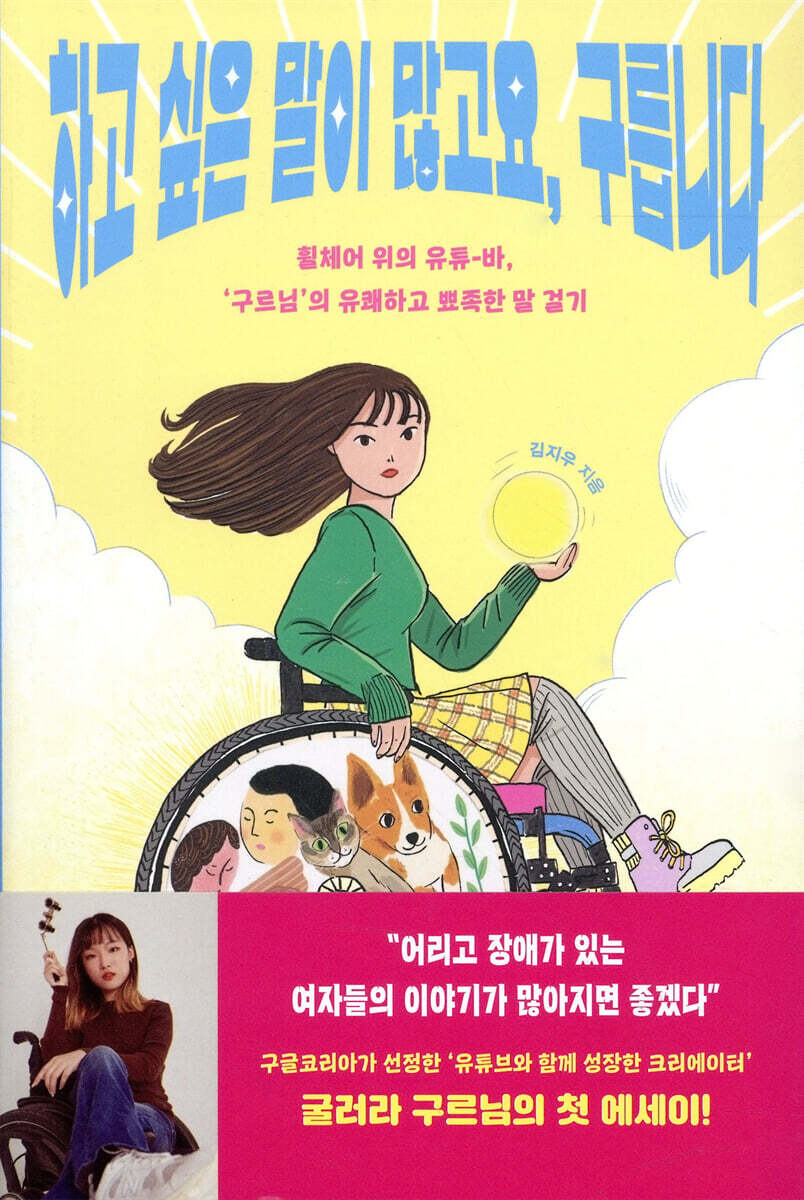
I have a lot to say, and I'm rolling around.
 |
Description
Book Introduction
“This is a body that may or may not resemble me. “It’s a story about people.” Kim Ji-woo, who has been running the channel 'Rollerara Gureunim' since 2017 and was selected as one of the '50 Creators Who Grew Up with YouTube' by Google Korea and YouTube, has published her first collection of essays, 'I Have a Lot to Say, and I'm Rolling'. The author, Gurunim, is a 22-year-old university student and a woman with brain damage who has been actively involved in disability issues since high school. He has revealed himself through various media, including his own channel, appearances on public broadcasting such as EBS documentaries, SBS news, and KBS joy entertainment, lectures at Sebashi, and as a torch bearer for the Pyeongchang Winter Paralympic Games. This book vividly conveys the daily experiences and concerns of Gurunim in Korean society, as a young person, a woman, a person with a disability who uses a wheelchair, a student, someone's daughter, sister, and friend, through witty rebukes and thoughtful suggestions. As readers follow the specific memories of one person's body living within the magnetic field of society, such as the experience of being the only disabled person in a regular education course, the thrill of discovering the name "disabled woman," and a manual for dealing with rude stares in public places, they can picture the unfamiliar yet intimate relationship between disabled and non-disabled people. As a creator who enjoys the strong support of fans known as 'Teguldan', in addition to producing YouTube content, the author conducts media interviews, performs on stage, creates and distributes a map showing wheelchair-accessible restaurants, and runs a wheelchair decoration project. He describes himself as 'a person who likes to be in the spotlight, and is sometimes greedy and rude.' Readers will follow the tracks of Gurnim's wheels as he rolls here and there, and together they will reflect on whether the obstacles he encounters in his 'ordinary' daily life, as he fights or gives in to villains, challenges himself to do what he wants, and achieves what he desires, are really due to his 'personal idiosyncrasies.' |
- You can preview some of the book's contents.
Preview
index
007 Prologue
1.
Beings who observe how to live together
Living with a different body than mine
Bobas Hospital Golbaengi Muchim
Abnormal Our Family
Become a non-walking stranger
Finger to finger
Chu, Kumi
2.
Master of speaking without seeming to exist
A person who is obsessed with planning without any plan
A Review of the Manual for Managing Multiple Views
Poof!
Without thinking much, just
Becoming the protagonist of the sadness you want to see
Still, the video
Invited to the Theater, "Small Theater Version - Taji"
3.
A variety of songs that will make your heart burst
I don't mind being in a wheelchair in front of him.
Looking for a lover
Is there any juice that makes you stronger?
Shoe heels and wheelchair steps
A trivial dirty story
D-Sisters, I'm curious about the story of the older sisters
4.
Life goes on even without luck
Admission that requires luck
Thoughts about school
A tight and shallow friendship
Chronicle of Assistive Devices
Painkillers and entrance exams
1.
Beings who observe how to live together
Living with a different body than mine
Bobas Hospital Golbaengi Muchim
Abnormal Our Family
Become a non-walking stranger
Finger to finger
Chu, Kumi
2.
Master of speaking without seeming to exist
A person who is obsessed with planning without any plan
A Review of the Manual for Managing Multiple Views
Poof!
Without thinking much, just
Becoming the protagonist of the sadness you want to see
Still, the video
Invited to the Theater, "Small Theater Version - Taji"
3.
A variety of songs that will make your heart burst
I don't mind being in a wheelchair in front of him.
Looking for a lover
Is there any juice that makes you stronger?
Shoe heels and wheelchair steps
A trivial dirty story
D-Sisters, I'm curious about the story of the older sisters
4.
Life goes on even without luck
Admission that requires luck
Thoughts about school
A tight and shallow friendship
Chronicle of Assistive Devices
Painkillers and entrance exams
Detailed image

Into the book
“Oh my gosh, I almost got hit.”
That sentence remains in my mind and pops out whenever I encounter injustice.
Whenever Hyunmi heard such things, she didn't hide her disability or keep it at home, but lived with the determination to 'hit me'.
Those words seemed to tell me that I didn't need to hide, that I could just 'hit it once' and live on, and that the fault wasn't with me.
--- p.14~26 From “Living with a Body Different from Myself”
Around the sixth grade, I read an article by someone with a similar disability to mine.
When I asked my child, “Do you think Mom is different from other people?”, I heard the answer, “No, Mom is just like other people!”
I was so deeply moved that I went straight to Jiwon and asked him.
“Jiwon, do you think you and your other friends are different?”
“Huh? Uh.
“My sister can’t walk.”
This can't be happening.
I thought I heard a 'kwang!' sound.
I didn't expect such profoundly moving words between us, but is it really necessary to be so cold? Can't you just make it sound nicer or say something indirect?
--- p.61~70 From “Finger to Finger”
I figured out how to hug from a wheelchair, and I figured out how to keep a comfortable distance without stepping on his feet while holding his hand.
I'm starting to think that dating with a wheelchair isn't so bad.
I thought it was cute (on my own) to look up at someone while sitting down, and I also quite liked it when the other person squatted down and looked up at me.
It was also fun to see my partner gradually becoming more accustomed to walking with a wheelchair.
I no longer have to get out of my wheelchair and lean against the wall.
--- p.142~149 From "I don't mind riding in a wheelchair in front of him"
You are so selfish.
Meet each other.
This is a comment left on my channel when I talked about love on 'D-Sisters', a content where women with disabilities gather to share their experiences.
I was talking about my exes there, and there were a lot of comments saying that it was very selfish for a disabled person to date a non-disabled person.
In order not to be selfish, you have to meet 'like-minded people'.
I'm also selfish, but it's funny that people call me selfish just because I'm in love, when they don't even know the extent of my misdeeds.
I thought he would turn around if he saw my other actions.
You need to build up some courage and buy.
--- p.150~158 From "Looking for a Lover"
While I was in solidarity with the movement to remain single and childless, I remembered the chair in the obstetrics and gynecology department that I could not sit on.
It was as if the hospital was saying, “There are no pregnant women with disabilities.”
It's not that some people choose not to have children, it's that some people are considered incapable of having children.
Appearing among the women with an additional label that said 'disabled', I felt like I was standing out alone.
I was the kind of person who remembered my sisters outside the group who had suddenly fallen out of the group.
--- p.166~174 From “Shoe Heels and Wheelchair Footrests”
It's so obvious.
Going when I wanted to go and not going when I didn't want to go wasn't something that was natural to me, but at that moment, I realized that it was possible for me too.
It was a moment where I could exist as a natural person, rather than a burdensome person who had to do something 'more' to be together.
There are many things in the world that we have been 'less' prepared for, rather than things that require 'more' preparation.
What we need to do is find those 'less's' and fill them so that everyone can enjoy their rightful place.
That sentence remains in my mind and pops out whenever I encounter injustice.
Whenever Hyunmi heard such things, she didn't hide her disability or keep it at home, but lived with the determination to 'hit me'.
Those words seemed to tell me that I didn't need to hide, that I could just 'hit it once' and live on, and that the fault wasn't with me.
--- p.14~26 From “Living with a Body Different from Myself”
Around the sixth grade, I read an article by someone with a similar disability to mine.
When I asked my child, “Do you think Mom is different from other people?”, I heard the answer, “No, Mom is just like other people!”
I was so deeply moved that I went straight to Jiwon and asked him.
“Jiwon, do you think you and your other friends are different?”
“Huh? Uh.
“My sister can’t walk.”
This can't be happening.
I thought I heard a 'kwang!' sound.
I didn't expect such profoundly moving words between us, but is it really necessary to be so cold? Can't you just make it sound nicer or say something indirect?
--- p.61~70 From “Finger to Finger”
I figured out how to hug from a wheelchair, and I figured out how to keep a comfortable distance without stepping on his feet while holding his hand.
I'm starting to think that dating with a wheelchair isn't so bad.
I thought it was cute (on my own) to look up at someone while sitting down, and I also quite liked it when the other person squatted down and looked up at me.
It was also fun to see my partner gradually becoming more accustomed to walking with a wheelchair.
I no longer have to get out of my wheelchair and lean against the wall.
--- p.142~149 From "I don't mind riding in a wheelchair in front of him"
You are so selfish.
Meet each other.
This is a comment left on my channel when I talked about love on 'D-Sisters', a content where women with disabilities gather to share their experiences.
I was talking about my exes there, and there were a lot of comments saying that it was very selfish for a disabled person to date a non-disabled person.
In order not to be selfish, you have to meet 'like-minded people'.
I'm also selfish, but it's funny that people call me selfish just because I'm in love, when they don't even know the extent of my misdeeds.
I thought he would turn around if he saw my other actions.
You need to build up some courage and buy.
--- p.150~158 From "Looking for a Lover"
While I was in solidarity with the movement to remain single and childless, I remembered the chair in the obstetrics and gynecology department that I could not sit on.
It was as if the hospital was saying, “There are no pregnant women with disabilities.”
It's not that some people choose not to have children, it's that some people are considered incapable of having children.
Appearing among the women with an additional label that said 'disabled', I felt like I was standing out alone.
I was the kind of person who remembered my sisters outside the group who had suddenly fallen out of the group.
--- p.166~174 From “Shoe Heels and Wheelchair Footrests”
It's so obvious.
Going when I wanted to go and not going when I didn't want to go wasn't something that was natural to me, but at that moment, I realized that it was possible for me too.
It was a moment where I could exist as a natural person, rather than a burdensome person who had to do something 'more' to be together.
There are many things in the world that we have been 'less' prepared for, rather than things that require 'more' preparation.
What we need to do is find those 'less's' and fill them so that everyone can enjoy their rightful place.
--- p.233~247 From “Painkillers and Entrance Exams”
Publisher's Review
★ I was captivated as soon as I opened the book.
Living together with other bodies is a fascinating way to create stories together.
- Author Hong Eun-jeon
★ Sensing the world with a different body, trying it out, and sometimes overturning it
I want to keep listening to Gurunim's story.
- Gil Bora Lee, film director and writer
★ Like the famous line from the drama, “If you want sympathy, give me money!”
Throw away your useless tears and buy this book and read it.
- This artist
Introducing our Abnormal family
- Hyunmi, who was popular, Taegyun, who cried a lot,
Support, who lives with the presence of a pedestrian 1,
Chuwa and Kumi fall asleep leaning against my body
Part 1 of “I Have a Lot to Say, Rolling” consists of writings about Gurnim’s family: mother Hyeonmi, father Taegyun, younger sibling Jiwon, dog Jwi, and cat Kkumi.
As he reflects on his upbringing, Gurnim recalls memories of his family experiencing rejection along with his disability, something he had never experienced as a non-disabled person.
It also speaks to the preciousness of beings who observe how to live together through Chu and Kkumi, who enjoy demanding snacks with scary jumps or tripping their companions with sudden trips, but never inflict such 'fatal blows' on themselves.
In this book, you can also find interviews with families conducted by Gurnim himself.
Following the gaze of Gurnim, who describes the interviewee from an observer's point of view, we encounter the daily life of a family that is 'separated yet not separated', with its poignant affection and ecstatic collaboration.
At the same time, he tries to distance himself from those close to him, trying to see his family as individuals with their own desires and concerns that cannot be explained simply by the term “family of a disabled person.” Just as his disabled body is not everything to him, he tries to keep his distance from those close to him.
Part 2 contains the story of Gurnim, who lives a rough life in a society centered on non-disabled people.
They introduce a manual for dealing with rude stares on the subway, and analyze the types of malicious comments that are poured on 'special admissions for the disabled' or 'disabled people receiving assistance' when they are exposed to the media, and the types of netizens who respond to them. A brief introduction is as follows.
I consider any act of looking at me as an invitation to a staring contest.
I also make eye contact with him for as long as he looks at me.
(…) In this way, I live a victorious life every day.
The only downside is that you might lose sometimes.
There are people who don't avert their eyes until the very end (actually quite often).
It's a strong opponent that makes you want to train your eyes harder.
- Page 94, from “A Study on the Manual for Managing Multiple Views”
“The story of young, disabled women
I thought it would be nice if there were more
In fact, I was the one who needed that kind of content the most.”
- While thinking about the influence of the content you produce,
The brilliant insight and vivid voice of a woman in her 20s who doesn't hide her pride.
In Part 3, there are several people who are imbued with Gurnim's affection, namely 'disabled women who are different from me and the same as me.'
He talks about his concerns that as someone who read the Why series “Puberty and Sex” over and over again when he was young, he mastered basic sex education through self-directed learning, but that was only about sex for non-disabled people, and he had no idea how to deal with his own body, which he had lived with his entire life.
Also, “I appeared among the women with an additional label that said ‘disabled,’ and I felt like I was standing out alone.
He also confesses his loneliness, saying, “I was a person who thought of my sisters outside the family who had suddenly fallen away.”
After going through a period where she felt like her body was a segmented body that could only be read and sensed as either a woman or a disabled person, she also shares the joy of feeling “a strange, uneasy feeling that could be called camaraderie, or sisterhood, or solidarity” after learning the name “disabled woman.”
After starting her career as a YouTuber and interacting with other disabled women, Gurnim says, “I finally realized how much of a sense of belonging it was to meet people with bodies like mine.”
And I hope that there will be more personal and trivial stories of disabled women, and more stories in between, so that we can say, “Our bodies are not segmented things, but exist as connected lines within a large spectrum.”
“My story is not the representative’s story.
“I just want to be one of the many words.”
- Being easily promoted to the position of 'representative' is a great privilege, but at the same time
It is an act that reaffirms minority status in itself.
As a planner working on disability issues, he is often asked the following question:
‘What is your mindset as a representative of the disabled?’
Gurnim reveals his thoughts on the question as follows:
“I have never been in the position of a representative, nor do I have any intention of being one, but someone keeps putting me in that position.
“Being easily elevated to the position of ‘representative’ is a great privilege, but for social minorities, it also reaffirms their minority status.”
In the prologue, he says, “If you keep wanting to cry or reflect while reading, I recommend putting the book down and taking a short walk.”
By now, you've become accustomed to digesting the writings of '(disabled) representatives', so social perceptions will continue to stimulate your tear ducts, so I advise you not to get lost in unnecessary sentimentality.
Additionally, many people say they wish to sit comfortably between the bookmarks without having to correct their posture.
Expressing the thoughts I want to convey and keeping in mind the direction of influence I want to have on others are important virtues for content creators.
In that sense, Gurnim has been struggling for many years with the desire for self-expression and the question of how to record it.
As a person with a disability, I also know that Korean society needs more disabled voices and experiences of connection among diverse citizens amidst unfamiliarity and conflict.
So, in Part 4, he talks about his school life, where he was “lucky enough to complete compulsory education” because a school with an elevator opened in the neighborhood when he entered high school, “there were times when I had to do better to get the same spot as other students,” “became a super handicapped person because I was good at studying,” and was treated as a “child who didn’t exist” during physical education or music performance evaluations.
And even now, in a world that is 'less' prepared, individuals who face the same problems are pouring their time and effort into overcoming barriers.
One of the reasons he continues to make videos is that he hopes his voice can alleviate the vague anxieties of children with disabilities, parents living with children with disabilities, students with disabilities, and women with disabilities who are similar to him but different from him, and serve as a reference point.
These days, issues that have long been raised by those who have been advocating for the rights of people with disabilities, such as their right to mobility, education, labor, and deinstitutionalization, are beginning to receive attention. Through the story of Gurnim, who has appeared before us, readers will be able to gauge the direction of change from their own perspectives.
Gurnim does not want to define himself by any one identity.
He is a man who believes in the power of words and ponders the impact of actions, who takes a deep breath and moves forward even in fear, who documents the intersectionality of life felt through body and mind, and who connects people's thoughts.
She is an influencer who frequently overcomes the hurdles placed on a society centered on the able-bodied, responds with wit, but also becomes flabby and withdrawn at times, and feels herself not free from the gaze attached to women, while shining brightly with pride and insight as a creator.
Now, it's time for you to immerse yourself in this captivating story of Gurnim.
Living together with other bodies is a fascinating way to create stories together.
- Author Hong Eun-jeon
★ Sensing the world with a different body, trying it out, and sometimes overturning it
I want to keep listening to Gurunim's story.
- Gil Bora Lee, film director and writer
★ Like the famous line from the drama, “If you want sympathy, give me money!”
Throw away your useless tears and buy this book and read it.
- This artist
Introducing our Abnormal family
- Hyunmi, who was popular, Taegyun, who cried a lot,
Support, who lives with the presence of a pedestrian 1,
Chuwa and Kumi fall asleep leaning against my body
Part 1 of “I Have a Lot to Say, Rolling” consists of writings about Gurnim’s family: mother Hyeonmi, father Taegyun, younger sibling Jiwon, dog Jwi, and cat Kkumi.
As he reflects on his upbringing, Gurnim recalls memories of his family experiencing rejection along with his disability, something he had never experienced as a non-disabled person.
It also speaks to the preciousness of beings who observe how to live together through Chu and Kkumi, who enjoy demanding snacks with scary jumps or tripping their companions with sudden trips, but never inflict such 'fatal blows' on themselves.
In this book, you can also find interviews with families conducted by Gurnim himself.
Following the gaze of Gurnim, who describes the interviewee from an observer's point of view, we encounter the daily life of a family that is 'separated yet not separated', with its poignant affection and ecstatic collaboration.
At the same time, he tries to distance himself from those close to him, trying to see his family as individuals with their own desires and concerns that cannot be explained simply by the term “family of a disabled person.” Just as his disabled body is not everything to him, he tries to keep his distance from those close to him.
Part 2 contains the story of Gurnim, who lives a rough life in a society centered on non-disabled people.
They introduce a manual for dealing with rude stares on the subway, and analyze the types of malicious comments that are poured on 'special admissions for the disabled' or 'disabled people receiving assistance' when they are exposed to the media, and the types of netizens who respond to them. A brief introduction is as follows.
I consider any act of looking at me as an invitation to a staring contest.
I also make eye contact with him for as long as he looks at me.
(…) In this way, I live a victorious life every day.
The only downside is that you might lose sometimes.
There are people who don't avert their eyes until the very end (actually quite often).
It's a strong opponent that makes you want to train your eyes harder.
- Page 94, from “A Study on the Manual for Managing Multiple Views”
“The story of young, disabled women
I thought it would be nice if there were more
In fact, I was the one who needed that kind of content the most.”
- While thinking about the influence of the content you produce,
The brilliant insight and vivid voice of a woman in her 20s who doesn't hide her pride.
In Part 3, there are several people who are imbued with Gurnim's affection, namely 'disabled women who are different from me and the same as me.'
He talks about his concerns that as someone who read the Why series “Puberty and Sex” over and over again when he was young, he mastered basic sex education through self-directed learning, but that was only about sex for non-disabled people, and he had no idea how to deal with his own body, which he had lived with his entire life.
Also, “I appeared among the women with an additional label that said ‘disabled,’ and I felt like I was standing out alone.
He also confesses his loneliness, saying, “I was a person who thought of my sisters outside the family who had suddenly fallen away.”
After going through a period where she felt like her body was a segmented body that could only be read and sensed as either a woman or a disabled person, she also shares the joy of feeling “a strange, uneasy feeling that could be called camaraderie, or sisterhood, or solidarity” after learning the name “disabled woman.”
After starting her career as a YouTuber and interacting with other disabled women, Gurnim says, “I finally realized how much of a sense of belonging it was to meet people with bodies like mine.”
And I hope that there will be more personal and trivial stories of disabled women, and more stories in between, so that we can say, “Our bodies are not segmented things, but exist as connected lines within a large spectrum.”
“My story is not the representative’s story.
“I just want to be one of the many words.”
- Being easily promoted to the position of 'representative' is a great privilege, but at the same time
It is an act that reaffirms minority status in itself.
As a planner working on disability issues, he is often asked the following question:
‘What is your mindset as a representative of the disabled?’
Gurnim reveals his thoughts on the question as follows:
“I have never been in the position of a representative, nor do I have any intention of being one, but someone keeps putting me in that position.
“Being easily elevated to the position of ‘representative’ is a great privilege, but for social minorities, it also reaffirms their minority status.”
In the prologue, he says, “If you keep wanting to cry or reflect while reading, I recommend putting the book down and taking a short walk.”
By now, you've become accustomed to digesting the writings of '(disabled) representatives', so social perceptions will continue to stimulate your tear ducts, so I advise you not to get lost in unnecessary sentimentality.
Additionally, many people say they wish to sit comfortably between the bookmarks without having to correct their posture.
Expressing the thoughts I want to convey and keeping in mind the direction of influence I want to have on others are important virtues for content creators.
In that sense, Gurnim has been struggling for many years with the desire for self-expression and the question of how to record it.
As a person with a disability, I also know that Korean society needs more disabled voices and experiences of connection among diverse citizens amidst unfamiliarity and conflict.
So, in Part 4, he talks about his school life, where he was “lucky enough to complete compulsory education” because a school with an elevator opened in the neighborhood when he entered high school, “there were times when I had to do better to get the same spot as other students,” “became a super handicapped person because I was good at studying,” and was treated as a “child who didn’t exist” during physical education or music performance evaluations.
And even now, in a world that is 'less' prepared, individuals who face the same problems are pouring their time and effort into overcoming barriers.
One of the reasons he continues to make videos is that he hopes his voice can alleviate the vague anxieties of children with disabilities, parents living with children with disabilities, students with disabilities, and women with disabilities who are similar to him but different from him, and serve as a reference point.
These days, issues that have long been raised by those who have been advocating for the rights of people with disabilities, such as their right to mobility, education, labor, and deinstitutionalization, are beginning to receive attention. Through the story of Gurnim, who has appeared before us, readers will be able to gauge the direction of change from their own perspectives.
Gurnim does not want to define himself by any one identity.
He is a man who believes in the power of words and ponders the impact of actions, who takes a deep breath and moves forward even in fear, who documents the intersectionality of life felt through body and mind, and who connects people's thoughts.
She is an influencer who frequently overcomes the hurdles placed on a society centered on the able-bodied, responds with wit, but also becomes flabby and withdrawn at times, and feels herself not free from the gaze attached to women, while shining brightly with pride and insight as a creator.
Now, it's time for you to immerse yourself in this captivating story of Gurnim.
GOODS SPECIFICS
- Publication date: June 27, 2022
- Page count, weight, size: 248 pages | 356g | 135*200*15mm
- ISBN13: 9791160804201
- ISBN10: 1160804206
You may also like
카테고리
korean


korean

![GQ KOREA Mark (Monthly): December [2025]](http://librairie.coreenne.fr/cdn/shop/files/8ef265dbbfbf186523ed75ba7319009d.jpg?v=1765340328&width=3840)


