

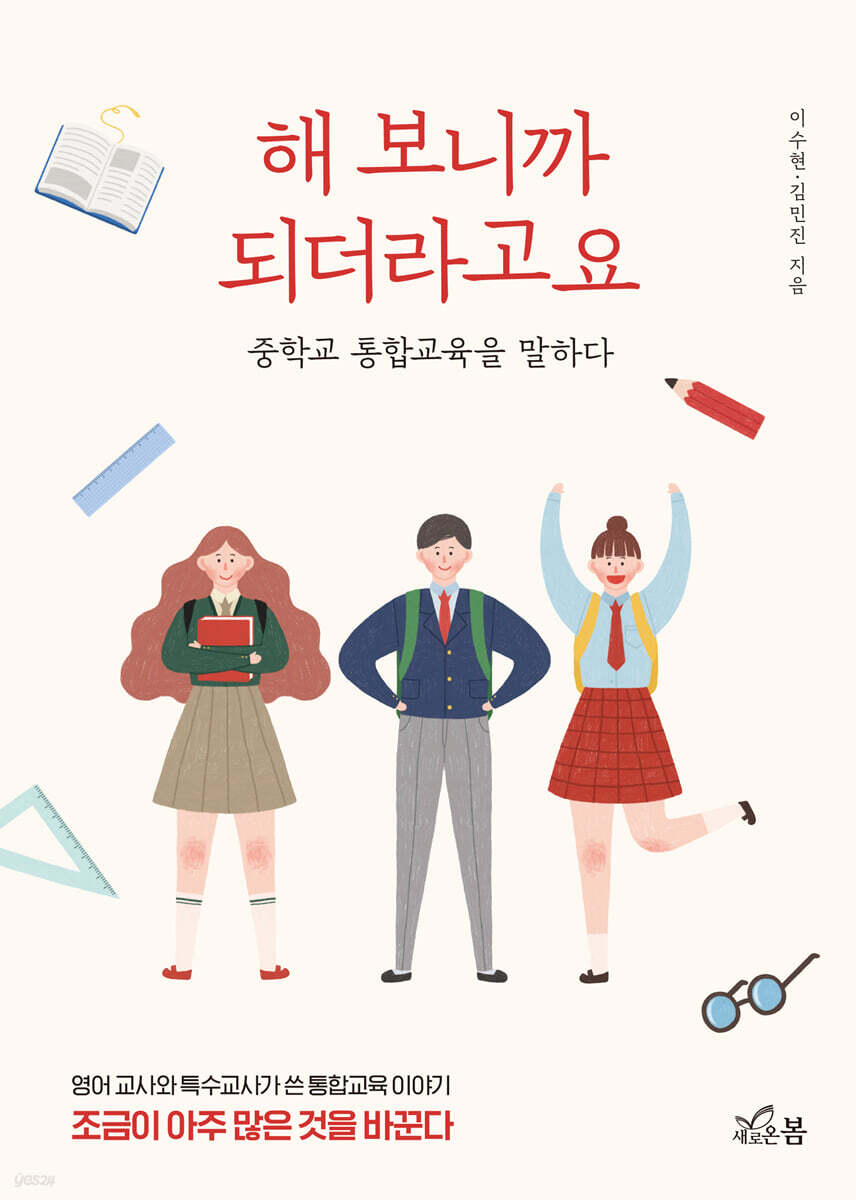
I tried it and it worked
 |
Description
Book Introduction
The first book to address integrated education in middle school. A story of how English and special education teachers approached integrated education from different perspectives.
This book is a series that follows “Talking about Special Education Teachers” and “Talking about Inclusive Education for Teachers.”
While the previous two books mainly addressed the reality, cases, and issues surrounding integrated education in elementary schools through the experiences of teachers, "It Worked When I Tried It" is a book that seeks to explore the reality, possibilities, and approaches to integrated education in secondary education.
Unlike elementary schools where one teacher is in charge of one class, starting in middle school, each subject teacher is responsible for the classroom and class.
There are bound to be many classes to attend and many students to form relationships with.
It is an environment where teachers may lack understanding and empathy for students with disabilities (special education students) in the classroom they are teaching.
As a result, many middle and high school teachers struggle with how to build relationships with students with disabilities, involve them in class, and properly build relationships and awareness with other students.
Inclusive education goes beyond simply dealing with students with disabilities; it comprehensively impacts the thoughts, behaviors, attitudes, values, and relationships of all students in the classroom.
The number of classes in domestic middle schools is 50,539 (2021 Education Statistics), and the number of students eligible for special education is 14,465 (2021 Special Education Statistics).
To put it simply, if one out of four classes has a student with special needs and a teacher teaches more than four classes, then almost all teachers are involved in inclusive education.
There was a need to resolve these realistic difficulties in integrated middle school education.
We sought to share thoughts on how to implement integrated education through the different experiences, approaches, and cases of general and special education teachers.
Part 1 explores how integrated education is possible for teachers and students, and how teachers and students grow through integrated education, through the experiences and attempts of an English teacher who teaches an integrated class from a general teacher's perspective.
Part 2 is a special education teacher's approach, sharing the insights and know-how gained from working as a special education teacher for over 10 years and challenging inclusive education beyond special education.
Most teachers treat their students with good intentions.
I stand before the podium hoping that my disciples will grow into better and greater people.
However, there are specific difficulties in integrated education that are encountered in reality.
For such teachers, the experiences and thoughts of these two teachers will provide inspiration and clues for understanding students with special needs and practicing inclusive education.
Although the two teachers' approaches start from different directions, their conclusions are similar.
If teachers change their perspective a little and put in some love, good inclusive education is possible.
It's not easy, but it can be done.
A little bit from a teacher can make a huge difference.
This book is a series that follows “Talking about Special Education Teachers” and “Talking about Inclusive Education for Teachers.”
While the previous two books mainly addressed the reality, cases, and issues surrounding integrated education in elementary schools through the experiences of teachers, "It Worked When I Tried It" is a book that seeks to explore the reality, possibilities, and approaches to integrated education in secondary education.
Unlike elementary schools where one teacher is in charge of one class, starting in middle school, each subject teacher is responsible for the classroom and class.
There are bound to be many classes to attend and many students to form relationships with.
It is an environment where teachers may lack understanding and empathy for students with disabilities (special education students) in the classroom they are teaching.
As a result, many middle and high school teachers struggle with how to build relationships with students with disabilities, involve them in class, and properly build relationships and awareness with other students.
Inclusive education goes beyond simply dealing with students with disabilities; it comprehensively impacts the thoughts, behaviors, attitudes, values, and relationships of all students in the classroom.
The number of classes in domestic middle schools is 50,539 (2021 Education Statistics), and the number of students eligible for special education is 14,465 (2021 Special Education Statistics).
To put it simply, if one out of four classes has a student with special needs and a teacher teaches more than four classes, then almost all teachers are involved in inclusive education.
There was a need to resolve these realistic difficulties in integrated middle school education.
We sought to share thoughts on how to implement integrated education through the different experiences, approaches, and cases of general and special education teachers.
Part 1 explores how integrated education is possible for teachers and students, and how teachers and students grow through integrated education, through the experiences and attempts of an English teacher who teaches an integrated class from a general teacher's perspective.
Part 2 is a special education teacher's approach, sharing the insights and know-how gained from working as a special education teacher for over 10 years and challenging inclusive education beyond special education.
Most teachers treat their students with good intentions.
I stand before the podium hoping that my disciples will grow into better and greater people.
However, there are specific difficulties in integrated education that are encountered in reality.
For such teachers, the experiences and thoughts of these two teachers will provide inspiration and clues for understanding students with special needs and practicing inclusive education.
Although the two teachers' approaches start from different directions, their conclusions are similar.
If teachers change their perspective a little and put in some love, good inclusive education is possible.
It's not easy, but it can be done.
A little bit from a teacher can make a huge difference.
- You can preview some of the book's contents.
Preview
index
Recommendation
Planning article
Part 1.
I tried it and it worked!
1.
Integrated education in middle school
2.
Please take care of the teacher
3.
A school I don't want to send my child to
4.
Teacher, Jinhyuk does this too
5.
If I do my best, please let me get full marks.
6.
Shouldn't I go to a special unit?
7.
Children who exist but do not exist
8.
Be my bridge
9.
How do you run an integrated class?
10.
I tried it and it worked!
11.
Isn't this reverse discrimination?
12.
Please write it like this in the bio
13.
Are disabilities overcome?
14.
It's a secret that I'm in a special unit.
15.
If my child goes to middle school
Part 2.
What the heck is this!
1.
Exclusion happens indirectly.
2.
Just lay down a mat
3.
It was better together
4.
fair evaluation
5.
How about an integrated club?
6.
A kind and firm teacher
7.
A safe zone for everyone
8.
Disability awareness education that highlights disabilities
9.
Your disability doesn't explain everything about you!
10.
Even if you can't see it right now
11.
Rain that falls together
12.
You and I both need encouragement.
13.
The Power of Class Meetings
14.
As we say
Planning article
Part 1.
I tried it and it worked!
1.
Integrated education in middle school
2.
Please take care of the teacher
3.
A school I don't want to send my child to
4.
Teacher, Jinhyuk does this too
5.
If I do my best, please let me get full marks.
6.
Shouldn't I go to a special unit?
7.
Children who exist but do not exist
8.
Be my bridge
9.
How do you run an integrated class?
10.
I tried it and it worked!
11.
Isn't this reverse discrimination?
12.
Please write it like this in the bio
13.
Are disabilities overcome?
14.
It's a secret that I'm in a special unit.
15.
If my child goes to middle school
Part 2.
What the heck is this!
1.
Exclusion happens indirectly.
2.
Just lay down a mat
3.
It was better together
4.
fair evaluation
5.
How about an integrated club?
6.
A kind and firm teacher
7.
A safe zone for everyone
8.
Disability awareness education that highlights disabilities
9.
Your disability doesn't explain everything about you!
10.
Even if you can't see it right now
11.
Rain that falls together
12.
You and I both need encouragement.
13.
The Power of Class Meetings
14.
As we say
Into the book
In my experience, good inclusive education isn't easy, but it's not difficult either.
My imagination was sparked as I tried to find ways for all students to participate in a fun way.
A little bit of joyful imagination becomes a great engine that creates a virtuous cycle of new attempts and challenges.
--- p.25
I think it was more difficult because I, as the homeroom teacher, thought I had to manage the integrated class by myself.
But there were people who helped me overcome my shortcomings and immaturity.
Looking back, the biggest helpers in running my integrated classroom were the children in my class.
--- p.36
Usually, it is assumed that students with special education needs will learn in special classes.
I don't even think about trying to learn in an integrated class because I think it would be too difficult.
I think it's fortunate that I can just sit in my seat and not disrupt class.
But if you think about it, isn't it more difficult to just sit there for 45 minutes and do nothing? During class, students work according to the teacher's instructions.
If the teacher doesn't give you what you can do, won't you just have to sit there and do nothing?
--- p.52
A significant number of learners who are slow learners for various reasons are destined to fail in the current average-oriented education system.
Without considering the unique characteristics and learning speed of each individual, they are simply judged by the average, and if they fail to reach the average, they are branded as inferior, so they cannot help but become helpless in the face of repeated failures.
This is why there are countless children who go home after sitting on a chair all day without even opening their textbooks.
--- p.54
An atmosphere that embraces those who are most challenged will also have a positive impact on others who are struggling but have not yet shown it.
Because a fence is meant to keep everyone inside the fence safe.
Isn't this the value and direction of integrated education?
--- p.67
In my experience, half the success is achieved by simply adjusting the difficulty of the assignments and the amount of learning to suit the students' abilities.
Small successes have led me to continue designing classes that acknowledge and reflect the diversity and differences of my students.
It was there that I could feel the ‘reward’ of being a teacher.
--- p.72
As we all know, school is a place where individuals develop their knowledge, character, and social skills, as well as the qualities and attitudes they possess as citizens of a community.
In fact, culture and attitude are learned through various relationships with friends rather than being taught by teachers.
--- p.87
Isolating and excluding is the easiest option, but it should be the last option.
Because teachers' choices have a huge impact on students in general.
If teachers choose the easiest method of separation and exclusion in uncomfortable situations, students will take separation and exclusion for granted and behave accordingly.
--- p.146
Inclusive education is not simply about teaching understanding or knowledge about disabilities, but rather about teaching and learning the qualities and attitudes of a citizen living together in society.
--- p.146
In fact, an integrated environment is an environment where people live and learn together regardless of their disability, appearance, tastes, or origins.
--- p.191
People who lift me up when I'm down, people who give me more energy in my tough daily life, people who lead me to light in the darkness - these are my safe zone.
This kind of safe space is needed for all of us: adults, children, special education teachers, and general education teachers.
--- p.223
If regular teachers who meet regular students all the time put in 10 times more effort in their respective classes, each teacher's 10 will add up to an effect of more than 100.
This is why ‘disability awareness education’ in regular schools must be taught by general teachers, not special education teachers.
--- p.214
These encouragements will accumulate and become the strength to live with self-esteem despite the criticism and hatred you will encounter in the future.
And you will grow into a good adult who can naturally pass on the encouragement you have received to someone else who needs it.
--- p.247
If teachers just lay out the mats properly, the students will take care of the rest.
Isn't this truly integrated education?
My imagination was sparked as I tried to find ways for all students to participate in a fun way.
A little bit of joyful imagination becomes a great engine that creates a virtuous cycle of new attempts and challenges.
--- p.25
I think it was more difficult because I, as the homeroom teacher, thought I had to manage the integrated class by myself.
But there were people who helped me overcome my shortcomings and immaturity.
Looking back, the biggest helpers in running my integrated classroom were the children in my class.
--- p.36
Usually, it is assumed that students with special education needs will learn in special classes.
I don't even think about trying to learn in an integrated class because I think it would be too difficult.
I think it's fortunate that I can just sit in my seat and not disrupt class.
But if you think about it, isn't it more difficult to just sit there for 45 minutes and do nothing? During class, students work according to the teacher's instructions.
If the teacher doesn't give you what you can do, won't you just have to sit there and do nothing?
--- p.52
A significant number of learners who are slow learners for various reasons are destined to fail in the current average-oriented education system.
Without considering the unique characteristics and learning speed of each individual, they are simply judged by the average, and if they fail to reach the average, they are branded as inferior, so they cannot help but become helpless in the face of repeated failures.
This is why there are countless children who go home after sitting on a chair all day without even opening their textbooks.
--- p.54
An atmosphere that embraces those who are most challenged will also have a positive impact on others who are struggling but have not yet shown it.
Because a fence is meant to keep everyone inside the fence safe.
Isn't this the value and direction of integrated education?
--- p.67
In my experience, half the success is achieved by simply adjusting the difficulty of the assignments and the amount of learning to suit the students' abilities.
Small successes have led me to continue designing classes that acknowledge and reflect the diversity and differences of my students.
It was there that I could feel the ‘reward’ of being a teacher.
--- p.72
As we all know, school is a place where individuals develop their knowledge, character, and social skills, as well as the qualities and attitudes they possess as citizens of a community.
In fact, culture and attitude are learned through various relationships with friends rather than being taught by teachers.
--- p.87
Isolating and excluding is the easiest option, but it should be the last option.
Because teachers' choices have a huge impact on students in general.
If teachers choose the easiest method of separation and exclusion in uncomfortable situations, students will take separation and exclusion for granted and behave accordingly.
--- p.146
Inclusive education is not simply about teaching understanding or knowledge about disabilities, but rather about teaching and learning the qualities and attitudes of a citizen living together in society.
--- p.146
In fact, an integrated environment is an environment where people live and learn together regardless of their disability, appearance, tastes, or origins.
--- p.191
People who lift me up when I'm down, people who give me more energy in my tough daily life, people who lead me to light in the darkness - these are my safe zone.
This kind of safe space is needed for all of us: adults, children, special education teachers, and general education teachers.
--- p.223
If regular teachers who meet regular students all the time put in 10 times more effort in their respective classes, each teacher's 10 will add up to an effect of more than 100.
This is why ‘disability awareness education’ in regular schools must be taught by general teachers, not special education teachers.
--- p.214
These encouragements will accumulate and become the strength to live with self-esteem despite the criticism and hatred you will encounter in the future.
And you will grow into a good adult who can naturally pass on the encouragement you have received to someone else who needs it.
--- p.247
If teachers just lay out the mats properly, the students will take care of the rest.
Isn't this truly integrated education?
--- p.299
Publisher's Review
Hope still lies in education and teachers!
Our education system emphasizes self-directedness, creativity and innovation, inclusiveness, and citizenship as the core competencies and human qualities that it pursues in preparation for the future society (2022 Revised Curriculum Overview).
The elements of inclusion and citizenship include consideration, communication, cooperation, empathy, and a sense of community.
All of this is in line with the principles of disability awareness, respect for diversity, disability awareness, universal design, learning-centeredness, global citizenship, democracy, and non-discrimination.
These are values that are considered very important for modern education and future society.
In reality, the place where these values are concentrated can be seen as an 'integrated classroom (education)'.
How does inclusive education work in practice, and how are values like citizenship instilled in students? Unlike elementary schools, where students learn the basics of citizenship, what does inclusive education look like in middle and high schools, where intellectual growth is more emphasized?
Although many teachers are putting forth their best efforts and good intentions, the reality is that they still face many difficulties.
The comprehensive impact is due to factors such as being caught up in class and curriculum progress, lack of understanding of students with disabilities (special education students), and lack of approaches and solutions to inclusive education.
As a result, the consideration and good intentions of teachers toward students with disabilities (special education students) can easily lead to separation or exclusion regardless of the students' wishes.
So this book is one that helps ensure that good intentions are properly realized in the classroom.
How is inclusive education possible for all teachers encountering students with disabilities (special education students) in middle school classrooms? Where and how should we begin? What are the best perspectives and approaches? This book offers a glimpse into the evolution of case studies and ideas, allowing us to reflect together.
As a homeroom teacher in a regular classroom or as a teacher teaching a specific subject, you can look at both the approach of meeting students with disabilities and creating inclusive education, and the approach of a special education teacher expanding inclusive education beyond special classes/education to the entire school.
This book will serve as a valuable reference for teachers who love their students, teachers who seek to develop character beyond textbook knowledge, teachers who seek to cultivate a better perspective on society and culture for the future, and teachers who teach students the rights, duties, qualities, and attitudes they need to become leaders of future society and citizens of their communities.
The possibility of a good society still lies with teachers.
Our education system emphasizes self-directedness, creativity and innovation, inclusiveness, and citizenship as the core competencies and human qualities that it pursues in preparation for the future society (2022 Revised Curriculum Overview).
The elements of inclusion and citizenship include consideration, communication, cooperation, empathy, and a sense of community.
All of this is in line with the principles of disability awareness, respect for diversity, disability awareness, universal design, learning-centeredness, global citizenship, democracy, and non-discrimination.
These are values that are considered very important for modern education and future society.
In reality, the place where these values are concentrated can be seen as an 'integrated classroom (education)'.
How does inclusive education work in practice, and how are values like citizenship instilled in students? Unlike elementary schools, where students learn the basics of citizenship, what does inclusive education look like in middle and high schools, where intellectual growth is more emphasized?
Although many teachers are putting forth their best efforts and good intentions, the reality is that they still face many difficulties.
The comprehensive impact is due to factors such as being caught up in class and curriculum progress, lack of understanding of students with disabilities (special education students), and lack of approaches and solutions to inclusive education.
As a result, the consideration and good intentions of teachers toward students with disabilities (special education students) can easily lead to separation or exclusion regardless of the students' wishes.
So this book is one that helps ensure that good intentions are properly realized in the classroom.
How is inclusive education possible for all teachers encountering students with disabilities (special education students) in middle school classrooms? Where and how should we begin? What are the best perspectives and approaches? This book offers a glimpse into the evolution of case studies and ideas, allowing us to reflect together.
As a homeroom teacher in a regular classroom or as a teacher teaching a specific subject, you can look at both the approach of meeting students with disabilities and creating inclusive education, and the approach of a special education teacher expanding inclusive education beyond special classes/education to the entire school.
This book will serve as a valuable reference for teachers who love their students, teachers who seek to develop character beyond textbook knowledge, teachers who seek to cultivate a better perspective on society and culture for the future, and teachers who teach students the rights, duties, qualities, and attitudes they need to become leaders of future society and citizens of their communities.
The possibility of a good society still lies with teachers.
GOODS SPECIFICS
- Date of issue: May 31, 2022
- Page count, weight, size: 304 pages | 150*210*30mm
- ISBN13: 9791197458545
- ISBN10: 1197458549
You may also like
카테고리
korean


korean

![GQ KOREA Mark (Monthly): December [2025]](http://librairie.coreenne.fr/cdn/shop/files/8ef265dbbfbf186523ed75ba7319009d.jpg?v=1765340328&width=3840)


