

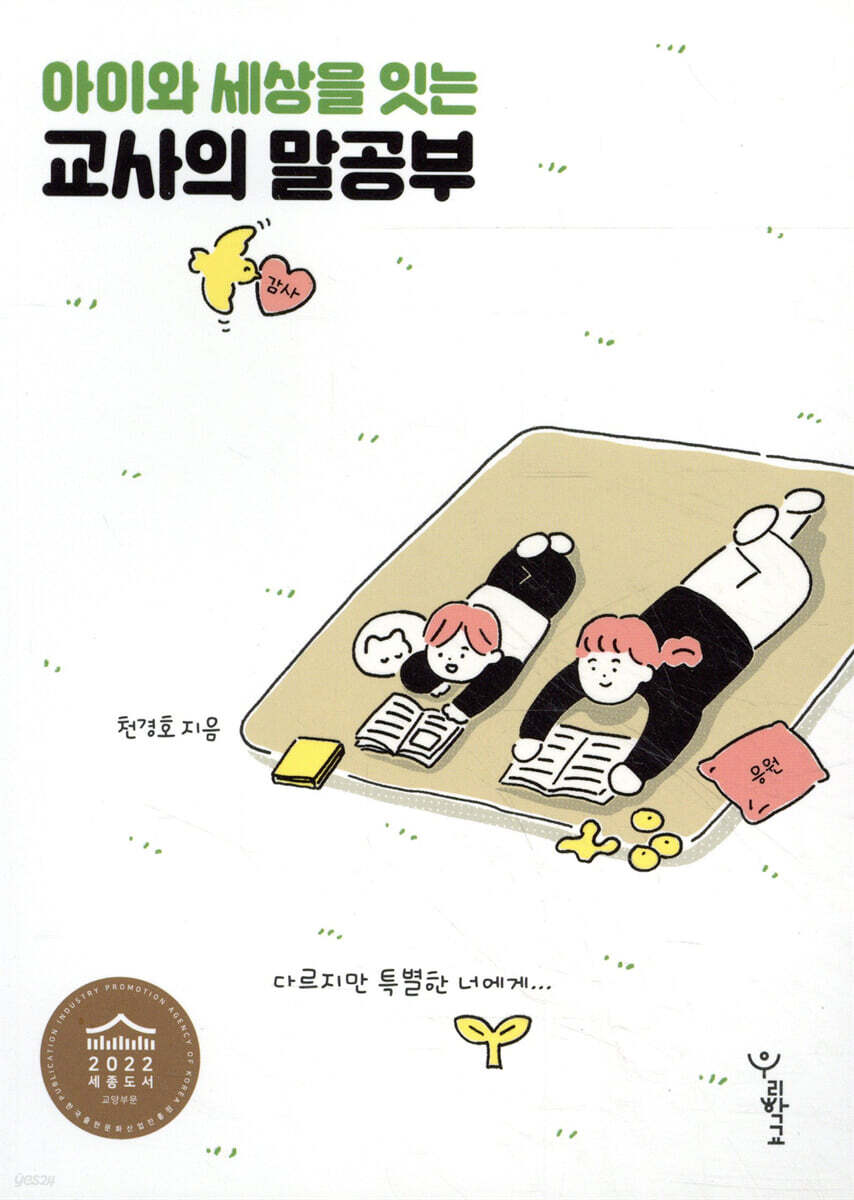
A teacher's study of language that connects children and the world
 |
Description
Book Introduction
“I don’t want to be in the same class as him.” “Why are there so many weird adults?” “Aren’t boys being discriminated against?” “They make fun of me for not having a mom.”… … The thoughts and situations of children in the classroom are all different.
From simple questions to unexpected remarks, countless 'words' are constantly exchanged between teachers and children.
It is also essential to share conversations not only with children but also with parents and fellow teachers.
The world and society change so rapidly, and various questions, conflicts, misunderstandings, and lack of communication constantly permeate schools, classrooms, and children.
That's why teachers often get lost in the forest of conversations they have with children, parents, and fellow teachers.
Teacher Cheon Gyeong-ho's first book, "A Teacher's Study of Words that Connects Hearts," which is a record of conversations that gradually resolve these concerns, has become a hot topic of conversation since its publication, instantly capturing the hearts of numerous teachers.
The new book, "A Teacher's Language Study that Connects Children and the World," goes one step further than "The First Language Study."
By enriching the children's questions about the wider world and society beyond the classroom, and the colorful real-life stories shared with parents and fellow teachers, it has established itself as a "second story of language study" that supports all children's path to confidently stepping out into the world on their own.
This is a warm guide and song of encouragement for all fellow teachers who want to connect children with the wider world.
From simple questions to unexpected remarks, countless 'words' are constantly exchanged between teachers and children.
It is also essential to share conversations not only with children but also with parents and fellow teachers.
The world and society change so rapidly, and various questions, conflicts, misunderstandings, and lack of communication constantly permeate schools, classrooms, and children.
That's why teachers often get lost in the forest of conversations they have with children, parents, and fellow teachers.
Teacher Cheon Gyeong-ho's first book, "A Teacher's Study of Words that Connects Hearts," which is a record of conversations that gradually resolve these concerns, has become a hot topic of conversation since its publication, instantly capturing the hearts of numerous teachers.
The new book, "A Teacher's Language Study that Connects Children and the World," goes one step further than "The First Language Study."
By enriching the children's questions about the wider world and society beyond the classroom, and the colorful real-life stories shared with parents and fellow teachers, it has established itself as a "second story of language study" that supports all children's path to confidently stepping out into the world on their own.
This is a warm guide and song of encouragement for all fellow teachers who want to connect children with the wider world.
- You can preview some of the book's contents.
Preview
index
Prologue · Before a New Beginning ·
Part 1 To you who is living hard
What kind of person do you want to be? | Why didn't you look back? | Can you be someone who doesn't hit even when you're angry? | I don't want to be in the same class as him. | What should I do if my friends say they care? | Who should I lie to first? | Is the teacher my older brother? | You have to ask permission because you're close. | Forbid self-help.
If you don't say anything, no one will know | You're just a tease | Do you want to be remembered as the kid who's late or disruptive to class? | Remember friendship | Why it's more sad than angry | How to use group chats | A person who finds and cultivates their own good points
Part 2 To you who dreams of the world
Why do I have to write a shitpost every day? | Because you hate yourself | Why are there so many weird adults? | What makes you suffer? | Don't put yourself down | You know when you look cool? | We have human rights too | The true use of school and friends
My dad got a 70,000 won fine | What do you want to fill it with? | Why we teach violin | The teacher wanted to apologize | Talking is better than a gun | How can a working person be happier? | Why do you work so hard? | What children need as they go out into the world
Part 3: Different but special for you
I don't want to go to the special class | Why do only disabled people use the elevator? | Don't help me | Why is he dark? | Can I tell him that my last name has changed? | People tease me about not having a mom | I really want to go with him | Education about respect for human differences
Why is the man pink? | I'm glad he's a male teacher | After all, he's a woman! | Is it because he's a man? | Aren't men being discriminated against? | The age-old obstacle of fixed gender roles
Part 4 For you with children
Just letting it go is more harmful to the child | No matter what anyone says, the teacher is a student | Inclusive education is the future of education | Where on earth do you go during class time? | I teach my child | It's not the mother's fault | What is the teacher's job? | That's why we need to separate them | Does my child have ADHD? | Why won't you give me your cell phone number? | The father should apologize first | The world of children and the world of adults, the beginning of modeling
Why don't you scold them? | Because of the child who is lacking | Those who have learned how to live together and those who have not | The power to overcome the seemingly impossible integrated education | I'm bad at math | An honest answer | A child who listens well, an adult who listens well
Epilogue · Our space to grow into a self-confident person ·
Part 1 To you who is living hard
What kind of person do you want to be? | Why didn't you look back? | Can you be someone who doesn't hit even when you're angry? | I don't want to be in the same class as him. | What should I do if my friends say they care? | Who should I lie to first? | Is the teacher my older brother? | You have to ask permission because you're close. | Forbid self-help.
If you don't say anything, no one will know | You're just a tease | Do you want to be remembered as the kid who's late or disruptive to class? | Remember friendship | Why it's more sad than angry | How to use group chats | A person who finds and cultivates their own good points
Part 2 To you who dreams of the world
Why do I have to write a shitpost every day? | Because you hate yourself | Why are there so many weird adults? | What makes you suffer? | Don't put yourself down | You know when you look cool? | We have human rights too | The true use of school and friends
My dad got a 70,000 won fine | What do you want to fill it with? | Why we teach violin | The teacher wanted to apologize | Talking is better than a gun | How can a working person be happier? | Why do you work so hard? | What children need as they go out into the world
Part 3: Different but special for you
I don't want to go to the special class | Why do only disabled people use the elevator? | Don't help me | Why is he dark? | Can I tell him that my last name has changed? | People tease me about not having a mom | I really want to go with him | Education about respect for human differences
Why is the man pink? | I'm glad he's a male teacher | After all, he's a woman! | Is it because he's a man? | Aren't men being discriminated against? | The age-old obstacle of fixed gender roles
Part 4 For you with children
Just letting it go is more harmful to the child | No matter what anyone says, the teacher is a student | Inclusive education is the future of education | Where on earth do you go during class time? | I teach my child | It's not the mother's fault | What is the teacher's job? | That's why we need to separate them | Does my child have ADHD? | Why won't you give me your cell phone number? | The father should apologize first | The world of children and the world of adults, the beginning of modeling
Why don't you scold them? | Because of the child who is lacking | Those who have learned how to live together and those who have not | The power to overcome the seemingly impossible integrated education | I'm bad at math | An honest answer | A child who listens well, an adult who listens well
Epilogue · Our space to grow into a self-confident person ·
Detailed image

Into the book
I was curious.
Children's thoughts.
I asked because I was curious about what you were thinking.
There weren't many children who would speak their minds freely when asked.
I had to try to look into the children's minds here and there, moving forward one move at a time, like playing Go.
I tried to let the children choose rather than direct them, and I tried to ask them as fellow human beings rather than giving orders with my authority as a teacher.
I first tried to live the way I told my children, and I passed that effort on to them.
---From the "Prologue"
Every child wants to be a good person.
Children get angry when their mistakes are pointed out, and they get enraged when their wrongdoings are exposed.
If you ask, “Are you a swearer?” while swearing, they get angry, and if you ask, “Are you a harasser?” while harassing someone, they get excited.
Even children who treat others rudely will be happy when others point out what they did well, and will open their hearts when others recognize their efforts.
---From "Part 1: Ban Self-help"
There were two promises I made to myself that I was determined to keep once I became a teacher.
It involved one-on-one conversations and handwriting letters to each child in the class.
To keep my promise to myself, I have been talking to my children and writing letters expressing my heart to them.
No special talent was required.
All I had to do was put in extra effort to convey my hope that he would grow into a better person than someone like me.
---From "Part 1: People Who Find and Develop Their Own Good Points"
Just as small dust particles gradually accumulate and become fossils, children gradually solidify their own identities.
Isn't it true that we live together in the classroom, year after year, with friends and teachers, watching over each other, comforting, supporting, and encouraging each other for so long? I believe that's the true purpose of school and friendship.
---From "Part 2: The True Use of School and Friends"
How can we raise our children to be questioners, adults who know how to admit mistakes and apologize, and mature citizens who don't build their happiness on the misfortunes of others? To understand ourselves and society from the perspectives of others, we must listen to the voices of people from different eras, countries, and social classes.
You have to listen to that voice, think about it, and express it in your own words.
We must delve deeply into the contradictions of the world that make no sense.
Before comparing yourself to others and lowering yourself and falling into apathy, you should learn to be grateful that others exist and allow you to see yourself in their light.
---From "What Children Need to Go Out into the World Part 2"
Wouldn't it be possible if, from a young age, we cultivate the belief that we can transcend diverse differences, wholeheartedly understand and empathize with one another, and live together in harmony, growing together as members of society? Especially in the school setting, wouldn't it be possible if we gradually overcome the mountains of misunderstanding and conflict that arise among peers from different classes and cultures? "I don't know much about you.
So, I think this is why we need to listen to each other's hearts with the mindset of 'I want to know.'
Because there is a person right in front of us.
---From “Part 3: Education on Respect for Human Differences”
Every child is different.
The inherent bias toward fixed gender roles is a barrier that limits the potential for all children to fully develop their talents.
We must recognize this and expose and tear down the invisible walls of gender roles within us.
The direction our education should take is to ensure that every child acknowledges, supports, and encourages each other's existence without exception, and lives a life that is truly their own.
---From "The Old Obstacle of Fixed Gender Roles"
I realized anew that children view their friends the same way their parents view school, and that children view the world the same way their parents view the world.
Watching the children taught me something.
When parents live their parents' lives, their children also live their children's lives properly.
---From "Part 4: The World of Children and the World of Adults, the Beginning of Modeling"
In 『Studying Language that Connects Children and the World』, we have included more of our colorful and intense real-life stories shared with students, parents, and teachers.
I hope this book will connect hearts and serve as a foundation for all children to confidently venture out into the world.
I will become a teacher who works even harder for the children in front of me and with them.
Thank you.
Children's thoughts.
I asked because I was curious about what you were thinking.
There weren't many children who would speak their minds freely when asked.
I had to try to look into the children's minds here and there, moving forward one move at a time, like playing Go.
I tried to let the children choose rather than direct them, and I tried to ask them as fellow human beings rather than giving orders with my authority as a teacher.
I first tried to live the way I told my children, and I passed that effort on to them.
---From the "Prologue"
Every child wants to be a good person.
Children get angry when their mistakes are pointed out, and they get enraged when their wrongdoings are exposed.
If you ask, “Are you a swearer?” while swearing, they get angry, and if you ask, “Are you a harasser?” while harassing someone, they get excited.
Even children who treat others rudely will be happy when others point out what they did well, and will open their hearts when others recognize their efforts.
---From "Part 1: Ban Self-help"
There were two promises I made to myself that I was determined to keep once I became a teacher.
It involved one-on-one conversations and handwriting letters to each child in the class.
To keep my promise to myself, I have been talking to my children and writing letters expressing my heart to them.
No special talent was required.
All I had to do was put in extra effort to convey my hope that he would grow into a better person than someone like me.
---From "Part 1: People Who Find and Develop Their Own Good Points"
Just as small dust particles gradually accumulate and become fossils, children gradually solidify their own identities.
Isn't it true that we live together in the classroom, year after year, with friends and teachers, watching over each other, comforting, supporting, and encouraging each other for so long? I believe that's the true purpose of school and friendship.
---From "Part 2: The True Use of School and Friends"
How can we raise our children to be questioners, adults who know how to admit mistakes and apologize, and mature citizens who don't build their happiness on the misfortunes of others? To understand ourselves and society from the perspectives of others, we must listen to the voices of people from different eras, countries, and social classes.
You have to listen to that voice, think about it, and express it in your own words.
We must delve deeply into the contradictions of the world that make no sense.
Before comparing yourself to others and lowering yourself and falling into apathy, you should learn to be grateful that others exist and allow you to see yourself in their light.
---From "What Children Need to Go Out into the World Part 2"
Wouldn't it be possible if, from a young age, we cultivate the belief that we can transcend diverse differences, wholeheartedly understand and empathize with one another, and live together in harmony, growing together as members of society? Especially in the school setting, wouldn't it be possible if we gradually overcome the mountains of misunderstanding and conflict that arise among peers from different classes and cultures? "I don't know much about you.
So, I think this is why we need to listen to each other's hearts with the mindset of 'I want to know.'
Because there is a person right in front of us.
---From “Part 3: Education on Respect for Human Differences”
Every child is different.
The inherent bias toward fixed gender roles is a barrier that limits the potential for all children to fully develop their talents.
We must recognize this and expose and tear down the invisible walls of gender roles within us.
The direction our education should take is to ensure that every child acknowledges, supports, and encourages each other's existence without exception, and lives a life that is truly their own.
---From "The Old Obstacle of Fixed Gender Roles"
I realized anew that children view their friends the same way their parents view school, and that children view the world the same way their parents view the world.
Watching the children taught me something.
When parents live their parents' lives, their children also live their children's lives properly.
---From "Part 4: The World of Children and the World of Adults, the Beginning of Modeling"
In 『Studying Language that Connects Children and the World』, we have included more of our colorful and intense real-life stories shared with students, parents, and teachers.
I hope this book will connect hearts and serve as a foundation for all children to confidently venture out into the world.
I will become a teacher who works even harder for the children in front of me and with them.
Thank you.
---From the "Epilogue"
Publisher's Review
To the children who are now going out into the wider world
I ask again today
Schools and classrooms are spaces where children from a very diverse spectrum gather.
The previous book, "A Teacher's Study of Words that Connects Hearts," is a compilation of scenes from conversations between teachers like Cheon Gyeong-ho, who spends his days interacting with children at elementary schools, and children.
The conversations and thoughts in this book focus on understanding children, guiding them to develop the ability to solve problems on their own, and holding their hand when they feel like giving up.
This book, which is a story about a teacher's 'study of speaking' and a teacher's basic 'attitude', became a hot topic in schools in an instant and captured the hearts of teachers who had been struggling with the same concerns.
The reactions of students who encountered the dialogue in this book were also enthusiastic.
The new book, "A Teacher's Language Study that Connects Children and the World," goes beyond "the first language study" and takes a step into a wider world.
This is the 'Second Story of Language Study', which enriches children's questions about our world and society and the colorful real-life stories they share with their parents and fellow teachers, and supports all children's path to confidently stepping out into the world on their own.
Sometimes I ask questions to children who encounter other beings.
Sometimes, I stand up with the children who are cowering.
Moments of affectionate and deep conversation that connect hearts and children with the world.
Part 1, 'To You Who Live Hard', continues the legacy of the previous work and focuses on the children in classrooms and schools where teachers spend the most time.
We ask children who are concerned about their friendships, tardiness, class disruption, and daily habits questions in reverse, listen to them, and work together to find answers.
Above all, we take great care to listen to the child's heart first, and explore with the child what the trigger point of the conflict is.
In the process, we help children examine their own minds, unravel their own words and actions, and help children understand each other.
In other words, it shows that the method of being curious about, listening to, and respecting children's thoughts is itself a solution for the classroom and a basic attitude for teachers.
Ultimately, the foundation of a classroom is that teachers are people who understand the hearts and minds of children, who extend a helping hand of understanding and empathy, and who help children grow.
Part 2, 'To You Who Dream of the World', looked back on the process of raising self-esteem and values, thinking, dreaming, working, and studying through conversations with children.
It also shows the importance of children having the opportunity to express and reflect on their daily thoughts through speech and writing.
This process gradually and firmly establishes the children's identity.
Living together with friends and teachers in a classroom is a meaningful process of watching over, comforting, supporting, and encouraging one another.
This is the true use of school and friends.
We can now reaffirm that teachers are there to prepare and support the growth of children who will soon leave the classroom and go out into the wider world.
That is why the universe called the classroom is so precious.
Part 3, “To You, Different but Special,” and Part 4, “To You with Children,” are the core themes that this book truly wants to share.
“Why is he dark?” “They tease him for not having a mom.” “Why is the boy pink?” “It’s a good thing the teacher is a man.” “Why don’t you scold him?” “That’s why you have to separate him.”… … The classroom is already a microcosm of society.
It is natural that teachers and students, teachers and parents, and teachers and teachers do not understand each other when they meet for the first time every March.
Because people from diverse backgrounds and with diverse perspectives are gathered in one space, conflict is unavoidable.
But in the process, we also witness and create together the shining growth of our children.
For a long time, schools have strived to teach tolerance and respect for diversity, transcending individual, cultural, and gender differences through integrated education, multicultural education, gender equality education, and human rights education.
Why should schools teach tolerance and respect for diversity across differences?
Quoting a philosopher who said, "Civilization is, above all, the will to coexist," the author emphasizes that true coexistence and respect are only possible when we accumulate experiences of understanding, empathizing, and living together with one another with all our hearts, with the belief that we can transcend various differences from a young age.
That is why the process of overcoming the mountains of misunderstandings and conflicts experienced by peers from different classes and cultures, especially in a school setting, is so important.
'I don't know much about you.
This is why we must listen to each other's hearts with the mindset of 'I want to know'.
The author says that this is because there are people right in front of us.
Prejudice, hatred, exclusion, and segregation are no longer the problems of certain groups or regions.
Children learn about the absurdity of conflict and exclusion in the world through the eyes of adults.
Even in elementary schools, the problems of misandry and misogyny, the separation and misunderstanding of special classes, disabled children, and normal children, class disparity, and violation of teachers' authority have already permeated the school environment.
Countless discriminatory views based on sex, gender, race, nationality, age, religion, etc., fixed gender roles, views and demands for separation of minority groups such as children with special needs, and sometimes demands from parents that threaten teachers' authority...
In such a situation, what should be the direction of a teacher's wise words and conversations? How should they interact with parents? How should teachers communicate with children who display sharp prejudices, not by issuing unconditional commands, but by fostering a perspective of understanding? Through a wealth of case studies, we can explore solutions together, gradually unraveling the myriad challenges faced in the classroom.
Sometimes we face reality, and sometimes we bow down before the wall of reality.
To all teachers,
Above all, a song of encouragement for all our children
All the dialogue scenes contained in "A Teacher's Study of Language Connecting Children and the World" are pieces that the author shared with fellow teachers on Facebook over a long period of time before publication, and which received much interest and sympathy.
In particular, through articles that have recently generated heated debate and reactions, I have attempted to reaffirm our reality, confront it head-on, and take the time to think again about the world we dream of for our children.
Above all, the reason I have courageously shared my perhaps embarrassing classroom stories through real classroom stories and school stories is because I hope that this will be a time for me to find out what stories I truly need to share with my children.
School is really important.
This book contains warm encouragement and courage for all teachers who dream of becoming teachers who are not good teachers, but who are simply trying hard.
I ask again today
Schools and classrooms are spaces where children from a very diverse spectrum gather.
The previous book, "A Teacher's Study of Words that Connects Hearts," is a compilation of scenes from conversations between teachers like Cheon Gyeong-ho, who spends his days interacting with children at elementary schools, and children.
The conversations and thoughts in this book focus on understanding children, guiding them to develop the ability to solve problems on their own, and holding their hand when they feel like giving up.
This book, which is a story about a teacher's 'study of speaking' and a teacher's basic 'attitude', became a hot topic in schools in an instant and captured the hearts of teachers who had been struggling with the same concerns.
The reactions of students who encountered the dialogue in this book were also enthusiastic.
The new book, "A Teacher's Language Study that Connects Children and the World," goes beyond "the first language study" and takes a step into a wider world.
This is the 'Second Story of Language Study', which enriches children's questions about our world and society and the colorful real-life stories they share with their parents and fellow teachers, and supports all children's path to confidently stepping out into the world on their own.
Sometimes I ask questions to children who encounter other beings.
Sometimes, I stand up with the children who are cowering.
Moments of affectionate and deep conversation that connect hearts and children with the world.
Part 1, 'To You Who Live Hard', continues the legacy of the previous work and focuses on the children in classrooms and schools where teachers spend the most time.
We ask children who are concerned about their friendships, tardiness, class disruption, and daily habits questions in reverse, listen to them, and work together to find answers.
Above all, we take great care to listen to the child's heart first, and explore with the child what the trigger point of the conflict is.
In the process, we help children examine their own minds, unravel their own words and actions, and help children understand each other.
In other words, it shows that the method of being curious about, listening to, and respecting children's thoughts is itself a solution for the classroom and a basic attitude for teachers.
Ultimately, the foundation of a classroom is that teachers are people who understand the hearts and minds of children, who extend a helping hand of understanding and empathy, and who help children grow.
Part 2, 'To You Who Dream of the World', looked back on the process of raising self-esteem and values, thinking, dreaming, working, and studying through conversations with children.
It also shows the importance of children having the opportunity to express and reflect on their daily thoughts through speech and writing.
This process gradually and firmly establishes the children's identity.
Living together with friends and teachers in a classroom is a meaningful process of watching over, comforting, supporting, and encouraging one another.
This is the true use of school and friends.
We can now reaffirm that teachers are there to prepare and support the growth of children who will soon leave the classroom and go out into the wider world.
That is why the universe called the classroom is so precious.
Part 3, “To You, Different but Special,” and Part 4, “To You with Children,” are the core themes that this book truly wants to share.
“Why is he dark?” “They tease him for not having a mom.” “Why is the boy pink?” “It’s a good thing the teacher is a man.” “Why don’t you scold him?” “That’s why you have to separate him.”… … The classroom is already a microcosm of society.
It is natural that teachers and students, teachers and parents, and teachers and teachers do not understand each other when they meet for the first time every March.
Because people from diverse backgrounds and with diverse perspectives are gathered in one space, conflict is unavoidable.
But in the process, we also witness and create together the shining growth of our children.
For a long time, schools have strived to teach tolerance and respect for diversity, transcending individual, cultural, and gender differences through integrated education, multicultural education, gender equality education, and human rights education.
Why should schools teach tolerance and respect for diversity across differences?
Quoting a philosopher who said, "Civilization is, above all, the will to coexist," the author emphasizes that true coexistence and respect are only possible when we accumulate experiences of understanding, empathizing, and living together with one another with all our hearts, with the belief that we can transcend various differences from a young age.
That is why the process of overcoming the mountains of misunderstandings and conflicts experienced by peers from different classes and cultures, especially in a school setting, is so important.
'I don't know much about you.
This is why we must listen to each other's hearts with the mindset of 'I want to know'.
The author says that this is because there are people right in front of us.
Prejudice, hatred, exclusion, and segregation are no longer the problems of certain groups or regions.
Children learn about the absurdity of conflict and exclusion in the world through the eyes of adults.
Even in elementary schools, the problems of misandry and misogyny, the separation and misunderstanding of special classes, disabled children, and normal children, class disparity, and violation of teachers' authority have already permeated the school environment.
Countless discriminatory views based on sex, gender, race, nationality, age, religion, etc., fixed gender roles, views and demands for separation of minority groups such as children with special needs, and sometimes demands from parents that threaten teachers' authority...
In such a situation, what should be the direction of a teacher's wise words and conversations? How should they interact with parents? How should teachers communicate with children who display sharp prejudices, not by issuing unconditional commands, but by fostering a perspective of understanding? Through a wealth of case studies, we can explore solutions together, gradually unraveling the myriad challenges faced in the classroom.
Sometimes we face reality, and sometimes we bow down before the wall of reality.
To all teachers,
Above all, a song of encouragement for all our children
All the dialogue scenes contained in "A Teacher's Study of Language Connecting Children and the World" are pieces that the author shared with fellow teachers on Facebook over a long period of time before publication, and which received much interest and sympathy.
In particular, through articles that have recently generated heated debate and reactions, I have attempted to reaffirm our reality, confront it head-on, and take the time to think again about the world we dream of for our children.
Above all, the reason I have courageously shared my perhaps embarrassing classroom stories through real classroom stories and school stories is because I hope that this will be a time for me to find out what stories I truly need to share with my children.
School is really important.
This book contains warm encouragement and courage for all teachers who dream of becoming teachers who are not good teachers, but who are simply trying hard.
GOODS SPECIFICS
- Publication date: December 23, 2021
- Page count, weight, size: 200 pages | 280g | 138*190*20mm
- ISBN13: 9791167550316
- ISBN10: 1167550315
You may also like
카테고리
korean


korean

![GQ KOREA Mark (Monthly): December [2025]](http://librairie.coreenne.fr/cdn/shop/files/8ef265dbbfbf186523ed75ba7319009d.jpg?v=1765340328&width=3840)


