

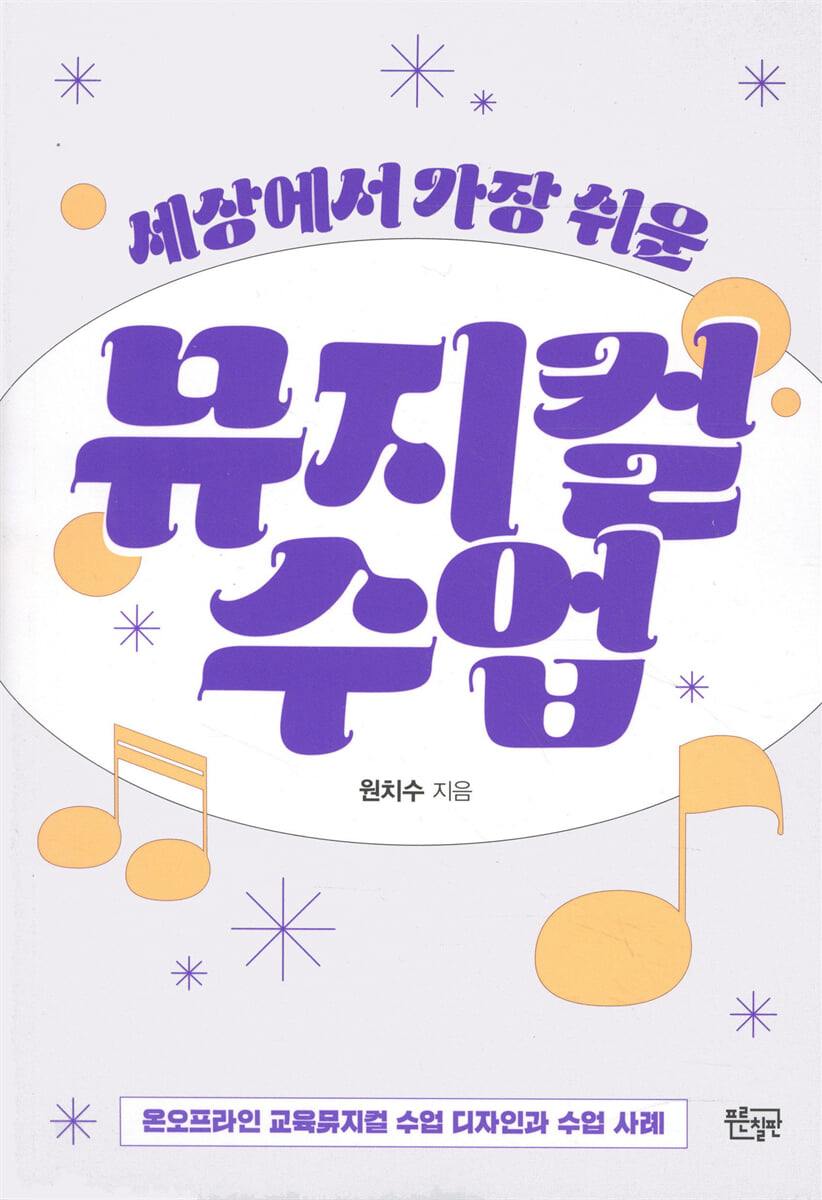
The world's easiest musical class
 |
Description
Book Introduction
For teachers who are new to educational musicals,
Everything you need to know about musical theater classes: appreciating, creating, and performing.
In schools, convergence education is now a common educational method that is no longer an option but a necessity.
Students who used to learn in segmented subjects such as Korean, math, and science are now participating in classes designed to integrate multiple subjects centered on topics such as human rights, the environment, and emotions.
To create a topic-centered lesson, you need to find achievement standards for multiple subjects that can cover the topic and put a lot of effort into connecting them.
The author of this book discovered the advantages of convergence education in 'musicals', which contain various artistic activities based on a single dramatic element.
And I thought about how diverse the charm of musicals, which encompass a variety of artistic activities, could be if they were combined with education.
"The World's Easiest Musical Lesson" is the second book in the "Living Arts Education in the Classroom" series, which tells the story of teachers and students growing together through art in school settings.
This book is a guide to 'educational musicals,' which are educational activities planned and implemented using musical elements to achieve various educational goals.
The author, who has been researching and practicing educational musicals for over ten years, says that through musicals, students can experience the joy of learning, gain self-understanding and expression, and even the ability to communicate with others.
And it introduces a realistic approach to integrating musicals into education in schools.
This book will serve as a valuable guide for establishing educational musicals as a fun educational activity that everyone can participate in, and as an alternative to future education that embraces student-centered learning and competency-based education.
Everything you need to know about musical theater classes: appreciating, creating, and performing.
In schools, convergence education is now a common educational method that is no longer an option but a necessity.
Students who used to learn in segmented subjects such as Korean, math, and science are now participating in classes designed to integrate multiple subjects centered on topics such as human rights, the environment, and emotions.
To create a topic-centered lesson, you need to find achievement standards for multiple subjects that can cover the topic and put a lot of effort into connecting them.
The author of this book discovered the advantages of convergence education in 'musicals', which contain various artistic activities based on a single dramatic element.
And I thought about how diverse the charm of musicals, which encompass a variety of artistic activities, could be if they were combined with education.
"The World's Easiest Musical Lesson" is the second book in the "Living Arts Education in the Classroom" series, which tells the story of teachers and students growing together through art in school settings.
This book is a guide to 'educational musicals,' which are educational activities planned and implemented using musical elements to achieve various educational goals.
The author, who has been researching and practicing educational musicals for over ten years, says that through musicals, students can experience the joy of learning, gain self-understanding and expression, and even the ability to communicate with others.
And it introduces a realistic approach to integrating musicals into education in schools.
This book will serve as a valuable guide for establishing educational musicals as a fun educational activity that everyone can participate in, and as an alternative to future education that embraces student-centered learning and competency-based education.
- You can preview some of the book's contents.
Preview
index
Prologue_ Story, Meeting an Art Friend
Chapter 1: Understanding Educational Musicals
Musicals through the lens of education
Easy to understand musicals
The Birth of a Musical Through Storytelling
How do musicals and education intersect?
Class curriculum and musical
Chapter 2: Why an Educational Musical?
Fusion for the sake of fusion? Musicals are inherently fusion.
Children, Become Masters of the Class
Teacher, put your own color on it
Musical: Becoming a Shared Culture
Musicals, Embracing Core Competencies
Chapter 3: Designing Educational Musical Lessons
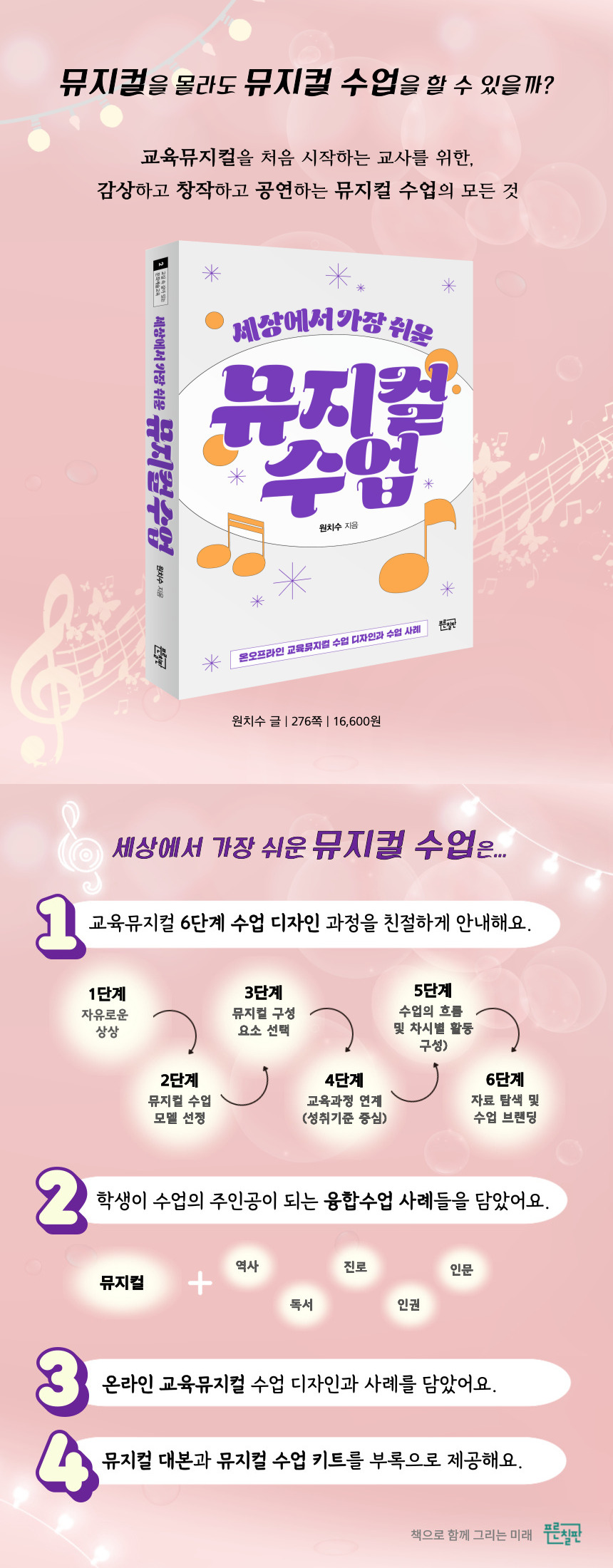
6-Step Educational Musical Lesson Design Process
Step 1: Free imagination
Step 2: Selecting an Educational Musical Class Model
Step 3: Selecting Educational Musical Components
Step 4: Curriculum Analysis and Linkage
Step 5: Flow of Educational Musical Classes and Activity Structure for Each Session
Step 6: Explore Materials and Brand Your Course
Chapter 4: Educational Musical Class Case Studies
Musical becomes a class
Case 1: Experience History Education Through Musical
Case 2: Reading Education: Deeper Reading Through Music
Case 3: Career Education: Dreaming Through Musicals
Case 4: Human Rights Education: Considering Musicals
Case 5: Humanities Education Meets Musical
Chapter 5: Educational Musicals Go Online
Can I take musical lessons online?
Designing an Online Educational Musical Class
Case 1: Curriculum-Linked Online and Offline Hybrid Musical Project Class
Case 2: Musical Club Online/Offline Hybrid Classes
Epilogue_ Curtain Call, a Time When Everyone Becomes a Main Character
Appendix 1: Musical script
Appendix 2: Teacher Chisu's Musical Lesson Kit
Chapter 1: Understanding Educational Musicals
Musicals through the lens of education
Easy to understand musicals
The Birth of a Musical Through Storytelling
How do musicals and education intersect?
Class curriculum and musical
Chapter 2: Why an Educational Musical?
Fusion for the sake of fusion? Musicals are inherently fusion.
Children, Become Masters of the Class
Teacher, put your own color on it
Musical: Becoming a Shared Culture
Musicals, Embracing Core Competencies
Chapter 3: Designing Educational Musical Lessons
6-Step Educational Musical Lesson Design Process
Step 1: Free imagination
Step 2: Selecting an Educational Musical Class Model
Step 3: Selecting Educational Musical Components
Step 4: Curriculum Analysis and Linkage
Step 5: Flow of Educational Musical Classes and Activity Structure for Each Session
Step 6: Explore Materials and Brand Your Course
Chapter 4: Educational Musical Class Case Studies
Musical becomes a class
Case 1: Experience History Education Through Musical
Case 2: Reading Education: Deeper Reading Through Music
Case 3: Career Education: Dreaming Through Musicals
Case 4: Human Rights Education: Considering Musicals
Case 5: Humanities Education Meets Musical
Chapter 5: Educational Musicals Go Online
Can I take musical lessons online?
Designing an Online Educational Musical Class
Case 1: Curriculum-Linked Online and Offline Hybrid Musical Project Class
Case 2: Musical Club Online/Offline Hybrid Classes
Epilogue_ Curtain Call, a Time When Everyone Becomes a Main Character
Appendix 1: Musical script
Appendix 2: Teacher Chisu's Musical Lesson Kit
Detailed image
Into the book
It doesn't matter if the teacher can't create stories, is tone-deaf, or has no rhythm, or dances like a robot.
Anyone can design an educational musical class if they can think about which elements of the musical's various components to include in class activities and how much to link to the curriculum.
Educational musical classes have diverse goals, and unless the project focuses on technical aspects such as students' singing, creativity, and choreographic abilities, the teacher's understanding of musical classes is more important than their musical skills.
--- From "How Musical and Education Meet"
In the process of conducting an educational musical class, the teacher's role is that of a planner and producer.
Of course, it also plays a role in guiding students.
It is the students' responsibility to explore themes and materials, create a story, select appropriate music, write lyrics, create choreography that matches the music, think of and prepare the necessary props and costumes, practice, and then present the work on stage.
If the purpose of the class is to put on a perfect musical performance, the teacher will have to work harder. However, if the purpose is to allow students to express what they have learned through educational musical activities, the teacher can guide the activities alone to make it a great educational musical class.
--- From "Children, Become the Masters of Class"
It seemed like doing educational musical activities online would be a complicated and difficult process, but in fact, there were many things I had to worry about when preparing for educational musical activities before.
If we look at the process of preparing an educational musical as an algorithm, it has a complex structure.
Thinking back now, it was a truly happy worry.
However, when I tried to draw up an algorithm to do online educational musical activities, it turned out to be much simpler than I thought.
"Should I do it or not?" The things that were daunting before I even started preparing were easily resolved when I chose "YES."
This algorithm will likely be equally applicable to the question of whether to do an educational musical online or not.
Of course, I recommend choosing 'YES'.
It's up to you to press the button.
Anyone can design an educational musical class if they can think about which elements of the musical's various components to include in class activities and how much to link to the curriculum.
Educational musical classes have diverse goals, and unless the project focuses on technical aspects such as students' singing, creativity, and choreographic abilities, the teacher's understanding of musical classes is more important than their musical skills.
--- From "How Musical and Education Meet"
In the process of conducting an educational musical class, the teacher's role is that of a planner and producer.
Of course, it also plays a role in guiding students.
It is the students' responsibility to explore themes and materials, create a story, select appropriate music, write lyrics, create choreography that matches the music, think of and prepare the necessary props and costumes, practice, and then present the work on stage.
If the purpose of the class is to put on a perfect musical performance, the teacher will have to work harder. However, if the purpose is to allow students to express what they have learned through educational musical activities, the teacher can guide the activities alone to make it a great educational musical class.
--- From "Children, Become the Masters of Class"
It seemed like doing educational musical activities online would be a complicated and difficult process, but in fact, there were many things I had to worry about when preparing for educational musical activities before.
If we look at the process of preparing an educational musical as an algorithm, it has a complex structure.
Thinking back now, it was a truly happy worry.
However, when I tried to draw up an algorithm to do online educational musical activities, it turned out to be much simpler than I thought.
"Should I do it or not?" The things that were daunting before I even started preparing were easily resolved when I chose "YES."
This algorithm will likely be equally applicable to the question of whether to do an educational musical online or not.
Of course, I recommend choosing 'YES'.
It's up to you to press the button.
--- From "Can I Take Musical Lessons Online?"
Publisher's Review
From designing a 6-step educational musical class to actual classes and performances!
A fusion class and educational musical that captures the growth of teachers and students.
Musicals are comprised of various activities, so they capture the diverse aspects of students and help establish themselves as a fun educational activity that everyone can participate in. However, on the other hand, this can also be a reason why teachers and students find musical classes burdensome.
This is because of the nature of musicals, which make you think about the outcome of the performance.
This book generously shares the author's extensive research and expertise, enabling even teachers who are new to musical education to easily get started, dreaming of student-centered classes.
The primary purpose of this book is to design educational musical lessons that can be fully implemented within class time, closely linked to school and classroom curricula.
First, we will introduce the main elements that make up a musical, such as story, music, acting, choreography, and stage design, to help students understand musicals. Based on this, we can take a big picture look at the process of how the curriculum and musicals meet to become classes.
We also discuss the process of selecting and assigning musical components according to the class environment and direction.
And, through a six-step educational musical class design process developed by analyzing musical education activities, we lead classes and performances.
Imagine freely, choose a suitable class model, select musical elements that fit the class, analyze and connect the curriculum, organize the flow of the musical class and activities for each class, and then explore materials to use in class to create a more complete musical class and intuitively brand your own class.
We also discuss online teaching tools and activities that can be utilized in non-face-to-face classes brought about by changes in the classroom environment.
Each course includes tips to help students become more actively involved in activities, along with a musical script and musical lesson kit as appendices. This book will play a significant role in creating a time of growth through passionate communication with students through musicals.
A fusion class and educational musical that captures the growth of teachers and students.
Musicals are comprised of various activities, so they capture the diverse aspects of students and help establish themselves as a fun educational activity that everyone can participate in. However, on the other hand, this can also be a reason why teachers and students find musical classes burdensome.
This is because of the nature of musicals, which make you think about the outcome of the performance.
This book generously shares the author's extensive research and expertise, enabling even teachers who are new to musical education to easily get started, dreaming of student-centered classes.
The primary purpose of this book is to design educational musical lessons that can be fully implemented within class time, closely linked to school and classroom curricula.
First, we will introduce the main elements that make up a musical, such as story, music, acting, choreography, and stage design, to help students understand musicals. Based on this, we can take a big picture look at the process of how the curriculum and musicals meet to become classes.
We also discuss the process of selecting and assigning musical components according to the class environment and direction.
And, through a six-step educational musical class design process developed by analyzing musical education activities, we lead classes and performances.
Imagine freely, choose a suitable class model, select musical elements that fit the class, analyze and connect the curriculum, organize the flow of the musical class and activities for each class, and then explore materials to use in class to create a more complete musical class and intuitively brand your own class.
We also discuss online teaching tools and activities that can be utilized in non-face-to-face classes brought about by changes in the classroom environment.
Each course includes tips to help students become more actively involved in activities, along with a musical script and musical lesson kit as appendices. This book will play a significant role in creating a time of growth through passionate communication with students through musicals.
GOODS SPECIFICS
- Date of issue: September 30, 2021
- Page count, weight, size: 276 pages | 444g | 148*210*16mm
- ISBN13: 9791191638035
- ISBN10: 1191638030
You may also like
카테고리
korean


korean

![GQ KOREA Mark (Monthly): December [2025]](http://librairie.coreenne.fr/cdn/shop/files/8ef265dbbfbf186523ed75ba7319009d.jpg?v=1765340328&width=3840)


