

Media Literacy Board Game Book
 |
Description
Book Introduction
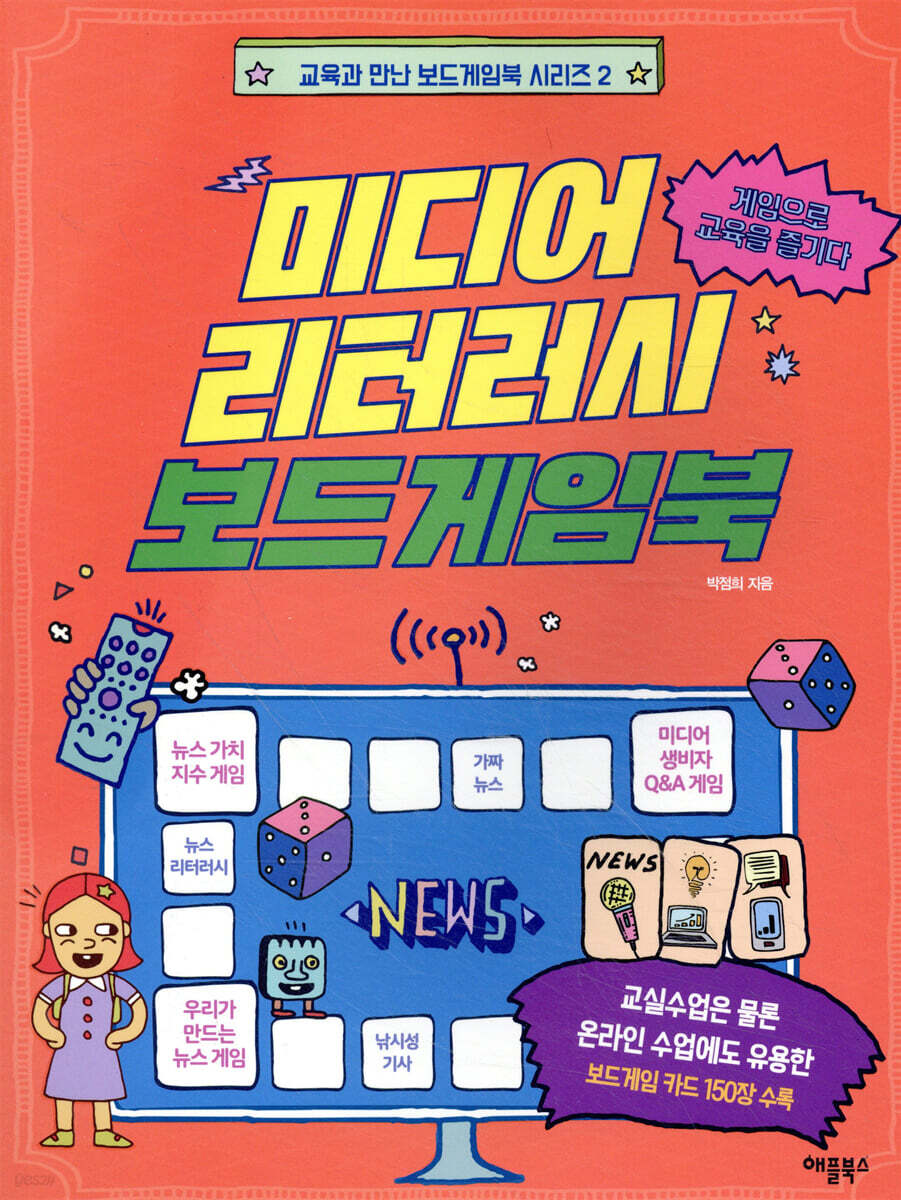
Misinformation, exaggerated advertising, and media overload. . . Develop proper media literacy skills with three board games! We live in an era where media production and consumption have become so commonplace that YouTuber is ranked as the number one preferred occupation among children. However, to properly understand and utilize the media overflowing through various channels, including misinformation and exaggerated advertising, it is necessary to have media literacy, the ability to think critically and select. Apple Books' new publication, "Media Literacy Board Game Book," is a book that allows students exposed to a variety of information to learn in a fun way through three board games how to properly accept media and think critically, how to select the right value standards for news, and what to keep in mind when producing news on their own. When media classes at school are taught on rigid topics like reading the news or interpreting information, most students fall asleep or have their minds wander. The students cannot be solely responsible for their lack of concentration in one-way teaching. Therefore, a teaching method that allows students to actively participate in class and easily understand the content is required. Author Park Jeom-hee, a media literacy education expert, draws on her extensive experience to address the concerns of frontline teachers and instructors. In this book, she introduces a method for developing media literacy skills by leveraging the strengths of board games so that students can simultaneously learn and have fun during class. |
- You can preview some of the book's contents.
Preview
index
Recommendation for this book
Prologue - Learning the Right Media World Through Games
Structure and Use of This Book
Chapter 1: Definition and Theory of Media Literacy
1.
What is media?
2.
Media Literacy in the Classroom
3.
Aiming for news and journalism
4.
Let the media and learners decide for themselves.
5.
Let's design classes with media and gamification.
6.
Is it possible to teach media literacy games online?
Chapter 2: Media Literacy Board Game
Media Visa Q&A Game
News Value Index Game
The news game we make
Activity materials
Media Visa Q&A Game Manual
Media Visa Q&A Card (24 sheets)
News Value Index Game Manual
News Value Index Cards (36 cards)
News Term Match Game Instructions
News Term Matching Cards (36 cards)
News Game Guide We Make
board
News Literacy Cards (54 cards)
dice, pieces
Card cover
Prologue - Learning the Right Media World Through Games
Structure and Use of This Book
Chapter 1: Definition and Theory of Media Literacy
1.
What is media?
2.
Media Literacy in the Classroom
3.
Aiming for news and journalism
4.
Let the media and learners decide for themselves.
5.
Let's design classes with media and gamification.
6.
Is it possible to teach media literacy games online?
Chapter 2: Media Literacy Board Game
Media Visa Q&A Game
News Value Index Game
The news game we make
Activity materials
Media Visa Q&A Game Manual
Media Visa Q&A Card (24 sheets)
News Value Index Game Manual
News Value Index Cards (36 cards)
News Term Match Game Instructions
News Term Matching Cards (36 cards)
News Game Guide We Make
board
News Literacy Cards (54 cards)
dice, pieces
Card cover
Detailed image

Into the book
We introduced games as a way to get children who hate reading newspapers to read naturally, and this method worked for them.
Since there is work to do and fun to be had during class time, naturally, the number of children sleeping has decreased.
Since then, I've been thinking about different types of board games that would be good to use in class.
We ran games ranging from simple match-making games to games students created and enjoyed themselves, and the students' responses were quite positive.
--- p.7, from “Prologue_ Learning the right media world while enjoying games”
Board games can also be used as a communication tool in online classes.
1.
You could also present a few Media Visa Q&A cards in an interactive lesson or online video and assign students to answer the questions on the cards as an assignment.
Students feel less pressure when assignments are presented in the form of a game.
2.
When conducting the News Value Index game during an interactive class, the teacher acts as the game facilitator, turns over five cards, and asks students to choose numbers.
If it is a class where you create and upload a video, students watch the teacher's play, write down the number, and submit their reasons for thinking that way through comments or other means.
At this time, it can be run as a telepathy quiz, such as a radio program.
3.
When playing News Term Match Interactively, you can easily play by randomly assigning numbers to the locations where the cards are placed or by assigning coordinate values.
If you're filming, you can just line up some matching cards with similar colors and have a game where you try to find the student who has made the most matching pairs.
--- p.11, from “The Structure and Use of This Book”
Students have heard the word "media" many times, but they use it without even knowing what it is or feeling the need to know.
Even when we are exposed to information about the positive and negative functions of media use, including critical thinking, we often do not understand what it means.
So, when providing media education, it is necessary to first understand what media is and what it applies to.
--- p.16, from “Chapter 1: Definition and Theory of Media Literacy”
By gamifying media classes, we can see the effects of getting children who don't read the newspaper to read it and reducing the number of children who doze off or sleep.
By simply borrowing the game's play techniques for education, we can achieve the effect of promoting learning and solving problems.
One common request from teachers requesting lessons is, “Please don’t let the kids sleep.”
In that sense, it can be said to be a successful teaching method.
--- p.28, from “Chapter 1: Definition and Theory of Media Literacy”
If the terminology isn't clear, try adding some rules like "card flipping" and "friend chance" to play the game.
'Flipping the card' can be effective in memorizing terms by directly reading and understanding the meaning of the value terms written on the back of the card.
A 'Friend Chance' is when a player nominates a friend and that friend explains the value term without looking at the card.
--- p.42, from “Chapter 2 _ Media Literacy Board Game”
In a class on understanding media, 'when selecting information to include in the media, we choose based on various values such as objectivity, interest, fame, novelty, influence, timeliness, and conflict.
Each value is briefly explained as 'meaningful in one respect'.
Learning to understand what the cards are saying will help you play the game more smoothly.
--- p.35~36, from “Chapter 2 _ Media Literacy Board Game”
The learner places each card on the floor so that it matches the other card and is visible.
After all the cards have been paired, the leader reads the blue letters and the learners check the black letters.
It's easy to find because it's colored.
Afterwards, the leader continues learning about journalism by providing additional explanations to the learners.
Afterwards, we will play the 'News Term Matching' game.
--- p.51, from “Chapter 2 _ Media Literacy Board Game”
Example of writing a life record book
ㆍIn the 'News Game We Create' activity, we learned about the principles of journalism and the role of the media, and critically explained problems that arise in the process of news creation using examples.
ㆍIn the 'News Game We Create' activity, we learned about the principles of journalism and explained that each media outlet may have different perspectives in the process of creating news.
ㆍUnderstand the principles of journalism in the 'News Game We Create' activity and understand why, as a consumer, you should strive to read critically.
Since there is work to do and fun to be had during class time, naturally, the number of children sleeping has decreased.
Since then, I've been thinking about different types of board games that would be good to use in class.
We ran games ranging from simple match-making games to games students created and enjoyed themselves, and the students' responses were quite positive.
--- p.7, from “Prologue_ Learning the right media world while enjoying games”
Board games can also be used as a communication tool in online classes.
1.
You could also present a few Media Visa Q&A cards in an interactive lesson or online video and assign students to answer the questions on the cards as an assignment.
Students feel less pressure when assignments are presented in the form of a game.
2.
When conducting the News Value Index game during an interactive class, the teacher acts as the game facilitator, turns over five cards, and asks students to choose numbers.
If it is a class where you create and upload a video, students watch the teacher's play, write down the number, and submit their reasons for thinking that way through comments or other means.
At this time, it can be run as a telepathy quiz, such as a radio program.
3.
When playing News Term Match Interactively, you can easily play by randomly assigning numbers to the locations where the cards are placed or by assigning coordinate values.
If you're filming, you can just line up some matching cards with similar colors and have a game where you try to find the student who has made the most matching pairs.
--- p.11, from “The Structure and Use of This Book”
Students have heard the word "media" many times, but they use it without even knowing what it is or feeling the need to know.
Even when we are exposed to information about the positive and negative functions of media use, including critical thinking, we often do not understand what it means.
So, when providing media education, it is necessary to first understand what media is and what it applies to.
--- p.16, from “Chapter 1: Definition and Theory of Media Literacy”
By gamifying media classes, we can see the effects of getting children who don't read the newspaper to read it and reducing the number of children who doze off or sleep.
By simply borrowing the game's play techniques for education, we can achieve the effect of promoting learning and solving problems.
One common request from teachers requesting lessons is, “Please don’t let the kids sleep.”
In that sense, it can be said to be a successful teaching method.
--- p.28, from “Chapter 1: Definition and Theory of Media Literacy”
If the terminology isn't clear, try adding some rules like "card flipping" and "friend chance" to play the game.
'Flipping the card' can be effective in memorizing terms by directly reading and understanding the meaning of the value terms written on the back of the card.
A 'Friend Chance' is when a player nominates a friend and that friend explains the value term without looking at the card.
--- p.42, from “Chapter 2 _ Media Literacy Board Game”
In a class on understanding media, 'when selecting information to include in the media, we choose based on various values such as objectivity, interest, fame, novelty, influence, timeliness, and conflict.
Each value is briefly explained as 'meaningful in one respect'.
Learning to understand what the cards are saying will help you play the game more smoothly.
--- p.35~36, from “Chapter 2 _ Media Literacy Board Game”
The learner places each card on the floor so that it matches the other card and is visible.
After all the cards have been paired, the leader reads the blue letters and the learners check the black letters.
It's easy to find because it's colored.
Afterwards, the leader continues learning about journalism by providing additional explanations to the learners.
Afterwards, we will play the 'News Term Matching' game.
--- p.51, from “Chapter 2 _ Media Literacy Board Game”
Example of writing a life record book
ㆍIn the 'News Game We Create' activity, we learned about the principles of journalism and the role of the media, and critically explained problems that arise in the process of news creation using examples.
ㆍIn the 'News Game We Create' activity, we learned about the principles of journalism and explained that each media outlet may have different perspectives in the process of creating news.
ㆍUnderstand the principles of journalism in the 'News Game We Create' activity and understand why, as a consumer, you should strive to read critically.
--- p.56, from “Chapter 2_ Media Literacy Board Game”
Publisher's Review
Significance and features of publication
We know that games can make lessons engaging and engaging, but few teachers know how to design them.
If you only incorporate games into part of the class, it will be difficult to achieve the fun effect, and if only games are emphasized, it is easy to miss out on learning.
Even if you have fun during class, if you don't actually learn anything, the meaning of gamification fades away.
The "Media Literacy Board Game Book" is meticulously designed to ensure both fun and learning, from defining news terms that make up most of the media to creating news, by structuring the entire class into a card game.
It encourages learners to be active by incorporating the core elements of the game: challenge, competition, points, and rewards, such as rewarding students for answering the questions correctly and determining the ultimate winner.
In particular, since groups of 4-5 people play the game together, you can learn how to communicate, discuss, and collaborate with your friends at the same time.
A media exploration journey that makes difficult and boring classes fun!
'Media' refers to all means by which people receive information.
As the saying goes, "information overload," we receive a variety of information through numerous channels, including TV, the Internet, YouTube, and social media.
'Media literacy' refers to "the ability to acquire, absorb, and contextualize information by interpreting, analyzing, and processing messages provided by the media."
However, most students come to class without even knowing what media specifically is.
Media education should be based on fostering critical thinking.
To do this, teachers must guide students to compare and judge the given information on their own, rather than simply pouring information into the students.
Most students come to news literacy classes because they have no choice.
When teaching students like this, you always have to think of ways to make it fun.
If you teach using the board games introduced in this book, children who have never read newspapers before will naturally start reading them, and you will be able to instantly wake up children who are sleeping during class.
Providing the power to correctly understand the media world and think critically.
The media literacy board game introduced in this book consists of three parts.
[Media Visa Q&A Game] explores how we normally access and use media, such as what channels we watch the most, what information we have recently shared with people around us, and what kind of news we like.
This game allows you to look at media from the perspectives of both producers and consumers, and understand your own usage habits.
In the [News Value Index Game], you'll learn about the importance of criteria in selecting news by matching cards with 36 value criteria, including notability, influence, and timeliness, and the corresponding content. You'll also learn what makes news valuable.
This game helps you understand how news is filtered, determine the value of news, and improve your ability to present your findings based on your own evidence.
[The News Game We Make] teaches you how to understand the complex process of news creation and how to distinguish good news through various situations that arise during the news creation process.
Class content that kills two birds with one stone through gamification
Includes 150 board game cards that can be used in online classes.
In online classes where students meet face-to-face only via video, if the teacher only explains things verbally or shows PowerPoint presentations, it is difficult for children to concentrate for more than 10 minutes.
In times like these, using offline card games can add more excitement to online classes.
For example, in an interactive live class, the teacher presents a media artist Q&A card and asks students to answer the questions on the card.
The News Value Index game is played by a teacher who presents five cards, and students choose a number and then write a comment explaining why they chose that number.
Since you can't gamify the entire online class, you can just play the parts that explain the important content.
Each game can have different difficulty levels and methods to suit the age and level of the learners and the number of participants.
Additionally, the learning objectives are clearly presented, and the learning procedures, materials, and activity materials required for the game are included, so readers can immediately start playing the game on site without any additional preparation.
Who needs this book?
* Teachers and instructors who want to teach media literacy in a fun way
* Parents who want their children to have sound media literacy education
* Elementary, middle, and high school students curious about media literacy
We know that games can make lessons engaging and engaging, but few teachers know how to design them.
If you only incorporate games into part of the class, it will be difficult to achieve the fun effect, and if only games are emphasized, it is easy to miss out on learning.
Even if you have fun during class, if you don't actually learn anything, the meaning of gamification fades away.
The "Media Literacy Board Game Book" is meticulously designed to ensure both fun and learning, from defining news terms that make up most of the media to creating news, by structuring the entire class into a card game.
It encourages learners to be active by incorporating the core elements of the game: challenge, competition, points, and rewards, such as rewarding students for answering the questions correctly and determining the ultimate winner.
In particular, since groups of 4-5 people play the game together, you can learn how to communicate, discuss, and collaborate with your friends at the same time.
A media exploration journey that makes difficult and boring classes fun!
'Media' refers to all means by which people receive information.
As the saying goes, "information overload," we receive a variety of information through numerous channels, including TV, the Internet, YouTube, and social media.
'Media literacy' refers to "the ability to acquire, absorb, and contextualize information by interpreting, analyzing, and processing messages provided by the media."
However, most students come to class without even knowing what media specifically is.
Media education should be based on fostering critical thinking.
To do this, teachers must guide students to compare and judge the given information on their own, rather than simply pouring information into the students.
Most students come to news literacy classes because they have no choice.
When teaching students like this, you always have to think of ways to make it fun.
If you teach using the board games introduced in this book, children who have never read newspapers before will naturally start reading them, and you will be able to instantly wake up children who are sleeping during class.
Providing the power to correctly understand the media world and think critically.
The media literacy board game introduced in this book consists of three parts.
[Media Visa Q&A Game] explores how we normally access and use media, such as what channels we watch the most, what information we have recently shared with people around us, and what kind of news we like.
This game allows you to look at media from the perspectives of both producers and consumers, and understand your own usage habits.
In the [News Value Index Game], you'll learn about the importance of criteria in selecting news by matching cards with 36 value criteria, including notability, influence, and timeliness, and the corresponding content. You'll also learn what makes news valuable.
This game helps you understand how news is filtered, determine the value of news, and improve your ability to present your findings based on your own evidence.
[The News Game We Make] teaches you how to understand the complex process of news creation and how to distinguish good news through various situations that arise during the news creation process.
Class content that kills two birds with one stone through gamification
Includes 150 board game cards that can be used in online classes.
In online classes where students meet face-to-face only via video, if the teacher only explains things verbally or shows PowerPoint presentations, it is difficult for children to concentrate for more than 10 minutes.
In times like these, using offline card games can add more excitement to online classes.
For example, in an interactive live class, the teacher presents a media artist Q&A card and asks students to answer the questions on the card.
The News Value Index game is played by a teacher who presents five cards, and students choose a number and then write a comment explaining why they chose that number.
Since you can't gamify the entire online class, you can just play the parts that explain the important content.
Each game can have different difficulty levels and methods to suit the age and level of the learners and the number of participants.
Additionally, the learning objectives are clearly presented, and the learning procedures, materials, and activity materials required for the game are included, so readers can immediately start playing the game on site without any additional preparation.
Who needs this book?
* Teachers and instructors who want to teach media literacy in a fun way
* Parents who want their children to have sound media literacy education
* Elementary, middle, and high school students curious about media literacy
GOODS SPECIFICS
- Date of publication: October 22, 2020
- Page count, weight, size: 136 pages | 552g | 190*250*12mm
- ISBN13: 9791190147330
- ISBN10: 1190147335
You may also like
카테고리
korean


korean

![GQ KOREA Mark (Monthly): December [2025]](http://librairie.coreenne.fr/cdn/shop/files/8ef265dbbfbf186523ed75ba7319009d.jpg?v=1765340328&width=3840)


