

We have a constitution
 |
Description
Book Introduction
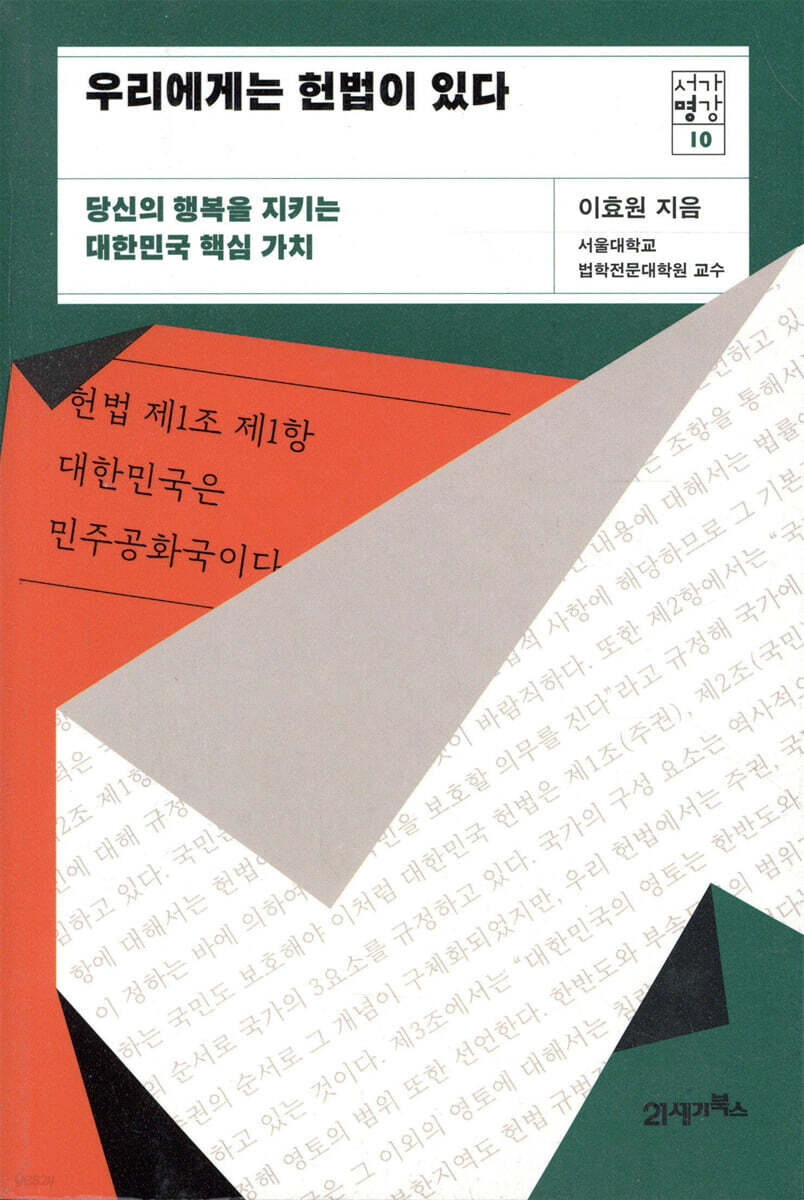
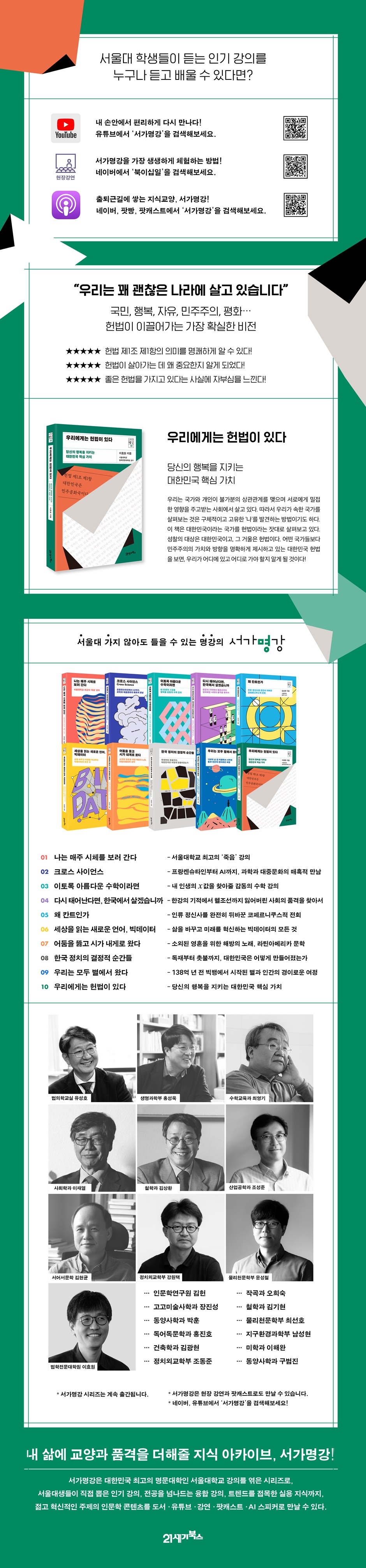
"Seogamyeonggang": A famous lecture you can attend without going to Seoul National University. Special lecture on the Constitution of the Republic of Korea that protects your happiness Discover Korea's finest lectures in book form! The tenth volume in the "Seogamyeonggang" series, featuring carefully curated lectures by current Seoul National University faculty, has been published. The Seoga Myunggang series, which transcribes the lectures of Seoul National University's top professors in various fields, including history, philosophy, science, medicine, and art, into books, provides readers with the expansion of knowledge and the joy of learning. "We Have a Constitution" is a book based on a lecture on the Constitution by Professor Lee Hyo-won, a professor at Seoul National University Law School and a leading authority on the Constitution and Unification Law of the Republic of Korea. Professor Lee Hyo-won has been studying and pondering the gap between the values protected by the law and reality since his 14 years as a practicing prosecutor. This book examines the core values enshrined in the Constitution of the Republic of Korea—"popular sovereignty," "rule of law," "liberal democracy," and "peace and unification"—and uses them as a mirror to reflect on the reality of the Republic of Korea and consider where we should be heading. |
index
Classification of Academic Studies Before Reading This Book
Main keywords
The Constitution is a vision of a happy nation.
Part 1: The sovereignty of the Republic of Korea resides in the people - Popular Sovereignty
Why We Need a Good Constitution
The Constitution, a 49-Day Miracle
How was the Constitution of the Republic of Korea created?
The highest power in the Republic of Korea lies with the people.
Q/A Ask and Answer
Part 2: The law guarantees the right to pursue happiness - a country governed by the rule of law
The double-edged sword of protection and control
How is the rule of law justified?
Conditions for a trustworthy law
All citizens are equal before the law.
Q/A Ask and Answer
Part 3: We follow the basic liberal democratic order - liberal democracy
Democracy, a way for different ideas to coexist
The essential value that individuals desire, freedom
Constitutional devices that guarantee a humane life
Eliminate evil rather than seek good
Q/A Ask and Answer
Part 4: The Republic of Korea Aims for Peaceful Unification - Peace and Unification
The ultimate value of the Constitution is 'peace.'
The Challenges of Our Constitution in the International Community
Specific living conditions, right to peace
The foundation for a unified nation that must be prepared from now on
Q/A Ask and Answer
Outgoing Article: We Have a 'Good' Constitution
References
Main keywords
The Constitution is a vision of a happy nation.
Part 1: The sovereignty of the Republic of Korea resides in the people - Popular Sovereignty
Why We Need a Good Constitution
The Constitution, a 49-Day Miracle
How was the Constitution of the Republic of Korea created?
The highest power in the Republic of Korea lies with the people.
Q/A Ask and Answer
Part 2: The law guarantees the right to pursue happiness - a country governed by the rule of law
The double-edged sword of protection and control
How is the rule of law justified?
Conditions for a trustworthy law
All citizens are equal before the law.
Q/A Ask and Answer
Part 3: We follow the basic liberal democratic order - liberal democracy
Democracy, a way for different ideas to coexist
The essential value that individuals desire, freedom
Constitutional devices that guarantee a humane life
Eliminate evil rather than seek good
Q/A Ask and Answer
Part 4: The Republic of Korea Aims for Peaceful Unification - Peace and Unification
The ultimate value of the Constitution is 'peace.'
The Challenges of Our Constitution in the International Community
Specific living conditions, right to peace
The foundation for a unified nation that must be prepared from now on
Q/A Ask and Answer
Outgoing Article: We Have a 'Good' Constitution
References
Detailed image
Into the book
The state is also unreliable because it runs the risk of violently dominating individuals at any time.
But if you understand the country properly, you can love it.
If patriotism is understood as respect and loyalty to the nation itself, it can easily become the ideology of those in power.
Patriotism should be about loving the constitutional values of one's country.
Only then can we love our country and patriotism become valuable.
---From “Introductory Notes | The Constitution is the Vision of a Happy Nation”
It should be borne in mind that popular sovereignty includes not only the basis for the legitimacy of state power and the control mechanism for state power, but also the responsibility of the individual who is the sovereign.
The people, as sovereign citizens, also bear a great deal of responsibility for the state's unlawful violence in the name of popular sovereignty.
When humanity experienced state violence in the name of popular sovereignty, the majority of the people participated as perpetrators without taking any responsibility.
When a nation collectively commits violence, the individuals involved may become insensitive to guilt.
Every individual must have a sense of political responsibility to ensure that the state does not abuse its power to oppress minorities.
---From "Part 1 | The sovereignty of the Republic of Korea resides in the people - The people are the highest power in the Republic of Korea"
The rule of law was not the country's political philosophy from the beginning.
The rule of law has not been considered the best way to govern in the historical course of national development, nor has it been actively adopted.
It was a passive choice of the lesser evil, based on distrust of humanity.
---From "Part 2 | The law guarantees the right to pursue happiness - the double-edged sword of protection and control"
The ideological foundation of the Republic of Korea, popular sovereignty, is realized in the form of a state governed by the rule of law and is completed through liberal democracy.
State power must be exercised in accordance with the rule of law, based on popular sovereignty, and is justified by realizing liberal democracy.
This type of liberal democracy is a combination of liberalism and democracy, and can be said to be a democracy limited by the value of freedom.
---From "Part 3 | We follow the basic order of liberal democracy - Democracy, a way for different ideas to coexist"
All human beings, as beings with dignity and value, want to live happily, and to do so, individual freedom must be guaranteed.
Therefore, humans, as political animals and social beings with different thoughts and lifestyles, must be guaranteed peace in order to be free.
Without peace, individuals cannot enjoy freedom, human beings cannot have dignity, and they cannot be valuable beings.
The formation of a nation by humans is also for a peaceful life.
Accordingly, the Constitution of the Republic of Korea declares pacifism as its fundamental principle, while presenting the realization of human dignity and value as its highest goal.
---From “Part 4 | The Republic of Korea pursues peaceful unification - The ultimate value of the Constitution is ‘peace’”
Since the establishment of the Constitution in 1948, the Republic of Korea has overcome past wounds by focusing on its constitutional values.
Of course, we have not yet reached our destination, and if we look at it solely based on constitutional values, the Republic of Korea today is still unstable and has a long and arduous road ahead.
It is impossible to know where South Korea will go in the future.
But at least the direction and how to go are clearly stated in the Constitution.
But if you understand the country properly, you can love it.
If patriotism is understood as respect and loyalty to the nation itself, it can easily become the ideology of those in power.
Patriotism should be about loving the constitutional values of one's country.
Only then can we love our country and patriotism become valuable.
---From “Introductory Notes | The Constitution is the Vision of a Happy Nation”
It should be borne in mind that popular sovereignty includes not only the basis for the legitimacy of state power and the control mechanism for state power, but also the responsibility of the individual who is the sovereign.
The people, as sovereign citizens, also bear a great deal of responsibility for the state's unlawful violence in the name of popular sovereignty.
When humanity experienced state violence in the name of popular sovereignty, the majority of the people participated as perpetrators without taking any responsibility.
When a nation collectively commits violence, the individuals involved may become insensitive to guilt.
Every individual must have a sense of political responsibility to ensure that the state does not abuse its power to oppress minorities.
---From "Part 1 | The sovereignty of the Republic of Korea resides in the people - The people are the highest power in the Republic of Korea"
The rule of law was not the country's political philosophy from the beginning.
The rule of law has not been considered the best way to govern in the historical course of national development, nor has it been actively adopted.
It was a passive choice of the lesser evil, based on distrust of humanity.
---From "Part 2 | The law guarantees the right to pursue happiness - the double-edged sword of protection and control"
The ideological foundation of the Republic of Korea, popular sovereignty, is realized in the form of a state governed by the rule of law and is completed through liberal democracy.
State power must be exercised in accordance with the rule of law, based on popular sovereignty, and is justified by realizing liberal democracy.
This type of liberal democracy is a combination of liberalism and democracy, and can be said to be a democracy limited by the value of freedom.
---From "Part 3 | We follow the basic order of liberal democracy - Democracy, a way for different ideas to coexist"
All human beings, as beings with dignity and value, want to live happily, and to do so, individual freedom must be guaranteed.
Therefore, humans, as political animals and social beings with different thoughts and lifestyles, must be guaranteed peace in order to be free.
Without peace, individuals cannot enjoy freedom, human beings cannot have dignity, and they cannot be valuable beings.
The formation of a nation by humans is also for a peaceful life.
Accordingly, the Constitution of the Republic of Korea declares pacifism as its fundamental principle, while presenting the realization of human dignity and value as its highest goal.
---From “Part 4 | The Republic of Korea pursues peaceful unification - The ultimate value of the Constitution is ‘peace’”
Since the establishment of the Constitution in 1948, the Republic of Korea has overcome past wounds by focusing on its constitutional values.
Of course, we have not yet reached our destination, and if we look at it solely based on constitutional values, the Republic of Korea today is still unstable and has a long and arduous road ahead.
It is impossible to know where South Korea will go in the future.
But at least the direction and how to go are clearly stated in the Constitution.
---From "Outgoing Writing | We Have a 'Good' Constitution"
Publisher's Review
“We live in a pretty decent country.”
The Constitution, the power that protects you and me
Professor Lee Hyo-won of Seoul National University Law School, who has 14 years of experience as a prosecutor, is a legal scholar who studies the ideals and visions pursued by law with sharp and keen insight.
Professor Lee Hyo-won, who laments the decline in opportunities to delve deeply into the Constitution with students in the classroom after the transition to a law school system and the elimination of law schools, explains the core values contained in the Constitution of the Republic of Korea through "We Have a Constitution," written for the public.
And I suggest that readers consider whether our society is functioning healthily.
The Constitution is the highest law among laws and contains the philosophy and vision of the nation.
It could be said that the Constitution is the vision of the future of the nation.
That is why the author confidently states that a country with a 'bad' constitution has no future.
No matter how vast the territory or how abundant the resources, a healthy society cannot be created without a national ideology and goals.
Moreover, in an unhealthy country, no matter how moral and wise an individual may be, he cannot be happy.
The author says, “South Korea has a ‘good’ constitution.”
Our Constitution is like a lighthouse, a guiding lighthouse that will protect us from the rough waves and winds.
Although it cannot be said with certainty that South Korea is a happy and healthy nation now, this book emphasizes that as long as we have a 'good' constitution, our country's future is bright.
“The Republic of Korea is a democratic republic.”
Four Values of the Constitution that Understand the Republic of Korea
So, what philosophy and vision does the Constitution of the Republic of Korea promote? The author cites "popular sovereignty," "rule of law," "liberal democracy," and "peace and unification."
This is because, although our Constitution has been amended nine times since its enactment on July 17, 1948, it is a core value that has been preserved to this day and must be preserved in the future.
This book not only examines the process of how the Constitution of the Republic of Korea was created and how it has changed, but also provides a three-dimensional explanation, along with case law, of how the core values of the Republic of Korea are embodied in the preamble and 10 chapters and 130 articles of the Constitution.
The Constitution of the Republic of Korea did not develop the nation's own national philosophy, but rather adopted the political ideology of Western modern states. However, it clearly asserts its national identity as a "democratic republic" more than any other country that claims to be democratic.
In particular, this book interprets the meaning of “popular sovereignty” from the constitutional values stated in Article 1, Paragraph 1, “The Republic of Korea is a democratic republic” and Article 1, Paragraph 2, “The sovereignty of the Republic of Korea resides in the people,” and provides insight into state power.
In addition, it provides an opportunity to examine the national philosophy that the country promotes as a “state governed by the rule of law” through the constitutional values that can be confirmed in Article 2, Paragraph 1, “The requirements for becoming a citizen of the Republic of Korea shall be determined by law” and Article 2, Paragraph 2, “The State has the duty to protect its citizens abroad as prescribed by law,” and to think about ways to protect the fundamental rights of the people.
In addition, through the constitutional values espoused in Article 4, “The Republic of Korea seeks unification,” we reflect together on why the Constitution, created immediately after the division, contains a vision for the future of a unified nation, and what its significance is.
While this book emphasizes that the constitutional values contained in our Constitution serve as a means and standard for properly understanding the Republic of Korea, it also points out that they are not absolute truths.
This is because the Constitution must not only be applied by distinguishing between the public and private spheres, but it can also be subject to continuous change.
However, since the Constitution reflects reality, we must repeatedly work to recognize our reality using the current Constitution as a yardstick.
That will be the only way to envision and realize a better future for our nation.
An era in which the entire world ponders 'democracy'
Why We Should Study the Constitution
We are now living in an era where the meaning of "democracy" is being reconsidered as we witness the restrictions on freedom and violence occurring in some countries due to the global pandemic.
And, timely, this book goes beyond simply understanding the value of the Constitution, and brings it into the personal realm of why we should study it.
In this book, the author argues that the state should not be blindly trusted, as it is at risk of violently dominating individuals at any time.
Therefore, it is emphasized that patriotism, that is, love for one's country, cannot be a respect for the country itself or loyalty to those in power, but must necessarily be a love for the country's constitutional values.
The Constitution of the Republic of Korea holds ‘popular sovereignty,’ ‘rule of law,’ ‘liberal democracy,’ and ‘peace and unification’ as its core values.
We must enhance our national pride and dignity by addressing the challenges we face while simultaneously seeking ways to properly realize these constitutional values without losing them.
In this way, holding the Constitution as a mirror will open the way for us to discover our existential and concrete selves within the Republic of Korea in which we live today.
I hope that I can find my own path to happiness along with the future of a happy nation.
The Constitution, the power that protects you and me
Professor Lee Hyo-won of Seoul National University Law School, who has 14 years of experience as a prosecutor, is a legal scholar who studies the ideals and visions pursued by law with sharp and keen insight.
Professor Lee Hyo-won, who laments the decline in opportunities to delve deeply into the Constitution with students in the classroom after the transition to a law school system and the elimination of law schools, explains the core values contained in the Constitution of the Republic of Korea through "We Have a Constitution," written for the public.
And I suggest that readers consider whether our society is functioning healthily.
The Constitution is the highest law among laws and contains the philosophy and vision of the nation.
It could be said that the Constitution is the vision of the future of the nation.
That is why the author confidently states that a country with a 'bad' constitution has no future.
No matter how vast the territory or how abundant the resources, a healthy society cannot be created without a national ideology and goals.
Moreover, in an unhealthy country, no matter how moral and wise an individual may be, he cannot be happy.
The author says, “South Korea has a ‘good’ constitution.”
Our Constitution is like a lighthouse, a guiding lighthouse that will protect us from the rough waves and winds.
Although it cannot be said with certainty that South Korea is a happy and healthy nation now, this book emphasizes that as long as we have a 'good' constitution, our country's future is bright.
“The Republic of Korea is a democratic republic.”
Four Values of the Constitution that Understand the Republic of Korea
So, what philosophy and vision does the Constitution of the Republic of Korea promote? The author cites "popular sovereignty," "rule of law," "liberal democracy," and "peace and unification."
This is because, although our Constitution has been amended nine times since its enactment on July 17, 1948, it is a core value that has been preserved to this day and must be preserved in the future.
This book not only examines the process of how the Constitution of the Republic of Korea was created and how it has changed, but also provides a three-dimensional explanation, along with case law, of how the core values of the Republic of Korea are embodied in the preamble and 10 chapters and 130 articles of the Constitution.
The Constitution of the Republic of Korea did not develop the nation's own national philosophy, but rather adopted the political ideology of Western modern states. However, it clearly asserts its national identity as a "democratic republic" more than any other country that claims to be democratic.
In particular, this book interprets the meaning of “popular sovereignty” from the constitutional values stated in Article 1, Paragraph 1, “The Republic of Korea is a democratic republic” and Article 1, Paragraph 2, “The sovereignty of the Republic of Korea resides in the people,” and provides insight into state power.
In addition, it provides an opportunity to examine the national philosophy that the country promotes as a “state governed by the rule of law” through the constitutional values that can be confirmed in Article 2, Paragraph 1, “The requirements for becoming a citizen of the Republic of Korea shall be determined by law” and Article 2, Paragraph 2, “The State has the duty to protect its citizens abroad as prescribed by law,” and to think about ways to protect the fundamental rights of the people.
In addition, through the constitutional values espoused in Article 4, “The Republic of Korea seeks unification,” we reflect together on why the Constitution, created immediately after the division, contains a vision for the future of a unified nation, and what its significance is.
While this book emphasizes that the constitutional values contained in our Constitution serve as a means and standard for properly understanding the Republic of Korea, it also points out that they are not absolute truths.
This is because the Constitution must not only be applied by distinguishing between the public and private spheres, but it can also be subject to continuous change.
However, since the Constitution reflects reality, we must repeatedly work to recognize our reality using the current Constitution as a yardstick.
That will be the only way to envision and realize a better future for our nation.
An era in which the entire world ponders 'democracy'
Why We Should Study the Constitution
We are now living in an era where the meaning of "democracy" is being reconsidered as we witness the restrictions on freedom and violence occurring in some countries due to the global pandemic.
And, timely, this book goes beyond simply understanding the value of the Constitution, and brings it into the personal realm of why we should study it.
In this book, the author argues that the state should not be blindly trusted, as it is at risk of violently dominating individuals at any time.
Therefore, it is emphasized that patriotism, that is, love for one's country, cannot be a respect for the country itself or loyalty to those in power, but must necessarily be a love for the country's constitutional values.
The Constitution of the Republic of Korea holds ‘popular sovereignty,’ ‘rule of law,’ ‘liberal democracy,’ and ‘peace and unification’ as its core values.
We must enhance our national pride and dignity by addressing the challenges we face while simultaneously seeking ways to properly realize these constitutional values without losing them.
In this way, holding the Constitution as a mirror will open the way for us to discover our existential and concrete selves within the Republic of Korea in which we live today.
I hope that I can find my own path to happiness along with the future of a happy nation.
GOODS SPECIFICS
- Date of issue: May 18, 2020
- Page count, weight, size: 312 pages | 128*188*30mm
- ISBN13: 9788950988265
- ISBN10: 8950988267
You may also like
카테고리
korean


korean

![GQ KOREA Mark (Monthly): December [2025]](http://librairie.coreenne.fr/cdn/shop/files/8ef265dbbfbf186523ed75ba7319009d.jpg?v=1765340328&width=3840)


