

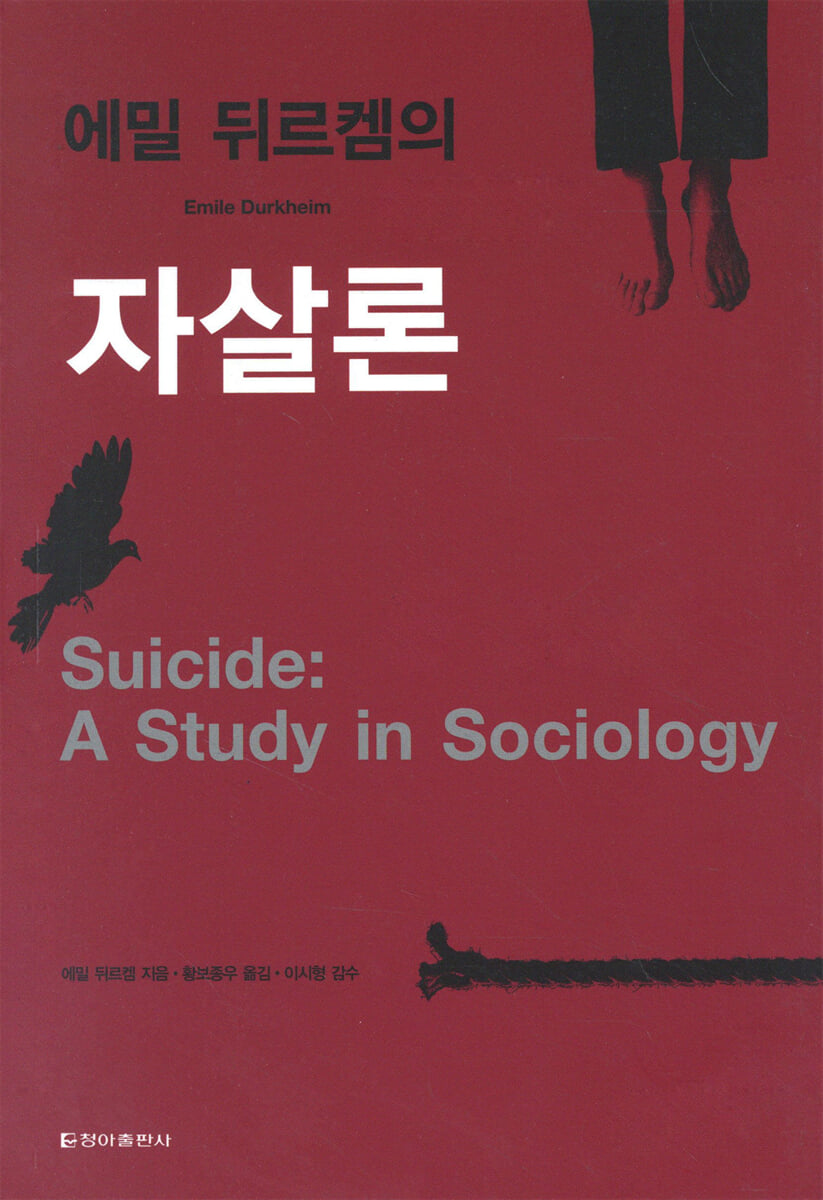
Emile Durkheim's theory of suicide
 |
Description
Book Introduction
A classic in sociological research on suicide
Suicide is probably one of the top five causes of death among modern people.
The extreme choice to voluntarily end one's life, whether actively or passively, is a unique human behavior that cannot be seen in animals.
So why do so many people commit suicide? Were the reasons behind their decision to kill themselves truly so painful and debilitating? Why don't others in similar situations make the same choice? It's astonishing that this book, written before the turn of the 20th century, offers answers to questions modern people might have about suicide.
In this book, French sociologist Émile Durkheim presents important concepts for understanding the phenomenon of suicide in a logical and clear manner, and even today, more than 100 years later, it is recognized as an outstanding analysis of suicide.
We explore the true causes behind those who commit suicide out of poverty and suffering, out of boredom and depression, and even out of honor.
And, using suicide-related statistics and other extensive data, we analyzed and revealed in detail how the suicide rate varies depending on age, region, climate, health, marital status, etc., and how suicide can be prevented.
In particular, we are correcting stereotypes that people have about suicide, such as the belief that people with mental illness will commit suicide, that preventing suicide will lead to violence and murder, and that there are far more people who commit suicide during economic crises than during economic booms, through rigorous data comparison and analysis.
Suicide is probably one of the top five causes of death among modern people.
The extreme choice to voluntarily end one's life, whether actively or passively, is a unique human behavior that cannot be seen in animals.
So why do so many people commit suicide? Were the reasons behind their decision to kill themselves truly so painful and debilitating? Why don't others in similar situations make the same choice? It's astonishing that this book, written before the turn of the 20th century, offers answers to questions modern people might have about suicide.
In this book, French sociologist Émile Durkheim presents important concepts for understanding the phenomenon of suicide in a logical and clear manner, and even today, more than 100 years later, it is recognized as an outstanding analysis of suicide.
We explore the true causes behind those who commit suicide out of poverty and suffering, out of boredom and depression, and even out of honor.
And, using suicide-related statistics and other extensive data, we analyzed and revealed in detail how the suicide rate varies depending on age, region, climate, health, marital status, etc., and how suicide can be prevented.
In particular, we are correcting stereotypes that people have about suicide, such as the belief that people with mental illness will commit suicide, that preventing suicide will lead to violence and murder, and that there are far more people who commit suicide during economic crises than during economic booms, through rigorous data comparison and analysis.
index
Recommendation
preface
introduction
Part 1: Non-social factors
Chapter 1: Suicide and Mental Illness
Chapter 2: Suicide and Normal Psychological State - Race and Genetics
Chapter 3: Suicide and Cosmic Factors
Chapter 4 Imitation
Part 2 Social Causes and Social Types
Chapter 1: Distinction between Social Causes and Social Types
Chapter 2: Selfish Suicide
Chapter 3: Selfish Suicide (Secret)
Chapter 4 Altruistic Suicide
Chapter 5: Anomic Suicide
Chapter 6: Personal Forms of Various Types of Suicide
Part 3: The General Character of Suicide as a Social Phenomenon
Chapter 1: Social Factors of Suicide
Chapter 2: Suicide and its Relationship to Other Social Phenomena
Chapter 3: Practical Results
Émile Durkheim Chronology
supplement
Americas
preface
introduction
Part 1: Non-social factors
Chapter 1: Suicide and Mental Illness
Chapter 2: Suicide and Normal Psychological State - Race and Genetics
Chapter 3: Suicide and Cosmic Factors
Chapter 4 Imitation
Part 2 Social Causes and Social Types
Chapter 1: Distinction between Social Causes and Social Types
Chapter 2: Selfish Suicide
Chapter 3: Selfish Suicide (Secret)
Chapter 4 Altruistic Suicide
Chapter 5: Anomic Suicide
Chapter 6: Personal Forms of Various Types of Suicide
Part 3: The General Character of Suicide as a Social Phenomenon
Chapter 1: Social Factors of Suicide
Chapter 2: Suicide and its Relationship to Other Social Phenomena
Chapter 3: Practical Results
Émile Durkheim Chronology
supplement
Americas
Into the book
If, as is often said, man is dual, it is because the physical man is duplicated with the social man.
Social man presupposes the society he symbolizes and serves.
If society disintegrates, if we no longer feel that it exists and works for us, everything social within us loses its purpose and its foundation.
What remains are artificial illusions that will disappear with a little reflection and cannot serve as goals for action.
However, social man is the essence of civilized man and the most excellent form of existence.
Therefore, when the only life we depend on is no longer real, and the only realistically possible way of life no longer satisfies our needs, we lose the reason to live.
Because we have already been exposed to a higher-dimensional lifestyle, we can no longer be satisfied with the lifestyle that would satisfy a child or an animal, and we become despairing because other lifestyles have already disappeared.
So there is nothing left to hold on to, and I just feel it disappearing into emptiness.
In this sense, it is true that our activities require a transcendent purpose.
Our need for a transcendent purpose is not because we want to remain in an unattainable fantasy of immortality.
The transcendent purpose is inherent in our morality and will not disappear in the least as long as morality itself does not lose its raison d'être.
But if you are in a state of confusion where you lose your moral compass, even the slightest disappointment can easily lead you to make a desperate decision.
If life isn't worth living, everything can become an excuse to commit suicide.
And that's not all.
Such isolation from society is not something that happens only to one individual.
The components of national character also include the way we value life.
The temperament that makes people see things brightly or darkly, that makes people sad or cheerful, is not only an individual but also a collective temperament.
In fact, only society can transmit a collective view of the values of life.
In this respect, the individual is powerless.
An individual knows only himself and his narrow sphere of activity.
Therefore, individual experience is too limited to serve as the basis for universal evaluation.
An individual may feel that his or her life has no purpose, but the same cannot be said for others.
Conversely, society can be said to universalize feelings about society itself.
Society can now be universally said to be healthy or unhealthy.
This is not sophistry.
Because individuals share deeply in social life, if society becomes sick, individuals cannot avoid being infected.
The illnesses that society suffers from are inevitably suffered by individuals as well.
Because society is a whole, its ills spread to each part.
Therefore, the disintegration of society means that the normal conditions for ordinary life are damaged.
We cannot leave society without recognizing that our activities are meaningless, because society is the very reason for our existence upon which our better selves depend.
Since we are the works of society, we cannot be conscious of the decline of society itself without feeling that our works have become worthless.
Therefore, the wave of frustration and disappointment does not come from any particular individual, but represents the disintegration of society itself.
It is as if chronic grief of an individual is detrimental to the individual's body, and so it leads to a breakdown of social solidarity, a kind of collective debilitation, a social disease.
During this period, metaphysical and religious systems emerged, asserting the meaninglessness of life in order to sort out ambiguous feelings and claiming that the idea that life has a purpose is a self-deception.
During this period, a new morality emerged, elevating facts to ethics and praising suicide or encouraging a short life, leading to suicide.
At first glance, such morality may seem to have been created by founders notorious for their pessimistic doctrines, but in reality, such morality is an effect rather than a cause.
Such morality is nothing more than a symbolization in abstract language and systematic form of the physiological suffering of the social organism.
Since these tendencies are collective, their collective origin gives them the authority to influence individuals, and they further aggravate the mental distress already experienced by individuals due to the disintegration of society.
Therefore, even when an individual liberates himself from the social environment with extreme passion, he still succumbs to the influence of society.
No matter how individualized an individual becomes, something collective always remains.
Depression and discouragement caused by excessive individualism are also examples.
When individuals have nothing to bond with one another, they bond by sharing their sorrows.
Therefore, this type of suicide can be called egoistic suicide.
Selfishness is not only a contributing factor to suicide, it is also a cause of suicide.
In this case, as the bond connecting the individual and society becomes loose, the link with life also becomes weak.
Although privacy issues appear to be the direct trigger and decisive cause of suicide, in fact, they are merely incidental causes.
The reason individuals commit suicide even in minor shocking situations is because society has made them easy prey for suicide.
Social man presupposes the society he symbolizes and serves.
If society disintegrates, if we no longer feel that it exists and works for us, everything social within us loses its purpose and its foundation.
What remains are artificial illusions that will disappear with a little reflection and cannot serve as goals for action.
However, social man is the essence of civilized man and the most excellent form of existence.
Therefore, when the only life we depend on is no longer real, and the only realistically possible way of life no longer satisfies our needs, we lose the reason to live.
Because we have already been exposed to a higher-dimensional lifestyle, we can no longer be satisfied with the lifestyle that would satisfy a child or an animal, and we become despairing because other lifestyles have already disappeared.
So there is nothing left to hold on to, and I just feel it disappearing into emptiness.
In this sense, it is true that our activities require a transcendent purpose.
Our need for a transcendent purpose is not because we want to remain in an unattainable fantasy of immortality.
The transcendent purpose is inherent in our morality and will not disappear in the least as long as morality itself does not lose its raison d'être.
But if you are in a state of confusion where you lose your moral compass, even the slightest disappointment can easily lead you to make a desperate decision.
If life isn't worth living, everything can become an excuse to commit suicide.
And that's not all.
Such isolation from society is not something that happens only to one individual.
The components of national character also include the way we value life.
The temperament that makes people see things brightly or darkly, that makes people sad or cheerful, is not only an individual but also a collective temperament.
In fact, only society can transmit a collective view of the values of life.
In this respect, the individual is powerless.
An individual knows only himself and his narrow sphere of activity.
Therefore, individual experience is too limited to serve as the basis for universal evaluation.
An individual may feel that his or her life has no purpose, but the same cannot be said for others.
Conversely, society can be said to universalize feelings about society itself.
Society can now be universally said to be healthy or unhealthy.
This is not sophistry.
Because individuals share deeply in social life, if society becomes sick, individuals cannot avoid being infected.
The illnesses that society suffers from are inevitably suffered by individuals as well.
Because society is a whole, its ills spread to each part.
Therefore, the disintegration of society means that the normal conditions for ordinary life are damaged.
We cannot leave society without recognizing that our activities are meaningless, because society is the very reason for our existence upon which our better selves depend.
Since we are the works of society, we cannot be conscious of the decline of society itself without feeling that our works have become worthless.
Therefore, the wave of frustration and disappointment does not come from any particular individual, but represents the disintegration of society itself.
It is as if chronic grief of an individual is detrimental to the individual's body, and so it leads to a breakdown of social solidarity, a kind of collective debilitation, a social disease.
During this period, metaphysical and religious systems emerged, asserting the meaninglessness of life in order to sort out ambiguous feelings and claiming that the idea that life has a purpose is a self-deception.
During this period, a new morality emerged, elevating facts to ethics and praising suicide or encouraging a short life, leading to suicide.
At first glance, such morality may seem to have been created by founders notorious for their pessimistic doctrines, but in reality, such morality is an effect rather than a cause.
Such morality is nothing more than a symbolization in abstract language and systematic form of the physiological suffering of the social organism.
Since these tendencies are collective, their collective origin gives them the authority to influence individuals, and they further aggravate the mental distress already experienced by individuals due to the disintegration of society.
Therefore, even when an individual liberates himself from the social environment with extreme passion, he still succumbs to the influence of society.
No matter how individualized an individual becomes, something collective always remains.
Depression and discouragement caused by excessive individualism are also examples.
When individuals have nothing to bond with one another, they bond by sharing their sorrows.
Therefore, this type of suicide can be called egoistic suicide.
Selfishness is not only a contributing factor to suicide, it is also a cause of suicide.
In this case, as the bond connecting the individual and society becomes loose, the link with life also becomes weak.
Although privacy issues appear to be the direct trigger and decisive cause of suicide, in fact, they are merely incidental causes.
The reason individuals commit suicide even in minor shocking situations is because society has made them easy prey for suicide.
---From "Chapter 3 Selfish Suicide (included)"
Publisher's Review
A classic in sociological research on suicide
Suicide is probably one of the top five causes of death among modern people.
The extreme choice to voluntarily end one's life, whether actively or passively, is a unique human behavior that cannot be seen in animals.
So why do so many people commit suicide? Was the motivation behind their decision truly so painful and debilitating that it was truly destructive? Why don't others in similar situations make the same choice?
It is surprising that the answers to the questions modern people might have about suicide are contained in this book, written before the turn of the 20th century.
In this book, French sociologist Émile Durkheim presents important concepts for understanding the phenomenon of suicide in a logical and clear manner, and even today, more than 100 years later, it is recognized as an outstanding analysis of suicide.
We explore the true causes behind those who commit suicide out of poverty and suffering, out of boredom and depression, and even out of honor.
And, using suicide-related statistics and other extensive data, we analyzed and revealed in detail how the suicide rate varies depending on age, region, climate, health, marital status, etc., and how suicide can be prevented.
In particular, we are correcting stereotypes that people have about suicide, such as the belief that people with mental illness will commit suicide, that preventing suicide will lead to violence and murder, and that there are far more people who commit suicide during economic crises than during economic booms, through rigorous data comparison and analysis.
Suicide is a social phenomenon.
Is suicide simply an individual phenomenon that occurs for personal reasons?
To explain a phenomenon, we must either rely on non-social causes that have widespread universality or on clearly social causes.
This book first explores the influence of non-social factors on suicide, such as mental illness, race, climate, genetics, and imitation, and empirically argues whether these factors exist and are worth considering.
Next, we will examine the social causes that influence suicide, how they work, and how they relate to individual cases of suicide.
Today, our country has the highest suicide rate among OECD countries.
As Durkheim said, suicide can no longer be considered solely as a problem resulting from an individual's physical and psychological maladjustment; it has become a social phenomenon, and its causes are also social.
Therefore, we should pay more attention to suicide.
Through Durkheim's sociological analysis of suicide, we can see that suicide is not a crime or a simple mental illness, but a serious social phenomenon that requires everyone's cooperation to solve.
Additionally, we will be able to understand the causes of the prevalence of suicide in modern society and seek the path society should take in the future.
Suicide is probably one of the top five causes of death among modern people.
The extreme choice to voluntarily end one's life, whether actively or passively, is a unique human behavior that cannot be seen in animals.
So why do so many people commit suicide? Was the motivation behind their decision truly so painful and debilitating that it was truly destructive? Why don't others in similar situations make the same choice?
It is surprising that the answers to the questions modern people might have about suicide are contained in this book, written before the turn of the 20th century.
In this book, French sociologist Émile Durkheim presents important concepts for understanding the phenomenon of suicide in a logical and clear manner, and even today, more than 100 years later, it is recognized as an outstanding analysis of suicide.
We explore the true causes behind those who commit suicide out of poverty and suffering, out of boredom and depression, and even out of honor.
And, using suicide-related statistics and other extensive data, we analyzed and revealed in detail how the suicide rate varies depending on age, region, climate, health, marital status, etc., and how suicide can be prevented.
In particular, we are correcting stereotypes that people have about suicide, such as the belief that people with mental illness will commit suicide, that preventing suicide will lead to violence and murder, and that there are far more people who commit suicide during economic crises than during economic booms, through rigorous data comparison and analysis.
Suicide is a social phenomenon.
Is suicide simply an individual phenomenon that occurs for personal reasons?
To explain a phenomenon, we must either rely on non-social causes that have widespread universality or on clearly social causes.
This book first explores the influence of non-social factors on suicide, such as mental illness, race, climate, genetics, and imitation, and empirically argues whether these factors exist and are worth considering.
Next, we will examine the social causes that influence suicide, how they work, and how they relate to individual cases of suicide.
Today, our country has the highest suicide rate among OECD countries.
As Durkheim said, suicide can no longer be considered solely as a problem resulting from an individual's physical and psychological maladjustment; it has become a social phenomenon, and its causes are also social.
Therefore, we should pay more attention to suicide.
Through Durkheim's sociological analysis of suicide, we can see that suicide is not a crime or a simple mental illness, but a serious social phenomenon that requires everyone's cooperation to solve.
Additionally, we will be able to understand the causes of the prevalence of suicide in modern society and seek the path society should take in the future.
GOODS SPECIFICS
- Date of issue: August 30, 2019
- Format: Paperback book binding method guide
- Page count, weight, size: 580 pages | 720g | 142*206*35mm
- ISBN13: 9788936811488
- ISBN10: 8936811487
You may also like
카테고리
korean


korean

![GQ KOREA Mark (Monthly): December [2025]](http://librairie.coreenne.fr/cdn/shop/files/8ef265dbbfbf186523ed75ba7319009d.jpg?v=1765340328&width=3840)


