

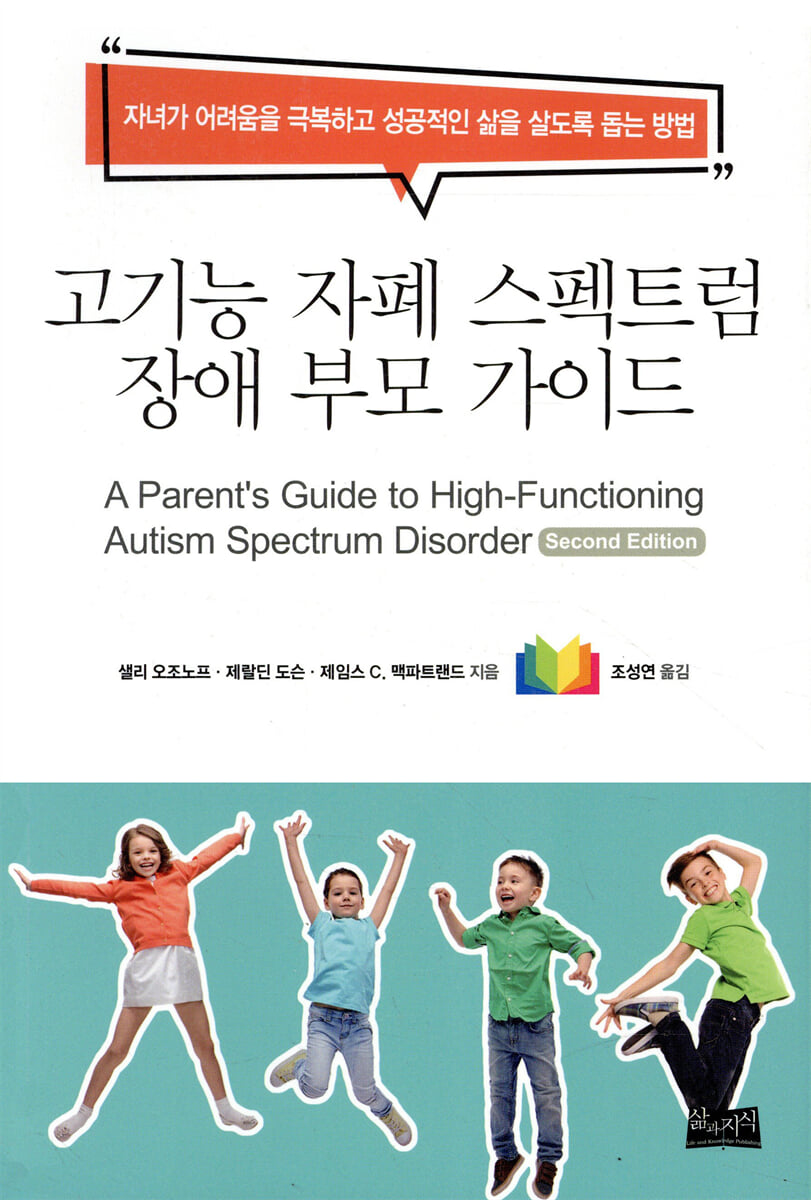
A Parent's Guide to High-Functioning Autism Spectrum Disorder
 |
Description
Book Introduction
A book that will help children with high-functioning autism have a better future.
Autism is not a simple disease.
If you think of autism in the classical sense of social isolation and avoidance of others, you are not understanding it properly.
Many children have normal intelligence and few learning problems, or even fluent language skills.
They simply have difficulty interacting and communicating socially with other people.
Rather, in some areas, they have abilities that ordinary people cannot imagine.
This condition is called high-functioning autism spectrum disorder (ASD).
This book provides guidance on how to detect and educate children in this condition early and help them grow into healthy members of society.
In Western countries, including the United States, there are well-established systems to care for and educate these children.
It is not uncommon for children with these disabilities to use their strengths to pursue professional careers, such as university professors or researchers.
But Korea is not like that.
We still don't know how much these children can develop with proper education and training.
This book details all the challenges and solutions that children with high-functioning autism spectrum disorder face from the time they are diagnosed until they become healthy working adults.
This book will be a ray of light for children with autism and their families.
Autism is not a simple disease.
If you think of autism in the classical sense of social isolation and avoidance of others, you are not understanding it properly.
Many children have normal intelligence and few learning problems, or even fluent language skills.
They simply have difficulty interacting and communicating socially with other people.
Rather, in some areas, they have abilities that ordinary people cannot imagine.
This condition is called high-functioning autism spectrum disorder (ASD).
This book provides guidance on how to detect and educate children in this condition early and help them grow into healthy members of society.
In Western countries, including the United States, there are well-established systems to care for and educate these children.
It is not uncommon for children with these disabilities to use their strengths to pursue professional careers, such as university professors or researchers.
But Korea is not like that.
We still don't know how much these children can develop with proper education and training.
This book details all the challenges and solutions that children with high-functioning autism spectrum disorder face from the time they are diagnosed until they become healthy working adults.
This book will be a ray of light for children with autism and their families.
- You can preview some of the book's contents.
Preview
index
Acknowledgments · 10
Introduction · 12
PART 1: Understanding High-Functioning Autism Spectrum Disorder
1.
What is Functional Autism Spectrum Disorder? · 15
1.1 What does high-functioning autism spectrum disorder look like? · 21
1.1.1 Social Interaction and Communication Problems · 22
1.1.2 Unusual interests and repetitive or ritualistic behaviors · 26
1.1.3 The Benefits of Difficulties · 29
1.2 What Happens Next? · 30
1.3 Parents Find Social Support · 32
2.
Diagnostic Process · 35
2.1 The Diagnostic Bible: DSM-5 37
2.2 DSM-IV · 38
2.3 New research brings significant changes to the DSM · 39
2.4 DSM-5 · 41
2.5 How Does DSM-5 Affect Us? · 44
2.6 How does the DSM-5 revision help? · 48
2.7 Is the diagnosis accurate? · 50
2.7.1 What should I do if one expert says my child has autism spectrum disorder and another says he or she is normal? · 50
2.7.2 How can I be sure my child has autism spectrum disorder and not ADHD, obsessive-compulsive disorder, or another disorder? · 52
2.7.3 Can my child have another diagnosis along with autism spectrum disorder? · 57
2.8 Evaluation Process · 59
2.8.1 Who is qualified to diagnose autism spectrum disorder? · 59
2.8.2 Developmental Abilities · 61
2.8.3 Observing Your Child · 61
2.8.4 Medical Tests: Helpful but Usually Not Diagnostic · 62
2.8.5 Psychological Testing · 63
2.8.5.1 Intelligence Test · 64
2.8.6 Additional Testing · 66
2.9 After diagnosis · 67
2.10 What should I tell my child? · 69
3.
Causes of Autism Spectrum Disorder · 71
3.1 Brain Differences in the Autism Spectrum Disorder Chapter 72
3.1.1 Autopsy Studies · 73
3.1.2 Structural Image Study · 74
3.1.3 Several studies, including functional imaging, on how the brain works · 76
3.1.3.1 Frontal Lobe · 76
3.1.3.2 Temporal Lobe · 77
3.1.3.3 Differences in Brain Region Connectivity · 78
3.1.4 Summary · 79
3.2 Genetic Influences in Autism Spectrum Disorder · 79
3.3 What about environmental causes? · 82
4.
Treatment of High-Functioning Autism Spectrum Disorder · 86
4.1 So what do we do now? · 87
4.2 Treatment Options for Preschool-Age Children · 89
4.2.1 Applied Behavior Analysis · 94
4.2.2 Early Start Denver Model · 97
4.2.3 TEACCH · 98
4.3 Preschool and Post-School Interventions · 100
4.3.1 Social Intervention · 101
4.3.2 Educational Support · 103
4.3.3 Pragmatic Language-Communication Therapy · 105
4.3.4 Behavioral Interventions to Address Difficult Behaviors · 106
4.3.4.1 Changing What Precedes Action · 107
4.3.4.2 Changing the Consequences of Actions · 108
4.3.4.3 Problems found and blocked · 112
4.3.4.4 Strengthening Self-Monitoring for Teens and Adults · 113
4.3.4.5 Consulting with a Behavioral Specialist · 114
4.3.5 Drug Treatment · 114
4.3.6 Sensory Integration Therapy · 118
4.3.7 Individual Psychotherapy · 121
4.3.8 Diet · 122
4.3.9 Supporting Your Family · 123
4.4 Parents as Care Managers · 125
PART 2 Living with High-Functioning Autism Spectrum Disorder
5.
Letting Your Child's Strengths Come to Life (Guiding Principles) · 131
5.1 True Strengths and Innate Abilities · 135
5.1.1 Excellent Memory · 136
5.1.2 Excellent Academic Skills · 137
5.1.3 Visual Thinking · 137
5.2 Unusual Behaviors That Can Be Advantages · 140
5.2.1 Recognizing Order and Following Rules · 141
5.2.2 Passion and Belief · 143
5.2.3 Getting along comfortably with adults · 147
5.3 Identifying Your Child's Strengths · 148
6.
High-Functioning Autism Spectrum Disorder at Home · 151
6.1 Background: Consistency · 152
6.2 Understanding Difficult Behaviors · 153
6.2.1 Step 1: Identify What Your Child Is Trying to Communicate Through His Difficult Behavior · 154
6.2.2 Step 2: Consider how you can change the situation, first making your child feel less need to express his or her message · 157
6.2.3 Step 3: If a message needs to be conveyed, think of a way for your child to communicate his or her needs or desires through more appropriate behaviors. · 160
6.2.4 Step 4: Practice Your New Communication Skills · 162
6.2.5 Step 5: Reward your child using strategies that show him or her that he or she will get what he or she needs. · 163
6.2.6 Step 6: Make Sure the Problem Behavior No Longer Effectively Meets Your Child's Needs · 164
6.3 Strategies Using Positive Rules · 165
6.4 Strategies for Difficult Times in the Day · 167
6.4.1 Morning · 167
6.4.2 Meal Times · 167
6.4.3 After School · 169
6.4.4 Sleep · 170
6.4.5 Family Outing · 171
6.4.6 Housework and Household Responsibilities · 172
6.4.7 Homework · 173
6.5 Maintaining a Healthy Family Attitude · 175
6.5.1 Brothers · 175
6.5.1.1 Communicating with Siblings · 176
6.5.1.2 Guilt and Excessive Responsibility · 177
6.5.1.3 Equal Interests, Activities, and Discipline · 178
6.5.1.4 Peer Relationships · 180
6.5.1.5 Private Life · 180
6.5.1.6 Additional Support · 181
6.5.2 Parents as Humans · 182
7.
High-Functioning Autism Spectrum Disorder in Schools · 185
7.1 Cognitive and Academic Profiles of Individuals with High-Functioning Autism Spectrum Disorder · 186
7.2 Learning Disabilities and High-Functioning Autism Spectrum Disorder · 189
7.3 Education Services · 190
7.3.1 Special Education Options - What is an IEP? · 191
7.3.2 Classroom Options · 196
7.3.3 Public or Private School? · 197
7.3.4 Classroom Convenience - What is the 504 Plan? · 198
7.3.4.1 Teacher and Classroom Characteristics · 199
7.3.4.2 Workload · 201
7.3.4.3 Visual Strategy · 202
7.3.4.4 Help with the Run Function · 203
7.3.4.5 Help-Seeking Routine · 204
7.3.4.6 Group Learning · 205
7.3.4.7 Cursive Alternatives · 206
7.3.4.8 Taking the Test · 207
7.3.4.9 Comprehension and Abstract Conceptualization Skills · 208
7.3.4.10 Behavioral Problems · 211
7.3.4.11 Transition · 211
7.4 Concluding Thoughts · 212
8.
The Social World of Children and Adolescents with High-Functioning Autism Spectrum Disorder · 215
8.1 "Goodbye, friend - now go away." · 215
8.2 Strategies to Improve Your Child's Social Behavior · 221
8.2.1 What Your Child's Therapist Can Provide · 221
8.2.1.1 Group Social Skills Training · 221
8.2.1.2 Cognitive Behavioral Therapy · 225
8.2.2 Social Skills Training Strategies Outside the Clinic · 227
8.2.2.1 Feedback and Modeling · 228
8.2.2.2 How to Make the Most of Clubs, Activities, and Playtime · 230
8.2.2.3 Social Script · 232
8.2.2.4 Social Stories · 234
8.2.2.5 Describing Life · 236
8.2.2.6 Friendship File · 238
8.2.2.7 Peer Coach · 238
8.2.2.8 Circle of Friends · 240
8.3 Strategies to Improve Your Child's Ability to Manage Emotions · 242
8.4 Dealing with Teasing and Bullying · 245
9.
Looking Ahead: High-Functioning ASD in Late Adolescence and Adulthood · 249
9.1 Good News About Aging · 250
9.2 Important Issues of Adolescence and Adulthood · 253
9.2.1 Supporters · 255
9.2.2 Revealing the Diagnosis · 257
9.2.3 Sexual Development · 261
9.2.4 Romantic Relationships · 263
9.2.5 Development of Self-Awareness, Self-Esteem, and Identity · 266
9.2.6 Depression and Anxiety · 268
9.2.7 Epilepsy · 269
9.3 Plan to Develop Independence · 270
9.4 University · 271
9.4.1 Revealing the Diagnosis · 271
9.4.2 Choosing a Course · 272
9.4.3 Choosing a Professor · 273
9.4.4 Requesting Conveniences · 273
9.4.5 Planning Your Course Schedule · 274
9.4.6 Monitoring Deadlines · 274
9.4.7 Improving Learning Skills · 275
9.4.8 Promoting Social Opportunities · 275
9.5 Housing Type · 276
9.5.1 Independent Living · 277
9.5.2 Supervised Group Housing · 280
9.5.3 Technology Development Assumptions · 280
9.6 Employment · 280
9.6.1 Employment Options · 281
9.6.1.1 Competitive Hiring · 281
9.6.1.2 Supported Employment · 281
9.6.1.3 Stable Employment · 282
9.6.1.4 Protected Workplace · 282
9.6.2 Choosing a Career · 282
9.6.2.1 Interview · 285
9.6.2.2 Workplace Conveniences · 285
9.7 Final Notes · 286
Materials · 287
References · 298
Introduction · 12
PART 1: Understanding High-Functioning Autism Spectrum Disorder
1.
What is Functional Autism Spectrum Disorder? · 15
1.1 What does high-functioning autism spectrum disorder look like? · 21
1.1.1 Social Interaction and Communication Problems · 22
1.1.2 Unusual interests and repetitive or ritualistic behaviors · 26
1.1.3 The Benefits of Difficulties · 29
1.2 What Happens Next? · 30
1.3 Parents Find Social Support · 32
2.
Diagnostic Process · 35
2.1 The Diagnostic Bible: DSM-5 37
2.2 DSM-IV · 38
2.3 New research brings significant changes to the DSM · 39
2.4 DSM-5 · 41
2.5 How Does DSM-5 Affect Us? · 44
2.6 How does the DSM-5 revision help? · 48
2.7 Is the diagnosis accurate? · 50
2.7.1 What should I do if one expert says my child has autism spectrum disorder and another says he or she is normal? · 50
2.7.2 How can I be sure my child has autism spectrum disorder and not ADHD, obsessive-compulsive disorder, or another disorder? · 52
2.7.3 Can my child have another diagnosis along with autism spectrum disorder? · 57
2.8 Evaluation Process · 59
2.8.1 Who is qualified to diagnose autism spectrum disorder? · 59
2.8.2 Developmental Abilities · 61
2.8.3 Observing Your Child · 61
2.8.4 Medical Tests: Helpful but Usually Not Diagnostic · 62
2.8.5 Psychological Testing · 63
2.8.5.1 Intelligence Test · 64
2.8.6 Additional Testing · 66
2.9 After diagnosis · 67
2.10 What should I tell my child? · 69
3.
Causes of Autism Spectrum Disorder · 71
3.1 Brain Differences in the Autism Spectrum Disorder Chapter 72
3.1.1 Autopsy Studies · 73
3.1.2 Structural Image Study · 74
3.1.3 Several studies, including functional imaging, on how the brain works · 76
3.1.3.1 Frontal Lobe · 76
3.1.3.2 Temporal Lobe · 77
3.1.3.3 Differences in Brain Region Connectivity · 78
3.1.4 Summary · 79
3.2 Genetic Influences in Autism Spectrum Disorder · 79
3.3 What about environmental causes? · 82
4.
Treatment of High-Functioning Autism Spectrum Disorder · 86
4.1 So what do we do now? · 87
4.2 Treatment Options for Preschool-Age Children · 89
4.2.1 Applied Behavior Analysis · 94
4.2.2 Early Start Denver Model · 97
4.2.3 TEACCH · 98
4.3 Preschool and Post-School Interventions · 100
4.3.1 Social Intervention · 101
4.3.2 Educational Support · 103
4.3.3 Pragmatic Language-Communication Therapy · 105
4.3.4 Behavioral Interventions to Address Difficult Behaviors · 106
4.3.4.1 Changing What Precedes Action · 107
4.3.4.2 Changing the Consequences of Actions · 108
4.3.4.3 Problems found and blocked · 112
4.3.4.4 Strengthening Self-Monitoring for Teens and Adults · 113
4.3.4.5 Consulting with a Behavioral Specialist · 114
4.3.5 Drug Treatment · 114
4.3.6 Sensory Integration Therapy · 118
4.3.7 Individual Psychotherapy · 121
4.3.8 Diet · 122
4.3.9 Supporting Your Family · 123
4.4 Parents as Care Managers · 125
PART 2 Living with High-Functioning Autism Spectrum Disorder
5.
Letting Your Child's Strengths Come to Life (Guiding Principles) · 131
5.1 True Strengths and Innate Abilities · 135
5.1.1 Excellent Memory · 136
5.1.2 Excellent Academic Skills · 137
5.1.3 Visual Thinking · 137
5.2 Unusual Behaviors That Can Be Advantages · 140
5.2.1 Recognizing Order and Following Rules · 141
5.2.2 Passion and Belief · 143
5.2.3 Getting along comfortably with adults · 147
5.3 Identifying Your Child's Strengths · 148
6.
High-Functioning Autism Spectrum Disorder at Home · 151
6.1 Background: Consistency · 152
6.2 Understanding Difficult Behaviors · 153
6.2.1 Step 1: Identify What Your Child Is Trying to Communicate Through His Difficult Behavior · 154
6.2.2 Step 2: Consider how you can change the situation, first making your child feel less need to express his or her message · 157
6.2.3 Step 3: If a message needs to be conveyed, think of a way for your child to communicate his or her needs or desires through more appropriate behaviors. · 160
6.2.4 Step 4: Practice Your New Communication Skills · 162
6.2.5 Step 5: Reward your child using strategies that show him or her that he or she will get what he or she needs. · 163
6.2.6 Step 6: Make Sure the Problem Behavior No Longer Effectively Meets Your Child's Needs · 164
6.3 Strategies Using Positive Rules · 165
6.4 Strategies for Difficult Times in the Day · 167
6.4.1 Morning · 167
6.4.2 Meal Times · 167
6.4.3 After School · 169
6.4.4 Sleep · 170
6.4.5 Family Outing · 171
6.4.6 Housework and Household Responsibilities · 172
6.4.7 Homework · 173
6.5 Maintaining a Healthy Family Attitude · 175
6.5.1 Brothers · 175
6.5.1.1 Communicating with Siblings · 176
6.5.1.2 Guilt and Excessive Responsibility · 177
6.5.1.3 Equal Interests, Activities, and Discipline · 178
6.5.1.4 Peer Relationships · 180
6.5.1.5 Private Life · 180
6.5.1.6 Additional Support · 181
6.5.2 Parents as Humans · 182
7.
High-Functioning Autism Spectrum Disorder in Schools · 185
7.1 Cognitive and Academic Profiles of Individuals with High-Functioning Autism Spectrum Disorder · 186
7.2 Learning Disabilities and High-Functioning Autism Spectrum Disorder · 189
7.3 Education Services · 190
7.3.1 Special Education Options - What is an IEP? · 191
7.3.2 Classroom Options · 196
7.3.3 Public or Private School? · 197
7.3.4 Classroom Convenience - What is the 504 Plan? · 198
7.3.4.1 Teacher and Classroom Characteristics · 199
7.3.4.2 Workload · 201
7.3.4.3 Visual Strategy · 202
7.3.4.4 Help with the Run Function · 203
7.3.4.5 Help-Seeking Routine · 204
7.3.4.6 Group Learning · 205
7.3.4.7 Cursive Alternatives · 206
7.3.4.8 Taking the Test · 207
7.3.4.9 Comprehension and Abstract Conceptualization Skills · 208
7.3.4.10 Behavioral Problems · 211
7.3.4.11 Transition · 211
7.4 Concluding Thoughts · 212
8.
The Social World of Children and Adolescents with High-Functioning Autism Spectrum Disorder · 215
8.1 "Goodbye, friend - now go away." · 215
8.2 Strategies to Improve Your Child's Social Behavior · 221
8.2.1 What Your Child's Therapist Can Provide · 221
8.2.1.1 Group Social Skills Training · 221
8.2.1.2 Cognitive Behavioral Therapy · 225
8.2.2 Social Skills Training Strategies Outside the Clinic · 227
8.2.2.1 Feedback and Modeling · 228
8.2.2.2 How to Make the Most of Clubs, Activities, and Playtime · 230
8.2.2.3 Social Script · 232
8.2.2.4 Social Stories · 234
8.2.2.5 Describing Life · 236
8.2.2.6 Friendship File · 238
8.2.2.7 Peer Coach · 238
8.2.2.8 Circle of Friends · 240
8.3 Strategies to Improve Your Child's Ability to Manage Emotions · 242
8.4 Dealing with Teasing and Bullying · 245
9.
Looking Ahead: High-Functioning ASD in Late Adolescence and Adulthood · 249
9.1 Good News About Aging · 250
9.2 Important Issues of Adolescence and Adulthood · 253
9.2.1 Supporters · 255
9.2.2 Revealing the Diagnosis · 257
9.2.3 Sexual Development · 261
9.2.4 Romantic Relationships · 263
9.2.5 Development of Self-Awareness, Self-Esteem, and Identity · 266
9.2.6 Depression and Anxiety · 268
9.2.7 Epilepsy · 269
9.3 Plan to Develop Independence · 270
9.4 University · 271
9.4.1 Revealing the Diagnosis · 271
9.4.2 Choosing a Course · 272
9.4.3 Choosing a Professor · 273
9.4.4 Requesting Conveniences · 273
9.4.5 Planning Your Course Schedule · 274
9.4.6 Monitoring Deadlines · 274
9.4.7 Improving Learning Skills · 275
9.4.8 Promoting Social Opportunities · 275
9.5 Housing Type · 276
9.5.1 Independent Living · 277
9.5.2 Supervised Group Housing · 280
9.5.3 Technology Development Assumptions · 280
9.6 Employment · 280
9.6.1 Employment Options · 281
9.6.1.1 Competitive Hiring · 281
9.6.1.2 Supported Employment · 281
9.6.1.3 Stable Employment · 282
9.6.1.4 Protected Workplace · 282
9.6.2 Choosing a Career · 282
9.6.2.1 Interview · 285
9.6.2.2 Workplace Conveniences · 285
9.7 Final Notes · 286
Materials · 287
References · 298
Publisher's Review
This book was personally discovered by the translator, a psychiatrist who directly treats children with autism.
The translator has personally experienced the power of this book in clinical practice.
The translator has always lamented the reality in Korea, where children with high-functioning autism can be identified early and properly educated to grow into healthy members of society, but this does not provide sufficient opportunities.
He also lamented the lack of a proper guide to help parents raising children with high-functioning autism make the right choices.
If parents know how to do it right, their high-functioning autistic children can have a better chance of becoming healthy, productive members of society.
This book contains a variety of case studies, solutions, and guidelines for children with high-functioning autism from birth to adulthood.
This will be a beacon of light for families with children with high-functioning autism.
I hope that this book will bring comfort to many families with children with high-functioning autism, and that these children will grow into healthy adults.
The translator has personally experienced the power of this book in clinical practice.
The translator has always lamented the reality in Korea, where children with high-functioning autism can be identified early and properly educated to grow into healthy members of society, but this does not provide sufficient opportunities.
He also lamented the lack of a proper guide to help parents raising children with high-functioning autism make the right choices.
If parents know how to do it right, their high-functioning autistic children can have a better chance of becoming healthy, productive members of society.
This book contains a variety of case studies, solutions, and guidelines for children with high-functioning autism from birth to adulthood.
This will be a beacon of light for families with children with high-functioning autism.
I hope that this book will bring comfort to many families with children with high-functioning autism, and that these children will grow into healthy adults.
GOODS SPECIFICS
- Date of issue: May 13, 2019
- Page count, weight, size: 304 pages | 452g | 152*225*16mm
- ISBN13: 9791185324456
- ISBN10: 1185324453
You may also like
카테고리
korean


korean

![GQ KOREA Mark (Monthly): December [2025]](http://librairie.coreenne.fr/cdn/shop/files/8ef265dbbfbf186523ed75ba7319009d.jpg?v=1765340328&width=3840)


