

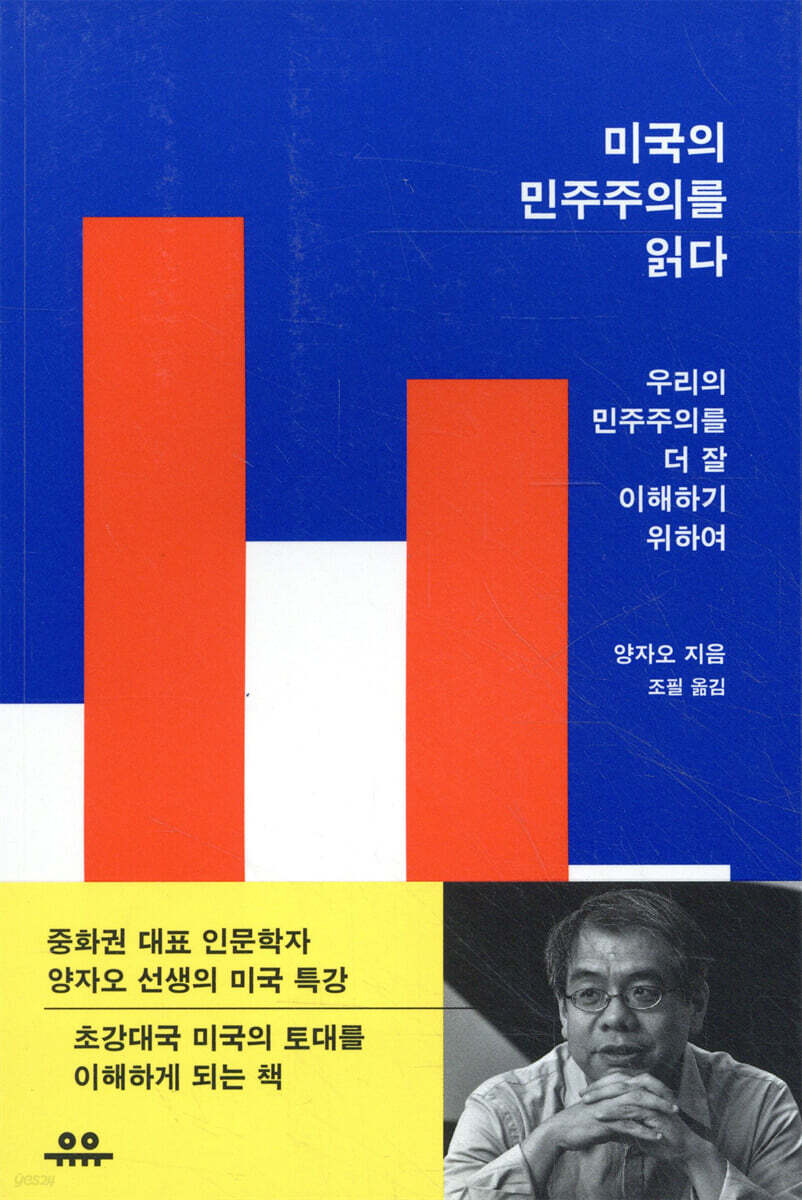
Reading American Democracy
 |
Description
Book Introduction
Democracy and equality demonstrated by outstanding observation and insight
And the democracy and equality we must think about
Tocqueville's Democracy in America was included in the list of classical lectures by Taiwanese intellectual Yang Zhao, who led people to read classical texts from both the East and the West.
As with Yang Zhao's classic lecture series, here he examines the historical context in which Democracy in America was written.
This book explains and analyzes the similarities and differences between the French Revolution and the American Revolution, which took place at nearly the same time, and the impact these differences have had on the present and future of history from various perspectives.
Tocqueville's "Democracy in America," a massive two-volume book, is likely to be disappointing and give up if readers are not thoroughly prepared. Through this book, "Reading Democracy in America," Yang Zhao guides readers to read it comprehensively, while also encouraging us, in the modern age, to reflect on and think about democracy, civic consciousness, and equality.
Democracy is a system we are familiar with, and equality is an important principle in democracy.
Civic awareness is also an essential element in exercising this equality.
While explaining Tocqueville's careful comparison between France and the United States, Yang Zhao also talks about Taiwan's democracy.
For him, too, Democracy in America is not just an old classic.
Actually, we are like that too.
For us, democracy is a new product that is not even 100 years old.
Looking at our modern history, democracy has been established, shaken, and strengthened in this short period of time.
Looking at the capabilities and results of the past candlelight revolution and the growing civic consciousness, our democracy will only improve in the future.
We are more interested in democracy, thinking about civic consciousness, and considering equality and human rights.
In that sense, American democracy may be far ahead of us.
Because it is the country that created modern democracy, spread it around the world, and influenced the establishment of our country's constitution.
It may be quite meaningful to look to America's past for our present and future.
It would be like reading the fundamentals.
The state of France after the French Revolution, which Tocqueville lamented, and the present state of American democracy, which he envied, will certainly serve as a compass for us who dream of a bright future.
And the democracy and equality we must think about
Tocqueville's Democracy in America was included in the list of classical lectures by Taiwanese intellectual Yang Zhao, who led people to read classical texts from both the East and the West.
As with Yang Zhao's classic lecture series, here he examines the historical context in which Democracy in America was written.
This book explains and analyzes the similarities and differences between the French Revolution and the American Revolution, which took place at nearly the same time, and the impact these differences have had on the present and future of history from various perspectives.
Tocqueville's "Democracy in America," a massive two-volume book, is likely to be disappointing and give up if readers are not thoroughly prepared. Through this book, "Reading Democracy in America," Yang Zhao guides readers to read it comprehensively, while also encouraging us, in the modern age, to reflect on and think about democracy, civic consciousness, and equality.
Democracy is a system we are familiar with, and equality is an important principle in democracy.
Civic awareness is also an essential element in exercising this equality.
While explaining Tocqueville's careful comparison between France and the United States, Yang Zhao also talks about Taiwan's democracy.
For him, too, Democracy in America is not just an old classic.
Actually, we are like that too.
For us, democracy is a new product that is not even 100 years old.
Looking at our modern history, democracy has been established, shaken, and strengthened in this short period of time.
Looking at the capabilities and results of the past candlelight revolution and the growing civic consciousness, our democracy will only improve in the future.
We are more interested in democracy, thinking about civic consciousness, and considering equality and human rights.
In that sense, American democracy may be far ahead of us.
Because it is the country that created modern democracy, spread it around the world, and influenced the establishment of our country's constitution.
It may be quite meaningful to look to America's past for our present and future.
It would be like reading the fundamentals.
The state of France after the French Revolution, which Tocqueville lamented, and the present state of American democracy, which he envied, will certainly serve as a compass for us who dream of a bright future.
- You can preview some of the book's contents.
Preview
index
Introduction: The Equality Consciousness That Protects America, the Center of Capitalism
1.
A continued experiment between centralization and decentralization
Why Read Modern Classics
I'm sorry I'm American
Politics is at the heart of the American story.
Big states and small states are equal
Winner-take-all Electoral College system
The three power structures that define a 'state'
The Special Invention of American Democracy: The Presidency
I will do anything for the Federation
Give to the states what belongs to the states, and to the federal government what belongs to the federal government.
2.
Two Frenchmen in America
Democracy is a good thing
The republican system does not apply only to small countries.
Spreading ideology with eloquence in pamphlets
A Frenchman who objectively analyzed American democracy
A bureaucratic system that even the French Revolution could not overturn
A political turmoil, bureaucrats in disarray
Two Frenchmen, Two Views on America
Preparing the Way for French Democracy
3.
Understanding Two Keyword America
History moves toward equality.
Written for readers who believe in progressive views of history
Equality is God's will
Why America Developed Democracy Before France
Geography and climate determine the form of colonial society.
There are no European nobility in the New World.
Establish your own kingdom of faith
Harvard wasn't originally a university.
Why did democracy begin in New England?
4.
Democracy in Reality
Democracy isn't glamorous, but it's not miserable either.
Democracy creates intermediate goodness and goodness.
The American experience shows the future of human politics.
In the United States, the power of the president is directly proportional to the national power.
5.
Distinguishing between two freedoms
The great contradiction between government and freedom
Napoleon replaces individual freedom with nationalism
Two Freedoms: Natural Liberty and Civil Liberty
Civil liberties built on the foundation of Puritan morality
Homogeneity Creates Direct Democracy in Town Meetings
The Great Revolution never produced citizens.
Local public spirit realized by self-sufficient towns
Public spirit creates a focused and effective government.
6.
Delicate arrangement of three volumes
The meaning of the establishment of the Constitution is more than the war of independence.
Judiciary above the legislature, legislation above the executive
A political party that acts as a mediator between the legislative and executive branches
The greatest self-correcting capacity of a democratic system
7.
Sociological perspective
A volume describing the specifics of American democracy
Volume 2, a sociological analysis of Volume 1
Democracy comes from empathy, not revolution.
An equal democratic society that allows individuals to imagine more broadly and freely
Predicting the Progress That Will Drive American Society Forward
Popularity and practicality are the criteria for judging 'goodness'.
I don't care about the details because I don't care about the differences.
There is no canonical American language, literature, or poetry.
An observation worth pondering, even if it has nothing to do with American democracy.
8.
The effects of 'equality' that have spread everywhere
The Great Revolution proved that philanthropy is a fearsome thing.
Equality is more welcome than freedom.
The aftermath of democracy and equality
Wealth determines a person's status in an equal society.
The pursuit of wealth is to become God's chosen people.
The more democratic and equal a society is, the greater the incentive for economic development?
An equal society no longer regards etiquette and norms.
The expansion of equality cannot be stopped.
The question Tocqueville left us with
More books to read
Chronology of "Democracy in America"
Translator's Note: Exploring the Roots of Modern Democratic Institutions
Publisher's Review
Why American Democracy?
Some of you may be wondering what democracy means now.
Even 'American democracy'.
It's true that the United States, a superpower, is great, and its influence in every field around the world is vast and widespread, but talking about American democracy somehow seems like repeating the obvious.
When we were in school, we learned that there was democracy in ancient Greece (albeit quite limited).
Therefore, the concept of democracy is not unfamiliar to us, and there is no need to be conscious of any significant differences from today's democracy.
But surprisingly, after ancient Greece, democracy was only found in literature and thought, and it was only after America gained independence from Britain that it was applied to large areas of land and people.
Here is Tocqueville's "Democracy in America," which witnesses the process by which the democracy we currently enjoy and cultivate in the United States began and took root.
The first thing we need to know from Tocqueville's Democracy in America is that Tocqueville was a French bureaucrat who had just experienced the French Revolution.
The French Revolution, which left a deep impression on world history with its slogans of liberty, equality, and fraternity and its dramatic development, continued to throw France into turmoil for a long time thereafter.
And across the Atlantic, in America, another revolution took place: the American Revolution.
Compared to France, where people were constantly dying and order was difficult to find, the situation in the United States gradually found stability after the Revolutionary War.
Tocqueville, who was a member of the old aristocracy and also a bureaucrat of the time, went to the United States to observe such an America.
You must be tired of the never-ending chaos in France.
After returning to France from his travels, Tocqueville poured the money he had earned in America into Democracy in America.
He wanted to explain the situation in the United States to France, which was in a state of turmoil, and to persuade France to move towards a better situation.
That's how Tocqueville's two-volume masterpiece, Democracy in America, came about.
Some of you may be wondering what democracy means now.
Even 'American democracy'.
It's true that the United States, a superpower, is great, and its influence in every field around the world is vast and widespread, but talking about American democracy somehow seems like repeating the obvious.
When we were in school, we learned that there was democracy in ancient Greece (albeit quite limited).
Therefore, the concept of democracy is not unfamiliar to us, and there is no need to be conscious of any significant differences from today's democracy.
But surprisingly, after ancient Greece, democracy was only found in literature and thought, and it was only after America gained independence from Britain that it was applied to large areas of land and people.
Here is Tocqueville's "Democracy in America," which witnesses the process by which the democracy we currently enjoy and cultivate in the United States began and took root.
The first thing we need to know from Tocqueville's Democracy in America is that Tocqueville was a French bureaucrat who had just experienced the French Revolution.
The French Revolution, which left a deep impression on world history with its slogans of liberty, equality, and fraternity and its dramatic development, continued to throw France into turmoil for a long time thereafter.
And across the Atlantic, in America, another revolution took place: the American Revolution.
Compared to France, where people were constantly dying and order was difficult to find, the situation in the United States gradually found stability after the Revolutionary War.
Tocqueville, who was a member of the old aristocracy and also a bureaucrat of the time, went to the United States to observe such an America.
You must be tired of the never-ending chaos in France.
After returning to France from his travels, Tocqueville poured the money he had earned in America into Democracy in America.
He wanted to explain the situation in the United States to France, which was in a state of turmoil, and to persuade France to move towards a better situation.
That's how Tocqueville's two-volume masterpiece, Democracy in America, came about.
GOODS SPECIFICS
- Date of issue: May 14, 2018
- Page count, weight, size: 294 pages | 280g | 128*188*20mm
- ISBN13: 9791185152844
- ISBN10: 1185152849
You may also like
카테고리
korean


korean

![GQ KOREA Mark (Monthly): December [2025]](http://librairie.coreenne.fr/cdn/shop/files/8ef265dbbfbf186523ed75ba7319009d.jpg?v=1765340328&width=3840)


