

Best education
 |
Description
Book Introduction
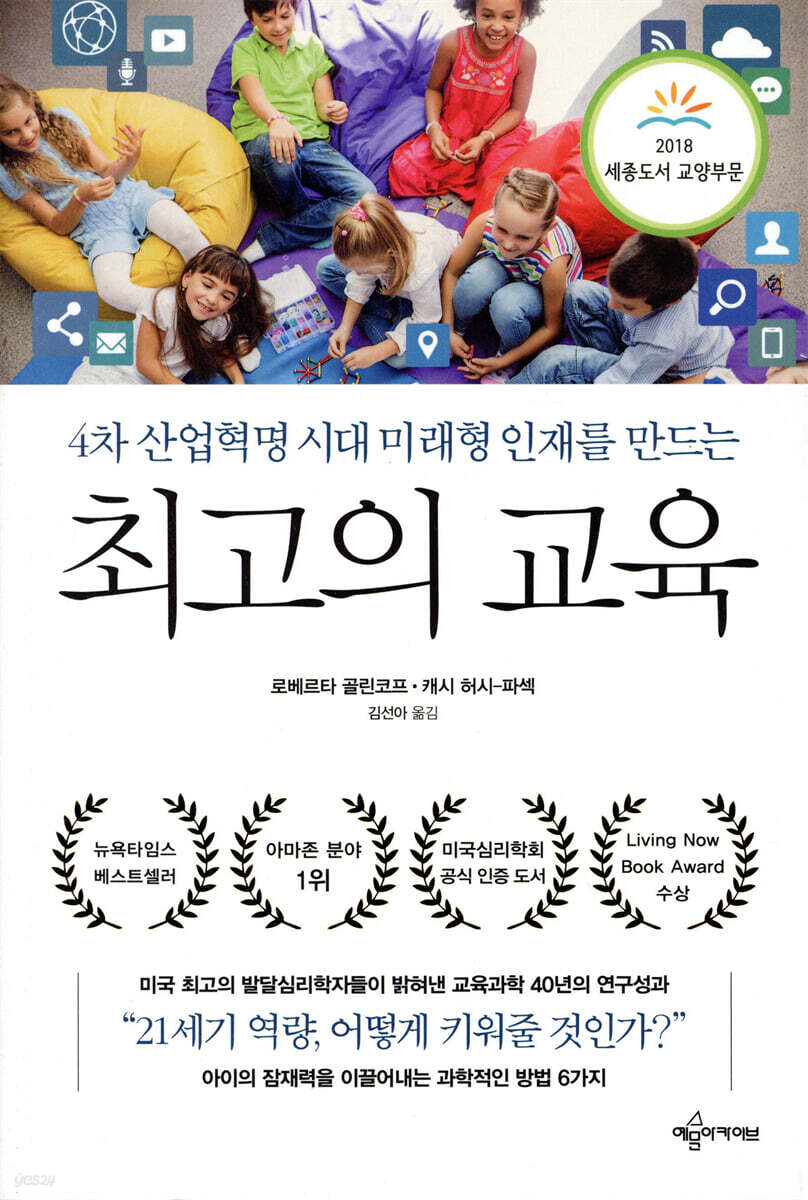
40 years of educational science research uncovered by America's leading developmental psychologists
“How can we develop 21st century capabilities?”
#1 bestseller on Amazon
New York Times bestseller
Officially certified book by the American Psychological Association
Winner of the 'Living Now Book Award'
Will our children have the competitive edge they need for the future? A new book, "Becoming Brilliant," has been published, revealing the six core competencies children must develop to thrive in the 21st century.
Professor Roberta Golinkoff of the University of Delaware, who has pioneered the field of 'educational science', which studies ways to improve learning ability for 40 years, proposes 21st century competencies, or '6C competencies', as the conditions for future talent, together with Cathy Hirsch-Pasek, a senior fellow at the Brookings Institution.
These are ‘Collaboration’, ‘Communication’, ‘Content’, ‘Critical Thinking’, ‘Creative Innovation’, and ‘Confidence’.
The rapid social changes brought about by the Fourth Industrial Revolution are amplifying uncertainty about the future, which in turn is fueling anxiety and doubts about the current knowledge-centered education system.
However, the two authors assert that even in a world dominated by artificial intelligence and robots, “if children possess the 6C competencies, they will be able to adapt and be sufficiently competitive.”
This book divides the 6Cs, each organically connected, into four stages, and provides specific methods to guide children from the first stage to the last.
It also explains, based on scientific and psychological evidence, what our education system should focus on and reform, what abilities children should develop in schools, and how we can provide support at home.
“How can we develop 21st century capabilities?”
#1 bestseller on Amazon
New York Times bestseller
Officially certified book by the American Psychological Association
Winner of the 'Living Now Book Award'
Will our children have the competitive edge they need for the future? A new book, "Becoming Brilliant," has been published, revealing the six core competencies children must develop to thrive in the 21st century.
Professor Roberta Golinkoff of the University of Delaware, who has pioneered the field of 'educational science', which studies ways to improve learning ability for 40 years, proposes 21st century competencies, or '6C competencies', as the conditions for future talent, together with Cathy Hirsch-Pasek, a senior fellow at the Brookings Institution.
These are ‘Collaboration’, ‘Communication’, ‘Content’, ‘Critical Thinking’, ‘Creative Innovation’, and ‘Confidence’.
The rapid social changes brought about by the Fourth Industrial Revolution are amplifying uncertainty about the future, which in turn is fueling anxiety and doubts about the current knowledge-centered education system.
However, the two authors assert that even in a world dominated by artificial intelligence and robots, “if children possess the 6C competencies, they will be able to adapt and be sufficiently competitive.”
This book divides the 6Cs, each organically connected, into four stages, and provides specific methods to guide children from the first stage to the last.
It also explains, based on scientific and psychological evidence, what our education system should focus on and reform, what abilities children should develop in schools, and how we can provide support at home.
- You can preview some of the book's contents.
Preview
index
Introduction_How to develop potential
Chapter 1: Can Past Methods Lead to Future Success? The Meaning of Success
What is the secret to success for future generations? / The capabilities the future desires for children / Factors that will lead children to success.
Chapter 2: How Education Went Wrong: The Education Industry and Educational Science
Is Education the Reason We Fall Behind Other Countries? / Shifting to a Testing Culture / The Future of Education
Chapter 3: Children's Stage is Global: Innovative Education
Education in the World / Singapore's New Attempt / Finland Leading the World / Canada Surpassing the US / Uruguay's Experiment / Back to Singapore's Future
Chapter 4: Balancing Hard and Soft Skills: 21st Century Competencies
What skills are truly needed? / What parents obsess over? / What skills are truly needed in the business world? / The '21st century skills' that are gaining attention. / The balance between hard and soft skills. / A broader perspective on children's success.
Chapter 5: No One Can Play a Symphony Alone: Collaboration
We need opportunities to learn interaction. / Stage 1: Alone / Stage 2: Side by Side / Stage 3: Give and Take / Stage 4: Create Together / Paths for Children to Grow / Scaffolding: How to Move Up the Collaborative Level
Chapter 6: What Would We Do Without Communication? Communication
Has communication improved as much as technology has advanced? / Step 1: Expressing feelings / Step 2: Showing and telling / Step 3: Conversing / Step 4: Sharing stories / Paths for children to grow / Scaffolding: How to facilitate communication
Chapter 7: The Illusion of "Knowledge Acquisition is the Best" Content
Does having a lot of knowledge prepare you for the 21st century? / Stage 1: Early learning and specific situations / Stage 2: Broad and shallow understanding / Stage 3: Making connections / Stage 4: Expertise / Paths for children to grow / Scaffolding: How to help them acquire content
Chapter 8: The Power to Seek Truth Beyond Facts: Critical Thinking
The College Admissions War Begins in Kindergarten/Step 1: Believing What You See/Step 2: Comparing Facts/Step 3: Forming an Opinion/Step 4: Finding Evidence and "Handling Complex Doubts"/Paths for Children to Grow/Scaffolding: How to Develop Critical Thinking
Chapter 9: Creating New Things from Old Things: Creative Innovation
Creativity has been declining for 20 years/3 misconceptions about creativity/How does creativity develop?/Step 1: Experiment/Step 2: Having a means and a goal/Step 3: Finding your own voice/Step 4: Embracing a vision/Paths for children to grow/Scaffolding_How to foster creativity
Chapter 10: Stop or Take on the Challenge? Confidence
Two Elements of Confidence / Step 1: Trial and Error / Step 2: Establishing Your Position / Step 3: Taking Calculated Risks / Step 4: The Courage to Fail / Paths for Children to Grow / Scaffolding: How to Boost Confidence
Chapter 11: The Big Picture: Creating Future Talent: A 21st Century Report Card
6C Concert: Realizing a Broader Perspective/Putting the 6Cs in Practice: Home, Village, City, and School/Creating Valuable Education
Coming out_How do children learn?
Translator's Note
main
Search
Chapter 1: Can Past Methods Lead to Future Success? The Meaning of Success
What is the secret to success for future generations? / The capabilities the future desires for children / Factors that will lead children to success.
Chapter 2: How Education Went Wrong: The Education Industry and Educational Science
Is Education the Reason We Fall Behind Other Countries? / Shifting to a Testing Culture / The Future of Education
Chapter 3: Children's Stage is Global: Innovative Education
Education in the World / Singapore's New Attempt / Finland Leading the World / Canada Surpassing the US / Uruguay's Experiment / Back to Singapore's Future
Chapter 4: Balancing Hard and Soft Skills: 21st Century Competencies
What skills are truly needed? / What parents obsess over? / What skills are truly needed in the business world? / The '21st century skills' that are gaining attention. / The balance between hard and soft skills. / A broader perspective on children's success.
Chapter 5: No One Can Play a Symphony Alone: Collaboration
We need opportunities to learn interaction. / Stage 1: Alone / Stage 2: Side by Side / Stage 3: Give and Take / Stage 4: Create Together / Paths for Children to Grow / Scaffolding: How to Move Up the Collaborative Level
Chapter 6: What Would We Do Without Communication? Communication
Has communication improved as much as technology has advanced? / Step 1: Expressing feelings / Step 2: Showing and telling / Step 3: Conversing / Step 4: Sharing stories / Paths for children to grow / Scaffolding: How to facilitate communication
Chapter 7: The Illusion of "Knowledge Acquisition is the Best" Content
Does having a lot of knowledge prepare you for the 21st century? / Stage 1: Early learning and specific situations / Stage 2: Broad and shallow understanding / Stage 3: Making connections / Stage 4: Expertise / Paths for children to grow / Scaffolding: How to help them acquire content
Chapter 8: The Power to Seek Truth Beyond Facts: Critical Thinking
The College Admissions War Begins in Kindergarten/Step 1: Believing What You See/Step 2: Comparing Facts/Step 3: Forming an Opinion/Step 4: Finding Evidence and "Handling Complex Doubts"/Paths for Children to Grow/Scaffolding: How to Develop Critical Thinking
Chapter 9: Creating New Things from Old Things: Creative Innovation
Creativity has been declining for 20 years/3 misconceptions about creativity/How does creativity develop?/Step 1: Experiment/Step 2: Having a means and a goal/Step 3: Finding your own voice/Step 4: Embracing a vision/Paths for children to grow/Scaffolding_How to foster creativity
Chapter 10: Stop or Take on the Challenge? Confidence
Two Elements of Confidence / Step 1: Trial and Error / Step 2: Establishing Your Position / Step 3: Taking Calculated Risks / Step 4: The Courage to Fail / Paths for Children to Grow / Scaffolding: How to Boost Confidence
Chapter 11: The Big Picture: Creating Future Talent: A 21st Century Report Card
6C Concert: Realizing a Broader Perspective/Putting the 6Cs in Practice: Home, Village, City, and School/Creating Valuable Education
Coming out_How do children learn?
Translator's Note
main
Search
Detailed image
Into the book
If knowledge information were the only thing that mattered, robots would be able to do it much better than humans.
But we know that only our children, not robots, have the potential to interact with each other, socialize, become good citizens, and think and create.
After decades of research, hundreds of papers, and 13 books under our name, it's time to share our collective wisdom from "educational science" and cultivate in our children the 6Cs: a new way of thinking.
--- p.10
In the era of big data, diversity explodes.
We are overflowing with information: data from business transactions, health data collected through sensors (aren't you wearing a wristband that measures your activity right now?), route maps created through GPS tracking, tweets, and so on.
You can't cram 100 or 1,000 times more information into the heads of 7-year-olds.
However, the current curriculum still focuses on providing the correct answer to a single question on an exam.
Kids of the Google generation have all the facts at their fingertips.
--- p.162
In 2009, only one-fifth of all jobs in the United States were manufacturing jobs.
Think about your own work environment.
Middle-class jobs like file clerks and secretaries are disappearing like filing cabinets being transported.
At one American university, there was one adjunct faculty member for every four faculty members.
But now the rate has dropped dramatically to 1 in 24 people.
As the number of non-computerized, low-status service jobs, such as medical support or security guards, continues to grow, the demand for expert thinking is also increasing.
As the middle class disappears, our children's future will see a rise in upper-level occupations that require critical thinking and lower-level occupations that require relatively less specialized skills.
--- p.237
Professor Kyunghee Kim, who teaches at the College of William and Mary, looked at 300,000 scores from the traditional Torrance Test of Creative Thinking.
Scores were rising until 1990, but over the past 20 years they have begun to decline.
In this test, people of all ages must complete a drawing by drawing lines and shapes on a minimal design they have never seen before.
Since 1990, people have started scoring lower than in the past.
That means we haven't been able to produce as many unique and distinctive designs as before.
--- p.254
Once we understand what skills children need to succeed, once we let go of the idea that learning is limited to textbooks at school, once we recognize that play and stories are the driving force behind children's learning, we can begin to see the connection between play and education through the 6Cs.
The possibilities are endless and learning overflows in every moment and place we experience.
But we know that only our children, not robots, have the potential to interact with each other, socialize, become good citizens, and think and create.
After decades of research, hundreds of papers, and 13 books under our name, it's time to share our collective wisdom from "educational science" and cultivate in our children the 6Cs: a new way of thinking.
--- p.10
In the era of big data, diversity explodes.
We are overflowing with information: data from business transactions, health data collected through sensors (aren't you wearing a wristband that measures your activity right now?), route maps created through GPS tracking, tweets, and so on.
You can't cram 100 or 1,000 times more information into the heads of 7-year-olds.
However, the current curriculum still focuses on providing the correct answer to a single question on an exam.
Kids of the Google generation have all the facts at their fingertips.
--- p.162
In 2009, only one-fifth of all jobs in the United States were manufacturing jobs.
Think about your own work environment.
Middle-class jobs like file clerks and secretaries are disappearing like filing cabinets being transported.
At one American university, there was one adjunct faculty member for every four faculty members.
But now the rate has dropped dramatically to 1 in 24 people.
As the number of non-computerized, low-status service jobs, such as medical support or security guards, continues to grow, the demand for expert thinking is also increasing.
As the middle class disappears, our children's future will see a rise in upper-level occupations that require critical thinking and lower-level occupations that require relatively less specialized skills.
--- p.237
Professor Kyunghee Kim, who teaches at the College of William and Mary, looked at 300,000 scores from the traditional Torrance Test of Creative Thinking.
Scores were rising until 1990, but over the past 20 years they have begun to decline.
In this test, people of all ages must complete a drawing by drawing lines and shapes on a minimal design they have never seen before.
Since 1990, people have started scoring lower than in the past.
That means we haven't been able to produce as many unique and distinctive designs as before.
--- p.254
Once we understand what skills children need to succeed, once we let go of the idea that learning is limited to textbooks at school, once we recognize that play and stories are the driving force behind children's learning, we can begin to see the connection between play and education through the 6Cs.
The possibilities are endless and learning overflows in every moment and place we experience.
--- p.349
Publisher's Review
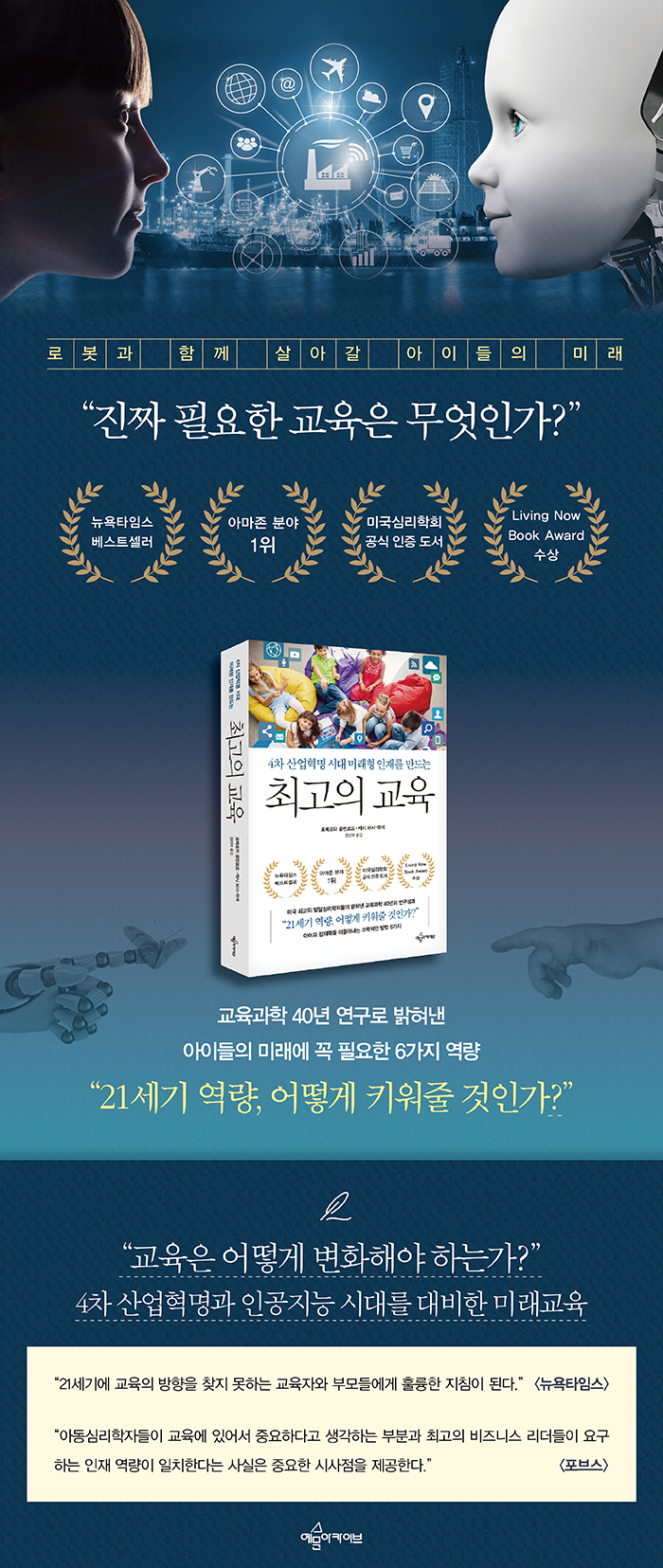
The future of children living with robots
“What kind of education is really needed?”
6 Scientific Ways to Unleash Your Child's Potential
What skills will children need in the era of the Fourth Industrial Revolution? With countless jobs disappearing and new ones emerging, even the definition of work is shifting.
So, can simply following the current education system really improve children's competitiveness? No.
Our education system is backward.
Education in many countries around the world is already changing to adapt to the era of the Fourth Industrial Revolution.
This book shows the direction in which countries like Finland, Canada, Singapore, and Uruguay are pursuing educational reforms to secure future national competitiveness, and shares innovative educational cases that are fostering 6C capabilities, such as Friends Central School in Philadelphia, High-Tech High School in San Diego, and Reggio Emilia Village in Italy.
It also explains how creativity, innovation, expertise, self-esteem, passion and perseverance, and teamwork, which world-renowned scholars and best-selling authors such as Howard Gardner, Peter Drucker, Ken Robinson, Daniel Pink, Malcolm Gladwell, Carol Dweck, and Angela Duckworth consider as key factors in developing individual capabilities, are related to children's 6C capabilities.
What Should We Teach in the Era of the Fourth Industrial Revolution?
“We are now educating children about what robots and artificial intelligence (AI) will do in the future.
This is an obvious fact.
And in that work they will always be better than humans.”
These authors' warnings make us reflect on the reality of our education.
As the era of the Fourth Industrial Revolution, characterized by artificial intelligence and big data, arrives, anxiety about jobs and careers is growing.
Adding to this distrust in the existing education system, children's anxiety about education has grown significantly.
Can Korea's recently mandated coding education alone prepare children for the future? Today's children must navigate waves of change their parents could not even imagine.
The author points out that “It is estimated that today’s graduates will have 10 different jobs during their lifetime, and 8 of these jobs have not even been created yet,” and argues based on educational science that we must move beyond education that only memorizes knowledge and “evolve toward education that can comprehensively develop the 6Cs.”
What kind of talent does the business world want?
“The future will belong to different kinds of people with very different ideas.
“People who are creative and empathetic, who recognize patterns and create meaning, who are artists, inventors, designers, and storytellers, who care for others, who integrate, and who think big-picture, will be rewarded with the greatest wealth and enjoy the greatest joy in society.”
Daniel Pink predicted this in “A Whole New Future”:
This is becoming more and more a reality.
The era of favoring people with specific ideas or specific abilities, like computer programmers, lawyers, and MBA graduates, who made the past few decades their own, is coming to an end.
"The Best Education" emphasizes the need for education in intangible skills, or soft skills, that go beyond hard skills, such as math, language, and writing, that can be measured through tests on traditional report cards, in order to prepare for the future.
Soft skills include all competencies other than hard skills, such as the ability to collaborate with others, executive functioning to solve problems, self-control to regulate emotions, communication skills, leadership, and resilience.
A June 2015 report on child trends in Workforce Connections stated that “soft skills are a critical competency for human capital development and career success,” and that “soft skills are increasingly demonstrating superior performance as predictors of future employment and earnings.”
Also in 2013, Forbes examined what skills college graduates need to succeed in the workplace.
In a survey conducted by the National Association of Colleges and Employers, the top skills listed were "teamwork," "decision-making," and "problem-solving."
Likewise, soft skills are increasingly considered important competencies in the business world, connecting them to hard skills.
Schools and parents need to develop both hard and soft skills in children.
Only when these two skills are well connected can children acquire the 21st century skills they need.
The authors express deep concern about the existing education system that emphasizes only hard skills, the technical aspect, and treats this as the path to success.
However, we should not overlook hard skills, as talent management strategist Dorothy Dalton reminds us.
“Hard skills are the foundation of a successful career.
But soft skills are cement.”
―6C competencies needed for future generations
The 6Cs encompass both hard and soft skills.
The 6Cs were systematized by Professors Golinkoff and Hersh-Pasek, who have been scientifically researching “how children learn” for decades.
Two educational scientists who have been researching effective ways to improve children's learning abilities offer answers to the question, "How can we develop children's abilities that will lead them to future success?"
Collaboration is the foundation of all competencies and is the most essential ability.
Because humans are social animals, they learn cooperation in the process of learning social skills from infancy.
Teamwork, considered one of the most important competencies in today's businesses, and self-control, made famous by the marshmallow test, are examples of skills that create collaborative capabilities.
Communication both fosters and builds upon collaboration.
Because if there is no one to tell the story to, there is no need for communication.
Technological advancements have made communication more convenient, but paradoxically, people are finding communication more difficult.
The fact that leading business leaders are desperately seeking talent with communication skills is significant.
Content is related to knowledge acquisition and is ultimately the result of communication skills.
However, schools today only focus on learning content as the center of education.
The authors warn against the uniformity of content-focused education, noting that “not only are robots and artificial intelligence (AI) taking over more and more routine jobs, but even robots are beginning to ‘think’ more deeply.”
This isn't to say that content isn't important, but rather that we need to cultivate learning agility and develop the ability to think creatively and think more deeply.
Critical thinking is the ability to examine facts and form your own opinion.
This is an essential skill in the era of big data, where a vast amount of information is exploding.
Uncritical acceptance of facts or opinions only darkens children's futures.
The people the new era is looking for are those who are critical thinkers who can step back, reflect on what is needed, and consider what questions need answers.
Creative innovation is born from content and critical thinking.
Critical thinkers are those who can generate many answers (competence), those who can come up with many different types (diversity), and those who are different or clever (originality).
The authors emphasize the importance of critical thinking, saying, “If we don’t innovate our workforce more creatively, our children will lose their jobs to automation and offshoring.”
Confidence is made up of will and persistence.
Daniel Shechtman, a 70-year-old Israeli scientist, made the first observations in 1982, but it wasn't until 2011 that he won the Nobel Prize in Chemistry for his work demonstrating the crystal structure of quartz.
This is because I have been researching for 30 years without wavering despite the surrounding opposition.
When faced with a problem, a creative solution may or may not work.
If you have patience and confidence, you will not give up easily and will overcome failure.
To enable children to expand their thinking boundaries, we must “allow them to experiment, think, question, and fail, so they can learn from their failures and try again.”
-So that children can adapt even in the age of artificial intelligence
“It is not the strongest species that survives.
It is not always the most intelligent species that survives.
“The species that adapts best to change survives.”
Charles Darwin was right.
In the era of artificial intelligence and robotics, which has already begun, competitiveness hinges on how quickly children can adapt.
We can never surpass artificial intelligence and robots with the current education system that instills knowledge.
Published during this time, "The Best Education" helps children develop the ability to adapt to any environment or change they encounter through the 6Cs.
Additionally, ‘learning through play’ is suggested as one method to effectively teach these 6Cs.
Carla Rinaldi, who is implementing the Reggio Emilia approach, which has received worldwide attention for its child-centered education, agrees.
“Play and learning are perfectly interactive.
Just as a butterfly must flap its wings together.”
“What kind of education is really needed?”
6 Scientific Ways to Unleash Your Child's Potential
What skills will children need in the era of the Fourth Industrial Revolution? With countless jobs disappearing and new ones emerging, even the definition of work is shifting.
So, can simply following the current education system really improve children's competitiveness? No.
Our education system is backward.
Education in many countries around the world is already changing to adapt to the era of the Fourth Industrial Revolution.
This book shows the direction in which countries like Finland, Canada, Singapore, and Uruguay are pursuing educational reforms to secure future national competitiveness, and shares innovative educational cases that are fostering 6C capabilities, such as Friends Central School in Philadelphia, High-Tech High School in San Diego, and Reggio Emilia Village in Italy.
It also explains how creativity, innovation, expertise, self-esteem, passion and perseverance, and teamwork, which world-renowned scholars and best-selling authors such as Howard Gardner, Peter Drucker, Ken Robinson, Daniel Pink, Malcolm Gladwell, Carol Dweck, and Angela Duckworth consider as key factors in developing individual capabilities, are related to children's 6C capabilities.
What Should We Teach in the Era of the Fourth Industrial Revolution?
“We are now educating children about what robots and artificial intelligence (AI) will do in the future.
This is an obvious fact.
And in that work they will always be better than humans.”
These authors' warnings make us reflect on the reality of our education.
As the era of the Fourth Industrial Revolution, characterized by artificial intelligence and big data, arrives, anxiety about jobs and careers is growing.
Adding to this distrust in the existing education system, children's anxiety about education has grown significantly.
Can Korea's recently mandated coding education alone prepare children for the future? Today's children must navigate waves of change their parents could not even imagine.
The author points out that “It is estimated that today’s graduates will have 10 different jobs during their lifetime, and 8 of these jobs have not even been created yet,” and argues based on educational science that we must move beyond education that only memorizes knowledge and “evolve toward education that can comprehensively develop the 6Cs.”
What kind of talent does the business world want?
“The future will belong to different kinds of people with very different ideas.
“People who are creative and empathetic, who recognize patterns and create meaning, who are artists, inventors, designers, and storytellers, who care for others, who integrate, and who think big-picture, will be rewarded with the greatest wealth and enjoy the greatest joy in society.”
Daniel Pink predicted this in “A Whole New Future”:
This is becoming more and more a reality.
The era of favoring people with specific ideas or specific abilities, like computer programmers, lawyers, and MBA graduates, who made the past few decades their own, is coming to an end.
"The Best Education" emphasizes the need for education in intangible skills, or soft skills, that go beyond hard skills, such as math, language, and writing, that can be measured through tests on traditional report cards, in order to prepare for the future.
Soft skills include all competencies other than hard skills, such as the ability to collaborate with others, executive functioning to solve problems, self-control to regulate emotions, communication skills, leadership, and resilience.
A June 2015 report on child trends in Workforce Connections stated that “soft skills are a critical competency for human capital development and career success,” and that “soft skills are increasingly demonstrating superior performance as predictors of future employment and earnings.”
Also in 2013, Forbes examined what skills college graduates need to succeed in the workplace.
In a survey conducted by the National Association of Colleges and Employers, the top skills listed were "teamwork," "decision-making," and "problem-solving."
Likewise, soft skills are increasingly considered important competencies in the business world, connecting them to hard skills.
Schools and parents need to develop both hard and soft skills in children.
Only when these two skills are well connected can children acquire the 21st century skills they need.
The authors express deep concern about the existing education system that emphasizes only hard skills, the technical aspect, and treats this as the path to success.
However, we should not overlook hard skills, as talent management strategist Dorothy Dalton reminds us.
“Hard skills are the foundation of a successful career.
But soft skills are cement.”
―6C competencies needed for future generations
The 6Cs encompass both hard and soft skills.
The 6Cs were systematized by Professors Golinkoff and Hersh-Pasek, who have been scientifically researching “how children learn” for decades.
Two educational scientists who have been researching effective ways to improve children's learning abilities offer answers to the question, "How can we develop children's abilities that will lead them to future success?"
Collaboration is the foundation of all competencies and is the most essential ability.
Because humans are social animals, they learn cooperation in the process of learning social skills from infancy.
Teamwork, considered one of the most important competencies in today's businesses, and self-control, made famous by the marshmallow test, are examples of skills that create collaborative capabilities.
Communication both fosters and builds upon collaboration.
Because if there is no one to tell the story to, there is no need for communication.
Technological advancements have made communication more convenient, but paradoxically, people are finding communication more difficult.
The fact that leading business leaders are desperately seeking talent with communication skills is significant.
Content is related to knowledge acquisition and is ultimately the result of communication skills.
However, schools today only focus on learning content as the center of education.
The authors warn against the uniformity of content-focused education, noting that “not only are robots and artificial intelligence (AI) taking over more and more routine jobs, but even robots are beginning to ‘think’ more deeply.”
This isn't to say that content isn't important, but rather that we need to cultivate learning agility and develop the ability to think creatively and think more deeply.
Critical thinking is the ability to examine facts and form your own opinion.
This is an essential skill in the era of big data, where a vast amount of information is exploding.
Uncritical acceptance of facts or opinions only darkens children's futures.
The people the new era is looking for are those who are critical thinkers who can step back, reflect on what is needed, and consider what questions need answers.
Creative innovation is born from content and critical thinking.
Critical thinkers are those who can generate many answers (competence), those who can come up with many different types (diversity), and those who are different or clever (originality).
The authors emphasize the importance of critical thinking, saying, “If we don’t innovate our workforce more creatively, our children will lose their jobs to automation and offshoring.”
Confidence is made up of will and persistence.
Daniel Shechtman, a 70-year-old Israeli scientist, made the first observations in 1982, but it wasn't until 2011 that he won the Nobel Prize in Chemistry for his work demonstrating the crystal structure of quartz.
This is because I have been researching for 30 years without wavering despite the surrounding opposition.
When faced with a problem, a creative solution may or may not work.
If you have patience and confidence, you will not give up easily and will overcome failure.
To enable children to expand their thinking boundaries, we must “allow them to experiment, think, question, and fail, so they can learn from their failures and try again.”
-So that children can adapt even in the age of artificial intelligence
“It is not the strongest species that survives.
It is not always the most intelligent species that survives.
“The species that adapts best to change survives.”
Charles Darwin was right.
In the era of artificial intelligence and robotics, which has already begun, competitiveness hinges on how quickly children can adapt.
We can never surpass artificial intelligence and robots with the current education system that instills knowledge.
Published during this time, "The Best Education" helps children develop the ability to adapt to any environment or change they encounter through the 6Cs.
Additionally, ‘learning through play’ is suggested as one method to effectively teach these 6Cs.
Carla Rinaldi, who is implementing the Reggio Emilia approach, which has received worldwide attention for its child-centered education, agrees.
“Play and learning are perfectly interactive.
Just as a butterfly must flap its wings together.”
GOODS SPECIFICS
- Date of publication: January 22, 2018
- Page count, weight, size: 408 pages | 740g | 152*224*30mm
- ISBN13: 9791187749578
- ISBN10: 1187749575
You may also like
카테고리
korean


korean

![GQ KOREA Mark (Monthly): December [2025]](http://librairie.coreenne.fr/cdn/shop/files/8ef265dbbfbf186523ed75ba7319009d.jpg?v=1765340328&width=3840)


