

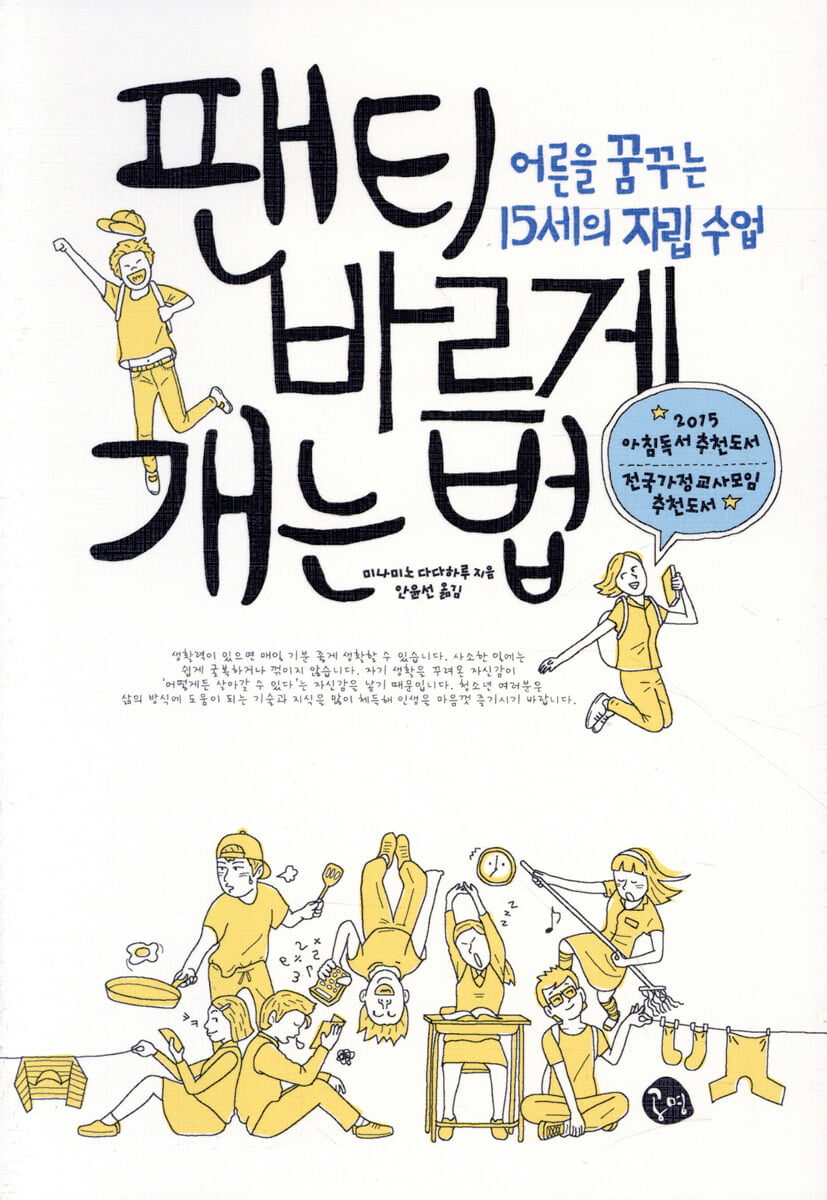
How to properly open your panties
 |
Description
Book Introduction
A vivid story of a school-based self-reliance class designed to empower youth with the "strength to live" and the "strength to fully enjoy life." ― 'If I can enjoy every day, be happy with people, and live my life on my own, then life is a great success!' A teacher's class on the four major areas of self-reliance and life skills. Let's ask this question to middle and high school students who are becoming adults. “Can you wake up on your own without anyone waking you up?” “Can you cook rice, since it’s food you’ll be eating for the rest of your life?” “Have you ever done laundry? And do you have your own way of folding your underwear correctly?” “Are you having a good time every day?” What if you are a teenager who can readily answer “yes!” here? They can be considered positive individuals who do not become frustrated or depressed when faced with the difficulties they often encounter in life, but rather live each day happily, adapt well to their families and society, and lead fulfilling lives. Mr. Tadaharu Minamino, Japan's first male home economics teacher, made this claim, giving a fresh shock to the Japanese education world. If you can enjoy life, which is made up of each day, and have the power to truly love yourself, if you can acquire this power during your youth, you can grow into a healthy adult and live a happy life, regardless of your current grades and environment. Mr. Minamino says this is based on self-reliance and vitality. The book that contains the contents of the self-reliance class taught by Minamino Tadaharu, a home economics teacher, on this topic is “How to Open Your Panties Correctly” (published by Gongmyeong Publishing). This book attracted attention in 2012 when it ranked 8th in the Japan New Book Award, a rare achievement for an educational book, as it selected only the top 20 best works among tens of thousands of new publications in Japan. Through discussions with students who enthusiastically participate in class and complete assignments, readers of this book will also enjoy this enjoyable self-reliance class together with them and gradually acquire weapons for life through Chapter 1, 'Self-reliance Class 1 - The Power to Live in the Present', Chapter 2, 'Self-reliance Class 2 - Living in the Family', Chapter 3, 'Self-reliance Class 3 - Living in Society', and Chapter 4, 'Self-reliance Class 4 - Skills for a Rich Life'. |
- You can preview some of the book's contents.
Preview
index
Recommendation_For teenagers who love themselves and want to become real adults.
Author's Note: I want to remind you of the great power of vitality and independence as you grow into adulthood.
Introduction: Important Life Lessons from the Panty Dog Law
There are many ways to change your underwear | Understanding the differences between each other | People with vitality are also mentally strong.
Chapter 1_ Self-Reliance Lesson 1 / The Power of Living in the Present
Packing Your Own Lunch | Waking Up | The Precious Breakfast | Developing the 'Four Keys of Self-Reliance' - Personal, Mental, Financial, and Sexual Independence 6 0
Finding the Meaning of Studying in Everyday Life | The 'Three Key Subjects' You're Missing Out on While Focusing on Korean, English, and Math
Chapter 2: Self-Reliance Lesson 2 / Living in a Family
What do you think family is? | Those who consider themselves family are family to that person. | The scope of family in my opinion. | When you realize the true meaning of family. | Thoughts on the family table. | Challenge yourself to treat the whole family to a meal! | What are the conditions for family? | Understanding human relationships through the lens of an 'ideal marriage partner.'
Chapter 3: Self-Reliance Lesson 3 / Living in Society
About working | Reflecting on the true meaning of labor | To be human, you must have social skills | Now is the time to know how to use money | Become a wise consumer who is not fooled by this harsh world | Earning money on your own | Develop the ability to live without being swayed by money | How to handle money | Know your workers' rights | The era where work-life balance is important is coming | Is it too early to prepare for retirement? | Imagine myself at 100 | Think about preparing for retirement at least once | I like practical training the most | Skills that make my life enjoyable | Develop the ability to live and accept the ways of others
Chapter 4_ Self-Reliance Lesson 4 / Skills for a Rich Life
What's your play level? | DV-free, Creating Equal Relationships | About Sexual Independence | Build Respectful Family Relationships for an Independent Life | A person who knows how to have fun is an independent person.
Conclusion: Hints for a Happy Everyday Life and a Better You
Author's Note: I want to remind you of the great power of vitality and independence as you grow into adulthood.
Introduction: Important Life Lessons from the Panty Dog Law
There are many ways to change your underwear | Understanding the differences between each other | People with vitality are also mentally strong.
Chapter 1_ Self-Reliance Lesson 1 / The Power of Living in the Present
Packing Your Own Lunch | Waking Up | The Precious Breakfast | Developing the 'Four Keys of Self-Reliance' - Personal, Mental, Financial, and Sexual Independence 6 0
Finding the Meaning of Studying in Everyday Life | The 'Three Key Subjects' You're Missing Out on While Focusing on Korean, English, and Math
Chapter 2: Self-Reliance Lesson 2 / Living in a Family
What do you think family is? | Those who consider themselves family are family to that person. | The scope of family in my opinion. | When you realize the true meaning of family. | Thoughts on the family table. | Challenge yourself to treat the whole family to a meal! | What are the conditions for family? | Understanding human relationships through the lens of an 'ideal marriage partner.'
Chapter 3: Self-Reliance Lesson 3 / Living in Society
About working | Reflecting on the true meaning of labor | To be human, you must have social skills | Now is the time to know how to use money | Become a wise consumer who is not fooled by this harsh world | Earning money on your own | Develop the ability to live without being swayed by money | How to handle money | Know your workers' rights | The era where work-life balance is important is coming | Is it too early to prepare for retirement? | Imagine myself at 100 | Think about preparing for retirement at least once | I like practical training the most | Skills that make my life enjoyable | Develop the ability to live and accept the ways of others
Chapter 4_ Self-Reliance Lesson 4 / Skills for a Rich Life
What's your play level? | DV-free, Creating Equal Relationships | About Sexual Independence | Build Respectful Family Relationships for an Independent Life | A person who knows how to have fun is an independent person.
Conclusion: Hints for a Happy Everyday Life and a Better You
Into the book
One male student announced:
“I made omelet rice on August 30th and the three of us ate it: my father, mother, and I.
The reason I chose omelet rice was simple, and it was because I wanted to eat omelet rice at the time.
When I didn't know how to make it, my mother taught me.
But, since I couldn't stop crying from the beginning when I was chopping onions, my mother did most of the chopping for me.
It's done by pouring tomato ketchup on the rice, mixing it in, and covering it with a fried egg, but I couldn't make the fried egg look pretty, so the egg ended up tangled.
First I made omelet for my father, then for my mother, and finally for myself, but my father's omelet was terrible.
Honestly, it ended up being more like fried rice with ketchup than an omelet rice.
Although the last one I made was the prettiest, I was very disappointed because the rice I had sprinkled ketchup on ended up completely cold.
After the meal, my father didn't say much and my mother said it was delicious, but to be honest, I didn't like it.
It was very refreshing.
The omelet rice my mother used to make is ten times more delicious.
“Once again, I felt the greatness of my mother.”
As I recalled the scene of their struggle, my students and I burst into laughter.
“It must be hard to chop onions finely,” “I worked hard to make it, but it’s too much for your father to not comment,” and other comments followed.
As many students seemed to have had the same experience, shouts of “Good job!” could be heard here and there after the presentation.
There were also students who were good at cooking and often tried cooking during summer vacation and made various dishes.
At times like that, my students and I would not spare our praise, saying, “That’s amazing.”
Whether it was a story of failure or success, the classroom atmosphere was brightened by the warm laughter and stories of empathy.
The expressions on the students' faces as they presented were shining with the joy of having accomplished something.
The purpose of this assignment is twofold:
The first is the experience of ‘doing something for someone (family)’.
This is because students have a lot of 'receiving' experience, including cooking, but they lack the experience of 'giving' to others. (Omitted)
Second, it is to make students and parents feel that even though they are high school students, they can fully play their roles in daily life with their families.
High school students are no longer dependent children who must be looked after by their parents. While they may not be on equal footing with their parents, they can fulfill their roles as full members of the family.
When you are given a clear role within the family and try to fulfill it, you also develop a sense of responsibility.
It will be good training for students who are taking a step forward as adults.
It is not something to be taken lightly and called 'just housework'.
Housework is actually connected to various disciplines that occur in society.
The sooner you become aware of this, the sooner you can become independent.
---From "Challenge to Treat the Whole Family to a Meal!"
There are students who sleep during class without a care, and among them, there are some experts who sleep soundly from the first period.
Some of you may recall something similar. It's from when I was a rookie teacher.
I woke up the sleeping students right away, hoping they would listen to the class properly.
“Did you stay up all night last night?” “Wake up!” I wake them up, but if they respond with “I couldn’t sleep at all last night” or “I’ll sleep a little more,” that’s better. Some students just sleep silently without saying anything.
I thought that students sleeping during class was due to their irregular schedules.
But surprisingly, the students answered, “I went to bed early last night” and “I try not to fall asleep during class.”
My mind was filled with questions like, "Why do I sleep in the morning even though I've had enough sleep? If I'm interested in attending class, could it be because I simply don't want to study?"
That's when I heard about blood sugar levels.
It's already been 20 years.
My ears perked up at the sound of a voice coming from the radio.
“They say that eating something sweet when you’re tired gives you energy.
Sweet foods raise blood sugar levels.
Blood sugar level refers to the concentration of glucose in the blood.
Glucose is the energy source for cells.
However, if you consume more than necessary, your body will react, and you may feel mentally foggy or lose motivation, just like before you go to sleep.
If you gulp down sugary juice or cola for breakfast or eat too much cake or sweets, you may feel dizzy or have trouble fighting off sleepiness by the time first period starts.
What about you? The impact of food on our bodies is so profound that it's hard to fathom." I immediately realized, "Aha! This is the cause!"
(syncopation)
If you're going to wake up on your own in the morning, I hope you've had a proper breakfast.
You shouldn't dismiss it as "just breakfast."
Because it's an opportunity to hear the sounds coming from my own body.
And if we're going to eat breakfast anyway, let's research a diet that responds to the voices of our body and mind.
Discussing it with your family is also a good idea.
For the new generation, who are concerned about lifestyle-related diseases, a balanced diet is very important.
To wake up refreshed in the morning, it is recommended to eat dinner with about 80 percent of your stomach empty (stop eating just before you are full) and finish eating no later than three hours before going to bed.
This way, you can sleep well without putting a strain on your stomach, and wake up in the morning with your eyes wide open on an empty stomach.
So, have you decided what you're going to have for breakfast tomorrow?
---From "A Very Precious Breakfast"
I believe that the four major self-reliances written on the board are important for growing into an adult.
So, in classes on the topic of ‘self-reliance,’ we always emphasize these four major self-reliances.
Because you can look at yourself objectively as much as you have done the ‘Self-reliance Check’.
Now, let me explain each independence.
'Life independence' refers to the basic ability necessary for living, the ability to lead a comfortable life on one's own without relying on others.
When birds and animals grow up, they build and maintain their own nests and provide their own food.
Just live your life in a way that is comfortable for you and within the limits that you can accept.
It doesn't matter if you're not good at cooking or cleaning.
There is no need to compare yourself to others.
If you are a middle or high school student and live with your family, it is common for parents and other people to be the mainstays of your life.
Rather than being lazy and complaining to your family members about how to live, practicing being able to do things on your own is the shortcut to becoming independent.
To do this, you need to acquire the skills necessary for life quickly.
The feeling that 'I can do it on my own' will undoubtedly be the greatest source of confidence.
'Mental independence' is the power to make your own final decisions and take responsibility for them.
It's wonderful to have someone you can turn to for advice when you're in trouble or struggling.
But ultimately, you have to be able to decide for yourself how to resolve it.
Even decisions made after careful thought and consideration can fail.
There may be times when you think, 'I should have chosen B instead of A.'
It's okay to fail.
No, it is true that it fails.
You can learn a lot there.
Rather, the problem is blaming others when you fail.
'Financial independence' is the ability to lead a predictable life, such as spending within your means.
It is not enough to just earn the income you need to live.
It is important to balance your income and expenses.
For middle and high school students, we check whether they can live within the scope of their allowance or part-time job income.
One way to monitor your money flow is to create a spending journal.
It's a fascinating experience to know how much money you spend on things like cell phone bills and socializing with friends.
By accumulating such experiences, you will acquire the power to use your money systematically, thinking about the balance between your income and expenses.
It also gives you the strength to live your life predicting the future when you become a member of society.
'Sexual independence' refers to a state in which each person can enjoy their own 'sex' happily without using it as a purpose or tool for something, or without being used or violated by others.
Some people think of sex as a tool for forming relationships, as it can enrich relationships and even be a force that attracts people.
But sex is only a part of human nature.
If you have the strength to build strong relationships, you won't be swayed more than necessary.
We will discuss sexual independence in more detail in the next chapter.
“I made omelet rice on August 30th and the three of us ate it: my father, mother, and I.
The reason I chose omelet rice was simple, and it was because I wanted to eat omelet rice at the time.
When I didn't know how to make it, my mother taught me.
But, since I couldn't stop crying from the beginning when I was chopping onions, my mother did most of the chopping for me.
It's done by pouring tomato ketchup on the rice, mixing it in, and covering it with a fried egg, but I couldn't make the fried egg look pretty, so the egg ended up tangled.
First I made omelet for my father, then for my mother, and finally for myself, but my father's omelet was terrible.
Honestly, it ended up being more like fried rice with ketchup than an omelet rice.
Although the last one I made was the prettiest, I was very disappointed because the rice I had sprinkled ketchup on ended up completely cold.
After the meal, my father didn't say much and my mother said it was delicious, but to be honest, I didn't like it.
It was very refreshing.
The omelet rice my mother used to make is ten times more delicious.
“Once again, I felt the greatness of my mother.”
As I recalled the scene of their struggle, my students and I burst into laughter.
“It must be hard to chop onions finely,” “I worked hard to make it, but it’s too much for your father to not comment,” and other comments followed.
As many students seemed to have had the same experience, shouts of “Good job!” could be heard here and there after the presentation.
There were also students who were good at cooking and often tried cooking during summer vacation and made various dishes.
At times like that, my students and I would not spare our praise, saying, “That’s amazing.”
Whether it was a story of failure or success, the classroom atmosphere was brightened by the warm laughter and stories of empathy.
The expressions on the students' faces as they presented were shining with the joy of having accomplished something.
The purpose of this assignment is twofold:
The first is the experience of ‘doing something for someone (family)’.
This is because students have a lot of 'receiving' experience, including cooking, but they lack the experience of 'giving' to others. (Omitted)
Second, it is to make students and parents feel that even though they are high school students, they can fully play their roles in daily life with their families.
High school students are no longer dependent children who must be looked after by their parents. While they may not be on equal footing with their parents, they can fulfill their roles as full members of the family.
When you are given a clear role within the family and try to fulfill it, you also develop a sense of responsibility.
It will be good training for students who are taking a step forward as adults.
It is not something to be taken lightly and called 'just housework'.
Housework is actually connected to various disciplines that occur in society.
The sooner you become aware of this, the sooner you can become independent.
---From "Challenge to Treat the Whole Family to a Meal!"
There are students who sleep during class without a care, and among them, there are some experts who sleep soundly from the first period.
Some of you may recall something similar. It's from when I was a rookie teacher.
I woke up the sleeping students right away, hoping they would listen to the class properly.
“Did you stay up all night last night?” “Wake up!” I wake them up, but if they respond with “I couldn’t sleep at all last night” or “I’ll sleep a little more,” that’s better. Some students just sleep silently without saying anything.
I thought that students sleeping during class was due to their irregular schedules.
But surprisingly, the students answered, “I went to bed early last night” and “I try not to fall asleep during class.”
My mind was filled with questions like, "Why do I sleep in the morning even though I've had enough sleep? If I'm interested in attending class, could it be because I simply don't want to study?"
That's when I heard about blood sugar levels.
It's already been 20 years.
My ears perked up at the sound of a voice coming from the radio.
“They say that eating something sweet when you’re tired gives you energy.
Sweet foods raise blood sugar levels.
Blood sugar level refers to the concentration of glucose in the blood.
Glucose is the energy source for cells.
However, if you consume more than necessary, your body will react, and you may feel mentally foggy or lose motivation, just like before you go to sleep.
If you gulp down sugary juice or cola for breakfast or eat too much cake or sweets, you may feel dizzy or have trouble fighting off sleepiness by the time first period starts.
What about you? The impact of food on our bodies is so profound that it's hard to fathom." I immediately realized, "Aha! This is the cause!"
(syncopation)
If you're going to wake up on your own in the morning, I hope you've had a proper breakfast.
You shouldn't dismiss it as "just breakfast."
Because it's an opportunity to hear the sounds coming from my own body.
And if we're going to eat breakfast anyway, let's research a diet that responds to the voices of our body and mind.
Discussing it with your family is also a good idea.
For the new generation, who are concerned about lifestyle-related diseases, a balanced diet is very important.
To wake up refreshed in the morning, it is recommended to eat dinner with about 80 percent of your stomach empty (stop eating just before you are full) and finish eating no later than three hours before going to bed.
This way, you can sleep well without putting a strain on your stomach, and wake up in the morning with your eyes wide open on an empty stomach.
So, have you decided what you're going to have for breakfast tomorrow?
---From "A Very Precious Breakfast"
I believe that the four major self-reliances written on the board are important for growing into an adult.
So, in classes on the topic of ‘self-reliance,’ we always emphasize these four major self-reliances.
Because you can look at yourself objectively as much as you have done the ‘Self-reliance Check’.
Now, let me explain each independence.
'Life independence' refers to the basic ability necessary for living, the ability to lead a comfortable life on one's own without relying on others.
When birds and animals grow up, they build and maintain their own nests and provide their own food.
Just live your life in a way that is comfortable for you and within the limits that you can accept.
It doesn't matter if you're not good at cooking or cleaning.
There is no need to compare yourself to others.
If you are a middle or high school student and live with your family, it is common for parents and other people to be the mainstays of your life.
Rather than being lazy and complaining to your family members about how to live, practicing being able to do things on your own is the shortcut to becoming independent.
To do this, you need to acquire the skills necessary for life quickly.
The feeling that 'I can do it on my own' will undoubtedly be the greatest source of confidence.
'Mental independence' is the power to make your own final decisions and take responsibility for them.
It's wonderful to have someone you can turn to for advice when you're in trouble or struggling.
But ultimately, you have to be able to decide for yourself how to resolve it.
Even decisions made after careful thought and consideration can fail.
There may be times when you think, 'I should have chosen B instead of A.'
It's okay to fail.
No, it is true that it fails.
You can learn a lot there.
Rather, the problem is blaming others when you fail.
'Financial independence' is the ability to lead a predictable life, such as spending within your means.
It is not enough to just earn the income you need to live.
It is important to balance your income and expenses.
For middle and high school students, we check whether they can live within the scope of their allowance or part-time job income.
One way to monitor your money flow is to create a spending journal.
It's a fascinating experience to know how much money you spend on things like cell phone bills and socializing with friends.
By accumulating such experiences, you will acquire the power to use your money systematically, thinking about the balance between your income and expenses.
It also gives you the strength to live your life predicting the future when you become a member of society.
'Sexual independence' refers to a state in which each person can enjoy their own 'sex' happily without using it as a purpose or tool for something, or without being used or violated by others.
Some people think of sex as a tool for forming relationships, as it can enrich relationships and even be a force that attracts people.
But sex is only a part of human nature.
If you have the strength to build strong relationships, you won't be swayed more than necessary.
We will discuss sexual independence in more detail in the next chapter.
---From "Achieving the 'Four Major Independences': Lifestyle, Mental, Economic, and Sexual Independence"
Publisher's Review
What happened before an English teacher became the nation's only male home economics teacher?
― I rethink the education system that focuses solely on Korean, English, and math, but misses out on the three core subjects (health, physical education, arts, and technology and home economics) that are so crucial for life studies.
Mr. Minamino was a successful English teacher.
Then, I was shocked to see that most students were dozing off during class and were leading a listless school life without any motivation to participate in class.
At first, I thought the cause was an irregular lifestyle or a personal mental problem.
But gradually, I realized that the reason was that students were not managing and enjoying their daily lives well.
Afterwards, he began to research the question, 'What is the power that must be acquired during adolescence to properly live the long life that lies ahead?'
And I transferred to the technology home economics department as a teacher who intensively teaches these parts as curriculum content (for example, the problem of children who are sleepy from the morning is mostly due to excessive intake of 'glucose' from eating too much sweet food in their daily life - text 55p).
He became Japan's first male teacher of technical home economics.
"How to Wear Your Panties Correctly" is a book written based on vivid classroom experiences that teach children the "four major independences (life, economic, mental, and sexual independence)" and "life skills" through actual home economics subjects to equip them with the "strength to live" in order to live their lives.
The teenage years are a crucial, once-in-a-lifetime period when we dream of leaving childhood behind and becoming adults.
Through his students, he came to realize that the independence and vitality that were naturally required at this time were the 'strength to live life from now on.'
The author's so-called "4 major self-reliance training classes" are the most core messages of this book: getting up on your own, cooking a meal, preparing a meal and serving it to your family, looking at your parents' pay slips to understand your family's finances, thinking about your allowance, acquiring practical knowledge about part-time job common sense and protection laws, thinking about what a family is, thinking about your ideal spouse, thinking about the right sexual relationship, planning for "my 100 years old," etc.
Our youth must also be able to acquire strengths beyond just Korean, English, and math knowledge.
The self-reliance test presented in this book shows that it doesn't take much time or effort to get through your day on your own.
It's just that your own will is more important.
“Let’s not assume it’s difficult or impossible, but rather find the ‘joy of the morning’ in whatever it is.
And let's enjoy the act itself that happens.
When you find joy in waking up, life is already more than halfway there.
“Once you can control the start of your day, you will also become more adept at managing your time.” (p. 53, from ‘Getting Up on Your Own’) This passage clearly explains the method and meaning of ‘getting up on your own’, which is seen as the beginning of vitality.
Also, the homework of 'treating the whole family to a meal', which Mr. Minamino always assigns during vacation, allows children who are used to receiving and are new to doing something for their family to learn the 'joy of giving'.
It also carries the meaning of making people pay more attention to other family members they live with, who they may have become indifferent to while focusing only on studying.
Our teenagers spend all day commuting between school and academy, and it is difficult for them to even eat the meals prepared by their mothers on time.
Perhaps that is why this book strongly emphasizes education, which we take for granted and miss out on.
The most important thing is to raise a child who is independent enough to cook his or her own meals, learn how to do his or her own laundry, learn how to fold his or her own laundry, learn how to be economically independent enough to be aware of the household's financial situation and think about how to spend money, learn how to be mentally independent enough to be faithful to what needs to be done even if he or she doesn't want to do it, and learn how to be sexually independent enough to have the right mindset about sexual relations and the blind sexual demands of friends of the opposite sex.
The author defines the three main subjects that students miss out on while only pursuing Korean, English, and math, but that they must pay attention to for a rich life. He chose them as 'Health and Physical Education - a subject that cultivates the emotions of the body', 'Art - a subject that cultivates the emotions of the mind', and 'Technology and Home Economics - a subject that cultivates the emotions of life'.
The author's loving argument is that rather than half-assed studying just for the college entrance exam, students should actively and timely pursue studies that cannot be missed when considering their long life.
If you value yourself, enjoy each day, and are ready to truly enjoy life, you will become an independent adult who is not afraid of life.
―If you don't easily leave your life skills to your mother and take care of them yourself, you will have a pleasant day and a strong confidence that 'I can survive somehow!', and you will have a strong mentality.
Then, you can live life to the fullest.
The responses of students participating in self-reliance classes are surprisingly energetic, proactive, genuine, and cheerful.
We encounter new topics in our daily lives that we have never thought about before, and without realizing it, a serious thirst for knowledge is rekindled, and we delve into them with surprising earnestness and enthusiasm.
In a class that asks about the true categories and meaning of family, the students' bewilderment is vividly revealed as they confront themselves with the fact that they have never seriously reflected on the concept of family, which they had taken for granted.
And we gather strength in the conclusion that 'the people we consider family are family to us.'
A scene where a student who presents the homework of 'treating a family to a meal' feels embarrassed by the realistic reactions of his family but also feels a deep attachment to his family; a serious and passionate reaction of teenagers in a bidding card class that takes things a step further and makes them think about marriage partners, when up until now they had only been interested in friends of the opposite sex; and a fun and diverse class content that teaches consideration and social skills to accept various ways of opening panties. As readers watch, they come across one clear message in these days when the youth suicide rate has reached a dangerous level.
'Yes, this is the kind of learning that adolescence should be about, to grow into a person who knows how to enjoy life, how to take responsibility, and how to love oneself.'
Recommendation
Home economics deals with individual and family life and real life experiences.
We want to help students develop the ability to recognize and solve real-life problems.
What experiences have you had as a family man? Do you have your own "panty-opening method" developed from your own experiences?
"How to Open Your Underwear Correctly" by Mr. Tadaharu Minamino, a male teacher at a Japanese high school's Home Economics Department, talks about cultivating this "power to live a real life" in young people.
Starting with independence in life that enables the resolution of basic human needs and survival, it is said that the four major independences are 'economic independence, mental independence, and sexual independence.'
The four strengths of independence that Mr. Tadaharu Minamino seeks to foster through his home economics course are the result of conversations he had with students who, while working as an English teacher, were unmotivated, irritable, and uncomfortable, and had difficulty adjusting to school life.
I realized that such behaviors do not arise from the students' mindset that they find school life annoying and should just do it half-heartedly, but rather that the problem lies in the way they live their lives.
Teacher Tadaharu Minamino even changed his major from English to Technology and Home Economics to help his students. "How to Fold Your Panties Correctly" vividly illustrates how he helped students transform their lives through Technology and Home Economics.
The scenes from the classes, which were implemented with the goal of fostering the four major powers of self-reliance, namely 'life skills', begin with the meaning of 'working' and cover not only the story of part-time jobs, that is, the act of earning money, but also the social meaning and influence of 'labor', the act of making money.
It helps young people to look at their own and their families' problems clearly, not only from a personal and family perspective, but also from a social perspective.
[From the ''National Association of Orthodox Teachers'' recommendation]
[Amazon Japan Book Review]
***** Although this book is written for middle and high school students, I highly recommend it to everyone: married people, people preparing for marriage, men who work hard and neglect their families before retirement, and women who have barely managed to do housework in double-income households.
***** 'I hope you enjoy life to the fullest.'
This is what the author wants to convey to the readers through this book.
To do so, it provides various thoughts and perspectives to cultivate the 'life force' and 'independence' that are absolutely necessary.
This is a must-read book for both teenagers and adults.
***** I want to tell young people right now, “You must read this book because it teaches you important things about life!”
This is a truly valuable book that I believe will be of some help in living in this harsh world.
― I rethink the education system that focuses solely on Korean, English, and math, but misses out on the three core subjects (health, physical education, arts, and technology and home economics) that are so crucial for life studies.
Mr. Minamino was a successful English teacher.
Then, I was shocked to see that most students were dozing off during class and were leading a listless school life without any motivation to participate in class.
At first, I thought the cause was an irregular lifestyle or a personal mental problem.
But gradually, I realized that the reason was that students were not managing and enjoying their daily lives well.
Afterwards, he began to research the question, 'What is the power that must be acquired during adolescence to properly live the long life that lies ahead?'
And I transferred to the technology home economics department as a teacher who intensively teaches these parts as curriculum content (for example, the problem of children who are sleepy from the morning is mostly due to excessive intake of 'glucose' from eating too much sweet food in their daily life - text 55p).
He became Japan's first male teacher of technical home economics.
"How to Wear Your Panties Correctly" is a book written based on vivid classroom experiences that teach children the "four major independences (life, economic, mental, and sexual independence)" and "life skills" through actual home economics subjects to equip them with the "strength to live" in order to live their lives.
The teenage years are a crucial, once-in-a-lifetime period when we dream of leaving childhood behind and becoming adults.
Through his students, he came to realize that the independence and vitality that were naturally required at this time were the 'strength to live life from now on.'
The author's so-called "4 major self-reliance training classes" are the most core messages of this book: getting up on your own, cooking a meal, preparing a meal and serving it to your family, looking at your parents' pay slips to understand your family's finances, thinking about your allowance, acquiring practical knowledge about part-time job common sense and protection laws, thinking about what a family is, thinking about your ideal spouse, thinking about the right sexual relationship, planning for "my 100 years old," etc.
Our youth must also be able to acquire strengths beyond just Korean, English, and math knowledge.
The self-reliance test presented in this book shows that it doesn't take much time or effort to get through your day on your own.
It's just that your own will is more important.
“Let’s not assume it’s difficult or impossible, but rather find the ‘joy of the morning’ in whatever it is.
And let's enjoy the act itself that happens.
When you find joy in waking up, life is already more than halfway there.
“Once you can control the start of your day, you will also become more adept at managing your time.” (p. 53, from ‘Getting Up on Your Own’) This passage clearly explains the method and meaning of ‘getting up on your own’, which is seen as the beginning of vitality.
Also, the homework of 'treating the whole family to a meal', which Mr. Minamino always assigns during vacation, allows children who are used to receiving and are new to doing something for their family to learn the 'joy of giving'.
It also carries the meaning of making people pay more attention to other family members they live with, who they may have become indifferent to while focusing only on studying.
Our teenagers spend all day commuting between school and academy, and it is difficult for them to even eat the meals prepared by their mothers on time.
Perhaps that is why this book strongly emphasizes education, which we take for granted and miss out on.
The most important thing is to raise a child who is independent enough to cook his or her own meals, learn how to do his or her own laundry, learn how to fold his or her own laundry, learn how to be economically independent enough to be aware of the household's financial situation and think about how to spend money, learn how to be mentally independent enough to be faithful to what needs to be done even if he or she doesn't want to do it, and learn how to be sexually independent enough to have the right mindset about sexual relations and the blind sexual demands of friends of the opposite sex.
The author defines the three main subjects that students miss out on while only pursuing Korean, English, and math, but that they must pay attention to for a rich life. He chose them as 'Health and Physical Education - a subject that cultivates the emotions of the body', 'Art - a subject that cultivates the emotions of the mind', and 'Technology and Home Economics - a subject that cultivates the emotions of life'.
The author's loving argument is that rather than half-assed studying just for the college entrance exam, students should actively and timely pursue studies that cannot be missed when considering their long life.
If you value yourself, enjoy each day, and are ready to truly enjoy life, you will become an independent adult who is not afraid of life.
―If you don't easily leave your life skills to your mother and take care of them yourself, you will have a pleasant day and a strong confidence that 'I can survive somehow!', and you will have a strong mentality.
Then, you can live life to the fullest.
The responses of students participating in self-reliance classes are surprisingly energetic, proactive, genuine, and cheerful.
We encounter new topics in our daily lives that we have never thought about before, and without realizing it, a serious thirst for knowledge is rekindled, and we delve into them with surprising earnestness and enthusiasm.
In a class that asks about the true categories and meaning of family, the students' bewilderment is vividly revealed as they confront themselves with the fact that they have never seriously reflected on the concept of family, which they had taken for granted.
And we gather strength in the conclusion that 'the people we consider family are family to us.'
A scene where a student who presents the homework of 'treating a family to a meal' feels embarrassed by the realistic reactions of his family but also feels a deep attachment to his family; a serious and passionate reaction of teenagers in a bidding card class that takes things a step further and makes them think about marriage partners, when up until now they had only been interested in friends of the opposite sex; and a fun and diverse class content that teaches consideration and social skills to accept various ways of opening panties. As readers watch, they come across one clear message in these days when the youth suicide rate has reached a dangerous level.
'Yes, this is the kind of learning that adolescence should be about, to grow into a person who knows how to enjoy life, how to take responsibility, and how to love oneself.'
Recommendation
Home economics deals with individual and family life and real life experiences.
We want to help students develop the ability to recognize and solve real-life problems.
What experiences have you had as a family man? Do you have your own "panty-opening method" developed from your own experiences?
"How to Open Your Underwear Correctly" by Mr. Tadaharu Minamino, a male teacher at a Japanese high school's Home Economics Department, talks about cultivating this "power to live a real life" in young people.
Starting with independence in life that enables the resolution of basic human needs and survival, it is said that the four major independences are 'economic independence, mental independence, and sexual independence.'
The four strengths of independence that Mr. Tadaharu Minamino seeks to foster through his home economics course are the result of conversations he had with students who, while working as an English teacher, were unmotivated, irritable, and uncomfortable, and had difficulty adjusting to school life.
I realized that such behaviors do not arise from the students' mindset that they find school life annoying and should just do it half-heartedly, but rather that the problem lies in the way they live their lives.
Teacher Tadaharu Minamino even changed his major from English to Technology and Home Economics to help his students. "How to Fold Your Panties Correctly" vividly illustrates how he helped students transform their lives through Technology and Home Economics.
The scenes from the classes, which were implemented with the goal of fostering the four major powers of self-reliance, namely 'life skills', begin with the meaning of 'working' and cover not only the story of part-time jobs, that is, the act of earning money, but also the social meaning and influence of 'labor', the act of making money.
It helps young people to look at their own and their families' problems clearly, not only from a personal and family perspective, but also from a social perspective.
[From the ''National Association of Orthodox Teachers'' recommendation]
[Amazon Japan Book Review]
***** Although this book is written for middle and high school students, I highly recommend it to everyone: married people, people preparing for marriage, men who work hard and neglect their families before retirement, and women who have barely managed to do housework in double-income households.
***** 'I hope you enjoy life to the fullest.'
This is what the author wants to convey to the readers through this book.
To do so, it provides various thoughts and perspectives to cultivate the 'life force' and 'independence' that are absolutely necessary.
This is a must-read book for both teenagers and adults.
***** I want to tell young people right now, “You must read this book because it teaches you important things about life!”
This is a truly valuable book that I believe will be of some help in living in this harsh world.
GOODS SPECIFICS
- Date of publication: December 24, 2014
- Page count, weight, size: 252 pages | 404g | 145*207*20mm
- ISBN13: 9788997870073
- ISBN10: 8997870076
You may also like
카테고리
korean


korean

![GQ KOREA Mark (Monthly): December [2025]](http://librairie.coreenne.fr/cdn/shop/files/8ef265dbbfbf186523ed75ba7319009d.jpg?v=1765340328&width=3840)


