

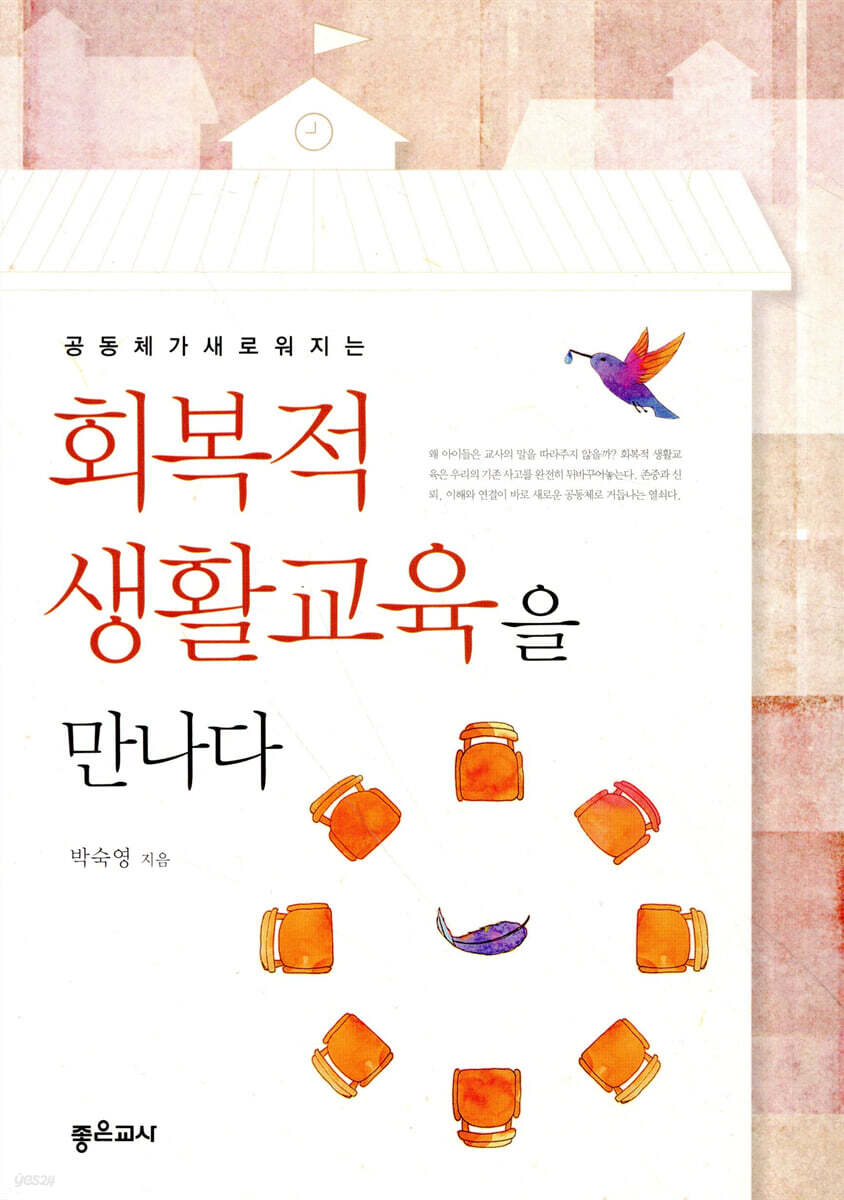
Discover restorative life education that renews communities.
 |
Description
Book Introduction
I want to experience a new community based on isolation and alienation.
Everyone is invited.
I believed that as my teaching career grew, my expertise would increase and my life as a teacher would become easier, but as time went on, guiding students became more difficult and my authority as a teacher began to erode.
Day by day, doubts about my teaching career and feelings of helplessness crept in, and through exhausting fights with the children, I had become a cruel and harsh teacher monster.
What on earth is the problem? I started asking myself.
Why did this fight start, what does this fight mean to me, what do I want, and what do my children want?
After much deliberation, I came across ‘recovery life education.’
Unlike 'life guidance', which primarily focuses on regulation and control, 'restorative life education' focuses on how to elicit cooperation and respect from students.
It focuses on ‘connection’ rather than ‘disconnection and confrontation’, and on ‘empathy’ rather than ‘shame’.
This is a method that completely changes the paradigm, overturning all the values and philosophies we previously had.
Teacher Park Sook-young has included in this book the story of her challenge to find new possibilities.
"Meeting Restorative Life Education that Renews Communities" begins with a detailed analysis and reflection on why life guidance based on oppression, coercion, intimidation, and shame makes students more rebellious, and why such mechanisms are ineffective.
Over the past four years, I have been conducting training and lectures based on my research and application of restorative living education. Through these experiences, I have discovered that "connection," "empathy," "understanding," and "respect" are the keys to creating a new community.
This book tells us, based on experience and learning, why we now have no choice but to make these choices.
Everyone is invited.
I believed that as my teaching career grew, my expertise would increase and my life as a teacher would become easier, but as time went on, guiding students became more difficult and my authority as a teacher began to erode.
Day by day, doubts about my teaching career and feelings of helplessness crept in, and through exhausting fights with the children, I had become a cruel and harsh teacher monster.
What on earth is the problem? I started asking myself.
Why did this fight start, what does this fight mean to me, what do I want, and what do my children want?
After much deliberation, I came across ‘recovery life education.’
Unlike 'life guidance', which primarily focuses on regulation and control, 'restorative life education' focuses on how to elicit cooperation and respect from students.
It focuses on ‘connection’ rather than ‘disconnection and confrontation’, and on ‘empathy’ rather than ‘shame’.
This is a method that completely changes the paradigm, overturning all the values and philosophies we previously had.
Teacher Park Sook-young has included in this book the story of her challenge to find new possibilities.
"Meeting Restorative Life Education that Renews Communities" begins with a detailed analysis and reflection on why life guidance based on oppression, coercion, intimidation, and shame makes students more rebellious, and why such mechanisms are ineffective.
Over the past four years, I have been conducting training and lectures based on my research and application of restorative living education. Through these experiences, I have discovered that "connection," "empathy," "understanding," and "respect" are the keys to creating a new community.
This book tells us, based on experience and learning, why we now have no choice but to make these choices.
- You can preview some of the book's contents.
Preview
index
Recommendation - Dreaming of 'Recovery of Education' through 'Recovery Education'
Prologue - What Teachers Really Want
Chapter 1: Life Guidance at its Limits
1.
Lost Teacher
2.
“I never learned proper leadership.”
3.
How to change behavior?
4.
Shame, an emotion that leads to violence
Chapter 2: Can We Meet Children with Our Hearts?
1.
Not punishment, but voluntary responsibility
2.
Life education based on trust and respect
3.
The Road to a Safe Classroom for Everyone
4.
A gift received when there is mutual respect
Chapter 3: Building a Restorative Classroom Community
1.
Share the pain and move forward together
2.
A class where relationships come first
3.
Only when we meet them as they are can we truly change.
4.
Conflict Becomes an Opportunity for Growth and Learning
5.
The Power of Equality, Circle Meetings
6.
It's fun when everyone agrees on the rules.
Chapter 4: Children Grow When Teachers Change
1.
“What we really want is not a game.”
2.
Teachers are creators of space
3.
Constantly ask questions and have conversations
4.
Teacher Leadership that Drives Collaboration
5.
Breaking free from the perpetrator-victim dichotomy
Chapter 5: One Class's Small Challenge Changes the World
1.
I hear the vivid voice of change.
2.
Embracing both light and shadow
3.
Teachers Creating Shortcuts to a Restorative Society
Epilogue - "I'm just doing what I can."
Appendix - Introduction to the Korean Restorative Justice Network
About the author?
Publisher's Review
Why don't children follow their teachers? What exactly went wrong? Where did it all begin?
Park Sook-young, a teacher who has been working with 'recovery life education' as her calling,
It summarizes everything I have experienced and learned over the past four years.
I want to experience a new community based on isolation and alienation.
Everyone is invited.
I believed that as my teaching career grew, my expertise would increase and my life as a teacher would become easier, but as time went on, guiding students became more difficult and my authority as a teacher began to erode.
Day by day, doubts about my teaching career and feelings of helplessness crept in, and through exhausting fights with the children, I had become a cruel and harsh teacher monster.
What on earth is the problem? I started asking myself.
Why did this fight start, what does this fight mean to me, what do I want, and what do my children want?
After much deliberation, I came across ‘recovery life education.’
Unlike 'life guidance', which primarily focuses on regulation and control, 'restorative life education' focuses on how to elicit cooperation and respect from students.
It focuses on ‘connection’ rather than ‘disconnection and confrontation’, and on ‘empathy’ rather than ‘shame’.
This is a method that completely changes the paradigm, overturning all the values and philosophies we previously had.
Teacher Park Sook-young has included in this book the story of her challenge to find new possibilities.
"Meeting Restorative Life Education that Renews Communities" begins with a detailed analysis and reflection on why life guidance based on oppression, coercion, intimidation, and shame makes students more rebellious, and why such mechanisms are ineffective.
Over the past four years, I have been conducting training and lectures based on my research and application of restorative living education. Through these experiences, I have discovered that "connection," "empathy," "understanding," and "respect" are the keys to creating a new community.
This book tells us, based on experience and learning, why we now have no choice but to make these choices.
Creating a Space for Learning to Happen - 'Check In' and 'Check Out' Circles
Under what conditions do students' change and growth occur? The author recognizes that "the belief that students can be changed is rooted in an oppressive, authoritarian culture," and argues that students can only truly learn when "teachers let go of their intention to change students and create a learning space with love and respect."
Learning begins when we establish peaceful and safe relationships.
A tool that can be used to create a learning space is the 'check in' and 'check out' circle.
Children have the ability to solve problems on their own - Asking 'restorative questions'
The author says, “The person in question knows the answer best.
“Teachers need to create a space where students can solve problems on their own, and encourage students to speak and listen honestly about their inner selves in that open space,” he emphasized repeatedly.
This is where a few 'restorative questions' can be a great gift.
This is an idea that can be applied not only to schools but to any community.
How to Deal with Problems and Conflict - "Restorative Circles": Transforming Conflict Through Dialogue
The purpose of restorative living education is not to ‘resolve’ conflict, but to ‘transform’ it.
Conflict provides us with opportunities for growth and learning.
The author suggests that teachers should create classrooms that are safe spaces where individuals can freely express their discomfort, and where they can collaborate to address any issues that arise through communication about their discomfort.
If a teacher tries to scold or judge right or wrong, the voices of the parties involved in the incident will not be heard and empathized with each other, which will likely further provoke resentment and anger, worsening the relationship.
Reborn as a true community
Restorative living education aims to build true community.
Ensure that the goals and rules of the school and classroom reflect the needs of students, and that students feel accepted, protected, and cared for, rather than shamed for their vulnerabilities.
Moreover, when we are encouraged to share our strengths and are free to express our opinions and self-expression, we can grow in solidarity and care with our community.
Sharing Power - 'Student Council Circle'
A typical meeting is one where the agenda is reviewed, someone expresses an opinion, and then a resolution is passed through agreement and re-adoption.
Here, the meeting is structured so that those who speak loudly are the center of the meeting, and those who are always quiet remain silent.
In times like these, we can apply a 'circle meeting' to hear the voices of the entire community.
Park Sook-young, a teacher who has been working with 'recovery life education' as her calling,
It summarizes everything I have experienced and learned over the past four years.
I want to experience a new community based on isolation and alienation.
Everyone is invited.
I believed that as my teaching career grew, my expertise would increase and my life as a teacher would become easier, but as time went on, guiding students became more difficult and my authority as a teacher began to erode.
Day by day, doubts about my teaching career and feelings of helplessness crept in, and through exhausting fights with the children, I had become a cruel and harsh teacher monster.
What on earth is the problem? I started asking myself.
Why did this fight start, what does this fight mean to me, what do I want, and what do my children want?
After much deliberation, I came across ‘recovery life education.’
Unlike 'life guidance', which primarily focuses on regulation and control, 'restorative life education' focuses on how to elicit cooperation and respect from students.
It focuses on ‘connection’ rather than ‘disconnection and confrontation’, and on ‘empathy’ rather than ‘shame’.
This is a method that completely changes the paradigm, overturning all the values and philosophies we previously had.
Teacher Park Sook-young has included in this book the story of her challenge to find new possibilities.
"Meeting Restorative Life Education that Renews Communities" begins with a detailed analysis and reflection on why life guidance based on oppression, coercion, intimidation, and shame makes students more rebellious, and why such mechanisms are ineffective.
Over the past four years, I have been conducting training and lectures based on my research and application of restorative living education. Through these experiences, I have discovered that "connection," "empathy," "understanding," and "respect" are the keys to creating a new community.
This book tells us, based on experience and learning, why we now have no choice but to make these choices.
Creating a Space for Learning to Happen - 'Check In' and 'Check Out' Circles
Under what conditions do students' change and growth occur? The author recognizes that "the belief that students can be changed is rooted in an oppressive, authoritarian culture," and argues that students can only truly learn when "teachers let go of their intention to change students and create a learning space with love and respect."
Learning begins when we establish peaceful and safe relationships.
A tool that can be used to create a learning space is the 'check in' and 'check out' circle.
Children have the ability to solve problems on their own - Asking 'restorative questions'
The author says, “The person in question knows the answer best.
“Teachers need to create a space where students can solve problems on their own, and encourage students to speak and listen honestly about their inner selves in that open space,” he emphasized repeatedly.
This is where a few 'restorative questions' can be a great gift.
This is an idea that can be applied not only to schools but to any community.
How to Deal with Problems and Conflict - "Restorative Circles": Transforming Conflict Through Dialogue
The purpose of restorative living education is not to ‘resolve’ conflict, but to ‘transform’ it.
Conflict provides us with opportunities for growth and learning.
The author suggests that teachers should create classrooms that are safe spaces where individuals can freely express their discomfort, and where they can collaborate to address any issues that arise through communication about their discomfort.
If a teacher tries to scold or judge right or wrong, the voices of the parties involved in the incident will not be heard and empathized with each other, which will likely further provoke resentment and anger, worsening the relationship.
Reborn as a true community
Restorative living education aims to build true community.
Ensure that the goals and rules of the school and classroom reflect the needs of students, and that students feel accepted, protected, and cared for, rather than shamed for their vulnerabilities.
Moreover, when we are encouraged to share our strengths and are free to express our opinions and self-expression, we can grow in solidarity and care with our community.
Sharing Power - 'Student Council Circle'
A typical meeting is one where the agenda is reviewed, someone expresses an opinion, and then a resolution is passed through agreement and re-adoption.
Here, the meeting is structured so that those who speak loudly are the center of the meeting, and those who are always quiet remain silent.
In times like these, we can apply a 'circle meeting' to hear the voices of the entire community.
GOODS SPECIFICS
- Date of publication: December 19, 2014
- Page count, weight, size: Checking page count | 306g | 160*220*10mm
- ISBN13: 9788991617209
- ISBN10: 8991617204
You may also like
카테고리
korean


korean

![GQ KOREA Mark (Monthly): December [2025]](http://librairie.coreenne.fr/cdn/shop/files/8ef265dbbfbf186523ed75ba7319009d.jpg?v=1765340328&width=3840)


