

Outside of capital
 |
Description
Book Introduction
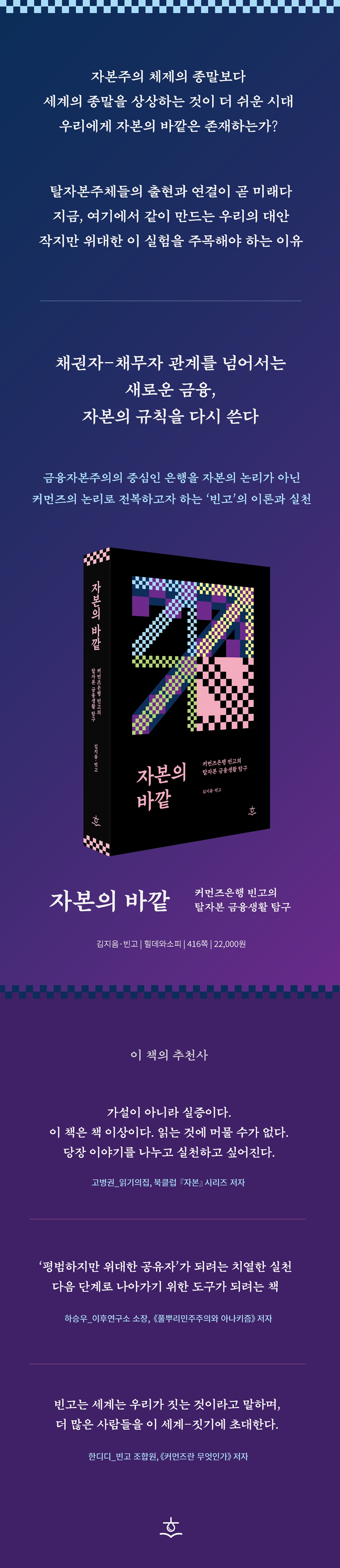
“Are banks an untouchable fortress?
If the bank is a collection of contracts, what if the contracts themselves were changed?
We create new banks and create new contracts.
In other words, it is about moving banks little by little.”
Commons Bank Bingo, which is creating a crack in the world of capital
The economics of resignation: a financial experiment and the theory behind it!
We come together like this to create a new world.
- Recommended by Go Byeong-gwon, Ha Seung-woo, and Han Didi!
“It is not a hypothesis, it is evidence.
(…) I can’t stop reading.
“I want to talk about it and put it into practice right away.” / Go Byeong-gwon
"A book that aims to be a tool for taking the next step in the fierce practice of becoming an 'ordinary but great sharer'" / Ha Seung-woo
“(Bingo) says that the world is what we build, and invites more people to build this world.” /Handidi
How to put post-capitalist principles into practice,
Commons Bank Bingo
There are many voices criticizing capitalism.
However, compared to that, there is no clear practical method to decapitalize life itself, which is entangled with capital.
Until now, the anti-capitalist movement has mainly been expressed as a labor movement and a consumer movement.
Through the labor movement, we have reclaimed the capital that companies have earned by exploiting workers, and through the consumer movement, we have reclaimed the capital that companies have taken by exploiting consumers.
But this alone is not enough.
This is because our small but precious capital, which we have reclaimed in this way, is being used again as financial capital through banks, thereby supporting capitalism.
Commons Bank Bingo proposes commons finance, which expands the commons together, breaking away from the flow of capital finance that inevitably leads to everyone using capitalist banks.
Of course, if we live in a capitalist world, we cannot completely escape from labor, consumption, saving, and lending for capital.
However, Bingo says that there is a possibility of escaping this reality if non-capitalist financial entities join together.
People who agree with the principle of post-capitalism can continuously create commons by exchanging and confirming each other's practices outside of capital.
Over the past 16 years, approximately 540 post-capitalist individuals have gradually moved their lives from the world of capital to the world of sharing through Bingo.
Commons Bank Bingo is a practice in itself that demonstrates the possibility of a post-capitalist life that expands the commons.
If the bank is a collection of contracts, what if the contracts themselves were changed?
We create new banks and create new contracts.
In other words, it is about moving banks little by little.”
Commons Bank Bingo, which is creating a crack in the world of capital
The economics of resignation: a financial experiment and the theory behind it!
We come together like this to create a new world.
- Recommended by Go Byeong-gwon, Ha Seung-woo, and Han Didi!
“It is not a hypothesis, it is evidence.
(…) I can’t stop reading.
“I want to talk about it and put it into practice right away.” / Go Byeong-gwon
"A book that aims to be a tool for taking the next step in the fierce practice of becoming an 'ordinary but great sharer'" / Ha Seung-woo
“(Bingo) says that the world is what we build, and invites more people to build this world.” /Handidi
How to put post-capitalist principles into practice,
Commons Bank Bingo
There are many voices criticizing capitalism.
However, compared to that, there is no clear practical method to decapitalize life itself, which is entangled with capital.
Until now, the anti-capitalist movement has mainly been expressed as a labor movement and a consumer movement.
Through the labor movement, we have reclaimed the capital that companies have earned by exploiting workers, and through the consumer movement, we have reclaimed the capital that companies have taken by exploiting consumers.
But this alone is not enough.
This is because our small but precious capital, which we have reclaimed in this way, is being used again as financial capital through banks, thereby supporting capitalism.
Commons Bank Bingo proposes commons finance, which expands the commons together, breaking away from the flow of capital finance that inevitably leads to everyone using capitalist banks.
Of course, if we live in a capitalist world, we cannot completely escape from labor, consumption, saving, and lending for capital.
However, Bingo says that there is a possibility of escaping this reality if non-capitalist financial entities join together.
People who agree with the principle of post-capitalism can continuously create commons by exchanging and confirming each other's practices outside of capital.
Over the past 16 years, approximately 540 post-capitalist individuals have gradually moved their lives from the world of capital to the world of sharing through Bingo.
Commons Bank Bingo is a practice in itself that demonstrates the possibility of a post-capitalist life that expands the commons.
- You can preview some of the book's contents.
Preview
index
Prologue: My Main Bank Is Something Special
Part 1: Hospitality
Hospitality-Life: The Birth of an Uninhabited House, an Empty Home
1.
Three people in one villa
2.
The front door code for all empty houses is 0221.
Hospitality-Exploration: The Capital Problem We Must Solve to Live Together
Ⅰ.
The Housing Cost-Capital Returns Game: Know Your Capital
Ⅱ.
The Political Economy of Living Together
III.
Money Transactions with Friends: Beyond the Creditor-Debtor Relationship
Part 2 Autonomy
Autonomous Living: A Small Miracle in Haebangchon, a Special Communal Life in an Empty House
1.
Guest in an empty house = Becoming the owner
2.
As the number of houses increased, it became a village.
3.
How to work less and play more
Autonomy-Exploration: Solutions for a Greater Us Together
I.
Changes in community size and altruism
Ⅱ.
The dilemma of the worker with capital
III.
The anti-capitalist movement of workers, consumers, and commoners
Ⅳ.
Monetary flow in decapitalized finance
Part 3 shared
Shared Living: People Who Don't Pay Interest, Commons Bank Bingo
1.
If we could share even the capital
2.
Bingo, a unique bank created by people who crossed the threshold
3.
A bank of commoners who create commons
Sharing-Exploration: The Economics of Specifications, Exchange-Form Game Theory
Ⅰ.
Simple Exchange Relationships: Offer and Response
Ⅱ.
Repeated exchange relations: gifts, exploitation, commodities, and specifications
III.
Extended Exchange Forms: Family, State, Capital, and the Commons
Ⅳ.
Money as a Generalized Form of Exchange: From Financial Capital to Financial Commons
4th Division Regiment
Solidarity Life: We Come Together to Create a New World
1.
Creating a counter-bank to capital
2.
How to Use Commons Bank Bingo
3.
Ten Features of Commons Bank Bingo
4.
Bingo Next, Imagining the Possibilities of Decapitalized Finance
Solidarity-Exploration: Rewriting the Rules Outside Capital
I.
We're not the first: several examples of decapitalization.
Ⅱ.
Counter-currency requires counter-banks.
III.
Commons Finance: Two Specifications
Ⅳ.
Commons = Community = Republic: A Triangle Against Capital
Epilogue: We Are Already Sharers = Post-Capitalists
Appendix_Bingo Declaration, References
Part 1: Hospitality
Hospitality-Life: The Birth of an Uninhabited House, an Empty Home
1.
Three people in one villa
2.
The front door code for all empty houses is 0221.
Hospitality-Exploration: The Capital Problem We Must Solve to Live Together
Ⅰ.
The Housing Cost-Capital Returns Game: Know Your Capital
Ⅱ.
The Political Economy of Living Together
III.
Money Transactions with Friends: Beyond the Creditor-Debtor Relationship
Part 2 Autonomy
Autonomous Living: A Small Miracle in Haebangchon, a Special Communal Life in an Empty House
1.
Guest in an empty house = Becoming the owner
2.
As the number of houses increased, it became a village.
3.
How to work less and play more
Autonomy-Exploration: Solutions for a Greater Us Together
I.
Changes in community size and altruism
Ⅱ.
The dilemma of the worker with capital
III.
The anti-capitalist movement of workers, consumers, and commoners
Ⅳ.
Monetary flow in decapitalized finance
Part 3 shared
Shared Living: People Who Don't Pay Interest, Commons Bank Bingo
1.
If we could share even the capital
2.
Bingo, a unique bank created by people who crossed the threshold
3.
A bank of commoners who create commons
Sharing-Exploration: The Economics of Specifications, Exchange-Form Game Theory
Ⅰ.
Simple Exchange Relationships: Offer and Response
Ⅱ.
Repeated exchange relations: gifts, exploitation, commodities, and specifications
III.
Extended Exchange Forms: Family, State, Capital, and the Commons
Ⅳ.
Money as a Generalized Form of Exchange: From Financial Capital to Financial Commons
4th Division Regiment
Solidarity Life: We Come Together to Create a New World
1.
Creating a counter-bank to capital
2.
How to Use Commons Bank Bingo
3.
Ten Features of Commons Bank Bingo
4.
Bingo Next, Imagining the Possibilities of Decapitalized Finance
Solidarity-Exploration: Rewriting the Rules Outside Capital
I.
We're not the first: several examples of decapitalization.
Ⅱ.
Counter-currency requires counter-banks.
III.
Commons Finance: Two Specifications
Ⅳ.
Commons = Community = Republic: A Triangle Against Capital
Epilogue: We Are Already Sharers = Post-Capitalists
Appendix_Bingo Declaration, References
Detailed image
Into the book
I neither want to be exploited by capital, nor do I want to exploit through capital.
So I decided not to capitalize my money.
--- p.17
Family, nation, and capital are not this simple, and neither is the commons.
Commons relationships are idealistic and rare, but they certainly exist, appear more frequently than we might think, and cannot and should not disappear.
Because the only possibility to change the solid reality composed of capital=state=family lies in the commons.
--- p.77
The sharing arrangement found in the empty house arose when both parties declined to receive capital gains.
The investor refused to pay the capital gains from the deposit for the family living together, and the user refused to pay the capital gains resulting from this, i.e. the reduced monthly rent burden, and tried to return them to the investor.
By denying capital gains on both sides in this way, the empty-house owners were always poor, but they always had a surplus of money left over.
--- p.95
Even the subjects of post-capitalist finance are people living in capitalism, and they do not consistently behave post-capitalist in all external relationships.
But even in this midst, the entities of post-capitalist finance that entertain each other occasionally make themselves apparent and even infect each other.
One could say that special people gathered in an empty house, but it would be more accurate to say that the unique space of an empty house was an environment that allowed for a special subjectivity to be revealed.
--- p.106
My assets are other people's liabilities, and my liabilities are other people's assets.
The income my assets earn ultimately comes out of someone else's pocket, and the interest I pay on my debt ultimately becomes someone else's asset income.
So when we figure out our financial situation, the choices we have as isolated individuals are a very difficult two-way street.
--- p.175
From the capitalist perspective, even if more is distributed to workers, there is a system in place that can be used for investment anyway.
In that case, it is not that the worker actually receives distribution, but rather that capital merely temporarily entrusts it to the worker.
--- p.183
This is not about robbing or taking over all the aforementioned banks at once, but rather moving them to Sinab.
And it is a relatively easy and sure way, yet completely legal and peaceful.
Banks are essentially a collection of countless debt-credit contracts, and we can break our contracts with capital and create new contracts among ourselves.
--- p.276
It is meaningless to simply criticize capital, or to criticize people's desire for capital and addiction to it.
We must change the reality that forces people to rely on capital.
We must replace capital with commons.
--- p.326
Just as capital is a social relation, post-capitalism cannot but be another form of social relation.
The act of refusing to capitalize money and rejecting capital returns is simply powerless for an isolated individual, and cannot alone be used to oppose capital.
Money cannot be capital simply because it is a simple medium of exchange or is owned by an isolated individual.
It must be accumulated, distributed, and invested in production.
--- p.354
Capitalism and the commons overlap and confront each other everywhere, and each of our small actions will make the world a more shared place.
Exactly to that extent we can live outside of capital and after capital.
So I decided not to capitalize my money.
--- p.17
Family, nation, and capital are not this simple, and neither is the commons.
Commons relationships are idealistic and rare, but they certainly exist, appear more frequently than we might think, and cannot and should not disappear.
Because the only possibility to change the solid reality composed of capital=state=family lies in the commons.
--- p.77
The sharing arrangement found in the empty house arose when both parties declined to receive capital gains.
The investor refused to pay the capital gains from the deposit for the family living together, and the user refused to pay the capital gains resulting from this, i.e. the reduced monthly rent burden, and tried to return them to the investor.
By denying capital gains on both sides in this way, the empty-house owners were always poor, but they always had a surplus of money left over.
--- p.95
Even the subjects of post-capitalist finance are people living in capitalism, and they do not consistently behave post-capitalist in all external relationships.
But even in this midst, the entities of post-capitalist finance that entertain each other occasionally make themselves apparent and even infect each other.
One could say that special people gathered in an empty house, but it would be more accurate to say that the unique space of an empty house was an environment that allowed for a special subjectivity to be revealed.
--- p.106
My assets are other people's liabilities, and my liabilities are other people's assets.
The income my assets earn ultimately comes out of someone else's pocket, and the interest I pay on my debt ultimately becomes someone else's asset income.
So when we figure out our financial situation, the choices we have as isolated individuals are a very difficult two-way street.
--- p.175
From the capitalist perspective, even if more is distributed to workers, there is a system in place that can be used for investment anyway.
In that case, it is not that the worker actually receives distribution, but rather that capital merely temporarily entrusts it to the worker.
--- p.183
This is not about robbing or taking over all the aforementioned banks at once, but rather moving them to Sinab.
And it is a relatively easy and sure way, yet completely legal and peaceful.
Banks are essentially a collection of countless debt-credit contracts, and we can break our contracts with capital and create new contracts among ourselves.
--- p.276
It is meaningless to simply criticize capital, or to criticize people's desire for capital and addiction to it.
We must change the reality that forces people to rely on capital.
We must replace capital with commons.
--- p.326
Just as capital is a social relation, post-capitalism cannot but be another form of social relation.
The act of refusing to capitalize money and rejecting capital returns is simply powerless for an isolated individual, and cannot alone be used to oppose capital.
Money cannot be capital simply because it is a simple medium of exchange or is owned by an isolated individual.
It must be accumulated, distributed, and invested in production.
--- p.354
Capitalism and the commons overlap and confront each other everywhere, and each of our small actions will make the world a more shared place.
Exactly to that extent we can live outside of capital and after capital.
--- p.391
Publisher's Review
How to create commons in Bingo,
Specify capital gains
When we have surplus, we all keep it in the bank rather than at home.
We simply keep our money in the bank, but the bank uses it as capital for purposes we do not agree with or know about.
Bingo proposes that this surplus be invested in Bingo rather than in capitalist banks, and the capital thus collected be utilized as a commons.
We establish a usage plan with people who need capital so that they can use (borrow) as much as they need, and those who use the money return a certain percentage of the profits (interest) along with the principal.
Investors can contribute (deposit) surplus that they do not need immediately to Bingo and receive a refund (withdrawal) whenever they want, just like in a bank.
This is where the biggest difference between Bingo and other banks comes into play.
The point is that both investors and users reject capital gains.
Users want to return all their profits to Bingo, and investors want to avoid the interest that accrues.
The investment reserve (interest) that Bingo provides to investors at a certain rate can be taken at any time, but if it is not greatly needed, it can be declined and used again as commons.
In this 'economy of specifications', where both sides refuse to profit from each other, capital is transformed into the commons.
This commons circulates again for someone's needs, reconfiguring the financial relationship from creditor and debtor to members of the community.
From housing to finance.
The beginning of a practice that breaks down boundaries
The practice of Bingo began in 2008 at the 'guests' house' in Haebangchon.
The empty house may not seem special in that several friends pooled their deposits to buy a house together, but it was groundbreaking in that everyone who visited was treated as both owner and guest of the house, regardless of the amount of capital contributed.
Everyone who entered this house was equal, regardless of who paid the deposit or who signed the contract.
This unique communal living environment in an empty house that is open to everyone has garnered attention as an alternative model to address the problem of high housing costs.
As the number of long-term guests in empty houses increased, new contracts were signed for one or two empty houses, and as several empty houses were created, an 'empty village' was created.
Then, financial problems that had not occurred when they were one household began to emerge.
In an empty house, the person who signed the contract, the person who paid the deposit, and the person who actually lives there were different people, and their numbers were not constant.
Neither the person who paid the deposit nor the person who benefited from it considered it very important, but as the number of houses increased and the gap between those who paid the deposit and those who did not began to appear, it became a problem.
To solve these problems, the empty houses created the 'Empty Village Safe' and began to manage the assets of several empty houses in an integrated manner.
Even if you didn't pay the deposit, you could still contribute through other empty village credit unions, and people who needed to get their deposits back could do so through the empty village credit union.
And soon after, the empty village tries to cross the border once again.
It breaks down the boundaries between the home and the outside world, allowing the assets of the empty village to be used by members outside the home.
The question, “Can we utilize the assets of empty houses in places other than empty houses?” became the impetus for expanding the scope of empty villages.
Anyone who agrees with the principles of 'autonomy, sharing, and hospitality', which are the principles of Bingo, can use Bingo's assets, and Bingo Village Credit Union is transforming from a residential cooperative centered on residents of empty houses into a financial cooperative.
If the empty house broke down the boundary between guest and host, bingo broke down the boundary between debtor and creditor.
The Commons Bank Bingo experiment, where what is 'mine' becomes 'everyone's' and we create prosperity together, has become a way of life where we support each other.
From practice to reason.
The New Rules of Exchange: The Economics of Specifications
If one axis of this book contains the life and practice of Commons Bank Bingo, the other axis contains the research that supports Commons Bank Bingo.
The members of Bingo have been putting their heads together to find answers to the questions that have been lingering since the empty house and why Bingo is possible.
None of the questions in Bingo are easy.
“Why does it become more difficult for a community to maintain commons as it grows?”, “What dilemmas arise when workers acquire capital?”, “How is post-capitalist finance different from existing labor or consumer movements?”, “Why is counter-currency not enough and counter-banks necessary?” This book follows these questions and introduces “specification exchange,” a new form of exchange that enables commons finance based on the principle of post-capitalism.
Bingo discovered the possibility of a shared relationship other than family, nation, or capital, starting from an empty house, and applied this as a general principle to bingo.
And in this process, I discovered that the Bingo diagram has structural similarities with Kojin Karatani's exchange modality theory.
Kojin Karatani explained that the economic system is not just capital, but a trinity structure in which capital, state, and nation are independent yet intertwined.
And the nation is based on the exchange form A of gifts and rewards, the state on the exchange form B of exploitation and redistribution, and capital on the exchange form C of commodities and money.
Therefore, I propose that a new exchange form D is needed to overcome this.
Karatani has explained this through various concepts, such as 'association of associations', 'consumer movement as a labor movement', 'producer-consumer cooperative', and 'world republic', but has not been able to define it as one.
Bingo, before defining the exchange form, decomposes the exchange into 'offer' and 'response', thereby revealing the validity of Kojin Karatani's exchange forms A, B, and C, while simultaneously revealing that exchange form D is a specification exchange that competes not to have.
And as the exchange of specifications is repeated and expanded, it becomes institutionalized as a commons.
Bingo proposes to expand the commons system of commons = community = republic, a new triangle that confronts the capital system of capital = state = family.
This book will show those who wish to realize the principles of decapitalization a path to achieving them together.
Specify capital gains
When we have surplus, we all keep it in the bank rather than at home.
We simply keep our money in the bank, but the bank uses it as capital for purposes we do not agree with or know about.
Bingo proposes that this surplus be invested in Bingo rather than in capitalist banks, and the capital thus collected be utilized as a commons.
We establish a usage plan with people who need capital so that they can use (borrow) as much as they need, and those who use the money return a certain percentage of the profits (interest) along with the principal.
Investors can contribute (deposit) surplus that they do not need immediately to Bingo and receive a refund (withdrawal) whenever they want, just like in a bank.
This is where the biggest difference between Bingo and other banks comes into play.
The point is that both investors and users reject capital gains.
Users want to return all their profits to Bingo, and investors want to avoid the interest that accrues.
The investment reserve (interest) that Bingo provides to investors at a certain rate can be taken at any time, but if it is not greatly needed, it can be declined and used again as commons.
In this 'economy of specifications', where both sides refuse to profit from each other, capital is transformed into the commons.
This commons circulates again for someone's needs, reconfiguring the financial relationship from creditor and debtor to members of the community.
From housing to finance.
The beginning of a practice that breaks down boundaries
The practice of Bingo began in 2008 at the 'guests' house' in Haebangchon.
The empty house may not seem special in that several friends pooled their deposits to buy a house together, but it was groundbreaking in that everyone who visited was treated as both owner and guest of the house, regardless of the amount of capital contributed.
Everyone who entered this house was equal, regardless of who paid the deposit or who signed the contract.
This unique communal living environment in an empty house that is open to everyone has garnered attention as an alternative model to address the problem of high housing costs.
As the number of long-term guests in empty houses increased, new contracts were signed for one or two empty houses, and as several empty houses were created, an 'empty village' was created.
Then, financial problems that had not occurred when they were one household began to emerge.
In an empty house, the person who signed the contract, the person who paid the deposit, and the person who actually lives there were different people, and their numbers were not constant.
Neither the person who paid the deposit nor the person who benefited from it considered it very important, but as the number of houses increased and the gap between those who paid the deposit and those who did not began to appear, it became a problem.
To solve these problems, the empty houses created the 'Empty Village Safe' and began to manage the assets of several empty houses in an integrated manner.
Even if you didn't pay the deposit, you could still contribute through other empty village credit unions, and people who needed to get their deposits back could do so through the empty village credit union.
And soon after, the empty village tries to cross the border once again.
It breaks down the boundaries between the home and the outside world, allowing the assets of the empty village to be used by members outside the home.
The question, “Can we utilize the assets of empty houses in places other than empty houses?” became the impetus for expanding the scope of empty villages.
Anyone who agrees with the principles of 'autonomy, sharing, and hospitality', which are the principles of Bingo, can use Bingo's assets, and Bingo Village Credit Union is transforming from a residential cooperative centered on residents of empty houses into a financial cooperative.
If the empty house broke down the boundary between guest and host, bingo broke down the boundary between debtor and creditor.
The Commons Bank Bingo experiment, where what is 'mine' becomes 'everyone's' and we create prosperity together, has become a way of life where we support each other.
From practice to reason.
The New Rules of Exchange: The Economics of Specifications
If one axis of this book contains the life and practice of Commons Bank Bingo, the other axis contains the research that supports Commons Bank Bingo.
The members of Bingo have been putting their heads together to find answers to the questions that have been lingering since the empty house and why Bingo is possible.
None of the questions in Bingo are easy.
“Why does it become more difficult for a community to maintain commons as it grows?”, “What dilemmas arise when workers acquire capital?”, “How is post-capitalist finance different from existing labor or consumer movements?”, “Why is counter-currency not enough and counter-banks necessary?” This book follows these questions and introduces “specification exchange,” a new form of exchange that enables commons finance based on the principle of post-capitalism.
Bingo discovered the possibility of a shared relationship other than family, nation, or capital, starting from an empty house, and applied this as a general principle to bingo.
And in this process, I discovered that the Bingo diagram has structural similarities with Kojin Karatani's exchange modality theory.
Kojin Karatani explained that the economic system is not just capital, but a trinity structure in which capital, state, and nation are independent yet intertwined.
And the nation is based on the exchange form A of gifts and rewards, the state on the exchange form B of exploitation and redistribution, and capital on the exchange form C of commodities and money.
Therefore, I propose that a new exchange form D is needed to overcome this.
Karatani has explained this through various concepts, such as 'association of associations', 'consumer movement as a labor movement', 'producer-consumer cooperative', and 'world republic', but has not been able to define it as one.
Bingo, before defining the exchange form, decomposes the exchange into 'offer' and 'response', thereby revealing the validity of Kojin Karatani's exchange forms A, B, and C, while simultaneously revealing that exchange form D is a specification exchange that competes not to have.
And as the exchange of specifications is repeated and expanded, it becomes institutionalized as a commons.
Bingo proposes to expand the commons system of commons = community = republic, a new triangle that confronts the capital system of capital = state = family.
This book will show those who wish to realize the principles of decapitalization a path to achieving them together.
GOODS SPECIFICS
- Date of issue: December 1, 2025
- Page count, weight, size: 416 pages | 557g | 145*210*24mm
- ISBN13: 9791198135865
You may also like
카테고리
korean


korean

![GQ KOREA Mark (Monthly): December [2025]](http://librairie.coreenne.fr/cdn/shop/files/8ef265dbbfbf186523ed75ba7319009d.jpg?v=1765340328&width=3840)


