

After the dust settles
 |
Description
Book Introduction
Written by a world-renowned disaster recovery expert
Starting over from the broken ground
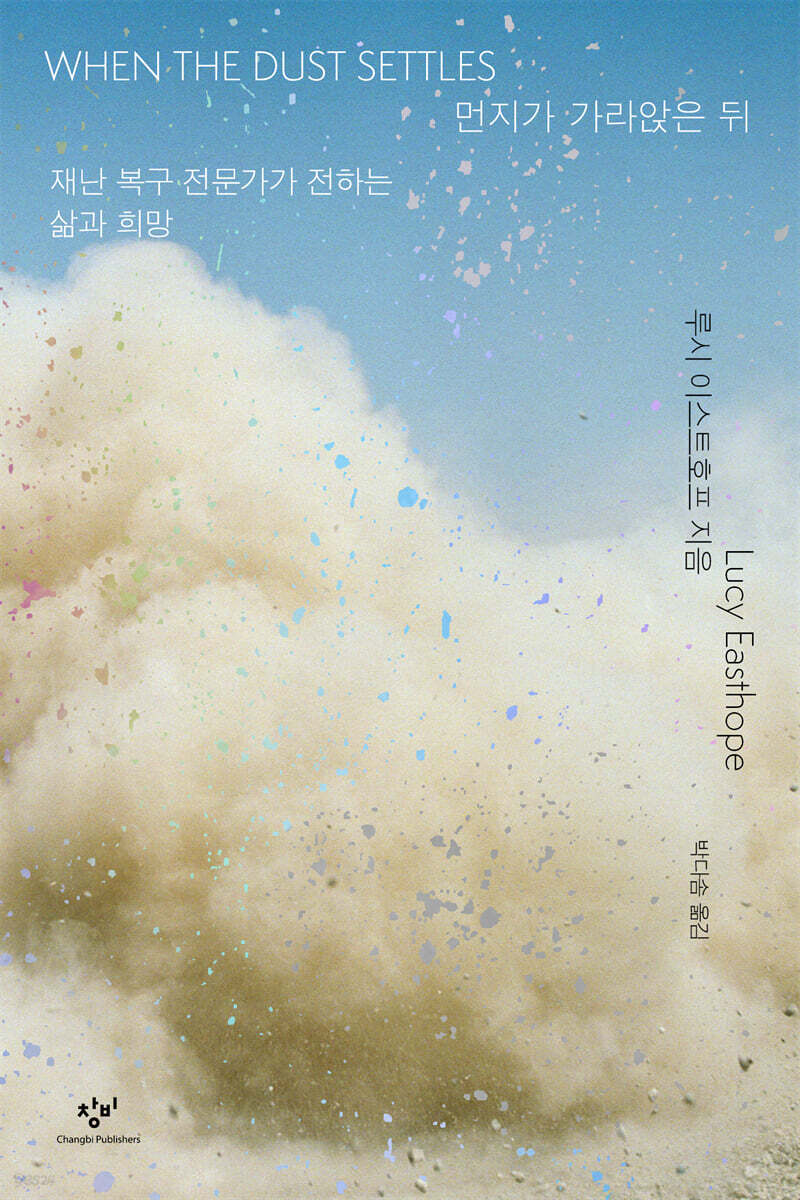
Lucy Easthope, a leading British disaster recovery expert who has worked at disaster sites around the world for the past 20 years, has published an essay titled “After the Dust Settles.”
The 9/11 terrorist attacks, the Indian Ocean tsunami, the 7/7 attacks in London, the Grenfell Tower fire, and the COVID-19 pandemic.
The author, who has been more deeply involved in the scenes of disasters, both large and small, and has stayed there the longest, has dedicated his life to answering the question, "How can we restore life after disaster?"
His job, 'disaster recovery,' goes beyond simply clearing rubble or recovering bodies.
It's a small task, properly delivering even the smallest of relics to the bereaved families, rebuilding a shattered community, examining the entire social system to prepare for another disaster, and creating a way for people to continue living even in grief.
Easthope demonstrates through his own experiences and vivid accounts that disaster recovery is a process of restoring human dignity, a form of mourning, and a time to prepare for hope.
The author asks Korean readers who still live with tragedies big and small in their hearts.
Has there ever been a true 'recovery'?
"After the Dust Settles" is a book that delivers the most urgent answers about the courage to start over from a broken place and the human dignity that must be preserved along the way.
Starting over from the broken ground
Lucy Easthope, a leading British disaster recovery expert who has worked at disaster sites around the world for the past 20 years, has published an essay titled “After the Dust Settles.”
The 9/11 terrorist attacks, the Indian Ocean tsunami, the 7/7 attacks in London, the Grenfell Tower fire, and the COVID-19 pandemic.
The author, who has been more deeply involved in the scenes of disasters, both large and small, and has stayed there the longest, has dedicated his life to answering the question, "How can we restore life after disaster?"
His job, 'disaster recovery,' goes beyond simply clearing rubble or recovering bodies.
It's a small task, properly delivering even the smallest of relics to the bereaved families, rebuilding a shattered community, examining the entire social system to prepare for another disaster, and creating a way for people to continue living even in grief.
Easthope demonstrates through his own experiences and vivid accounts that disaster recovery is a process of restoring human dignity, a form of mourning, and a time to prepare for hope.
The author asks Korean readers who still live with tragedies big and small in their hearts.
Has there ever been a true 'recovery'?
"After the Dust Settles" is a book that delivers the most urgent answers about the courage to start over from a broken place and the human dignity that must be preserved along the way.
index
Prologue / Arrival
Chapter 1 The Planner
Chapter 2 Bad Star
Chapter 3 In the Green Fields
Chapter 4 Boxing Day
Chapter 5, 44 minutes of chaos
Chapter 6 Hirais
Chapter 7: Small Losses
Chapter 8: Fear
Chapter 9: Ghost Train
Chapter 10 Sunflower
Chapter 11 Roller Coaster
Chapter 12: Two Trustworthy Hands
Chapter 13 Script
Chapter 14 Another Dove
Chapter 15 White Chrysanthemums
Chapter 16: The End
Epilogue / Beginning
Acknowledgements
Translator's Note
main
Chapter 1 The Planner
Chapter 2 Bad Star
Chapter 3 In the Green Fields
Chapter 4 Boxing Day
Chapter 5, 44 minutes of chaos
Chapter 6 Hirais
Chapter 7: Small Losses
Chapter 8: Fear
Chapter 9: Ghost Train
Chapter 10 Sunflower
Chapter 11 Roller Coaster
Chapter 12: Two Trustworthy Hands
Chapter 13 Script
Chapter 14 Another Dove
Chapter 15 White Chrysanthemums
Chapter 16: The End
Epilogue / Beginning
Acknowledgements
Translator's Note
main
Detailed image

Into the book
This book is about disaster, physical fragility, loss and grief.
But it's also a book about hope and rebirth and laughter, a book about friendship and resilience and love.
--- p.17
In the chaotic first hours, it's easy to be tempted to try to make things 'simpler' by estimating the overall time of death rather than looking into the individual circumstances of each deceased person.
But in disaster situations, death comes in many ways over time, and bereaved families have a right to know their loved one's story.
You never know how much comfort small details can bring until you experience such loss yourself.
--- p.20
In the months since the Hillsborough disaster, I've come to understand that terrible things can happen in the world, and that those in charge—countries and government agencies—make terrible mistakes.
The fact that the target of the finger pointing is the local community that the country has already abandoned.
--- p.34
Once, a receipt found in a pair of torn pants was held in the hands of a grieving mother.
She found some comfort in knowing that her son had had coffee and a croissant that morning.
Sometimes, when you unfold a bundle of papers, you find writings written while trapped inside a building.
One note simply said:
12 people trapped in the west office on the 84th floor.
There were bloody fingerprints on the note, and later DNA testing allowed us to confirm to the family that Randy Scott, the father of the family, was present there before he died.
--- p.58
There are many other cases where the mistreatment of disaster victims increases the suffering of their bereaved families.
Members of Disaster Action have witnessed this situation over and over again.
The white lie Maureen Cavanagh heard that her son was asleep at the time of the crash.
Margaret, the mother of Martian's victim Sean Lockwoodcroft, still believes the body in the casket is not Sean's because the government has refused to open the casket.
Forensic documents later stated that the man in the coffin was bald, but Sean was a young man with thick black hair.
Margaret is still fighting to get the coffin dug up and opened.
--- p.103
The first humanitarian support center for the families of the 7/7 attacks was hastily set up in the city council leisure center.
It was a very bad choice, both in terms of location and acoustics.
When the bereaved family members heard the worst news imaginable, they began to cry and the sound bounced off the walls and echoed in all directions.
To make matters worse, the building smelled like a swimming pool, and Disaster Action, recognizing the importance of olfactory trauma and memory, raised concerns that parents or children who have lost loved ones might seek out a swimming pool or hotel with a swimming pool to relax.
It was pointed out that adding the smell of chlorine in the swimming pool to the olfactory memory of the disaster was too harsh.
--- p.123
One lesson I learned from my seniors in the industry when I first started was that people who constantly face death and disaster really do live that way.
Life is so precious, it ends someday, and it is so fragile.
We must live without forgetting this.
--- p.188
I don't want unanimity or groupthink.
I want messy, truthful, complex human responses.
I'm an emergency planner, but I also know that you can't always trust a plan.
--- p.253
Initial press releases suggested the dead were Chinese nationals, but as evidence emerged, it became increasingly clear they were Vietnamese.
Responders worried that this mistake could be perceived as insincere or racist.
It could be misunderstood as having a prejudice that all Asians look the same.
But in fact, the cause of this mistake was not the responders' lack of racial sensitivity, but rather intentional deception.
All of the documents found with the dead were forged Chinese identity cards.
First responders didn't realize the ID was forged and gave incorrect answers for a moment.
--- p.316~17
I always felt that a pandemic was inevitable.
I thought I would definitely experience a pandemic in my lifetime.
Because that's what science tells us.
But some people at the meeting were arrogant and believed we could stop the pandemic.
They were confident that they could stop the pandemic as soon as it started.
Of course, we couldn't stop it.
--- p.326
Peter says.
“Take care of all the ones smaller than you.” Then the smallest child, Too Small, asks.
“Then who am I supposed to look after?” Peter asks him before flying home to London.
“Neverbugs.
Take care of the little bugs.
But it's also a book about hope and rebirth and laughter, a book about friendship and resilience and love.
--- p.17
In the chaotic first hours, it's easy to be tempted to try to make things 'simpler' by estimating the overall time of death rather than looking into the individual circumstances of each deceased person.
But in disaster situations, death comes in many ways over time, and bereaved families have a right to know their loved one's story.
You never know how much comfort small details can bring until you experience such loss yourself.
--- p.20
In the months since the Hillsborough disaster, I've come to understand that terrible things can happen in the world, and that those in charge—countries and government agencies—make terrible mistakes.
The fact that the target of the finger pointing is the local community that the country has already abandoned.
--- p.34
Once, a receipt found in a pair of torn pants was held in the hands of a grieving mother.
She found some comfort in knowing that her son had had coffee and a croissant that morning.
Sometimes, when you unfold a bundle of papers, you find writings written while trapped inside a building.
One note simply said:
12 people trapped in the west office on the 84th floor.
There were bloody fingerprints on the note, and later DNA testing allowed us to confirm to the family that Randy Scott, the father of the family, was present there before he died.
--- p.58
There are many other cases where the mistreatment of disaster victims increases the suffering of their bereaved families.
Members of Disaster Action have witnessed this situation over and over again.
The white lie Maureen Cavanagh heard that her son was asleep at the time of the crash.
Margaret, the mother of Martian's victim Sean Lockwoodcroft, still believes the body in the casket is not Sean's because the government has refused to open the casket.
Forensic documents later stated that the man in the coffin was bald, but Sean was a young man with thick black hair.
Margaret is still fighting to get the coffin dug up and opened.
--- p.103
The first humanitarian support center for the families of the 7/7 attacks was hastily set up in the city council leisure center.
It was a very bad choice, both in terms of location and acoustics.
When the bereaved family members heard the worst news imaginable, they began to cry and the sound bounced off the walls and echoed in all directions.
To make matters worse, the building smelled like a swimming pool, and Disaster Action, recognizing the importance of olfactory trauma and memory, raised concerns that parents or children who have lost loved ones might seek out a swimming pool or hotel with a swimming pool to relax.
It was pointed out that adding the smell of chlorine in the swimming pool to the olfactory memory of the disaster was too harsh.
--- p.123
One lesson I learned from my seniors in the industry when I first started was that people who constantly face death and disaster really do live that way.
Life is so precious, it ends someday, and it is so fragile.
We must live without forgetting this.
--- p.188
I don't want unanimity or groupthink.
I want messy, truthful, complex human responses.
I'm an emergency planner, but I also know that you can't always trust a plan.
--- p.253
Initial press releases suggested the dead were Chinese nationals, but as evidence emerged, it became increasingly clear they were Vietnamese.
Responders worried that this mistake could be perceived as insincere or racist.
It could be misunderstood as having a prejudice that all Asians look the same.
But in fact, the cause of this mistake was not the responders' lack of racial sensitivity, but rather intentional deception.
All of the documents found with the dead were forged Chinese identity cards.
First responders didn't realize the ID was forged and gave incorrect answers for a moment.
--- p.316~17
I always felt that a pandemic was inevitable.
I thought I would definitely experience a pandemic in my lifetime.
Because that's what science tells us.
But some people at the meeting were arrogant and believed we could stop the pandemic.
They were confident that they could stop the pandemic as soon as it started.
Of course, we couldn't stop it.
--- p.326
Peter says.
“Take care of all the ones smaller than you.” Then the smallest child, Too Small, asks.
“Then who am I supposed to look after?” Peter asks him before flying home to London.
“Neverbugs.
Take care of the little bugs.
--- p.338
Publisher's Review
At the scene of the disaster
The person who stays the longest
Lucy Easthope, who was born and raised in Liverpool, was 10 years old when she experienced the Hillsborough Stadium stampede up close.
Having personally experienced the shock of losing close family and friends in his community, he took to heart his father's words, "Someone has to do something about it," and began working on disaster and social causes from a young age.
Starting his career with Kenyon International Emergency Services, he has worked at disaster sites around the world for over 20 years, including the 9/11 terrorist attacks, the Indian Ocean tsunami, the 7/7 attacks in London, the Grenfell Tower fire, and the COVID-19 pandemic, establishing himself as an expert responsible for the 'post-disaster' response.
His role is not limited to simply clearing debris or recovering bodies.
Identifying the deceased without error, deciding which box to place the remains in to deliver them to the bereaved family, and offering a warm drink and a reassuring smile.
These small, specific things come together to complete the process of disaster recovery.
As a leading expert in the industry, Easthope meticulously directs this entire process, saying that it is the invisible "details of recovery" that provide the greatest comfort to those enduring pain.
East Hope's work extends infinitely, from protecting the dignity of the deceased and those left behind to examining and implementing countermeasures to prevent similar tragedies from recurring, to helping rebuild devastated communities.
Through this entire process, the author demonstrates that disaster recovery is not simply a matter of recovery, but a process of restoring human dignity and rebuilding hope at the end of despair.
The reason I stay awake every night,
Unstoppable responsibility
Disasters are always overwhelming and societal problems, but their repercussions penetrate deep into individual lives.
Through his own experience, the author vividly demonstrates that the scars left by disaster are both a tragedy for the community and a pain that shakes the entire life of an individual.
Even after leaving the collapsed site, the time of those left behind never finds its place.
The moment the bereaved family members, who are more active than anyone else in uncovering the truth and demanding institutional reform, confess that they do everything at night because they "can't sleep at night anymore," we realize that disasters continue to shake people's lives to the core even after they are over.
Mourning sometimes lingers like a shadow throughout life.
But Easthope's gaze doesn't stop there.
He constantly emphasizes that small things that heal an individual's wounds can become the starting point for rebuilding the social system.
Based on field experience, we ask and answer questions about how systems must change to prevent recurring tragedies and what preparations are needed to prepare for the next disaster.
He further demonstrates that disaster recovery is not simply a matter of repairing the past, but a collective commitment to making the future a safer and more dignified society.
His story, which begins at the end of a disaster, soon becomes a compass pointing the way for the entire community to move forward.
“Some disasters are simply overwhelming.
But life must go on”
Korean society has experienced numerous disasters, including the Sewol ferry disaster, the Itaewon disaster, the collapse of Seongsu Bridge, and the Sampoong Department Store collapse.
Disasters have always shaken our lives to their core, but as time passes, our resolve fades and sadness hardens into a part of our daily lives.
We created a place for remembrance and mourning, but we haven't given enough thought to how to rebuild the lives that have been shattered.
Have we ever truly 'recovered' even once?
Lucy Easthope's book poses this very question, calmly reminding us of what we still need to do in the wake of disaster, and what we have yet to learn.
"After the Dust Settles" is not simply a record of recovery, but a book about a human journey of preserving dignity and preparing for hope.
How to start over from the ground up, how to move on from loss, and how to never give up hope even in despair.
East Hope's "Language of Recovery" resonates deeply with us living in times of disaster, offering a poignant testimony to the courage to rise again amidst repeated tragedies and the profound human power to move forward from a broken place toward a better future.
Author's Note
As a child, I took my father's casual remark, "Someone has to solve it," as my life's guide.
If I could go back in time and meet that little boy now, I would tell him that he can't solve everything.
But I also want to let you know that the journey itself will be meaningful.
Every little bit of help you give to someone becomes a purpose in itself.
There's value in offering a warm drink and a reassuring smile to someone going through a tough time.
I will tell the little boy how important it is to respect the dead, what it means to have the opportunity to say goodbye to the deceased, and what death itself means.
It will teach you that not only the remains of a loved one but also the objects they carried have value; that a ceramic elephant figurine can be sacred to someone; and that providing appropriate care and support to responders can help them care for the deceased without causing them deep wounds.
(…) I would tell my younger self to keep going.
I will tell you to hold on to every moment.
Disasters will inevitably happen, and when they do, there will always be people willing to help.
The pain will continue, but so will the recovery.
The person who stays the longest
Lucy Easthope, who was born and raised in Liverpool, was 10 years old when she experienced the Hillsborough Stadium stampede up close.
Having personally experienced the shock of losing close family and friends in his community, he took to heart his father's words, "Someone has to do something about it," and began working on disaster and social causes from a young age.
Starting his career with Kenyon International Emergency Services, he has worked at disaster sites around the world for over 20 years, including the 9/11 terrorist attacks, the Indian Ocean tsunami, the 7/7 attacks in London, the Grenfell Tower fire, and the COVID-19 pandemic, establishing himself as an expert responsible for the 'post-disaster' response.
His role is not limited to simply clearing debris or recovering bodies.
Identifying the deceased without error, deciding which box to place the remains in to deliver them to the bereaved family, and offering a warm drink and a reassuring smile.
These small, specific things come together to complete the process of disaster recovery.
As a leading expert in the industry, Easthope meticulously directs this entire process, saying that it is the invisible "details of recovery" that provide the greatest comfort to those enduring pain.
East Hope's work extends infinitely, from protecting the dignity of the deceased and those left behind to examining and implementing countermeasures to prevent similar tragedies from recurring, to helping rebuild devastated communities.
Through this entire process, the author demonstrates that disaster recovery is not simply a matter of recovery, but a process of restoring human dignity and rebuilding hope at the end of despair.
The reason I stay awake every night,
Unstoppable responsibility
Disasters are always overwhelming and societal problems, but their repercussions penetrate deep into individual lives.
Through his own experience, the author vividly demonstrates that the scars left by disaster are both a tragedy for the community and a pain that shakes the entire life of an individual.
Even after leaving the collapsed site, the time of those left behind never finds its place.
The moment the bereaved family members, who are more active than anyone else in uncovering the truth and demanding institutional reform, confess that they do everything at night because they "can't sleep at night anymore," we realize that disasters continue to shake people's lives to the core even after they are over.
Mourning sometimes lingers like a shadow throughout life.
But Easthope's gaze doesn't stop there.
He constantly emphasizes that small things that heal an individual's wounds can become the starting point for rebuilding the social system.
Based on field experience, we ask and answer questions about how systems must change to prevent recurring tragedies and what preparations are needed to prepare for the next disaster.
He further demonstrates that disaster recovery is not simply a matter of repairing the past, but a collective commitment to making the future a safer and more dignified society.
His story, which begins at the end of a disaster, soon becomes a compass pointing the way for the entire community to move forward.
“Some disasters are simply overwhelming.
But life must go on”
Korean society has experienced numerous disasters, including the Sewol ferry disaster, the Itaewon disaster, the collapse of Seongsu Bridge, and the Sampoong Department Store collapse.
Disasters have always shaken our lives to their core, but as time passes, our resolve fades and sadness hardens into a part of our daily lives.
We created a place for remembrance and mourning, but we haven't given enough thought to how to rebuild the lives that have been shattered.
Have we ever truly 'recovered' even once?
Lucy Easthope's book poses this very question, calmly reminding us of what we still need to do in the wake of disaster, and what we have yet to learn.
"After the Dust Settles" is not simply a record of recovery, but a book about a human journey of preserving dignity and preparing for hope.
How to start over from the ground up, how to move on from loss, and how to never give up hope even in despair.
East Hope's "Language of Recovery" resonates deeply with us living in times of disaster, offering a poignant testimony to the courage to rise again amidst repeated tragedies and the profound human power to move forward from a broken place toward a better future.
Author's Note
As a child, I took my father's casual remark, "Someone has to solve it," as my life's guide.
If I could go back in time and meet that little boy now, I would tell him that he can't solve everything.
But I also want to let you know that the journey itself will be meaningful.
Every little bit of help you give to someone becomes a purpose in itself.
There's value in offering a warm drink and a reassuring smile to someone going through a tough time.
I will tell the little boy how important it is to respect the dead, what it means to have the opportunity to say goodbye to the deceased, and what death itself means.
It will teach you that not only the remains of a loved one but also the objects they carried have value; that a ceramic elephant figurine can be sacred to someone; and that providing appropriate care and support to responders can help them care for the deceased without causing them deep wounds.
(…) I would tell my younger self to keep going.
I will tell you to hold on to every moment.
Disasters will inevitably happen, and when they do, there will always be people willing to help.
The pain will continue, but so will the recovery.
GOODS SPECIFICS
- Date of issue: September 26, 2025
- Page count, weight, size: 364 pages | 560g | 141*209*22mm
- ISBN13: 9788936480943
You may also like
카테고리
korean


korean

![GQ KOREA Mark (Monthly): December [2025]](http://librairie.coreenne.fr/cdn/shop/files/8ef265dbbfbf186523ed75ba7319009d.jpg?v=1765340328&width=3840)


