

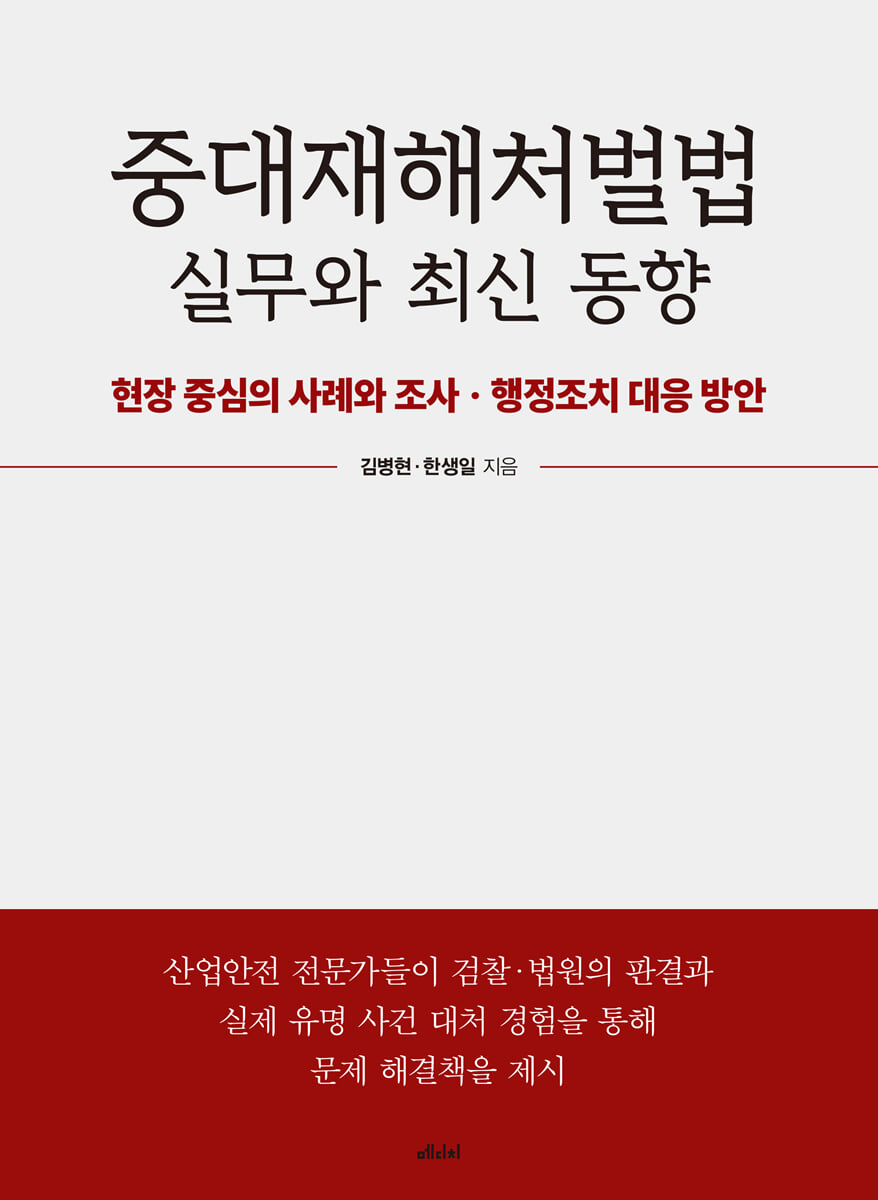
Practice and Latest Trends of the Serious Disaster Punishment Act
 |
Description
Book Introduction
Written with a focus on key contents and practical examples
A 'living guide' applicable to business settings
Since the enactment of the Serious Disaster Punishment Act, there has been a constant thirst in the field for practical solutions to 'what to protect and how to protect it.'
Although the legal provisions appear clear, the actual situations encountered in the field are much more complex, and the law has been interpreted and applied from different perspectives.
In that sense, the publication of this book, “Practice and Latest Trends of the Serious Disaster Punishment Act,” is very timely.
Unlike existing commentaries that focus on textual analysis and institutional background, this book broadly captures court decisions, investigation records, media reports, and vivid voices from the industrial field.
In particular, it shows in detail what issues were addressed in cases where the law was actually applied, what decisions the courts made, and what impact the results had on the industrial field.
This book accurately interprets the law and the flow of case law, and presents practical alternatives based on this understanding. It is a "living guide" that can be applied immediately in business settings.
A 'living guide' applicable to business settings
Since the enactment of the Serious Disaster Punishment Act, there has been a constant thirst in the field for practical solutions to 'what to protect and how to protect it.'
Although the legal provisions appear clear, the actual situations encountered in the field are much more complex, and the law has been interpreted and applied from different perspectives.
In that sense, the publication of this book, “Practice and Latest Trends of the Serious Disaster Punishment Act,” is very timely.
Unlike existing commentaries that focus on textual analysis and institutional background, this book broadly captures court decisions, investigation records, media reports, and vivid voices from the industrial field.
In particular, it shows in detail what issues were addressed in cases where the law was actually applied, what decisions the courts made, and what impact the results had on the industrial field.
This book accurately interprets the law and the flow of case law, and presents practical alternatives based on this understanding. It is a "living guide" that can be applied immediately in business settings.
- You can preview some of the book's contents.
Preview
index
Recommendation
preface
Chapter 1 Serious Disaster Punishment Act
▲ Comparison of the Serious Disaster Punishment Act and the Industrial Safety and Health Act
1.
Background of enactment, similar overseas laws, and key terms
2.
Scope and timing of application
3.
Obligation to ensure safety and health
4.
Punishment of business owners and managers responsible for major industrial accidents
5.
Taking safety and health training
6.
Announcement of the occurrence of a major industrial accident
7.
Review of annual schedule for industrial safety and health
8.
Understanding Major Civil Disasters
9.
Guidelines for responding to the Serious Disaster Punishment Act
10.
Related cases, precedents, and recent trends
11.
Serious Disaster Punishment Act and its Enforcement Decree
Chapter 2 Industrial Safety and Health Act
▲ Changes to the industrial safety and health system starting in 2025
1.
Background and key terms of the legislation, etc.
2.
Occupational Safety and Health Management System
3.
Safety and health education
4.
Safety and health measures
5.
Hazard Prevention Plan, Process Safety Report, Safety and Health Diagnosis
6.
Industrial accident prevention during subcontracting
7.
Prevention of industrial accidents in the construction industry and measures to take when they occur
8.
Construction industry occupational safety and health management expenses
9.
Major Cases and Judgments
preface
Chapter 1 Serious Disaster Punishment Act
▲ Comparison of the Serious Disaster Punishment Act and the Industrial Safety and Health Act
1.
Background of enactment, similar overseas laws, and key terms
2.
Scope and timing of application
3.
Obligation to ensure safety and health
4.
Punishment of business owners and managers responsible for major industrial accidents
5.
Taking safety and health training
6.
Announcement of the occurrence of a major industrial accident
7.
Review of annual schedule for industrial safety and health
8.
Understanding Major Civil Disasters
9.
Guidelines for responding to the Serious Disaster Punishment Act
10.
Related cases, precedents, and recent trends
11.
Serious Disaster Punishment Act and its Enforcement Decree
Chapter 2 Industrial Safety and Health Act
▲ Changes to the industrial safety and health system starting in 2025
1.
Background and key terms of the legislation, etc.
2.
Occupational Safety and Health Management System
3.
Safety and health education
4.
Safety and health measures
5.
Hazard Prevention Plan, Process Safety Report, Safety and Health Diagnosis
6.
Industrial accident prevention during subcontracting
7.
Prevention of industrial accidents in the construction industry and measures to take when they occur
8.
Construction industry occupational safety and health management expenses
9.
Major Cases and Judgments
Into the book
Attorney Kim Byung-hyun pioneered the field of industrial safety while working at the prosecution. As an attorney, he formed the first expert consortium in the industry and has taken the lead in establishing an inspection system to prevent accidents.
Director Han Saeng-il is also known to have a wealth of experience in investigative fields and management work, as well as continuous case studies, as he is a former civil service examination graduate.
That's why I was able to include the voices of field workers throughout the book, vividly conveying the "difficulties of actual safety management" that cannot be captured through legal language alone.
Accidents that occurred despite the presence of safety equipment on site due to failure to follow procedures, and cases where safety management manuals existed but were not enforced, make readers aware of the gap between the system and practice.
The Serious Accident Punishment Act is not simply a punishment regulation, but rather a law that brings about “management changes to prevent accidents.”
However, to achieve that goal, we must correctly understand the spirit of the law and find concrete ways to put it into practice.
This book will serve as a solid guide on your journey to find the answer.
--- From the "Recommendation"
This book focuses on the main contents and practical cases of the Serious Disaster Punishment Act, and also explains related laws such as the Industrial Safety and Health Act that must be learned in advance to properly understand and implement the Serious Disaster Punishment Act.
In particular, avoiding abstract interpretation of legal provisions or discursive discussions, and focusing on safety-related issues applicable to business sites, major cases related to the Serious Accident Punishment Act, cases related to the Industrial Safety and Health Act (hereinafter referred to as the “OSHA”), articles and papers related to serious accidents, media articles, Ministry of Employment and Labor data, Prosecutors’ Office penalty commentary, practical data, prosecution’s non-indictment decision, court ruling (2025.
We aim to provide practical information based on the following (as of August).
If practitioners are familiar with specific examples of safety-related violations in each field, they will be able to receive assistance in the field.
Furthermore, if we knew what punishments or disadvantages would be incurred if we were caught committing such violations, we would be able to thoroughly prepare to prevent such misfortunes from occurring in advance.
--- From the "Preface"
The main contents of this law are summarized as follows:
First, business owners or managers, etc. have a duty to prevent safety and health hazards or risks to employees at businesses or workplaces that the business owner, corporation, or institution actually controls, operates, or manages. In addition, if the business owner, corporation, or institution contracts out, services, or entrusts work to a third party, the business owner, corporation, or institution is responsible for ensuring the safety and health of the third party's employees (Articles 4 and 5).
Second, if a business owner or manager violates the duty to ensure safety and health and causes a major industrial accident, the business owner or manager shall be punished, and if a business owner or manager of a corporation or institution commits a punishable violation, in addition to punishing the perpetrator, a fine shall also be imposed on the corporation or institution (Articles 6 and 7).
--- 「Chapter 1 '1.
Among the "Enactment Background, Similar Foreign Legislation, Main Contents, and Key Terms"
The crime of homicide resulting from violation of safety and health obligations is committed when an individual business owner or manager violates the safety and health obligations under Article 4 or 5 of the Act, resulting in the death of an employee.
The crime of violating the duty to ensure safety and health resulting in injury or death, which is established when an individual business owner or manager violates the duty to ensure safety and health pursuant to Article 4 or 5 of the Act, resulting in two or more injured workers requiring treatment for six months or more due to the same accident, or three or more workers suffering from an occupational disease, such as acute poisoning, prescribed by Presidential Decree, within one year due to the same hazardous factor.
Looking at the elements, first, the individual business owner or manager must violate the obligations under Article 4 or 5 of the Act, the intent to fail to perform the obligations under Article 4 or 5 of the Act must be recognized, the result of death, injury, or disease must occur and the occurrence of the result must be foreseeable, and a causal relationship must be recognized between the violation of the obligations under Article 4 or 5 of the Act and the occurrence of the result.
--- 「Chapter 1 '4.
From "Punishment of Business Owners and Managers of Serious Industrial Accidents"
A major civil disaster (Article 2, Paragraph 3 of the Act) refers to a disaster caused by a defect in the design, manufacturing, installation, or management of a specific raw material or product, public facility, or public transportation, and is defined as: ① a disaster resulting in one or more deaths; ② a disaster resulting in ten or more injuries requiring treatment for two months or more due to the same accident; or ③ a disaster resulting in ten or more illnesses requiring treatment for three months or more due to the same cause.
However, accidents that constitute serious industrial accidents are excluded.
Although serious civil disasters are not directly related to the construction and manufacturing industries, according to the prosecution's interpretation of the Serious Disaster Punishment Act, cases where death occurs due to arson or other causes caused by defects in the building itself may be considered serious civil disasters, so a general understanding is necessary.
In the case of a major civil disaster, violations will be subject to criminal punishment in the same manner as for a major industrial disaster.
However, unlike serious industrial accidents, there is no provision for increased punishment for those who commit serious civil disasters again within 5 years of being sentenced for serious civil disasters.
--- 「Chapter 1 '8.
From "Understanding Major Civil Disasters"
The case of Korea Steel, in which a worker belonging to a subcontractor (resident at the main contractor's workplace since 2014) who received subcontracting for facility maintenance from the main contractor at a steel manufacturing plant in Haman, Gyeongsangnam-do, died after his leg was crushed by a radiator (weighing 1.2 tons) that fell from a crane, is not a case of a temporary subcontracting transaction, but the first case in which a representative of a main contractor was indicted for the death of a worker of a subcontractor who had resided at the main contractor for a long period of time. On April 26, 2023, he was sentenced to one year in prison in the first trial and detained in court, but the sentence was confirmed by the Supreme Court on December 28 of the same year (Supreme Court Decision 2023do12316, corporation fined 100 million won).
The core reason for the prison sentence was that the employer had repeatedly caused industrial accidents due to frequent violations of safety measures.
Business owners who fail to improve their structures to prevent accidents despite frequent accidents are likely to be arrested or sentenced to prison.
It is expected that this court decision will lead to more thorough safety management by the general contractor for the workers of resident subcontractors who have been in a safety blind spot.
--- 「Chapter 1 '10.
Among the related cases, precedents and latest trends
In case of an industrial accident, the measures and handling procedures are as follows.
First, measures taken when a disaster victim is discovered include stopping the machine causing the disaster, rescuing the victim, transporting the victim to a hospital, reporting, and preserving the scene.
Second, industrial accidents must be reported.
An industrial accident investigation report must be submitted to the competent local labor office within one month from the date of occurrence of an industrial accident requiring a leave of absence for three days or more. Serious accidents must be reported to the competent local labor office without delay. The report must include an overview of the accident, damage situation, measures and prospects, and other important matters.
Third, industrial accident records must be preserved.
The workplace outline and personal information of workers, the time and location of the accident, the cause and process of the accident, and the plan to prevent recurrence of the accident are recorded and preserved for three years.
Finally, improvement activities are carried out in accordance with the recurrence prevention plan (the established contents are posted at the workplace and shared with workers, and the accident prevention plan is recorded and preserved for three years).
--- 「Chapter 2 '1.
Among the "Background and Key Terms of the Act"
Employers must contract out work to employers who have the ability to take measures to prevent industrial accidents (Article 61 of the Act).
Detailed standards and contents are set forth in the “Operation Manual for Safety and Health Management in Subcontracting Projects” of the Ministry of Employment and Labor.
The guidelines for selecting qualified suppliers in the manual detail the notices for bidding on subcontracts, the safety and health level evaluation of suppliers (evaluation items, evaluation criteria, and distribution of points), selection criteria, and feedback of evaluation results.
First, efforts must be made to prevent industrial accidents from the time of bidding for a subcontract.
In other words, it is desirable to review safety and health issues from the initial stage of operating a subcontracting business, and to operate a system that continuously develops through safety and health management implementation, evaluation, and feedback to prevent accidents at subcontracting companies during business execution.
In the case of subcontracting projects, safety and health activities must be inspected at each stage of the contract, performance, and return process.
The contract stage can be divided into the following order: review of the contract project, bidding for the contract, review of bidding documents, and contract with the contractor.
In reviewing a subcontracted project, it is confirmed whether the subcontracted project is subject to subcontracting approval and whether safety and health management regulations have been prepared. At the bidding stage, the safety work plan and safety and health level evaluation criteria are checked, and the safety and health level of the contractor is evaluated during the bidding document review.
Finally, a qualified supplier is selected and a contract is signed.
--- 「Chapter 2 '6.
From “Prevention of Industrial Accidents in Subcontracting”
Supreme Court precedents state that the crime of violating the Industrial Safety and Health Act is not established simply by the fact that dangerous work is performed at a workplace without taking necessary safety measures (Supreme Court decision 2009do12515, etc.), and that a crime is established only when the employer instructs dangerous work to be performed without safety measures or when the employer knows that work is being performed without safety measures and neglects to do so.
For example, in a case where a worker fell to his death while cleaning the inside of a 4m high pipe without wearing a safety helmet, etc., each individual was provided with a safety helmet and safety belt, and training was given on how to wear the helmet, but the victim was ultimately found not guilty considering that he was the only one working without a safety helmet and fell when the accident occurred (in the first trial, a fine of 3 million won was imposed for reasons such as not wearing a safety helmet and not installing a work platform).
(Refer to Suwon District Court Decision 2015gojeong673).
In addition, the corporation was found not guilty as it was recognized that the corporation had exercised due care and supervision in considering that the corporation had conducted periodic safety training for the management office manager and technical staff, provided safety helmets and other equipment, and conducted regular inspections related to industrial safety and health and prepared reports on the results.
Director Han Saeng-il is also known to have a wealth of experience in investigative fields and management work, as well as continuous case studies, as he is a former civil service examination graduate.
That's why I was able to include the voices of field workers throughout the book, vividly conveying the "difficulties of actual safety management" that cannot be captured through legal language alone.
Accidents that occurred despite the presence of safety equipment on site due to failure to follow procedures, and cases where safety management manuals existed but were not enforced, make readers aware of the gap between the system and practice.
The Serious Accident Punishment Act is not simply a punishment regulation, but rather a law that brings about “management changes to prevent accidents.”
However, to achieve that goal, we must correctly understand the spirit of the law and find concrete ways to put it into practice.
This book will serve as a solid guide on your journey to find the answer.
--- From the "Recommendation"
This book focuses on the main contents and practical cases of the Serious Disaster Punishment Act, and also explains related laws such as the Industrial Safety and Health Act that must be learned in advance to properly understand and implement the Serious Disaster Punishment Act.
In particular, avoiding abstract interpretation of legal provisions or discursive discussions, and focusing on safety-related issues applicable to business sites, major cases related to the Serious Accident Punishment Act, cases related to the Industrial Safety and Health Act (hereinafter referred to as the “OSHA”), articles and papers related to serious accidents, media articles, Ministry of Employment and Labor data, Prosecutors’ Office penalty commentary, practical data, prosecution’s non-indictment decision, court ruling (2025.
We aim to provide practical information based on the following (as of August).
If practitioners are familiar with specific examples of safety-related violations in each field, they will be able to receive assistance in the field.
Furthermore, if we knew what punishments or disadvantages would be incurred if we were caught committing such violations, we would be able to thoroughly prepare to prevent such misfortunes from occurring in advance.
--- From the "Preface"
The main contents of this law are summarized as follows:
First, business owners or managers, etc. have a duty to prevent safety and health hazards or risks to employees at businesses or workplaces that the business owner, corporation, or institution actually controls, operates, or manages. In addition, if the business owner, corporation, or institution contracts out, services, or entrusts work to a third party, the business owner, corporation, or institution is responsible for ensuring the safety and health of the third party's employees (Articles 4 and 5).
Second, if a business owner or manager violates the duty to ensure safety and health and causes a major industrial accident, the business owner or manager shall be punished, and if a business owner or manager of a corporation or institution commits a punishable violation, in addition to punishing the perpetrator, a fine shall also be imposed on the corporation or institution (Articles 6 and 7).
--- 「Chapter 1 '1.
Among the "Enactment Background, Similar Foreign Legislation, Main Contents, and Key Terms"
The crime of homicide resulting from violation of safety and health obligations is committed when an individual business owner or manager violates the safety and health obligations under Article 4 or 5 of the Act, resulting in the death of an employee.
The crime of violating the duty to ensure safety and health resulting in injury or death, which is established when an individual business owner or manager violates the duty to ensure safety and health pursuant to Article 4 or 5 of the Act, resulting in two or more injured workers requiring treatment for six months or more due to the same accident, or three or more workers suffering from an occupational disease, such as acute poisoning, prescribed by Presidential Decree, within one year due to the same hazardous factor.
Looking at the elements, first, the individual business owner or manager must violate the obligations under Article 4 or 5 of the Act, the intent to fail to perform the obligations under Article 4 or 5 of the Act must be recognized, the result of death, injury, or disease must occur and the occurrence of the result must be foreseeable, and a causal relationship must be recognized between the violation of the obligations under Article 4 or 5 of the Act and the occurrence of the result.
--- 「Chapter 1 '4.
From "Punishment of Business Owners and Managers of Serious Industrial Accidents"
A major civil disaster (Article 2, Paragraph 3 of the Act) refers to a disaster caused by a defect in the design, manufacturing, installation, or management of a specific raw material or product, public facility, or public transportation, and is defined as: ① a disaster resulting in one or more deaths; ② a disaster resulting in ten or more injuries requiring treatment for two months or more due to the same accident; or ③ a disaster resulting in ten or more illnesses requiring treatment for three months or more due to the same cause.
However, accidents that constitute serious industrial accidents are excluded.
Although serious civil disasters are not directly related to the construction and manufacturing industries, according to the prosecution's interpretation of the Serious Disaster Punishment Act, cases where death occurs due to arson or other causes caused by defects in the building itself may be considered serious civil disasters, so a general understanding is necessary.
In the case of a major civil disaster, violations will be subject to criminal punishment in the same manner as for a major industrial disaster.
However, unlike serious industrial accidents, there is no provision for increased punishment for those who commit serious civil disasters again within 5 years of being sentenced for serious civil disasters.
--- 「Chapter 1 '8.
From "Understanding Major Civil Disasters"
The case of Korea Steel, in which a worker belonging to a subcontractor (resident at the main contractor's workplace since 2014) who received subcontracting for facility maintenance from the main contractor at a steel manufacturing plant in Haman, Gyeongsangnam-do, died after his leg was crushed by a radiator (weighing 1.2 tons) that fell from a crane, is not a case of a temporary subcontracting transaction, but the first case in which a representative of a main contractor was indicted for the death of a worker of a subcontractor who had resided at the main contractor for a long period of time. On April 26, 2023, he was sentenced to one year in prison in the first trial and detained in court, but the sentence was confirmed by the Supreme Court on December 28 of the same year (Supreme Court Decision 2023do12316, corporation fined 100 million won).
The core reason for the prison sentence was that the employer had repeatedly caused industrial accidents due to frequent violations of safety measures.
Business owners who fail to improve their structures to prevent accidents despite frequent accidents are likely to be arrested or sentenced to prison.
It is expected that this court decision will lead to more thorough safety management by the general contractor for the workers of resident subcontractors who have been in a safety blind spot.
--- 「Chapter 1 '10.
Among the related cases, precedents and latest trends
In case of an industrial accident, the measures and handling procedures are as follows.
First, measures taken when a disaster victim is discovered include stopping the machine causing the disaster, rescuing the victim, transporting the victim to a hospital, reporting, and preserving the scene.
Second, industrial accidents must be reported.
An industrial accident investigation report must be submitted to the competent local labor office within one month from the date of occurrence of an industrial accident requiring a leave of absence for three days or more. Serious accidents must be reported to the competent local labor office without delay. The report must include an overview of the accident, damage situation, measures and prospects, and other important matters.
Third, industrial accident records must be preserved.
The workplace outline and personal information of workers, the time and location of the accident, the cause and process of the accident, and the plan to prevent recurrence of the accident are recorded and preserved for three years.
Finally, improvement activities are carried out in accordance with the recurrence prevention plan (the established contents are posted at the workplace and shared with workers, and the accident prevention plan is recorded and preserved for three years).
--- 「Chapter 2 '1.
Among the "Background and Key Terms of the Act"
Employers must contract out work to employers who have the ability to take measures to prevent industrial accidents (Article 61 of the Act).
Detailed standards and contents are set forth in the “Operation Manual for Safety and Health Management in Subcontracting Projects” of the Ministry of Employment and Labor.
The guidelines for selecting qualified suppliers in the manual detail the notices for bidding on subcontracts, the safety and health level evaluation of suppliers (evaluation items, evaluation criteria, and distribution of points), selection criteria, and feedback of evaluation results.
First, efforts must be made to prevent industrial accidents from the time of bidding for a subcontract.
In other words, it is desirable to review safety and health issues from the initial stage of operating a subcontracting business, and to operate a system that continuously develops through safety and health management implementation, evaluation, and feedback to prevent accidents at subcontracting companies during business execution.
In the case of subcontracting projects, safety and health activities must be inspected at each stage of the contract, performance, and return process.
The contract stage can be divided into the following order: review of the contract project, bidding for the contract, review of bidding documents, and contract with the contractor.
In reviewing a subcontracted project, it is confirmed whether the subcontracted project is subject to subcontracting approval and whether safety and health management regulations have been prepared. At the bidding stage, the safety work plan and safety and health level evaluation criteria are checked, and the safety and health level of the contractor is evaluated during the bidding document review.
Finally, a qualified supplier is selected and a contract is signed.
--- 「Chapter 2 '6.
From “Prevention of Industrial Accidents in Subcontracting”
Supreme Court precedents state that the crime of violating the Industrial Safety and Health Act is not established simply by the fact that dangerous work is performed at a workplace without taking necessary safety measures (Supreme Court decision 2009do12515, etc.), and that a crime is established only when the employer instructs dangerous work to be performed without safety measures or when the employer knows that work is being performed without safety measures and neglects to do so.
For example, in a case where a worker fell to his death while cleaning the inside of a 4m high pipe without wearing a safety helmet, etc., each individual was provided with a safety helmet and safety belt, and training was given on how to wear the helmet, but the victim was ultimately found not guilty considering that he was the only one working without a safety helmet and fell when the accident occurred (in the first trial, a fine of 3 million won was imposed for reasons such as not wearing a safety helmet and not installing a work platform).
(Refer to Suwon District Court Decision 2015gojeong673).
In addition, the corporation was found not guilty as it was recognized that the corporation had exercised due care and supervision in considering that the corporation had conducted periodic safety training for the management office manager and technical staff, provided safety helmets and other equipment, and conducted regular inspections related to industrial safety and health and prepared reports on the results.
--- 「Chapter 2 '9.
Among the “Major Cases and Judgments”
Among the “Major Cases and Judgments”
Publisher's Review
Through the judgments of the prosecution and the court and the experience of dealing with actual cases
The ultimate guide to practical information for business.
Although the Serious Disaster Punishment Act has generated significant social impact since its enactment, there is still considerable confusion in the field about how to understand and apply it.
This book reduces such confusion and provides specific suggestions on how to apply the law in practice.
In particular, avoid abstract legal interpretations or discursive discussions, and focus on safety-related issues applicable to business sites, major cases related to the Serious Disaster Punishment Act, cases related to the Industrial Safety and Health Act, articles and papers related to serious disasters, media articles, Ministry of Employment and Labor data, Prosecutors' Office penalty commentary, practical data, prosecution's non-indictment decisions, and court decisions (2025.
We provide practical information based on the following (as of August).
Attorney Kim Byeong-hyeon, the author, pioneered the field of industrial safety while working as a prosecutor. While working as a lawyer, he formed the first expert consortium in the industry and has taken the lead in establishing an inspection system to prevent accidents.
The author, Director Han Saeng-il, is also known as an expert with extensive experience in investigations and management, as well as ongoing case studies.
Drawing on their extensive experience and expertise, the authors have effectively captured the voices of those working in the field, vividly conveying the "difficulties of actual safety management" that cannot be grasped through legal text alone.
Accidents that occurred when procedures were not followed despite the presence of safety equipment on site, and cases where safety management manuals existed but were not enforced, highlight the gap between the system and practice.
According to the authors, most labor and prosecutors believe that harsh punishment can prevent industrial accidents.
Of course, this idea is not meaningless, but it is more important for field managers to have a constant, experiential warning awareness.
In the preface, the authors call for the awakening of middle managers before intervention by the judicial authorities or top management.
This is why it is a must-read not only for lawyers and managers, but also for safety managers, union officials, and workers themselves.
Since the enactment of the Serious Disaster Punishment Act, there has been a constant thirst in the field for practical solutions to 'what to protect and how to protect it.'
Although the legal provisions appear clear, the actual situations encountered in the field are much more complex, and the law has been interpreted and applied from different perspectives.
In that sense, the publication of this book, “Practice and Latest Trends of the Serious Disaster Punishment Act,” is very timely.
This booklet, written based on practical experience in safety and health management and experience in safety and health-related investigations and research at investigative agencies, is expected to provide safety managers and business owners with the necessary information to conduct business efficiently while complying with laws and regulations.
Today, safety is a key to corporate competitiveness and social trust.
This book, which accurately interprets the law and the flow of case law, and presents practical alternatives based on this, is expected to penetrate more fields and contribute greatly to creating a "society without major disasters."
The ultimate guide to practical information for business.
Although the Serious Disaster Punishment Act has generated significant social impact since its enactment, there is still considerable confusion in the field about how to understand and apply it.
This book reduces such confusion and provides specific suggestions on how to apply the law in practice.
In particular, avoid abstract legal interpretations or discursive discussions, and focus on safety-related issues applicable to business sites, major cases related to the Serious Disaster Punishment Act, cases related to the Industrial Safety and Health Act, articles and papers related to serious disasters, media articles, Ministry of Employment and Labor data, Prosecutors' Office penalty commentary, practical data, prosecution's non-indictment decisions, and court decisions (2025.
We provide practical information based on the following (as of August).
Attorney Kim Byeong-hyeon, the author, pioneered the field of industrial safety while working as a prosecutor. While working as a lawyer, he formed the first expert consortium in the industry and has taken the lead in establishing an inspection system to prevent accidents.
The author, Director Han Saeng-il, is also known as an expert with extensive experience in investigations and management, as well as ongoing case studies.
Drawing on their extensive experience and expertise, the authors have effectively captured the voices of those working in the field, vividly conveying the "difficulties of actual safety management" that cannot be grasped through legal text alone.
Accidents that occurred when procedures were not followed despite the presence of safety equipment on site, and cases where safety management manuals existed but were not enforced, highlight the gap between the system and practice.
According to the authors, most labor and prosecutors believe that harsh punishment can prevent industrial accidents.
Of course, this idea is not meaningless, but it is more important for field managers to have a constant, experiential warning awareness.
In the preface, the authors call for the awakening of middle managers before intervention by the judicial authorities or top management.
This is why it is a must-read not only for lawyers and managers, but also for safety managers, union officials, and workers themselves.
Since the enactment of the Serious Disaster Punishment Act, there has been a constant thirst in the field for practical solutions to 'what to protect and how to protect it.'
Although the legal provisions appear clear, the actual situations encountered in the field are much more complex, and the law has been interpreted and applied from different perspectives.
In that sense, the publication of this book, “Practice and Latest Trends of the Serious Disaster Punishment Act,” is very timely.
This booklet, written based on practical experience in safety and health management and experience in safety and health-related investigations and research at investigative agencies, is expected to provide safety managers and business owners with the necessary information to conduct business efficiently while complying with laws and regulations.
Today, safety is a key to corporate competitiveness and social trust.
This book, which accurately interprets the law and the flow of case law, and presents practical alternatives based on this, is expected to penetrate more fields and contribute greatly to creating a "society without major disasters."
GOODS SPECIFICS
- Date of issue: September 15, 2025
- Page count, weight, size: 312 pages | 188*257*30mm
- ISBN13: 9791157064724
- ISBN10: 1157064728
You may also like
카테고리
korean


korean

![GQ KOREA Mark (Monthly): December [2025]](http://librairie.coreenne.fr/cdn/shop/files/8ef265dbbfbf186523ed75ba7319009d.jpg?v=1765340328&width=3840)


