

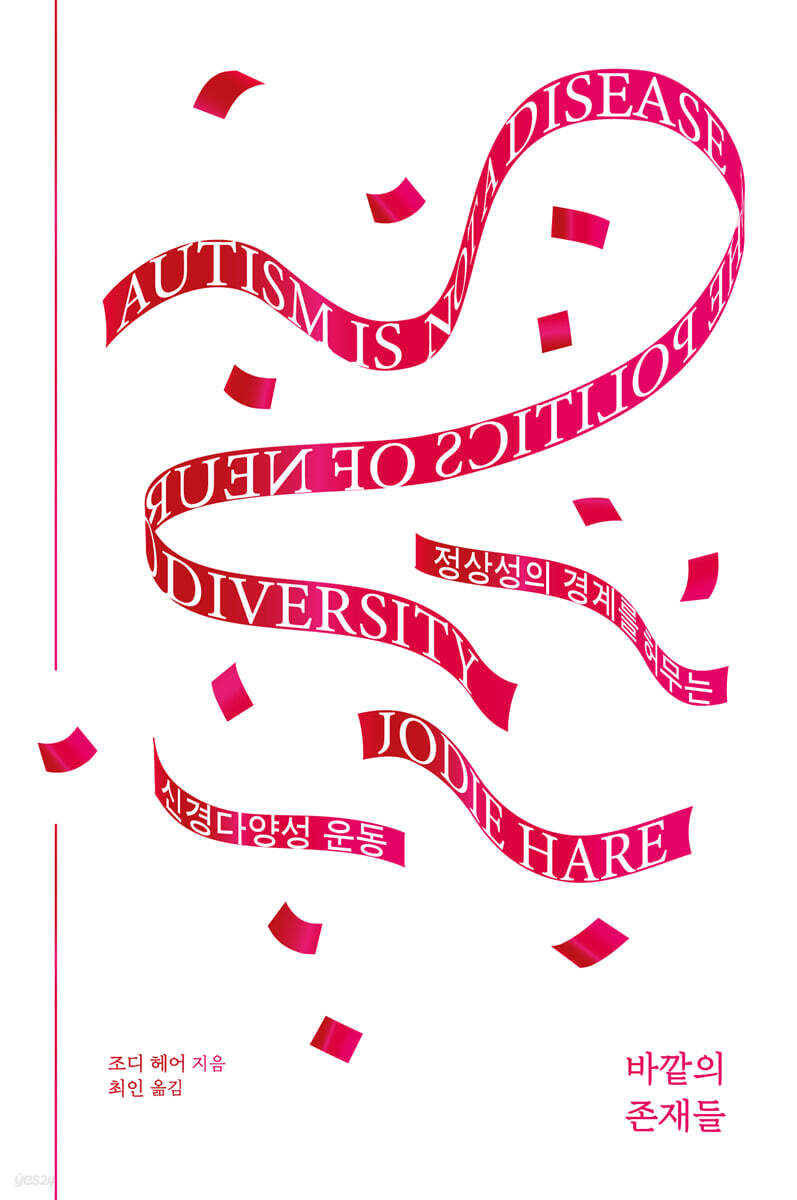
Beings outside
 |
Description
Book Introduction
From history and politics to declarations and visions
The most compelling guide to understanding the neurodiversity movement
Neurodiversity is one of the most pressing political issues today.
As diagnoses of autism spectrum disorders, ADHD, dyslexia, and dyspraxia increase, the concept of a “normal brain” is being exposed as a myth.
However, society still operates on the premise of neuronormality and regards autism as a disease of social deficits.
This book, "Existences from Outside," is an attempt to overturn this distorted history and perspective.
Author Jodi Hare, who was diagnosed with autism at age 23, presents neurodiversity as a social and political agenda, not a personal issue.
He criticizes how the standard of 'normality' has organized society and made those outside it targets of discrimination and exclusion.
At the same time, it persuasively demonstrates that society as a whole can become richer when differences are recognized as diversity rather than deficiency.
Various figures clearly reveal the seriousness of the reality.
The average life expectancy for people with autism is only 36 years, and the suicide rate is much higher than the general population.
They are 30% more likely to experience severe trauma, and 66% of families with autistic children in the United States face financial hardship.
In the UK, only 6% of neurodiverse students receive statutory support, and the employment rate for people with autism is just 22%.
In a time of austerity, even social care systems are unstable, and neurodiverse people experience exclusion and discrimination on a daily basis.
Based on this reality, the author argues that neurodiversity should be recognized as a natural variation rather than an “abnormal condition.”
He presents concrete suggestions for how neurodiverse people can live more inclusively in education, labor, and social life, and further envisions a democratic society in connection with other structures of inequality such as race, class, gender, and disability.
Neurodiversity is no longer a minority issue.
It is a political vision that designs a future of democracy where everyone lives equally, transcending inequalities entangled with class, gender, and race.
This book testifies to the present and future of the neurodiversity movement, moving from resistance to politics and from the margins to the center.
Rather than an academic paper, it is a vivid testimony and declaration rooted in activism and social practice, making it easily readable and relatable to both experts and general readers.
It is a powerful voice that seeks a new path to coexistence beyond the rigid framework of 'normality.'
The most compelling guide to understanding the neurodiversity movement
Neurodiversity is one of the most pressing political issues today.
As diagnoses of autism spectrum disorders, ADHD, dyslexia, and dyspraxia increase, the concept of a “normal brain” is being exposed as a myth.
However, society still operates on the premise of neuronormality and regards autism as a disease of social deficits.
This book, "Existences from Outside," is an attempt to overturn this distorted history and perspective.
Author Jodi Hare, who was diagnosed with autism at age 23, presents neurodiversity as a social and political agenda, not a personal issue.
He criticizes how the standard of 'normality' has organized society and made those outside it targets of discrimination and exclusion.
At the same time, it persuasively demonstrates that society as a whole can become richer when differences are recognized as diversity rather than deficiency.
Various figures clearly reveal the seriousness of the reality.
The average life expectancy for people with autism is only 36 years, and the suicide rate is much higher than the general population.
They are 30% more likely to experience severe trauma, and 66% of families with autistic children in the United States face financial hardship.
In the UK, only 6% of neurodiverse students receive statutory support, and the employment rate for people with autism is just 22%.
In a time of austerity, even social care systems are unstable, and neurodiverse people experience exclusion and discrimination on a daily basis.
Based on this reality, the author argues that neurodiversity should be recognized as a natural variation rather than an “abnormal condition.”
He presents concrete suggestions for how neurodiverse people can live more inclusively in education, labor, and social life, and further envisions a democratic society in connection with other structures of inequality such as race, class, gender, and disability.
Neurodiversity is no longer a minority issue.
It is a political vision that designs a future of democracy where everyone lives equally, transcending inequalities entangled with class, gender, and race.
This book testifies to the present and future of the neurodiversity movement, moving from resistance to politics and from the margins to the center.
Rather than an academic paper, it is a vivid testimony and declaration rooted in activism and social practice, making it easily readable and relatable to both experts and general readers.
It is a powerful voice that seeks a new path to coexistence beyond the rigid framework of 'normality.'
- You can preview some of the book's contents.
Preview
index
introduction
Chapter 1: Neurodiversity: Beyond Concept to Movement
How has meaning expanded?
Different approaches, different possibilities
Why this movement is needed now
Chapter 2: Why Neurodiversity Became a Social Issue
Beyond Structures of Oppression, Neurodiversity and the Politics of Liberation
An identity that refuses to become a commodity
Chapter 3: Encountering the Disability Justice Movement
Beyond solidarity, expanding boundaries
Chapter 4: Labor, Poverty, and Living Conditions
What should we change?
Beyond perception to mindset
Who is welfare for?
Are public services sufficient?
The right to learn to work
Chapter 5: Neurodiversity: Imagining the Next World
The world created by language, the world that language will change
Responding to the Care Crisis
How far can the horizon of understanding expand?
The power to imagine the future
The transformative potential of the neurodiversity movement
Acknowledgements
Information to learn more
main
Chapter 1: Neurodiversity: Beyond Concept to Movement
How has meaning expanded?
Different approaches, different possibilities
Why this movement is needed now
Chapter 2: Why Neurodiversity Became a Social Issue
Beyond Structures of Oppression, Neurodiversity and the Politics of Liberation
An identity that refuses to become a commodity
Chapter 3: Encountering the Disability Justice Movement
Beyond solidarity, expanding boundaries
Chapter 4: Labor, Poverty, and Living Conditions
What should we change?
Beyond perception to mindset
Who is welfare for?
Are public services sufficient?
The right to learn to work
Chapter 5: Neurodiversity: Imagining the Next World
The world created by language, the world that language will change
Responding to the Care Crisis
How far can the horizon of understanding expand?
The power to imagine the future
The transformative potential of the neurodiversity movement
Acknowledgements
Information to learn more
main
Detailed image
.jpg)
Into the book
‘Neurodiversity’ was originally coined to call for radical social solidarity, a deconstruction of perceptions of ‘normality’, and a demand for systemic change.
But for this very reason, its meaning is gradually being diluted.
The goal of this book is to address this lack of understanding and to clearly present neurodiversity as a movement for social change.
--- p.21
Disability is not an individual problem, but a complex problem created by the social environment.
Therefore, society has a responsibility to consider how to effectively address the issue of disability and remove structural barriers to ensure that no one is marginalized in society.
A frequently cited example is the problem of wheelchairs not being able to enter buildings.
From a medical perspective, the wheelchair user is the cause of the problem, so they should do everything they can to regain mobility, including through rehabilitation treatment.
In contrast, the social model requires ensuring accessibility by installing ramps or modifying facilities to allow entry into buildings.
--- p.32
We must understand autism as a natural neurological difference, and acknowledge that autistic and neurodiverse people have always existed and will always exist.
Autism is not a disease to be pathologized or 'cured', but rather a natural characteristic of some human beings.
While autism itself has its own challenges, what makes autism a disability is the social environment that excludes and isolates those who deviate from our society's predetermined standards of "normality."
This makes life much more difficult for neurodiverse people, and they are excluded from many areas of life, including education, social activities, sports, housing, and healthcare.
--- p.33
The most important thing is acceptance, understanding, and the elimination of stigma.
Opposing the medical pathologization of people diagnosed with neurodiversity means wanting a world where people can receive adequate support when they need it.
In such a world, diagnosis itself will become unnecessary, and instead of asking, “Why don’t you fit in with our world?” we will ask, “What support do you need to get through life?”
--- p.42
Looking at this situation from a pathological perspective, it seems that autistic people have a flaw in their natural communication style, and therefore it is their responsibility to change their behavior to fit society.
However, within the neurodiversity paradigm, we can ask the following question:
Why have we created hierarchies that define certain interactions and communication styles as normal and marginalize others? For whom does this "normality" serve, and who is excluded?
But for this very reason, its meaning is gradually being diluted.
The goal of this book is to address this lack of understanding and to clearly present neurodiversity as a movement for social change.
--- p.21
Disability is not an individual problem, but a complex problem created by the social environment.
Therefore, society has a responsibility to consider how to effectively address the issue of disability and remove structural barriers to ensure that no one is marginalized in society.
A frequently cited example is the problem of wheelchairs not being able to enter buildings.
From a medical perspective, the wheelchair user is the cause of the problem, so they should do everything they can to regain mobility, including through rehabilitation treatment.
In contrast, the social model requires ensuring accessibility by installing ramps or modifying facilities to allow entry into buildings.
--- p.32
We must understand autism as a natural neurological difference, and acknowledge that autistic and neurodiverse people have always existed and will always exist.
Autism is not a disease to be pathologized or 'cured', but rather a natural characteristic of some human beings.
While autism itself has its own challenges, what makes autism a disability is the social environment that excludes and isolates those who deviate from our society's predetermined standards of "normality."
This makes life much more difficult for neurodiverse people, and they are excluded from many areas of life, including education, social activities, sports, housing, and healthcare.
--- p.33
The most important thing is acceptance, understanding, and the elimination of stigma.
Opposing the medical pathologization of people diagnosed with neurodiversity means wanting a world where people can receive adequate support when they need it.
In such a world, diagnosis itself will become unnecessary, and instead of asking, “Why don’t you fit in with our world?” we will ask, “What support do you need to get through life?”
--- p.42
Looking at this situation from a pathological perspective, it seems that autistic people have a flaw in their natural communication style, and therefore it is their responsibility to change their behavior to fit society.
However, within the neurodiversity paradigm, we can ask the following question:
Why have we created hierarchies that define certain interactions and communication styles as normal and marginalize others? For whom does this "normality" serve, and who is excluded?
--- p.78
Publisher's Review
From Resistance to Solidarity: The Geography of the Neurodiversity Movement
This book consists of five chapters, each of which presents a specific perspective on the challenges and prospects of the neurodiversity movement.
Chapter 1 explains how the concept of 'normality' was formed and solidified in society.
It points out that neurodiversity, including autism, has been defined solely as a medical diagnosis, resulting in a structure that stigmatizes differences as “deficiencies.”
Chapter 2 focuses on the experiences of individuals with autism, showing how standards of normalcy constrain individuals' lives.
It contains vivid testimonies and examples of how barriers in education, diagnosis, and welfare systems make 'difference' a problem.
Chapter 3 examines the emergence and development of the neurodiversity movement in detail.
It vividly illustrates how the resistance of people with autism, which began in the UK and the US, spread into an international movement, and how this movement evolved beyond mere self-expression into a political practice demanding institutional and policy change.
Chapter 4 deals with the realities of labor, welfare, and social participation for neurodiverse people.
Comparing statistical data from Australia and China, it highlights the reality that many countries lack access to relevant data, highlighting that this is not simply a matter of numbers, but structural evidence of social exclusion.
By adding a footnote to the reality of Korean society, we point out that we too are in a similar situation and point out what tasks are needed going forward.
Chapter 5 depicts the future society proposed by the neurodiversity movement.
The author emphasizes that 'imagination that breaks down the boundaries of normality' is the path to moving beyond discrimination and toward coexistence.
It highlights the power of movements that move from resistance to politics, and from politics to a vision of coexistence, making it clear that neurodiversity is not just a minority issue, but a social challenge we all must address together.
This book consists of five chapters, each of which presents a specific perspective on the challenges and prospects of the neurodiversity movement.
Chapter 1 explains how the concept of 'normality' was formed and solidified in society.
It points out that neurodiversity, including autism, has been defined solely as a medical diagnosis, resulting in a structure that stigmatizes differences as “deficiencies.”
Chapter 2 focuses on the experiences of individuals with autism, showing how standards of normalcy constrain individuals' lives.
It contains vivid testimonies and examples of how barriers in education, diagnosis, and welfare systems make 'difference' a problem.
Chapter 3 examines the emergence and development of the neurodiversity movement in detail.
It vividly illustrates how the resistance of people with autism, which began in the UK and the US, spread into an international movement, and how this movement evolved beyond mere self-expression into a political practice demanding institutional and policy change.
Chapter 4 deals with the realities of labor, welfare, and social participation for neurodiverse people.
Comparing statistical data from Australia and China, it highlights the reality that many countries lack access to relevant data, highlighting that this is not simply a matter of numbers, but structural evidence of social exclusion.
By adding a footnote to the reality of Korean society, we point out that we too are in a similar situation and point out what tasks are needed going forward.
Chapter 5 depicts the future society proposed by the neurodiversity movement.
The author emphasizes that 'imagination that breaks down the boundaries of normality' is the path to moving beyond discrimination and toward coexistence.
It highlights the power of movements that move from resistance to politics, and from politics to a vision of coexistence, making it clear that neurodiversity is not just a minority issue, but a social challenge we all must address together.
GOODS SPECIFICS
- Date of issue: September 22, 2025
- Page count, weight, size: 184 pages | 248g | 125*188*15mm
- ISBN13: 9791194144106
You may also like
카테고리
korean


korean

![GQ KOREA Mark (Monthly): December [2025]](http://librairie.coreenne.fr/cdn/shop/files/8ef265dbbfbf186523ed75ba7319009d.jpg?v=1765340328&width=3840)


