

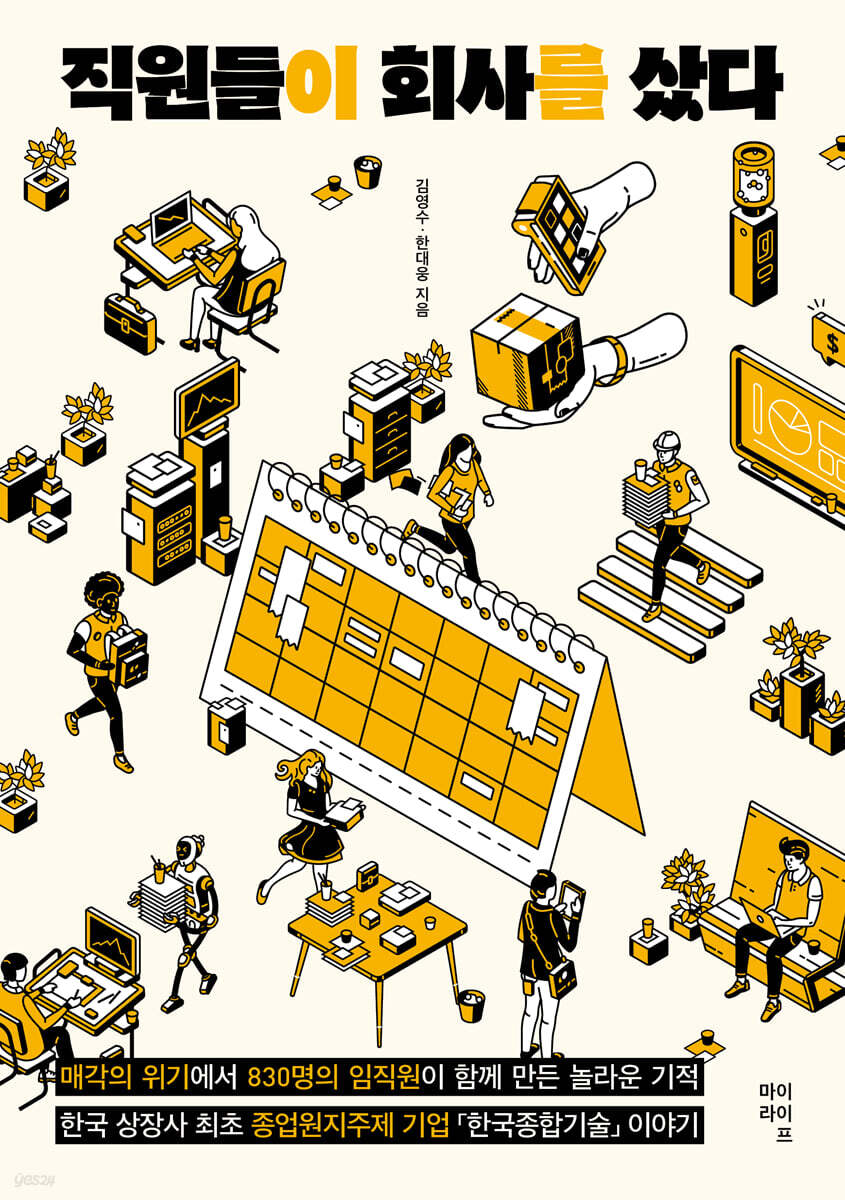
The employees bought the company
 |
Description
Book Introduction
An amazing miracle created by 830 employees during the crisis of sale brought about by imperial management.
The story of Korea's first employee-owned company, Korea Engineering & Construction.
Each person invested 50 million won and raised a total of 53 billion won to acquire a listed company.
A fairytale-like story that created a new paradigm for the Korean economy.
Protect their own jobs and job security.
In seven years, sales nearly doubled and the number of employees increased from 1,100 to 1,900.
A company without owner risk, electing the CEO and shareholder representatives through public offering and election.
Ownership and management are separated, and everyone, whether they are the CEO or a new employee, has equal rights and obligations.
Korea Engineering & Construction was an affiliate of Hanjin Heavy Industries & Construction Group (Chairman Cho Nam-ho).
In March 2017, 830 executives and employees of Korea Engineering & Construction were put at risk of being sold off as the group's flagship company, Hanjin Heavy Industries & Construction, was facing difficulties in management.
Accordingly, 830 executives and employees contributed 50 million won each, raising a total of 53 billion won to acquire their own company.
Afterwards, employees elected the CEO and shareholder representatives through direct voting with the participation of all employees (investors), separated ownership and management, and created a system and culture that allowed them to participate in management.
The company has grown significantly since its acquisition in 2017.
Sales nearly doubled from KRW 199.3 billion in 2017 to KRW 376.9 billion in 2023, and the number of employees increased from approximately 1,100 to approximately 1,900.
If the so-called M&A had taken place, mass layoffs, restructuring, and asset sales could have occurred. However, the employees of Korea Engineering & Construction kept their jobs and job security, and even achieved further growth.
This book covers the acquisition process, from the sale of Korea Advanced Institute of Technology in March 2017, to the establishment of new governance.
There were numerous obstacles, including creating public opinion for the acquisition, difficulties in raising funds, wavering opinions among employees, and opposition from management.
In this process, the labor union and author Kim Young-su (union chairman) played a major role.
The labor union and author Kim Young-soo (union chairman) did not shout "opposition to the sale," but declared "direct takeover by employees," and focused all their efforts on this.
In particular, the right of first arbitration was received on August 16, about five months after the sale began, and the role of author Kim Young-soo was very important until then.
The book depicts author Kim Young-soo running breathlessly toward his goal of 'direct employee acquisition.'
If you follow his actions and decisions at every moment, or rather, the way he had no choice but to act, you will see that the story unfolds in a way that was serious at the time but is now an interesting read.
The story of Korea's first employee-owned company, Korea Engineering & Construction.
Each person invested 50 million won and raised a total of 53 billion won to acquire a listed company.
A fairytale-like story that created a new paradigm for the Korean economy.
Protect their own jobs and job security.
In seven years, sales nearly doubled and the number of employees increased from 1,100 to 1,900.
A company without owner risk, electing the CEO and shareholder representatives through public offering and election.
Ownership and management are separated, and everyone, whether they are the CEO or a new employee, has equal rights and obligations.
Korea Engineering & Construction was an affiliate of Hanjin Heavy Industries & Construction Group (Chairman Cho Nam-ho).
In March 2017, 830 executives and employees of Korea Engineering & Construction were put at risk of being sold off as the group's flagship company, Hanjin Heavy Industries & Construction, was facing difficulties in management.
Accordingly, 830 executives and employees contributed 50 million won each, raising a total of 53 billion won to acquire their own company.
Afterwards, employees elected the CEO and shareholder representatives through direct voting with the participation of all employees (investors), separated ownership and management, and created a system and culture that allowed them to participate in management.
The company has grown significantly since its acquisition in 2017.
Sales nearly doubled from KRW 199.3 billion in 2017 to KRW 376.9 billion in 2023, and the number of employees increased from approximately 1,100 to approximately 1,900.
If the so-called M&A had taken place, mass layoffs, restructuring, and asset sales could have occurred. However, the employees of Korea Engineering & Construction kept their jobs and job security, and even achieved further growth.
This book covers the acquisition process, from the sale of Korea Advanced Institute of Technology in March 2017, to the establishment of new governance.
There were numerous obstacles, including creating public opinion for the acquisition, difficulties in raising funds, wavering opinions among employees, and opposition from management.
In this process, the labor union and author Kim Young-su (union chairman) played a major role.
The labor union and author Kim Young-soo (union chairman) did not shout "opposition to the sale," but declared "direct takeover by employees," and focused all their efforts on this.
In particular, the right of first arbitration was received on August 16, about five months after the sale began, and the role of author Kim Young-soo was very important until then.
The book depicts author Kim Young-soo running breathlessly toward his goal of 'direct employee acquisition.'
If you follow his actions and decisions at every moment, or rather, the way he had no choice but to act, you will see that the story unfolds in a way that was serious at the time but is now an interesting read.
- You can preview some of the book's contents.
Preview
index
Recommendation/ When you enter
Chapter 1: The Road Not Taken
New boss/Voluntary agreement/Employee buyout is the answer/I was mentally prepared
Chapter 2: The Ideal and Reality Before Our Eyes
First Step: Becoming the President of Our Company's Shareholders' Association / Proposing a Debt-Based ESOP /
Collecting "Letter of Intent to Participate in the Acquisition," Building External Collaboration, Funding, and the Power of Solidarity
Chapter 3: The Worker Bought the Company
Preferential negotiation rights/ wavering minds/ takeover task force/ fateful week/ final contract at last
Chapter 4: Employee Stock Ownership: Everyone Has 1/n Rights
The first listed company to separate ownership and management, elect a CEO by vote, and voluntarily return wages.
Conclusion/ Acknowledgments/ Korea Comprehensive Technology Acquisition Schedule
Chapter 1: The Road Not Taken
New boss/Voluntary agreement/Employee buyout is the answer/I was mentally prepared
Chapter 2: The Ideal and Reality Before Our Eyes
First Step: Becoming the President of Our Company's Shareholders' Association / Proposing a Debt-Based ESOP /
Collecting "Letter of Intent to Participate in the Acquisition," Building External Collaboration, Funding, and the Power of Solidarity
Chapter 3: The Worker Bought the Company
Preferential negotiation rights/ wavering minds/ takeover task force/ fateful week/ final contract at last
Chapter 4: Employee Stock Ownership: Everyone Has 1/n Rights
The first listed company to separate ownership and management, elect a CEO by vote, and voluntarily return wages.
Conclusion/ Acknowledgments/ Korea Comprehensive Technology Acquisition Schedule
Publisher's Review
A miracle created by 830 employees during a crisis of sale.
Concerns that the 50 million won in investment could disappear, but the acquisition is complete.
Korea Engineering & Construction, which was put on the market in March 2017, was in danger of becoming prey to corporate raiders (speculative capital) who prioritize profit recovery over management, or being acquired by a large construction company.
Even if they were lucky enough to be acquired by a large construction company rather than a speculative capitalist, it would be expected that there would be restructuring, layoffs, and deterioration of employee benefits, although the degree of this would vary.
Of the 1,100 employees at the time, 830 made a decision.
50 million won was a lot of money to a working person back then, and it is still the case now.
Despite the anxiety that their 50 million won in investment could disappear, they trusted the acquisition team and each other and participated in the 'direct employee acquisition.'
They expressed their enthusiasm by participating in a rally calling for a "fair sale" in front of the headquarters of the Industrial Bank of Korea, the lead manager for the sale, and Hanjin Heavy Industries & Construction, and actively participating in the acquisition-related briefing session.
There was also a major crisis.
Although some executives, particularly those in management, began to oppose the 'direct takeover of employees' in the final stages of the takeover, this ultimately led to an extreme confrontation.
Even at this time, the executives and employees supported the takeover task force team and wanted to become the owners themselves.
Despite three consecutive years of negative profits, the company overcame the crisis with measures such as its own "10% wage return resolution."
Since its acquisition on December 15, 2017, Korea Advanced Institute of Technology has been a testing ground for new corporate models.
The process of establishing governance was not smooth.
Korea Advanced Institute of Technology recorded negative operating profits for three consecutive years from 2017, when it acquired the company, to 2019.
Within the engineering industry, to which Korea Engineering & Construction belongs, rumors were circulating that the company would soon go under, calling it a "union-controlled company" and a "company without an owner."
Also, “If a deficit occurs for three consecutive years, the KOSPI listing will be delisted.
There was even a groundless rumor going around that “If that happens, you will lose all of your 50 million won in investment.”
In this situation, at the end of 2018, employees voluntarily passed a resolution to return 10% of their wages.
In a typical company, it would be the management and executives who would first cut their salaries, but Korea Technology's executives and employees did not do so.
They had a heated discussion and passed a resolution to return 10% of wages by a vote of all employees.
The executives and employees of Korea Advanced Institute of Technology have proven that they are the owners of the company.
Why is Korea Engineering & Construction the first publicly listed company in Korea to have an employee stock ownership system?
There are several companies that advocate employee stock ownership.
But why does Korea Advanced Institute of Technology confidently use the word "first"? Korea Advanced Institute of Technology's employee stock ownership system differs from that of typical companies.
It goes beyond the simple concept of “employees own the company’s stock” to include the aspect of “all members manage the company” or “all members are owners of the company.”
The executives and employees took over management rights.
First, ownership and management were separated.
In general companies, as well as companies that advocate employee stock ownership, the CEO is either appointed by the largest shareholder or is appointed directly by the largest shareholder.
Ultimately, ownership and management cannot be separated.
However, Korea Comprehensive Technology is a company that invests in Korea Comprehensive Technology (KECC) Holdings.
Of the total 1,800 employees, 1,035 are regular shareholders.
Korea Engineering & Construction Corporation (KECC) Holdings is exploring various support measures to expand its regular investors.
The president is elected by direct vote.
Korea Advanced Institute of Technology appoints the president elected in this manner at the general shareholders' meeting.
Ultimately, the CEO has no choice but to listen to the voices of his employees, and ownership and management will naturally be separated.
Second, although the largest shareholder of a company is an individual, the largest shareholder of Korea Engineering & Construction Co., Ltd. is the 'KECC Engineers Cooperative' with 1,035 investors.
The 'KECC Engineers Cooperative' operates to ensure that Korea Advanced Institute of Technology (KAIST) remains a sort of employee self-governing community.
Executives and employees can run for election as members of the Board of Directors (consisting of 40 members) or as the Chairman of the Finance Committee, the Chairman of the Management Committee, the Chairman of the Shareholder Value Committee, or the Chairman of the Personnel Committee, and if elected, can participate in management.
The roles of the Board of Directors and its four chairmen are substantive, not formal.
The Board of Directors receives a monthly report on the company's status from the President, and has the right to elect the three final candidates from among the applicants when electing the President of Korea Advanced Institute of Technology.
Third, the CEO and the ‘KECC Holdings representative (shareholder representative)’ are elected through direct voting by the investing executives and employees.
The CEO and the 'KECC Holdings representative (shareholder representative)' representing the company are elected by vote, so they cannot make arbitrary decisions.
Naturally, they have no choice but to listen to the voices of their employees.
This enables democratic decision-making.
Fourth, the term of office of the President and the ‘KECC Holdings Representative (Shareholder Representative)’ is three years.
The CEO may be reappointed after a three-year term through a vote of confidence from the investing executives and employees, and the 'KECC Holdings CEO (shareholder representative)' is reappointed through an election.
Fifth, everyone has 1/n rights.
Every citizen has equal rights and obligations from the moment he or she is born.
Likewise, in the case of Korea Advanced Institute of Technology, if each person invests 50 million won and becomes a shareholder, everyone has equal rights and obligations.
Under current law, a shareholder with even one more share can exercise more rights, but Korea Advanced Institute of Technology has prevented this in advance by establishing its governance structure.
For example, when electing a representative for Korea Advanced Institute of Technology, any employee who invested 50 million won, regardless of whether he or she is a new employee or the president, only casts one vote.
No one can exercise more voting rights than that.
The 50 million won deposit will be returned upon retirement.
Sixth, what do employees do when a company's net income turns negative? They demand wage cuts, starting with management.
However, as the executives and employees of Korea Advanced Institute of Technology are the owners, they could voluntarily decide to 'cut wages' or 'defer wages', and they did so in the second half of 2019.
At that time, Korea Advanced Institute of Technology decided on this issue through a vote for or against with the participation of all executives and employees.
After the launch of the employee stock ownership system, all four appointed presidents were elected through public offering and voting.
Because Korea Advanced Institute of Technology elects its CEO and shareholder representatives through public offering and elections, the owner risk commonly mentioned in society cannot exist.
Since the employee stock ownership system was launched in 2018, all four CEOs have been elected through open competition and voting.
In particular, the three presidents from the 2nd to the current 4th term are people who joined Korea Advanced Institute of Technology when they were young and have had their abilities and character verified.
There is a unique culture among the systems related to the president of Korea Advanced Institute of Technology.
After their term ends, the CEOs return to the department of their choice, work just like regular employees, and retire.
Korea Advanced Institute of Technology has made this culture a natural thing.
A model that ensures job security and maintains business sustainability after the Baby Boomer generation of entrepreneurs.
Since the IMF crisis in 1998, corporate M&A has become common.
When M&A occurs, restructuring often results in mass layoffs, a decline in welfare levels, and asset sales.
This kind of thing happens, big or small, just to varying degrees.
However, in cases where executives and employees directly acquire the company, as in the case of Korea Advanced Institute of Technology, employment stability is maintained, and the company can grow significantly as owner risk is eliminated.
In particular, since a significant number of M&As are the result of corporate takeovers by predatory capital, and in such cases, layoffs and asset sales have become natural, 'direct employee acquisition' can become a new economic alternative model.
Also, baby boomer founders are starting to retire.
How can these companies maintain their sustainability? Korean society needs to seriously debate this issue, and "direct employee buyouts" offer a promising model.
The best answer to the difficult question: "Does democracy feed you?"
Since its acquisition in 2017, Korea Engineering & Construction's order performance has ranked 4th to 6th for several years, but it has risen to 2nd place in the industry in 2023.
Sales have grown significantly compared to 2017, and accordingly, the number of employees has increased by more than 800, from approximately 1,100 immediately after the acquisition to approximately 1,900, with more than 100 employees hired each year.
If the acquisition had been by another company or predatory financial capital rather than an 'employee buyout', sales would have decreased and there could have been a significant reduction in staff.
But that didn't happen, and instead, there was great growth.
What power has this potential? Democratic decision-making is a prime example.
Since there is no arbitrary decision by the largest shareholder (owner), democratic decision-making is inevitable.
Democratic decision-making may seem slow at first, but it ultimately becomes a force that can create greater things through majority participation.
Korea Advanced Institute of Science and Technology (KAIST) has created a system that reflects this trend.
A representative example is the election of the CEO, shareholder representatives, and board members.
Anyone who has invested 50 million won can run for president, shareholder representative, or board of directors.
Also, anyone, whether the CEO or a new employee, can participate in the voting with one vote per person.
Additionally, the CEO is required to report business performance to the 40 board members every month, and this system is practical rather than formal.
Some people talk about the tragedy of the commons, pointing out the problems of communal organization and democratic decision-making.
However, if we organize the system and share the content with those who participate, there will be no tragedy in the commons, and instead, flowers will bloom.
This is the case with Korea Advanced Institute of Science and Technology's election and board of directors operation system.
A fairy tale, what results can one human's awakening and will bring?
Author Kim Young-soo, currently the CEO of Korea Engineering & Construction Co., Ltd. (KECC) Holdings, was the union chairman at the time of the acquisition in 2017.
Author Kim Young-su learned about the 'employee stock ownership system' and 'direct employee acquisition' while working in the labor union before the acquisition in 2017.
He showed solidarity and support for the establishment of several labor unions, including the Seoyoung Engineering Labor Union in the same industry.
I also witnessed the process of Saman Engineering pursuing an 'employee acquisition' but unfortunately failing.
This experience served as a driving force for Korea Advanced Institute of Technology to respond quickly, centering on the labor union, when the company was facing a crisis of being sold, and to formulate a plan for an "employee buyout," which was ultimately accomplished.
When you read this book, the experiences of author Kim Young-su unfold like a fairy tale or novel.
These events are sometimes dramatic and sometimes show the formation of extreme conflicts.
At other times, it shows the human figure enduring with perseverance and patience.
And sometimes dramatic luck follows.
So, reading this book is dramatically entertaining.
As soon as he announced the "employee buyout," he organized a "Right Sale Urging Rally" and a National Assembly press conference to raise funds and shape public opinion, and frequently met with reporters, civic groups, and politicians.
One of the most difficult tasks in the 'employee takeover' process was financing.
The bank refused to lend money on the grounds that “the employees (workers) are taking over the business.”
They predicted that “the funds might not be recovered” and were afraid of this.
What if employees (laborers) refused to collect their funds from the bank and staged a strike and protest in front of the bank? They were afraid of that and refused to lend money.
Funding was rejected by all major banks, including Kookmin, Woori, Shinhan, and Hana.
However, the union leader (author Kim Young-soo) who led the acquisition was not discouraged and continued to knock on the financial sector.
Finally, just a few days before the June 21st bidding deadline, we received funding from Cape Securities.
According to him, it would be like scoring a goal just before the end of the second half of a soccer match.
Also, after receiving the preferential negotiation rights on August 16, there was organized action by some executives opposing the employee takeover.
They preached the reasons why the acquisition should not be made and encouraged employees to leave.
The company experienced major internal strife for a week.
But the process was resolved dramatically and cleverly.
In the process, author Kim Young-su demonstrated patience and harmony, taking the lead in resolving this issue harmoniously.
In addition, after the acquisition, we focused on establishing governance.
He ran for and was elected as the CEO of Korea Technology Holdings, and played a leading role in the establishment of the CEO public offering system and the construction of the 'KECC Engineers' Cooperative.'
It was a serious story at the time, but now it adds to the fun of reading.
There have been stories before of employees taking over a company.
However, it was an uncommon story, and the company that set the stage was small.
There has been no such example among companies listed on KOSPI or KOSDAQ, such as Korea Advanced Institute of Science and Technology.
Also, stories that are generally unimaginable, such as ‘the president is elected’ or ‘both the president and new employees have 1/n of the rights’, did not unfold.
However, the story of Korea Advanced Institute of Technology over the past eight years is different.
As a result, the stories that emerge are also different.
The stories written in this book are things we have never heard or experienced before.
So, as you read, you feel a great sense of fun and novelty.
For example, there are:
I will write down a few stories from the union chairman (author Kim Young-soo) who led the takeover.
① I secretly met with officials from Hoban Construction, the competitor to the main bidder, at night to confirm their intentions.
They met in groups of three from each side at a Japanese restaurant, and as if they were engaged in a espionage war, they tried to gauge each other's intentions, extracted information, and exchanged words to weaken the other side's will to take over.
② A reporter who was very interested in employee stock ownership came to visit.
With the help of that reporter, I learned about a civic group called the 'Korea Federation of Employee Stock Owners Associations'.
The story of meeting with the Blue House administrative officer with the support of that group, explaining the 'employee takeover', and asking for cooperation.
③ I kept asking around and by chance, I learned about a method of raising funds from a fellow union leader.
④ After the acquisition, the company faced difficulties due to a decrease in operating profit in 2018, so there was an explanation session about ‘cutting the wages of executives and employees.’
The union leader (author Kim Young-soo), who led the takeover, had to explain at this event why wage cuts were necessary.
However, since 'cutting wages' is a topic that everyone hates, author Kim Young-soo wanted to avoid this place.
It was a moment of minor internal conflict for him.
⑤ After the acquisition, Chairman Kim Young-soo became the CEO of Korea Technology Holdings.
After I was elected, my wife said:
“I saw the news, and I heard that many of the holding company representatives I know are going to jail.”
But that didn't happen.
Korea Advanced Institute of Technology separated ownership and management, elected its CEO and shareholder representatives, and increased transparency and employee participation in management, leaving no room for negative factors to intervene.
Rather, the company has grown nearly twice since the acquisition, and employee welfare has also improved.
Concerns that the 50 million won in investment could disappear, but the acquisition is complete.
Korea Engineering & Construction, which was put on the market in March 2017, was in danger of becoming prey to corporate raiders (speculative capital) who prioritize profit recovery over management, or being acquired by a large construction company.
Even if they were lucky enough to be acquired by a large construction company rather than a speculative capitalist, it would be expected that there would be restructuring, layoffs, and deterioration of employee benefits, although the degree of this would vary.
Of the 1,100 employees at the time, 830 made a decision.
50 million won was a lot of money to a working person back then, and it is still the case now.
Despite the anxiety that their 50 million won in investment could disappear, they trusted the acquisition team and each other and participated in the 'direct employee acquisition.'
They expressed their enthusiasm by participating in a rally calling for a "fair sale" in front of the headquarters of the Industrial Bank of Korea, the lead manager for the sale, and Hanjin Heavy Industries & Construction, and actively participating in the acquisition-related briefing session.
There was also a major crisis.
Although some executives, particularly those in management, began to oppose the 'direct takeover of employees' in the final stages of the takeover, this ultimately led to an extreme confrontation.
Even at this time, the executives and employees supported the takeover task force team and wanted to become the owners themselves.
Despite three consecutive years of negative profits, the company overcame the crisis with measures such as its own "10% wage return resolution."
Since its acquisition on December 15, 2017, Korea Advanced Institute of Technology has been a testing ground for new corporate models.
The process of establishing governance was not smooth.
Korea Advanced Institute of Technology recorded negative operating profits for three consecutive years from 2017, when it acquired the company, to 2019.
Within the engineering industry, to which Korea Engineering & Construction belongs, rumors were circulating that the company would soon go under, calling it a "union-controlled company" and a "company without an owner."
Also, “If a deficit occurs for three consecutive years, the KOSPI listing will be delisted.
There was even a groundless rumor going around that “If that happens, you will lose all of your 50 million won in investment.”
In this situation, at the end of 2018, employees voluntarily passed a resolution to return 10% of their wages.
In a typical company, it would be the management and executives who would first cut their salaries, but Korea Technology's executives and employees did not do so.
They had a heated discussion and passed a resolution to return 10% of wages by a vote of all employees.
The executives and employees of Korea Advanced Institute of Technology have proven that they are the owners of the company.
Why is Korea Engineering & Construction the first publicly listed company in Korea to have an employee stock ownership system?
There are several companies that advocate employee stock ownership.
But why does Korea Advanced Institute of Technology confidently use the word "first"? Korea Advanced Institute of Technology's employee stock ownership system differs from that of typical companies.
It goes beyond the simple concept of “employees own the company’s stock” to include the aspect of “all members manage the company” or “all members are owners of the company.”
The executives and employees took over management rights.
First, ownership and management were separated.
In general companies, as well as companies that advocate employee stock ownership, the CEO is either appointed by the largest shareholder or is appointed directly by the largest shareholder.
Ultimately, ownership and management cannot be separated.
However, Korea Comprehensive Technology is a company that invests in Korea Comprehensive Technology (KECC) Holdings.
Of the total 1,800 employees, 1,035 are regular shareholders.
Korea Engineering & Construction Corporation (KECC) Holdings is exploring various support measures to expand its regular investors.
The president is elected by direct vote.
Korea Advanced Institute of Technology appoints the president elected in this manner at the general shareholders' meeting.
Ultimately, the CEO has no choice but to listen to the voices of his employees, and ownership and management will naturally be separated.
Second, although the largest shareholder of a company is an individual, the largest shareholder of Korea Engineering & Construction Co., Ltd. is the 'KECC Engineers Cooperative' with 1,035 investors.
The 'KECC Engineers Cooperative' operates to ensure that Korea Advanced Institute of Technology (KAIST) remains a sort of employee self-governing community.
Executives and employees can run for election as members of the Board of Directors (consisting of 40 members) or as the Chairman of the Finance Committee, the Chairman of the Management Committee, the Chairman of the Shareholder Value Committee, or the Chairman of the Personnel Committee, and if elected, can participate in management.
The roles of the Board of Directors and its four chairmen are substantive, not formal.
The Board of Directors receives a monthly report on the company's status from the President, and has the right to elect the three final candidates from among the applicants when electing the President of Korea Advanced Institute of Technology.
Third, the CEO and the ‘KECC Holdings representative (shareholder representative)’ are elected through direct voting by the investing executives and employees.
The CEO and the 'KECC Holdings representative (shareholder representative)' representing the company are elected by vote, so they cannot make arbitrary decisions.
Naturally, they have no choice but to listen to the voices of their employees.
This enables democratic decision-making.
Fourth, the term of office of the President and the ‘KECC Holdings Representative (Shareholder Representative)’ is three years.
The CEO may be reappointed after a three-year term through a vote of confidence from the investing executives and employees, and the 'KECC Holdings CEO (shareholder representative)' is reappointed through an election.
Fifth, everyone has 1/n rights.
Every citizen has equal rights and obligations from the moment he or she is born.
Likewise, in the case of Korea Advanced Institute of Technology, if each person invests 50 million won and becomes a shareholder, everyone has equal rights and obligations.
Under current law, a shareholder with even one more share can exercise more rights, but Korea Advanced Institute of Technology has prevented this in advance by establishing its governance structure.
For example, when electing a representative for Korea Advanced Institute of Technology, any employee who invested 50 million won, regardless of whether he or she is a new employee or the president, only casts one vote.
No one can exercise more voting rights than that.
The 50 million won deposit will be returned upon retirement.
Sixth, what do employees do when a company's net income turns negative? They demand wage cuts, starting with management.
However, as the executives and employees of Korea Advanced Institute of Technology are the owners, they could voluntarily decide to 'cut wages' or 'defer wages', and they did so in the second half of 2019.
At that time, Korea Advanced Institute of Technology decided on this issue through a vote for or against with the participation of all executives and employees.
After the launch of the employee stock ownership system, all four appointed presidents were elected through public offering and voting.
Because Korea Advanced Institute of Technology elects its CEO and shareholder representatives through public offering and elections, the owner risk commonly mentioned in society cannot exist.
Since the employee stock ownership system was launched in 2018, all four CEOs have been elected through open competition and voting.
In particular, the three presidents from the 2nd to the current 4th term are people who joined Korea Advanced Institute of Technology when they were young and have had their abilities and character verified.
There is a unique culture among the systems related to the president of Korea Advanced Institute of Technology.
After their term ends, the CEOs return to the department of their choice, work just like regular employees, and retire.
Korea Advanced Institute of Technology has made this culture a natural thing.
A model that ensures job security and maintains business sustainability after the Baby Boomer generation of entrepreneurs.
Since the IMF crisis in 1998, corporate M&A has become common.
When M&A occurs, restructuring often results in mass layoffs, a decline in welfare levels, and asset sales.
This kind of thing happens, big or small, just to varying degrees.
However, in cases where executives and employees directly acquire the company, as in the case of Korea Advanced Institute of Technology, employment stability is maintained, and the company can grow significantly as owner risk is eliminated.
In particular, since a significant number of M&As are the result of corporate takeovers by predatory capital, and in such cases, layoffs and asset sales have become natural, 'direct employee acquisition' can become a new economic alternative model.
Also, baby boomer founders are starting to retire.
How can these companies maintain their sustainability? Korean society needs to seriously debate this issue, and "direct employee buyouts" offer a promising model.
The best answer to the difficult question: "Does democracy feed you?"
Since its acquisition in 2017, Korea Engineering & Construction's order performance has ranked 4th to 6th for several years, but it has risen to 2nd place in the industry in 2023.
Sales have grown significantly compared to 2017, and accordingly, the number of employees has increased by more than 800, from approximately 1,100 immediately after the acquisition to approximately 1,900, with more than 100 employees hired each year.
If the acquisition had been by another company or predatory financial capital rather than an 'employee buyout', sales would have decreased and there could have been a significant reduction in staff.
But that didn't happen, and instead, there was great growth.
What power has this potential? Democratic decision-making is a prime example.
Since there is no arbitrary decision by the largest shareholder (owner), democratic decision-making is inevitable.
Democratic decision-making may seem slow at first, but it ultimately becomes a force that can create greater things through majority participation.
Korea Advanced Institute of Science and Technology (KAIST) has created a system that reflects this trend.
A representative example is the election of the CEO, shareholder representatives, and board members.
Anyone who has invested 50 million won can run for president, shareholder representative, or board of directors.
Also, anyone, whether the CEO or a new employee, can participate in the voting with one vote per person.
Additionally, the CEO is required to report business performance to the 40 board members every month, and this system is practical rather than formal.
Some people talk about the tragedy of the commons, pointing out the problems of communal organization and democratic decision-making.
However, if we organize the system and share the content with those who participate, there will be no tragedy in the commons, and instead, flowers will bloom.
This is the case with Korea Advanced Institute of Science and Technology's election and board of directors operation system.
A fairy tale, what results can one human's awakening and will bring?
Author Kim Young-soo, currently the CEO of Korea Engineering & Construction Co., Ltd. (KECC) Holdings, was the union chairman at the time of the acquisition in 2017.
Author Kim Young-su learned about the 'employee stock ownership system' and 'direct employee acquisition' while working in the labor union before the acquisition in 2017.
He showed solidarity and support for the establishment of several labor unions, including the Seoyoung Engineering Labor Union in the same industry.
I also witnessed the process of Saman Engineering pursuing an 'employee acquisition' but unfortunately failing.
This experience served as a driving force for Korea Advanced Institute of Technology to respond quickly, centering on the labor union, when the company was facing a crisis of being sold, and to formulate a plan for an "employee buyout," which was ultimately accomplished.
When you read this book, the experiences of author Kim Young-su unfold like a fairy tale or novel.
These events are sometimes dramatic and sometimes show the formation of extreme conflicts.
At other times, it shows the human figure enduring with perseverance and patience.
And sometimes dramatic luck follows.
So, reading this book is dramatically entertaining.
As soon as he announced the "employee buyout," he organized a "Right Sale Urging Rally" and a National Assembly press conference to raise funds and shape public opinion, and frequently met with reporters, civic groups, and politicians.
One of the most difficult tasks in the 'employee takeover' process was financing.
The bank refused to lend money on the grounds that “the employees (workers) are taking over the business.”
They predicted that “the funds might not be recovered” and were afraid of this.
What if employees (laborers) refused to collect their funds from the bank and staged a strike and protest in front of the bank? They were afraid of that and refused to lend money.
Funding was rejected by all major banks, including Kookmin, Woori, Shinhan, and Hana.
However, the union leader (author Kim Young-soo) who led the acquisition was not discouraged and continued to knock on the financial sector.
Finally, just a few days before the June 21st bidding deadline, we received funding from Cape Securities.
According to him, it would be like scoring a goal just before the end of the second half of a soccer match.
Also, after receiving the preferential negotiation rights on August 16, there was organized action by some executives opposing the employee takeover.
They preached the reasons why the acquisition should not be made and encouraged employees to leave.
The company experienced major internal strife for a week.
But the process was resolved dramatically and cleverly.
In the process, author Kim Young-su demonstrated patience and harmony, taking the lead in resolving this issue harmoniously.
In addition, after the acquisition, we focused on establishing governance.
He ran for and was elected as the CEO of Korea Technology Holdings, and played a leading role in the establishment of the CEO public offering system and the construction of the 'KECC Engineers' Cooperative.'
It was a serious story at the time, but now it adds to the fun of reading.
There have been stories before of employees taking over a company.
However, it was an uncommon story, and the company that set the stage was small.
There has been no such example among companies listed on KOSPI or KOSDAQ, such as Korea Advanced Institute of Science and Technology.
Also, stories that are generally unimaginable, such as ‘the president is elected’ or ‘both the president and new employees have 1/n of the rights’, did not unfold.
However, the story of Korea Advanced Institute of Technology over the past eight years is different.
As a result, the stories that emerge are also different.
The stories written in this book are things we have never heard or experienced before.
So, as you read, you feel a great sense of fun and novelty.
For example, there are:
I will write down a few stories from the union chairman (author Kim Young-soo) who led the takeover.
① I secretly met with officials from Hoban Construction, the competitor to the main bidder, at night to confirm their intentions.
They met in groups of three from each side at a Japanese restaurant, and as if they were engaged in a espionage war, they tried to gauge each other's intentions, extracted information, and exchanged words to weaken the other side's will to take over.
② A reporter who was very interested in employee stock ownership came to visit.
With the help of that reporter, I learned about a civic group called the 'Korea Federation of Employee Stock Owners Associations'.
The story of meeting with the Blue House administrative officer with the support of that group, explaining the 'employee takeover', and asking for cooperation.
③ I kept asking around and by chance, I learned about a method of raising funds from a fellow union leader.
④ After the acquisition, the company faced difficulties due to a decrease in operating profit in 2018, so there was an explanation session about ‘cutting the wages of executives and employees.’
The union leader (author Kim Young-soo), who led the takeover, had to explain at this event why wage cuts were necessary.
However, since 'cutting wages' is a topic that everyone hates, author Kim Young-soo wanted to avoid this place.
It was a moment of minor internal conflict for him.
⑤ After the acquisition, Chairman Kim Young-soo became the CEO of Korea Technology Holdings.
After I was elected, my wife said:
“I saw the news, and I heard that many of the holding company representatives I know are going to jail.”
But that didn't happen.
Korea Advanced Institute of Technology separated ownership and management, elected its CEO and shareholder representatives, and increased transparency and employee participation in management, leaving no room for negative factors to intervene.
Rather, the company has grown nearly twice since the acquisition, and employee welfare has also improved.
GOODS SPECIFICS
- Date of issue: August 25, 2025
- Page count, weight, size: 292 pages | 488g | 149*210*18mm
- ISBN13: 9791197575570
- ISBN10: 119757557X
You may also like
카테고리
korean


korean

![GQ KOREA Mark (Monthly): December [2025]](http://librairie.coreenne.fr/cdn/shop/files/8ef265dbbfbf186523ed75ba7319009d.jpg?v=1765340328&width=3840)


