

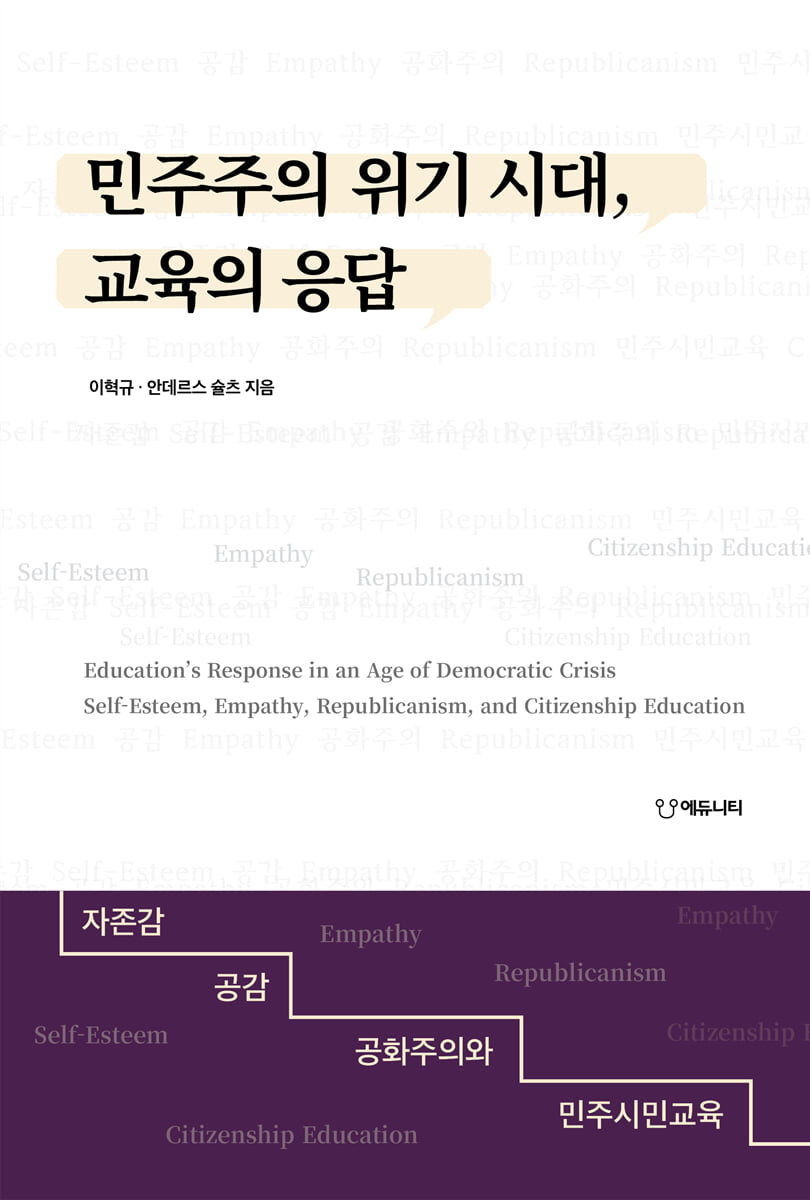
Education's Response to a Democracy Crisis
 |
Description
Book Introduction
“How should education respond to the crisis of democracy?”
The December 3, 2025 martial law and impeachment of the president showed how easily Korean democracy can be shaken.
Democracy cannot be protected by institutions and constitutions alone.
A living, breathing democracy is only possible when there are individuals with self-respect, citizens who can empathize with others, and a republican attitude that takes responsibility for the community.
『Education's Response in the Age of Democracy's Crisis』 is a book written by Professor Lee Hyuk-gyu (Cheongju National University of Education) based on decades of research and field experience in education, and added an international perspective in collaboration with Danish educator Anders Schultz.
The book examines the causes of the democratic crisis within the cultural and educational context of Korean society, and suggests how education can foster self-esteem, empathy, and republicanism.
This book is not simply a theoretical book for teachers and educators.
It includes activities, discussion topics, and roundtable suggestions that you can use with your students in the classroom, making it a ready-to-use teaching resource.
At the same time, it helps teachers reflect on their own democratic leadership.
We also interpret the democratic crisis our society is currently facing from an educational perspective and ask teachers and parents to provide practical responses.
If you're looking for a book that connects education and democracy, this is the answer.
The December 3, 2025 martial law and impeachment of the president showed how easily Korean democracy can be shaken.
Democracy cannot be protected by institutions and constitutions alone.
A living, breathing democracy is only possible when there are individuals with self-respect, citizens who can empathize with others, and a republican attitude that takes responsibility for the community.
『Education's Response in the Age of Democracy's Crisis』 is a book written by Professor Lee Hyuk-gyu (Cheongju National University of Education) based on decades of research and field experience in education, and added an international perspective in collaboration with Danish educator Anders Schultz.
The book examines the causes of the democratic crisis within the cultural and educational context of Korean society, and suggests how education can foster self-esteem, empathy, and republicanism.
This book is not simply a theoretical book for teachers and educators.
It includes activities, discussion topics, and roundtable suggestions that you can use with your students in the classroom, making it a ready-to-use teaching resource.
At the same time, it helps teachers reflect on their own democratic leadership.
We also interpret the democratic crisis our society is currently facing from an educational perspective and ask teachers and parents to provide practical responses.
If you're looking for a book that connects education and democracy, this is the answer.
- You can preview some of the book's contents.
Preview
index
Recommendation
prolog.
About what led me to write the book
Part 1.
Self-esteem and self-esteem education
Chapter 1.
Different Parenting Environments in Each Society _22
1.
Biological vulnerability of human infants
2.
Parental Ethnotheories
3.
Education that builds self-esteem vs. education that builds confidence
Chapter 2.
A Look Back at Korea's Childcare Environment _32
1.
A parenting environment focused on achievement and competition
2.
A culture of discrimination within individual households
3.
Historical and social context of the child-rearing environment
Chapter 3.
Human Types Based on Self-Esteem and Confidence _45
1.
A culture that values self-esteem and confidence
2.
Human types based on self-esteem and confidence
3.
Self-Esteem and Confidence Diagnostic Checklist
4.
A leader type with low self-esteem and high confidence
Chapter 4.
Education and Society: Fostering Self-Esteem and Healthy Leaders _60
1.
Education that boosts self-esteem
2.
A society that fosters healthy leaders
Chapter 5.
Things to keep in mind when teaching self-esteem _79
1.
Potential for drifting into narcissism and evasion of responsibility
2.
Self-Esteem Education and Adolescent Health Issues
3.
The communal self as an extension of self-esteem
4.
Connecting Self-Esteem Education with Equality and Social Justice
Part 2.
Empathy and Empathy Education
Chapter 1.
The Biological Basis of Empathy _90
1.
Etymology and Related Concepts of Empathy
2.
Animal empathy
3.
Humans' innate ability to empathize
Chapter 2.
The Social Dimension of Human Empathy _102
1.
Dunbar's number
2.
The paradox of empathy
3.
The evolution of empathy
Chapter 3.
The Paradox of Empathy in Korean Society _114
1.
familism
2.
nepotism
3.
regionalism
4.
culture of observing others' eyes
5.
meritocracy
Chapter 4.
Specific Methods of Empathy Education _133
1.
Developmental Dimensions of Empathy Education
2.
Empathy Education at Home, School, and Society
Chapter 5.
Points to Consider in Empathy Education _146
1.
Over-sympathy
2.
emotional bias
3.
Moralization of Empathy
4.
Concealing structural problems
Part 3.
Democratic citizenship education and republican education
Chapter 1.
The Republic of Korea is a democratic republic _158
1.
Imagined Community, Republic of Korea
2.
State form, democratic republic
3.
Examining the Preamble to the Constitution of the Republic of Korea
4.
A great journey, a new leap?!
Chapter 2.
Democratization and Consolidation of Democracy _173
1.
The ambiguity of the concept of democracy
2.
Transition to Democracy
3.
Consolidation of democracy
Chapter 3.
The Crisis of Korean Democracy After Martial Law on December 3rd _187
1.
Multiple Dimensions of Analysis of the Causes of Martial Law
2.
Is this a confrontation between conservatives and progressives, or is this the institutionalization of hostility?
3.
The decline of party democracy
4.
YouTube Politics and Political Polarization
Chapter 4.
Liberal Democracy and Republican Democracy _202
1.
liberal democracy
2.
Republican democracy
3.
The possibility of a connection between liberal democracy and republican democracy
Chapter 5.
Democratic Citizenship Education and Republican Education _216
1.
democratic citizenship education
2.
Republican education
Chapter 6.
Democracy as Culture: A Danish Approach _231
1.
Historical Roots: The Danish Way of Understanding Democracy as Culture
2.
The democratic culture embedded in Danish education and parenting
3.
Denmark's Efforts to Improve Civic Education and Its Implications for Korean Society
My Modern Korean History in Relation to Democracy _250
Epilogue.
Dreaming of the most democratic and happiest country _264
Americas _274
prolog.
About what led me to write the book
Part 1.
Self-esteem and self-esteem education
Chapter 1.
Different Parenting Environments in Each Society _22
1.
Biological vulnerability of human infants
2.
Parental Ethnotheories
3.
Education that builds self-esteem vs. education that builds confidence
Chapter 2.
A Look Back at Korea's Childcare Environment _32
1.
A parenting environment focused on achievement and competition
2.
A culture of discrimination within individual households
3.
Historical and social context of the child-rearing environment
Chapter 3.
Human Types Based on Self-Esteem and Confidence _45
1.
A culture that values self-esteem and confidence
2.
Human types based on self-esteem and confidence
3.
Self-Esteem and Confidence Diagnostic Checklist
4.
A leader type with low self-esteem and high confidence
Chapter 4.
Education and Society: Fostering Self-Esteem and Healthy Leaders _60
1.
Education that boosts self-esteem
2.
A society that fosters healthy leaders
Chapter 5.
Things to keep in mind when teaching self-esteem _79
1.
Potential for drifting into narcissism and evasion of responsibility
2.
Self-Esteem Education and Adolescent Health Issues
3.
The communal self as an extension of self-esteem
4.
Connecting Self-Esteem Education with Equality and Social Justice
Part 2.
Empathy and Empathy Education
Chapter 1.
The Biological Basis of Empathy _90
1.
Etymology and Related Concepts of Empathy
2.
Animal empathy
3.
Humans' innate ability to empathize
Chapter 2.
The Social Dimension of Human Empathy _102
1.
Dunbar's number
2.
The paradox of empathy
3.
The evolution of empathy
Chapter 3.
The Paradox of Empathy in Korean Society _114
1.
familism
2.
nepotism
3.
regionalism
4.
culture of observing others' eyes
5.
meritocracy
Chapter 4.
Specific Methods of Empathy Education _133
1.
Developmental Dimensions of Empathy Education
2.
Empathy Education at Home, School, and Society
Chapter 5.
Points to Consider in Empathy Education _146
1.
Over-sympathy
2.
emotional bias
3.
Moralization of Empathy
4.
Concealing structural problems
Part 3.
Democratic citizenship education and republican education
Chapter 1.
The Republic of Korea is a democratic republic _158
1.
Imagined Community, Republic of Korea
2.
State form, democratic republic
3.
Examining the Preamble to the Constitution of the Republic of Korea
4.
A great journey, a new leap?!
Chapter 2.
Democratization and Consolidation of Democracy _173
1.
The ambiguity of the concept of democracy
2.
Transition to Democracy
3.
Consolidation of democracy
Chapter 3.
The Crisis of Korean Democracy After Martial Law on December 3rd _187
1.
Multiple Dimensions of Analysis of the Causes of Martial Law
2.
Is this a confrontation between conservatives and progressives, or is this the institutionalization of hostility?
3.
The decline of party democracy
4.
YouTube Politics and Political Polarization
Chapter 4.
Liberal Democracy and Republican Democracy _202
1.
liberal democracy
2.
Republican democracy
3.
The possibility of a connection between liberal democracy and republican democracy
Chapter 5.
Democratic Citizenship Education and Republican Education _216
1.
democratic citizenship education
2.
Republican education
Chapter 6.
Democracy as Culture: A Danish Approach _231
1.
Historical Roots: The Danish Way of Understanding Democracy as Culture
2.
The democratic culture embedded in Danish education and parenting
3.
Denmark's Efforts to Improve Civic Education and Its Implications for Korean Society
My Modern Korean History in Relation to Democracy _250
Epilogue.
Dreaming of the most democratic and happiest country _264
Americas _274
Into the book
Although written in response to the shock of the declaration of martial law on December 3, this book is surprisingly logical and theoretically persuasive.
His passion for Korean democracy was so strong that he ran to the National Assembly building at 2 a.m. the day after martial law was declared and led a pro-impeachment rally in Cheongju. However, in this book, written in response to that incident, he maintains the desirable detached-within attitude that a social scientist should have until the very end.
Even though he is my disciple, I respect him.
From Professor Son Bong-ho's recommendation
--- p.7
My interest is not limited to interpreting and explaining the world, but also to changing it.
If public opinion is ultimately the driving force in a democratic society, I believe that if books can be used as a tool to enable many people to share their thoughts and aspirations for a better society and education, then that can be a force that truly changes society.
--- p.19
It is often said that democratic citizen education must be strengthened to prevent a recurrence of an incident like the 12.3 martial law.
I completely agree with that assertion.
But when can explicit democratic citizenship education be implemented? For reference, elementary school social studies covers local autonomy in the fourth grade, and only introduces the Constitution, state institutions, and fundamental rights in the sixth grade.
In fact, even Article 1, Paragraph 1 of the Constitution, which states that “sovereignty resides in the people,” is not easy for children to understand accurately.
So, what is the first education that children in a democratic country should receive when they are born in this land?
--- p.10
With this problem in mind, I began to consider a broader stage of lifelong education that encompasses democratic citizenship education.
And I tried to organize it into three steps.
In other words, the first education that human beings must receive is 'self-esteem education', 'empathy education' necessary for coexistence with others as a member of society, and lastly, 'republican and democratic citizenship education' necessary for living as a member of a larger community such as a nation or the global village.
It seemed to me that President Yoon Seok-yeol had failed in all three stages of education.
--- p.10
Looking at some indicators that demonstrate the excellence of Danish society, Denmark consistently ranks high in the World Happiness Report, and is characterized by high social trust and a low income gap.
Additionally, the welfare system and quality of education are excellent, and life satisfaction is at the highest level.
These indicators clearly demonstrate that Denmark's self-esteem education has a positive impact not only on the individual level but also on society as a whole.
So, which of these two countries is closer to Korea's parenting style?
--- p.29
Third, people with low self-esteem but high self-confidence.
This type has a negative perception of their own existence, but is confident in certain abilities or achievements.
For example, you might think, “I am confident in a certain area, but that doesn’t prove my worth.”
They constantly compare themselves to others and tend to try to prove their worth, making it difficult for them to feel inner satisfaction.
Therefore, it is important to help people overcome their performance-oriented self-image and find inner happiness and satisfaction.
--- p.48
I think the most representative recent example is President Yoon Seok-yeol.
He followed an elite path to become president.
However, low self-esteem is deeply ingrained in his overall behavior.
He can't control his anger and doesn't know how to apologize.
They have difficulty understanding what others say and are very aggressive towards others.
Unable to tolerate criticism of themselves, they respond violently.
This is a typical characteristic often seen in people with low self-esteem.
--- p.56
The first principle of self-esteem education is to recognize children as separate beings from themselves.
This is in line with the saying, “Children are a gift from heaven.”
Parents should respect their children not as their own creations, but as independent beings born into this world through the borrowing of their parents' bodies.
Respecting children as independent beings is the starting point for helping children become the masters of their own lives.
--- p.63
Teachers have a decisive influence on the development of students' self-esteem and, furthermore, self-confidence.
A teacher's words, attitude, and evaluation method can greatly affect a student's self-esteem and confidence.
You should treat students with respect and provide feedback that emphasizes their strengths and efforts.
In particular, Korean schools still fall short in providing personalized feedback to individual students.
--- p.69
From an anthropological perspective, modern society, with its incredibly complex social networks, is in constant dissonance with our instinctive way of empathizing.
This bias in empathy leads to discrimination and conflict, and in extreme cases, has historically led to violence against others and even genocide.
Human society has distinguished between ‘us’ and ‘others’ and has inflicted cruel violence on others.
--- p.106
The starting point of republicanism is the view that humans are 'political beings'.
This is fundamentally different from the liberal view of humanity.
Liberalism assumes that individuals exist before the community and are autonomous beings with free and selfish tendencies.
On the other hand, republicanism believes that humans are inherently beings who live within a community, and that they can realize freedom and identity only in relationships with others.
--- p.208
In today's world, where communities are divided in the name of freedom and civic engagement often leads to increased conflict and hostility, republican democracy offers an important ideological clue to complement and renew the shortcomings of liberal democracy.
At the same time, we must be wary of the risk of republican democracy drifting toward totalitarian communitarianism if it fails to sufficiently guarantee citizens' freedom and autonomy.
--- p.213
In a broad sense, democratic citizenship education is a collective concept that encompasses all processes that politically influence all people who are members of the social and political order through various social groups, organizations, systems, and media.
This broad sense of democratic citizenship education can be considered almost identical to the concept of political socialization.
This is because, compared to the narrow concept of democratic citizenship education, it is relatively weak in direction, intentionality, or planning, and precisely because of this, it can be understood as a functional process.
--- p.218
Second, it is not easy to implement case studies or experience-based classes.
As previously mentioned, these classes involve out-of-classroom activities such as field trips, experiential learning, and field trips.
However, when safety issues arise during these activities, teachers are placed in a situation where they have to bear excessive responsibility.
Our society needs to recognize that the "safety-first" education that holds teachers accountable for problems that occur despite adequate preparation and safety training can have a negative impact on students' growth, and a new approach is needed.
--- p.221
In contrast, republican legal education understands law not simply as rules to be followed, but as a public promise created by citizens together, and helps students participate in the process of forming law and grow into citizens who pursue the common good.
This republican approach can complement existing legal education in a more active and participatory direction by recognizing law as a voluntary agreement of the community rather than an external imposition.
--- p.225
Although Denmark is today seen as a symbol of democratic civic education, it was not such a country from the beginning.
The first national education law, enacted in 1814, was rather aimed at legitimizing hierarchy and privilege and supporting the absolute monarchy.
The peasant class, which made up the majority of the population at the time, was only educated in how to obey their superiors and in the minimum skills necessary to perform their assigned roles.
Expressing one's opinions in a public space was unimaginable.
--- p.233
Even before Danish children understand the concept of "democracy," they begin learning the values that make up democratic culture through various daily experiences and activities starting in kindergarten.
The Danish Ministry of Children and Education identifies six core competencies that should be nurtured in all early childhood education institutions and kindergartens:
--- p.238
Denmark's Primary Education Act (Folkeskole) states that "students must be prepared to grow into responsible citizens who can exercise their rights and duties, participate in them, and live in a society based on freedom and democracy."
What's interesting is that, despite this clear legal basis and cultural commitment, Danish schools have traditionally not imparted these values through 'lectures'.
Rather, the core of the educational philosophy is to integrate democratic practices into the daily life of the school and allow students to experience them firsthand.
In other words, “don’t teach with words, show with examples.”
--- p.240
What sets this book apart from my previous works is that it is intended for a wider audience.
While previous books on the topics of "class critique," "educational ecosystem," and "teachers and becoming teachers" targeted teachers as their primary readers, this book was written with the hope that parents and citizens who are concerned about the reality of Korean education, which has neglected character and citizenship education and is immersed solely in competitive education, will also read it.
Because this book deals with the issue of education that spans the entire lifespan.
And above all, it is a book written during a time when the entire country was suffering amidst the chaos brought about by the martial law declaration of the Yoon Seok-yeol administration.
His passion for Korean democracy was so strong that he ran to the National Assembly building at 2 a.m. the day after martial law was declared and led a pro-impeachment rally in Cheongju. However, in this book, written in response to that incident, he maintains the desirable detached-within attitude that a social scientist should have until the very end.
Even though he is my disciple, I respect him.
From Professor Son Bong-ho's recommendation
--- p.7
My interest is not limited to interpreting and explaining the world, but also to changing it.
If public opinion is ultimately the driving force in a democratic society, I believe that if books can be used as a tool to enable many people to share their thoughts and aspirations for a better society and education, then that can be a force that truly changes society.
--- p.19
It is often said that democratic citizen education must be strengthened to prevent a recurrence of an incident like the 12.3 martial law.
I completely agree with that assertion.
But when can explicit democratic citizenship education be implemented? For reference, elementary school social studies covers local autonomy in the fourth grade, and only introduces the Constitution, state institutions, and fundamental rights in the sixth grade.
In fact, even Article 1, Paragraph 1 of the Constitution, which states that “sovereignty resides in the people,” is not easy for children to understand accurately.
So, what is the first education that children in a democratic country should receive when they are born in this land?
--- p.10
With this problem in mind, I began to consider a broader stage of lifelong education that encompasses democratic citizenship education.
And I tried to organize it into three steps.
In other words, the first education that human beings must receive is 'self-esteem education', 'empathy education' necessary for coexistence with others as a member of society, and lastly, 'republican and democratic citizenship education' necessary for living as a member of a larger community such as a nation or the global village.
It seemed to me that President Yoon Seok-yeol had failed in all three stages of education.
--- p.10
Looking at some indicators that demonstrate the excellence of Danish society, Denmark consistently ranks high in the World Happiness Report, and is characterized by high social trust and a low income gap.
Additionally, the welfare system and quality of education are excellent, and life satisfaction is at the highest level.
These indicators clearly demonstrate that Denmark's self-esteem education has a positive impact not only on the individual level but also on society as a whole.
So, which of these two countries is closer to Korea's parenting style?
--- p.29
Third, people with low self-esteem but high self-confidence.
This type has a negative perception of their own existence, but is confident in certain abilities or achievements.
For example, you might think, “I am confident in a certain area, but that doesn’t prove my worth.”
They constantly compare themselves to others and tend to try to prove their worth, making it difficult for them to feel inner satisfaction.
Therefore, it is important to help people overcome their performance-oriented self-image and find inner happiness and satisfaction.
--- p.48
I think the most representative recent example is President Yoon Seok-yeol.
He followed an elite path to become president.
However, low self-esteem is deeply ingrained in his overall behavior.
He can't control his anger and doesn't know how to apologize.
They have difficulty understanding what others say and are very aggressive towards others.
Unable to tolerate criticism of themselves, they respond violently.
This is a typical characteristic often seen in people with low self-esteem.
--- p.56
The first principle of self-esteem education is to recognize children as separate beings from themselves.
This is in line with the saying, “Children are a gift from heaven.”
Parents should respect their children not as their own creations, but as independent beings born into this world through the borrowing of their parents' bodies.
Respecting children as independent beings is the starting point for helping children become the masters of their own lives.
--- p.63
Teachers have a decisive influence on the development of students' self-esteem and, furthermore, self-confidence.
A teacher's words, attitude, and evaluation method can greatly affect a student's self-esteem and confidence.
You should treat students with respect and provide feedback that emphasizes their strengths and efforts.
In particular, Korean schools still fall short in providing personalized feedback to individual students.
--- p.69
From an anthropological perspective, modern society, with its incredibly complex social networks, is in constant dissonance with our instinctive way of empathizing.
This bias in empathy leads to discrimination and conflict, and in extreme cases, has historically led to violence against others and even genocide.
Human society has distinguished between ‘us’ and ‘others’ and has inflicted cruel violence on others.
--- p.106
The starting point of republicanism is the view that humans are 'political beings'.
This is fundamentally different from the liberal view of humanity.
Liberalism assumes that individuals exist before the community and are autonomous beings with free and selfish tendencies.
On the other hand, republicanism believes that humans are inherently beings who live within a community, and that they can realize freedom and identity only in relationships with others.
--- p.208
In today's world, where communities are divided in the name of freedom and civic engagement often leads to increased conflict and hostility, republican democracy offers an important ideological clue to complement and renew the shortcomings of liberal democracy.
At the same time, we must be wary of the risk of republican democracy drifting toward totalitarian communitarianism if it fails to sufficiently guarantee citizens' freedom and autonomy.
--- p.213
In a broad sense, democratic citizenship education is a collective concept that encompasses all processes that politically influence all people who are members of the social and political order through various social groups, organizations, systems, and media.
This broad sense of democratic citizenship education can be considered almost identical to the concept of political socialization.
This is because, compared to the narrow concept of democratic citizenship education, it is relatively weak in direction, intentionality, or planning, and precisely because of this, it can be understood as a functional process.
--- p.218
Second, it is not easy to implement case studies or experience-based classes.
As previously mentioned, these classes involve out-of-classroom activities such as field trips, experiential learning, and field trips.
However, when safety issues arise during these activities, teachers are placed in a situation where they have to bear excessive responsibility.
Our society needs to recognize that the "safety-first" education that holds teachers accountable for problems that occur despite adequate preparation and safety training can have a negative impact on students' growth, and a new approach is needed.
--- p.221
In contrast, republican legal education understands law not simply as rules to be followed, but as a public promise created by citizens together, and helps students participate in the process of forming law and grow into citizens who pursue the common good.
This republican approach can complement existing legal education in a more active and participatory direction by recognizing law as a voluntary agreement of the community rather than an external imposition.
--- p.225
Although Denmark is today seen as a symbol of democratic civic education, it was not such a country from the beginning.
The first national education law, enacted in 1814, was rather aimed at legitimizing hierarchy and privilege and supporting the absolute monarchy.
The peasant class, which made up the majority of the population at the time, was only educated in how to obey their superiors and in the minimum skills necessary to perform their assigned roles.
Expressing one's opinions in a public space was unimaginable.
--- p.233
Even before Danish children understand the concept of "democracy," they begin learning the values that make up democratic culture through various daily experiences and activities starting in kindergarten.
The Danish Ministry of Children and Education identifies six core competencies that should be nurtured in all early childhood education institutions and kindergartens:
--- p.238
Denmark's Primary Education Act (Folkeskole) states that "students must be prepared to grow into responsible citizens who can exercise their rights and duties, participate in them, and live in a society based on freedom and democracy."
What's interesting is that, despite this clear legal basis and cultural commitment, Danish schools have traditionally not imparted these values through 'lectures'.
Rather, the core of the educational philosophy is to integrate democratic practices into the daily life of the school and allow students to experience them firsthand.
In other words, “don’t teach with words, show with examples.”
--- p.240
What sets this book apart from my previous works is that it is intended for a wider audience.
While previous books on the topics of "class critique," "educational ecosystem," and "teachers and becoming teachers" targeted teachers as their primary readers, this book was written with the hope that parents and citizens who are concerned about the reality of Korean education, which has neglected character and citizenship education and is immersed solely in competitive education, will also read it.
Because this book deals with the issue of education that spans the entire lifespan.
And above all, it is a book written during a time when the entire country was suffering amidst the chaos brought about by the martial law declaration of the Yoon Seok-yeol administration.
--- p.265
Publisher's Review
"Education's Response in the Age of Democracy's Crisis" asks, from an educational perspective, where the power to preserve democracy comes from amid the political shock of martial law and impeachment that Korean society experienced in 2025.
The author, Professor Lee Hyuk-gyu of Cheongju National University of Education, views democracy not as a simple system or procedure, but as a way of life for citizens.
Democracy is not maintained by constitutional provisions or voting procedures alone.
This is only possible with citizens who have self-respect, empathy, and a republican attitude.
This book presents the direction of democratic citizenship education centered on three axes.
First, self-esteem is the power to respect oneself as a dignified being without comparing oneself to others.
The lower the self-esteem in a society, the more likely it is to rely on authoritarian leaders.
Second, empathy is the cultural foundation of democracy.
When competition-driven education weakens empathy, democracy becomes a hollow shell.
Third, republicanism is an attitude that pursues the good of the entire community beyond the rights of the individual.
Without republican citizenship, democracy easily fragments.
Through examples from overseas countries like Denmark, the author demonstrates that democracy begins with small experiences within the classroom, and explores how Korean education can foster democratic citizens.
Emphasizing that teachers' language and attitude in the classroom are the starting point of democracy, we ask teachers to create a 'living experience' of democracy together with their students.
"Education's Response in a Time of Democracy's Crisis" asks a poignant question: what teachers and schools should do in this era of democracy's crisis.
The message that the power that sustains democracy lies in education, not institutions, will be the most urgent topic for teachers and educators today.
The author, Professor Lee Hyuk-gyu of Cheongju National University of Education, views democracy not as a simple system or procedure, but as a way of life for citizens.
Democracy is not maintained by constitutional provisions or voting procedures alone.
This is only possible with citizens who have self-respect, empathy, and a republican attitude.
This book presents the direction of democratic citizenship education centered on three axes.
First, self-esteem is the power to respect oneself as a dignified being without comparing oneself to others.
The lower the self-esteem in a society, the more likely it is to rely on authoritarian leaders.
Second, empathy is the cultural foundation of democracy.
When competition-driven education weakens empathy, democracy becomes a hollow shell.
Third, republicanism is an attitude that pursues the good of the entire community beyond the rights of the individual.
Without republican citizenship, democracy easily fragments.
Through examples from overseas countries like Denmark, the author demonstrates that democracy begins with small experiences within the classroom, and explores how Korean education can foster democratic citizens.
Emphasizing that teachers' language and attitude in the classroom are the starting point of democracy, we ask teachers to create a 'living experience' of democracy together with their students.
"Education's Response in a Time of Democracy's Crisis" asks a poignant question: what teachers and schools should do in this era of democracy's crisis.
The message that the power that sustains democracy lies in education, not institutions, will be the most urgent topic for teachers and educators today.
GOODS SPECIFICS
- Date of issue: September 1, 2025
- Page count, weight, size: 284 pages | 152*225*16mm
- ISBN13: 9791164251889
You may also like
카테고리
korean


korean

![GQ KOREA Mark (Monthly): December [2025]](http://librairie.coreenne.fr/cdn/shop/files/8ef265dbbfbf186523ed75ba7319009d.jpg?v=1765340328&width=3840)


