

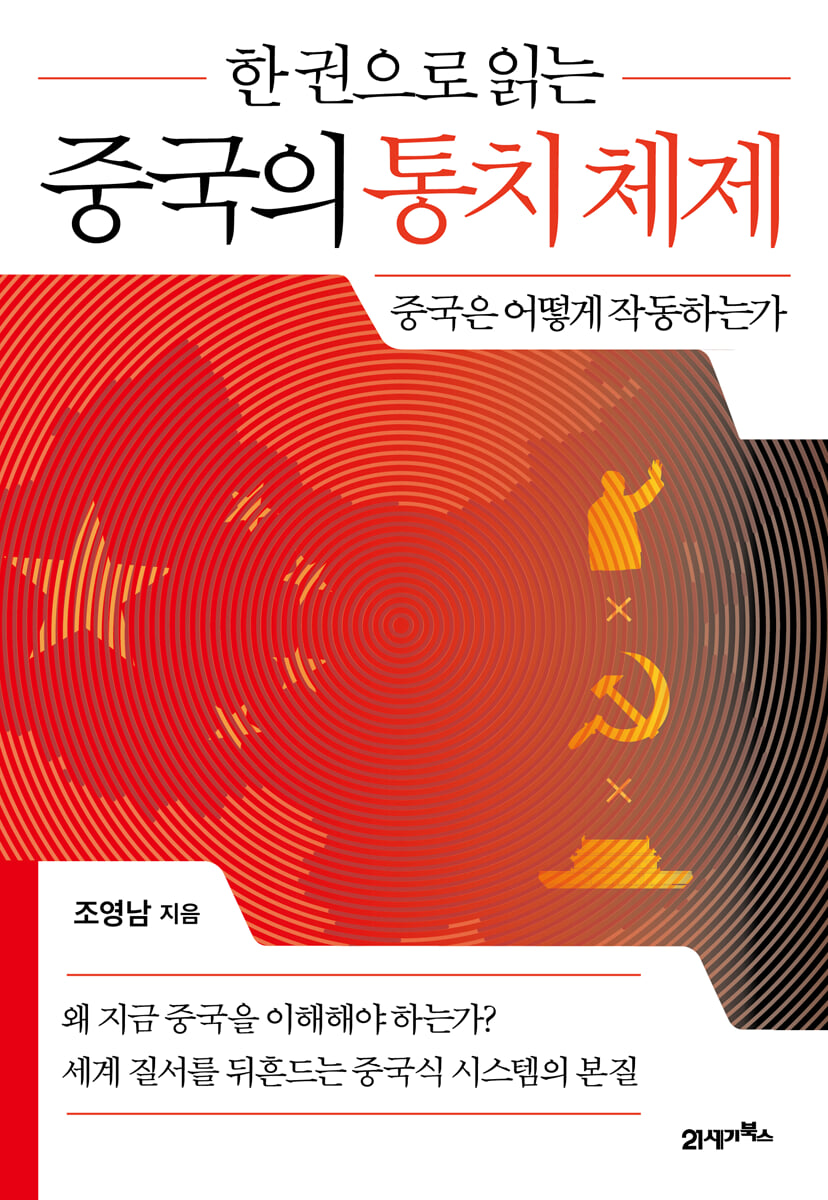
China's Governing System in One Volume
 |
Description
Book Introduction
“To understand China, you must understand the ‘Party’!”
Professor Youngnam Cho of Seoul National University Graduate School of International Studies
The most complete commentary on Chinese politics, culminating in 30 years of research.
Everything about the complex and secretive Chinese politics
The essence of the "Chinese Governance System Series" in one volume
While conflicting observations and information have emerged regarding recent shifts in China's power structure, a systematic understanding of Chinese society and political system is essential for a precise interpretation.
However, Korean society's perception of China is driven by prejudice and emotion, and structural limitations stemming from fundamental differences in political systems further increase the difficulty of analysis.
Moreover, given the covert nature of Chinese politics and the Communist Party's operations, it is extremely difficult to grasp the inside story from the outside.
In this context, Professor Cho Young-nam of Seoul National University's Graduate School of International Studies' 'China's Governing System Series' systematically covers the core topics of each volume through 'China's Governing System 1: Communist Party Leadership System', 'China's Governing System 2: Communist Party Control Mechanism', and 'China's Governing System 3: National Constitutional System', and has been evaluated as a professional research achievement of a level rarely seen in Korea.
Throughout the series, the principles of the party-state system, the control mechanisms that enable the maintenance of power, and the structure of the constitutional system are examined with academic depth and a broad perspective, providing a three-dimensional explanation of the operating principles of Chinese politics.
"China's Governing System in One Volume" is a work that selects and condenses the main contents of this series, making it more accessible to the general public.
By providing an in-depth yet concise explanation of China's complex and vast political structure, it presents an analytical framework that enables a comprehensive understanding of the reality of Chinese politics.
Professor Youngnam Cho of Seoul National University Graduate School of International Studies
The most complete commentary on Chinese politics, culminating in 30 years of research.
Everything about the complex and secretive Chinese politics
The essence of the "Chinese Governance System Series" in one volume
While conflicting observations and information have emerged regarding recent shifts in China's power structure, a systematic understanding of Chinese society and political system is essential for a precise interpretation.
However, Korean society's perception of China is driven by prejudice and emotion, and structural limitations stemming from fundamental differences in political systems further increase the difficulty of analysis.
Moreover, given the covert nature of Chinese politics and the Communist Party's operations, it is extremely difficult to grasp the inside story from the outside.
In this context, Professor Cho Young-nam of Seoul National University's Graduate School of International Studies' 'China's Governing System Series' systematically covers the core topics of each volume through 'China's Governing System 1: Communist Party Leadership System', 'China's Governing System 2: Communist Party Control Mechanism', and 'China's Governing System 3: National Constitutional System', and has been evaluated as a professional research achievement of a level rarely seen in Korea.
Throughout the series, the principles of the party-state system, the control mechanisms that enable the maintenance of power, and the structure of the constitutional system are examined with academic depth and a broad perspective, providing a three-dimensional explanation of the operating principles of Chinese politics.
"China's Governing System in One Volume" is a work that selects and condenses the main contents of this series, making it more accessible to the general public.
By providing an in-depth yet concise explanation of China's complex and vast political structure, it presents an analytical framework that enables a comprehensive understanding of the reality of Chinese politics.
- You can preview some of the book's contents.
Preview
index
Introduction: Dreaming of a good introduction to Chinese politics!
Chapter 1: Introduction: China's Political System: The Party-State System
Party-state system: a political system in which the Communist Party leads the country.
Two elements of the party-state system: the "Communist Party leadership system" and the "state constitutional system."
Relations between the two systems: acceptance and conflict
Three Essential Elements of the Communist Party's Leadership System
Part 1: Communist Party Leadership System
Chapter 2: The Communist Party's Leadership Principles
Characteristics of the Communist Party: It is both a "ruling party" and a "leading party."
The principle of comprehensive leadership: "The Communist Party leads everything."
The principle of democratic centralism: "All party members and organizations must obey the party central committee."
Party Cadre Principle: "Only the Communist Party Manages Cadres"
The United Front Principle: "Multi-Party Cooperation under the Leadership of the Communist Party" 41
Chapter 3: Organization and Operation of the Communist Party
National Congress (Party Congress): 'A political event held once every five years'
Central Committee: 'Annual political event'
Politburo: "The Communist Party's undisputed leadership core."
The Politburo Standing Committee: "The de facto party central committee."
General Secretary and Central Secretariat
Chapter 4: Joining and Activities of Communist Party Members
Conditions for joining the Communist Party and the obligations of party members
Admission Process: 'Strict Selection and Systematic Training'
The Communist Party's 'organizational life'
Part 2: Communist Party Control Mechanisms
Chapter 5 Personnel Control
The Communist Party's central cadre management system
Civil Service System: Application of the "Party Official" Principle
Executive Education and Training Institute
Central Party School's cadre education and training
Chapter 6 Organizational Control
The nature and mission of the party
Conditions and reality of the establishment of the party
Types of leadership teams
Foreign policy decision-making structure and the case of the leadership team
Chapter 7 Thought Control
Rectification Movement and Party Member Education
Examples of "advanced education activities" during the Hu Jintao era
The Communist Party's National Education Campaign 1: "Law Popularization" and "Building Spiritual Civilization"
The Communist Party's National Education Movement 2: The "Socialist Patriotism Education Movement"
Chapter 8: Control of Force
The Communist Party's Military Control Mechanism: "Power Comes from the Muzzle of a Gun."
Chairmanship system: 'A civilian chairman commands the military.'
The Political Commissar System and the Collective Leadership of the Communist Party Committee
Changes in the status of the Political and Legal Affairs Committee
The duties and composition of the Political and Legal Affairs Committee
The principle of 'party rule'
Part 3: National Constitutional System
Chapter 9: Government Organization and Operation
The State Council's status and duties: 'the highest state administrative organ'
Organizational structure of the State Council
State Council Operation: Prime Minister's Responsibility System
Chapter 10: Government Activities in Daily Times: The Case of Healthcare Reform
The urgency and difficulty of healthcare reform
Promotion of medical reform and preparation of reform plans
Internal review and public comment on the draft healthcare reform bill
Confirmation of reform plans and the roles of key organizations
Implementing Health Care Reform: Achievements and Limitations
Chapter 11: Structure and Operation of the National Assembly
The Structure and Operation of China's Parliament: The "Dual Structure Phenomenon"
The Strengthening Role of China's Parliament: A "Selective Role Enhancement Phenomenon"
Chapter 12 Legislative Activities of the National Assembly
China's legislative system
Relations between the Communist Party and the National Assembly: The Issue of Legislative Autonomy
Relations between Government and Parliament: The Problem of Departmental Egoism
Improvement and development of the legislative system
Case study of the enactment of the Shanghai Municipal Labor Contract Ordinance (2001)
Amendment Cases of the Shanghai Municipal Consumer Protection Ordinance (2002)
Chapter 13: Conclusion: Evaluation and Prospects for China's Political System
Three Types of 'Party-State' Systems
Prospects for China's Political System
Assessment and Prospects for China's Political Development: My Perspective
Chapter 1: Introduction: China's Political System: The Party-State System
Party-state system: a political system in which the Communist Party leads the country.
Two elements of the party-state system: the "Communist Party leadership system" and the "state constitutional system."
Relations between the two systems: acceptance and conflict
Three Essential Elements of the Communist Party's Leadership System
Part 1: Communist Party Leadership System
Chapter 2: The Communist Party's Leadership Principles
Characteristics of the Communist Party: It is both a "ruling party" and a "leading party."
The principle of comprehensive leadership: "The Communist Party leads everything."
The principle of democratic centralism: "All party members and organizations must obey the party central committee."
Party Cadre Principle: "Only the Communist Party Manages Cadres"
The United Front Principle: "Multi-Party Cooperation under the Leadership of the Communist Party" 41
Chapter 3: Organization and Operation of the Communist Party
National Congress (Party Congress): 'A political event held once every five years'
Central Committee: 'Annual political event'
Politburo: "The Communist Party's undisputed leadership core."
The Politburo Standing Committee: "The de facto party central committee."
General Secretary and Central Secretariat
Chapter 4: Joining and Activities of Communist Party Members
Conditions for joining the Communist Party and the obligations of party members
Admission Process: 'Strict Selection and Systematic Training'
The Communist Party's 'organizational life'
Part 2: Communist Party Control Mechanisms
Chapter 5 Personnel Control
The Communist Party's central cadre management system
Civil Service System: Application of the "Party Official" Principle
Executive Education and Training Institute
Central Party School's cadre education and training
Chapter 6 Organizational Control
The nature and mission of the party
Conditions and reality of the establishment of the party
Types of leadership teams
Foreign policy decision-making structure and the case of the leadership team
Chapter 7 Thought Control
Rectification Movement and Party Member Education
Examples of "advanced education activities" during the Hu Jintao era
The Communist Party's National Education Campaign 1: "Law Popularization" and "Building Spiritual Civilization"
The Communist Party's National Education Movement 2: The "Socialist Patriotism Education Movement"
Chapter 8: Control of Force
The Communist Party's Military Control Mechanism: "Power Comes from the Muzzle of a Gun."
Chairmanship system: 'A civilian chairman commands the military.'
The Political Commissar System and the Collective Leadership of the Communist Party Committee
Changes in the status of the Political and Legal Affairs Committee
The duties and composition of the Political and Legal Affairs Committee
The principle of 'party rule'
Part 3: National Constitutional System
Chapter 9: Government Organization and Operation
The State Council's status and duties: 'the highest state administrative organ'
Organizational structure of the State Council
State Council Operation: Prime Minister's Responsibility System
Chapter 10: Government Activities in Daily Times: The Case of Healthcare Reform
The urgency and difficulty of healthcare reform
Promotion of medical reform and preparation of reform plans
Internal review and public comment on the draft healthcare reform bill
Confirmation of reform plans and the roles of key organizations
Implementing Health Care Reform: Achievements and Limitations
Chapter 11: Structure and Operation of the National Assembly
The Structure and Operation of China's Parliament: The "Dual Structure Phenomenon"
The Strengthening Role of China's Parliament: A "Selective Role Enhancement Phenomenon"
Chapter 12 Legislative Activities of the National Assembly
China's legislative system
Relations between the Communist Party and the National Assembly: The Issue of Legislative Autonomy
Relations between Government and Parliament: The Problem of Departmental Egoism
Improvement and development of the legislative system
Case study of the enactment of the Shanghai Municipal Labor Contract Ordinance (2001)
Amendment Cases of the Shanghai Municipal Consumer Protection Ordinance (2002)
Chapter 13: Conclusion: Evaluation and Prospects for China's Political System
Three Types of 'Party-State' Systems
Prospects for China's Political System
Assessment and Prospects for China's Political Development: My Perspective
Detailed image
.jpg)
Into the book
Unlike the ruling parties of other countries, the Communist Party is the sole 'ruling party' and at the same time has the character of a 'leading party'.
For this reason, we call China's political system an authoritarian system, combining the Communist Party's leadership system and the state constitutional system, with the former leading and replacing the latter in the actual political process.
We could simply call this the 'Communist Party-led system'.
The Communist Party leadership system is maintained and operates through several principles.
The first is the principle of ‘comprehensive leadership by the Communist Party.’
This principle governs and takes precedence over all other principles.
The second is the principle of ‘democratic centralism.’
This is the principle of organization and operation of the Communist Party.
Because the Communist Party is organized and operated according to this principle, China's political system is a system of centralized power.
On the other hand, Korea's democratic political system is a system of decentralized power.
Third is the ‘party official’ principle.
This is the principle that justifies the Communist Party's monopoly on personnel.
Fourth is the principle of the ‘united front’.
This is the principle by which the Communist Party integrates and leads various social forces.
--- From "Chapter 2: The Communist Party's Leadership Principles"
The most effective control mechanism of the Communist Party leadership system is the principle that only the Communist Party manages cadres, that is, the principle of "party cadres."
The Communist Party's control over personnel is realized through four systems.
The first is the personnel appointment system, which refers to the control mechanism by which the Communist Party appoints or dismisses key cadres.
The Communist Party exerts strict control, especially over leading cadres.
The specific way to implement this is the ‘Executive Job Title Table’ system.
In contrast, the civil service system is mainly used as an auxiliary means of managing civil servants in non-leadership positions.
--- From "Chapter 5 Personnel Control"
It seems that personnel control and organizational control alone are sufficient to maintain the Communist Party leadership system.
But the Communist Party is not satisfied with this.
This is because I believe that maintaining the Communist Party leadership system through personnel control and organizational control alone has limitations.
Personnel control and organizational control are, so to speak, attempts to control people from the outside.
But what if someone hides their "inner" self—their thoughts and feelings—and only pretends to obey on the outside? Controlling the "outer" alone won't prevent this situation.
This is why the Communist Party tries to control even the 'inner self' of people.
The Communist Party calls this 'ideological political work', or 'ideological work' or 'political work' for short.
--- From "Chapter 7 Thought Control"
The Chinese parliament, similar to Korea, is divided into a central parliament and local parliaments.
The official name of the Central Committee is the National People's Congress, and its abbreviation is the National People's Congress (NPC).
It is wrong to call this the 'National People's Congress'.
Not only is this term not used in China, but if this usage were extended, local councils would have to be called "direndai" (地人大), which would be too awkward.
This has led to the strange practice of calling China's provincial legislatures "provincial national people's congresses."
--- From “Chapter 11: Structure and Operation of the National Assembly”
China faces a difficult task: it must choose between two options.
One path is to move toward political democratization after achieving political institutionalization, like in Korea or Taiwan.
However, given China's vast territory and population, its multi-ethnic society of Han Chinese and ethnic minorities, its chaotic history, and its order-oriented political culture, it will not be easy for China to choose this path, and even if it does, there is no guarantee of success.
The other way is to stick to the current system and continue the ambiguous system of 'market economy + authoritarianism.'
If China follows this path, it may maintain political stability, but the people's political rights and participation will still not be guaranteed, and various political, economic, social, and environmental problems may continue to arise.
The choice of which path China will take is entirely up to the Chinese people.
For this reason, we call China's political system an authoritarian system, combining the Communist Party's leadership system and the state constitutional system, with the former leading and replacing the latter in the actual political process.
We could simply call this the 'Communist Party-led system'.
The Communist Party leadership system is maintained and operates through several principles.
The first is the principle of ‘comprehensive leadership by the Communist Party.’
This principle governs and takes precedence over all other principles.
The second is the principle of ‘democratic centralism.’
This is the principle of organization and operation of the Communist Party.
Because the Communist Party is organized and operated according to this principle, China's political system is a system of centralized power.
On the other hand, Korea's democratic political system is a system of decentralized power.
Third is the ‘party official’ principle.
This is the principle that justifies the Communist Party's monopoly on personnel.
Fourth is the principle of the ‘united front’.
This is the principle by which the Communist Party integrates and leads various social forces.
--- From "Chapter 2: The Communist Party's Leadership Principles"
The most effective control mechanism of the Communist Party leadership system is the principle that only the Communist Party manages cadres, that is, the principle of "party cadres."
The Communist Party's control over personnel is realized through four systems.
The first is the personnel appointment system, which refers to the control mechanism by which the Communist Party appoints or dismisses key cadres.
The Communist Party exerts strict control, especially over leading cadres.
The specific way to implement this is the ‘Executive Job Title Table’ system.
In contrast, the civil service system is mainly used as an auxiliary means of managing civil servants in non-leadership positions.
--- From "Chapter 5 Personnel Control"
It seems that personnel control and organizational control alone are sufficient to maintain the Communist Party leadership system.
But the Communist Party is not satisfied with this.
This is because I believe that maintaining the Communist Party leadership system through personnel control and organizational control alone has limitations.
Personnel control and organizational control are, so to speak, attempts to control people from the outside.
But what if someone hides their "inner" self—their thoughts and feelings—and only pretends to obey on the outside? Controlling the "outer" alone won't prevent this situation.
This is why the Communist Party tries to control even the 'inner self' of people.
The Communist Party calls this 'ideological political work', or 'ideological work' or 'political work' for short.
--- From "Chapter 7 Thought Control"
The Chinese parliament, similar to Korea, is divided into a central parliament and local parliaments.
The official name of the Central Committee is the National People's Congress, and its abbreviation is the National People's Congress (NPC).
It is wrong to call this the 'National People's Congress'.
Not only is this term not used in China, but if this usage were extended, local councils would have to be called "direndai" (地人大), which would be too awkward.
This has led to the strange practice of calling China's provincial legislatures "provincial national people's congresses."
--- From “Chapter 11: Structure and Operation of the National Assembly”
China faces a difficult task: it must choose between two options.
One path is to move toward political democratization after achieving political institutionalization, like in Korea or Taiwan.
However, given China's vast territory and population, its multi-ethnic society of Han Chinese and ethnic minorities, its chaotic history, and its order-oriented political culture, it will not be easy for China to choose this path, and even if it does, there is no guarantee of success.
The other way is to stick to the current system and continue the ambiguous system of 'market economy + authoritarianism.'
If China follows this path, it may maintain political stability, but the people's political rights and participation will still not be guaranteed, and various political, economic, social, and environmental problems may continue to arise.
The choice of which path China will take is entirely up to the Chinese people.
--- From "Chapter 13: Conclusion: Evaluation and Prospects of China's Political System"
Publisher's Review
The force that moves China steadily,
The Communist Party's leadership system and five control mechanisms
The Chinese Communist Party has maintained stable governance over the country and society and achieved remarkable socioeconomic development through the "Communist Party leadership system" and the five "Communist Party control mechanisms" that support it.
The Chinese system is defined as a 'party-state system', which consists of a 'Communist Party leadership system' and a 'national constitutional system'.
In actual political processes, the Communist Party-led system operates as an authoritarian political system that not only leads but often replaces the state constitutional system.
The Communist Party is not a 'ruling party' that has the potential to lose power, but rather the only ruling party and 'leading party'.
Beyond ‘governing’ the state, it ‘leads’ all areas of society and even the lives of individuals.
From politics to art, there is little that is not influenced by the Communist Party.
A broad and deep understanding of China must begin from this very point.
The Communist Party's leadership system is supported by various leadership principles.
These are ‘Comprehensive leadership of the Communist Party’ (the Communist Party leads everything), ‘Democratic centralism’ (all party members and organizations are subordinate to the Party Central Committee), ‘Party cadres’ (only the Communist Party appoints and manages cadres), and ‘United Front’ (multi-party cooperation under the leadership of the Communist Party).
The Communist Party's organizational system can be divided into central, local, and grassroots organizations by region, and leadership organizations and secretariats by function.
The central leadership organizations include the National Congress (party congress, held once every five years), the Central Committee (held once a year), the Central Political Bureau (the core leadership body of the Communist Party), and the Standing Committee of the Central Political Bureau (the actual party center).
There are also unique forms of leadership organizations such as 'party groups' and 'leading small groups'.
A Communist Party committee is established in each province (province, city, or county), and a grassroots committee is established at the grassroots level (township, town, or district). Below that, there is a Communist Party (general) branch in each urban community and rural administrative village.
In China, many people strive to become members of the Communist Party.
They grow into 'communists' through rigorous selection and systematic training, and experience various 'party organizational life'.
Criticism and self-criticism, which are unfamiliar in Korea, are also an important part of this organizational life.
In this way, the Communist Party's leadership system and the five major control mechanisms are the core driving forces that keep China moving steadily, and they are the starting point for understanding today's China.
Control mechanisms that control personnel, organization, ideology, military power, and economy
Reading China's Party-State System Through the Five Principles of the Constitution
The background to China's unique "party-state system," or "Communist Party-led system," which has been able to maintain stability for decades and achieve remarkable socio-economic growth is the five Communist Party control mechanisms that control personnel, organization, ideology, military power, and the economy.
It is not a simple auxiliary device, but functions as a structural foundation that supports the leadership system and a core device for maintaining power.
By monopolizing key cadres in the state, public institutions, state-owned enterprises, and mass organizations through personnel control, all human resources are placed within the Party's sphere of influence, and through organizational control, various social forces, including private enterprises, non-governmental organizations, universities, and grassroots society, are thoroughly managed.
Ideological control is continuously implemented through political education systems and mass education campaigns, targeting party cadres, party members, and even the general public, and controlling everything from traditional media to new media to justify and propagate the system.
Here, physical control combining force and economy is added, and military and public power are seized through the People's Liberation Army, armed police, militia, public security, courts, and prosecutors, and the political base is solidified by controlling the entire economy through state-owned assets and state-owned enterprises.
These five pillars, hidden behind the institutional facade of the national constitutional system, are the actual operating principles by which the Chinese Communist Party governs the country and guides society and individuals. They are the key to explaining the maintenance of power and the sustainability of the system in modern China.
In particular, China's constitutional system, unlike the constitutionalism of Western democratic countries, has a structure in which the leadership principles of the Communist Party and the state operating system are closely linked.
In accordance with the five principles stipulated in the Constitution—the leadership of the Communist Party, the sovereignty of the people and the system of people's congresses, democratic centralism, the system of national autonomy, and the rule of law—state organs such as the parliament, government, and judiciary all function organically under the unified leadership of the Communist Party.
The central government of the Communist Party has exclusive power to decide on policies, and the government bureaucracy carries out the function of executing them.
This is why nationwide mobilization and coordinated execution were possible in a national crisis like the COVID-19 pandemic.
The National People's Congress and local people's congresses perform legislative, supervisory, and representative functions, while also serving to legitimize the Communist Party's rule, and the unique dual structure of the National People's Congress Standing Committee complements or replaces this.
Although it appears similar to a Western-style system, it is essentially a political organization that embodies the party's policies and will into systems and practices.
Ultimately, the Communist Party's control mechanism and the constitutional system are combined into a single organic system that forms the operating principles of Chinese politics, and understanding this is the first step to grasping the true nature of China's massive power structure.
Why Understand China Now?
The Strategic Value of Interpreting Power Structures in the Intensifying Global Hegemony Competition
The reason we need to deeply understand China at this point is that the US-China hegemony competition is moving beyond a simple economic dispute into a structural confrontation spanning geopolitics, military affairs, technology, and ideology.
The competitive landscape between the liberal democratic bloc led by the United States and the authoritarian bloc led by China is triggering changes across the international order, including the restructuring of global supply chains, control of advanced technologies, and the restructuring of security alliances.
Within China, this is perceived as a "comprehensive encirclement and blockade" and is used as a justification to strengthen the legitimacy of the Communist Party's leadership.
The political discourse that all people and nations must unite around the party functions as a key variable that determines the overall power structure and policy direction.
Globally, supply chain restructuring and technological bloc formation are accelerating in strategic areas such as semiconductors, artificial intelligence, energy, and maritime security, and this is closely linked to the deepening conflict between the US and China.
Major issues such as the South China Sea, the Taiwan Strait, and the Belt and Road Initiative also significantly influence the international security environment due to China's political decision-making structure and the way it sets national goals.
Therefore, a close analysis of China's authoritarian party-state system goes beyond understanding a country's political system; it is essential for forecasting the restructuring of the 21st-century world order and predicting the strategic choices each country will face.
This serves as one of the most important analytical frameworks for interpreting the structure and direction of the global hegemony competition that will continue for the next several decades.
The Communist Party's leadership system and five control mechanisms
The Chinese Communist Party has maintained stable governance over the country and society and achieved remarkable socioeconomic development through the "Communist Party leadership system" and the five "Communist Party control mechanisms" that support it.
The Chinese system is defined as a 'party-state system', which consists of a 'Communist Party leadership system' and a 'national constitutional system'.
In actual political processes, the Communist Party-led system operates as an authoritarian political system that not only leads but often replaces the state constitutional system.
The Communist Party is not a 'ruling party' that has the potential to lose power, but rather the only ruling party and 'leading party'.
Beyond ‘governing’ the state, it ‘leads’ all areas of society and even the lives of individuals.
From politics to art, there is little that is not influenced by the Communist Party.
A broad and deep understanding of China must begin from this very point.
The Communist Party's leadership system is supported by various leadership principles.
These are ‘Comprehensive leadership of the Communist Party’ (the Communist Party leads everything), ‘Democratic centralism’ (all party members and organizations are subordinate to the Party Central Committee), ‘Party cadres’ (only the Communist Party appoints and manages cadres), and ‘United Front’ (multi-party cooperation under the leadership of the Communist Party).
The Communist Party's organizational system can be divided into central, local, and grassroots organizations by region, and leadership organizations and secretariats by function.
The central leadership organizations include the National Congress (party congress, held once every five years), the Central Committee (held once a year), the Central Political Bureau (the core leadership body of the Communist Party), and the Standing Committee of the Central Political Bureau (the actual party center).
There are also unique forms of leadership organizations such as 'party groups' and 'leading small groups'.
A Communist Party committee is established in each province (province, city, or county), and a grassroots committee is established at the grassroots level (township, town, or district). Below that, there is a Communist Party (general) branch in each urban community and rural administrative village.
In China, many people strive to become members of the Communist Party.
They grow into 'communists' through rigorous selection and systematic training, and experience various 'party organizational life'.
Criticism and self-criticism, which are unfamiliar in Korea, are also an important part of this organizational life.
In this way, the Communist Party's leadership system and the five major control mechanisms are the core driving forces that keep China moving steadily, and they are the starting point for understanding today's China.
Control mechanisms that control personnel, organization, ideology, military power, and economy
Reading China's Party-State System Through the Five Principles of the Constitution
The background to China's unique "party-state system," or "Communist Party-led system," which has been able to maintain stability for decades and achieve remarkable socio-economic growth is the five Communist Party control mechanisms that control personnel, organization, ideology, military power, and the economy.
It is not a simple auxiliary device, but functions as a structural foundation that supports the leadership system and a core device for maintaining power.
By monopolizing key cadres in the state, public institutions, state-owned enterprises, and mass organizations through personnel control, all human resources are placed within the Party's sphere of influence, and through organizational control, various social forces, including private enterprises, non-governmental organizations, universities, and grassroots society, are thoroughly managed.
Ideological control is continuously implemented through political education systems and mass education campaigns, targeting party cadres, party members, and even the general public, and controlling everything from traditional media to new media to justify and propagate the system.
Here, physical control combining force and economy is added, and military and public power are seized through the People's Liberation Army, armed police, militia, public security, courts, and prosecutors, and the political base is solidified by controlling the entire economy through state-owned assets and state-owned enterprises.
These five pillars, hidden behind the institutional facade of the national constitutional system, are the actual operating principles by which the Chinese Communist Party governs the country and guides society and individuals. They are the key to explaining the maintenance of power and the sustainability of the system in modern China.
In particular, China's constitutional system, unlike the constitutionalism of Western democratic countries, has a structure in which the leadership principles of the Communist Party and the state operating system are closely linked.
In accordance with the five principles stipulated in the Constitution—the leadership of the Communist Party, the sovereignty of the people and the system of people's congresses, democratic centralism, the system of national autonomy, and the rule of law—state organs such as the parliament, government, and judiciary all function organically under the unified leadership of the Communist Party.
The central government of the Communist Party has exclusive power to decide on policies, and the government bureaucracy carries out the function of executing them.
This is why nationwide mobilization and coordinated execution were possible in a national crisis like the COVID-19 pandemic.
The National People's Congress and local people's congresses perform legislative, supervisory, and representative functions, while also serving to legitimize the Communist Party's rule, and the unique dual structure of the National People's Congress Standing Committee complements or replaces this.
Although it appears similar to a Western-style system, it is essentially a political organization that embodies the party's policies and will into systems and practices.
Ultimately, the Communist Party's control mechanism and the constitutional system are combined into a single organic system that forms the operating principles of Chinese politics, and understanding this is the first step to grasping the true nature of China's massive power structure.
Why Understand China Now?
The Strategic Value of Interpreting Power Structures in the Intensifying Global Hegemony Competition
The reason we need to deeply understand China at this point is that the US-China hegemony competition is moving beyond a simple economic dispute into a structural confrontation spanning geopolitics, military affairs, technology, and ideology.
The competitive landscape between the liberal democratic bloc led by the United States and the authoritarian bloc led by China is triggering changes across the international order, including the restructuring of global supply chains, control of advanced technologies, and the restructuring of security alliances.
Within China, this is perceived as a "comprehensive encirclement and blockade" and is used as a justification to strengthen the legitimacy of the Communist Party's leadership.
The political discourse that all people and nations must unite around the party functions as a key variable that determines the overall power structure and policy direction.
Globally, supply chain restructuring and technological bloc formation are accelerating in strategic areas such as semiconductors, artificial intelligence, energy, and maritime security, and this is closely linked to the deepening conflict between the US and China.
Major issues such as the South China Sea, the Taiwan Strait, and the Belt and Road Initiative also significantly influence the international security environment due to China's political decision-making structure and the way it sets national goals.
Therefore, a close analysis of China's authoritarian party-state system goes beyond understanding a country's political system; it is essential for forecasting the restructuring of the 21st-century world order and predicting the strategic choices each country will face.
This serves as one of the most important analytical frameworks for interpreting the structure and direction of the global hegemony competition that will continue for the next several decades.
GOODS SPECIFICS
- Date of issue: August 20, 2025
- Page count, weight, size: 308 pages | 145*210*30mm
- ISBN13: 9791173574405
- ISBN10: 1173574409
You may also like
카테고리
korean


korean

![GQ KOREA Mark (Monthly): December [2025]](http://librairie.coreenne.fr/cdn/shop/files/8ef265dbbfbf186523ed75ba7319009d.jpg?v=1765340328&width=3840)


