

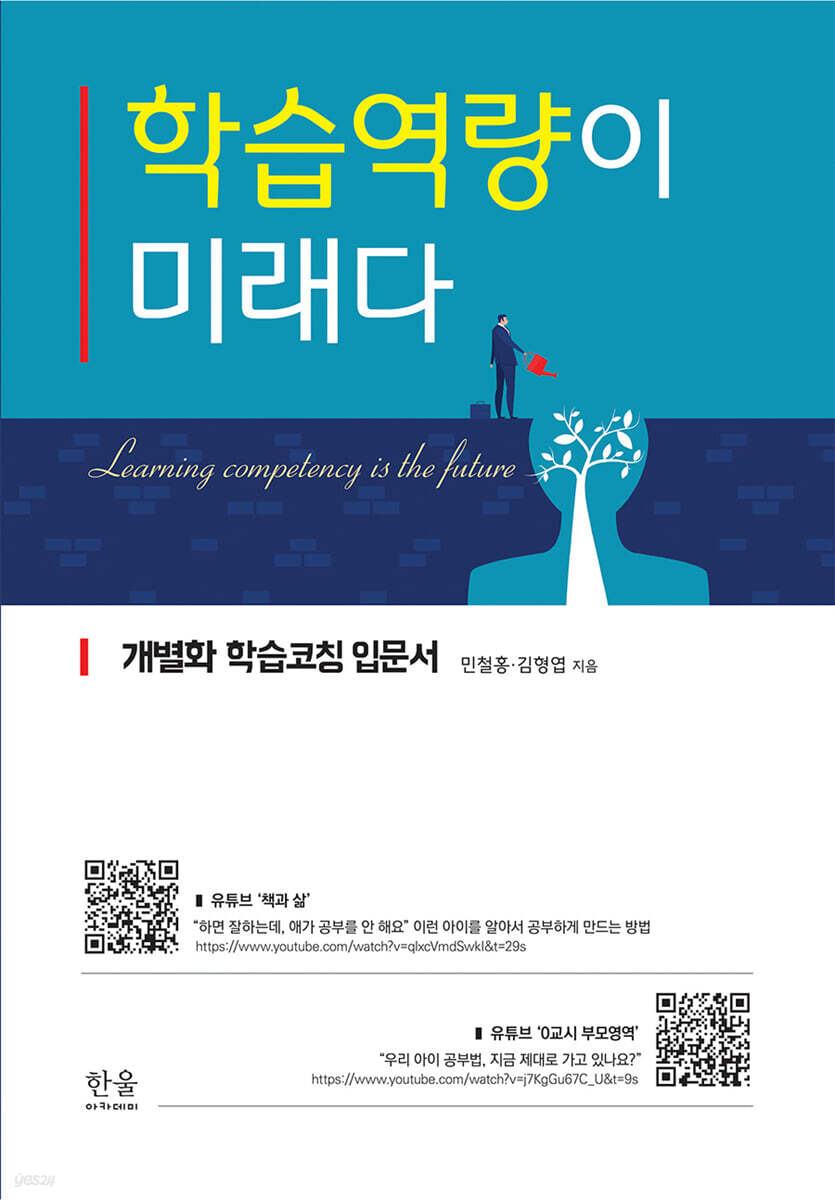
Learning capacity is the future
 |
Description
Book Introduction
In the era of artificial intelligence and digital transformation,
The direction education should take is toward 'individualization.'
Why Individualized Learning Coaching Based on Learning Competency Is Needed Now
In today's world, where knowledge and information are complex and rapidly changing, education must go beyond formal classroom instruction and support children in solving diverse problems in their lives.
The 'individualized learning coaching' presented in this book takes into account the important fact that not all children start from the same starting point.
Children have different foundational skills, learning experiences, personalities, and family backgrounds.
Therefore, this book emphasizes that the focus of education should shift from 'standardization' to 'individualization' to ensure learning for life, not learning for grades.
In individualized learning coaching, the role of the learning coach is to support the learner's change and growth so that they can be realized through action. This requires various professional coaching techniques such as listening, questioning, and utilizing emotional language based on a coaching philosophy.
This book is an introductory guide that defines these coaching techniques and covers the basics you need to know about learning coaching.
It will serve as a good guide for public education teachers and other education-related workers.
Part 1, 'Understanding Learning Coaching', covers the theoretical basis of learning coaching.
The explanation focused on the necessity of learning coaching, the definition of learning and coaching, the concept of competency, and understanding learning capacity.
In addition to the theoretical basis, the attitude and beliefs that a learning coach should have were also included as important factors.
Part 2, "The Reality of Learning Coaching," introduces four core learning competencies: cognitive, motivational, social and emotional, and behavioral, as well as key topics that must be addressed in learning coaching settings, such as grit, learning difficulties, and test anxiety.
Finally, we introduce the Multi-Tiered Learning Competency Test (MTLC), a learning competency diagnostic test developed by the author himself.
The direction education should take is toward 'individualization.'
Why Individualized Learning Coaching Based on Learning Competency Is Needed Now
In today's world, where knowledge and information are complex and rapidly changing, education must go beyond formal classroom instruction and support children in solving diverse problems in their lives.
The 'individualized learning coaching' presented in this book takes into account the important fact that not all children start from the same starting point.
Children have different foundational skills, learning experiences, personalities, and family backgrounds.
Therefore, this book emphasizes that the focus of education should shift from 'standardization' to 'individualization' to ensure learning for life, not learning for grades.
In individualized learning coaching, the role of the learning coach is to support the learner's change and growth so that they can be realized through action. This requires various professional coaching techniques such as listening, questioning, and utilizing emotional language based on a coaching philosophy.
This book is an introductory guide that defines these coaching techniques and covers the basics you need to know about learning coaching.
It will serve as a good guide for public education teachers and other education-related workers.
Part 1, 'Understanding Learning Coaching', covers the theoretical basis of learning coaching.
The explanation focused on the necessity of learning coaching, the definition of learning and coaching, the concept of competency, and understanding learning capacity.
In addition to the theoretical basis, the attitude and beliefs that a learning coach should have were also included as important factors.
Part 2, "The Reality of Learning Coaching," introduces four core learning competencies: cognitive, motivational, social and emotional, and behavioral, as well as key topics that must be addressed in learning coaching settings, such as grit, learning difficulties, and test anxiety.
Finally, we introduce the Multi-Tiered Learning Competency Test (MTLC), a learning competency diagnostic test developed by the author himself.
index
Introduction · 8
Part 1: Understanding Learning Coaching
Chapter 1: The Need for Learning Coaching · 12
1.
Changes in Education · 12
2.
Awareness of Learning Coaching · 17
3.
Interest in Learning Coaching · 20
4.
Perceptions of Learning Coaching in Public Education · 24
Chapter 2: What is Learning? · 26
1.
Educational Philosophy and Humanistic Perspectives · 26
2.
Educational Perspective · 29
3.
Education and Learning · 31
4.
Approaches to Self-Regulated Learning · 33
5.
The Development of Self-Regulated Learning · 37
6.
Components of Self-Regulated Learning · 39
7.
Self-Directed Learning and Self-Regulated Learning · 41
Chapter 3: Understanding and Applying Coaching · 45
1.
The Etymology of Coaching · 45
2.
Coaching Orientation · 47
3.
Coaching Philosophy · 49
4.
Person-Centered Coaching Approach · 52
5.
Coaching Paradigm · 57
6.
Various Coaching Theories · 61
7.
Coaching Sessions and the Coaching Process · 64
8.
Coaching Skills · 68
9.
Coaching Competency · 70
10.
Communication · 72
11.
Language · 75
12.
Listening · 79
13.
Question 96
14.
Coaching Conversation Model · 102
15.
Coaching and Mentoring · 108
16.
Building Rapport in Coaching · 112
Chapter 4: What is Competency? · 122
1.
Understanding Competency · 122
2. OECD Learning Compass 2030 · 128
3.
Competency-Based Education · 135
Chapter 5: Understanding Learning Competency · 140
1.
The Concept of Learning Competency · 140
2.
Brain and Learning Capacity · 142
3.
Neurotransmitters and Learning · 150
4.
Classification of Learning Competencies · 158
Part 2: The Reality of Learning Coaching
Chapter 6 Cognitive Ability · 162
1.
Attention · 162
2.
Memory · 174
3.
Demonstration · 186
4.
Elaboration · 192
5.
Graphic Organizer · 201
6.
Metacognition · 205
Chapter 7: Motivational Competence · 211
1.
Self-Determination Learning Motivation · 211
2.
Academic Achievement Motivation · 217
3.
Goal Orientation · 224
4.
Academic Self-Efficacy · 227
5.
Mindset · 232
6.
Learning Immersion · 239
Chapter 8: Social and Emotional Competencies · 246
1.
Why Social and Emotional Competence? · 246
2.
Self-Awareness · 250
3.
Self-management · 256
4.
Social Awareness · 265
5.
Relationship Management · 270
6.
Responsible Decision Making · 275
7.
Resilience · 279
Chapter 9: Behavioral Competencies · 285
1.
Study Plan · 285
2.
Study Habits · 288
3.
Resource Management · 291
4.
Learning Environment · 296
5.
Body Care · 306
6.
Learning Attitude · 311
Chapter 10: Other Learning Coaching · 318
1.
Grit · 318
2.
Learning difficulties · 321
3.
Test Anxiety · 326
Chapter 11: MTLC Multi-Functional Learning Competency Test · 334
Appendix Learning Competency Coaching Specialist Training Course · 335
References · 336
Part 1: Understanding Learning Coaching
Chapter 1: The Need for Learning Coaching · 12
1.
Changes in Education · 12
2.
Awareness of Learning Coaching · 17
3.
Interest in Learning Coaching · 20
4.
Perceptions of Learning Coaching in Public Education · 24
Chapter 2: What is Learning? · 26
1.
Educational Philosophy and Humanistic Perspectives · 26
2.
Educational Perspective · 29
3.
Education and Learning · 31
4.
Approaches to Self-Regulated Learning · 33
5.
The Development of Self-Regulated Learning · 37
6.
Components of Self-Regulated Learning · 39
7.
Self-Directed Learning and Self-Regulated Learning · 41
Chapter 3: Understanding and Applying Coaching · 45
1.
The Etymology of Coaching · 45
2.
Coaching Orientation · 47
3.
Coaching Philosophy · 49
4.
Person-Centered Coaching Approach · 52
5.
Coaching Paradigm · 57
6.
Various Coaching Theories · 61
7.
Coaching Sessions and the Coaching Process · 64
8.
Coaching Skills · 68
9.
Coaching Competency · 70
10.
Communication · 72
11.
Language · 75
12.
Listening · 79
13.
Question 96
14.
Coaching Conversation Model · 102
15.
Coaching and Mentoring · 108
16.
Building Rapport in Coaching · 112
Chapter 4: What is Competency? · 122
1.
Understanding Competency · 122
2. OECD Learning Compass 2030 · 128
3.
Competency-Based Education · 135
Chapter 5: Understanding Learning Competency · 140
1.
The Concept of Learning Competency · 140
2.
Brain and Learning Capacity · 142
3.
Neurotransmitters and Learning · 150
4.
Classification of Learning Competencies · 158
Part 2: The Reality of Learning Coaching
Chapter 6 Cognitive Ability · 162
1.
Attention · 162
2.
Memory · 174
3.
Demonstration · 186
4.
Elaboration · 192
5.
Graphic Organizer · 201
6.
Metacognition · 205
Chapter 7: Motivational Competence · 211
1.
Self-Determination Learning Motivation · 211
2.
Academic Achievement Motivation · 217
3.
Goal Orientation · 224
4.
Academic Self-Efficacy · 227
5.
Mindset · 232
6.
Learning Immersion · 239
Chapter 8: Social and Emotional Competencies · 246
1.
Why Social and Emotional Competence? · 246
2.
Self-Awareness · 250
3.
Self-management · 256
4.
Social Awareness · 265
5.
Relationship Management · 270
6.
Responsible Decision Making · 275
7.
Resilience · 279
Chapter 9: Behavioral Competencies · 285
1.
Study Plan · 285
2.
Study Habits · 288
3.
Resource Management · 291
4.
Learning Environment · 296
5.
Body Care · 306
6.
Learning Attitude · 311
Chapter 10: Other Learning Coaching · 318
1.
Grit · 318
2.
Learning difficulties · 321
3.
Test Anxiety · 326
Chapter 11: MTLC Multi-Functional Learning Competency Test · 334
Appendix Learning Competency Coaching Specialist Training Course · 335
References · 336
Publisher's Review
Learning coaching that leads to studying for a healthy life, not just for grades.
Learning capacity is the power that moves us forward in life.
The 'learning capacity' discussed in learning coaching is a concept that goes beyond simply accumulating knowledge.
Learning capacity refers to the power to continuously grow and change through learning.
In other words, it is a process of not just knowing information, but expanding one's own capabilities based on it.
Applying this concept to academic learning, Korean language learning ability goes beyond simply being able to read and write well; it is the ability to think, express, and communicate through Korean.
It includes not only basic knowledge and understanding of the Korean language, but also the skills to apply it in real-life situations, a positive attitude and responsible attitude toward learning the language, and even the values of understanding and caring for others through language.
In this way, learning ability is not a fragmented skill in each subject, but an integrated ability that encompasses knowledge, skills, attitudes, beliefs, and values.
When a student studies a particular subject, the true meaning of learning ability is not simply 'studying for grades', but rather developing the ability to think, grow, and apply what they learn to their lives.
This book examines learning capacity by dividing it into four areas: cognitive capacity, motivational capacity, social and emotional capacity, and behavioral capacity.
A learning coach is someone who communicates with learners on an equal footing.
Coaching is not simply a conversational technique; it is a structured system based on a solid philosophy.
The core of the learning coaching presented in this book is that the learning coach and the learner form a 'horizontal partnership.'
This means that coaching is not a one-sided instruction or command, but a process in which the learning coach and the learner work together on equal footing and grow together.
Therefore, this book emphasizes that when providing learning coaching, coaches must be careful not to make personal judgments, rash judgments, instructions, advice, criticism, complaints, assumptions, or suggestions.
Learning coaching is a process that helps learners determine their own future actions and problem-solving strategies.
In this process, the learning coach does not simply provide solutions or instructions, but rather acts as a facilitator who supports learners to think and choose for themselves.
In other words, coaching is a self-directed change process that guides learners to clearly understand their situation, set goals, and develop specific action plans.
Coaching is a 'journey together' that helps learners grow independently.
At the heart of this journey lies a deep bond of trust and collaboration.
* Learning coaching is based on a ‘person-centered approach’, that is, a humanistic philosophy.
* The fundamental belief of learning coaching is that people can find their own answers.
* The core of learning coaching is that learners take ownership of their own change and growth.
* Rather than giving direct advice to learners, coaches help them find answers on their own.
* Coaches assist learners by using accurate questioning skills, listening skills, and insightful professional conversation skills.
Cognitive competency, motivational competency, social and emotional competency, behavioral competency
Why Learning Competency Is Differentiated from a Brain Science Perspective
The brain is made up of nerve cells, or neurons, and the series of processes by which the brain processes information are accomplished through signal transmission between neurons.
For the brain to process information efficiently, it must have a developed neural network of synapses.
A synapse is a connection between neurons, and one neuron connects with many neurons.
In coaching, 'relationships' help neurons develop and grow, and provide the energy they need to grow and survive.
Good coaching is about stimulating children biochemically, creating a physiological environment suitable for growth, and thus activating neuroplasticity.
Learning capacity can be expressed in four major areas, and the division of these areas is closely related to the brain.
Looking at the functional organization model of the human brain, it largely functions as a 'cognitive brain', a 'motivational brain', an 'emotional brain', and a 'behavioral brain'.
Recently, the 'social and emotional brain' has been added to the brain of society.
In learning coaching, we integrate research on the classification of self-regulated learning and brain mechanisms to distinguish each area.
* In cognitive ability, strategies to improve concentration and memory are key.
* In motivational competency, the key is a strategy that stimulates goals and motivation to help achieve them.
* The core of social and emotional competencies is the skill of recognizing oneself and forming good relationships with others.
* In behavioral competencies, the ability to plan learning, form learning habits, and manage resources is important.
Just as information processing takes place in the brain, coaching is a process of 'change and growth' through problem solving or goal achievement.
When the relationship between the coach and the client, that is, the coaching environment, is systematically well-structured like a neural network, the effect is outstanding.
To improve cognitive abilities, you must develop selective attention.
Motivational competence begins with self-belief, not results.
The key to improving cognitive ability is to increase concentration and memory.
To improve concentration in class, you need the ability to avoid being distracted by minor stimuli unrelated to the class and to return your focus to the class.
In other words, 'selective attention' is important, and learning coaches must help students recognize distractions and find strategies to regain their attention on their own.
In this way, individualized learning coaching is based on a strategic approach to specifically developing learners' attention control and self-directedness.
Concentration is not an innate ability, but rather a skill that is developed through training, and a learning coach is a strong guide to this training.
Strategies to improve memory are also important in learning.
Memories that remain in our brain for a certain period of time are not continuously circulating currents, but are imprinted and stored physically.
To pass the filter of short-term memory and store it in long-term memory, you must use learning strategies such as repetition, encoding, elaboration, and imaging.
In motivational capacity, 'achievement motivation' refers to the internal energy that an individual has to work hard and take on challenges to achieve a certain goal.
The period when achievement motivation is truly formed is around the time of entering elementary school.
From this age onwards, children begin to compare themselves with their peers and naturally experience competition during learning and play.
If you frequently fail in competition or have persistent negative experiences, you may develop the habit of easily becoming discouraged or giving up.
On the other hand, when children experience small victories or successes repeatedly, they develop self-confidence and feel the joy and motivation of accomplishment.
Therefore, during this period, the process of experiencing success is more important than the outcome of learning.
Learning coaches should provide tasks that challenge the child at an appropriate level and actively acknowledge and encourage the efforts made.
For example, rather than saying, “You got it right!”, it is more effective to praise the effort and process by saying, “You worked hard!” or “It’s great that you got through it!”
As a learning coach, you must recognize that motivation for achievement does not come from blindly setting high goals or competing, but rather from self-belief, born from the feeling of "I did it."
Social and emotional competencies are the psychological foundation for sustaining learning throughout life.
Behavioral competencies enable learners to plan and manage their own learning.
The reason why we address social and emotional competencies in learning coaching is because 'academic competency' is not simply a cognitive ability, but operates effectively on a social and emotional foundation.
For example, attention, self-regulation, learning motivation, and resilience are all closely linked to social and emotional competencies, and when these are supported, academic performance naturally improves.
Ultimately, addressing social and emotional competencies in learning coaching is a process of establishing a "psychological foundation" for students to grow into complete human beings and continue learning in their lives.
Social and emotional learning is the process of helping students understand themselves, manage their emotions, and establish healthy self-identities by forming positive relationships with others, enabling them to take responsible care of themselves and their communities.
The core of behavioral competencies is planning learning, forming learning habits, and managing learning resources.
Creating a learning environment is also an important factor. The learning environment refers to the physical, social, and psychological environment in which learners perform learning activities.
The learning environment has a significant impact on learners' concentration, efficiency, and motivation, and is an important factor in determining learning outcomes.
* The physical environment is a learning space.
The composition and condition of the space where students can study are important.
* A social environment is a collaborative environment where you learn with your peers.
Relationships with teachers and support from family and friends are important factors.
This environment helps us exchange opinions and get new ideas.
* A psychological environment is an environment that motivates students to take the initiative in learning, and an environment where learners can learn with confidence in their own abilities.
* A cultural environment is one in which different cultural backgrounds are respected and diversity is accepted.
Introducing the MTLC Multifaceted Learning Competency Test developed by the author.
Providing a guide to the training course for learning competency coaching experts
The MTLC (Multi-dimensional Test for Learning Competency) is a test developed to help students improve and maintain their learning competency by checking the status of their learning competency through a simple diagnosis, and by providing learning counseling and a customized learning coaching solution, the 'Learning Competency Coaching Program', to strengthen their learning competency and contribute to improving academic achievement.
The guide to the training course for learning competency coaching experts provided as an appendix will serve as a useful reference for those working in public and private education.
Learning capacity is the power that moves us forward in life.
The 'learning capacity' discussed in learning coaching is a concept that goes beyond simply accumulating knowledge.
Learning capacity refers to the power to continuously grow and change through learning.
In other words, it is a process of not just knowing information, but expanding one's own capabilities based on it.
Applying this concept to academic learning, Korean language learning ability goes beyond simply being able to read and write well; it is the ability to think, express, and communicate through Korean.
It includes not only basic knowledge and understanding of the Korean language, but also the skills to apply it in real-life situations, a positive attitude and responsible attitude toward learning the language, and even the values of understanding and caring for others through language.
In this way, learning ability is not a fragmented skill in each subject, but an integrated ability that encompasses knowledge, skills, attitudes, beliefs, and values.
When a student studies a particular subject, the true meaning of learning ability is not simply 'studying for grades', but rather developing the ability to think, grow, and apply what they learn to their lives.
This book examines learning capacity by dividing it into four areas: cognitive capacity, motivational capacity, social and emotional capacity, and behavioral capacity.
A learning coach is someone who communicates with learners on an equal footing.
Coaching is not simply a conversational technique; it is a structured system based on a solid philosophy.
The core of the learning coaching presented in this book is that the learning coach and the learner form a 'horizontal partnership.'
This means that coaching is not a one-sided instruction or command, but a process in which the learning coach and the learner work together on equal footing and grow together.
Therefore, this book emphasizes that when providing learning coaching, coaches must be careful not to make personal judgments, rash judgments, instructions, advice, criticism, complaints, assumptions, or suggestions.
Learning coaching is a process that helps learners determine their own future actions and problem-solving strategies.
In this process, the learning coach does not simply provide solutions or instructions, but rather acts as a facilitator who supports learners to think and choose for themselves.
In other words, coaching is a self-directed change process that guides learners to clearly understand their situation, set goals, and develop specific action plans.
Coaching is a 'journey together' that helps learners grow independently.
At the heart of this journey lies a deep bond of trust and collaboration.
* Learning coaching is based on a ‘person-centered approach’, that is, a humanistic philosophy.
* The fundamental belief of learning coaching is that people can find their own answers.
* The core of learning coaching is that learners take ownership of their own change and growth.
* Rather than giving direct advice to learners, coaches help them find answers on their own.
* Coaches assist learners by using accurate questioning skills, listening skills, and insightful professional conversation skills.
Cognitive competency, motivational competency, social and emotional competency, behavioral competency
Why Learning Competency Is Differentiated from a Brain Science Perspective
The brain is made up of nerve cells, or neurons, and the series of processes by which the brain processes information are accomplished through signal transmission between neurons.
For the brain to process information efficiently, it must have a developed neural network of synapses.
A synapse is a connection between neurons, and one neuron connects with many neurons.
In coaching, 'relationships' help neurons develop and grow, and provide the energy they need to grow and survive.
Good coaching is about stimulating children biochemically, creating a physiological environment suitable for growth, and thus activating neuroplasticity.
Learning capacity can be expressed in four major areas, and the division of these areas is closely related to the brain.
Looking at the functional organization model of the human brain, it largely functions as a 'cognitive brain', a 'motivational brain', an 'emotional brain', and a 'behavioral brain'.
Recently, the 'social and emotional brain' has been added to the brain of society.
In learning coaching, we integrate research on the classification of self-regulated learning and brain mechanisms to distinguish each area.
* In cognitive ability, strategies to improve concentration and memory are key.
* In motivational competency, the key is a strategy that stimulates goals and motivation to help achieve them.
* The core of social and emotional competencies is the skill of recognizing oneself and forming good relationships with others.
* In behavioral competencies, the ability to plan learning, form learning habits, and manage resources is important.
Just as information processing takes place in the brain, coaching is a process of 'change and growth' through problem solving or goal achievement.
When the relationship between the coach and the client, that is, the coaching environment, is systematically well-structured like a neural network, the effect is outstanding.
To improve cognitive abilities, you must develop selective attention.
Motivational competence begins with self-belief, not results.
The key to improving cognitive ability is to increase concentration and memory.
To improve concentration in class, you need the ability to avoid being distracted by minor stimuli unrelated to the class and to return your focus to the class.
In other words, 'selective attention' is important, and learning coaches must help students recognize distractions and find strategies to regain their attention on their own.
In this way, individualized learning coaching is based on a strategic approach to specifically developing learners' attention control and self-directedness.
Concentration is not an innate ability, but rather a skill that is developed through training, and a learning coach is a strong guide to this training.
Strategies to improve memory are also important in learning.
Memories that remain in our brain for a certain period of time are not continuously circulating currents, but are imprinted and stored physically.
To pass the filter of short-term memory and store it in long-term memory, you must use learning strategies such as repetition, encoding, elaboration, and imaging.
In motivational capacity, 'achievement motivation' refers to the internal energy that an individual has to work hard and take on challenges to achieve a certain goal.
The period when achievement motivation is truly formed is around the time of entering elementary school.
From this age onwards, children begin to compare themselves with their peers and naturally experience competition during learning and play.
If you frequently fail in competition or have persistent negative experiences, you may develop the habit of easily becoming discouraged or giving up.
On the other hand, when children experience small victories or successes repeatedly, they develop self-confidence and feel the joy and motivation of accomplishment.
Therefore, during this period, the process of experiencing success is more important than the outcome of learning.
Learning coaches should provide tasks that challenge the child at an appropriate level and actively acknowledge and encourage the efforts made.
For example, rather than saying, “You got it right!”, it is more effective to praise the effort and process by saying, “You worked hard!” or “It’s great that you got through it!”
As a learning coach, you must recognize that motivation for achievement does not come from blindly setting high goals or competing, but rather from self-belief, born from the feeling of "I did it."
Social and emotional competencies are the psychological foundation for sustaining learning throughout life.
Behavioral competencies enable learners to plan and manage their own learning.
The reason why we address social and emotional competencies in learning coaching is because 'academic competency' is not simply a cognitive ability, but operates effectively on a social and emotional foundation.
For example, attention, self-regulation, learning motivation, and resilience are all closely linked to social and emotional competencies, and when these are supported, academic performance naturally improves.
Ultimately, addressing social and emotional competencies in learning coaching is a process of establishing a "psychological foundation" for students to grow into complete human beings and continue learning in their lives.
Social and emotional learning is the process of helping students understand themselves, manage their emotions, and establish healthy self-identities by forming positive relationships with others, enabling them to take responsible care of themselves and their communities.
The core of behavioral competencies is planning learning, forming learning habits, and managing learning resources.
Creating a learning environment is also an important factor. The learning environment refers to the physical, social, and psychological environment in which learners perform learning activities.
The learning environment has a significant impact on learners' concentration, efficiency, and motivation, and is an important factor in determining learning outcomes.
* The physical environment is a learning space.
The composition and condition of the space where students can study are important.
* A social environment is a collaborative environment where you learn with your peers.
Relationships with teachers and support from family and friends are important factors.
This environment helps us exchange opinions and get new ideas.
* A psychological environment is an environment that motivates students to take the initiative in learning, and an environment where learners can learn with confidence in their own abilities.
* A cultural environment is one in which different cultural backgrounds are respected and diversity is accepted.
Introducing the MTLC Multifaceted Learning Competency Test developed by the author.
Providing a guide to the training course for learning competency coaching experts
The MTLC (Multi-dimensional Test for Learning Competency) is a test developed to help students improve and maintain their learning competency by checking the status of their learning competency through a simple diagnosis, and by providing learning counseling and a customized learning coaching solution, the 'Learning Competency Coaching Program', to strengthen their learning competency and contribute to improving academic achievement.
The guide to the training course for learning competency coaching experts provided as an appendix will serve as a useful reference for those working in public and private education.
GOODS SPECIFICS
- Date of issue: August 20, 2025
- Page count, weight, size: 352 pages | 153*224*12mm
- ISBN13: 9788946075818
You may also like
카테고리
korean


korean

![GQ KOREA Mark (Monthly): December [2025]](http://librairie.coreenne.fr/cdn/shop/files/8ef265dbbfbf186523ed75ba7319009d.jpg?v=1765340328&width=3840)


