

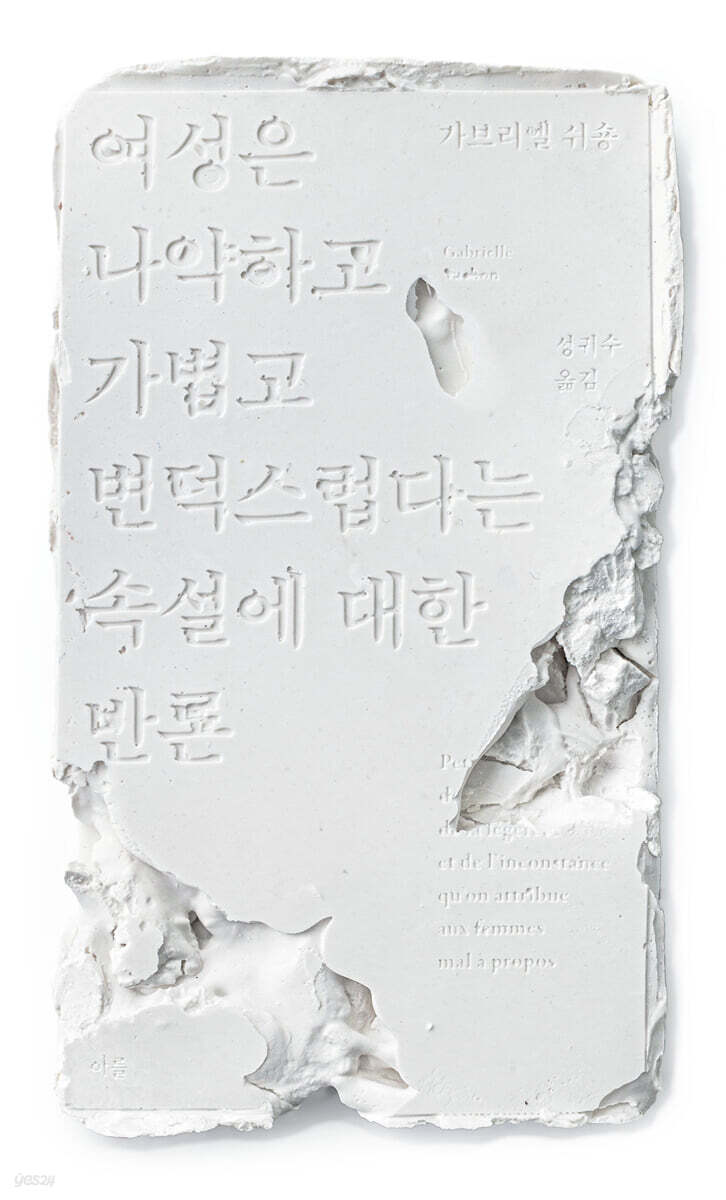
A rebuttal to the myth that women are weak, fickle, and fickle.
 |
Description
Book Introduction
The hidden works of 17th-century French philosopher and 'proto-feminist' Gabrielle Suchon have finally been published.
With its subversive logic and compelling language, this book challenged the long-standing prejudices of a male-dominated society and was rediscovered in the 20th century, becoming considered "one of the first complete and compelling works by a woman on women's issues."
Gabrielle Schichon points out the injustice of attributing three negative attributes to women: 'weakness', 'lightness', and 'fickleness', and offers a refreshing counterargument to it.
The structure is simple and clear, the arguments and counterarguments are impeccable, and the tone in which they are presented is strong.
This book presents a vision of a woman possessing not only "rebuttal" but also "strength, righteousness, and perseverance," and moves on to the question of how women suffering from the shackles of discrimination and prejudice can live "good lives."
The powerful argument, contained in captivating sentences, transcends the weight of time and evokes broad sympathy, and the irrefutable argument perfectly resonates with the reality of women facing countless instances of discrimination, exclusion, and hatred in their daily lives, as well as with the current situation surrounding women's right to self-determination, such as remaining single and not having children.
With its subversive logic and compelling language, this book challenged the long-standing prejudices of a male-dominated society and was rediscovered in the 20th century, becoming considered "one of the first complete and compelling works by a woman on women's issues."
Gabrielle Schichon points out the injustice of attributing three negative attributes to women: 'weakness', 'lightness', and 'fickleness', and offers a refreshing counterargument to it.
The structure is simple and clear, the arguments and counterarguments are impeccable, and the tone in which they are presented is strong.
This book presents a vision of a woman possessing not only "rebuttal" but also "strength, righteousness, and perseverance," and moves on to the question of how women suffering from the shackles of discrimination and prejudice can live "good lives."
The powerful argument, contained in captivating sentences, transcends the weight of time and evokes broad sympathy, and the irrefutable argument perfectly resonates with the reality of women facing countless instances of discrimination, exclusion, and hatred in their daily lives, as well as with the current situation surrounding women's right to self-determination, such as remaining single and not having children.
- You can preview some of the book's contents.
Preview
index
Translator's Note: The First Feminist
introduction
1 On weakness
2 About strength
3 About Lightness
4 About the will
5 About change
6 About Persistence
7 Women are strong, righteous, and persistent.
conclusion
Rain
Hymn
In lieu of the annual report
introduction
1 On weakness
2 About strength
3 About Lightness
4 About the will
5 About change
6 About Persistence
7 Women are strong, righteous, and persistent.
conclusion
Rain
Hymn
In lieu of the annual report
Detailed image

Into the book
Strong strength, perseverance, and a strong character are all highly regarded qualities, so it is no surprise that men seek to possess them to the best of their ability.
The surprising thing is that men go out of their way to monopolize these qualities by harming women.
It is truly incomprehensible how women, who possess an equal share in human nature, have not thought of rebelling against a culture that has taken such extreme contempt for granted for so long.
Was there ever a Taoist teaching that the best thing for a woman to do was to simply take a gentle attitude and ignore pain, insults, anger, and fate?
--- p.26
In short, there are countless reasons to point out the errors of those who slander women, but for now, we need to persuade them using strong and expressive language.
To be clear, the writings you will read below are not written from a momentary impulse or fantasy, but from a perspective of reason, justice, and fairness.
--- p.34-35
Men who want to see women as physically weak often use another argument, claiming that women are mentally weak, but the result is more regrettable than their physical flaws.
Since nothing represents the weakness of humanity as much as the sins committed by humans, the so-called 'original sin' is the root of all other sins, and so the argument is persistently put forward that the first woman is the cause of all human misfortune.
The logic is that women were too mentally weak to fall for the temptation of evil snakes, and because of this, human descendants fell into the abyss of misfortune.
--- p.45
I would like to recommend this to men who pride themselves on being strong but openly point out women's weaknesses.
Observe carefully how the woman treats you like that.
Eventually, you will quickly realize that the woman is treating the man like a child.
A woman does not try to attract a man's heart with her serious virtues, wisdom, and mental strength.
Women only use makeup, jewelry, and light grooming techniques.
Rather than moving the heart with genuine empathy and charm, they only stimulate curiosity with flashy clothes, hairstyles, and cute expressions and speech.
Using such flimsy weapons, the woman subdued the mighty Samson, and like a child who is simply delighted with a toy, Samson knelt down obediently.
In short, men always become captives of women too easily, not through solid reason, logic, or high intelligence, but through the power of light and sweet seduction.
--- p.61-62
Even if we are not happy with the rise in women's status, we should not criticize the upright attitude of a human being.
How many women have struggled through difficult lives without recognition for their abilities and opportunities?
Their heads and hearts were like rocks tossed by the rough waves, chiseled and polished through trials.
As Seneca so well expressed, the struggles of those who do not shy away from hardships, who have the courage and spirit to not lose faith in themselves, are watched closely by the gods.
The sight of a woman who rejects the injustice she suffers as a weakling and rises up to fight is enough to attract the attention of God.
--- p.100-101
There are important distinctions between so-called 'change' and lightness of mind.
Above all, although lightness almost always leads to reprehensible results, it is beneficial and sometimes even necessary for people to change.
Moreover, while lightness may often be the result of a weak nature or a fault, change, whether it is for good or evil, is always born of a solid principle of reason.
It is an undeniable truth that righteous and good changes exist in the world.
--- p.105
Men often dismiss women as hypocrites without properly understanding the situation or providing examples.
I think that even if a woman gets into something and gets absorbed in it, it's only because of temporary interest and curiosity, and that she can leave at any time if it no longer becomes fun.
If you show that you are content with what you have for a long time without changing, it is criticized as being because you do not have the courage to leave or do not see a suitable alternative.
Some even say that if women could change their husbands, they would do so just as the Romans did, taking a census every four or five years, holding the Olympic Games, and changing their consuls every year.
The surprising thing is that men go out of their way to monopolize these qualities by harming women.
It is truly incomprehensible how women, who possess an equal share in human nature, have not thought of rebelling against a culture that has taken such extreme contempt for granted for so long.
Was there ever a Taoist teaching that the best thing for a woman to do was to simply take a gentle attitude and ignore pain, insults, anger, and fate?
--- p.26
In short, there are countless reasons to point out the errors of those who slander women, but for now, we need to persuade them using strong and expressive language.
To be clear, the writings you will read below are not written from a momentary impulse or fantasy, but from a perspective of reason, justice, and fairness.
--- p.34-35
Men who want to see women as physically weak often use another argument, claiming that women are mentally weak, but the result is more regrettable than their physical flaws.
Since nothing represents the weakness of humanity as much as the sins committed by humans, the so-called 'original sin' is the root of all other sins, and so the argument is persistently put forward that the first woman is the cause of all human misfortune.
The logic is that women were too mentally weak to fall for the temptation of evil snakes, and because of this, human descendants fell into the abyss of misfortune.
--- p.45
I would like to recommend this to men who pride themselves on being strong but openly point out women's weaknesses.
Observe carefully how the woman treats you like that.
Eventually, you will quickly realize that the woman is treating the man like a child.
A woman does not try to attract a man's heart with her serious virtues, wisdom, and mental strength.
Women only use makeup, jewelry, and light grooming techniques.
Rather than moving the heart with genuine empathy and charm, they only stimulate curiosity with flashy clothes, hairstyles, and cute expressions and speech.
Using such flimsy weapons, the woman subdued the mighty Samson, and like a child who is simply delighted with a toy, Samson knelt down obediently.
In short, men always become captives of women too easily, not through solid reason, logic, or high intelligence, but through the power of light and sweet seduction.
--- p.61-62
Even if we are not happy with the rise in women's status, we should not criticize the upright attitude of a human being.
How many women have struggled through difficult lives without recognition for their abilities and opportunities?
Their heads and hearts were like rocks tossed by the rough waves, chiseled and polished through trials.
As Seneca so well expressed, the struggles of those who do not shy away from hardships, who have the courage and spirit to not lose faith in themselves, are watched closely by the gods.
The sight of a woman who rejects the injustice she suffers as a weakling and rises up to fight is enough to attract the attention of God.
--- p.100-101
There are important distinctions between so-called 'change' and lightness of mind.
Above all, although lightness almost always leads to reprehensible results, it is beneficial and sometimes even necessary for people to change.
Moreover, while lightness may often be the result of a weak nature or a fault, change, whether it is for good or evil, is always born of a solid principle of reason.
It is an undeniable truth that righteous and good changes exist in the world.
--- p.105
Men often dismiss women as hypocrites without properly understanding the situation or providing examples.
I think that even if a woman gets into something and gets absorbed in it, it's only because of temporary interest and curiosity, and that she can leave at any time if it no longer becomes fun.
If you show that you are content with what you have for a long time without changing, it is criticized as being because you do not have the courage to leave or do not see a suitable alternative.
Some even say that if women could change their husbands, they would do so just as the Romans did, taking a census every four or five years, holding the Olympic Games, and changing their consuls every year.
--- p.106
Publisher's Review
“Based on solid logic and credible citations
“It will not be easy to refute my argument.”
Gabrielle Chichon, the 'first feminist' ahead of her time,
A book that will shatter old prejudices about women!
“This book, which was ahead of its time and at odds with the customs of the time, is not only a classic that is being rediscovered and reread, but it also transcends the 300 years since the 17th century when Shi Xiong lived and wrote, and connects with us today as it is intertwined with contemporary situations surrounding non-marriage, childlessness, and women’s right to self-determination.” - Kim Eun-ju (Professor, Humanities Research Institute, Seoul Metropolitan University)
“The powerful, forward-moving writing style grips the reader tightly and does not let go, and the extensive knowledge of history, anger at unjust discrimination, and lively humor confirm where the fundamental power of feminist thought originated.
“You could almost call her a ‘proto-feminist.’” - Son Hee-jung (cultural critic)
“I refuse to read this book as simply a feminist book.
This book should be read as a universal philosophical work that challenges, for the first time, the special gender that has over-represented humans for a long time and the 'knowledge' that has been monopolized by men, and further expands the category of 'human'." - Jeong Hee-jin (feminist scholar)
“The first and most complete work on women’s issues written by a woman.”
In a time when the term "feminism" didn't even exist, how did women address the challenges they faced? In a world where literature, philosophy, science, art, and all other social disciplines were overwhelmingly male domains, how loudly did women speak out for their "universal humanity" and how did they fight against long-standing prejudices?
In his book, “Refutation of the Popular Saying that Women are Weak, Light, and Fickle,” which is powerfully titled and impressive from the start, the 17th-century French philosopher Gabriel Suchon (1632-1703) criticizes the long-standing prejudices that support misogyny and inequality, and offers a refreshing counterargument.
It also points out the serious flaws of the male-centered system that has constantly tried to exclude women from history, and presents a vision of women possessing 'strength, righteousness, and perseverance.'
“The truth, mired in error, can only be revealed when the darkness of prejudice is dispelled.
Therefore, through this short piece, I want to delve into the motives of those who too easily say that women are weak, frivolous, and fickle, and, by extension, to reveal the strength, will, and perseverance inherent in women.” (p. 28)
In fact, when this book first came out, it was completely ignored by the male mainstream intellectuals at the time and almost completely forgotten, not only because of its groundbreaking argument but also because of its subversive and appealing tone that urged the autonomy and self-development of contemporary women (“There are countless reasons to point out the errors of those who slander women, but we need to persuade them first with strong and expressive language.” p. 32).
Along with this, Gabrielle Suchon, a woman 'ahead of her time', was also forgotten for a long time, but was rediscovered in the 1970s, and in the 1990s, she was given full attention as a forerunner of Simone de Beauvoir ("Women can develop their inherent freedom and choose alternatives in life").
Later feminists began to call Gabrielle Suchon the "proto-feminist," and today the book is considered "one of the first complete and compelling works written by a woman on the women's question."
“No matter how much people criticize women, it does not make them sinners, and no matter how much they slander them, it does not tarnish the perfect character of women.
However, when the other person remains silent, there are always those who believe that it is due to some shady nature rather than self-control and moderation, so it is very important to refute persistent criticism and insults against women.” (p. 32)
This book was written from the perspective of reason, justice, and fairness.
This book, which has finally been introduced in Korea after overcoming the weight of 300 years, does not feel awkward at all even when read now.
“Men’s verbal abuse of women has become a huge custom, and is carried out indiscriminately without even thinking that the other person will be offended.” (p. 26), “Women are aware that they may be deprived of the legitimate freedom to enjoy pleasure in real life.
(…) Rather, in such times, women will consistently show their strong mentality by ignoring them, strengthen their resolve with upright conduct, and decorate their true lives with noble perseverance.” (pp. 33-34) The powerful argument contained in such captivating sentences transcends the weight of time and elicits broad sympathy, and the irrefutable logic perfectly matches the reality of women who face countless discrimination, exclusion, and hatred in their daily lives, and the current situation surrounding women’s right to self-determination, such as not being married or not having children.
This book points out the injustice of attributing three negative attributes—“weakness,” “lightness,” and “fickleness”—to women, and presents counterarguments to each of them. In addition, it addresses the sources of the attributes that are the opposite of these three negative attributes: “strength,” “will,” and “persistence.”
The structure is simple and clear, the arguments and counterarguments are impeccable, and the tone in which they are presented is strong.
His extensive knowledge of Christianity and ancient philosophical thought shines through, as does his satire and paradoxical use of Aristotle, Virgil, and Seneca (all men) as he appropriately quotes them.
Meanwhile, in each of the counterarguments that demonstrate the book's appeal, Shih-chung consistently emphasizes that weakness, lightness, and fickleness are not inherent attributes of women or men, but are inherent qualities of human existence.
Following this logic, it is argued that attributes such as strength, will, and perseverance cannot be monopolized by men, and it is proven through the examples of women in ancient Rome and Sparta who performed heroic deeds.
In other words, this book demonstrates the 'excellence' of critically penetrating the unjust reality faced by women, while at the same time showing that the limitations and possibilities of human nature cannot be transferred to or monopolized by one side.
As Shi-Shong himself reveals, this book was “written from the perspective of reason, justice, and fairness” (p. 35).
The following sentences clearly demonstrate the charm and characteristics of this book.
“If you put your mind to it, you can find women anywhere in the world who do hard and difficult work just as hard as men.
“The weaknesses we attribute to women are likely to be inherent in our own prejudices, not in their bodies or minds.” (p. 52)
“I would like to recommend this to men who pride themselves on being strong but openly point out women’s weaknesses.
Observe carefully how the woman treats you like that.
Eventually, you will quickly realize that the woman is treating the man like a child.
“Women do not try to attract men’s hearts with their serious virtues, wisdom, and mental strength.” (p. 61)
“If we consider the hardships and efforts that women endure as a given fate and say that there is no need to praise them, that would be a very flawed logic.
Because anyone is far more likely to be a strong and perfect human being when their virtues are revealed through hardship rather than comfort.
We see examples like this in all aspects of life.
A sailor rowing the waters with difficulty, a soldier risking his life on the battlefield, an athlete fighting with himself until his breath is out, and all workers sweating in the fields of life.
“Aren’t we all human beings who have grown into strong beings through hardship and suffering?” (p. 73)
“When it comes to thoughts, feelings, and desires, there can be no word more inappropriate than ‘light.’
Because it means judging a problem that men cannot understand.
“To be clear, delving into the inner workings of a woman is a divine matter.” (p. 88)
“There probably aren’t many men who would doubt the courage and tenacity of women who silently and steadfastly endure a life filled with hardship.
When faced with something that needs to change, women genuinely try to reduce the extent of that change.
Women's transformation never comes lightly.
“It is the same reason that their upright integrity is not the result of stubbornness or coercion.” (p. 107)
The Powerful Weapons Left Behind by 'Cursed Female Writers' and 'Dangerous Feminists'
"A Refutation of the Popular Idea that Women are Weak, Fragile, and Fickle" is a work of such sophistication that it is hard to believe it was written in the 17th century.
Shi Xiong's response to contemporary women's issues already went beyond the concept of equality, and through her exploration of human nature, she moved on to the question of how women, suffering from the shackles of countless discriminations and prejudices, could live a "good life."
This serves as an opportunity to confirm the roots of the modern women's rights movement and modern feminism.
If you follow the logic of this book closely, you will realize that the reality facing women today has not fundamentally changed much.
Social problems such as the male-dominated elite structure, their (and their blind followers') misogyny, and the constant dating murders targeting women seem to have gotten even worse.
There are still many unfair and unreasonable points in long-standing issues such as women's social advancement, marriage, and childcare.
This book asks whether the fundamental reason these problems persist is because of the male-centered social structure that denies women as “beings who possess an equal share in human nature” (p. 26) and intentionally excludes them.
Shi-Shong's clear 'rebuttal' to this becomes a powerful weapon that shatters the frame that reproduces inequality and the tired, stale prejudices.
In an era when women were considered cursed for writing and stigmatized as dangerous for resisting male hegemony, Gabrielle Suchon did both.
In an age when church and state sought to subjugate women to male power through convents and marriage, he rejected both.
And finally, after being hidden for so many years, the fascinating and brilliant work of this 'first feminist' is now available here.
Now it's our turn to rediscover its true value.
“It will not be easy to refute my argument.”
Gabrielle Chichon, the 'first feminist' ahead of her time,
A book that will shatter old prejudices about women!
“This book, which was ahead of its time and at odds with the customs of the time, is not only a classic that is being rediscovered and reread, but it also transcends the 300 years since the 17th century when Shi Xiong lived and wrote, and connects with us today as it is intertwined with contemporary situations surrounding non-marriage, childlessness, and women’s right to self-determination.” - Kim Eun-ju (Professor, Humanities Research Institute, Seoul Metropolitan University)
“The powerful, forward-moving writing style grips the reader tightly and does not let go, and the extensive knowledge of history, anger at unjust discrimination, and lively humor confirm where the fundamental power of feminist thought originated.
“You could almost call her a ‘proto-feminist.’” - Son Hee-jung (cultural critic)
“I refuse to read this book as simply a feminist book.
This book should be read as a universal philosophical work that challenges, for the first time, the special gender that has over-represented humans for a long time and the 'knowledge' that has been monopolized by men, and further expands the category of 'human'." - Jeong Hee-jin (feminist scholar)
“The first and most complete work on women’s issues written by a woman.”
In a time when the term "feminism" didn't even exist, how did women address the challenges they faced? In a world where literature, philosophy, science, art, and all other social disciplines were overwhelmingly male domains, how loudly did women speak out for their "universal humanity" and how did they fight against long-standing prejudices?
In his book, “Refutation of the Popular Saying that Women are Weak, Light, and Fickle,” which is powerfully titled and impressive from the start, the 17th-century French philosopher Gabriel Suchon (1632-1703) criticizes the long-standing prejudices that support misogyny and inequality, and offers a refreshing counterargument.
It also points out the serious flaws of the male-centered system that has constantly tried to exclude women from history, and presents a vision of women possessing 'strength, righteousness, and perseverance.'
“The truth, mired in error, can only be revealed when the darkness of prejudice is dispelled.
Therefore, through this short piece, I want to delve into the motives of those who too easily say that women are weak, frivolous, and fickle, and, by extension, to reveal the strength, will, and perseverance inherent in women.” (p. 28)
In fact, when this book first came out, it was completely ignored by the male mainstream intellectuals at the time and almost completely forgotten, not only because of its groundbreaking argument but also because of its subversive and appealing tone that urged the autonomy and self-development of contemporary women (“There are countless reasons to point out the errors of those who slander women, but we need to persuade them first with strong and expressive language.” p. 32).
Along with this, Gabrielle Suchon, a woman 'ahead of her time', was also forgotten for a long time, but was rediscovered in the 1970s, and in the 1990s, she was given full attention as a forerunner of Simone de Beauvoir ("Women can develop their inherent freedom and choose alternatives in life").
Later feminists began to call Gabrielle Suchon the "proto-feminist," and today the book is considered "one of the first complete and compelling works written by a woman on the women's question."
“No matter how much people criticize women, it does not make them sinners, and no matter how much they slander them, it does not tarnish the perfect character of women.
However, when the other person remains silent, there are always those who believe that it is due to some shady nature rather than self-control and moderation, so it is very important to refute persistent criticism and insults against women.” (p. 32)
This book was written from the perspective of reason, justice, and fairness.
This book, which has finally been introduced in Korea after overcoming the weight of 300 years, does not feel awkward at all even when read now.
“Men’s verbal abuse of women has become a huge custom, and is carried out indiscriminately without even thinking that the other person will be offended.” (p. 26), “Women are aware that they may be deprived of the legitimate freedom to enjoy pleasure in real life.
(…) Rather, in such times, women will consistently show their strong mentality by ignoring them, strengthen their resolve with upright conduct, and decorate their true lives with noble perseverance.” (pp. 33-34) The powerful argument contained in such captivating sentences transcends the weight of time and elicits broad sympathy, and the irrefutable logic perfectly matches the reality of women who face countless discrimination, exclusion, and hatred in their daily lives, and the current situation surrounding women’s right to self-determination, such as not being married or not having children.
This book points out the injustice of attributing three negative attributes—“weakness,” “lightness,” and “fickleness”—to women, and presents counterarguments to each of them. In addition, it addresses the sources of the attributes that are the opposite of these three negative attributes: “strength,” “will,” and “persistence.”
The structure is simple and clear, the arguments and counterarguments are impeccable, and the tone in which they are presented is strong.
His extensive knowledge of Christianity and ancient philosophical thought shines through, as does his satire and paradoxical use of Aristotle, Virgil, and Seneca (all men) as he appropriately quotes them.
Meanwhile, in each of the counterarguments that demonstrate the book's appeal, Shih-chung consistently emphasizes that weakness, lightness, and fickleness are not inherent attributes of women or men, but are inherent qualities of human existence.
Following this logic, it is argued that attributes such as strength, will, and perseverance cannot be monopolized by men, and it is proven through the examples of women in ancient Rome and Sparta who performed heroic deeds.
In other words, this book demonstrates the 'excellence' of critically penetrating the unjust reality faced by women, while at the same time showing that the limitations and possibilities of human nature cannot be transferred to or monopolized by one side.
As Shi-Shong himself reveals, this book was “written from the perspective of reason, justice, and fairness” (p. 35).
The following sentences clearly demonstrate the charm and characteristics of this book.
“If you put your mind to it, you can find women anywhere in the world who do hard and difficult work just as hard as men.
“The weaknesses we attribute to women are likely to be inherent in our own prejudices, not in their bodies or minds.” (p. 52)
“I would like to recommend this to men who pride themselves on being strong but openly point out women’s weaknesses.
Observe carefully how the woman treats you like that.
Eventually, you will quickly realize that the woman is treating the man like a child.
“Women do not try to attract men’s hearts with their serious virtues, wisdom, and mental strength.” (p. 61)
“If we consider the hardships and efforts that women endure as a given fate and say that there is no need to praise them, that would be a very flawed logic.
Because anyone is far more likely to be a strong and perfect human being when their virtues are revealed through hardship rather than comfort.
We see examples like this in all aspects of life.
A sailor rowing the waters with difficulty, a soldier risking his life on the battlefield, an athlete fighting with himself until his breath is out, and all workers sweating in the fields of life.
“Aren’t we all human beings who have grown into strong beings through hardship and suffering?” (p. 73)
“When it comes to thoughts, feelings, and desires, there can be no word more inappropriate than ‘light.’
Because it means judging a problem that men cannot understand.
“To be clear, delving into the inner workings of a woman is a divine matter.” (p. 88)
“There probably aren’t many men who would doubt the courage and tenacity of women who silently and steadfastly endure a life filled with hardship.
When faced with something that needs to change, women genuinely try to reduce the extent of that change.
Women's transformation never comes lightly.
“It is the same reason that their upright integrity is not the result of stubbornness or coercion.” (p. 107)
The Powerful Weapons Left Behind by 'Cursed Female Writers' and 'Dangerous Feminists'
"A Refutation of the Popular Idea that Women are Weak, Fragile, and Fickle" is a work of such sophistication that it is hard to believe it was written in the 17th century.
Shi Xiong's response to contemporary women's issues already went beyond the concept of equality, and through her exploration of human nature, she moved on to the question of how women, suffering from the shackles of countless discriminations and prejudices, could live a "good life."
This serves as an opportunity to confirm the roots of the modern women's rights movement and modern feminism.
If you follow the logic of this book closely, you will realize that the reality facing women today has not fundamentally changed much.
Social problems such as the male-dominated elite structure, their (and their blind followers') misogyny, and the constant dating murders targeting women seem to have gotten even worse.
There are still many unfair and unreasonable points in long-standing issues such as women's social advancement, marriage, and childcare.
This book asks whether the fundamental reason these problems persist is because of the male-centered social structure that denies women as “beings who possess an equal share in human nature” (p. 26) and intentionally excludes them.
Shi-Shong's clear 'rebuttal' to this becomes a powerful weapon that shatters the frame that reproduces inequality and the tired, stale prejudices.
In an era when women were considered cursed for writing and stigmatized as dangerous for resisting male hegemony, Gabrielle Suchon did both.
In an age when church and state sought to subjugate women to male power through convents and marriage, he rejected both.
And finally, after being hidden for so many years, the fascinating and brilliant work of this 'first feminist' is now available here.
Now it's our turn to rediscover its true value.
GOODS SPECIFICS
- Date of issue: August 5, 2025
- Format: Paperback book binding method guide
- Page count, weight, size: 136 pages | 174g | 115*190*13mm
- ISBN13: 9791193955109
You may also like
카테고리
korean


korean

![GQ KOREA Mark (Monthly): December [2025]](http://librairie.coreenne.fr/cdn/shop/files/8ef265dbbfbf186523ed75ba7319009d.jpg?v=1765340328&width=3840)


