

Women who died after breaking up
 |
Description
Book Introduction
The first book to comprehensively address the issue of dating violence in Korean society!
The Kyunghyang Shinmun Women's Narrative Archive Flat Team met
Stories from victims of dating violence, their families, survivors, advocates, and experts.
On May 12, 2025, around 10:00 AM, while the whole country was in an uproar over the news that former President Yoon Seok-yeol, suspected of being a sedition ringleader, had finally stood in the photo line in front of the courtroom, a woman was found bleeding to death on the floor in front of an apartment building in Dongtan New Town.
His hands were tied behind his back, and a black mask was placed over his head.
The victim, who was stabbed at least 10 times, had reported her ex-boyfriend to the police nine times before her death.
The so-called 'Dongtan kidnapping and murder case' received a brief moment of attention when the Hwaseong Dongtan Police Chief publicly apologized 16 days after the incident, but in some ways it is just another common case.
This is because in our country, one woman a day is murdered or threatened with murder by a male partner (including ex-husbands and ex-boyfriends) with whom she is in an “intimate relationship” (2024 statistics released by the Korea Women’s Hotline based on incidents reported in the media).
Including victims' children, parents, friends, and other people around them, the number reaches 650, or one victim every 13 hours and 30 minutes.
Last year, 181 women were murdered due to such intimate relationships.
It is larger than the Jeju Air disaster (179 people) and smaller than the Daegu subway disaster (186 people).
"Women Who Died While Breaking Up" is a book by the Kyunghyang Shinmun Women's Narrative Archive Flat Team, which reported on these tragic yet everyday deaths in a feature article titled "We Can't Lose Anymore."
This is the first book to comprehensively address the issue of dating violence in Korean society, and contains vivid testimonies from victims' families, supporters, experts, and survivors.
This book asks:
Is the phenomenon of female murder, in which one woman is killed or threatened with death every day, really nothing more than a personal, unfortunate incident?
If this isn't a social disaster, then what is?
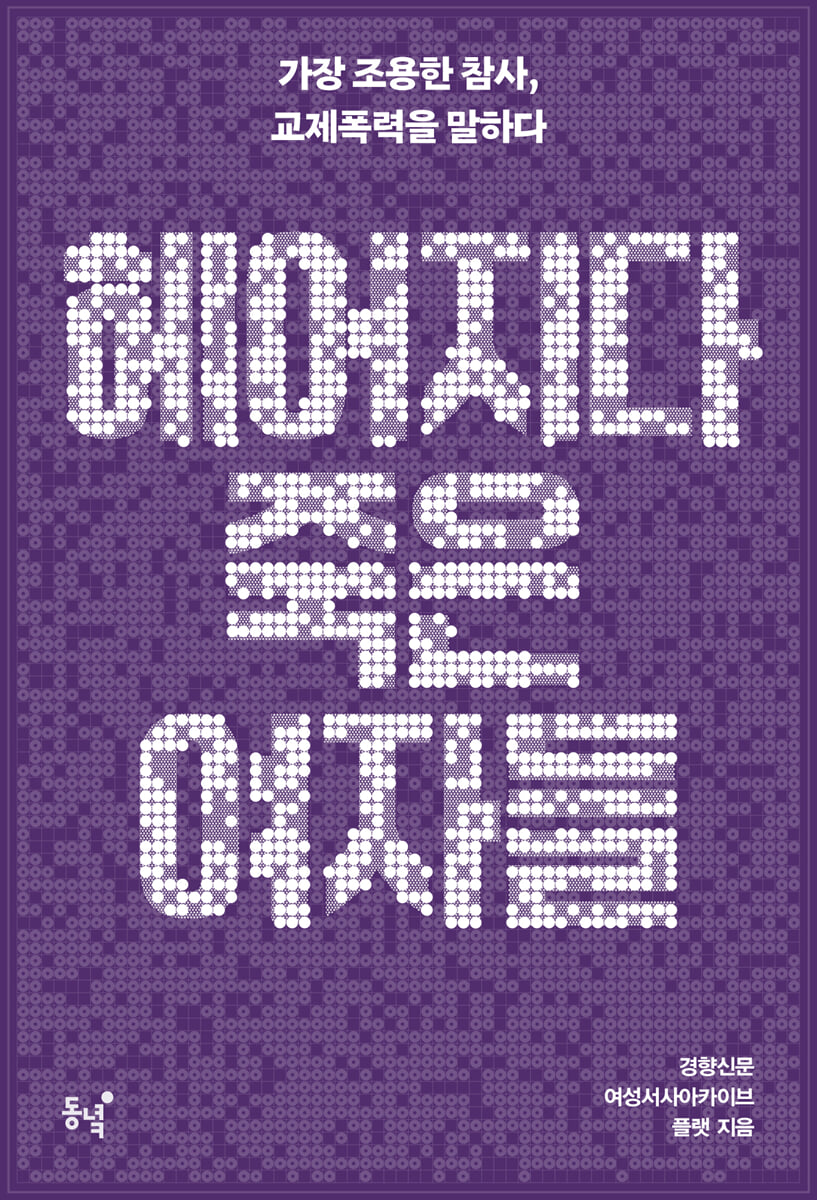
The book's cover features circles representing the 4,423 women who lost their lives or were threatened with death by their male partners over a period of 5,840 days from 2009 to 2024.
It is my hope that our society will remember each and every woman who has been sacrificed in the absence of the concept of gender-based violence.
The Kyunghyang Shinmun Women's Narrative Archive Flat Team met
Stories from victims of dating violence, their families, survivors, advocates, and experts.
On May 12, 2025, around 10:00 AM, while the whole country was in an uproar over the news that former President Yoon Seok-yeol, suspected of being a sedition ringleader, had finally stood in the photo line in front of the courtroom, a woman was found bleeding to death on the floor in front of an apartment building in Dongtan New Town.
His hands were tied behind his back, and a black mask was placed over his head.
The victim, who was stabbed at least 10 times, had reported her ex-boyfriend to the police nine times before her death.
The so-called 'Dongtan kidnapping and murder case' received a brief moment of attention when the Hwaseong Dongtan Police Chief publicly apologized 16 days after the incident, but in some ways it is just another common case.
This is because in our country, one woman a day is murdered or threatened with murder by a male partner (including ex-husbands and ex-boyfriends) with whom she is in an “intimate relationship” (2024 statistics released by the Korea Women’s Hotline based on incidents reported in the media).
Including victims' children, parents, friends, and other people around them, the number reaches 650, or one victim every 13 hours and 30 minutes.
Last year, 181 women were murdered due to such intimate relationships.
It is larger than the Jeju Air disaster (179 people) and smaller than the Daegu subway disaster (186 people).
"Women Who Died While Breaking Up" is a book by the Kyunghyang Shinmun Women's Narrative Archive Flat Team, which reported on these tragic yet everyday deaths in a feature article titled "We Can't Lose Anymore."
This is the first book to comprehensively address the issue of dating violence in Korean society, and contains vivid testimonies from victims' families, supporters, experts, and survivors.
This book asks:
Is the phenomenon of female murder, in which one woman is killed or threatened with death every day, really nothing more than a personal, unfortunate incident?
If this isn't a social disaster, then what is?
The book's cover features circles representing the 4,423 women who lost their lives or were threatened with death by their male partners over a period of 5,840 days from 2009 to 2024.
It is my hope that our society will remember each and every woman who has been sacrificed in the absence of the concept of gender-based violence.
- You can preview some of the book's contents.
Preview
index
Introductory text: We can't afford to lose anyone anymore.
Chapter 1 How can you hit someone you love, how can you kill them?
The Cry of a Father Who Lost Two Daughters | People I Met: Na Jong-gi, the Father of the Dangjin Sisters Murder Case
Men Who Exploit Intimacy | Met: Attorney Kim Tae-yeon, the YouTuber Tzuyang Case
Chapter 2: Case Conclusion: A Common Fight Between Lovers
- I reported it eleven times, but lost my life | Person I met: Son Eun-jin's mother, involved in the Geoje Gyoje murder case
- 〈Introduction〉 The Reality and Current Status of Dating Violence
Chapter 3: Too many people die, but there is no sense of crisis.
Another perpetrator, the judiciary | People I met: Barricand assault and confinement case, now an activist
- To become a nation that solves problems | People I met: Kim Hyo-jeong, Associate Research Fellow, Korean Women's Development Institute; Choi Seon-hye, Secretary General, Korean Women's Hotline
- 〈A Look Inside〉 How Far Have We Come in Legislating the Punishment of Dating Violence?
Chapter 4: I was a victim in the past, a survivor now, and I want to be a helper in the future.
Living Beyond 'Victimization' | People I Met: Kim Ji-young, Survivor of Dating Violence
- Becoming a Supporter of One Another | Met: Park A-reum, an activist at the Korea Sexual Violence Relief Center
- 〈A Look at〉Overseas Cases of Advanced Legal Systems
The text that appears
Chapter 1 How can you hit someone you love, how can you kill them?
The Cry of a Father Who Lost Two Daughters | People I Met: Na Jong-gi, the Father of the Dangjin Sisters Murder Case
Men Who Exploit Intimacy | Met: Attorney Kim Tae-yeon, the YouTuber Tzuyang Case
Chapter 2: Case Conclusion: A Common Fight Between Lovers
- I reported it eleven times, but lost my life | Person I met: Son Eun-jin's mother, involved in the Geoje Gyoje murder case
- 〈Introduction〉 The Reality and Current Status of Dating Violence
Chapter 3: Too many people die, but there is no sense of crisis.
Another perpetrator, the judiciary | People I met: Barricand assault and confinement case, now an activist
- To become a nation that solves problems | People I met: Kim Hyo-jeong, Associate Research Fellow, Korean Women's Development Institute; Choi Seon-hye, Secretary General, Korean Women's Hotline
- 〈A Look Inside〉 How Far Have We Come in Legislating the Punishment of Dating Violence?
Chapter 4: I was a victim in the past, a survivor now, and I want to be a helper in the future.
Living Beyond 'Victimization' | People I Met: Kim Ji-young, Survivor of Dating Violence
- Becoming a Supporter of One Another | Met: Park A-reum, an activist at the Korea Sexual Violence Relief Center
- 〈A Look at〉Overseas Cases of Advanced Legal Systems
The text that appears
Detailed image

Into the book
He said, “When I look at young people these days, I just want to tell them not to date or get married.”
“If you meet the wrong man and die unjustly, the government will not take any responsibility.
How many people died before and after our children died?
This is the result of the state not giving any warning message to the perpetrators until now.
Even if you commit sexual assault, if you reach an agreement, you are released, but then you are assaulted and killed afterward…
Even recently, there have been endless incidents of dating violence.
If something similar happens again, we need to make sure it never happens again, but that's not happening at all.
So, there are people who keep saying that it’s okay to hit or kill.”
--- p.30~31
“Even when the news talks about relationship violence, ordinary people don’t think it could happen to them.
Looking back, everything was a warning sign, and I regret that I only realized it after I died.
(…) The bigger problem is that there are too many people like us in this world.
Gather the families of those who died from dating violence and partner violence across the country.
"How is this different from other social disasters? It's the same."
--- p.50
Dating violence is treated as a crime of intimidation and assault under the criminal law, and the non-punishment clause applies, so if the victim says they do not want to be punished, the perpetrator cannot be punished.
However, in a situation where the perpetrator knows the victim's personal information well and can easily retaliate, asking the victim if they really want the perpetrator to be punished is no different from sending the message to the perpetrator that they can avoid punishment as long as they threaten and bully the victim.
While lawmakers are turning a blind eye to legislative reform, arguing that it is difficult to define a relationship, countless victims of dating violence are being murdered.”
--- p.64~65
In dating violence, ‘strangulation’ is an important aspect.
Jeong Jae-heun, secretary general of the Gyeongnam Women's Association, said in a press conference, "Dating violence tends to suddenly move from a crime of intimidation to a violent crime." He added, "Strangulation reveals that the victim's life is in their hands, and that petty sense of power and desire to show off is revealed."
--- p.75~76
Ultimately, the reason these kinds of rulings are repeated is because society's view of violence committed by men against women has not changed.
Whether it is domestic violence or relationship violence, if a male partner continuously assaults a female victim and it results in death, most cases are subject to assault resulting in death or assault resulting in death under criminal law.
This contrasts with the heavy sentence given to a woman who murders her male partner after being repeatedly beaten, who is charged with 'premeditated murder'.
--- p.76
“The context of the defendant’s lawyer’s questions seems to be directed at justifying the perpetrator’s violence, even if only a little.
The court's perspective on the case itself is centered on the perpetrator, and no measures are taken to help the victim recover, which is a major limitation.
What exactly is the connection between the victim's sex life and the assault or rape she suffered while incarcerated? The court may view it as the perpetrator's right to defend himself, but in the process, the victim is re-traumatized.
“Shouldn’t we have blocked questions that are not directly related to the case?”
--- p.101
“In a romantic relationship, even if I tell the other person not to contact me or come see me, there are many cases where I end up meeting them after receiving a phone call or text message.
I feel like if I cut off contact from the beginning, something bigger will happen, so I have no choice but to meet up again and again.
That is the psychology and situation of victims of dating violence.
However, the police say that it is difficult to file a case in this situation.
Anyway, I got a call from the other party.
In stalking crimes, 'persistence and repetition' are important, but the frustrating reality is that once you are contacted, all previous actions are 'reset.'
Maybe we just have to wait until the damage is really serious.”
--- p.115~116
“When you fight with a friend in elementary school, you say, ‘He did it,’ or ‘He did it first,’ and the teacher comes out and says, ‘You both were wrong, so make up.’
That's exactly how I felt at the police station.
“It seemed like the investigative agency was trying to maintain mechanical neutrality from the beginning, and it felt like all my damages were being denied.”
--- p.155
“I feel like a bit of a weed.
There have been many difficult times in life, but I overcame them and am still alive today.
I used to be a victim, but now I think I'm a survivor.
My dream for the future is to become a winner, and even more so, a helper.
I want to help others in whatever way I can.
“If others were to repeat the pain I experienced alone, I would tell them, ‘You don’t have to do that,’ and ‘It’s not your fault.’”
“If you meet the wrong man and die unjustly, the government will not take any responsibility.
How many people died before and after our children died?
This is the result of the state not giving any warning message to the perpetrators until now.
Even if you commit sexual assault, if you reach an agreement, you are released, but then you are assaulted and killed afterward…
Even recently, there have been endless incidents of dating violence.
If something similar happens again, we need to make sure it never happens again, but that's not happening at all.
So, there are people who keep saying that it’s okay to hit or kill.”
--- p.30~31
“Even when the news talks about relationship violence, ordinary people don’t think it could happen to them.
Looking back, everything was a warning sign, and I regret that I only realized it after I died.
(…) The bigger problem is that there are too many people like us in this world.
Gather the families of those who died from dating violence and partner violence across the country.
"How is this different from other social disasters? It's the same."
--- p.50
Dating violence is treated as a crime of intimidation and assault under the criminal law, and the non-punishment clause applies, so if the victim says they do not want to be punished, the perpetrator cannot be punished.
However, in a situation where the perpetrator knows the victim's personal information well and can easily retaliate, asking the victim if they really want the perpetrator to be punished is no different from sending the message to the perpetrator that they can avoid punishment as long as they threaten and bully the victim.
While lawmakers are turning a blind eye to legislative reform, arguing that it is difficult to define a relationship, countless victims of dating violence are being murdered.”
--- p.64~65
In dating violence, ‘strangulation’ is an important aspect.
Jeong Jae-heun, secretary general of the Gyeongnam Women's Association, said in a press conference, "Dating violence tends to suddenly move from a crime of intimidation to a violent crime." He added, "Strangulation reveals that the victim's life is in their hands, and that petty sense of power and desire to show off is revealed."
--- p.75~76
Ultimately, the reason these kinds of rulings are repeated is because society's view of violence committed by men against women has not changed.
Whether it is domestic violence or relationship violence, if a male partner continuously assaults a female victim and it results in death, most cases are subject to assault resulting in death or assault resulting in death under criminal law.
This contrasts with the heavy sentence given to a woman who murders her male partner after being repeatedly beaten, who is charged with 'premeditated murder'.
--- p.76
“The context of the defendant’s lawyer’s questions seems to be directed at justifying the perpetrator’s violence, even if only a little.
The court's perspective on the case itself is centered on the perpetrator, and no measures are taken to help the victim recover, which is a major limitation.
What exactly is the connection between the victim's sex life and the assault or rape she suffered while incarcerated? The court may view it as the perpetrator's right to defend himself, but in the process, the victim is re-traumatized.
“Shouldn’t we have blocked questions that are not directly related to the case?”
--- p.101
“In a romantic relationship, even if I tell the other person not to contact me or come see me, there are many cases where I end up meeting them after receiving a phone call or text message.
I feel like if I cut off contact from the beginning, something bigger will happen, so I have no choice but to meet up again and again.
That is the psychology and situation of victims of dating violence.
However, the police say that it is difficult to file a case in this situation.
Anyway, I got a call from the other party.
In stalking crimes, 'persistence and repetition' are important, but the frustrating reality is that once you are contacted, all previous actions are 'reset.'
Maybe we just have to wait until the damage is really serious.”
--- p.115~116
“When you fight with a friend in elementary school, you say, ‘He did it,’ or ‘He did it first,’ and the teacher comes out and says, ‘You both were wrong, so make up.’
That's exactly how I felt at the police station.
“It seemed like the investigative agency was trying to maintain mechanical neutrality from the beginning, and it felt like all my damages were being denied.”
--- p.155
“I feel like a bit of a weed.
There have been many difficult times in life, but I overcame them and am still alive today.
I used to be a victim, but now I think I'm a survivor.
My dream for the future is to become a winner, and even more so, a helper.
I want to help others in whatever way I can.
“If others were to repeat the pain I experienced alone, I would tell them, ‘You don’t have to do that,’ and ‘It’s not your fault.’”
--- p.171
Publisher's Review
Violence within intimate relationships can lead to death even if left untreated for just a single time.
Chapter 1, “How can you hit someone you love, how can you kill them?” contains the cries of the father, a bereaved family member of the “Dangjin Sisters Murder Case.”
This is an incident in which the younger sister's boyfriend strangled her to death and then immediately killed her older sister who lived in the same apartment.
The man my divorced sister met while entering a rehabilitation facility for alcoholism is the perpetrator.
The sisters' father only learned after his two daughters died that the perpetrator had a history of violence, and that his older daughter (his older sister) had also divorced due to years of domestic violence.
The sisters, who had shared unfortunate experiences with male partners, were bound to become even closer, and in that state, a tragedy occurred in which the sisters were simultaneously murdered by a man who had infiltrated their lives.
What are the characteristics of violence that occurs in intimate relationships, such as dating violence and domestic violence?
The case of Tzuyang, a YouTuber with 10 million subscribers, who was exposed to the public due to threats from cybercriminals, concisely illustrates this characteristic.
First, multiple crimes, including assault, sexual assault, extortion, and illegal filming, overlap; second, victims are unable to escape the relationship due to fear of threats; and third, victims become isolated.
Therefore, even if this type of violence is left unchecked just once, it can easily lead to greater violence and ultimately death.
Attorney Kim Tae-yeon, who represented Tzuyang, emphasized the following:
“Even a single assault is very different in nature whether it happens in a romantic relationship or from a stranger.
“In the case of romantic relationships, even if there is no repetition, if the situation is urgent, investigative authorities should step in from the beginning to prevent bigger crimes.”
An investigative process that does not recognize gender hierarchy,
Legislative failure due to lack of recognition of gender hierarchy
Chapter 2, 'Case Summary: A Common Quarrel Between Lovers', deals with the 'Geoje Dating Murder Case' in which a woman died after being assaulted by her ex-boyfriend of the same age in April 2024.
The ex-boyfriend broke into the victim's studio apartment after she stopped responding to his calls and messages, climbed on her body, strangled her, and indiscriminately beat her head and body. Ten days later, the victim suffered a traumatic subdural hemorrhage, followed by multiple organ failure due to sepsis, and died nine days later in the hospital.
The victim reported the incident to the police no fewer than eleven times in the year before her death, but was unable to escape this fate.
Looking at the 'case closure details' in the 112 report records of her daughter that Ms. Son received through a freedom of information request, the police repeatedly treated the case as mutual assault or closed the investigation based on the victim's unwillingness to be punished (under current law, assault is a crime not punishable without consent).
This clearly shows the reality that “a woman’s self-defense for survival is punished as mutual assault.”
It is the result of a complete disregard for the power of men, who have physical superiority and the mental superiority that comes with it.
It is also a reflection of the reality that there is a provision for non-punishment of crimes of violence against women.
Meanwhile, bills related to dating violence have been proposed several times from the 19th National Assembly (2012) to the 22nd National Assembly (2024), but have yet to pass the National Assembly.
This is because it is unclear where and how to consider a ‘relationship’.
However, overseas, considering the seriousness of violence against women, dating relationships and dating violence were defined early on.
The United States Code of Federal Regulations, under the heading "Violence Against Women," defines the concepts of "dating partner" and "dating violence."
According to him, dating violence is “violence from someone who is or has been in a romantic or intimate social relationship.”
The presence of an 'intimate social relationship' is determined by considering the duration of the relationship, its type, and the frequency of interaction between the people involved.
The Domestic Violence Act, which came into effect in the UK in 2021, treats the family as a broader concept than just family members, to include violence in intimate relationships.
Researcher Kim Hye-jeong, who introduced these overseas cases in a research report ("Conceptualization of Intimate Violence as Gender-Based Violence and Exploring Response Directions," December 2023, Korea Women's Development Institute), said, "Defining an intimate relationship is not at all difficult.
“The will of the country is important, but because there is no recognition that this is a structural problem that arises from the gender hierarchy, it is not being discussed,” he said.
Secondary harm during the trial process due to lack of sensitivity to adult perception
Chapter 3, “So many people are dying, but there is no sense of crisis,” examines the “barricade assault and confinement incident” that occurred in July 2023 and points out the secondary harm caused by the judicial system.
This is a bizarre incident in which a person was locked in an officetel in Guri-si, Gyeonggi-do, had their head shaved with a barbwire, was assaulted, threatened, and had urine and spit poured on their face.
The victim, who had dramatically escaped from a life-or-death situation, was trampled once again by the perpetrator's former lawyers from a large law firm during the trial.
I was bombarded with questions that had nothing to do with the confinement and assault, such as “Who did you have sex with and how?” and “How long did you have it for?”
The reason for the crime was that the perpetrator suspected the victim of cheating.
During the process, the court did not impose any restraint.
This practice violates recommendations from the UN Committee on the Elimination of Discrimination against Women (CEDAW), which prohibit the discriminatory stigmatization of victims through secondary victimization during investigations and trials. This book details Korea's concerns regarding "gender-based violence against women," presented at a CEDAW conference in Geneva, Switzerland, in 2024.
In addition, through a conversation with Kim Hyo-jeong, a research fellow at the Korea Women's Development Institute, and Choi Seon-hye, the director of the Korea Women's Hotline, we discussed a wide range of topics, including a clear national perspective on dating violence crimes, the need for official statistics, and issues raised during the legislative process.
We also summarized the current status of legislation and revisions to punish dating violence crimes, the difficulties they face, and the direction they should take.
Beyond self-loathing, the power of solidarity
Chapter 4, “I was a victim in the past, a survivor now, and I want to be a helper in the future,” depicts the process by which a victim of violence in an intimate relationship overcomes the difficult stage of self-loathing due to social pressure and ultimately grows into a helper.
Kim Ji-young (pseudonym), a victim of dating violence, was on the verge of death several years ago when her boyfriend strangled her and stomped on her.
After hearing the boyfriend say that he did it because he suspected cheating, the police responded by saying, "You're both at fault, so make up."
What tormented Kim more than anything was the fact that his lover had tried to kill him.
In the midst of all this, even the words of comfort from acquaintances became arrows that pierced him one by one.
It was the Korea Sexual Violence Relief Center's 'Sexual Violence Specialist Counselor Training Course' that helped Kim, who had been socially isolated and reclusive, to rise again.
As he learned there and talked to his students, Kim realized, not just with words, but with his whole body, that the incident was not his fault.
We have acquired the language and logic to interpret the event.
Building on that strength, he moves beyond himself to solidarity with those who have experienced the same thing, and shows the process of recovery.
We spoke in more detail with Park A-reum, an activist at the Korea Sexual Violence Relief Center, about this ‘sexual violence specialist counselor training.’
Through education, we introduced how clearly recognizing the deep-rooted gender inequality and misogynistic dating scripts in our society can help victims recover, and how those around survivors should treat and support them.
In addition, we looked at examples from Australia and Sweden, countries that legalized dating violence before Korea, to see what our society can learn from.
Chapter 1, “How can you hit someone you love, how can you kill them?” contains the cries of the father, a bereaved family member of the “Dangjin Sisters Murder Case.”
This is an incident in which the younger sister's boyfriend strangled her to death and then immediately killed her older sister who lived in the same apartment.
The man my divorced sister met while entering a rehabilitation facility for alcoholism is the perpetrator.
The sisters' father only learned after his two daughters died that the perpetrator had a history of violence, and that his older daughter (his older sister) had also divorced due to years of domestic violence.
The sisters, who had shared unfortunate experiences with male partners, were bound to become even closer, and in that state, a tragedy occurred in which the sisters were simultaneously murdered by a man who had infiltrated their lives.
What are the characteristics of violence that occurs in intimate relationships, such as dating violence and domestic violence?
The case of Tzuyang, a YouTuber with 10 million subscribers, who was exposed to the public due to threats from cybercriminals, concisely illustrates this characteristic.
First, multiple crimes, including assault, sexual assault, extortion, and illegal filming, overlap; second, victims are unable to escape the relationship due to fear of threats; and third, victims become isolated.
Therefore, even if this type of violence is left unchecked just once, it can easily lead to greater violence and ultimately death.
Attorney Kim Tae-yeon, who represented Tzuyang, emphasized the following:
“Even a single assault is very different in nature whether it happens in a romantic relationship or from a stranger.
“In the case of romantic relationships, even if there is no repetition, if the situation is urgent, investigative authorities should step in from the beginning to prevent bigger crimes.”
An investigative process that does not recognize gender hierarchy,
Legislative failure due to lack of recognition of gender hierarchy
Chapter 2, 'Case Summary: A Common Quarrel Between Lovers', deals with the 'Geoje Dating Murder Case' in which a woman died after being assaulted by her ex-boyfriend of the same age in April 2024.
The ex-boyfriend broke into the victim's studio apartment after she stopped responding to his calls and messages, climbed on her body, strangled her, and indiscriminately beat her head and body. Ten days later, the victim suffered a traumatic subdural hemorrhage, followed by multiple organ failure due to sepsis, and died nine days later in the hospital.
The victim reported the incident to the police no fewer than eleven times in the year before her death, but was unable to escape this fate.
Looking at the 'case closure details' in the 112 report records of her daughter that Ms. Son received through a freedom of information request, the police repeatedly treated the case as mutual assault or closed the investigation based on the victim's unwillingness to be punished (under current law, assault is a crime not punishable without consent).
This clearly shows the reality that “a woman’s self-defense for survival is punished as mutual assault.”
It is the result of a complete disregard for the power of men, who have physical superiority and the mental superiority that comes with it.
It is also a reflection of the reality that there is a provision for non-punishment of crimes of violence against women.
Meanwhile, bills related to dating violence have been proposed several times from the 19th National Assembly (2012) to the 22nd National Assembly (2024), but have yet to pass the National Assembly.
This is because it is unclear where and how to consider a ‘relationship’.
However, overseas, considering the seriousness of violence against women, dating relationships and dating violence were defined early on.
The United States Code of Federal Regulations, under the heading "Violence Against Women," defines the concepts of "dating partner" and "dating violence."
According to him, dating violence is “violence from someone who is or has been in a romantic or intimate social relationship.”
The presence of an 'intimate social relationship' is determined by considering the duration of the relationship, its type, and the frequency of interaction between the people involved.
The Domestic Violence Act, which came into effect in the UK in 2021, treats the family as a broader concept than just family members, to include violence in intimate relationships.
Researcher Kim Hye-jeong, who introduced these overseas cases in a research report ("Conceptualization of Intimate Violence as Gender-Based Violence and Exploring Response Directions," December 2023, Korea Women's Development Institute), said, "Defining an intimate relationship is not at all difficult.
“The will of the country is important, but because there is no recognition that this is a structural problem that arises from the gender hierarchy, it is not being discussed,” he said.
Secondary harm during the trial process due to lack of sensitivity to adult perception
Chapter 3, “So many people are dying, but there is no sense of crisis,” examines the “barricade assault and confinement incident” that occurred in July 2023 and points out the secondary harm caused by the judicial system.
This is a bizarre incident in which a person was locked in an officetel in Guri-si, Gyeonggi-do, had their head shaved with a barbwire, was assaulted, threatened, and had urine and spit poured on their face.
The victim, who had dramatically escaped from a life-or-death situation, was trampled once again by the perpetrator's former lawyers from a large law firm during the trial.
I was bombarded with questions that had nothing to do with the confinement and assault, such as “Who did you have sex with and how?” and “How long did you have it for?”
The reason for the crime was that the perpetrator suspected the victim of cheating.
During the process, the court did not impose any restraint.
This practice violates recommendations from the UN Committee on the Elimination of Discrimination against Women (CEDAW), which prohibit the discriminatory stigmatization of victims through secondary victimization during investigations and trials. This book details Korea's concerns regarding "gender-based violence against women," presented at a CEDAW conference in Geneva, Switzerland, in 2024.
In addition, through a conversation with Kim Hyo-jeong, a research fellow at the Korea Women's Development Institute, and Choi Seon-hye, the director of the Korea Women's Hotline, we discussed a wide range of topics, including a clear national perspective on dating violence crimes, the need for official statistics, and issues raised during the legislative process.
We also summarized the current status of legislation and revisions to punish dating violence crimes, the difficulties they face, and the direction they should take.
Beyond self-loathing, the power of solidarity
Chapter 4, “I was a victim in the past, a survivor now, and I want to be a helper in the future,” depicts the process by which a victim of violence in an intimate relationship overcomes the difficult stage of self-loathing due to social pressure and ultimately grows into a helper.
Kim Ji-young (pseudonym), a victim of dating violence, was on the verge of death several years ago when her boyfriend strangled her and stomped on her.
After hearing the boyfriend say that he did it because he suspected cheating, the police responded by saying, "You're both at fault, so make up."
What tormented Kim more than anything was the fact that his lover had tried to kill him.
In the midst of all this, even the words of comfort from acquaintances became arrows that pierced him one by one.
It was the Korea Sexual Violence Relief Center's 'Sexual Violence Specialist Counselor Training Course' that helped Kim, who had been socially isolated and reclusive, to rise again.
As he learned there and talked to his students, Kim realized, not just with words, but with his whole body, that the incident was not his fault.
We have acquired the language and logic to interpret the event.
Building on that strength, he moves beyond himself to solidarity with those who have experienced the same thing, and shows the process of recovery.
We spoke in more detail with Park A-reum, an activist at the Korea Sexual Violence Relief Center, about this ‘sexual violence specialist counselor training.’
Through education, we introduced how clearly recognizing the deep-rooted gender inequality and misogynistic dating scripts in our society can help victims recover, and how those around survivors should treat and support them.
In addition, we looked at examples from Australia and Sweden, countries that legalized dating violence before Korea, to see what our society can learn from.
GOODS SPECIFICS
- Date of issue: July 25, 2025
- Page count, weight, size: 208 pages | 242g | 128*188*16mm
- ISBN13: 9788972971696
- ISBN10: 8972971693
You may also like
카테고리
korean


korean

![GQ KOREA Mark (Monthly): December [2025]](http://librairie.coreenne.fr/cdn/shop/files/8ef265dbbfbf186523ed75ba7319009d.jpg?v=1765340328&width=3840)


