

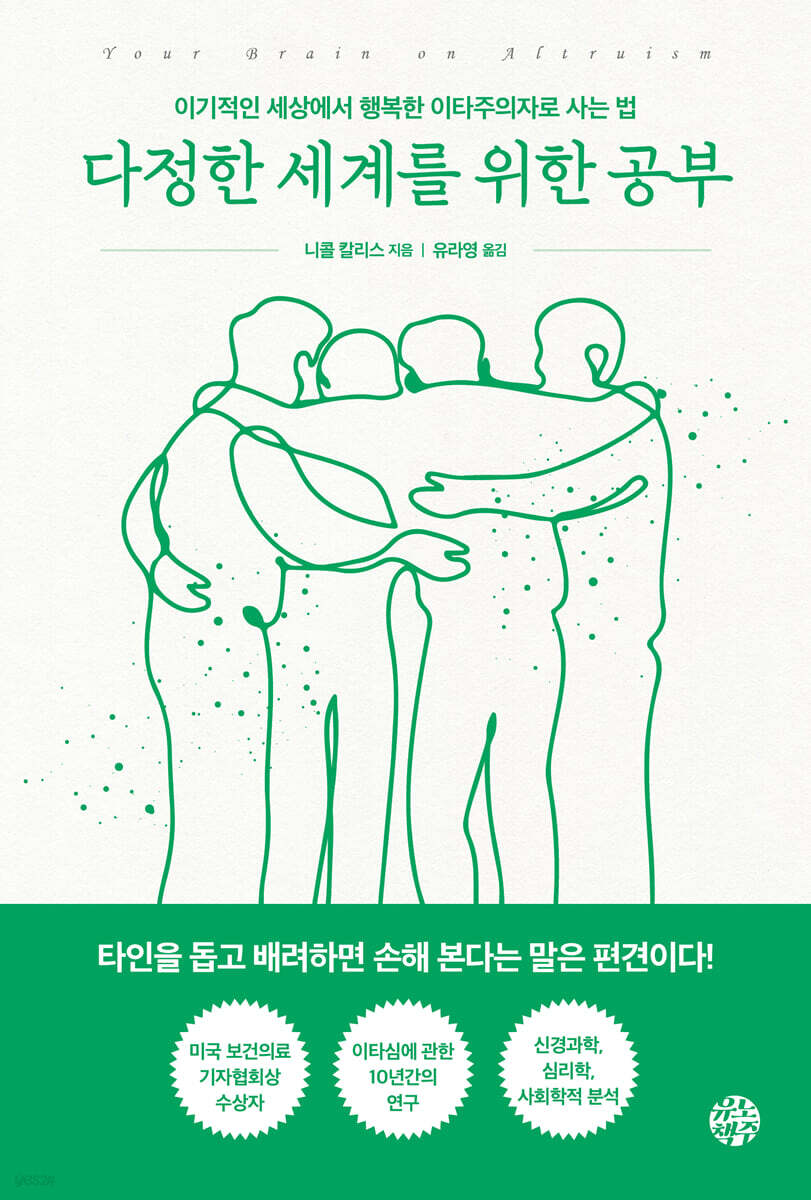
Studying for a Kind World
 |
Description
Book Introduction
Do selfish people in disaster movies actually exist?
Why do we help others without asking for anything in return whenever accidents or disasters strike?
How to Live as a Happy Altruist in a Selfish World
This book invites you to a new field of awareness by analyzing from the perspectives of neuroscience, psychology, and sociology why people help each other without compensation in times of crisis such as pandemics, natural disasters, and war, and feel a sense of belonging and happiness in the process. It is based on 10 years of research and interviews by the author, a recipient of the American Society of Healthcare Journalists Award and a journalist covering science and health.
We also looked at how altruistic thoughts and actions can help my life, and how they can benefit those around me and society.
Disaster movies often feature a so-called 'villain' who acts selfishly and disregards others in order to survive alone.
But in a global disaster, would villains actually emerge, acting out of spite to survive, and would social order crumble without a trace? The author firmly answers, "No."
Felix Warneken and Michael Tomasello of the Max Planck Institute for Evolutionary Anthropology in Germany published a study in Science in 2006.
In this study, researchers deliberately dropped clothespins in front of toddlers, subtly signaling that they needed help.
Then, almost all the infants responded by trying to help.
The study shows that even very young children have an "innate tendency" to help others solve their problems.
This could answer the question of the role of altruism, cooperation, and kindness in human evolution, which scientists have been studying for about 100 years.
There is something we see again and again in times of crisis.
The truth is that crises, no matter how big, have the power to bring people together.
There are both sociological and biological reasons for this phenomenon.
Humans have evolved in groups, and numbers are a powerful force for survival.
Acts of kindness performed in a crisis can calm the overactive nervous systems of both the giver and the receiver.
Ultimately, altruistic behavior grows and strengthens both individuals and society.
This is a social responsibility that must be pursued and practiced by the community, not just by individuals. Only by supporting this can we overcome personal crises such as loneliness, isolation, and a lack of belonging.
Ultimately, this is a book that says, 'A warm society is created when people connect with each other.'
Recent social events have made many people realize the importance of solidarity, empathy, and consideration.
This book will open the way to becoming a happy altruist by understanding 'how we can unite', 'why we unite', and 'what changes when we unite', which are the foundation of the truth that we become stronger when we unite.
Why do we help others without asking for anything in return whenever accidents or disasters strike?
How to Live as a Happy Altruist in a Selfish World
This book invites you to a new field of awareness by analyzing from the perspectives of neuroscience, psychology, and sociology why people help each other without compensation in times of crisis such as pandemics, natural disasters, and war, and feel a sense of belonging and happiness in the process. It is based on 10 years of research and interviews by the author, a recipient of the American Society of Healthcare Journalists Award and a journalist covering science and health.
We also looked at how altruistic thoughts and actions can help my life, and how they can benefit those around me and society.
Disaster movies often feature a so-called 'villain' who acts selfishly and disregards others in order to survive alone.
But in a global disaster, would villains actually emerge, acting out of spite to survive, and would social order crumble without a trace? The author firmly answers, "No."
Felix Warneken and Michael Tomasello of the Max Planck Institute for Evolutionary Anthropology in Germany published a study in Science in 2006.
In this study, researchers deliberately dropped clothespins in front of toddlers, subtly signaling that they needed help.
Then, almost all the infants responded by trying to help.
The study shows that even very young children have an "innate tendency" to help others solve their problems.
This could answer the question of the role of altruism, cooperation, and kindness in human evolution, which scientists have been studying for about 100 years.
There is something we see again and again in times of crisis.
The truth is that crises, no matter how big, have the power to bring people together.
There are both sociological and biological reasons for this phenomenon.
Humans have evolved in groups, and numbers are a powerful force for survival.
Acts of kindness performed in a crisis can calm the overactive nervous systems of both the giver and the receiver.
Ultimately, altruistic behavior grows and strengthens both individuals and society.
This is a social responsibility that must be pursued and practiced by the community, not just by individuals. Only by supporting this can we overcome personal crises such as loneliness, isolation, and a lack of belonging.
Ultimately, this is a book that says, 'A warm society is created when people connect with each other.'
Recent social events have made many people realize the importance of solidarity, empathy, and consideration.
This book will open the way to becoming a happy altruist by understanding 'how we can unite', 'why we unite', and 'what changes when we unite', which are the foundation of the truth that we become stronger when we unite.
- You can preview some of the book's contents.
Preview
index
Prologue: Why Altruists Need the Kindness They Create
Part 1: What's the Benefit of Being Kind to Others? The Nature of Altruism
1. The illusion that being kind will result in a loss
2 Why the Mouse Saved the Lion
3 The era of the 'loneliness pandemic' brought on by smartphones
4 Why are mothers sensitive to their babies' cries?
Part 2: The Kind Survive: A Scientific Perspective on Altruism
5. What Changes When We 'Prescribe' Altruism?
6 Reasons Why Giving Makes You Feel Good
7 Evidence That Volunteering Improves Your Health
8 We evolved to cooperate with each other
9 What Makes Selfish Genes Different?
Part 3: United We Stand, Divided We Fall: Strategies for Maintaining Altruism
10 The Power of Kindness We Forgot
11 Selflessness begins with listening and empathy.
12 If you can't give, witness.
Epilogue: The Power of Good Actions That Bring Happiness to Us All
References
Part 1: What's the Benefit of Being Kind to Others? The Nature of Altruism
1. The illusion that being kind will result in a loss
2 Why the Mouse Saved the Lion
3 The era of the 'loneliness pandemic' brought on by smartphones
4 Why are mothers sensitive to their babies' cries?
Part 2: The Kind Survive: A Scientific Perspective on Altruism
5. What Changes When We 'Prescribe' Altruism?
6 Reasons Why Giving Makes You Feel Good
7 Evidence That Volunteering Improves Your Health
8 We evolved to cooperate with each other
9 What Makes Selfish Genes Different?
Part 3: United We Stand, Divided We Fall: Strategies for Maintaining Altruism
10 The Power of Kindness We Forgot
11 Selflessness begins with listening and empathy.
12 If you can't give, witness.
Epilogue: The Power of Good Actions That Bring Happiness to Us All
References
Detailed image
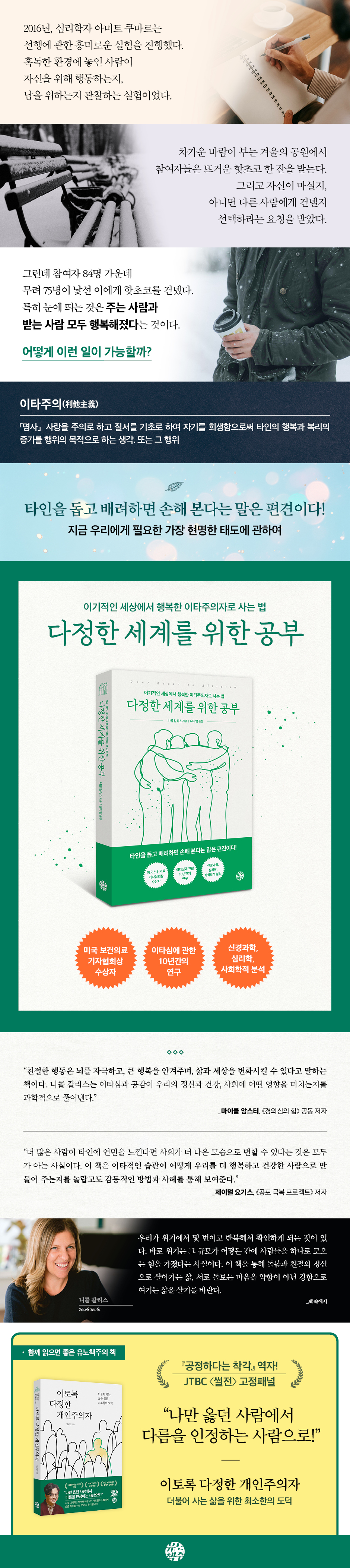
Into the book
When a disaster like a wildfire strikes, affected communities experience a special sense of solidarity they don't normally experience—a powerful urge to help one another.
Acts of altruism in the midst of tragedy, or acts of kindness for the well-being of others, are deeply etched in the hearts of those who witness or experience them firsthand.
As a result, disasters are not remembered only as losses and tragedies, but also as memories of what was gained through the mutual help and support we shared.
This phenomenon is not limited to natural disasters.
The same thing happens to all crisis situations that come unexpectedly, force us to face the reality before our eyes, and remind us of what is truly important in life.
As Ruprecht noted, even as his neighborhood was literally reduced to ashes, he felt more connected to his friends and neighbors than ever before.
Also, for the first time in my life, I felt a strong desire to help strangers.
But I never imagined that I would experience such feelings at my most vulnerable moment.
--- From "The Illusion That Being Kind Will Bring Losses"
It was once a common belief that humans inevitably show their worst side when faced with a crisis.
Hollywood movies have repeatedly depicted people panicking in times of crisis and prioritizing individual interests over the collective.
(Omitted) However, as pointed out in a research paper published just before COVID-19 spread around the world, the collapse of social order and panic that often appears in thriller movies do not match actual reality.
The researchers wrote:
“Movies are not reality.
“The reason that disturbing, fear-inducing elements appear repeatedly in dramatic narratives about infectious diseases is solely for entertainment value.”
Contagion isn't the only film that exemplifies the typical narrative structure of mainstream media dealing with crises.
Recent apocalyptic TV dramas also portray humans in disaster situations as instinctively selfish.
Examples include The Last of Us and Station Eleven.
The narrative of 'everyone for himself' that the mass media repeatedly portrays instills in people the perception that reality is like that.
In fact, there have been several reports that billionaires are building secret bunkers to prepare for future disasters.
But as we saw with COVID-19, early in the pandemic, people came together to help others, sometimes even putting their own health at risk.
--- From "Why the Mouse Saved the Lion"
For example, monkeys appeared more generous to each other than before.
The researchers expected that the monkeys would rely on individuals with whom they already had existing relationships to cope with the disruption to their ecosystem.
But contrary to expectations, the monkeys showed a tendency to expand their social networks by seeking new relationships.
Although there was still much to be gained from close relationships, the monkeys seemed to have come to the realization that social networks where everyone maintained somewhat friendly relationships were more beneficial to overall survival than those with only a few close ties.
“I think it’s a really good idea,” Flatt said in an interview.
“What was really surprising was that immediately after the disaster, the monkeys started reaching out to each other and making more friends.
In that densely interconnected network, everyone was connected to everyone else.” Interestingly enough, even the previously socially isolated monkeys began to break out of their shells of loneliness and form new relationships.
Most monkeys survived the direct impact of the hurricane, but mortality rates within the population began to increase a month later.
Over time, the researchers found that monkeys with more friends were more likely to survive the degraded ecosystem over the next two years.
--- From "Why Donating Makes You Feel Good"
Carter's words about oxytocin being nature's natural digestive aid and the way it works with vasopressin kept coming to mind.
The two hormones need each other and, in a sense, take care of each other.
Even within the human body, at the molecular level, aggression and calmness engage in a delicate dance of constant push and pull.
But when these two work together optimally, the default between them is one of tranquility.
When that happens, humans can do amazing things.
Because we can feel safe and cared for by each other.
“Oxytocin exists to help us connect socially.
Social connections have a positive impact on all aspects of our lives.
But at the same time, oxytocin exists to prevent us from overreacting to vasopressin.
“This is my personal theory,” Carter said.
“Oxytocin was once considered a female hormone, but it’s actually a hormone at the heart of resilience and survival.” In other words, nurturing and caring, often considered feminine traits, are actually the biological basis for resilience.
Acts of altruism in the midst of tragedy, or acts of kindness for the well-being of others, are deeply etched in the hearts of those who witness or experience them firsthand.
As a result, disasters are not remembered only as losses and tragedies, but also as memories of what was gained through the mutual help and support we shared.
This phenomenon is not limited to natural disasters.
The same thing happens to all crisis situations that come unexpectedly, force us to face the reality before our eyes, and remind us of what is truly important in life.
As Ruprecht noted, even as his neighborhood was literally reduced to ashes, he felt more connected to his friends and neighbors than ever before.
Also, for the first time in my life, I felt a strong desire to help strangers.
But I never imagined that I would experience such feelings at my most vulnerable moment.
--- From "The Illusion That Being Kind Will Bring Losses"
It was once a common belief that humans inevitably show their worst side when faced with a crisis.
Hollywood movies have repeatedly depicted people panicking in times of crisis and prioritizing individual interests over the collective.
(Omitted) However, as pointed out in a research paper published just before COVID-19 spread around the world, the collapse of social order and panic that often appears in thriller movies do not match actual reality.
The researchers wrote:
“Movies are not reality.
“The reason that disturbing, fear-inducing elements appear repeatedly in dramatic narratives about infectious diseases is solely for entertainment value.”
Contagion isn't the only film that exemplifies the typical narrative structure of mainstream media dealing with crises.
Recent apocalyptic TV dramas also portray humans in disaster situations as instinctively selfish.
Examples include The Last of Us and Station Eleven.
The narrative of 'everyone for himself' that the mass media repeatedly portrays instills in people the perception that reality is like that.
In fact, there have been several reports that billionaires are building secret bunkers to prepare for future disasters.
But as we saw with COVID-19, early in the pandemic, people came together to help others, sometimes even putting their own health at risk.
--- From "Why the Mouse Saved the Lion"
For example, monkeys appeared more generous to each other than before.
The researchers expected that the monkeys would rely on individuals with whom they already had existing relationships to cope with the disruption to their ecosystem.
But contrary to expectations, the monkeys showed a tendency to expand their social networks by seeking new relationships.
Although there was still much to be gained from close relationships, the monkeys seemed to have come to the realization that social networks where everyone maintained somewhat friendly relationships were more beneficial to overall survival than those with only a few close ties.
“I think it’s a really good idea,” Flatt said in an interview.
“What was really surprising was that immediately after the disaster, the monkeys started reaching out to each other and making more friends.
In that densely interconnected network, everyone was connected to everyone else.” Interestingly enough, even the previously socially isolated monkeys began to break out of their shells of loneliness and form new relationships.
Most monkeys survived the direct impact of the hurricane, but mortality rates within the population began to increase a month later.
Over time, the researchers found that monkeys with more friends were more likely to survive the degraded ecosystem over the next two years.
--- From "Why Donating Makes You Feel Good"
Carter's words about oxytocin being nature's natural digestive aid and the way it works with vasopressin kept coming to mind.
The two hormones need each other and, in a sense, take care of each other.
Even within the human body, at the molecular level, aggression and calmness engage in a delicate dance of constant push and pull.
But when these two work together optimally, the default between them is one of tranquility.
When that happens, humans can do amazing things.
Because we can feel safe and cared for by each other.
“Oxytocin exists to help us connect socially.
Social connections have a positive impact on all aspects of our lives.
But at the same time, oxytocin exists to prevent us from overreacting to vasopressin.
“This is my personal theory,” Carter said.
“Oxytocin was once considered a female hormone, but it’s actually a hormone at the heart of resilience and survival.” In other words, nurturing and caring, often considered feminine traits, are actually the biological basis for resilience.
--- From “Altruism begins with listening and empathy”
Publisher's Review
A Guide to Selflessness: From Knowing Only Yourself to Becoming a Shared Person
Blaise Pascal, the French mathematician and philosopher famous for the saying, "Man is a thinking reed," once said:
“Don’t be kind and good only when it benefits you.
Always be kind and good.
Because that kindness and generosity are warmth, strength, and light to oneself.” If we were to summarize this in one word, it could be expressed as ‘altruism.’
So what is altruism? According to the Standard Korean Dictionary, it is "the idea that the purpose of one's actions is to increase the happiness and well-being of others through self-sacrifice, based on love and order."
or the act.' is defined.
Author Nicole Callis, who went to India to overcome her loneliness and anxiety, learned a profound life lesson.
It was the realization that sometimes helping others is more beneficial to our health and happiness than taking care of ourselves.
It was the exact opposite of the message that America's self-care industry has been constantly sending.
This leads the author to ask questions such as whether we can maintain a willingness to give more to others in times of crisis or not? Is a culture that prioritizes mutual care even more necessary to prepare for the coming global crisis? Is modern self-care perhaps evolving into another form of individualism that is harming us?
This book, "Studying for a Kinder World," is the result of ten years of interviews with neuroscientists, doctors, sociologists, psychologists, and disaster safety researchers, as well as research on relevant studies, to find answers to these questions.
"Affection becomes a stronger force the moment it is shared."
The Power of Healthy Connections Created by Altruism
In 2018, a joint study was published in the journal Emotion.
The researchers divided the participants into three groups: one group performed a random act of kindness, another group received kindness, and the third group simply witnessed kindness.
Positive effects were observed in all three groups.
People who simply witnessed kindness also experienced less loneliness and depression and more positive emotions.
The feeling we get when we witness the kindness and care of others is called 'moral elevation'.
It refers to the emotional reaction that appears when witnessing the good and moral behavior of others.
“Our nervous system perceives moral experiences as pleasurable, and it signals that these are experiences we want to revisit, continue, or experience ourselves,” says Dr. Emiliana Simon-Thomas, scientific director of the Greater Good Science Center.
We are a hypersocial species.
“Our moral predispositions—our sense of fairness, equity, and justice—are deeply ingrained in our nervous system,” he said.
And that's not all.
This book is filled with evidence of the sense of belonging we feel when we help others, the negative emotions like anxiety and sadness that are offset when we are with someone, and the fact that people who volunteer frequently are healthier.
It also shows the direction and direction of society's slow transformation after the COVID-19 pandemic, from volunteering to prescribe medicine instead of medication at hospitals, to wellness businesses that move beyond the individual's well-being to fostering a sense of connection, to the emergence of NICE news platforms that serve as a buffer in a world that assumes only negative news.
Giving to others is ultimately a giving to yourself.
The good we do for others ultimately inevitably improves our own health and the health of society as a whole, helping us all build resilience.
Because hope is resilience.
Modern society, which was chaotic and saw each other only as competitors, has finally entered a period of heightened social interest in connection and altruism through empathy and solidarity.
I hope that through this book, you will discover the importance of living together, the direction in which each individual should pursue their life, and various methods for moving toward a path of shared happiness.
Blaise Pascal, the French mathematician and philosopher famous for the saying, "Man is a thinking reed," once said:
“Don’t be kind and good only when it benefits you.
Always be kind and good.
Because that kindness and generosity are warmth, strength, and light to oneself.” If we were to summarize this in one word, it could be expressed as ‘altruism.’
So what is altruism? According to the Standard Korean Dictionary, it is "the idea that the purpose of one's actions is to increase the happiness and well-being of others through self-sacrifice, based on love and order."
or the act.' is defined.
Author Nicole Callis, who went to India to overcome her loneliness and anxiety, learned a profound life lesson.
It was the realization that sometimes helping others is more beneficial to our health and happiness than taking care of ourselves.
It was the exact opposite of the message that America's self-care industry has been constantly sending.
This leads the author to ask questions such as whether we can maintain a willingness to give more to others in times of crisis or not? Is a culture that prioritizes mutual care even more necessary to prepare for the coming global crisis? Is modern self-care perhaps evolving into another form of individualism that is harming us?
This book, "Studying for a Kinder World," is the result of ten years of interviews with neuroscientists, doctors, sociologists, psychologists, and disaster safety researchers, as well as research on relevant studies, to find answers to these questions.
"Affection becomes a stronger force the moment it is shared."
The Power of Healthy Connections Created by Altruism
In 2018, a joint study was published in the journal Emotion.
The researchers divided the participants into three groups: one group performed a random act of kindness, another group received kindness, and the third group simply witnessed kindness.
Positive effects were observed in all three groups.
People who simply witnessed kindness also experienced less loneliness and depression and more positive emotions.
The feeling we get when we witness the kindness and care of others is called 'moral elevation'.
It refers to the emotional reaction that appears when witnessing the good and moral behavior of others.
“Our nervous system perceives moral experiences as pleasurable, and it signals that these are experiences we want to revisit, continue, or experience ourselves,” says Dr. Emiliana Simon-Thomas, scientific director of the Greater Good Science Center.
We are a hypersocial species.
“Our moral predispositions—our sense of fairness, equity, and justice—are deeply ingrained in our nervous system,” he said.
And that's not all.
This book is filled with evidence of the sense of belonging we feel when we help others, the negative emotions like anxiety and sadness that are offset when we are with someone, and the fact that people who volunteer frequently are healthier.
It also shows the direction and direction of society's slow transformation after the COVID-19 pandemic, from volunteering to prescribe medicine instead of medication at hospitals, to wellness businesses that move beyond the individual's well-being to fostering a sense of connection, to the emergence of NICE news platforms that serve as a buffer in a world that assumes only negative news.
Giving to others is ultimately a giving to yourself.
The good we do for others ultimately inevitably improves our own health and the health of society as a whole, helping us all build resilience.
Because hope is resilience.
Modern society, which was chaotic and saw each other only as competitors, has finally entered a period of heightened social interest in connection and altruism through empathy and solidarity.
I hope that through this book, you will discover the importance of living together, the direction in which each individual should pursue their life, and various methods for moving toward a path of shared happiness.
GOODS SPECIFICS
- Date of issue: June 30, 2025
- Page count, weight, size: 368 pages | 476g | 148*210*20mm
- ISBN13: 9791171831197
- ISBN10: 1171831196
You may also like
카테고리
korean


korean

![GQ KOREA Mark (Monthly): December [2025]](http://librairie.coreenne.fr/cdn/shop/files/8ef265dbbfbf186523ed75ba7319009d.jpg?v=1765340328&width=3840)


